
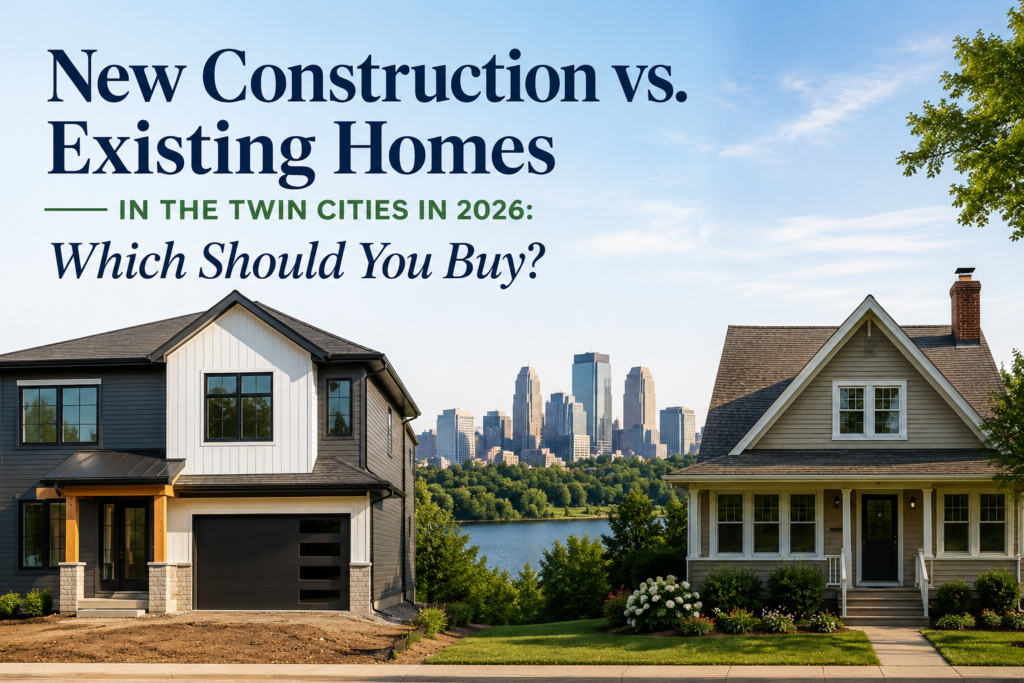
If you’re starting a home search in the Twin Cities this year, you’ve probably already landed on the big question: new construction vs. existing homes — which one actually makes sense for you? It’s one of the most common questions buyers bring to MinnMatch, and there’s no universal right answer — but there is a clearer picture in 2026 than there’s been in years. The price gap between new construction and existing homes in the Twin Cities has narrowed significantly, builders are leaning on incentives instead of price cuts, and inventory in older neighborhoods is still tight. Here’s how to think through the decision.
New Construction vs. Existing Homes: What’s Actually Cheaper Right Now
For most of the past 15 years, new construction carried a clear price premium over existing homes. That’s not really true anymore — at least not nationally, and the Twin Cities reflects the broader trend. Nationally, in the first quarter of 2026, the median price for a new single-family home actually came in slightly below the median price for an existing home, marking the fourth straight quarter that resale prices have edged out new-build prices. Builders have been managing affordability by building smaller homes, building on smaller lots, and offering closing-cost credits and rate buydowns instead of dropping list prices outright, while existing-home prices have kept climbing — albeit slowly — because so many owners are reluctant to give up mortgage rates they locked in years ago.
In the Midwest specifically, new homes still carry a modest premium over existing homes — roughly $60,000–$67,000 in recent quarters — but that’s a much smaller gap than the Northeast or West see, and it’s been shrinking. Locally, Twin Cities resale prices have been holding fairly steady, with the 13-county metro’s median sale price sitting somewhere in the high $380,000s to low $390,000s through early 2026, depending on the month and data source. New construction pricing across the metro varies widely by suburb, lot type, and builder, but third-ring suburbs like Rogers, Otsego, Dayton, Lakeville, and Rosemount tend to offer the most new-build inventory under $450,000, while closer-in, established suburbs command higher premiums for land and location.
The Case for New Construction
In the new construction vs. existing homes debate, new builds win on predictability. A new home comes with a builder warranty, new mechanicals, and current energy codes — which matters in a state with Minnesota’s heating bills. You typically get more say in floor plan, finishes, and layout, and you’re not inheriting someone else’s deferred maintenance, outdated electrical panel, or 1990s kitchen.
It’s also where most of the buyer leverage is right now. Builders are actively offering mortgage rate buydowns, closing cost credits, and free upgrade packages on many homes, particularly spec homes and communities with aging inventory — incentives that often aren’t advertised and have to be specifically requested. The most active new-construction suburbs in the metro right now include Rogers, Otsego, and Dayton in the northwest corridor; Lakeville and Rosemount in the south metro; Woodbury in the east metro; and Maple Grove for buyers targeting a more established, premium new-build market. Builders active across these communities include D.R. Horton, Pulte Homes, M/I Homes, David Weekley Homes, Lennar, and several smaller regional builders.
The tradeoffs are real, though. Production-built single-family homes typically take six to nine months from contract to closing, longer if you start a build in fall given Minnesota winters. Design center upgrades add up fast — the average Twin Cities buyer spends $40,000 to $80,000 above the base price on options — and lot premiums for walkout, pond-facing, or cul-de-sac lots can run another $10,000 to $50,000. New construction also typically means a longer commute, since most active building is happening in third-ring suburbs rather than the urban core or first-ring suburbs like Richfield, Roseville, or Golden Valley, where new building mostly means infill or teardown projects on a much smaller scale.
The Case for an Existing Home
Existing homes still win on a few fronts that matter a lot to many buyers: location, lot size and mature landscaping, established neighborhoods with sidewalks and tree cover already in place, and proximity to the urban core or first-ring suburbs where new construction is scarce. If you want to be in South Minneapolis, Edina’s Country Club neighborhood, Linden Hills, or a walkable first-ring suburb, you’re shopping the resale market almost by default — there simply isn’t much room left to build new there.
Existing homes also close faster. Instead of a six-to-nine-month build timeline, a typical Twin Cities resale closing happens within 30 to 60 days of an accepted offer, which matters if you’re working around a lease, a school year, or a job start date. And while the price math between new construction and existing homes is closer than it used to be, an existing home in a desirable established neighborhood with multiple offers can still come in below what a comparable new build would cost once you add lot premiums and design center upgrades.
The downside is inventory. Twin Cities active listings have stayed tight, with many longtime owners holding onto homes they financed at much lower mortgage rates, which keeps competition for the best existing homes high in popular neighborhoods. Redfin’s Minneapolis market data shows homes still receiving multiple offers and selling in around a month on average in competitive pockets of the metro. Existing homes also mean inheriting someone else’s choices — and someone else’s age of roof, furnace, and water heater — so a thorough inspection matters more here than almost anywhere else in the process.
Property Taxes and Energy Costs: New Construction vs. Existing Homes
One detail that catches new-construction buyers off guard: property tax assessments on a brand-new home are often based on the completed value, not the price of the lot before the house went up, so your first full-year tax bill can come in noticeably higher than what you estimated at the design center. It’s worth asking your builder or lender for a realistic estimate before you sign, rather than assuming taxes will track an older comparable home nearby.
On the efficiency side, new homes are typically built to current energy codes with tighter envelopes, newer insulation, and more efficient HVAC systems — a real advantage for Minnesota heating bills. Worth noting, though: Minnesota’s HOMES energy rebate program is limited to existing single-family homes and multifamily buildings, so if you’re buying an older home, that program may be worth exploring after closing, while new-construction buyers should ask their builder directly about utility-sponsored efficiency rebates, since several Minnesota utilities offer their own new-construction incentive programs.
New Construction vs. Existing Homes: So, Which Should You Buy?
There’s no single right answer to the new construction vs. existing homes question — it really comes down to what you’re optimizing for. If predictability, a warranty, modern systems, and builder incentives matter most, and you’re flexible on location, new construction in a third-ring suburb is worth a serious look. If location, lot character, mature neighborhoods, and a faster closing timeline matter more, an existing home is probably the better fit, even with the inspection homework that comes with it.
Either path comes with its own negotiation landscape — builder contracts work very differently than resale purchase agreements, and most builders require buyer-agent registration before or at your first model home visit, or you can lose your right to independent representation on that community entirely. That’s exactly the kind of detail a locally connected agent catches before it costs you. If you’re trying to decide between new construction and an existing home in the Twin Cities, MinnMatch can match you with a local agent who works both sides of the market and can walk you through the real numbers for your specific suburbs and budget. And if you’re still early in the process and want to understand how matching works first, our How It Works page is a good place to start.
New construction or existing home — not sure which fits your budget and timeline?
MinnMatch connects you with a vetted local agent who can walk you through both options for free — no algorithm, just a real Twin Cities expert who knows your target suburbs.