
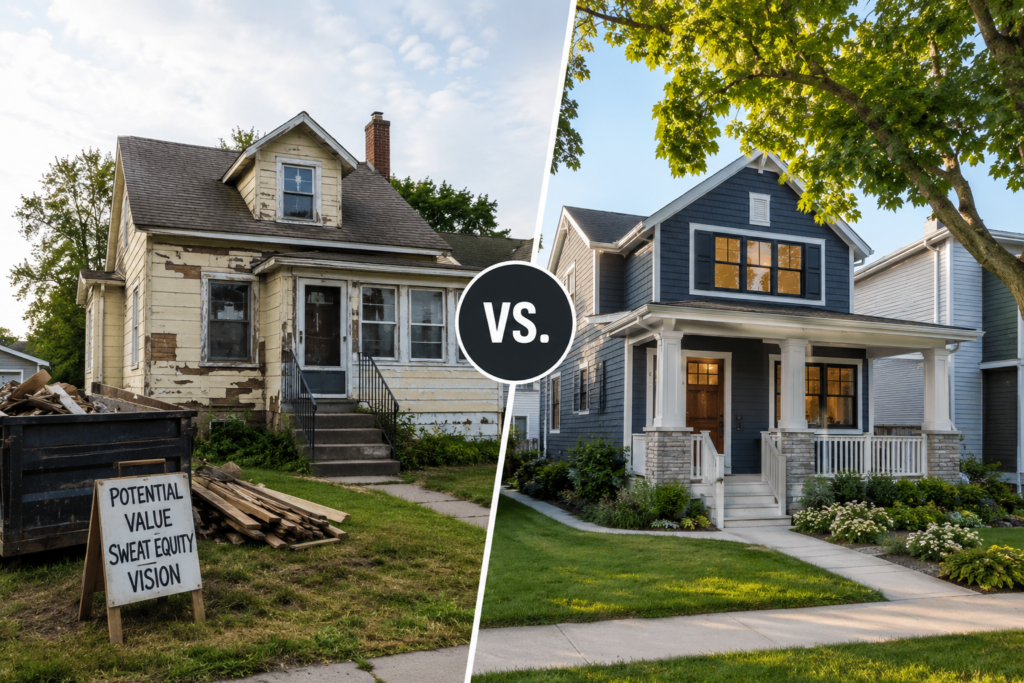
If you’re house hunting in the Twin Cities this year, you’ve probably stood in a dated kitchen at some point and wondered: is this a diamond in the rough, or a money pit with new carpet? The fixer-upper vs. move-in ready question is one of the most common forks in the road for Minnesota buyers in 2026, and with mortgage rates still hovering in the mid-6% range and metro inventory finally loosening up, the answer isn’t as obvious as it used to be. Whether the better investment is the home that needs work or the one that’s already done depends on your budget, your timeline, and how much Minnesota winter you’re willing to spend under a tarp.
What “Fixer-Upper” and “Move-In Ready” Actually Mean Right Now
In the Twin Cities, a huge share of the housing stock dates back to the 1950s through the 1980s, which means “fixer-upper” can mean anything from a home that just needs cosmetic updates — paint, flooring, a kitchen refresh — to a full gut job with knob-and-tube wiring or a leaking cast iron sewer line hiding behind the walls. Move-in ready, meanwhile, typically means a home where the roof, mechanicals, and major systems have already been updated, even if the finishes aren’t your personal style. The metro’s inventory has grown noticeably this year, with the number of homes for sale climbing to roughly 10,900 across the 13-county area, giving buyers more of both types to choose from than they’ve seen in years.
That added supply matters, because it means buyers weighing fixer-upper vs. move-in ready options aren’t forced into a single lane the way they were in tighter markets. You have room to actually compare, rather than grabbing whatever hits the market first.
The Math: Renovation Costs vs. the Price Premium for Move-In Ready
This is where a lot of buyers get tripped up, because renovation math in the Twin Cities doesn’t always match what you’ll see on national remodeling shows. Local kitchen remodels commonly run $50,000 to $175,000 or more depending on scope and finishes, bathroom remodels typically land between $30,000 and $85,000, and a basement finish can run $45,000 to $200,000+. Twin Cities pricing tends to run higher than national averages, partly because of an older housing stock that often needs electrical panel or plumbing updates before the “pretty” work can even start.
On the resale side, a mid-range kitchen remodel has historically recouped somewhere in the 75–85% range at resale, while smaller, cosmetic-only updates can return 90% or more. Compare that to the current metro median sale price of around $400,000–$410,000, and you can start running your own back-of-napkin math: is the discount on the fixer-upper larger than what you’d spend to bring it up to move-in-ready condition, plus a buffer for surprises? In most cases in this market, the discount needs to be meaningful — not just a few thousand dollars — for a fixer-upper to pencil out as the better investment.
Financing the Gap: Rates, Renovation Loans, and Timeline Reality
Financing is where the fixer-upper vs. move-in ready decision gets real. As of late July 2026, the 30-year fixed mortgage rate has been sitting around 6.58%, a level that’s held fairly steady over the past several weeks. For a fixer-upper, you’re often financing two things at once — the purchase and the renovation — which usually means a renovation-specific loan product (like an FHA 203(k) or a conventional renovation loan) rather than just a standard purchase mortgage. These loans typically carry more paperwork, more inspections, and a longer closing timeline than a conventional purchase, so budget extra weeks, not days.
Move-in ready homes skip that complexity entirely — you close, you move in, and your mortgage payment is your only monthly wildcard. If your timeline is tight (a job relocation, a lease ending, kids starting school), that predictability alone can outweigh a lower purchase price on a project home.
Where Fixer-Uppers Make Sense in the Twin Cities — and Where They Don’t
Location changes this calculus quite a bit. In established, high-demand areas where land and lot value carry a lot of the price, a dated home on a great block can be a smart renovation candidate, because you’re paying primarily for location and can add value through updates. In faster-moving suburban markets with newer housing stock, the “fixer-uppers” you find are often outliers for a reason — deferred maintenance that’s more expensive to fix than the discount suggests. It’s also worth noting that months of supply varies a lot by price range in the metro right now, with mid-priced homes moving faster than either the lower or upper ends, which affects how much negotiating room you’ll actually have on a project home.
The honest answer to fixer-upper vs. move-in ready isn’t universal — it’s specific to the suburb, the price range, and the individual house. A local agent who knows which streets have aging infrastructure and which renovations actually hold their value in your target neighborhood is worth far more here than a national rule of thumb.
Fixer-Upper vs. Move-In Ready: Which Is the Better Investment for You?
There’s no universal winner in the fixer-upper vs. move-in ready debate — just a better fit for your budget, your timeline, and your appetite for a construction dumpster in the driveway through a Minnesota winter. What matters most is running the real numbers on a specific house, not a hypothetical one, before you fall in love with either the discount or the granite countertops.
That’s exactly the kind of judgment call a good local agent helps with every day. If you’re trying to figure out whether a specific fixer-upper is a smart bet or a slow-motion budget blowout, MinnMatch can match you with a Twin Cities agent who knows the renovation history and resale patterns of the neighborhoods you’re considering — for free. Curious how the matching process works? Here’s how MinnMatch works.
Sources: Freddie Mac Primary Mortgage Market Survey, Minneapolis Area Realtors Market Data, Redfin Minneapolis Housing Market.