
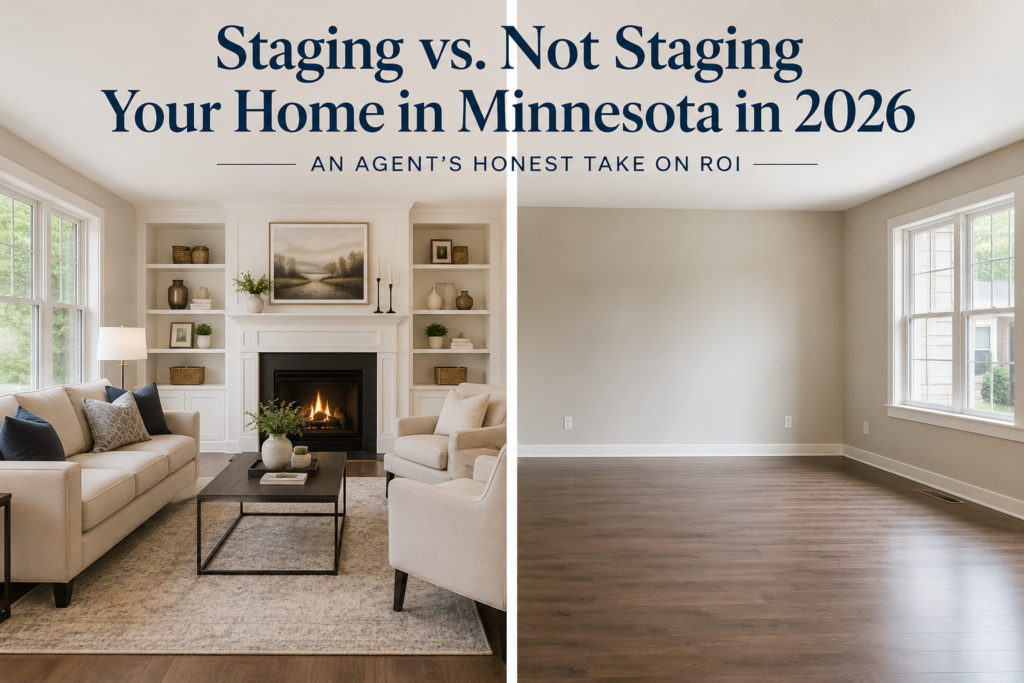
Every seller asks some version of the same question: “Do I actually need to stage this place?” It’s a fair question, especially when a full staging job can run into the thousands of dollars. After watching staged and unstaged homes hit the market across the Twin Cities all year, I can tell you the honest answer isn’t yes or no — it’s “it depends on your home, your price point, and your competition.” Let’s talk through the real home staging ROI picture for Minnesota sellers in 2026, without the sales pitch.
What Staging Actually Costs in the Twin Cities
Full-service staging (a professional coming in and furnishing empty or awkward rooms) typically runs $2,000–$6,000 for a first month in a mid-size Twin Cities home, depending on square footage and how many rooms need furniture versus a simple refresh. Consultation-only staging, where a stager walks through your already-furnished home and tells you what to move, remove, or rearrange, is far cheaper — often $150–$400 for a two-hour visit. Vacant homes cost the most to stage because everything from the sofa to the artwork has to be brought in and rented monthly.
For context on how these costs measure against typical resale numbers, Redfin’s housing market data is a solid, current benchmark for Twin Cities price trends by neighborhood.
The Case for Staging: Where It Pays Off
Staging earns its keep in a few very specific situations. Vacant homes are the clearest case — empty rooms photograph poorly, make spaces feel smaller than they are, and give buyers nothing to picture their own life inside. Higher-priced listings ($500K and up) are another spot where staging tends to pay for itself, because buyers at that price point expect a move-in-ready, magazine-quality presentation and will mentally deduct for anything that looks dated or unfinished. Awkward layouts — a bonus room with no obvious purpose, a basement that’s half-finished, a formal dining room nobody uses anymore — also benefit from staging, since a stager’s job is essentially to answer the buyer’s unspoken question: “what would I even do with this space?”
When Staging Isn’t Worth the Money
On the flip side, I’ve watched plenty of sellers spend money on staging that didn’t move the needle. If your home is already tastefully furnished and decluttered, a full staging job is often overkill — a two-hour consultation to fine-tune what you already have will get you 90% of the benefit for a fraction of the cost. Starter homes and homes priced under roughly $300K in competitive Twin Cities suburbs like Plymouth or Prior Lake also tend to sell fast on price and location alone; buyers in that range are often more forgiving of a lived-in look, especially in a tight inventory market. And if your timeline is short or your home is going to sell primarily on land value or a teardown/renovation basis, staging dollars are usually better spent elsewhere — like a fresh coat of paint or fixing a known inspection issue.
4 Factors That Actually Determine Your Staging ROI
Whether the Home Is Vacant or Occupied
Vacant homes see the biggest lift from staging because there’s simply nothing for buyers to compare their imagination against. Occupied homes usually need editing, not furnishing.
Price Point and Buyer Expectations
The higher the price, the more polish buyers expect. A $700K Edina listing and a $280K Prior Lake starter home are playing by different rules entirely.
How Competitive Your Local Market Is
In neighborhoods with tight inventory, buyers will look past cosmetic flaws. In slower or more saturated pockets, staging becomes a real differentiator against similar listings.
The Home’s Layout and Quirks
Unusual or ambiguous spaces benefit most from staging’s core job: showing buyers exactly how to use a room they wouldn’t otherwise know what to do with.
DIY Staging: Getting 80% of the Benefit for Almost Nothing
If a full staging budget isn’t in the cards, you can get most of the visual benefit yourself. Declutter aggressively — pack away a third of what’s in every room, including closets, since buyers open them. Depersonalize by putting away family photos and strong personal decor choices so buyers can picture themselves there instead of you. Fix the small stuff a stager would flag anyway: burnt-out bulbs, scuffed walls, cluttered countertops. And don’t underestimate curb appeal — for many Twin Cities buyers, the first impression happens in the driveway, not the entryway. None of this requires a stager’s invoice, just a weekend and a willingness to pack a few boxes early.
So, Should You Stage?
The honest answer: it depends on your specific home, price range, and market — which is exactly the kind of judgment call a good local agent should be helping you make, not a blanket rule from a blog post. An agent who knows your neighborhood’s current competition can tell you in five minutes whether staging dollars will come back to you at closing or whether that money is better spent elsewhere. If you’re getting ready to sell and want a second opinion on staging (or anything else in your prep list), MinnMatch can connect you with a vetted local agent who’ll walk your home and give you a straight answer — free, with no pressure to hire the first person you talk to.
For more on how the Minneapolis Area Realtors track local market conditions that influence pricing and presentation decisions, visit mplsrealtor.com.