
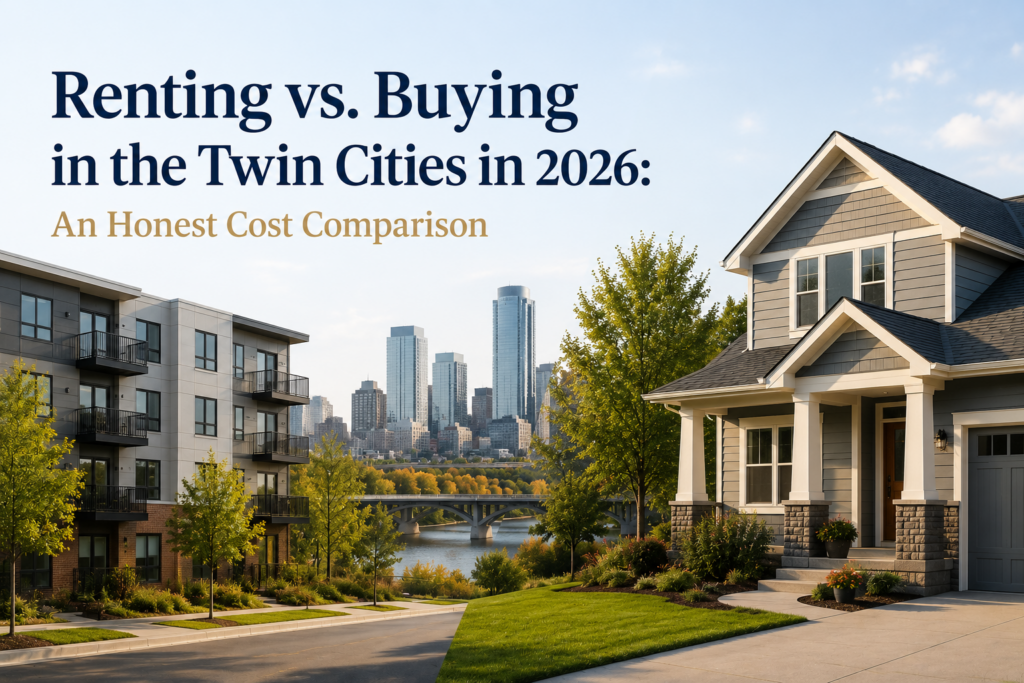
It’s one of the most common questions in personal finance — and in the Twin Cities in 2026, it’s especially loaded. Should you keep renting, or is it finally time to buy? The honest answer depends on more than a monthly payment comparison. It hinges on how long you plan to stay, what you can put down, and what your alternatives to a down payment would earn elsewhere. This guide cuts through the noise and lays out what renting vs. buying in the Twin Cities in 2026 actually costs — line by line — so you can make the call with clear eyes.
What Renting Actually Costs in the Twin Cities Right Now
Renting in the Twin Cities remains meaningfully below the national average, which gives the metro a genuine affordability advantage for renters — at least on the surface. Here’s what the market looks like as of mid-2026:
| Unit Type | Minneapolis Avg. | St. Paul Avg. |
|---|---|---|
| Studio | ~$1,210/mo | ~$1,095/mo |
| 1 Bedroom | ~$1,259–$1,512/mo | ~$1,149/mo |
| 2 Bedroom | ~$1,745–$2,086/mo | ~$1,466–$1,764/mo |
| 3 Bedroom | ~$2,446/mo | ~$2,497/mo |
The wide range in Minneapolis reflects the city’s neighborhood-by-neighborhood variation — a one-bedroom in Ventura Village or Camden can be had for well under $1,000, while the same unit in Cedar-Isles-Dean or Linden Hills runs $2,500 or more. Rent across Minneapolis has climbed roughly 4% year-over-year, according to recent tracking data, while St. Paul has been comparatively flat.
For suburban renters, the picture shifts. Renting a two-bedroom house or townhome in Plymouth, Minnetonka, or Eden Prairie typically runs $1,800–$2,400 per month — territory where the buy-vs.-rent math starts to tighten considerably.
It’s also worth noting what renting doesn’t cost you: no property taxes, no homeowners insurance (renters insurance is typically $15–$20/month), no maintenance bills, and no down payment tying up capital. These are real financial advantages, not footnotes.
What Buying Actually Costs in the Twin Cities in 2026
The median home price across Minnesota came in at around $358,700 in early 2026, according to recent MLS data. In the Twin Cities metro specifically, the picture has varied by data source, but most tracking points to a range of $355,000–$390,000 depending on the submarket and property type. The Minneapolis Area Realtors annual report put the 2025 metro median sales price at $390,000 — still well above pre-pandemic levels despite a slowdown in appreciation. Condos and attached townhomes offer lower entry points, often in the $190,000–$280,000 range, while single-family homes in competitive suburbs push well above the metro median.
Here’s what a realistic monthly cost of ownership looks like on a $375,000 home with a 10% down payment ($37,500) and a 6.5% fixed 30-year mortgage rate:
| Cost Category | Monthly Estimate |
|---|---|
| Principal & Interest (6.5%, 30yr, $337,500 loan) | ~$2,133 |
| Property Taxes (est. 1.12% effective rate) | ~$350 |
| Homeowners Insurance (est. avg. ~$165–$200/mo) | ~$185 |
| PMI (required under 20% down, est.) | ~$125 |
| Maintenance reserve (est. 1% of home value/yr) | ~$313 |
| Estimated Total Monthly Cost of Ownership | ~$3,106 |
Estimates are illustrative. Actual costs vary based on purchase price, credit score, loan type, county, HOA fees (if applicable), and individual insurance quotes. Mortgage rates fluctuate — check current rates with an MHFA-approved lender.
At roughly $3,100/month all-in, buying a median-priced Twin Cities home on a 10% down payment runs noticeably higher than renting a comparable unit. That gap is real — and for some households, it’s the right reason to keep renting for now. But the monthly payment comparison is only part of the story.
The Costs That Don’t Show Up in the Monthly Numbers
A fair rent-vs.-buy comparison has to account for costs on both sides that don’t appear in the monthly payment.
Buying: Upfront costs are significant. Closing costs in Minnesota typically run 2–3% of the purchase price — on a $375,000 home, that’s $7,500–$11,250 out of pocket before you move in, on top of your down payment. Buyers using MHFA programs like the Monthly Payment Loan or Deferred Payment Loan can offset some of this, but it remains a meaningful hurdle. Learn more about homebuying resources on MinnMatch, including how to use state programs to reduce these costs.
Renting: Your down payment has opportunity cost. The $37,500 that stays in your pocket as a renter (the 10% down payment in our example) can be invested. At a conservative 6–8% annual return, that capital compounds significantly over time. Renters who invest the difference between rent and what ownership would cost are often better off financially — at least in the short run.
Buying: You build equity. Every mortgage payment builds ownership stake in an asset that, historically, appreciates. Twin Cities home values have risen meaningfully over time, even accounting for periods of volatility. Renters build no equity; 100% of rent goes to the landlord.
Renting: Maintenance is not your problem. A new HVAC system, a roof replacement, a failed water heater — these are landlord expenses when you rent. Homeowners absorb them. The 1% annual maintenance estimate in the table above is a long-run average; in any given year, actual costs can swing dramatically higher.
Buying: Rent increases don’t apply to you. A fixed-rate mortgage payment stays the same for 30 years. Minneapolis rents climbed roughly 4% last year. Over a decade, that compounding rent growth adds up — and can eventually make a fixed mortgage look very cheap by comparison.
The Break-Even Horizon: How Long Before Buying Makes Sense?
The single most important variable in any rent-vs.-buy analysis is how long you plan to stay. Buying a home and selling it within two to three years almost always results in a financial loss, once you account for closing costs on both ends and the front-loaded interest on your mortgage.
As a general framework for the Twin Cities market in 2026:
- Under 3 years: Renting almost always wins. Transaction costs alone consume most or all of the appreciation you’d gain.
- 3–5 years: The math becomes situational. Buyers who put 20% down, found a well-priced home in a stable neighborhood, and see modest appreciation may come out ahead — but it’s not guaranteed.
- 5–7+ years: Buying tends to win, assuming typical appreciation and rent increases. The equity you’ve built, combined with rising rent comparisons, increasingly tilts the long-run calculus toward ownership.
It’s worth noting that in 2025, by mid-year, the typical first-time buyer in the U.S. was 40 years old — a record high, according to the Minneapolis Area Realtors annual report. Buyers are taking longer to pull the trigger, often because the monthly cost gap is real. But many of those same buyers are finding that continued renting delays the equity clock — and the longer you wait, the further prices tend to move.
Scenarios Where Renting Still Makes More Sense
Buying isn’t always the right move, regardless of what the long-run math says. Renting tends to be the smarter choice when:
- You’re uncertain about your job stability or expect a relocation within two to three years
- Your credit score is below 640 and you’d qualify for a less favorable rate — buying time to improve it often pays off
- You don’t have enough saved for a down payment plus closing costs plus a maintenance reserve
- You’re new to the Twin Cities and haven’t yet figured out which neighborhood or suburb fits your life
- You genuinely value flexibility — career pivots, family changes, lifestyle exploration — and ownership would constrain that
None of these make you financially unsophisticated. They make you realistic — and renting intentionally while building toward ownership is a completely sound strategy. The Minnesota Housing Finance Agency (mnhousing.gov) offers homebuyer education and pre-purchase counseling that can help you build a clear timeline even if you’re 12–24 months out from being ready.
Scenarios Where Buying Makes More Sense in 2026
Conversely, 2026 presents genuine buying opportunities for the right household:
- You plan to stay in the Twin Cities for five or more years and have found a neighborhood that fits your life
- You’re currently paying $2,000+ per month in rent for a unit that’s smaller than what you’d buy — the monthly gap narrows considerably at that level
- You qualify for MHFA programs that can meaningfully reduce your upfront costs and down payment burden
- You’re building a family and want stability, control over your space, and a fixed housing cost
- You want to lock in a rate before potential policy or market shifts affect affordability further
In suburbs like Plymouth, Minnetonka, and Eden Prairie — where quality rental housing in family-appropriate sizes runs $2,000–$2,400/month — the monthly gap between renting and buying shrinks considerably. At that level, the equity you’d build as an owner starts to look a lot more compelling. Explore our community guides for Plymouth, Minnetonka, and Eden Prairie to see what the current market looks like in each suburb.
Not Sure If You’re Ready to Buy? Let’s Figure It Out Together.
MinnMatch connects Twin Cities buyers with experienced local agents who can walk you through the real numbers in your specific situation — no pressure, no generic advice. Whether you’re ready to move now or planning for a year from now, a quick conversation can clarify a lot.