
Renting vs. Buying in the Twin Cities in 2026: An Honest Cost Comparison

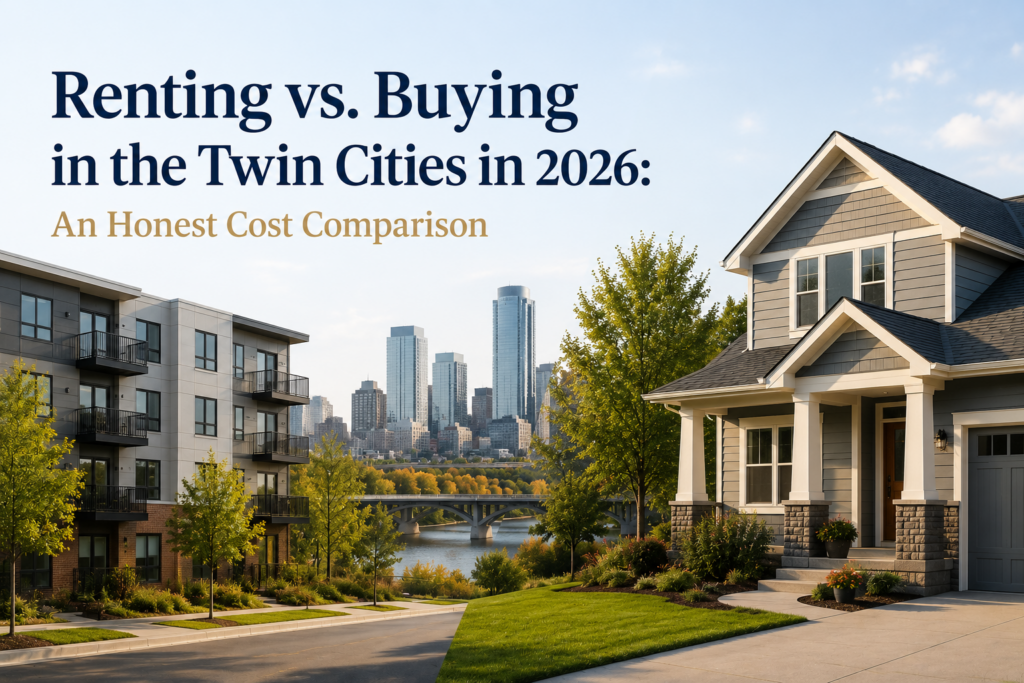
Renting vs. buying in the Twin Cities in 2026 — apartment building on the left, suburban home on the right, Minneapolis skyline and river bridge in the background

It’s one of the most common questions in personal finance — and in the Twin Cities in 2026, it’s especially loaded. Should you keep renting, or is it finally time to buy? The honest answer depends on more than a monthly payment comparison. It hinges on how long you plan to stay, what you can put down, and what your alternatives to a down payment would earn elsewhere. This guide cuts through the noise and lays out what renting vs. buying in the Twin Cities in 2026 actually costs — line by line — so you can make the call with clear eyes.

What Renting Actually Costs in the Twin Cities Right Now

Renting in the Twin Cities remains meaningfully below the national average, which gives the metro a genuine affordability advantage for renters — at least on the surface. Here’s what the market looks like as of mid-2026:

Unit Type Minneapolis Avg. St. Paul Avg.
Studio ~$1,210/mo ~$1,095/mo
1 Bedroom ~$1,259–$1,512/mo ~$1,149/mo
2 Bedroom ~$1,745–$2,086/mo ~$1,466–$1,764/mo
3 Bedroom ~$2,446/mo ~$2,497/mo

The wide range in Minneapolis reflects the city’s neighborhood-by-neighborhood variation — a one-bedroom in Ventura Village or Camden can be had for well under $1,000, while the same unit in Cedar-Isles-Dean or Linden Hills runs $2,500 or more. Rent across Minneapolis has climbed roughly 4% year-over-year, according to recent tracking data, while St. Paul has been comparatively flat.

For suburban renters, the picture shifts. Renting a two-bedroom house or townhome in Plymouth, Minnetonka, or Eden Prairie typically runs $1,800–$2,400 per month — territory where the buy-vs.-rent math starts to tighten considerably.

It’s also worth noting what renting doesn’t cost you: no property taxes, no homeowners insurance (renters insurance is typically $15–$20/month), no maintenance bills, and no down payment tying up capital. These are real financial advantages, not footnotes.

What Buying Actually Costs in the Twin Cities in 2026

The median home price across Minnesota came in at around $358,700 in early 2026, according to recent MLS data. In the Twin Cities metro specifically, the picture has varied by data source, but most tracking points to a range of $355,000–$390,000 depending on the submarket and property type. The Minneapolis Area Realtors annual report put the 2025 metro median sales price at $390,000 — still well above pre-pandemic levels despite a slowdown in appreciation. Condos and attached townhomes offer lower entry points, often in the $190,000–$280,000 range, while single-family homes in competitive suburbs push well above the metro median.

Here’s what a realistic monthly cost of ownership looks like on a $375,000 home with a 10% down payment ($37,500) and a 6.5% fixed 30-year mortgage rate:

Cost Category Monthly Estimate
Principal & Interest (6.5%, 30yr, $337,500 loan) ~$2,133
Property Taxes (est. 1.12% effective rate) ~$350
Homeowners Insurance (est. avg. ~$165–$200/mo) ~$185
PMI (required under 20% down, est.) ~$125
Maintenance reserve (est. 1% of home value/yr) ~$313
Estimated Total Monthly Cost of Ownership ~$3,106

Estimates are illustrative. Actual costs vary based on purchase price, credit score, loan type, county, HOA fees (if applicable), and individual insurance quotes. Mortgage rates fluctuate — check current rates with an MHFA-approved lender.

At roughly $3,100/month all-in, buying a median-priced Twin Cities home on a 10% down payment runs noticeably higher than renting a comparable unit. That gap is real — and for some households, it’s the right reason to keep renting for now. But the monthly payment comparison is only part of the story.

The Costs That Don’t Show Up in the Monthly Numbers

A fair rent-vs.-buy comparison has to account for costs on both sides that don’t appear in the monthly payment.

Buying: Upfront costs are significant. Closing costs in Minnesota typically run 2–3% of the purchase price — on a $375,000 home, that’s $7,500–$11,250 out of pocket before you move in, on top of your down payment. Buyers using MHFA programs like the Monthly Payment Loan or Deferred Payment Loan can offset some of this, but it remains a meaningful hurdle. Learn more about homebuying resources on MinnMatch, including how to use state programs to reduce these costs.

Renting: Your down payment has opportunity cost. The $37,500 that stays in your pocket as a renter (the 10% down payment in our example) can be invested. At a conservative 6–8% annual return, that capital compounds significantly over time. Renters who invest the difference between rent and what ownership would cost are often better off financially — at least in the short run.

Buying: You build equity. Every mortgage payment builds ownership stake in an asset that, historically, appreciates. Twin Cities home values have risen meaningfully over time, even accounting for periods of volatility. Renters build no equity; 100% of rent goes to the landlord.

Renting: Maintenance is not your problem. A new HVAC system, a roof replacement, a failed water heater — these are landlord expenses when you rent. Homeowners absorb them. The 1% annual maintenance estimate in the table above is a long-run average; in any given year, actual costs can swing dramatically higher.

Buying: Rent increases don’t apply to you. A fixed-rate mortgage payment stays the same for 30 years. Minneapolis rents climbed roughly 4% last year. Over a decade, that compounding rent growth adds up — and can eventually make a fixed mortgage look very cheap by comparison.

The Break-Even Horizon: How Long Before Buying Makes Sense?

The single most important variable in any rent-vs.-buy analysis is how long you plan to stay. Buying a home and selling it within two to three years almost always results in a financial loss, once you account for closing costs on both ends and the front-loaded interest on your mortgage.

As a general framework for the Twin Cities market in 2026:

  • Under 3 years: Renting almost always wins. Transaction costs alone consume most or all of the appreciation you’d gain.
  • 3–5 years: The math becomes situational. Buyers who put 20% down, found a well-priced home in a stable neighborhood, and see modest appreciation may come out ahead — but it’s not guaranteed.
  • 5–7+ years: Buying tends to win, assuming typical appreciation and rent increases. The equity you’ve built, combined with rising rent comparisons, increasingly tilts the long-run calculus toward ownership.

It’s worth noting that in 2025, by mid-year, the typical first-time buyer in the U.S. was 40 years old — a record high, according to the Minneapolis Area Realtors annual report. Buyers are taking longer to pull the trigger, often because the monthly cost gap is real. But many of those same buyers are finding that continued renting delays the equity clock — and the longer you wait, the further prices tend to move.

Scenarios Where Renting Still Makes More Sense

Buying isn’t always the right move, regardless of what the long-run math says. Renting tends to be the smarter choice when:

  • You’re uncertain about your job stability or expect a relocation within two to three years
  • Your credit score is below 640 and you’d qualify for a less favorable rate — buying time to improve it often pays off
  • You don’t have enough saved for a down payment plus closing costs plus a maintenance reserve
  • You’re new to the Twin Cities and haven’t yet figured out which neighborhood or suburb fits your life
  • You genuinely value flexibility — career pivots, family changes, lifestyle exploration — and ownership would constrain that

None of these make you financially unsophisticated. They make you realistic — and renting intentionally while building toward ownership is a completely sound strategy. The Minnesota Housing Finance Agency (mnhousing.gov) offers homebuyer education and pre-purchase counseling that can help you build a clear timeline even if you’re 12–24 months out from being ready.

Scenarios Where Buying Makes More Sense in 2026

Conversely, 2026 presents genuine buying opportunities for the right household:

  • You plan to stay in the Twin Cities for five or more years and have found a neighborhood that fits your life
  • You’re currently paying $2,000+ per month in rent for a unit that’s smaller than what you’d buy — the monthly gap narrows considerably at that level
  • You qualify for MHFA programs that can meaningfully reduce your upfront costs and down payment burden
  • You’re building a family and want stability, control over your space, and a fixed housing cost
  • You want to lock in a rate before potential policy or market shifts affect affordability further

In suburbs like Plymouth, Minnetonka, and Eden Prairie — where quality rental housing in family-appropriate sizes runs $2,000–$2,400/month — the monthly gap between renting and buying shrinks considerably. At that level, the equity you’d build as an owner starts to look a lot more compelling. Explore our community guides for Plymouth, Minnetonka, and Eden Prairie to see what the current market looks like in each suburb.

Not Sure If You’re Ready to Buy? Let’s Figure It Out Together.

MinnMatch connects Twin Cities buyers with experienced local agents who can walk you through the real numbers in your specific situation — no pressure, no generic advice. Whether you’re ready to move now or planning for a year from now, a quick conversation can clarify a lot.
See How MinnMatch Works →

First-Time Home Buyer in Minnesota 2026: Programs, Grants & Your Step-by-Step Roadmap

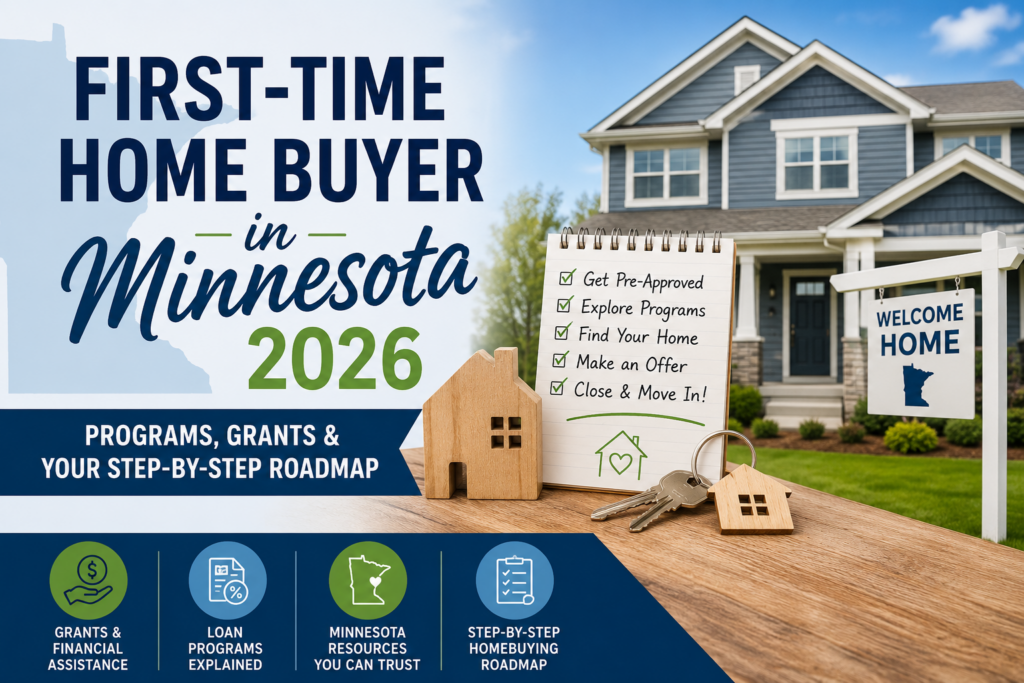
First-time home buyer in Minnesota 2026 — programs, grants and step-by-step homebuying roadmap

Buying your first home in Minnesota is one of the biggest financial moves you’ll ever make — and in 2026, it’s more achievable than you might think. Between competitive mortgage programs through the Minnesota Housing Finance Agency (MHFA), targeted down payment grants, and a Twin Cities market that still offers real opportunities in the right neighborhoods, first-time home buyers in Minnesota have more tools at their disposal than ever. This guide walks you through every program worth knowing about — and gives you a clear, step-by-step roadmap from “I think I’m ready” to keys in hand.

What Counts as a First-Time Home Buyer in Minnesota?

Before diving into programs, it helps to know how Minnesota officially defines “first-time buyer.” The MHFA uses a standard definition: you qualify if you have not owned a primary residence in the past three years. That means even if you owned a home a decade ago but have been renting since, you can still access first-time buyer programs today. Divorced individuals who haven’t owned since the split may also qualify — it’s worth confirming your status with an MHFA-approved lender.

There’s also an important distinction between programs for first-time buyers specifically and programs open to any buyer. The MHFA’s Step Up program, for example, is available to repeat buyers as well — so even if you don’t qualify as a first-timer, don’t stop reading.

Minnesota First-Time Home Buyer Programs in 2026

The state’s main gateway for first-time home buyer programs in Minnesota is the Minnesota Housing Finance Agency (MHFA), which offers below-market interest rate loans and down payment assistance that can dramatically reduce what you need upfront. Here’s a breakdown of the primary programs available in 2026.

🏠 MHFA Start Up Loan

The Start Up loan is the flagship program for first-time buyers in Minnesota. It offers a competitively priced first mortgage with below-market interest rates — and it’s the required first mortgage for accessing most of MHFA’s down payment assistance options.

  • Who qualifies: First-time buyers (no ownership in past 3 years)
  • Income limits (Twin Cities 11-county metro): Up to $124,200 for 1–2 person households; up to $142,800 for 3+ person households
  • Income limits (all other MN counties): Up to $111,800 for 1–2 person; up to $128,500 for 3+
  • Minimum credit score: 640
  • Purchase price limit: $450,000
  • Education required: Yes — a homebuyer education course is mandatory

💰 Down Payment & Closing Cost Assistance

Paired with a Start Up first mortgage, MHFA offers three down payment loan options that can cover both your down payment and closing costs:

Monthly Payment Loan — Borrow up to $18,000 as a second mortgage at 0% interest, repaid in monthly installments over 10 years alongside your main mortgage. No separate income limits apply; any Start Up-eligible borrower can use this option.

Deferred Payment Loan (DPL) — A 0% interest second mortgage with no monthly payments required. You repay the loan when you sell, refinance, or pay off the home. Income limits apply (up to $89,000 for 1–2 person households in the metro).

Deferred Payment Loan Plus (DPL+) — For lower-income buyers with at least one “targeting factor” (such as purchasing in a high-cost area or being a person of color), this offers larger assistance amounts with favorable terms.

⭐ First-Generation Homebuyer Loan Program

One of the most significant programs launched in recent years, the First-Generation Homebuyer Loan offers up to $35,000 in down payment and closing cost assistance — as a deferred, interest-free, and forgivable loan. Half of the loan is forgiven after 10 years and the remainder after 20 years. To qualify, you must be a first-generation homebuyer (meaning neither of your parents owned a home, or you were in foster care), and you must use a Start Up first mortgage.

Note: This program is funded and available on a first-come, first-served basis. If you think you may qualify, connecting with an MHFA-approved lender early is strongly advised.

Local & Federal Programs First-Time Buyers in Minnesota Should Know

Beyond the MHFA’s statewide programs, Minnesota buyers may have access to additional assistance through local governments and federal loan types. A few worth knowing:

FHA Loans — Federally backed mortgages requiring as little as 3.5% down with a 580+ credit score. FHA loans are especially popular with first-time buyers who have limited savings or are still building credit. They’re widely available through conventional lenders in the Twin Cities and can be combined with MHFA down payment assistance.

VA Loans — If you’re a veteran, active-duty service member, or eligible surviving spouse, VA loans offer 0% down financing with no private mortgage insurance. Minnesota has a strong military community, and many Twin Cities buyers take advantage of this benefit.

USDA Rural Development Loans — Available in qualifying rural and some suburban areas of Minnesota, USDA loans also offer 0% down. Some communities in the outer metro — think areas beyond the immediate Twin Cities ring — may qualify. Worth checking if you’re open to a longer commute.

City & County Programs — Minneapolis, Saint Paul, and several suburban counties offer their own buyer assistance programs on top of state resources. Anoka County, for example, points buyers directly to MHFA’s programs; other counties have additional local funds. Ask your agent or lender what’s available in the specific community where you’re shopping.

For a broader look at the Minnesota housing market and what today’s buyers are navigating, Redfin’s Minneapolis market overview is a helpful real-time reference.

Your Step-by-Step Roadmap to Buying Your First Home in Minnesota

Knowing the programs is one thing. Knowing what to do — and in what order — is what actually gets you from renter to homeowner. Here’s how the process looks for a typical first-time buyer in the Twin Cities metro.

1

Check Your Credit & Know Your Numbers

Pull your credit report and know your score before you talk to anyone. Most MHFA programs require a minimum 640. If you’re below that, spend 3–6 months paying down balances and correcting any errors on your report. Also tally your savings — you’ll want a clear picture of what you have available for a down payment, closing costs, and emergency reserves after closing.

2

Take the Required Homebuyer Education Course

Most MHFA programs require completing an approved homebuyer education course before closing. The good news: it’s available online, takes roughly 6 hours, and costs around $75. Minnesota Housing publishes a list of approved providers at mnhousing.gov. Get this done early — it’s a prerequisite, not an afterthought.

3

Get Pre-Approved Through an MHFA-Approved Lender

To access any MHFA program, you must work with an MHFA-approved lender — not just any bank or mortgage company. The list is available on the Minnesota Housing website. When you apply, your lender will automatically assess which state programs you qualify for and handle the paperwork. This is also where you’ll lock in your pre-approval letter, which is essential before making any offers in today’s Twin Cities market.

4

Find a Local Real Estate Agent Who Knows the Market

For first-time buyers especially, your agent makes an enormous difference. You want someone who works regularly in the neighborhoods you’re targeting, understands how MHFA programs interact with offer strategy, and will advocate for you through inspection, negotiation, and closing. The Twin Cities has hundreds of agents — the challenge is finding the right fit for your situation, not just someone with a license. This is exactly why MinnMatch exists: to connect first-time buyers with vetted, locally experienced agents who specialize in exactly what you’re looking for.

5

Search, Offer & Negotiate

With pre-approval in hand and an agent by your side, you’re ready to start shopping. In the Twin Cities, the sub-$400K segment tends to move quickly — especially in suburbs like Plymouth, Lakeville, and Woodbury where first-time buyers often compete. Your agent will help you structure competitive offers, advise on contingencies, and negotiate on your behalf if issues come up after inspection.

6

Home Inspection, Appraisal & Final Financing

Once your offer is accepted, you’ll move into the due diligence period. A home inspection is strongly recommended — even in competitive markets. Your lender will order an appraisal, and your MHFA loan will be formally processed during this period. Budget 30–45 days from accepted offer to close in most Twin Cities transactions.

7

Close & Get Your Keys

Closing day is when everything comes together. You’ll sign documents, your down payment assistance is applied, closing costs are settled, and ownership transfers to you. If you used a Deferred Payment Loan, note that there are no extra payments at the closing table for that portion — it’s handled as a second lien that only comes due when you sell or refinance later. Then: you’re a homeowner.

What’s the Real Cost of Buying Your First Home in the Twin Cities in 2026?

Let’s talk numbers. The median home price in Minnesota was approximately $354,500 as of early 2026, though Twin Cities metro prices vary widely by neighborhood and suburb. Here’s a rough picture of what a first-time buyer might need at closing — and how MHFA assistance changes that equation.

Expense Without Assistance With MHFA Programs
Down Payment (3.5% FHA on $350K) $12,250 Covered by DPA loan
Closing Costs (~3% of purchase) ~$10,500 Partially/fully covered by DPA
Homebuyer Education Course ~$75 ~$75
Home Inspection $350–$550 $350–$550
Total Out-of-Pocket Estimate $23,000–$25,000 As low as $500–$2,000+

*Estimates based on a $350,000 purchase price using FHA financing with a Monthly Payment Loan for down payment assistance. Actual amounts vary by purchase price, loan type, and specific programs used. Consult an MHFA-approved lender for a precise breakdown.

For a deeper look at how Minnesota compares nationally and what homeownership trends look like, the U.S. Census Bureau’s homeownership data provides useful context.

Where in the Twin Cities Should First-Time Buyers Look in 2026?

With the MHFA purchase price cap at $450,000, first-time buyers have more options than you might expect — including in some of the metro’s most desirable communities. Here are a few areas where first-time buyers are finding traction right now.

Plymouth — Consistently ranked among the best suburbs in the state, Plymouth offers solid inventory in the $300K–$420K range, excellent schools, and a community feel that first-time buyers tend to love. It’s competitive but not impossible.

Lakeville & Burnsville — South metro suburbs with strong value, newer housing stock, and room to grow. Lakeville especially has attracted first-time buyers who want more space for their money.

Brooklyn Park & Maple Grove — Northwest metro suburbs that offer a wide price range and a diverse housing market. Brooklyn Park in particular is seeing renewed buyer interest from first-timers priced out of tighter suburban markets.

South Minneapolis Neighborhoods — For buyers who want city living, neighborhoods like Nokomis, Longfellow, and Powderhorn offer urban character, walkability, and entry-level price points that remain accessible compared to many coastal metros. Explore MinnMatch’s guide to South Minneapolis real estate for a closer look.

Eden Prairie — If your budget stretches toward the higher end of what MHFA allows, Eden Prairie gives first-time buyers access to one of the Twin Cities’ top-rated suburbs. It’s not the cheapest option, but the lifestyle amenities and school quality are hard to beat.

Ready to Take the Next Step?

Knowing the programs is only half the equation. The other half is having the right agent in your corner — someone who knows the Twin Cities market, understands how MHFA financing works in an offer situation, and will walk with you from your first showing to closing day. MinnMatch connects first-time buyers with hand-picked, locally vetted agents at no cost to you.

Find My Agent — It’s Free