
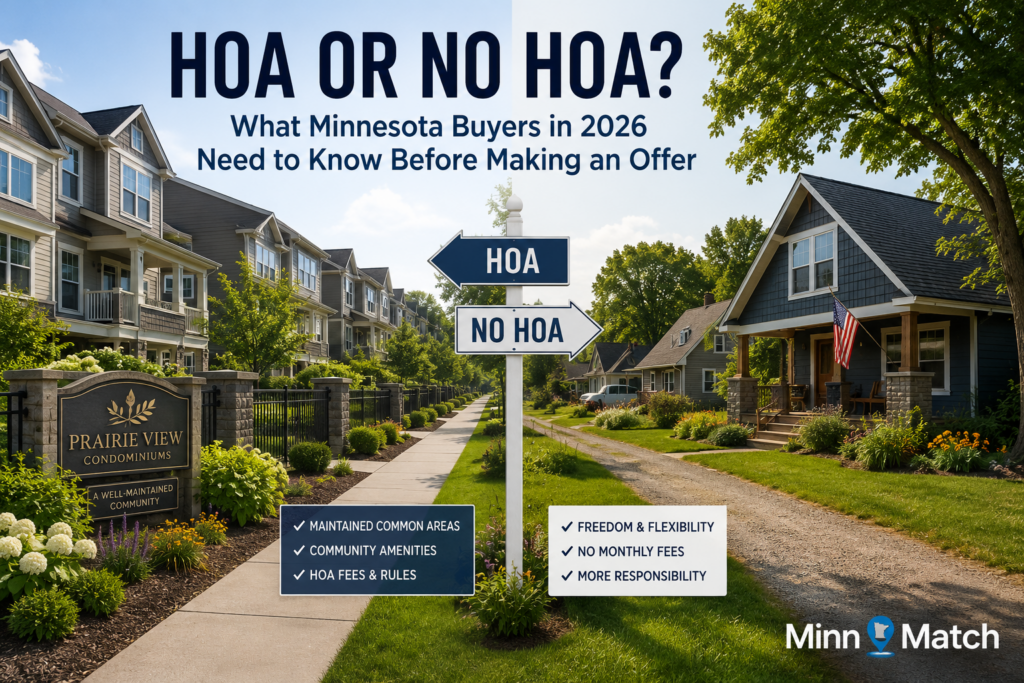
You found the layout you want, the price feels right, and then the listing mentions it: HOA. For a lot of Twin Cities buyers, that one line raises more questions than it answers. Is an HOA in Minnesota a dealbreaker, a convenience, or just part of the territory once you start touring townhomes and condos? The honest answer is “it depends” — but 2026 is actually a meaningful year to be asking, because Minnesota just overhauled the law that governs how an HOA in Minnesota operates. Here’s what buyers need to understand before writing an offer.
What an HOA in Minnesota Actually Is (And Who It Governs)
Most homeowners associations in Minnesota — whether attached to a townhome, condo, or single-family planned community — fall under the Minnesota Common Interest Ownership Act, commonly shortened to MCIOA. This is the state law that has applied automatically to common interest communities created after June 1, 1994, and it sets the ground rules for how an HOA collects dues, manages shared property, and communicates with owners. Older associations aren’t automatically covered, though many have voluntarily opted in over the years. If a property you’re considering has an association, that association almost certainly answers to MCIOA, and understanding the basics of that law is one of the more useful things a Minnesota buyer can do before making an offer.
In practice, an HOA takes on responsibilities you’d otherwise handle yourself: exterior maintenance, landscaping, snow removal, insurance on shared structures, and upkeep of amenities like pools or clubhouses. In exchange, you agree to pay dues, follow the community’s rules, and accept that some decisions about your building or block are made collectively rather than individually. For buyers weighing a lower-maintenance lifestyle against wanting full control of their property, that trade-off is really the heart of the HOA question.
What an HOA in Minnesota Actually Costs You Each Month
This is where buyers are often caught off guard, and the numbers vary enough that a single figure would be misleading. Metro-wide reporting on 2025 sales put the median HOA fee across the Twin Cities at roughly $278 a month — a notably higher share of the typical house payment than most U.S. metros see. Townhome-specific associations in the metro tend to run higher than that median, commonly landing somewhere in the $300–$450 range, especially in communities with more shared amenities. Condo dues can climb well beyond that: buildings with elevators, structural reserves, or full-service amenities have pushed some Twin Cities condo fees close to $1,000 a month.
Because the range is this wide, don’t anchor to a single “average” when you’re evaluating a specific property. Ask for the association’s most recent financials and reserve study, and look at the trend over the past three to five years, not just the current monthly number. A fee that looks reasonable today can jump significantly if the association has been underfunding its reserves — which is exactly the kind of risk Minnesota’s new rules are trying to catch earlier.
Minnesota’s New HOA Rules: What Changed in 2026
2026 is a genuinely important year for anyone buying into a homeowners association here. Minnesota lawmakers passed a significant update to MCIOA this session — sometimes referred to as an HOA “bill of rights” — with most provisions set to take effect January 1, 2027, giving associations roughly seven months to come into compliance. Buyers closing between now and then should know the changes are coming, because they’ll shape how the association you’re joining operates going forward.
Among the more buyer-relevant pieces: associations will face new transparency requirements around board meetings and documents, competitive-bidding rules for larger maintenance contracts, limits on fines, added protections against retaliation, and a streamlined process for terminating an HOA under certain conditions. Existing MCIOA requirements already in place include annual financial statements (with a CPA review unless owners waive it), reserve fund reviews at least every three years, and a resale disclosure certificate that sellers must provide when a unit changes hands. That resale certificate is one of the single most useful documents a buyer can request — it typically spells out current dues, any pending special assessments, and the financial health of the association.
The state’s Department of Commerce keeps current guidance on MCIOA and common interest communities, and it’s worth a look if you want the details straight from the source rather than secondhand. You can find that at the Minnesota Department of Commerce’s common interest community resource page.
HOA or No HOA: How to Decide What’s Right for You
There’s no universally right answer here — it comes down to what kind of homeowner you want to be. An HOA can be a genuinely good fit if you travel often, want predictable (if sometimes pricier) monthly costs instead of surprise repair bills, or specifically want amenities like a pool, fitness room, or maintained common grounds without personally managing any of it. Nationally, homes in HOA communities have tended to carry a modest price premium over similar non-HOA homes, which some buyers see as a sign the arrangement holds resale value — a data point tracked at the national level by the U.S. Census Bureau’s housing statistics.
On the other side, if you want full control over your landscaping, exterior paint color, or whether you can park a boat in the driveway, an association’s rules can feel restrictive fast. And as Twin Cities condo owners have learned recently, rising dues can make a property harder to resell, particularly at the entry-level price point where buyers are most fee-sensitive. If you’re comparing a specific HOA property against a non-HOA alternative, it often helps to look at recent comparable sales and neighborhood context — resources like Redfin’s neighborhood and market data can be useful for that kind of side-by-side comparison, alongside whatever your agent pulls directly from the MLS.
Whichever direction you lean, read the governing documents before you write an offer — not after. Declarations, bylaws, rules, and the most recent meeting minutes will tell you far more about day-to-day life in that community than the listing sheet ever will.
Getting the Right Guidance for Your Situation
HOA questions are exactly the kind of thing that benefit from someone who knows the specific building, block, or association you’re considering — not just general rules of thumb. A Twin Cities agent who regularly works in a given community will already know which associations are well-run, which have had special assessments, and which fee ranges are typical for that neighborhood. If you’re weighing an HOA property and want that kind of on-the-ground read before you make an offer, MinnMatch can match you with a local agent who’s handled exactly this kind of decision before.