
Down Payment Assistance in Minnesota 2026: Every Program Buyers Should Know About

Down Payment Assistance in Minnesota 2026 — home purchase clipboard, house model, and binder with Twin Cities lake and skyline in background

If saving for a down payment feels like the biggest hurdle between you and a Twin Cities home, you’re not alone — and the good news is that Minnesota down payment assistance is more available than most buyers realize. Between state programs, city-specific loans in Minneapolis and Saint Paul, and nonprofit options layered on top, many first-time buyers end up putting far less down than the traditional 20% myth suggests. The tricky part isn’t whether help exists — it’s figuring out which programs you actually qualify for and how they stack together. Here’s a clear, no-jargon walkthrough of the major programs on the table in 2026.

Minnesota Down Payment Assistance Through Start Up and Step Up

The most widely used source of Minnesota down payment assistance comes from Minnesota Housing (MHFA), the state’s housing finance agency. Its Start Up program is built for first-time buyers — meaning you haven’t owned a home in the last three years — and currently pairs a fixed-rate first mortgage with a downpayment and closing cost loan of up to $18,000. If you’ve owned before, or your income exceeds Start Up’s limits, the Step Up program offers similar downpayment assistance up to $14,000 and is open to repeat buyers as well. Both require completing an approved homebuyer education course and working with a Minnesota Housing–approved lender, since the agency itself doesn’t originate loans directly.

One detail buyers often miss: the downpayment loan amount and structure (deferred vs. monthly payment) can shift as the agency updates its offerings, so it’s worth confirming current figures directly with Minnesota Housing or your lender before you budget around a specific number.

The First-Generation Homebuyer Loan

One of the more meaningful additions to Minnesota’s down payment assistance lineup is the First-Generation Homebuyer Loan, aimed at buyers whose parents or legal guardians never owned a home (or lost one to foreclosure). It’s a 20-year deferred, interest-free loan of up to $35,000 for down payment and closing costs, and it’s forgivable — half the balance is forgiven after 10 years, with the rest forgiven at year 20, as long as you stay in the home. It has to be paired with a Start Up first mortgage, and it can’t be combined with a similar program run separately by the Midwest Minnesota Community Development Corporation, so a homeownership advisor can help you sort out which route fits your situation.

City-Specific Help in Minneapolis and Saint Paul

Buyers purchasing inside city limits often have an extra layer of Minnesota down payment assistance to draw on. Minneapolis runs its own program, Homeownership Opportunity Minneapolis (HOM), through the city’s Community Planning & Economic Development department. It’s a zero-interest, no-monthly-payment loan that doesn’t come due until you sell, refinance, or move, with the assistance amount tied to your income relative to the area median. Saint Paul offers a comparable interest-free, deferred down payment loan through its own housing program, with the assistance amount varying by household need. Both cities require homebuyer education or financial wellness counseling completed before you sign a purchase agreement, so it’s worth starting that step early if you’re house-hunting in either city.

Because exact loan amounts and income tiers for these city programs are updated periodically, treat any specific dollar figure you see online as a starting point rather than a guarantee — your lender or the city’s housing office can confirm what’s currently funded and what you’d qualify for.

County and Nonprofit Options Worth Knowing About

Beyond the state and the two biggest cities, several Twin Cities counties and nonprofits administer their own down payment assistance, often layered on top of a Minnesota Housing loan rather than replacing it. Dakota, Anoka, and other metro counties have offered downpayment and closing cost loans through their Community Development Agencies, and organizations like NeighborWorks Home Partners and Twin Cities Habitat for Humanity provide additional assistance and homeownership counseling, particularly for buyers who don’t quite fit the standard first-time buyer mold. Programs like these tend to have limited annual funding, so timing your application — and getting pre-approved with a participating lender — matters as much as meeting the eligibility criteria.

Figuring Out What You Actually Qualify For

With this many overlapping programs, the honest answer to “how much down payment assistance can I get in Minnesota?” is: it depends on your income relative to the area median income for your county, your target city, whether you’re a first-time or first-generation buyer, and which lender you work with. Some of these programs can be stacked; others explicitly can’t be combined. The most efficient path is usually to complete a homebuyer education course early, talk with a participating lender about which state and local programs apply to your situation, and loop in a local real estate agent who already knows which programs tend to move quickly at your target price point — especially in a market where listing prices vary widely by neighborhood.

Down payment assistance can make homeownership possible years sooner than you might expect, but sorting out eligibility across state, city, and nonprofit programs isn’t something to guess your way through. A local agent who works with these programs regularly can point you toward lenders who are approved for the specific assistance you need, and help you understand how a program’s repayment terms affect your long-term plans. If you’re ready to start that conversation, MinnMatch can match you with a local agent who knows the Twin Cities down payment landscape inside and out — or visit our how it works page to see how the matching process gets you there.
Understanding Closing Costs in Minnesota in 2026: What You’ll Pay and How to Negotiate

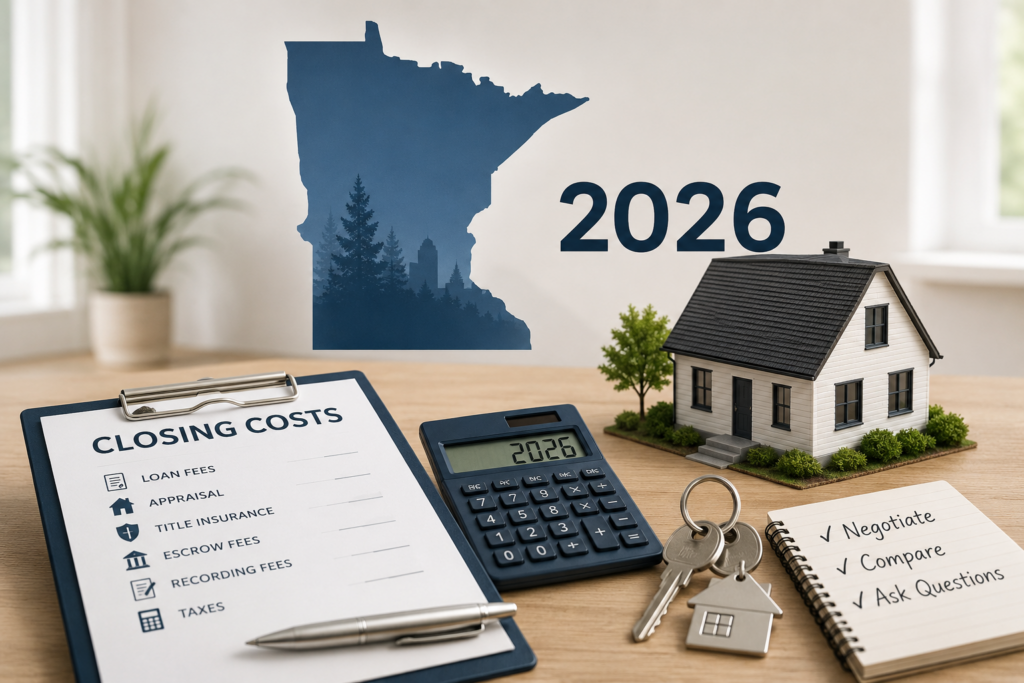
Closing costs checklist with calculator, house keys, and Minnesota state outline for 2026

Closing day is exciting — but the stack of fees that comes with it can catch buyers and sellers off guard. If you’re buying or selling a home in the Twin Cities or greater Minnesota in 2026, understanding closing costs ahead of time is one of the smartest moves you can make. Between Minnesota’s unique state taxes, lender fees, and negotiable charges, the numbers add up faster than most people expect. Here’s a plain-English breakdown of what you’ll actually pay — and where you might have room to negotiate.

What Are Closing Costs in Minnesota?

Closing costs are the fees and taxes paid at the end of a real estate transaction — on top of the purchase price and down payment. They cover everything from lender processing to title transfers, government recording, inspections, and prepaid insurance. In Minnesota, both buyers and sellers pay closing costs, but the split is decidedly unequal.

According to Edina Realty, the median sales price for a Minnesota home hit approximately $380,000 in early 2026. At that price point, buyers can expect to pay somewhere between $7,600 and $22,800 in closing costs, while sellers are typically looking at $22,800 to $38,000 — a figure that includes real estate commissions.

It’s also important to understand that closing costs and cash to close are not the same thing. Cash to close includes your down payment, prepaid property taxes, homeowners insurance, and initial escrow funding on top of closing costs. The full amount you bring to the table on closing day is typically higher than closing costs alone.

What Minnesota Buyers Pay at Closing

Buyers typically cover the lender-related fees and a handful of government charges. Plan to budget roughly 2% to 5% of the purchase price for closing costs as a buyer — on a $380,000 home, that’s approximately $7,600 to $19,000. Here’s where that money goes:

  • Loan origination fee: Charged by your lender for processing the mortgage. Usually 0.5% to 1% of the loan amount.
  • Appraisal fee: Your lender requires a professional appraisal to confirm the home’s value. Typically $400–$600 in the Twin Cities.
  • Home inspection fee: Not lender-required, but strongly recommended. Expect $350–$500 for a standard single-family home inspection.
  • Mortgage Registry Tax (MRT): This is one of Minnesota’s unique closing costs. Buyers pay a state tax of 0.23% of the loan amount when recording a mortgage. In Hennepin and Ramsey counties, a small additional levy applies. On a $300,000 loan, that’s roughly $690 at the base rate.
  • Title insurance (lender’s policy): Protects the lender against title defects. Required by virtually every mortgage lender.
  • Recording fees: The county charges a fee to officially record the deed and mortgage. Amounts vary by county.
  • Prepaid costs: These aren’t really fees — they’re future costs paid upfront, including homeowners insurance, prepaid mortgage interest, and the initial deposit into your escrow account for property taxes and insurance.

Minnesota’s property tax timing is worth flagging separately. Property taxes in Minnesota are paid in two installments — May 15 and October 15 — and the proration at closing can significantly affect how much cash you bring to the table, depending on when you close. Closing close to one of those due dates can noticeably increase your cash-to-close figure.

What Minnesota Sellers Pay at Closing

Sellers carry the heavier load at closing, primarily because real estate commissions come out of sale proceeds. When commissions are included, Minnesota sellers typically pay 6% to 10% of the sale price in total closing costs. Here’s the breakdown:

  • Real estate commissions: Fully negotiable, but average listing agent fees in Minnesota run around 2.96%, and many sellers still offer to cover the buyer’s agent fee as well. This is often the single largest cost at closing.
  • State Deed Tax (transfer tax): Minnesota charges $1.65 per $500 of the sale price (approximately 0.33%) when transferring the title to a new owner. On a $380,000 home, that’s roughly $1,254 — paid by the seller.
  • Title service fees: The seller typically pays for the title search and transfer, averaging around 0.29%–0.30% of the sale price in Minnesota.
  • Owner’s title insurance: In Minnesota, it’s more common for the seller to purchase the owner’s title insurance policy that protects the buyer. Cost varies based on the sale price.
  • Prorated property taxes: Sellers owe property taxes for the portion of the year they owned the home. This amount is credited to the buyer at closing.
  • Recording fees: Approximately $46 on average in Minnesota, though this varies by county.
  • Escrow/settlement fees: Sellers may pay $500 to $2,000 depending on the provider, property value, and transaction complexity.

If you’re selling in a competitive suburb like Edina, Wayzata, or Eden Prairie, market conditions affect how much of these costs you’ll actually absorb versus shift to the buyer. In a strong seller’s market, you may not need to offer concessions at all.

Minnesota’s Unique Closing Cost Features

Minnesota has a few state-specific closing cost characteristics that differ from many other states — and can surprise first-time buyers and out-of-state relocators:

The Mortgage Registry Tax (MRT). Most states don’t charge buyers a recording tax on their mortgage amount. Minnesota does. At 0.23% of the loan amount (with a small surcharge in Hennepin and Ramsey counties), this is a fixed, non-negotiable cost — but it’s predictable, and you can calculate it exactly once you know your loan amount. For reference, on a $320,000 mortgage, the base MRT is approximately $736.

The State Deed Tax. Minnesota’s deed transfer tax — paid by the seller — is calculated at $1.65 per $500 of the purchase price. It’s one of the non-negotiable, fixed costs that sellers can’t avoid, but they can sometimes negotiate with a buyer to share it.

Two-installment property taxes. Minnesota’s May and October property tax due dates mean that depending on when you close, the proration can feel like a significant unexpected expense — especially for buyers closing in the spring. Review the closing disclosure carefully to understand exactly what you’re prepaying.

For more detail on Minnesota’s transfer and deed taxes, you can reference the Minnesota Department of Revenue.

How to Negotiate Closing Costs in Minnesota

The good news: while state taxes and government fees are fixed, many closing costs are negotiable — or at least shoppable. Here’s where buyers and sellers actually have leverage:

For buyers:

  • Ask for seller concessions. In a buyer-friendly market, sellers can agree to pay a portion of your closing costs — either as a credit at closing or by absorbing certain fees directly. In a competitive market, this is harder to get, but always worth asking.
  • Shop your title company. You have the right to shop for title and settlement services in Minnesota. Get quotes from two or three providers — fees can vary meaningfully.
  • Compare lender fees. Loan origination fees, underwriting fees, and processing fees vary between lenders. Get multiple Loan Estimates and compare Section A and Section B of each one carefully. These are the fees you can negotiate most directly.
  • Consider a lender credit. Some lenders will offer a closing cost credit in exchange for a slightly higher interest rate. Whether this makes sense depends on how long you plan to stay in the home — run the math with your lender.
  • Ask about MHFA programs. The Minnesota Housing Finance Agency (MHFA) offers down payment and closing cost assistance programs for qualifying buyers. If you’re purchasing your first home — or haven’t owned in the past three years — it’s worth checking eligibility.

For sellers:

  • Negotiate your agent’s commission. Real estate commissions are fully negotiable in Minnesota. In a strong seller’s market, there may be room to discuss the rate — especially if your home is priced to move quickly.
  • Review your closing statement carefully. Escrow and settlement fees can vary between providers. Ask your agent to review the closing disclosure line by line — some fees are negotiable or may be in error.
  • Use market conditions as leverage. If you’re selling in a hot market, you may not need to offer buyer incentives at all. In softer conditions, offering to cover a portion of buyer closing costs can be more effective than a price reduction.

Quick Closing Cost Estimates for Twin Cities Home Prices

Here’s a rough snapshot of what buyers and sellers might expect at various Twin Cities price points in 2026, using the typical percentage ranges. These are estimates — your actual costs will vary based on lender, county, and what gets negotiated.

Home Price Buyer Closing Costs (2–5%) Seller Closing Costs (6–10%)
$300,000 $6,000 – $15,000 $18,000 – $30,000
$380,000 $7,600 – $19,000 $22,800 – $38,000
$500,000 $10,000 – $25,000 $30,000 – $50,000
$700,000 $14,000 – $35,000 $42,000 – $70,000

Estimates based on typical Minnesota closing cost ranges. Seller figures include agent commissions. Individual costs will vary.

Work with an Agent Who Knows the Numbers

A great local agent doesn’t just negotiate the purchase price — they help you understand every line on the closing disclosure, flag fees that might be negotiable, and position your offer (or listing) strategically from day one. MinnMatch connects Twin Cities buyers and sellers with vetted, local agents who know the Minneapolis–Saint Paul market inside and out. The service is completely free.

Find Your Agent →