10 Questions Every Minnesota Home Seller Should Ask Before Signing with an Agent

Minnesota home seller meeting with a real estate agent at a lake house dining table to ask listing questions

Picking a listing agent is a lot like hiring a contractor to renovate your kitchen: the person you choose will shape your timeline, your stress level, and ultimately your bottom line. Yet plenty of Minnesota sellers still pick an agent because a neighbor used them once, or because they recognize the name from a bus bench ad. With the Twin Cities market moving at a brisker pace than it has in years — homes here are selling in a median of three weeks or so — the agent you choose to represent your sale deserves more scrutiny than that. Before you sign anything, sit down with your top one or two candidates and ask them these 10 questions. The answers will tell you more about how your sale will actually go than any sales pitch will.

1. How will you price my home, and what’s your evidence?

Any agent can hand you a number. A good agent will walk you through a comparative market analysis (CMA) built from recent closed sales in your specific neighborhood — not just the metro-wide average. Twin Cities pricing varies block by block; a home in Edina’s Country Club neighborhood prices on an entirely different curve than one in South Minneapolis. Ask to see the comps. Ask why your home compares the way it does. If an agent’s number sounds suspiciously high “to win the listing,” that’s a red flag — an overpriced home tends to sit, and a home that sits long enough starts looking stale to buyers even after a price cut.

2. What’s your commission, and exactly what does it cover?

Since the 2024 NAR settlement reshaped how agents get paid, commission is no longer a fixed, take-it-or-leave-it number quietly baked into the deal — it’s a line item you negotiate directly with your listing agent, spelled out in writing before you sign anything. Minnesota listing commissions commonly run in the 2.5–3% range, though rates vary by brokerage, home price, and market. Ask specifically what services that fee includes: professional photography, staging consultation, a marketing budget, open houses, or just the listing itself. Also ask whether you’ll be offering any commission to a buyer’s agent and how that decision affects buyer interest in your specific price range.

3. What does your marketing plan actually look like?

“I’ll put it on the MLS” is not a marketing plan — every agent does that. Ask for specifics: Who shoots the photos, and have you seen their work? Is there a videographer or drone shot for larger lots and lake properties? How will the listing be promoted on social media, and to which buyer’s-agent networks? If you’re selling near Lake Minnetonka or in a higher-end suburb like Wayzata, ask how the agent reaches out-of-state or relocating buyers who may not be searching local Facebook groups. The right marketing plan should match your home’s price point and the buyer pool you’re actually trying to reach.

4. How many listings have you closed in my specific area this year?

An agent with 200 sales across the entire metro isn’t automatically the right fit for your street. Local market fluency — knowing which school district boundary line affects price, which suburb has tighter inventory, which neighborhood has an HOA quirk buyers ask about — comes from working that specific area repeatedly. Ask how many transactions they’ve closed in your city or neighborhood in the past 12 months, and ask to see (or at least hear about) a couple of recent examples. An agent who’s sold five homes in Plymouth this year will know that market’s rhythm far better than one whose business is spread thin across the whole metro.

5. What’s your communication style, and how often will I hear from you?

This sounds like a soft question, but it’s one of the biggest sources of seller frustration. Will you get a call after every showing, or radio silence until an offer comes in? Does the agent personally handle your file, or does a transaction coordinator or junior team member take over once it’s listed? Ask how they prefer to communicate (text, email, phone) and how quickly you can expect a response. If you’re balancing a sale with a full-time job and a move across the metro, knowing you won’t be left wondering what’s happening matters more than almost anything else on this list.

6. What should I fix, update, or stage before listing — and what should I skip?

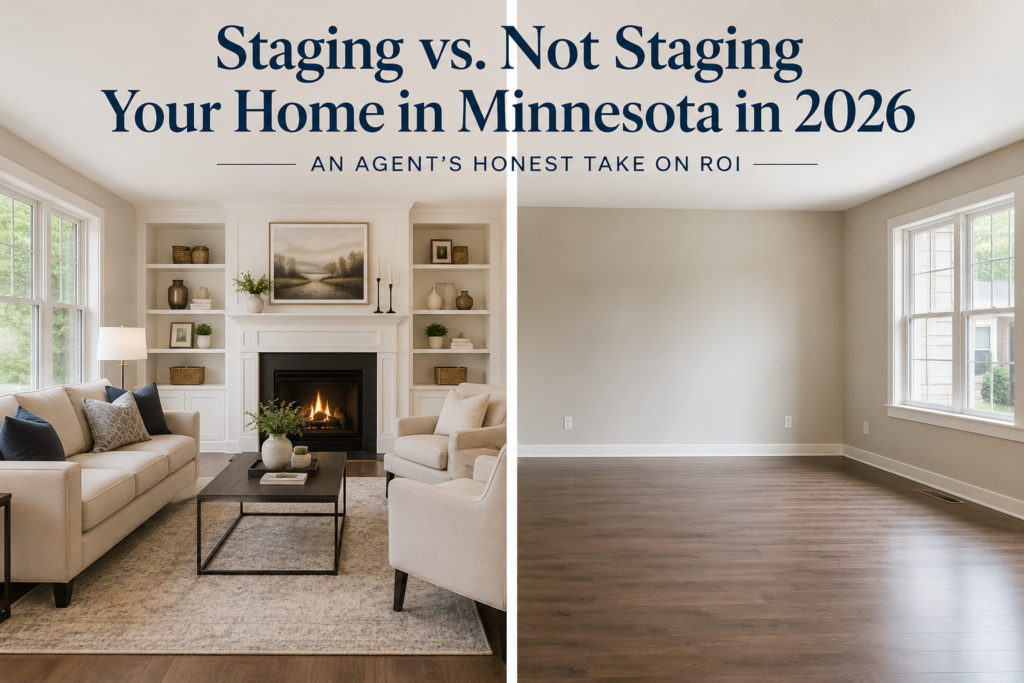
A good listing agent should be able to walk your home with you and tell you, room by room, what’s worth the investment and what isn’t. Twin Cities buyers tend to respond strongly to updated kitchens, fresh paint in neutral tones, and curb appeal — especially given how much of the buying season happens in spring and summer when lawns and landscaping are on full display. But not every project pays for itself. Ask the agent to be specific and honest, even if that means telling you not to spend money on something you were planning to fix.

7. How will you handle multiple offers, and how do you advise on offer terms beyond price?

With inventory still relatively tight across much of the metro, well-priced homes in popular suburbs can still draw competing offers. Ask how the agent typically structures an offer deadline, how they evaluate offers that aren’t all-cash or aren’t the highest price (financing contingencies, appraisal gaps, and closing timelines all matter), and how they’ll keep you from leaving money — or peace of mind — on the table. An agent who can talk through a real multiple-offer scenario in detail has clearly been through one before.

8. What happens if my home doesn’t sell quickly?

Not every home goes pending in the first week, and that’s worth planning for before it happens, not after. Ask what the agent’s plan is if the home is still active after 30 or 45 days: Do they recommend a price adjustment, new photography, a re-launch as a “new” listing, or a change in marketing strategy? Also ask about the length of the listing agreement itself and what your options are if the relationship isn’t working — a shorter initial term with the option to renew gives you flexibility without locking you in if expectations aren’t being met.

9. Who else is involved in my transaction, and what do they handle?

Many Twin Cities agents work as part of a team, which isn’t a bad thing — but you should know upfront who’s actually showing up to your listing appointment versus who’s drafting your paperwork, scheduling your photographer, or fielding buyer questions. Ask whether you’ll have one point of contact throughout, and get names and roles for anyone else who’ll touch your file. There’s nothing wrong with a team structure as long as you know exactly who to call when you have a question.

10. Can you walk me through a recent sale that didn’t go smoothly — and how you handled it?

Every experienced agent has a story about an inspection that turned up something unexpected, an appraisal that came in low, or a buyer who got cold feet days before closing. How they answer this question tells you a lot more than their highlight reel of easy sales. Listen for problem-solving, not blame — you want an agent who stays calm, communicates clearly, and has a track record of getting deals back on track when something goes sideways. Real estate rarely goes exactly according to plan, and the agent’s response to friction is often the best preview of what working with them will actually feel like.

Finding the right fit shouldn’t be guesswork

The best protection against a mismatched agent isn’t a longer list of interview questions — it’s starting the search with agents who are already a strong fit for your home, your neighborhood, and your goals. That’s the whole idea behind how MinnMatch works: instead of cold-calling agents off a billboard or picking whoever ran the last open house you attended, you tell us a little about your home and your timeline, and we hand-match you with local, vetted agents who actually specialize in your part of the Twin Cities. There’s no cost to you, no algorithm guessing on your behalf — just a real local matchmaker doing the legwork before you ever sit down for that first interview.

Ready to start those conversations with the right agents already in the room? Find your agent match with MinnMatch and walk into your listing interview already a step ahead.

Selling your Minnesota home? Get matched with a local agent who’s earned your questions — and your trust.


Find My Agent Match

Sources: Minneapolis Area Realtors®, Minnesota Housing Finance Agency, Redfin Minneapolis Housing Market Data.

Understanding Closing Costs in Minnesota in 2026: What You’ll Pay and How to Negotiate

Closing costs checklist with calculator, house keys, and Minnesota state outline for 2026

Closing day is exciting — but the stack of fees that comes with it can catch buyers and sellers off guard. If you’re buying or selling a home in the Twin Cities or greater Minnesota in 2026, understanding closing costs ahead of time is one of the smartest moves you can make. Between Minnesota’s unique state taxes, lender fees, and negotiable charges, the numbers add up faster than most people expect. Here’s a plain-English breakdown of what you’ll actually pay — and where you might have room to negotiate.

What Are Closing Costs in Minnesota?

Closing costs are the fees and taxes paid at the end of a real estate transaction — on top of the purchase price and down payment. They cover everything from lender processing to title transfers, government recording, inspections, and prepaid insurance. In Minnesota, both buyers and sellers pay closing costs, but the split is decidedly unequal.

According to Edina Realty, the median sales price for a Minnesota home hit approximately $380,000 in early 2026. At that price point, buyers can expect to pay somewhere between $7,600 and $22,800 in closing costs, while sellers are typically looking at $22,800 to $38,000 — a figure that includes real estate commissions.

It’s also important to understand that closing costs and cash to close are not the same thing. Cash to close includes your down payment, prepaid property taxes, homeowners insurance, and initial escrow funding on top of closing costs. The full amount you bring to the table on closing day is typically higher than closing costs alone.

What Minnesota Buyers Pay at Closing

Buyers typically cover the lender-related fees and a handful of government charges. Plan to budget roughly 2% to 5% of the purchase price for closing costs as a buyer — on a $380,000 home, that’s approximately $7,600 to $19,000. Here’s where that money goes:

  • Loan origination fee: Charged by your lender for processing the mortgage. Usually 0.5% to 1% of the loan amount.
  • Appraisal fee: Your lender requires a professional appraisal to confirm the home’s value. Typically $400–$600 in the Twin Cities.
  • Home inspection fee: Not lender-required, but strongly recommended. Expect $350–$500 for a standard single-family home inspection.
  • Mortgage Registry Tax (MRT): This is one of Minnesota’s unique closing costs. Buyers pay a state tax of 0.23% of the loan amount when recording a mortgage. In Hennepin and Ramsey counties, a small additional levy applies. On a $300,000 loan, that’s roughly $690 at the base rate.
  • Title insurance (lender’s policy): Protects the lender against title defects. Required by virtually every mortgage lender.
  • Recording fees: The county charges a fee to officially record the deed and mortgage. Amounts vary by county.
  • Prepaid costs: These aren’t really fees — they’re future costs paid upfront, including homeowners insurance, prepaid mortgage interest, and the initial deposit into your escrow account for property taxes and insurance.

Minnesota’s property tax timing is worth flagging separately. Property taxes in Minnesota are paid in two installments — May 15 and October 15 — and the proration at closing can significantly affect how much cash you bring to the table, depending on when you close. Closing close to one of those due dates can noticeably increase your cash-to-close figure.

What Minnesota Sellers Pay at Closing

Sellers carry the heavier load at closing, primarily because real estate commissions come out of sale proceeds. When commissions are included, Minnesota sellers typically pay 6% to 10% of the sale price in total closing costs. Here’s the breakdown:

  • Real estate commissions: Fully negotiable, but average listing agent fees in Minnesota run around 2.96%, and many sellers still offer to cover the buyer’s agent fee as well. This is often the single largest cost at closing.
  • State Deed Tax (transfer tax): Minnesota charges $1.65 per $500 of the sale price (approximately 0.33%) when transferring the title to a new owner. On a $380,000 home, that’s roughly $1,254 — paid by the seller.
  • Title service fees: The seller typically pays for the title search and transfer, averaging around 0.29%–0.30% of the sale price in Minnesota.
  • Owner’s title insurance: In Minnesota, it’s more common for the seller to purchase the owner’s title insurance policy that protects the buyer. Cost varies based on the sale price.
  • Prorated property taxes: Sellers owe property taxes for the portion of the year they owned the home. This amount is credited to the buyer at closing.
  • Recording fees: Approximately $46 on average in Minnesota, though this varies by county.
  • Escrow/settlement fees: Sellers may pay $500 to $2,000 depending on the provider, property value, and transaction complexity.

If you’re selling in a competitive suburb like Edina, Wayzata, or Eden Prairie, market conditions affect how much of these costs you’ll actually absorb versus shift to the buyer. In a strong seller’s market, you may not need to offer concessions at all.

Minnesota’s Unique Closing Cost Features

Minnesota has a few state-specific closing cost characteristics that differ from many other states — and can surprise first-time buyers and out-of-state relocators:

The Mortgage Registry Tax (MRT). Most states don’t charge buyers a recording tax on their mortgage amount. Minnesota does. At 0.23% of the loan amount (with a small surcharge in Hennepin and Ramsey counties), this is a fixed, non-negotiable cost — but it’s predictable, and you can calculate it exactly once you know your loan amount. For reference, on a $320,000 mortgage, the base MRT is approximately $736.

The State Deed Tax. Minnesota’s deed transfer tax — paid by the seller — is calculated at $1.65 per $500 of the purchase price. It’s one of the non-negotiable, fixed costs that sellers can’t avoid, but they can sometimes negotiate with a buyer to share it.

Two-installment property taxes. Minnesota’s May and October property tax due dates mean that depending on when you close, the proration can feel like a significant unexpected expense — especially for buyers closing in the spring. Review the closing disclosure carefully to understand exactly what you’re prepaying.

For more detail on Minnesota’s transfer and deed taxes, you can reference the Minnesota Department of Revenue.

How to Negotiate Closing Costs in Minnesota

The good news: while state taxes and government fees are fixed, many closing costs are negotiable — or at least shoppable. Here’s where buyers and sellers actually have leverage:

For buyers:

  • Ask for seller concessions. In a buyer-friendly market, sellers can agree to pay a portion of your closing costs — either as a credit at closing or by absorbing certain fees directly. In a competitive market, this is harder to get, but always worth asking.
  • Shop your title company. You have the right to shop for title and settlement services in Minnesota. Get quotes from two or three providers — fees can vary meaningfully.
  • Compare lender fees. Loan origination fees, underwriting fees, and processing fees vary between lenders. Get multiple Loan Estimates and compare Section A and Section B of each one carefully. These are the fees you can negotiate most directly.
  • Consider a lender credit. Some lenders will offer a closing cost credit in exchange for a slightly higher interest rate. Whether this makes sense depends on how long you plan to stay in the home — run the math with your lender.
  • Ask about MHFA programs. The Minnesota Housing Finance Agency (MHFA) offers down payment and closing cost assistance programs for qualifying buyers. If you’re purchasing your first home — or haven’t owned in the past three years — it’s worth checking eligibility.

For sellers:

  • Negotiate your agent’s commission. Real estate commissions are fully negotiable in Minnesota. In a strong seller’s market, there may be room to discuss the rate — especially if your home is priced to move quickly.
  • Review your closing statement carefully. Escrow and settlement fees can vary between providers. Ask your agent to review the closing disclosure line by line — some fees are negotiable or may be in error.
  • Use market conditions as leverage. If you’re selling in a hot market, you may not need to offer buyer incentives at all. In softer conditions, offering to cover a portion of buyer closing costs can be more effective than a price reduction.

Quick Closing Cost Estimates for Twin Cities Home Prices

Here’s a rough snapshot of what buyers and sellers might expect at various Twin Cities price points in 2026, using the typical percentage ranges. These are estimates — your actual costs will vary based on lender, county, and what gets negotiated.

Home Price Buyer Closing Costs (2–5%) Seller Closing Costs (6–10%)
$300,000 $6,000 – $15,000 $18,000 – $30,000
$380,000 $7,600 – $19,000 $22,800 – $38,000
$500,000 $10,000 – $25,000 $30,000 – $50,000
$700,000 $14,000 – $35,000 $42,000 – $70,000

Estimates based on typical Minnesota closing cost ranges. Seller figures include agent commissions. Individual costs will vary.

Work with an Agent Who Knows the Numbers

A great local agent doesn’t just negotiate the purchase price — they help you understand every line on the closing disclosure, flag fees that might be negotiable, and position your offer (or listing) strategically from day one. MinnMatch connects Twin Cities buyers and sellers with vetted, local agents who know the Minneapolis–Saint Paul market inside and out. The service is completely free.

Find Your Agent →

June 2026 Twin Cities Housing Market Report: Summer Trends, Inventory Shifts & Neighborhood Insights

Colorful stacked toy houses with cash and a sun illustration representing the Twin Cities summer 2026 housing market

Summer is here, and the Twin Cities housing market has something to say. After years of frenzied bidding wars, shrinking inventory, and buyers waiving every contingency just to get to the closing table, June 2026 feels noticeably different. More homes are hitting the market. Prices are softening in a meaningful way. And buyers — still cautious, but increasingly empowered — are taking their time. Whether you’re buying, selling, or just keeping an eye on the market, here’s your ground-level look at what’s happening across the Twin Cities metro this summer.

The Numbers Don’t Lie: A Market in Transition

The April 2026 data from Minneapolis Area Realtors® told a story that surprised even seasoned local agents. Home sales in the metro were down more than 3% compared to April 2025, with roughly 3,800 closings recorded. The median sale price dipped 2% to $392,000 — the first meaningful price decline in years. Active listings across the metro jumped 16.1% year-over-year, reaching approximately 13,560 available homes. And the average days on market stretched to 57 days, a sign that buyers are no longer rushing.

Most striking? Closed home prices in April 2026 were 3.5% lower than the same month in 2025 — one of the steeper year-over-year declines the metro has recorded in recent memory, and a notable reversal after years of steady appreciation. The 2026 Twin Cities market report headline from Minneapolis Area Realtors said it plainly: “More Homes, More Deals, Softer Metro Prices.” That’s not a crash — but it is a clear shift. Minneapolis Area Realtors leadership described the current softness as the market “finding balance” after the COVID-era surge — less a collapse and more a correction toward normalcy.

What’s Driving the Shift? Agents Weigh In

We asked two of our top MinnMatch partner agent teams to share what they’re seeing on the ground. Their perspectives offer a rare window into the real dynamics shaping transactions right now — not just the data, but the psychology behind it.

Emily & Kelly point to pricing strategy as the single most important variable in today’s market: “Homes that are priced correctly from the start tend to outperform those that chase the market. Even in what is still considered a seller-leaning environment, we’re seeing fewer multiple-offer situations than in previous years.” When a home is strategically priced — sometimes slightly below market — it generates stronger showings, shorter days on market, and often ends up closing higher due to competitive interest. Multiple-offer situations that do develop are closing around 10% over list price on average, though results vary considerably based on condition, location, and strategy.

Buyers, they note, are exercising real caution around waiving inspections — unless a pre-listing inspection is already on file, which has become an increasingly useful tool for sellers. Negotiations overall feel more deliberate. “Both sides are more selective and intentional,” they say, “which is shaping a more balanced negotiation environment.” Winning offers today often hinge on creative terms rather than simply the highest number — a recent deal their team closed came together because they identified a specific seller priority and addressed it directly in the offer, avoiding a prolonged multiple-offer situation altogether.

Art, another veteran MinnMatch partner agent, offers a blunter read: “The market doesn’t feel different. It IS different.” He’s been watching buyers become significantly more discerning — and he’s seeing a new factor at play. “AI is increasing its presence in vetting properties. Clients now use it to help them understand, as an independent party, what a property may be worth.” His view: AI tools can give buyers a starting point, but they’re no substitute for real MLS data and a knowledgeable local agent. A Buyer’s Market Analysis from an expert in the field remains the most reliable way to understand true value.

Art also points to a broader backdrop that’s shaping buyer psychology: “While interest rates have bounced a bit to the mid-6s, gas is at a 4.5-year high. Inflation is up again. And we’re involved in another international conflict.” Even with a strong stock market and continued consumer spending, economic anxiety is real — and it’s translating to more cautious offers and longer days on market across the metro. His bottom line: “It’s a buyer’s market, and now’s a great time to buy.” To be precise, the metro’s months of supply still sits between roughly 1.8 and 2.4 months — well below the 5 to 6 months that technically defines a buyer’s market. But Art’s point holds: buyers have meaningfully more leverage today than they’ve had in years, and the window is real.

Inventory Is Up — But It’s Not Equal Everywhere

One of the defining stories of the 2026 Twin Cities housing market is the inventory surge — the most available homes in nine consecutive years. But that inventory isn’t evenly distributed, and where you’re shopping makes an enormous difference.

In the urban cores of Minneapolis and St. Paul, well-conditioned and updated homes can still generate quick attention, but buyers have become more selective about what they’ll pay a premium for. The days of “buy anything, anywhere, at any price” are firmly over. Move-in-ready homes in desirable neighborhoods continue to perform; dated properties are sitting.

In the suburbs and south metro, including communities like Eden Prairie, Prior Lake, and Edina, listings are generally selling near asking price, but median market times are extending as buyers take a more measured approach. Affordability-focused buyers are increasingly looking to areas like Plymouth and the outer-ring suburbs where value per square foot remains compelling.

Townhomes are a notable bright spot. In April 2026, townhome sales were the only property type to show annual growth — up 7.2% metro-wide — as buyers gravitate toward lower-maintenance, more affordable entry points into homeownership. Condo prices, by contrast, saw the steepest decline, falling 3.1% year-over-year to a median of $190,000. Redfin’s Minneapolis market data reflects similar mixed signals at the neighborhood level.

Summer Seasonality: Slow Start, Active Ahead

June in the Twin Cities always comes with a familiar rhythm: school ends, cabin weekends pull families north, graduation parties fill up the calendar. Real estate activity typically softens slightly in early June before picking back up through July and into August. This year is following that pattern — with one key difference. Agents are reporting that buyer activity has picked up modestly over the past few weeks, suggesting we may be heading into a more active summer than the spring data implied.

Mortgage rates remain a variable worth watching. The 30-year fixed rate has been bouncing in the mid-6% range — elevated compared to the pandemic-era lows that many buyers still remember, but stabilizing compared to the volatility of recent years. Minnesota Housing Finance Agency programs continue to offer first-time buyer assistance that can meaningfully offset those rate headwinds for qualifying households.

For sellers, the summer window remains real — but the playbook has changed. Overpriced listings that once sold anyway are now sitting. Homes that are prepped, priced correctly, and positioned well for their neighborhood are still generating strong results. Pre-listing inspections are gaining traction as a way to reduce friction and give buyers confidence, shortening the path from offer to close.

More Leverage for Buyers — What It Means for Your Move

The June 2026 Twin Cities housing market presents a genuinely interesting opportunity — particularly for buyers who’ve been sitting on the sidelines waiting for conditions to improve. More inventory means more choices. Softer prices mean more negotiating room. Longer days on market mean more time for due diligence. This isn’t a buyer’s market in the technical sense — inventory levels aren’t there yet — but buyers have more breathing room than they’ve had since before the pandemic. Sellers willing to inspect, price honestly, and negotiate in good faith are still closing deals at solid prices. Those chasing 2022-era numbers are learning the hard way that this market doesn’t reward wishful thinking.

Whether this represents a temporary cooling or the beginning of a longer market shift is, honestly, the question everyone is asking. The smart move — for buyers and sellers alike — is to work with a local agent who knows the data, knows the neighborhoods, and can help you navigate the nuance. A Buyer’s Market Analysis or Seller’s Pricing Consultation from a vetted local expert is still the most reliable tool available, regardless of what any app or algorithm tells you.

At MinnMatch, we personally match Twin Cities buyers and sellers with handpicked, vetted local agents who specialize in your specific market — at no cost to you. If you’re trying to make sense of this shifting market and want someone who actually knows the neighborhoods, the data, and the dynamics firsthand, we’d love to connect you with the right agent today.