June 2026 Twin Cities Housing Market Report: Summer Trends, Inventory Shifts & Neighborhood Insights

Colorful stacked toy houses with cash and a sun illustration representing the Twin Cities summer 2026 housing market

Summer is here, and the Twin Cities housing market has something to say. After years of frenzied bidding wars, shrinking inventory, and buyers waiving every contingency just to get to the closing table, June 2026 feels noticeably different. More homes are hitting the market. Prices are softening in a meaningful way. And buyers — still cautious, but increasingly empowered — are taking their time. Whether you’re buying, selling, or just keeping an eye on the market, here’s your ground-level look at what’s happening across the Twin Cities metro this summer.

The Numbers Don’t Lie: A Market in Transition

The April 2026 data from Minneapolis Area Realtors® told a story that surprised even seasoned local agents. Home sales in the metro were down more than 3% compared to April 2025, with roughly 3,800 closings recorded. The median sale price dipped 2% to $392,000 — the first meaningful price decline in years. Active listings across the metro jumped 16.1% year-over-year, reaching approximately 13,560 available homes. And the average days on market stretched to 57 days, a sign that buyers are no longer rushing.

Most striking? Closed home prices in April 2026 were 3.5% lower than the same month in 2025 — one of the steeper year-over-year declines the metro has recorded in recent memory, and a notable reversal after years of steady appreciation. The 2026 Twin Cities market report headline from Minneapolis Area Realtors said it plainly: “More Homes, More Deals, Softer Metro Prices.” That’s not a crash — but it is a clear shift. Minneapolis Area Realtors leadership described the current softness as the market “finding balance” after the COVID-era surge — less a collapse and more a correction toward normalcy.

What’s Driving the Shift? Agents Weigh In

We asked two of our top MinnMatch partner agent teams to share what they’re seeing on the ground. Their perspectives offer a rare window into the real dynamics shaping transactions right now — not just the data, but the psychology behind it.

Emily & Kelly point to pricing strategy as the single most important variable in today’s market: “Homes that are priced correctly from the start tend to outperform those that chase the market. Even in what is still considered a seller-leaning environment, we’re seeing fewer multiple-offer situations than in previous years.” When a home is strategically priced — sometimes slightly below market — it generates stronger showings, shorter days on market, and often ends up closing higher due to competitive interest. Multiple-offer situations that do develop are closing around 10% over list price on average, though results vary considerably based on condition, location, and strategy.

Buyers, they note, are exercising real caution around waiving inspections — unless a pre-listing inspection is already on file, which has become an increasingly useful tool for sellers. Negotiations overall feel more deliberate. “Both sides are more selective and intentional,” they say, “which is shaping a more balanced negotiation environment.” Winning offers today often hinge on creative terms rather than simply the highest number — a recent deal their team closed came together because they identified a specific seller priority and addressed it directly in the offer, avoiding a prolonged multiple-offer situation altogether.

Art, another veteran MinnMatch partner agent, offers a blunter read: “The market doesn’t feel different. It IS different.” He’s been watching buyers become significantly more discerning — and he’s seeing a new factor at play. “AI is increasing its presence in vetting properties. Clients now use it to help them understand, as an independent party, what a property may be worth.” His view: AI tools can give buyers a starting point, but they’re no substitute for real MLS data and a knowledgeable local agent. A Buyer’s Market Analysis from an expert in the field remains the most reliable way to understand true value.

Art also points to a broader backdrop that’s shaping buyer psychology: “While interest rates have bounced a bit to the mid-6s, gas is at a 4.5-year high. Inflation is up again. And we’re involved in another international conflict.” Even with a strong stock market and continued consumer spending, economic anxiety is real — and it’s translating to more cautious offers and longer days on market across the metro. His bottom line: “It’s a buyer’s market, and now’s a great time to buy.” To be precise, the metro’s months of supply still sits between roughly 1.8 and 2.4 months — well below the 5 to 6 months that technically defines a buyer’s market. But Art’s point holds: buyers have meaningfully more leverage today than they’ve had in years, and the window is real.

Inventory Is Up — But It’s Not Equal Everywhere

One of the defining stories of the 2026 Twin Cities housing market is the inventory surge — the most available homes in nine consecutive years. But that inventory isn’t evenly distributed, and where you’re shopping makes an enormous difference.

In the urban cores of Minneapolis and St. Paul, well-conditioned and updated homes can still generate quick attention, but buyers have become more selective about what they’ll pay a premium for. The days of “buy anything, anywhere, at any price” are firmly over. Move-in-ready homes in desirable neighborhoods continue to perform; dated properties are sitting.

In the suburbs and south metro, including communities like Eden Prairie, Prior Lake, and Edina, listings are generally selling near asking price, but median market times are extending as buyers take a more measured approach. Affordability-focused buyers are increasingly looking to areas like Plymouth and the outer-ring suburbs where value per square foot remains compelling.

Townhomes are a notable bright spot. In April 2026, townhome sales were the only property type to show annual growth — up 7.2% metro-wide — as buyers gravitate toward lower-maintenance, more affordable entry points into homeownership. Condo prices, by contrast, saw the steepest decline, falling 3.1% year-over-year to a median of $190,000. Redfin’s Minneapolis market data reflects similar mixed signals at the neighborhood level.

Summer Seasonality: Slow Start, Active Ahead

June in the Twin Cities always comes with a familiar rhythm: school ends, cabin weekends pull families north, graduation parties fill up the calendar. Real estate activity typically softens slightly in early June before picking back up through July and into August. This year is following that pattern — with one key difference. Agents are reporting that buyer activity has picked up modestly over the past few weeks, suggesting we may be heading into a more active summer than the spring data implied.

Mortgage rates remain a variable worth watching. The 30-year fixed rate has been bouncing in the mid-6% range — elevated compared to the pandemic-era lows that many buyers still remember, but stabilizing compared to the volatility of recent years. Minnesota Housing Finance Agency programs continue to offer first-time buyer assistance that can meaningfully offset those rate headwinds for qualifying households.

For sellers, the summer window remains real — but the playbook has changed. Overpriced listings that once sold anyway are now sitting. Homes that are prepped, priced correctly, and positioned well for their neighborhood are still generating strong results. Pre-listing inspections are gaining traction as a way to reduce friction and give buyers confidence, shortening the path from offer to close.

More Leverage for Buyers — What It Means for Your Move

The June 2026 Twin Cities housing market presents a genuinely interesting opportunity — particularly for buyers who’ve been sitting on the sidelines waiting for conditions to improve. More inventory means more choices. Softer prices mean more negotiating room. Longer days on market mean more time for due diligence. This isn’t a buyer’s market in the technical sense — inventory levels aren’t there yet — but buyers have more breathing room than they’ve had since before the pandemic. Sellers willing to inspect, price honestly, and negotiate in good faith are still closing deals at solid prices. Those chasing 2022-era numbers are learning the hard way that this market doesn’t reward wishful thinking.

Whether this represents a temporary cooling or the beginning of a longer market shift is, honestly, the question everyone is asking. The smart move — for buyers and sellers alike — is to work with a local agent who knows the data, knows the neighborhoods, and can help you navigate the nuance. A Buyer’s Market Analysis or Seller’s Pricing Consultation from a vetted local expert is still the most reliable tool available, regardless of what any app or algorithm tells you.

At MinnMatch, we personally match Twin Cities buyers and sellers with handpicked, vetted local agents who specialize in your specific market — at no cost to you. If you’re trying to make sense of this shifting market and want someone who actually knows the neighborhoods, the data, and the dynamics firsthand, we’d love to connect you with the right agent today.

Twin Cities Suburbs Ranked: The Best Places to Buy a Home in 2026

Twin Cities suburbs ranked best places to buy a home in 2026, with Minneapolis skyline in background

Shopping for a home in the Twin Cities in 2026? You’re not alone — and you’re not without options. Despite higher mortgage rates and lingering affordability pressures across the country, the Minneapolis–St. Paul metro still has suburbs that offer real value, strong schools, and communities worth putting down roots in. Whether you’re a first-time buyer chasing square footage, a growing family eyeing top-rated districts, or a move-up buyer ready to upgrade, there’s a suburb on this list for you. We’ve pulled together the best places to buy a home in the Twin Cities suburbs right now, based on home prices, market trends, livability, and what buyers are actually prioritizing in 2026. If you want help finding an agent who knows these neighborhoods inside and out, MinnMatch can match you with a vetted local expert — for free.

How We Ranked These Twin Cities Suburbs

This isn’t a purely algorithmic list. We looked at a combination of real market data — median home prices, days on market, price trends from sources like Redfin’s Minnesota market reports and the Minneapolis Area Association of Realtors’ 2025 Annual Housing Market Report — along with livability factors like school quality, community character, commute access, and what buyers are actually asking for right now. The result is a practical guide to the best places to buy a home in the Twin Cities suburbs in 2026, across a range of price points.

One important note on context: the statewide median home sale price in Minnesota was around $354,500 as of March 2026, according to Redfin. Everything below is measured relative to that baseline — and to what your money actually buys you on the ground.

1. Maple Grove — Best Overall Value in the Northwest Metro

Maple Grove consistently earns high marks for livability, and 2026 is no different. With a median home price hovering around $390,000–$405,000, it sits comfortably above the state median while offering a level of amenity and polish that’s hard to beat at that price point. Think big-box convenience, fantastic parks like Elm Creek Park Reserve, highly rated Osseo-area schools, and neighborhoods that feel genuinely cared for.

The market here moves relatively fast — homes are typically going under contract within 31 to 35 days — which tells you demand is still healthy even if prices have softened slightly from their peak. For families who want a suburb that has it all without venturing into the $500K+ range, Maple Grove remains one of the best places to buy a home in the Twin Cities.

Best for: Families, first-time move-up buyers, anyone who wants suburban amenities without the luxury price tag.

2. Eden Prairie — Polished Living on the Southwest Side

Eden Prairie is one of those suburbs that earns its reputation year after year. With a median sale price around $438,000–$462,000 depending on the month, it’s priced noticeably above the county median of $376,000 — but buyers consistently find the value proposition compelling. Over 41% of Eden Prairie sellers received at or above their original asking price in 2025, according to NorthstarMLS data, one of the stronger close-price ratios in the metro.

Beyond the numbers: Eden Prairie offers Bryant Lake Regional Park, the Eden Prairie Center, a highly regarded school district, and convenient access to Highway 212 and I-494. It’s a suburb that functions well as a long-term place to live — not just a financial bet. Homes here are classified as “very competitive” by Redfin, typically selling in about 25 to 30 days, so buyers should come prepared to move quickly.

Best for: Buyers who want a well-rounded southwest suburb with strong resale value and quality schools. Explore the Eden Prairie community page for more local info.

3. Lakeville — Dakota County’s Growth Story

Lakeville has been one of the Twin Cities’ fastest-growing suburbs for years, and for good reason. With a median home price around $450,000–$467,000 as of early 2026, it’s priced competitively for what you get: newer construction, spacious lots, a well-regarded school district (ISD 194), and a small-town downtown that still has real character. The city is consistently ranked among the best places to raise a family in Minnesota.

Lakeville tends to attract buyers who prioritize space and newer builds over urban proximity. The commute to downtown Minneapolis is longer than some west-metro options — plan on 40–45 minutes without traffic — but many buyers consider that a worthwhile tradeoff for the square footage and lot sizes you get. Sales volume in early 2026 has been notably strong, with hundreds of transactions per month, suggesting robust buyer interest remains.

Best for: Families who want newer homes, bigger yards, and Dakota County’s excellent schools without leaving the metro.

4. Woodbury — The East Metro’s Consistent Performer

Woodbury doesn’t get as much attention as its west-metro counterparts, but buyers who discover it tend to stay loyal. The average home value sits around $457,000, up slightly year over year — a sign of steady, if not flashy, appreciation. What Woodbury delivers is reliability: well-planned neighborhoods, South Washington County Schools (consistently strong performers), low crime, and access to both St. Paul and downtown Minneapolis via I-94.

For buyers who work in St. Paul or the east metro — or who want to be closer to the Wisconsin border — Woodbury is often the first suburb they look at, and frequently the one they choose. Niche’s 2026 rankings highlighted it as one of the Twin Cities’ standout communities for housing stability, a factor that matters when you’re making a long-term investment.

Best for: East metro commuters, families, and buyers who value stability and long-term appreciation over flash.

5. Plymouth — The Premium West Metro Option

Plymouth commands some of the higher price points on this list — median values in the $520,000–$535,000 range — but it earns them. It’s one of the best places to buy a home in the Twin Cities if your priorities include lake access, top-tier Wayzata School District schools, and a suburban experience that genuinely borders on luxurious. Medicine Lake, Parkers Lake, and French Regional Park are all right there. And with Hwy 55, I-494, and Hwy 169 all converging nearby, Plymouth is one of the better-connected suburbs in the metro.

Buyers who stretch their budget for Plymouth tend to be rewarded — both in the quality of life and in resale performance. The Wayzata School District is one of the most coveted in the state, and homes in Plymouth routinely receive strong offers. If the price is within reach, it’s a community worth serious consideration. Check out MinnMatch’s Plymouth community page for neighborhood details.

Best for: Move-up buyers and families willing to invest more for the Wayzata School District and west-metro lake access.

6. Edina — Prestige, Proximity, and a Price to Match

Edina is in a different category than the rest of this list — and that’s by design. With a median home price around $750,000, it’s firmly luxury territory, but it’s included here because it consistently attracts buyers who are weighing the southwest suburbs and want to understand the full spectrum. What Edina offers is unmatched in the Twin Cities: proximity to Minneapolis, the 50th & France shopping district, Edina Public Schools (one of the most respected districts in Minnesota), and a density of amenities that suburban buyers rarely get at any price.

If your budget allows it, Edina functions almost like an urban neighborhood with suburban square footage. If Edina is on your radar, visit MinnMatch’s Edina community page and talk to an agent who specializes in the area — competition is real and strategy matters.

Best for: Luxury buyers who want the feel of a walkable, upscale community with full suburban amenities.

What to Keep in Mind as You Search in 2026

The Twin Cities suburbs market in 2026 is more nuanced than it was during the pandemic frenzy — and that’s actually a good thing for buyers who are patient and prepared. Inventory is slowly improving in many communities. Days on market have stretched in some suburbs, giving buyers a bit more breathing room. But well-priced homes in desirable neighborhoods are still moving quickly, often within a few weeks of listing.

One factor worth watching: property tax rates can vary meaningfully across these suburbs, even between cities with similar home prices. According to Minnesota Department of Revenue data, municipal tax rates differ notably across Hennepin County communities, and school district levies add another layer. Make sure you’re asking your agent for parcel-level tax estimates — not just city averages — before making a final decision. The Minnesota Housing Finance Agency also offers programs that may help with down payment assistance for qualifying buyers.

The other thing to keep in mind: ranking lists and market data tell part of the story, but every buyer’s situation is different. A suburb that’s objectively “ranked #1” might not be the right fit for your commute, your school priorities, or your lifestyle. That’s where a knowledgeable local agent makes all the difference.

Find the Right Twin Cities Suburb — With the Right Agent

At MinnMatch, we connect Twin Cities homebuyers with handpicked, vetted local agents who actually know the neighborhoods — not just the zip codes. Whether you’re eyeing Maple Grove’s value, Plymouth’s schools, or Lakeville’s space, we’ll match you with someone who can help you navigate the market with confidence. It’s free, it’s human-powered, and it works. See how MinnMatch works or get matched with an agent today.

Why MinnMatch Is the Smarter Way to Find a Real Estate Agent in the Twin Cities

A magnifying glass focusing on a home with a checkmark icon, with the Minneapolis skyline in the background — representing finding the right real estate agent in the Twin Cities

Finding a Twin Cities real estate agent shouldn’t feel like a gamble. Yet for most buyers and sellers, that’s exactly what it is — a scroll through Zillow profiles, a few Google searches, maybe a referral from a coworker who bought a house three years ago. You end up with someone who may or may not know your target neighborhood, may or may not have the experience level your situation demands, and may or may not be the right fit for how you like to communicate. There’s a smarter way — and that’s exactly what MinnMatch was built to do.

We Match You With a Twin Cities Real Estate Agent — You Don’t Search

The core difference between MinnMatch and every agent directory or referral platform you’ve used before is simple: we do the matching for you. You’re not handed a list of agents and left to figure it out. You’re not bidding on your own time with agents who pay to be at the top of a search result. Instead, a real human at MinnMatch listens to your situation — your timeline, your price range, your neighborhood preferences, your communication style — and handpicks a vetted local agent who genuinely fits.

Think of it less like a search engine and more like a trusted recruiter. Except instead of placing candidates for a job, we’re placing the right agent for one of the biggest financial decisions of your life.

“Most platforms are paid directories dressed up as matching services. MinnMatch is the opposite — free for buyers and sellers, with the matching done by people who actually know the Twin Cities market.”

Local Expertise That Actually Means Something

The Twin Cities real estate market isn’t monolithic. A buyer looking in Edina has entirely different needs than one eyeing a place in South Minneapolis. A seller in Lake Minnetonka is navigating a completely different buyer pool than someone listing in Plymouth. Hyper-local knowledge isn’t a nice-to-have — it’s the difference between getting the right offer and leaving money on the table, or winning a competitive bid versus losing out.

Every agent in the MinnMatch network is vetted specifically for their local expertise. We know which agents are specialists in Wayzata, who dominates in Eden Prairie, and who has the track record in Prior Lake to back it up. That intelligence doesn’t exist in a Zillow rating or a Google review count — according to the Minneapolis Area Realtors, local market conditions can vary significantly even between neighboring zip codes. It comes from doing this work, in this market, consistently.

It’s Free — And There’s No Catch

MinnMatch is completely free for buyers and sellers. No subscription. No lead fee passed along to you. No premium tier that unlocks the actually-good agents. The service works because agents value the quality of our referrals — you’re not a cold lead scraped from an ad click. You’re a matched client who is ready to move, informed about the process, and paired with an agent who is genuinely right for your situation. That’s worth something to agents, and it’s how the model sustains itself without charging you a dime.

You don’t have to wonder whether the agent being recommended to you paid for that recommendation. They didn’t.

The Problem With Most Agent-Finding Methods

Let’s be direct about the alternatives:

  • Big portal directories (Zillow, Realtor.com) — Agents pay for placement. The ones at the top aren’t necessarily the best for your situation; they’re the ones who spent the most on ads.
  • Friend and family referrals — Well-intentioned, but your cousin’s agent who sold a house in Bloomington two years ago may not be the right match for what you’re doing in Minnetonka today.
  • Random Google searches — SEO doesn’t equal competence. The agent ranking for “Twin Cities real estate agent” isn’t necessarily the agent who will serve you best.
  • National referral networks — These often match you with whoever is available or whoever pays the referral fee, not whoever is the best fit for your specific needs.

None of these methods start with your situation. MinnMatch does.

How MinnMatch Works in Practice

The process is designed to be low-friction. You share a little about what you’re looking for — buying or selling, where, when, and any specifics that matter to you. From there, MinnMatch does the work. We tap our curated network, identify the agents who are the strongest fit, and make an introduction. You’re not fielding calls from five agents who all got your number from a lead form. You’re getting a thoughtful match and a warm introduction.

You can learn more about the full process on our How It Works page, or browse our FAQ if you have questions about what to expect. If you’re still weighing your options, Redfin’s guide to choosing a real estate agent is a helpful overview of what to look for — and MinnMatch handles all of it for you.

The Right Twin Cities Real Estate Agent Changes Everything

A well-matched agent isn’t just more pleasant to work with — they produce better outcomes. They know how to price a home for your specific neighborhood. They know which listings are worth your time before they’re widely public. They negotiate in a way that fits the local market dynamics, not a one-size-fits-all playbook. They communicate on your schedule in your preferred style. The difference between a good agent and the right agent can be tens of thousands of dollars and months of stress.

Minnesota Housing Finance Agency data consistently shows that informed buyers and sellers — those who work with agents matched to their specific situation — fare better in negotiations and close with fewer surprises. You can explore current homebuyer resources at mnhousing.gov for additional context on the Minnesota market.

That’s the case MinnMatch makes every day for buyers and sellers across the Twin Cities. Not that we have all the agents — but that we have the right agents, and we know how to connect you with the one who’s right for you.

Ready to get matched?

It takes just a few minutes to tell us about your situation. Start the process here — and let MinnMatch handle the rest. You can also learn more about us or check out our market insights to get a sharper sense of what’s happening in the Twin Cities right now.

Edina MN Real Estate Spring 2026: Luxury Market Trends & What Today’s Buyers Expect

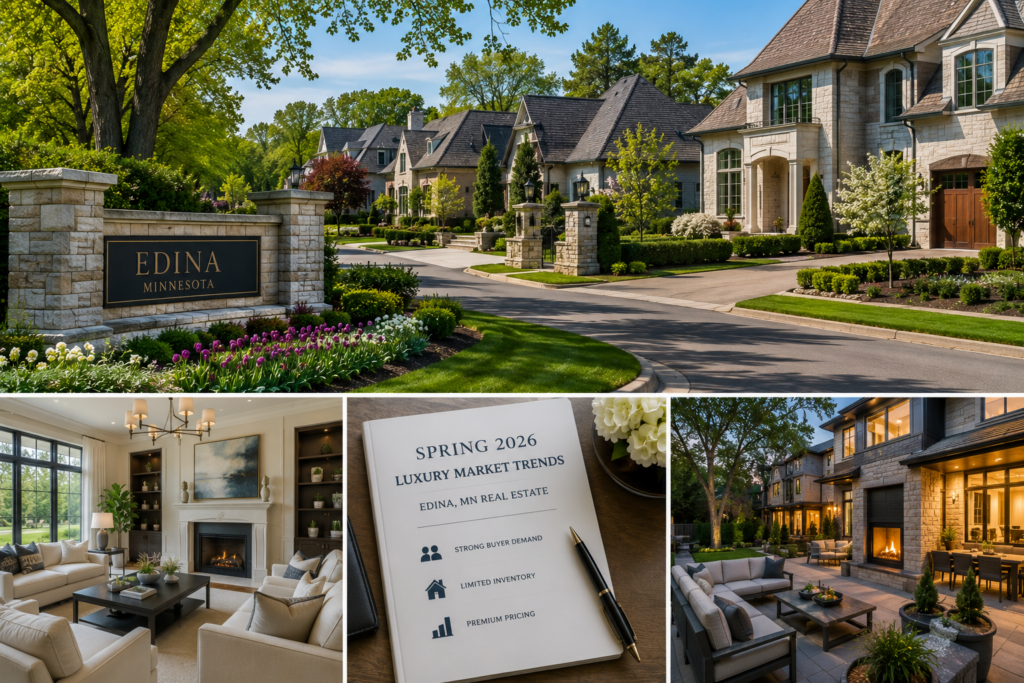
Edina Minnesota luxury homes in spring 2026 featuring stone architecture, manicured landscaping, elegant living spaces, and outdoor entertaining areas


Edina luxury real estate has long set the standard for the Twin Cities — and spring 2026 is reinforcing exactly why. As the broader Minnesota market stabilizes after years of pandemic-era volatility, Edina’s upper-bracket segment is telling its own, more nuanced story: one of selective buyers, rising expectations, and homes that either shine or sit.

If you’re buying or selling a high-end home in Edina this spring, understanding the current dynamics isn’t optional — it’s the difference between a smooth transaction and a frustrating one. Here’s what the market looks like right now, and what today’s buyers actually expect when they walk through the door.

Edina Luxury Real Estate: What the Spring 2026 Numbers Tell Us

Edina’s median home price sat at roughly $749,950 heading into spring 2026, with properties averaging around 45 days on market — slightly longer than the 40-day pace seen a year ago. That modest slowdown isn’t a red flag; it’s a recalibration. The frenzy of 2021–2022 has given way to a market where buyers are more deliberate and sellers who overprice find themselves waiting. According to Minneapolis Area Realtors, the Twin Cities market is stabilizing rather than declining — a meaningful distinction for anyone active in Edina’s upper brackets.

Across the broader Twin Cities metro, inventory is up about 5.4% year-over-year, giving buyers more choices than they’ve had in several years. Supply remains tight at roughly 2.5 months — still a seller’s market by definition — but the dynamic has shifted. Extreme bidding wars are rarer. Buyers are doing their homework. And in Edina’s upper brackets, the bar for a home to command top dollar has never been higher. Data from Redfin’s Edina luxury listings confirms that well-priced, well-presented homes continue to move, while overpriced properties are accumulating days on market.

Spring 2026 Snapshot — Edina & Twin Cities Luxury

$749,950

Edina Median List Price

45 days

Average Time on Market

2.5 mo.

Twin Cities Housing Supply

+5.4%

Year-Over-Year Inventory Gain

Sources: Movoto, Minnesota Realtors / Edina Realty, March–April 2026

Edina’s Luxury Neighborhoods: Not All Streets Are Equal

Edina isn’t one market — it’s dozens of micro-markets layered within 45 distinct neighborhoods. Spring 2026 is drawing sharp lines between them, and understanding those distinctions is essential for anyone navigating Edina luxury real estate this season.

Country Club remains the headline address, with mature tree-lined streets, walkability to 50th & France, and proximity to Lake Harriet drawing buyers willing to pay a significant premium. Storybook colonials and renovated mission-style homes here are among the most sought-after properties in the city, and well-presented listings in this neighborhood still move relatively quickly.

Rolling Green, Arden Park, and Parkwood Knolls appeal to buyers seeking larger lots, privacy, and newer construction or extensive renovation. These neighborhoods skew toward families prioritizing square footage and top-tier schools — Edina’s public school system consistently ranks among the best in Minnesota, a fact that the Minnesota Housing Finance Agency highlights as a key driver of sustained residential demand in high-performing suburban communities.

Morningside and East Edina offer a slightly lower entry point into the premium market, attracting buyers who want Edina’s cachet, school district access, and walkability without breaching the upper end of the luxury threshold. These areas have seen some of the strongest activity in early 2026 as buyers seek value within a still-competitive city.

The lesson for sellers: knowing which comparable sales apply to your home — and which neighborhoods to benchmark against — requires local expertise that goes well beyond a Zestimate. This is exactly why working with an agent who specializes in Edina is so valuable in a market like this.

What Today’s Edina Luxury Real Estate Buyers Expect

The buyer active in Edina’s $800K–$2M+ range in spring 2026 is not the same buyer from three years ago. They’re more informed, more patient, and far more selective. Years of watching frenzied markets have made them disciplined — and the slight inventory uptick has given them breathing room to act on that discipline. Here’s what they expect when they tour a home:

1

Move-In Ready Condition — No Exceptions

Today’s luxury buyers are not interested in inheriting a project. Deferred maintenance, dated kitchens, or bathrooms that haven’t seen an update in 15 years will be reflected in offers — if offers come at all. Sellers who invest in pre-listing updates, even modest ones like fresh paint, refinished hardwood, and updated fixtures, consistently see better returns than those who price high and negotiate down.

2

Kitchen & Primary Suite as Marquee Spaces

In Edina’s luxury tier, the kitchen and primary suite are the two spaces that carry a sale. Buyers expect quartz or stone countertops, custom cabinetry, premium appliances (Sub-Zero, Wolf, Thermador), and generous islands designed for gathering — not just cooking. In the primary suite, the expectation is spa-level: heated floors, a freestanding soaking tub, walk-in shower with multiple heads, and a closet system worth photographing.

3

Dedicated Work-from-Home Space

Remote and hybrid work isn’t a trend — it’s a permanent reality for a significant portion of Edina’s professional buyer pool. A dedicated home office with privacy, natural light, and solid broadband infrastructure is now a genuine checkbox, not a nice-to-have. Homes that can credibly offer this command attention; homes that lack it face pushback from buyers who work from home multiple days per week.

4

Outdoor Living That Extends the Square Footage

Minnesota’s summers are short and treasured, and luxury buyers know it. A large deck off the kitchen, a bluestone patio, built-in grilling station, or fire pit area transforms how a home feels — and how it photographs. Properties in Edina’s upper brackets that feature thoughtfully designed outdoor spaces consistently outperform comparable homes with bare or underutilized yards.

5

Smart Home Technology & Energy Efficiency

Integrated smart home systems — lighting automation, security, thermostat control, EV charging — are increasingly expected at this price point. On the efficiency side, buyers are paying attention to mechanicals: newer HVAC systems, quality windows, and updated insulation all factor into how buyers evaluate long-term value and operating cost. A home that hasn’t had a mechanical update in over a decade will prompt questions during due diligence.

6

Transparency and Story — Not Just a Listing

Today’s luxury buyers are research-savvy. They’ve already reviewed comparable sales, toured the neighborhood, and read everything available before they set foot in your home. What converts a tour into an offer is narrative: disclosures that build confidence, a list of improvements with receipts, and an agent who can speak to the home’s history and value proposition fluently. Opacity and vague listing descriptions lose buyers before they ever visit.

For Sellers: Pricing Is the Most Important Decision You’ll Make

In a normalizing market, overpricing a home is one of the costliest mistakes a seller can make — not just financially, but strategically. Homes that sit past 30–45 days begin to raise questions in buyers’ minds, even if the answer is simply “priced too high at launch.” A price reduction signals something to the market that is very difficult to walk back.

The sellers winning this spring are those who price sharply based on actual comparable sales in their specific Edina neighborhood, prepare the home to a near-model standard, and list with professional photography, drone footage, and a marketing plan built for the luxury buyer demographic — not a generic MLS blast.

If you’re considering listing this spring, the MinnMatch seller process starts with connecting you to a vetted Edina agent who knows your specific neighborhood — not just the city — before you make any pricing or preparation decisions.

For Buyers: More Breathing Room, But Not a Buyer’s Market

If you’ve been waiting for the Edina market to cool off before buying, spring 2026 offers something closer to that than anything seen in recent years — but it’s not a buyer’s market by any traditional definition. Supply is still lean. Well-priced, well-presented homes in desirable neighborhoods like Country Club or Arden Park will still attract competitive interest.

What buyers can do differently this spring: move with more confidence on negotiation. Inspection contingencies, which were routinely waived at the height of the market, are increasingly accepted again in Edina. Sellers who’ve been on market for 3+ weeks are more open to closing cost credits and price adjustments than they were in 2022. That’s a meaningful shift that rewards buyers who are patient, pre-approved, and working with an agent who has access to off-market or pre-list opportunities.

Explore more about the Edina community or browse how MinnMatch helps buyers get matched with the right local agent — at no cost.

“Real estate is always local — and getting the advice of a professional is always in your best interest. What works in one neighborhood may not work in another.”

— Edina Realty Housing Market Forecast, 2026

The Agent Advantage in Edina Luxury Real Estate

Edina’s upper-bracket segment is a specialist’s market. The subtleties between one street and the next, the difference between a home priced for a February listing versus a May listing, the buyer pool for a $1.1M home versus a $1.6M home — these are details that matter enormously and that only come with deep, localized experience.

The right agent isn’t just someone licensed in Minnesota with Edina on their website. It’s someone who has closed deals in your specific neighborhood, understands the buyer psychology at your price point, and has relationships with other local agents that surface off-market opportunities before they ever hit Zillow.

That’s the MinnMatch model: we act as a recruiter or matchmaker, evaluating your specific situation — neighborhood, price range, timeline, goals — and connecting you with a handpicked agent from our vetted local network. It’s free for buyers and sellers, and it starts with a conversation, not a form. See how it works.

Ready to buy or sell in Edina this spring?

MinnMatch matches you with a vetted, local Edina real estate agent — at no cost to you. No algorithms, no generic referrals. Just the right agent for your specific situation.

Minnetonka MN Spring 2026: What $350K, $500K & $700K Gets You Right Now

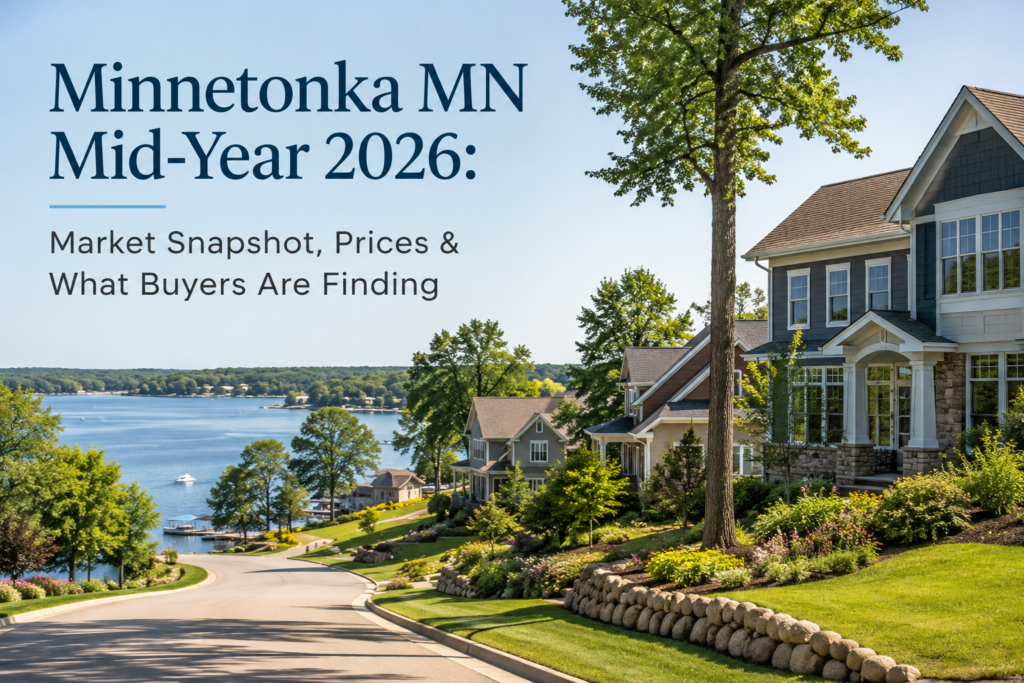
Three Minnetonka MN homes in spring representing $350K, $500K, and $700K price tiers, with lake view


Minnetonka Market Report  ·  Spring 2026

Minnetonka MN Spring 2026: What $350K, $500K & $700K Gets You Right Now

If you’re searching Minnetonka MN homes for sale in 2026, you already know this market doesn’t wait around. Strong schools, wooded lots, quick freeway access, and that proximity to Lake Minnetonka make this one of the Twin Cities’ most consistently competitive suburbs. But what does your budget actually buy right now? The average Minnetonka home is trading near $508,000, inventory is tight, and well-priced homes move fast. This guide breaks down three realistic price tiers — $350K, $500K, and $700K — so you know exactly what to expect before you start your search.

Quick Market Snapshot — Spring 2026

  • Median list price: ~$585,000 (March 2026)
  • Average sale price: ~$508,000 (up ~18.7% year-over-year)
  • Typical home value: ~$440,000
  • Median days on market: ~27 days
  • Market feel: Competitive — scoring 76 out of 100 on Redfin’s competitiveness scale
  • Price per sq ft: ~$238–$242

Sources: Redfin, Movoto, Zillow, MLS data — Spring 2026

$350K

Price Tier One

The Entry Point — and It’s Real

Minnetonka Homes for Sale Under $400K: What to Expect

At $350,000 you’re working near the bottom of Minnetonka’s active market — but that doesn’t mean you’re getting the short end of the stick. With a price per square foot around $238–$242, your budget stretches to roughly 1,400–1,500 square feet of finished living space. According to the Minnesota Housing Finance Agency, Hennepin County suburbs like Minnetonka consistently offer strong long-term value relative to statewide averages.

At this tier, expect:

  • 2–3 bedrooms, 2 bathrooms — often a rambler, twin home, or older split-level
  • A condo or townhome with resort-style HOA amenities (pools, sauna, exercise rooms) in communities like Woodhill or Brenwood II near Hwy 394
  • Older construction (1960s–1990s) with solid bones but potential for cosmetic updates — hardwood under the carpet, functional kitchens ready for a refresh
  • Lots within the Minnetonka School District — that’s the real value at this price
  • Convenient access to Hwy 7, Hwy 101, or I-494 — easy commutes in any direction

What to Watch Out For

Competition here is real. Anything priced under $400K in Minnetonka that’s move-in ready draws multiple offers fast — sometimes within the first weekend. If you’re in this range, get pre-approved, move decisively, and lean on a local agent who knows what’s coming to market before the public does. HOA fees on condos in this bracket can run $400–$600/month, so factor that into your monthly cost calculation.

MinnMatch Insight: The $350K buyer in Minnetonka is often choosing between a condo with great amenities or an older detached home with more upside. The right call depends on your lifestyle and how handy you are. A vetted local agent makes all the difference here — let us match you with one.

$500K

Price Tier Two

The Sweet Spot — Right at the Heart of the Market

Minnetonka MN Homes for Sale in the $500K Range

Half a million dollars puts you right at Minnetonka’s median — and that’s genuinely a good place to be. Your budget opens up to 2,000–2,400 square feet of finished space, often in a well-established neighborhood with mature trees, quiet cul-de-sacs, and real charm. Minneapolis Area REALTORS® data consistently shows the western suburbs, including Minnetonka, outperforming metro-wide appreciation averages at this price point.

At this tier, expect:

  • 3–4 bedrooms, 2–3 bathrooms — typically a two-story or walkout rambler on a private wooded lot
  • Updated kitchens with granite or quartz countertops, stainless steel appliances, and open layouts flowing into family rooms
  • Gas fireplaces, hardwood floors, and vaulted ceilings in move-in ready homes
  • A main-level primary suite in some ramblers — popular with buyers wanting single-floor living flexibility
  • Twin homes and townhomes with 2,300+ sq ft, vaulted ceilings, Alder cabinetry, and granite — like listings near Hwy 7 and Hwy 101
  • Proximity to Ridgedale, Whole Foods, Trader Joe’s, and major commuter routes

The Competition Reality

This is the most contested bracket in Minnetonka. Homes priced at $475K–$530K that are updated and well-located routinely see multiple offers. The 27-day median market time doesn’t tell the full story — the best homes go much faster. Sellers here have leverage, and buyers who aren’t prepared to move on Day 1 are learning that lesson the hard way this spring.

MinnMatch Insight: If you’re a buyer in the $500K range, understanding exactly what neighborhoods and streets command the best long-term value in Minnetonka is a real edge. That’s hyper-local knowledge — the kind a hand-matched agent brings to your search from day one.

$700K

Price Tier Three

The Move-Up Buy — Where Minnetonka Really Opens Up

2026 Minnetonka Homes for Sale at $700K: Executive-Level Buying

At $700,000, Minnetonka starts delivering the lifestyle it’s best known for. You’re in genuine executive-home territory — larger lots, higher-end finishes, more space, and in some cases a home that borders the Wayzata School District without the Wayzata price tag.

At this tier, expect:

  • 4–5 bedrooms, 4+ bathrooms — substantial two-story or custom homes with 3,200–4,400+ sq ft of finished living space
  • Half-acre+ private lots with mature trees, often backing to woods or wetlands — that “retreat in the city” feel Minnetonka does better than almost any other first-ring suburb
  • Fully remodeled or newer-construction homes with quartz islands, custom cabinetry, tile backsplash, spa-inspired primary baths, and three-car garages
  • Walkout lower levels with second living spaces, wet bars, or in-law suites
  • Features common in the 2024–2026 build cycle: 10-foot main-level ceilings, LVP flooring, smart home integration, oversized windows
  • Newer construction in established Minnetonka neighborhoods bordering Wayzata — without the waterfront premium
  • Award-winning Minnetonka or Wayzata school districts depending on exact location

What Sellers Expect at This Level

Homes in the $650K–$750K range in Minnetonka still move — but buyers have slightly more room to negotiate than in the mid-market. Days on market tend to run a bit longer at this tier, particularly for homes that need any updating. Sellers of truly turn-key homes still command strong prices and short timelines. If you’re a seller in this range, presentation and pricing precision matter enormously.

MinnMatch Insight: At $700K, the gap between an agent who truly knows Minnetonka’s luxury pockets — Sherwood Forest, Coventry Road, the Wayzata border neighborhoods — and one who doesn’t is measurable in dollars. The right match here isn’t optional, it’s the strategy.

Side-by-Side: What Each Budget Delivers

Feature ~$350K ~$500K ~$700K
Sq Footage (est.) 1,200–1,500 1,900–2,400 3,200–4,400+
Bedrooms / Baths 2–3 BR / 2 BA 3–4 BR / 2–3 BA 4–5 BR / 4+ BA
Home Type Condo / Twin / Older rambler Detached 2-story or walkout Executive 2-story / custom
Lot Size Small / shared Typical suburban lot ½ acre+ wooded
Kitchen Finishes Functional / dated or updated Granite/quartz, SS appliances Custom cabinetry, quartz island
Garage 1 car or underground 2 car attached 3 car attached
Finished Lower Level Varies Often yes Yes — bar, BR, rec room
School District Minnetonka ISD Minnetonka ISD Minnetonka or Wayzata ISD
Competition Level Very High Very High Moderate–High

The Bigger Picture: Spring 2026 Market Context

Minnesota’s housing market entered spring 2026 in a transitional posture. The Federal Reserve held rates steady at its most recent meeting, with tariff-driven inflation and global uncertainty keeping cuts off the table — at least for now. That means mortgage rates remain elevated, which has cooled some buyer demand at the margins but hasn’t meaningfully dented Minnetonka’s core appeal.

The statewide housing affordability index sits around 126 (March 2026), modestly above last year’s 123 — meaning purchasing power has actually improved slightly despite high rates, driven by wage growth. Minnesota Housing tracks this index as a key indicator of market accessibility statewide. But Minnetonka is above the state average in every price metric, and inventory remains constrained.

What does this mean practically? Sellers in all three price tiers still hold leverage on well-presented, well-located homes. Buyers need local market knowledge, speed, and smart strategy — not just financing approval.

Explore Nearby Communities

Minnetonka shares borders and school districts with some of the metro’s most sought-after communities. Depending on your budget and priorities, these might also be worth a look:

The Bottom Line on Minnetonka MN Homes for Sale in 2026

Minnetonka is one of the Twin Cities metro’s most durable real estate markets — not flashy, just consistently strong. Whether you’re stretching to get into the $350K range or ready to step into a $700K custom home on a private half-acre lot, you’re buying into excellent schools, mature neighborhoods, and a community with genuine staying power.

The question isn’t whether Minnetonka MN homes for sale are worth pursuing. It’s whether you have the right agent in your corner to help you win in a market that moves this fast. Browse current listings on Redfin’s Minnetonka page to get a feel for what’s active — then come back and let us match you with someone who knows every street.

Free — No Obligation

Ready to Buy or Sell in Minnetonka?

MinnMatch hand-picks a vetted, local Minnetonka agent based on your specific situation — not whoever’s next on a rotation list. It’s how real estate matchmaking should work.

Get Matched With a Minnetonka Agent →

Related Reading

Market data sourced from Redfin, Zillow, Movoto, MLS GRID, and City of Minnetonka public records — Spring 2026. All figures are approximations based on currently available data and should be independently verified. MinnMatch is a free agent-matching service for Minnesota buyers and sellers. We are not a brokerage.