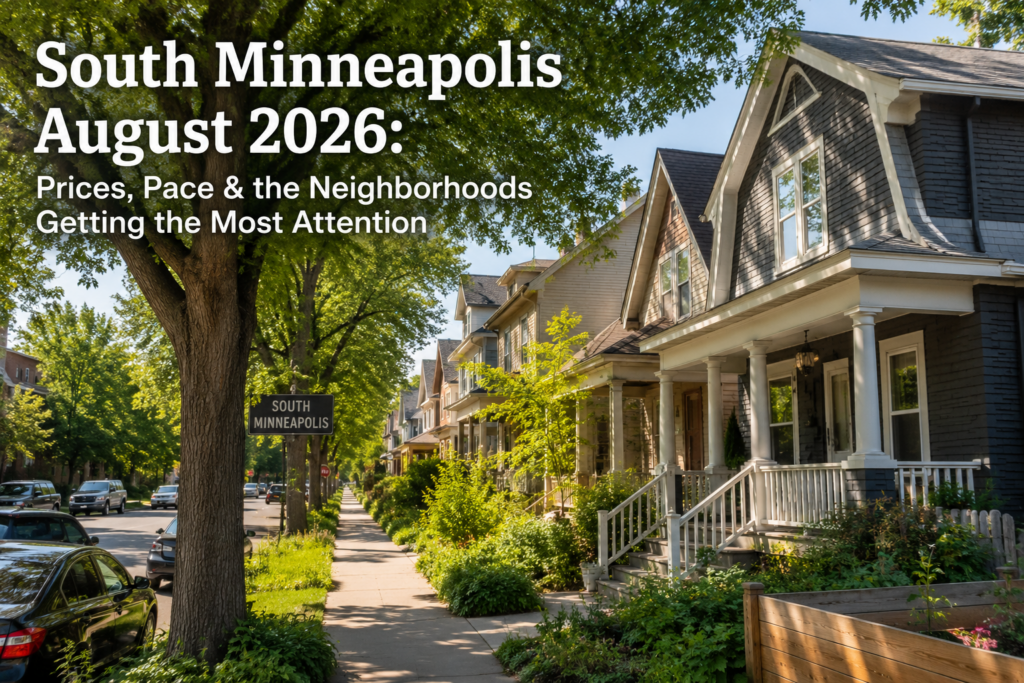
South Minneapolis Summer 2026: Urban Living, Walkable Neighborhoods & Real Estate Prices

Alt text: South Minneapolis row houses along a tree-lined walking path with the downtown Minneapolis skyline and a lake in the background, summer 2026

If you’re tracking South Minneapolis real estate summer 2026, you’re watching one of the most walkable, lake-rich corners of the Twin Cities hit its peak season. The Chain of Lakes is full of paddleboards, patios along Lake Street and 50th & France are packed by 6 p.m., and the lakefront paths are doing double duty as commuter routes and evening hangouts. It’s also, predictably, when this part of the city heats up on the market. If you’ve been circling neighborhoods like Nokomis, Longfellow, Tangletown, or Linden Hills, here’s a grounded look at what’s actually happening with prices, pace, and walkability right now.

South Minneapolis Real Estate Summer 2026: Prices by Neighborhood

“South Minneapolis” isn’t one market — it’s a patchwork of distinct pockets, and the price spread between them is significant. Based on recent neighborhood-level sales data from Redfin’s Minneapolis market reports, here’s roughly where things stand this summer:

  • Longfellow: Median sale prices have generally landed in the high $330Ks to mid $340Ks, making it one of the more accessible entry points along the river.
  • Nokomis: Recent sales have clustered in the mid-to-high $360Ks to upper $380Ks, reflecting steady demand for the lake-adjacent 1920s housing stock.
  • Tangletown: This pocket has consistently traded at a premium, with recent medians pushing into the high $700Ks to near $800K for many listings.
  • Linden Hills: The priciest of the bunch, with medians generally in the $690K–$700K range and some listings well above that for homes closest to the lake.
  • Southwest Minneapolis (broader area): Pulling these pockets together, the wider southwest submarket has shown a median in the $550Ks, up modestly year over year.

For context, the citywide Minneapolis median has been running somewhere in the $345K–$375K range this year, so South Minneapolis as a whole skews above the city average — though Longfellow and parts of Nokomis remain genuinely attainable compared to the lake-rim neighborhoods further west. You can dig into county-wide trends yourself through Minneapolis Area Realtors’ market data, which tracks pricing and inventory across the metro month to month.

Why Walkability Is Driving So Much of the Demand

Ask anyone shopping South Minneapolis real estate this summer what’s on their list, and “walkable” comes up almost every time. This part of the city was largely built before everyone assumed you’d drive everywhere, and it shows: corner coffee shops, neighborhood grocery stores, and a streetcar-era commercial grid that still works on foot or bike.

A few corridors stand out for summer livability:

  • Lake Harriet & Linden Hills: The bandshell, the walking path around the lake, and the 43rd & Upton shopping strip make this one of the most pedestrian-friendly stretches in the city.
  • 50th & France (Tangletown/Fulton edge): A genuine small-downtown feel with boutiques, restaurants, and patio seating that fills up on summer evenings.
  • Lake Nokomis: Beaches, a swimming area, and a recreational path that connects easily to the rest of the Chain of Lakes system.
  • Longfellow’s West River Parkway: Mississippi River access and proximity to Minnehaha Park give this neighborhood a different, more wooded kind of walkability.

If walkability is a top priority for you, it’s worth touring neighborhoods on foot rather than just driving through — the difference between a “walkable” listing description and an actual walkable block can be more nuanced than it looks online.

Market Pace This Summer: How Fast Are Homes Moving?

Pace varies meaningfully by neighborhood. Nokomis has generally been among the fastest-moving and most competitive pockets in the city, with homes often going under contract in under two weeks during active stretches. Longfellow and the broader southwest submarket have tended to move a bit more slowly — often three to four-plus weeks — giving buyers slightly more room to think before writing an offer.

Across Hennepin County more broadly, 2026 has brought a more balanced market than the previous few years — inventory has grown, and homes are sitting a bit longer on average than they did during the tightest pandemic-era stretches. That said, well-priced homes in desirable South Minneapolis pockets, especially anything near a lake or park, are still attracting multiple offers in many cases. The Minnesota Housing Finance Agency is also a useful resource if you’re exploring down payment assistance or first-time buyer programs that could apply to a South Minneapolis purchase.

Buying in South Minneapolis This Summer

Summer buyers are dealing with two forces at once: more overall inventory than recent years, but persistent competition for the most walkable, lake-adjacent blocks. A few practical takeaways:

  • If your budget points you toward Longfellow or parts of Nokomis, you’re likely to have more breathing room than in Linden Hills or Tangletown.
  • Get pre-approved before touring — in the hotter pockets, the timeline from listing to offer deadline can still move quickly.
  • Walk the neighborhood at different times of day. Summer evenings tell you a lot about traffic noise, patio activity, and how busy the lake paths really get.

Selling in South Minneapolis This Summer

If you own in South Minneapolis, summer is generally the strongest window of the year to list. Buyers can actually picture themselves on your block — patio furniture out, lake paths busy, trees fully leafed in. A few things matter more here than in a typical suburban listing:

  • Lead with location specifics. Distance to the lake path, the walk score to the nearest coffee shop, bike route access — these details sell South Minneapolis homes more than generic staging photos.
  • Price realistically for your micro-pocket. The difference between a Longfellow comp and a Linden Hills comp three neighborhoods away is enormous; pricing off the wrong comp set is a common and costly mistake.
  • Time showings around the lifestyle. Weekend morning showings near the lakes, when the neighborhood is at its liveliest but not overrun, tend to leave the best impression.

A local agent who actually knows the difference between a Nokomis buyer and a Tangletown buyer can make a real difference in how a listing is priced and marketed — this isn’t a market where a one-size-fits-all approach gets the best result.

Buying or selling in South Minneapolis this summer?

MinnMatch connects you with vetted local agents who know these neighborhoods block by block — from Longfellow’s river bluffs to Linden Hills’ lake paths. No algorithms, no guesswork, just the right local match.

Find Your South Minneapolis Agent

Curious how MinnMatch’s matching process actually works? Take a look at how it works — it takes just a few minutes to get paired with an agent who already knows your target neighborhood.

Edina vs. Wayzata in 2026: Which Upscale Twin Cities Suburb Is Worth the Price Tag?

Edina vs. Wayzata in 2026 — comparing luxury homes, lake lifestyle, schools, and cost of living in two upscale Twin Cities suburbs

Two names come up again and again when buyers are shopping the top tier of the Twin Cities market: Edina and Wayzata. Both are prestigious. Both have outstanding schools. Both will cost you. But they’re not the same place, and the right choice depends heavily on how you want to live. If you’re weighing these two upscale Twin Cities suburbs against each other in 2026, here’s what you actually need to know — prices, trade-offs, and all.

The Price Tag: What Homes Actually Cost in Edina vs. Wayzata

Let’s start with the number that matters most. Edina’s median home price is currently around $580,000–$630,000, depending on the month and source — with the most active segment sitting between $400,000 and $600,000. You’ll find entry-level condos near Southdale in the $180,000s and estate properties in Indian Hills pushing well past $3 million. That’s a wide range, which is part of Edina’s appeal: it has more runway for buyers at different budgets.

Wayzata runs considerably higher. Redfin data puts Wayzata’s median sale price at roughly $828,000, and price-per-square-foot figures reflect that premium — Minneapolis Area Realtors data shows Wayzata at approximately $310 per square foot compared to Edina’s $268. When you factor in the lakefront homes and large-lot estates near Lake Minnetonka, the ceiling in Wayzata is essentially unlimited.

Bottom line: if you’re comparing apples to apples in terms of square footage and condition, Wayzata will almost always cost more. The question is whether that premium is worth it to you — and that depends on what you’re buying into beyond the house itself.

Schools: Both Are Elite, but With Different Flavors

School quality is a primary driver for families choosing between these two suburbs, and you genuinely can’t go wrong with either. According to Niche’s 2026 Best School Districts in Minnesota rankings, Wayzata Public Schools ranks #1 in the Twin Cities metro, earning an A+. Edina Public School District follows closely at #3 statewide, also with an A+. Both districts have a strong college-prep culture, dedicated teaching staff, and robust extracurricular programs.

There are some nuanced differences. The Edina district has built a strong reputation around talent development programs, language immersion, and travel-based learning opportunities starting in early childhood. Wayzata schools boast a 96% graduation rate — well above state averages — and a wide range of AP and honors offerings. Wayzata High School itself is physically located in Plymouth, which surprises some buyers; the district boundary doesn’t perfectly match the city limits.

For most families, both districts will deliver an exceptional public school experience. If the small edge in district ranking matters to you, Wayzata has it — but Edina is not far behind by any meaningful measure.

Lifestyle and Location: The Real Differentiator

This is where Edina and Wayzata really diverge. Edina sits right on the border of Minneapolis — about 15 minutes to downtown — and feels like the best of suburban and urban living layered together. You get walkable retail at 50th & France, Centennial Lakes Park, a strong dining and coffee scene, and the kind of neighborhood character that comes from decades of established community. It’s practical, polished, and year-round livable.

Wayzata is a completely different vibe. It’s a small lakefront city on the north shore of Lake Minnetonka, with a compact, walkable downtown built around boutique shops, lakeside dining, and a marina. In summer, it’s magical — boat slips, waterfront promenades, and a community energy that’s hard to replicate. The trade-off is that Wayzata’s downtown appeal is seasonal, and it sits farther west of Minneapolis, adding commute time for those working in the city or eastern suburbs.

Simply put: if you want a suburb that functions efficiently year-round with quick city access, Edina wins. If lake life is central to how you relax and entertain — boating, swimming, watching sunsets over the water — Wayzata’s premium starts to make a lot more sense.

Commute and Convenience: Edina Has the Edge

Edina’s inner-ring location is genuinely one of its most underrated assets. Residents are 15 minutes from downtown Minneapolis, with easy access to major corridors like Highway 100, I-494, and France Avenue. Southdale Center, multiple grocery options, and a dense mix of services make daily errands fast and convenient regardless of the season.

Wayzata is farther west — typically 25 to 35 minutes from downtown Minneapolis depending on traffic — and its smaller size means fewer everyday conveniences within walking or short driving distance. That said, nearby Minnetonka and Plymouth fill in many of those gaps, and buyers who work in the western suburbs or from home often find the commute trade-off entirely acceptable.

If you commute into Minneapolis daily, Edina is the clearer choice. If your work is flexible or based on the west side of the metro, Wayzata becomes much more viable.

So Which One Is Worth It? Here’s How to Decide

There’s no universal right answer here — and anyone who tells you there is probably hasn’t spent much time in both communities. What we can tell you is this: Edina offers more value per dollar for buyers prioritizing proximity to Minneapolis, year-round convenience, and a slightly wider entry point into an upscale market. Its schools are elite, its neighborhoods are established, and its price appreciation has been consistent.

Wayzata commands a premium that’s justified for buyers who want lakefront access, a distinctive small-town atmosphere, and a lifestyle built around Lake Minnetonka. If the lake is a genuine priority — not just a nice-to-have — you’ll feel that difference every weekend from May through October, and the community identity will reward that investment.

According to Minnesota Housing Finance Agency data, both communities have shown long-term price resilience, making either a sound long-term investment for buyers who plan to stay. The real question isn’t which suburb is objectively better — it’s which one fits the way you actually want to live.

That’s where having a local expert in your corner makes all the difference. At MinnMatch, we connect buyers with vetted Twin Cities agents who know both of these markets from the inside — the streets, the neighborhoods, the blocks that hold value, and the ones that don’t. Whether you’re leaning toward Edina or Wayzata, we’ll match you with the right agent to make your move with confidence. Get matched for free →

June 2026 Twin Cities Housing Market Report: Summer Trends, Inventory Shifts & Neighborhood Insights

Colorful stacked toy houses with cash and a sun illustration representing the Twin Cities summer 2026 housing market

Summer is here, and the Twin Cities housing market has something to say. After years of frenzied bidding wars, shrinking inventory, and buyers waiving every contingency just to get to the closing table, June 2026 feels noticeably different. More homes are hitting the market. Prices are softening in a meaningful way. And buyers — still cautious, but increasingly empowered — are taking their time. Whether you’re buying, selling, or just keeping an eye on the market, here’s your ground-level look at what’s happening across the Twin Cities metro this summer.

The Numbers Don’t Lie: A Market in Transition

The April 2026 data from Minneapolis Area Realtors® told a story that surprised even seasoned local agents. Home sales in the metro were down more than 3% compared to April 2025, with roughly 3,800 closings recorded. The median sale price dipped 2% to $392,000 — the first meaningful price decline in years. Active listings across the metro jumped 16.1% year-over-year, reaching approximately 13,560 available homes. And the average days on market stretched to 57 days, a sign that buyers are no longer rushing.

Most striking? Closed home prices in April 2026 were 3.5% lower than the same month in 2025 — one of the steeper year-over-year declines the metro has recorded in recent memory, and a notable reversal after years of steady appreciation. The 2026 Twin Cities market report headline from Minneapolis Area Realtors said it plainly: “More Homes, More Deals, Softer Metro Prices.” That’s not a crash — but it is a clear shift. Minneapolis Area Realtors leadership described the current softness as the market “finding balance” after the COVID-era surge — less a collapse and more a correction toward normalcy.

What’s Driving the Shift? Agents Weigh In

We asked two of our top MinnMatch partner agent teams to share what they’re seeing on the ground. Their perspectives offer a rare window into the real dynamics shaping transactions right now — not just the data, but the psychology behind it.

Emily & Kelly point to pricing strategy as the single most important variable in today’s market: “Homes that are priced correctly from the start tend to outperform those that chase the market. Even in what is still considered a seller-leaning environment, we’re seeing fewer multiple-offer situations than in previous years.” When a home is strategically priced — sometimes slightly below market — it generates stronger showings, shorter days on market, and often ends up closing higher due to competitive interest. Multiple-offer situations that do develop are closing around 10% over list price on average, though results vary considerably based on condition, location, and strategy.

Buyers, they note, are exercising real caution around waiving inspections — unless a pre-listing inspection is already on file, which has become an increasingly useful tool for sellers. Negotiations overall feel more deliberate. “Both sides are more selective and intentional,” they say, “which is shaping a more balanced negotiation environment.” Winning offers today often hinge on creative terms rather than simply the highest number — a recent deal their team closed came together because they identified a specific seller priority and addressed it directly in the offer, avoiding a prolonged multiple-offer situation altogether.

Art, another veteran MinnMatch partner agent, offers a blunter read: “The market doesn’t feel different. It IS different.” He’s been watching buyers become significantly more discerning — and he’s seeing a new factor at play. “AI is increasing its presence in vetting properties. Clients now use it to help them understand, as an independent party, what a property may be worth.” His view: AI tools can give buyers a starting point, but they’re no substitute for real MLS data and a knowledgeable local agent. A Buyer’s Market Analysis from an expert in the field remains the most reliable way to understand true value.

Art also points to a broader backdrop that’s shaping buyer psychology: “While interest rates have bounced a bit to the mid-6s, gas is at a 4.5-year high. Inflation is up again. And we’re involved in another international conflict.” Even with a strong stock market and continued consumer spending, economic anxiety is real — and it’s translating to more cautious offers and longer days on market across the metro. His bottom line: “It’s a buyer’s market, and now’s a great time to buy.” To be precise, the metro’s months of supply still sits between roughly 1.8 and 2.4 months — well below the 5 to 6 months that technically defines a buyer’s market. But Art’s point holds: buyers have meaningfully more leverage today than they’ve had in years, and the window is real.

Inventory Is Up — But It’s Not Equal Everywhere

One of the defining stories of the 2026 Twin Cities housing market is the inventory surge — the most available homes in nine consecutive years. But that inventory isn’t evenly distributed, and where you’re shopping makes an enormous difference.

In the urban cores of Minneapolis and St. Paul, well-conditioned and updated homes can still generate quick attention, but buyers have become more selective about what they’ll pay a premium for. The days of “buy anything, anywhere, at any price” are firmly over. Move-in-ready homes in desirable neighborhoods continue to perform; dated properties are sitting.

In the suburbs and south metro, including communities like Eden Prairie, Prior Lake, and Edina, listings are generally selling near asking price, but median market times are extending as buyers take a more measured approach. Affordability-focused buyers are increasingly looking to areas like Plymouth and the outer-ring suburbs where value per square foot remains compelling.

Townhomes are a notable bright spot. In April 2026, townhome sales were the only property type to show annual growth — up 7.2% metro-wide — as buyers gravitate toward lower-maintenance, more affordable entry points into homeownership. Condo prices, by contrast, saw the steepest decline, falling 3.1% year-over-year to a median of $190,000. Redfin’s Minneapolis market data reflects similar mixed signals at the neighborhood level.

Summer Seasonality: Slow Start, Active Ahead

June in the Twin Cities always comes with a familiar rhythm: school ends, cabin weekends pull families north, graduation parties fill up the calendar. Real estate activity typically softens slightly in early June before picking back up through July and into August. This year is following that pattern — with one key difference. Agents are reporting that buyer activity has picked up modestly over the past few weeks, suggesting we may be heading into a more active summer than the spring data implied.

Mortgage rates remain a variable worth watching. The 30-year fixed rate has been bouncing in the mid-6% range — elevated compared to the pandemic-era lows that many buyers still remember, but stabilizing compared to the volatility of recent years. Minnesota Housing Finance Agency programs continue to offer first-time buyer assistance that can meaningfully offset those rate headwinds for qualifying households.

For sellers, the summer window remains real — but the playbook has changed. Overpriced listings that once sold anyway are now sitting. Homes that are prepped, priced correctly, and positioned well for their neighborhood are still generating strong results. Pre-listing inspections are gaining traction as a way to reduce friction and give buyers confidence, shortening the path from offer to close.

More Leverage for Buyers — What It Means for Your Move

The June 2026 Twin Cities housing market presents a genuinely interesting opportunity — particularly for buyers who’ve been sitting on the sidelines waiting for conditions to improve. More inventory means more choices. Softer prices mean more negotiating room. Longer days on market mean more time for due diligence. This isn’t a buyer’s market in the technical sense — inventory levels aren’t there yet — but buyers have more breathing room than they’ve had since before the pandemic. Sellers willing to inspect, price honestly, and negotiate in good faith are still closing deals at solid prices. Those chasing 2022-era numbers are learning the hard way that this market doesn’t reward wishful thinking.

Whether this represents a temporary cooling or the beginning of a longer market shift is, honestly, the question everyone is asking. The smart move — for buyers and sellers alike — is to work with a local agent who knows the data, knows the neighborhoods, and can help you navigate the nuance. A Buyer’s Market Analysis or Seller’s Pricing Consultation from a vetted local expert is still the most reliable tool available, regardless of what any app or algorithm tells you.

At MinnMatch, we personally match Twin Cities buyers and sellers with handpicked, vetted local agents who specialize in your specific market — at no cost to you. If you’re trying to make sense of this shifting market and want someone who actually knows the neighborhoods, the data, and the dynamics firsthand, we’d love to connect you with the right agent today.

South Minneapolis Real Estate Spring 2026: Neighborhoods, Prices & Where Buyers Are Competing

South Minneapolis real estate spring 2026 — lakeside homes, cherry blossoms, and the Minneapolis skyline

The South Minneapolis real estate market in spring 2026 is showing its characteristic energy — buyers circling open houses in Longfellow, sellers doing quick refreshes before listing in Nokomis, and “sold over ask” signs reappearing in the city’s most sought-after pockets. But this spring also looks meaningfully different from the frenzy of 2021 and 2022. If you’re buying or selling in South Minneapolis right now, understanding where competition is concentrated — and where it isn’t — can be the difference between a smart move and a costly one.

“This spring, South Minneapolis rewards the prepared buyer and the strategic seller. Knowing which neighborhoods are moving fast — and which offer room to negotiate — is the most important edge you can have.”

South Minneapolis Real Estate in Spring 2026: The Overall Picture

Minneapolis home prices in March 2026 were up 6% compared to a year ago, with a citywide median sale price of $355,000. Homes are selling in about 30 days on average — slightly faster than the 32-day pace seen a year earlier. That’s meaningful: the market isn’t stalling, but buyers are no longer stampeding either.

The data points to a stabilizing market — slightly more homes for sale, softer overall buyer demand, and prices holding steady rather than rapidly escalating. This creates a more balanced environment compared to the competitive and fast-moving years of 2021–2022. For buyers, that means more time to think. For sellers, it means pricing correctly matters more than ever. You can track current citywide trends at the Minneapolis Area Realtors market data hub.

South Minneapolis sits at the heart of this dynamic. The area south of I-94 — from the upscale Calhoun-Isles neighborhoods to the more accessible Powderhorn and Nokomis communities — spans a wide range of price points, neighborhood characters, and buyer competition levels. Here’s how the key neighborhoods stack up this spring.

Neighborhood-by-Neighborhood Breakdown

Nokomis & Minnehaha: Family-Friendly and Still Moving Fast

Nokomis continues to be one of South Minneapolis’s most desirable — and competitive — areas for families. The combination of lake access, Minnehaha Regional Park, and solid neighborhood schools draws consistent buyer interest year over year. Market data shows neighborhood medians in the low-to-mid $300,000s, with a strong supply of tidy single-family options appealing to buyers who want parks, paths, and a genuine neighborhood feel.

Well-maintained bungalows near the lake and Minnehaha Falls corridor are generating multiple offers quickly. If you’re targeting this area, expect to compete — and come in prepared with pre-approval in hand. First-time buyers who find a move-in-ready home in Nokomis under $350,000 should move decisively.

Longfellow: The Greenway Effect on Spring 2026 Home Prices

The Longfellow community — encompassing Seward, Cooper, Howe, and Hiawatha — offers a range of housing options from classic bungalows to modern updates, with home prices typically running from the mid-$200,000s to over $600,000. That wide range reflects the neighborhood’s diversity: some blocks command premiums for riverfront proximity or extensive updates, while others remain accessible to value-focused buyers.

Residents enjoy 5.7 miles of walking and bike paths on the Midtown Greenway, which runs through Longfellow and Seward — a significant lifestyle draw that supports strong demand from young professionals and active households. Homes within easy walking distance of the Greenway tend to list and close faster than those farther from the trail network.

For sellers in Longfellow, spring 2026 is a good moment to list — especially if your home has been recently updated. Buyers in this area are lifestyle-motivated and will pay for turnkey.

Powderhorn: Best Value in South Minneapolis Real Estate Right Now

Powderhorn Park is considered one of the value-focused options in Minneapolis, with reported medians ranging from the low $200,000s to the high $300,000s depending on sub-area and property condition. That makes it one of the few remaining areas of South Minneapolis where buyers — especially first-timers — can get into a detached single-family home without stretching their budget to the limit.

Investor activity has picked up in pockets of Powderhorn, reflecting growing confidence in the area’s long-term trajectory. For owner-occupants, this is a neighborhood worth watching carefully: prices are still accessible today, but the gap between Powderhorn and adjacent Nokomis and Longfellow has been narrowing. Buyers open to some cosmetic work can find the strongest value per square foot in South Minneapolis here.

Seward: Walkable, Transit-Connected, and Consistently In Demand

Seward sits just east of the Greenway, close to the University of Minnesota corridor and the Mississippi River gorge. It has a mix of older homes with strong transit options, including proximity to the light rail Green Line. Median prices in Seward typically land in the mid-to-upper $300,000s, with low vacancy and steady demand year-round.

Seward draws a broad mix of buyers: young professionals who want walkability, families who value proximity to the river gorge trails, and buyers who prioritize transit access. It’s one of the more reliably liquid neighborhoods in South Minneapolis — meaning homes sell consistently regardless of broader market conditions. Don’t expect many deals here; the market is efficient and buyers know what they’re getting.

Standish & Corcoran: The Spring 2026 Sleeper Neighborhoods

Standish and Corcoran are two adjacent South Minneapolis neighborhoods drawing significant buyer attention right now. They sit between the more premium Nokomis area to the south and busier corridors to the north, offering a price point — typically mid-$200,000s to mid-$300,000s — that has become increasingly attractive as values in surrounding neighborhoods have risen.

For buyers who’ve been priced out of Nokomis or Longfellow’s most desirable blocks, Standish and Corcoran are worth serious consideration this spring. The housing stock — predominantly craftsman bungalows and two-stories from the early-to-mid 20th century — is the same character buyers love in pricier South Minneapolis neighborhoods, often at a meaningful discount. That equation is unlikely to hold indefinitely.

Spring 2026 Price Snapshot: South Minneapolis Neighborhoods

Neighborhood Typical Price Range Buyer Competition Best For
Nokomis / Minnehaha Low–mid $300,000s High — moves fast Families, lake-lifestyle buyers
Longfellow Mid $200,000s–$600,000+ Moderate–high Greenway lifestyle, active households
Seward Mid–upper $300,000s Consistent, efficient Young professionals, transit users
Powderhorn Low $200,000s–high $300,000s Moderate Value-focused buyers, first-timers
Standish & Corcoran Mid $200,000s–mid $300,000s Growing Value seekers, long-term upside

Where Buyers Are Competing in South Minneapolis This Spring

Not every listing in South Minneapolis is drawing a crowd. But certain types of properties — in certain locations — are seeing multiple offers and quick closings. Here’s what’s generating competition in the spring 2026 market:

1

Move-in ready homes under $375,000

Turnkey homes in this price range consistently attract the most buyers across South Minneapolis neighborhoods. With mortgage rates still elevated, buyers are hesitant to take on major renovation costs on top of purchase price. Clean, updated, well-maintained homes sell quickly — often above list price.

2

Homes within walking distance of parks and trails

Proximity to Lake Nokomis, Minnehaha Falls, Minnehaha Creek, and the Midtown Greenway commands a premium. With limited inventory across Minneapolis this spring, well-located homes with lifestyle amenities are being absorbed quickly by the buyer pool.

3

Classic bungalows and craftsman homes with original character

South Minneapolis’s early-20th-century housing stock — original woodwork, built-ins, arched doorways — remains deeply appealing. Homes that preserve that character while offering updated kitchens or baths are among the most competed-for properties in the area.

4

Well-priced entry-level homes

The entry-level tier of South Minneapolis remains competitive despite the broader market cooling. Homes that are priced right in desirable areas are still drawing multiple looks — and sellers who price accurately are closing faster and with fewer concessions. For context on statewide affordability programs that may benefit first-time buyers, visit Minnesota Housing.

What Sellers Need to Know This Spring

Spring 2026 is still a good time to sell in South Minneapolis — but the days of listing at an inflated price and waiting for offers to roll in are behind us. The market rewards sellers who price accurately from day one, present their homes well, and work with an agent who genuinely knows the neighborhood.

Key considerations for sellers this spring:

  • Pricing is everything. Strategy matters more than ever in this environment. Homes that come in overpriced are sitting longer and often requiring price reductions — which signals weakness to buyers. Price to the comparable sales, not your wishlist.
  • First impressions drive offers. Buyers in South Minneapolis are lifestyle buyers. Curb appeal, fresh landscaping, and a clean interior are not optional in spring — they’re table stakes. Simple updates pay outsized dividends.
  • Neighborhood expertise matters. A price that’s right for Nokomis may be wrong for two miles north. You need an agent who can make that distinction confidently and back it up with data.
  • Timing the market is less important than timing your listing. Spring is South Minneapolis’s strongest buyer season. If you’re ready, don’t wait.

What Buyers Need to Know This Spring

The pressure to make an offer within hours has dissipated, replaced by a market that rewards thorough due diligence. That’s genuinely good news for buyers who’ve been frustrated by the past few years. But it doesn’t mean you can afford to be passive — especially in South Minneapolis, where well-priced, well-located homes are still moving quickly.

Practical advice for buyers this spring:

  • Get pre-approved before you start touring. In competitive pockets, sellers are still receiving multiple offers. Not having pre-approval ready means you can’t move when the right home hits.
  • Define your non-negotiables by neighborhood, not just features. Decide whether you’re a Nokomis buyer, a Longfellow buyer, or open to emerging areas like Standish. Your agent can focus and advocate much more effectively with that clarity.
  • Don’t dismiss fixer-uppers in premium locations. With competition for turnkey homes stiff, a home that needs cosmetic work in a top-tier block can be a smart play — especially if you’re patient and handy.
  • Understand what’s driving the market in your target neighborhood. The dynamics in Powderhorn are not the same as in Nokomis. A locally knowledgeable agent isn’t just helpful — it’s the single biggest advantage you can have. You can also explore current listings and recent sales data for South Minneapolis on Redfin.

Ready to Buy or Sell in South Minneapolis?

MinnMatch connects buyers and sellers with handpicked, vetted local real estate agents who specialize in South Minneapolis neighborhoods. Our matching process is free, human-powered, and built around your specific situation — not an algorithm. Whether you’re navigating Nokomis competition or figuring out if Powderhorn is right for you, we’ll connect you with an agent who genuinely knows the area.

Find Your South Minneapolis Agent →

The Bottom Line

South Minneapolis real estate in spring 2026 is not the frenzied seller’s market of a few years ago — and that’s actually a healthy thing. Prices are up modestly, inventory is slightly improved, and both buyers and sellers have more room to make deliberate decisions. But “more balanced” doesn’t mean “easy.” The best homes in the best spots still move fast, and the buyers and sellers who succeed are the ones who show up prepared, priced right, and matched with an agent who knows these blocks as well as they know the data.

If you’re planning a move in South Minneapolis this spring, don’t go it alone. See how MinnMatch works — and let us connect you with a local agent who can give you the edge you need.

Buyer’s Market or Seller’s Market? How to Read the Twin Cities Housing Market in 2026

A real estate agent showing the MinnMatch website to a couple on a suburban Twin Cities street

Buyer’s Market or Seller’s Market? How to Read the Twin Cities Housing Market in 2026

The Twin Cities housing market in 2026 is sending mixed signals — and if you’re trying to figure out whether it favors buyers or sellers right now, you’re asking exactly the right question. The answer is nuanced, and understanding the data can make a real difference whether you’re buying, selling, or simply deciding when to make your move.


The Twin Cities Housing Market in 2026: It’s Complicated — But Shifting

The market doesn’t fit neatly into either bucket. After years of an aggressive seller’s market where homes flew off the market in days, the region is experiencing what many local real estate professionals are calling a “great housing reset” — a meaningful transition toward more balanced conditions, even if we haven’t fully arrived there yet. According to the Minneapolis Area REALTORS®, early 2026 data confirms the shift is real and measurable.

Here’s what the latest data tells us:

📊 March 2026 Twin Cities Market Snapshot

  • Median Sales Price~$380,000 (flat YoY)
  • Inventory8,524 units (+3.3%)
  • New Listings6,182 (+1.9%)
  • Pending Sales4,126 (−2.9%)
  • Days on Market62 days (+5.1%)
  • Months Supply2.3 months (+4.5%)

What those numbers add up to: more breathing room for buyers — but sellers still hold an edge in most price ranges.


Why the 2026 Housing Market Still Leans Seller — Just Not Overwhelmingly So

A balanced market typically requires about five to six months of housing supply. At 2.3 months, the Twin Cities is still firmly in seller-favored territory — just far less intensely than it was in 2021–2022, when homes received dozens of offers within hours of listing.

Prices reflect this. The median sales price for single-family detached homes has actually increased 2.9% year-over-year to $429,000, even as overall market conditions soften. Homes that are priced correctly and well-presented are still selling — buyers are simply less willing to waive contingencies or dramatically overpay than they were a few years ago.

The $350,001–$500,000 range remains the sweet spot, moving in a median of just 41 days. At the other end, homes priced below $120,000 are sitting considerably longer — a median of 102 days. For statewide context, the Minnesota Housing Finance Agency tracks affordability trends that help explain why lower price points are lingering.


What’s Changed: The Buyer’s Leverage Is Growing

While sellers maintain the upper hand overall, 2026 has introduced real opportunities for buyers that simply didn’t exist in recent years:

More Time to Decide

With days on market rising and pending sales declining, buyers are no longer forced to write offers the same day they tour a home. You can schedule a proper inspection, compare multiple properties, and make a thoughtful decision without a five-offer bidding war breathing down your neck.

Seller Incentives Are Back

Something that disappeared entirely during the pandemic market frenzy has quietly returned: seller concessions. Builders and motivated sellers are increasingly offering incentives — rate buydowns, closing cost credits, and home warranties — to attract buyers in a more competitive listing environment.

Inventory Has Expanded

New listings are up across the metro, with Ramsey County seeing an 11.3% inventory increase. While supply remains tight, buyers in 2026 have meaningfully more options than they did in 2023 or 2024. That translates to less desperation and more informed decision-making. You can track active listings in real time on Redfin’s Minneapolis market page.


Not All Twin Cities Neighborhoods Are Equal

The Twin Cities metro is large and diverse — and market conditions vary significantly by area. Here’s a general read on how different submarkets are behaving in 2026:

🏙 Minneapolis & St. Paul

Well-maintained homes still generate quick interest — but condition and upgrades matter more than ever. Buyers have options and will pass on homes needing significant work unless the price reflects it.

🏡 South Metro & Apple Valley

Listings generally sell near asking price, but median market times are rising. Sellers need to be realistic; above-list offers are no longer automatic.

🌲 Suburban & Exurban Areas

Buyers are increasingly searching beyond city limits for value and space. Suburban markets are seeing a notable uptick as affordability takes priority over proximity.

📍 Hennepin vs. Ramsey

Hennepin held steady (+0.4% closed sales). Ramsey dipped slightly (−1.9%) but gained the most new inventory (+11.3%). Buyers didn’t disappear — they got selective.


What the Twin Cities Housing Market Means if You’re Buying in 2026

This is a strategic window — not a buyer’s market in the traditional sense, but one where thoughtful, well-prepared buyers have real power that simply wasn’t available a few years ago.

  • Get pre-approved before you start looking.
    Sellers still want certainty, and a strong pre-approval letter signals you’re serious.
  • 🔍
    Don’t skip the inspection.
    Unlike 2021, you no longer have to choose between an inspection and winning a bid. Use it.
  • 📊
    Negotiate with data, not emotion.
    With longer days on market, you have leverage to ask for concessions, repairs, or price reductions — especially on homes that have been sitting.
  • 🤝
    Work with a local expert.
    Neighborhood-level knowledge matters enormously when market conditions vary so widely across the metro.


What the Twin Cities Housing Market Means if You’re Selling in 2026

The market is still in your favor — but the margin for error has narrowed. Overpricing a home in 2026 doesn’t just cost you a few days; it can mean sitting for weeks while buyers scroll past your listing.

  • 💲
    Price it right from day one.
    Buyers are doing their homework and won’t overpay. A well-priced home still sells quickly; an overpriced one lingers.
  • 📸
    Presentation matters more than it used to.
    With more inventory to compare against, buyers are discerning. Professional photos, staging, and addressing obvious repairs are table stakes now.
  • 📅
    Consider strategic timing.
    Late spring and early summer remain peak listing season in Minnesota. Preparing early — not waiting until May — gives you a competitive edge.
  • 🔄
    Be open to negotiation.
    A buyer asking for closing cost assistance or a home warranty isn’t necessarily a bad offer — it may be the best offer you’ll get.

The Bottom Line for Twin Cities Homeowners and Buyers

The Twin Cities housing market in 2026 is best described as a soft seller’s market in transition. Prices are stable, inventory is slowly growing, and buyers are gaining leverage they haven’t had in years — but supply is still tight enough that well-prepared sellers with the right pricing strategy continue to do well.

Whether you’re buying or selling, the biggest mistake you can make right now is treating this market like it was in 2021 or assuming it’s flipped entirely to buyer-friendly territory. The truth is in between — and navigating that nuance is exactly where having the right agent makes all the difference.

Not sure which agent is right for your situation?That’s exactly what MinnMatch does. We match Twin Cities buyers and sellers with vetted, local real estate agents — hand-picked based on your neighborhood, price range, and goals. No algorithms. No guesswork. Just the right agent for you, at no cost.

Find Your Agent at MinnMatch.com →

Buying a Home in Minnesota

Two-story red craftsman-style home with white trim, dark shutters, a covered front porch, and a dormer window, representing a typical single-family home for sale in Minnesota

A Clear, Practical Guide for Minnesota Buyers Backed by Local Expertise

Buying a home in Minnesota is exciting, but it can also feel complex. From understanding local market conditions to navigating inspections and negotiations, small details can make a meaningful difference in outcomes.

This guide gives Minnesota buyers a clear, plain-language overview of the home buying process so you can make informed decisions and work confidently with the right local real estate professional.


1. Understanding the Minnesota Housing Market

Minnesota real estate is highly local. Market conditions can vary widely between the Twin Cities, first-ring suburbs, outer suburbs, and lake communities.

  • Inventory levels and available homes
  • Interest rates and affordability
  • Seasonal patterns, especially spring and early summer competition
  • Local demand by neighborhood and school district

In many Twin Cities communities, well-priced homes can still receive multiple offers. In others, buyers may have more room to negotiate. Understanding the dynamics of your specific area is critical.

This is where knowledgeable local guidance becomes invaluable.


2. Getting Financially Prepared

Before touring homes, it is important to understand your financial position.

  • Review your credit and monthly budget
  • Get pre-approved with a reputable lender
  • Understand down payment and closing cost requirements

Minnesota buyers often work with local mortgage professionals who understand state programs, property tax structures, and appraisal norms.

A strong pre-approval strengthens your offer and signals seriousness to sellers.


3. Choosing the Right Location

Minnesota offers a wide range of living environments, from urban neighborhoods to suburban communities and lake-area homes.

  • Commute and transportation options
  • Schools and amenities
  • Property taxes and assessments
  • Long-term resale potential
  • Lifestyle fit such as walkability or lake access

What works in Minneapolis may not apply in Edina, Wayzata, Prior Lake, or Lake Minnetonka. Local pricing patterns and buyer expectations differ by community.


4. Touring Homes and Evaluating Properties

  • Overall condition and maintenance
  • Layout and functionality
  • Age of major systems such as roof and HVAC
  • Traffic patterns and lot features

In Minnesota, seasonal conditions matter. Snow and frozen ground can conceal issues, making professional inspections especially important.


5. Making an Offer in Minnesota

A Minnesota purchase agreement typically includes:

  • Purchase price
  • Earnest money
  • Inspection and financing contingencies
  • Closing date
  • Included personal property
  • Additional terms or addenda

In competitive situations, strategy matters. Local insight can guide escalation clauses, inspection timing, and non-price terms.


6. Inspections and Due Diligence

  • General home inspection
  • Radon testing, very common in Minnesota
  • Sewer line inspection
  • Well and septic inspections where applicable

Based on results, buyers may proceed as-is, request repairs, renegotiate terms, or withdraw if contingencies allow.


7. Appraisal and Final Financing

The lender orders an appraisal to confirm value. If it meets expectations, the transaction proceeds. If it comes in low, additional negotiation may be required.

The lender completes underwriting before issuing clear-to-close approval.


8. Closing on Your Minnesota Home

  • Final walkthrough
  • Signing documents with title company or attorney
  • Funding down payment and closing costs
  • Recording of the deed

Once completed, the home is officially yours.


Why Local Guidance Matters

  • Neighborhood-specific pricing
  • Competitive offer strategy
  • Inspection norms
  • Negotiation expectations
  • Avoiding costly missteps

Online information is helpful, but buying a home is rarely one-size-fits-all.


How MinnMatch Helps

MinnMatch connects Minnesota buyers with trusted, experienced local real estate professionals through a thoughtful, human-reviewed matching process. There is no cost and no pressure. Just clear guidance and a carefully matched local expert when you are ready.

Get Matched