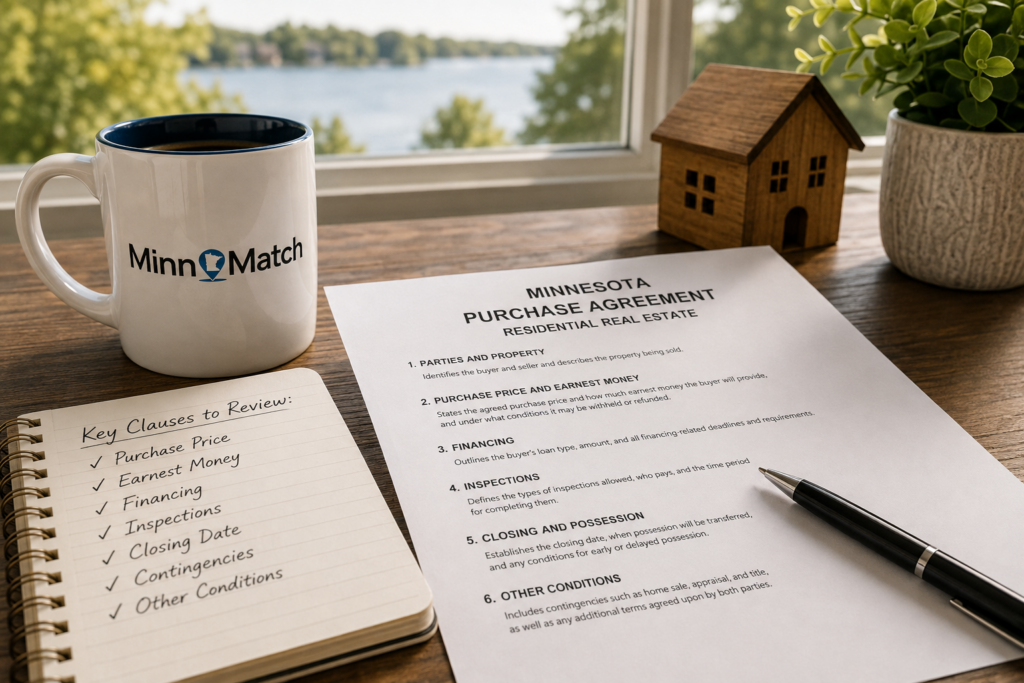
By the time a Twin Cities buyer sits down to sign, the Minnesota purchase agreement has already done most of the heavy lifting — it’s the document that turns a verbal “we have a deal” into a legally binding contract. But it’s also dense, full of checkboxes and legal shorthand, and easy to skim past when you’re excited about a house. Understanding what you’re actually agreeing to, clause by clause, is one of the best ways to avoid surprises between your accepted offer and closing day. Here’s what’s actually in a standard Minnesota purchase agreement in 2026, and why each section matters more than it looks.
What Your Purchase Agreement Says About Price & Financing
The top of the agreement covers the basics — purchase price, the legal property description, and the closing date — but the earnest money section deserves more attention than most buyers give it. Earnest money is the deposit you put down to show you’re serious, typically held in a broker’s trust account until closing. The agreement spells out the amount, where it’s held, and — critically — the conditions under which you get it back if the deal falls apart. If a contingency in your favor isn’t met and you cancel properly, your earnest money should be returned. If you back out for a reason the contract doesn’t cover, you could forfeit it. This section also lays out your financing terms: loan type, down payment amount, and the interest rate range you’re qualifying for, which protects you if rates move before your loan is locked. If you’re using a first-time buyer program or down payment assistance, make sure those details match what’s on file with your lender — Minnesota Housing is a good source for verifying program specifics before you sign.
Contingencies: The Escape Hatches Every Buyer Needs
Contingencies are the conditions that must be satisfied for the sale to move forward, and they’re the part of a Minnesota purchase agreement that actually protects you as a buyer. The most common ones are the financing contingency (the deal is off if your loan isn’t approved), the inspection contingency (you can renegotiate or walk away based on what an inspector finds), and the appraisal contingency (protection if the home appraises for less than your offer price). Some agreements also include a sale contingency, which makes your purchase dependent on selling your current home first — useful, but it can make your offer less competitive in a fast-moving market. Each contingency comes with a deadline written directly into the agreement, so missing a date can mean losing the protection entirely, even if you intended to use it. If a term like “appraisal gap” or “escalation clause” shows up alongside your contingencies, Redfin’s glossary of real estate terms is a quick way to double-check what you’re agreeing to.
Seller Disclosures and What Minnesota Law Requires
Minnesota law requires sellers to complete a written disclosure statement in good faith before a purchase agreement is signed, covering known material defects — things like a leaky roof, past water intrusion, or an aging furnace. Sellers also have to disclose specifics around private wells and septic or sewage systems, which matters a lot in the suburban and lake communities around the Twin Cities where municipal sewer isn’t a given. If the home was built before 1978, federal law adds a lead-based paint disclosure requirement on top of the state rules. Read this document closely and cross-reference it against what your inspector finds — a mismatch between what was disclosed and what’s actually there can be grounds to renegotiate. You can review the state’s disclosure framework directly through the Minneapolis Area Realtors resource library if you want the fuller legal picture.
Closing Date, Possession & What’s Actually Included
It sounds simple, but confusion over the closing date and possession date causes real friction. Closing is when ownership legally transfers; possession is when you actually get the keys — and in Minnesota, those aren’t always the same day. Some sellers negotiate a short post-closing occupancy period to give themselves time to move out, which should be spelled out with a per-diem rent amount if it runs long. Just as important is the fixtures and personal property section, which lists exactly what stays with the home — appliances, window treatments, that wall-mounted TV bracket — and what the seller plans to take. If you fell in love with the light fixtures during a showing, don’t assume; get them written into the agreement.
Default Clauses: What Happens If Something Falls Apart
Near the bottom of most Minnesota purchase agreements sits the default and remedies section — the part nobody wants to think about but everyone should read. It outlines what happens if either side fails to follow through: whether the non-defaulting party can pursue specific performance (forcing the sale to close), seek damages, or simply cancel and keep or recover the earnest money. There’s often an arbitration or mediation clause here too, which can affect how a dispute gets resolved if one comes up. None of this is meant to scare you off — most Twin Cities transactions close without incident — but knowing what recourse exists on both sides gives you a clearer picture of what you’re actually signing.
A purchase agreement is negotiable up until both parties sign, and a good buyer’s agent will walk you through every clause before you’re staring at a deadline. That kind of hands-on guidance is exactly what MinnMatch is built around — if you’re preparing to make an offer and want an agent who’ll actually explain what you’re signing, find your match with MinnMatch and get paired with a vetted local agent for free. Curious how the matching process works first? Take a look at how MinnMatch works.