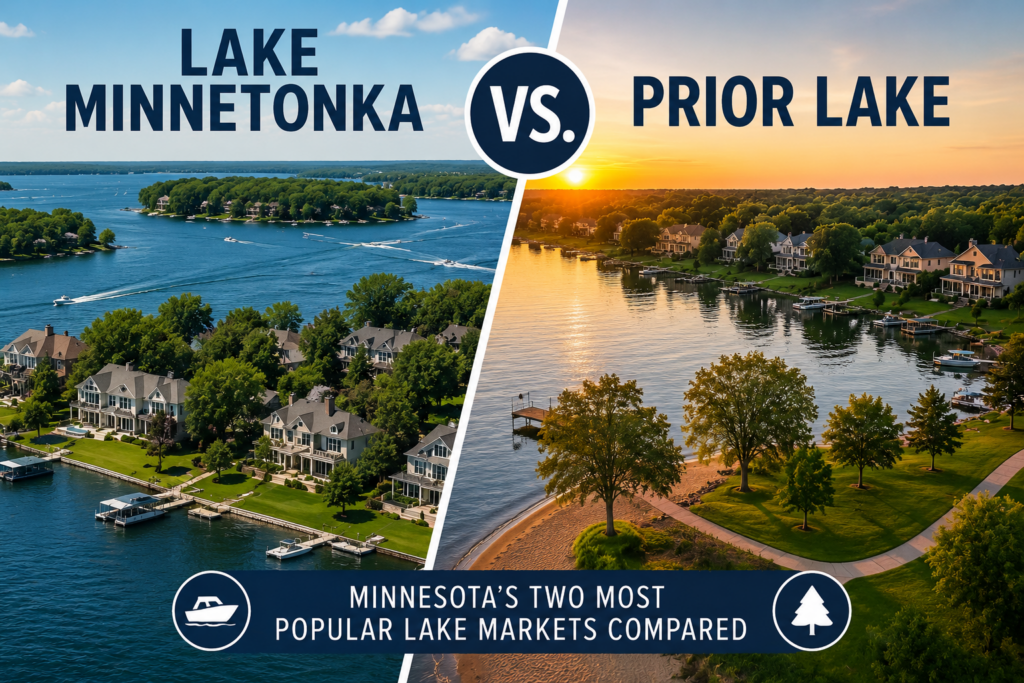
If you’re searching for a lake home in the Twin Cities metro, two names come up again and again: Lake Minnetonka and Prior Lake. Both offer genuine waterfront living, strong community identities, and real estate markets that consistently outperform their landlocked neighbors. But Lake Minnetonka vs. Prior Lake real estate is not an apples-to-apples comparison — and understanding the differences could save you months of searching in the wrong direction.
This guide breaks down both markets across price, lifestyle, buyer profile, and long-term value so you can make a more informed decision — or hand this article to the agent who’s helping you make it.
Not sure which market is right for you? MinnMatch can match you with a vetted local agent who knows both lakes inside and out.
Lake Minnetonka vs. Prior Lake: The Basics
Before comparing the real estate, it helps to understand what you’re actually buying access to.
Lake Minnetonka is the headline act of Minnesota metro lake living. Spanning roughly 14,000 acres across 14 communities in Hennepin County, it’s the largest and most storied lake in the Twin Cities area — a destination that has defined western-suburb prestige for more than a century. Wayzata, Excelsior, Orono, and Deephaven are among the communities that ring its 125 miles of shoreline. The lake sits approximately 12 miles west of downtown Minneapolis.
Prior Lake — technically two connected lakes, Upper and Lower Prior Lake — covers about 1,340 combined acres in Scott County, roughly 20 miles southwest of downtown Minneapolis. It’s smaller in scale but punches well above its size in desirability. The city of Prior Lake has grown significantly in recent decades and is now home to approximately 27,000 residents who have built their community identity around water access, outdoor recreation, and quality schools.
In short: Lake Minnetonka is the prestige play. Prior Lake is the accessible-but-still-aspirational alternative. Both are legitimate lake markets — but they attract meaningfully different buyers.
Price Comparison: What Does a Lake Home Actually Cost?
Lake Minnetonka
Lake Minnetonka is one of the most expensive residential real estate markets in Minnesota, full stop. As of May 2026, there are roughly 218 active waterfront listings on the lake with an average asking price of approximately $2.8 million — and a price per square foot hovering around $545. Typical lakeshore listings average about 4,500 square feet with nearly four bedrooms and four bathrooms.
The range is wide. Entry-level access to Lake Minnetonka shoreline can start around $1 million for a smaller or dated cottage, while high-end estates in Orono or Wayzata regularly list at $10 million and above. At the extreme end, an extraordinary off-market estate was listed at $55 million — more than 29,000 square feet with a wine cave, movie theater, bowling lanes, and multiple docks.
For buyers who want proximity to the lake but not a direct shoreline price tag, the broader communities surrounding the lake — the city of Minnetonka, Wayzata, Excelsior — offer more accessible entry points. The city of Minnetonka’s overall median home value sits around $521,000 as of 2025, reflecting the mix of lakefront luxury and inland residential neighborhoods.
Prior Lake
Prior Lake offers a more accessible price spectrum while still delivering real waterfront value. The citywide median home value is approximately $526,000 as of early 2026 — remarkably close to broader Minnetonka — but the waterfront premium is more moderate.
As of May 2026, there are 57 active lake property listings in Prior Lake with an average listing price of roughly $1.65 million and a price per square foot of $383 — meaningfully below Lake Minnetonka’s $545. The most expensive waterfront listing sits at $17.9 million, while more modest lake-access properties can be found for as little as $135,000 (typically association-access or smaller lots).
For buyers who want lakefront living in the $600,000–$1.2 million range, Prior Lake offers options that simply don’t exist on Lake Minnetonka. That’s a significant differentiator for move-up buyers, growing families, and buyers relocating from out of state.
Side-by-Side Snapshot
| Metric | Lake Minnetonka | Prior Lake |
|---|---|---|
| Lake size | ~14,000 acres | ~1,340 acres |
| Avg. waterfront listing price | ~$2.8M (May 2026) | ~$1.65M (May 2026) |
| Avg. price per sq ft (waterfront) | ~$545 | ~$383 |
| Citywide median home value | ~$521,000 (Minnetonka city) | ~$526,000 |
| Distance to Minneapolis | ~12 miles west | ~20 miles southwest |
| School district(s) | Minnetonka, Wayzata, Orono, Mound Westonka | Prior Lake-Savage Area Schools |
| Communities on the lake | 14 | 1 (city of Prior Lake) |
Lifestyle: Two Very Different Lake Vibes
Lake Minnetonka: Established Elegance, Walkable Villages, Deep Roots
Lake Minnetonka has a character that’s hard to replicate — it has been Minnesota’s most coveted lake address for well over a century. The 14 communities surrounding it each have distinct identities. Wayzata is boutique-chic with a vibrant downtown, waterfront dining, and a Metra train connection to Minneapolis. Excelsior has the feel of a classic Midwestern lake town, with independent shops, a public beach, and summer street festivals. Orono and Greenwood offer wooded privacy and estate-scale properties. Deephaven sits somewhere in between — elegantly residential, less commercial, deeply quiet.
The lake itself supports year-round recreation. In summer it’s a full destination: boating, paddleboarding, sailing regattas, and fishing tournaments. In winter, ice fishing shanties dot the bays and the lake is a fixture of the local snowmobile culture. The social fabric around Lake Minnetonka is dense — yacht clubs, community events in Excelsior, the iconic Lord Fletcher’s on the water — and buyers are often as drawn to that community energy as they are to the shoreline itself.
Proximity to Minneapolis is a genuine selling point, too. Most lake towns are a 20–30 minute drive, making it feasible to live a lake-first life without sacrificing urban access.
Prior Lake: Active, Unpretentious, Growing Fast
Prior Lake has a different energy — less legacy prestige, more lived-in vitality. The city has grown considerably over the past two decades, and that growth has attracted a younger demographic of families who want authentic lake access without the stratospheric price tag of the west metro lakes.
Upper Prior Lake tends to attract buyers who want calmer waters, more privacy, and a settled residential character. Lower Prior Lake, with its more open water, draws the boating and water sports crowd. Both are consistently among the most popular recreational lakes in the south metro. The lake hosts strong fishing — walleye, northern pike, largemouth bass, and crappie — and the broader community includes 51 parks, extensive trail networks, and the prestigious Wilds Golf Club adjacent to the lake’s southern neighborhoods.
The Prior Lake Association has worked since 1946 to preserve and promote the water and shoreline, and the city actively monitors water quality and manages aquatic invasive species — a sign that the community takes its lake asset seriously for the long term.
Scott County’s consistent growth has made Prior Lake one of the fastest-growing communities in Minnesota, and the Prior Lake-Savage Area Schools draw strong reviews from families considering the area. For buyers who are prioritizing school quality alongside lake access, Prior Lake checks both boxes at a more attainable price point.
Which Lake Market Is Right for You? Buyer Profiles
Both Lake Minnetonka and Prior Lake attract lake-lifestyle buyers — but the specific buyer profiles diverge in meaningful ways. Here’s a practical breakdown.
Lake Minnetonka Is Typically the Better Fit If:
- Your budget for waterfront is $1.5 million or above, and ideally $2–5 million for a move-in-ready lakeshore property.
- You want walkable access to vibrant communities like Wayzata or Excelsior — coffee shops, restaurants, boutiques, right from the boat or the sidewalk.
- You’re drawn to the prestige and legacy of the address — Lake Minnetonka is a known quantity nationwide and carries status that Prior Lake simply doesn’t match.
- You work in Minneapolis and want a west-metro commute or access to Wayzata’s Metra rail stop.
- You prioritize a robust social lake culture — yacht clubs, regattas, and a dense community of other lake residents who share the lifestyle.
- You’re looking at this as a long-term luxury investment and want the brand-name lake with historical price resilience.
Prior Lake Is Typically the Better Fit If:
- You want genuine waterfront access with a budget in the $500,000–$1.5 million range — a segment where Lake Minnetonka options are extremely limited.
- You have school-age children and want a strong, cohesive school district (Prior Lake-Savage) paired with a family-oriented community culture.
- You prefer a more intimate lake — fewer commercial operators, calmer on summer weekends, a more neighborhood-oriented feel.
- You work in the south metro (Shakopee, Eden Prairie, Burnsville) and want to minimize commute time while maximizing lifestyle.
- You’re a first-time lake-home buyer and want to learn the lifestyle before potentially stepping up to a higher-price lake market later.
- Outdoor recreation — fishing, boating, golf at The Wilds, trail access — matters more to you than proximity to upscale commercial districts.
Market Dynamics: Competition, Inventory, and Days on Market
Lake Minnetonka waterfront is structurally undersupplied — there’s a fixed amount of shoreline, very few new lots, and demand that remains elevated even when broader markets soften. In July 2025, waterfront homes on Lake Minnetonka averaged about 63 days on market, up from 31 days the prior year as buyers exercised more patience at elevated price points. That’s not a sign of weakness so much as a reflection of how selective the buyer pool is at $2–5 million.
Prior Lake is more active in volume terms. The broader Prior Lake market had 52 homes sold in August 2025, up meaningfully from 38 the prior year — and homes in the city sell in roughly 26–40 days depending on the segment. Waterfront properties move faster and with less negotiating room, similar to any lake-adjacent market in the metro.
Both markets benefit from Minnesota’s broader housing dynamics: statewide, inventory remains limited relative to buyer demand, and lake properties in the Twin Cities continue to be treated as lifestyle assets rather than purely transactional purchases. Buyers who hold well-positioned lake homes on either lake tend to hold them — which keeps turnover low and well-priced listings competitive.
What to Watch For in Either Market
Both lake markets have nuances that make local expertise essential. A few things to keep in mind before you make an offer on either lake:
Shoreline rights and dock permits. Not all “lake access” properties are equal. Direct shoreline ownership, deeded dock rights, water depth at the dock, and HOA rules around boat storage vary significantly — even between adjacent properties. Confirm these entitlements before you close, not after.
Aquatic invasive species. Both lakes have documented AIS concerns. Prior Lake manages zebra mussels and Eurasian watermilfoil actively, and Lake Minnetonka has faced similar challenges. This doesn’t diminish the lakes’ value, but it’s worth understanding what ongoing management looks like and how it affects your recreational experience.
Community fit over shoreline metrics. Buyers often get so focused on feet of frontage and water depth that they underweigh the community question: Will you feel at home here? Lake Minnetonka’s 14 distinct communities each have their own social temperature. Prior Lake’s neighborhoods — Sand Pointe, Watzl’s Beach, The Wilds, Jeffers Pond — also differ meaningfully. Touring the community at lake-season pace, not just viewing the house, matters.
Year-round livability. Both lakes support year-round living, but the off-season character is worth experiencing. Lake Minnetonka’s towns maintain energy through winter. Prior Lake is more residential-quiet off-season. Neither is a negative — just a question of what you’re optimizing for.
How MinnMatch Can Help You Choose
Choosing between Lake Minnetonka and Prior Lake isn’t just a price decision — it’s a lifestyle decision, and getting it right means having an agent who actually knows both markets, not just the MLS data.
At MinnMatch, we match buyers and sellers with vetted local agents based on your specific situation — your budget, your lifestyle priorities, your timeline, and which lake genuinely fits the life you’re trying to build. Our matching is personal, not algorithmic. You don’t get sorted into a pool and called by whoever picks up first. You get connected with an agent who has real, recent experience in the market you’re entering.
If you’re exploring lake home options in the Twin Cities — whether that’s Lake Minnetonka, Prior Lake, or somewhere else entirely — start here. The conversation is free, and the guidance is local.
You can also explore our community guides for Lake Minnetonka and Prior Lake for more neighborhood-level detail, or browse our market insights for the latest Twin Cities real estate trends.
For additional context on Minnesota lake markets and statewide housing data, see the Minneapolis Area Realtors monthly market reports, the Minnesota Housing Finance Agency, and property data from Redfin’s Minnesota market overview.