Inside Edina MN in 2026: Country Club, Morningside & the Neighborhoods Everyone Wants In

Tree-lined street of historic homes in Edina, MN with text "Inside Edina MN in 2026: Country Club, Morningside"

Ask five different people what their favorite among Edina’s neighborhoods is, and you’ll probably get five different answers — and they’ll all make a good case. Edina isn’t one big suburb with a single personality. It’s more like a cluster of small towns that happen to share a ZIP code, each with its own architecture, price point, and pace of life. Some streets feel like a stroll through 1928. Others feel like a quiet cul-de-sac built last decade. If you’re house hunting in Edina right now, knowing the difference between, say, Country Club and Parkwood Knolls isn’t trivia — it’s the difference between finding the right home and just finding a home in the right city.

Country Club: Edina’s Most Storied Address

If you’ve spent any time house hunting in the Edina neighborhoods near 50th & France, you’ve probably driven through Country Club without realizing it — until you noticed the sidewalks only run on one side of the street, the trees form a canopy overhead, and every home looks like it was built with the same careful hand. That’s not an accident. Country Club was platted in 1924 by developer Samuel Thorpe as one of the first planned communities in Minnesota, and it earned a spot on the National Register of Historic Places in 1980 for good reason.

Today, the 14-block district is still governed by a historic designation that protects street-facing facades, which means the Tudor and Colonial Revival homes you see today look remarkably close to how they looked decades ago. Buyers love that consistency, and they’re paying for it: the median sale price in Country Club has been hovering around $1.5 million, with homes typically moving in roughly a month. Walkability is a huge draw too — residents can stroll to the Edina Country Club itself (golf, tennis, a pool, and a clubhouse) or over to the boutiques and restaurants at 50th & France without ever getting in a car.

It’s a neighborhood that rewards buyers who value history and don’t mind a little structure — literally, since exterior changes go through a city approval process. For the right family, that trade-off is the whole point.

Morningside: Small-Town Charm, Big-City Access

Just south and west of Country Club, Morningside has its own following — and a noticeably different feel. This is one of the more affordable Edina neighborhoods, with a median sale price closer to $800,000, and it shows in the housing stock: charming 1930s and ’40s bungalows alongside newer custom builds, set on lots that average around a quarter acre. The vibe here is more village than estate. Locals describe it as the spot where Edina’s suburban comfort meets Minneapolis’s urban energy, sandwiched between the shops along Excelsior Boulevard, the boutiques at 50th & France, and the coffee shops near Lake Harriet.

Families gravitate here for the schools — Concord Elementary, South View Middle, and Edina High School all carry strong ratings — and for the walkability. It’s the kind of place where kids bike to the park and parents actually run into neighbors at the coffee shop, not just wave from the driveway. Homes here move fast, often in just over three weeks, which tells you something about demand in this corner of the Edina real estate market.

The Rest of the Map: Parkwood Knolls, Indian Hills, Highlands & More

Country Club and Morningside tend to get the headlines, but they’re far from the whole story. Edina is home to more than a dozen distinct pockets, and each one solves a slightly different problem for buyers:

  • Parkwood Knolls — newer construction, larger lots, and a more spacious, landscaped feel for buyers who want room to spread out without leaving Edina.
  • Arden Park — tucked along Minnehaha Creek, ideal for buyers who want parks and trails practically in the backyard.
  • Indian Hills — quiet, established, and known for some of the most exclusive homes in the city.
  • Highlands — a popular family pick with strong school access and a more classic suburban layout.
  • White Oaks — walkable to the Edina Country Club and 50th & France, with a mix of established and new builds on larger lots.

The throughline across nearly all of these Edina neighborhoods is school access — Edina Public Schools consistently earn top marks, and that reputation shapes demand block by block, sometimes even street by street.

How to Actually Choose Between Edina Neighborhoods

Here’s the thing nobody tells you when you start researching Edina neighborhoods online: the listing photos all start to look the same after a while, and the descriptions blur together. What actually separates Country Club from Morningside from Parkwood Knolls isn’t just price — it’s daily life. Do you want to walk to dinner, or do you want a three-car garage and a half-acre of yard? Are you drawn to historic character, or would you rather not deal with a certificate-of-appropriateness process before swapping out your front door?

According to market data from Redfin, pricing and pace can swing meaningfully even between neighborhoods that sit half a mile apart, which is exactly why a one-size-fits-all approach to house hunting in Edina rarely works.

This is exactly the kind of decision where a local agent earns their keep — someone who knows not just the listing prices, but which streets in Country Club rarely turn over, or which pocket of Morningside is about to see a wave of new listings. MinnMatch can match you with an Edina-area agent who already knows these neighborhoods block by block, so you’re not starting from scratch. Curious how the matching process works? Here’s how it works — and it’s free for buyers and sellers.

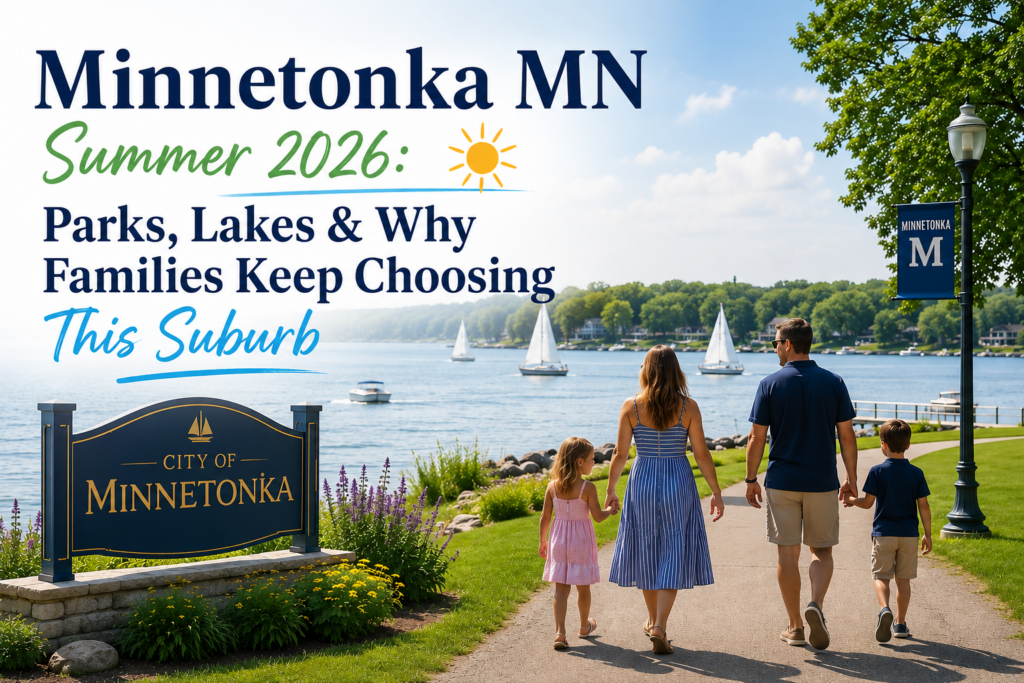
Minnetonka MN Summer 2026: Parks, Lakes & Why Families Keep Choosing This Suburb

Family walking along a lakeside path in Minnetonka MN with sailboats on the water and a City of Minnetonka sign in summer

If you’ve been spending any time on the west side of the Twin Cities this summer, you already know what makes Minnetonka, MN so hard to leave. Shimmering lakes just minutes from home, trails that wind through serious tree cover, a school district that consistently ranks among the best in the state — and a real estate market that reflects exactly how much families value all of it. Whether you’re seriously considering a move or just starting to explore Minnetonka as a landing spot, summer is the ideal time to see this suburb at its best. Here’s what you need to know.

Parks and Lakes: Minnetonka’s Outdoor Scene Is the Real Draw

Minnetonka sits in one of the most lake-dense pockets of the Twin Cities metro, and residents take full advantage of it from Memorial Day through Labor Day. The city maintains an impressive system of public parks — including Lone Lake Park, Big Willow Park, and the popular Libbs Lake — each offering a mix of trails, open green space, fishing access, and family-friendly amenities. On a warm Tuesday afternoon, these parks don’t feel like afterthoughts; they feel like the center of the community.

Just beyond Minnetonka’s city limits, Lake Minnetonka Regional Park — managed by Three Rivers Park District — gives residents easy access to Lake Minnetonka itself. The park features a nautical-themed play area, a sandy-bottom chlorinated swimming pond, a fishing pier, disc golf, and over three miles of biking and hiking trails. It’s the kind of place you can spend a full summer Saturday without once checking your phone. For families with young kids, the stroller-friendly paved paths and supervised swim area are a particular draw.

Beyond formal parks, Minnetonka’s position adjacent to Lake Minnetonka — one of Minnesota’s largest and most beloved recreational lakes — means boating, paddleboarding, kayaking, and open-water swimming are woven into everyday summer life here. It’s not a weekend-only thing. Residents talk about the lake the way people in other cities talk about their backyard.

Minnetonka Schools: A Top-Ranked District That Families Plan Around

Ask any family why they chose Minnetonka, and the school district comes up almost immediately. Minnetonka Public Schools ranks #2 in Minnesota on Niche’s 2026 Best School Districts list and sits among the top 50 school districts in the entire country. The numbers behind that ranking are hard to argue with: the district’s average testing rank scores in the top 1% of Minnesota public schools, with math proficiency at 76% — compared to the state average of 46%.

Minnetonka High School ranks among the top three high schools in Minnesota, and individual elementary schools like Scenic Heights and Groveland appear in top-60 rankings statewide. Beyond academics, the district is known for its deep arts and music programs, K-12 Spanish and Chinese immersion options, advanced coursework, and a 98% graduation rate. The Minnetonka Class of 2026 held its commencement at US Bank Stadium — which tells you something about the scale and pride of this community.

It’s worth noting that the Minnetonka district is also the most sought-after for open enrollment in Minnesota, drawing nearly 3,600 nonresident students annually. Families who don’t live in the district actively try to get in. Families who do live here tend to stay.

Minnetonka MN Summer 2026 Real Estate: What the Market Looks Like Right Now

The Minnetonka real estate market heading into summer 2026 is active, competitive in desirable neighborhoods, and still fairly tight on inventory. Median home prices in Minnetonka have been running in the $470,000–$550,000 range depending on the data source and time period, reflecting both the quality of housing stock and the premium buyers willingly pay to be in this school district and community. As one industry overview noted, inner-ring suburbs like Minnetonka with strong schools consistently carry medians in the $500,000 to $700,000-plus range.

Homes here are moving in roughly 25–29 days on average, and a meaningful percentage continue to sell above asking price — a sign that buyer demand hasn’t cooled off even as broader inventory has loosened slightly across the state. The sale-to-list price ratio has held near 99.5%, meaning sellers are still commanding close to full price. If you’re buying this summer, come prepared with a pre-approval letter and a clear sense of what you want — well-priced homes in Minnetonka don’t sit.

What does your budget get you? In the $400,000–$500,000 range, expect well-maintained ramblers and split-levels in established neighborhoods — often with mature trees, finished basements, and proximity to parks. Move into the $550,000–$700,000 range and you’ll find newer construction, larger lots, and updated interiors. Above $700,000, Minnetonka offers some of the Twin Cities’ most beautiful executive homes, including properties with lake access or views. Check the Minnetonka market page on Redfin for current listings and pricing trends.

What Living in Minnetonka Actually Feels Like Day-to-Day

Minnetonka occupies a sweet spot in the Twin Cities suburb matrix: it’s suburban enough to offer space, quiet streets, and great schools, but urban enough to have genuine amenity density. The city has its own distinct commercial corridors, a mix of independent restaurants, coffee shops and local businesses alongside larger retail, and a community identity that doesn’t feel like it was designed by committee.

Downtown Minneapolis is about 12 miles from central Minnetonka — a 20-minute drive in non-rush traffic. That proximity matters for residents who work in the city but want the kind of outdoor lifestyle Minnetonka delivers on weekends. The city also sits along Highway 394 and Interstate 494, giving commuters solid options in multiple directions across the metro.

Summer weekends in Minnetonka have a particular rhythm to them: kids riding bikes to the park in the morning, families launching kayaks by afternoon, and neighbors gathering around fire pits after the sun goes down. It’s genuinely one of those places where the lifestyle matches the listing.

Is Minnetonka the Right Fit for Your Family?

Minnetonka tends to attract families with kids, nature-oriented buyers who want lake and trail access baked into daily life, and move-up buyers coming from other Twin Cities suburbs who are ready to settle in somewhere they can stay long-term. It’s also consistently popular with relocating professionals who research school districts before picking a neighborhood — Minnetonka routinely tops those searches.

If Minnetonka is on your radar, summer is the right time to see it in person. Neighborhoods show best when the trees are full, the lakes are busy, and you can get a feel for the parks your kids would actually use. Just don’t expect a leisurely timeline once you find something you like — the market rewards buyers who are ready to move quickly.

For a deeper look at what’s happening across the metro, visit the Minneapolis Area Realtors for the latest market data, or browse our Minnetonka community page for more neighborhood insights.

Ready to Buy in Minnetonka This Summer?

Minnetonka’s market moves fast, and who you work with matters. MinnMatch connects Twin Cities buyers with experienced, vetted local agents who know this neighborhood — the streets, the schools, the price points that make sense. It’s free, it’s personal, and there’s no algorithm deciding your match.

Find a Minnetonka Agent →

Wayzata MN Summer 2026: Boating, Dining & a Real Estate Market That Never Slows Down

Lakefront dining table with wine glass overlooking Lake Minnetonka with sailboat at sunset in Wayzata MN

If you’ve spent even one summer evening in Wayzata — watching sailboats cross Wayzata Bay, the sun dropping behind the tree line over Lake Minnetonka — you already understand why people don’t just visit this town. They try to figure out how to stay. The Wayzata MN real estate market reflects that pull: a small, tightly held inventory of luxury homes in a community where lifestyle, location, and long-term value all point in the same direction. Whether you’re here to boat, to dine, or to seriously consider making a move, summer 2026 is a compelling time to pay attention.

Wayzata on the Water: Why Summer Here Is Unlike Anywhere Else in Minnesota

Lake Minnetonka is the crown jewel of the Twin Cities metro, and Wayzata sits on its northern shore with front-row access. The city’s name itself comes from the Dakota word Waziyata, meaning “north shore” — a fitting origin for a community that has organized itself around the lake for well over a century.

Summer in Wayzata means pontoon boats cutting across calm bays on weekday mornings, regattas drawing weekend crowds to the waterfront, and the steady hum of activity along the Panoway — the community’s lakeside promenade. The pedestrian-only boardwalk has become one of the most popular gathering spots in the western suburbs, a place where families stroll, couples catch sunsets, and locals run into neighbors they haven’t seen since spring.

For boaters, Wayzata Marine and other local outfitters keep the docks busy all season, and the public launch gives access to all 14,000-plus acres of Lake Minnetonka. Each summer, the Wayzata Art Experience transforms the Panoway into a two-day juried art festival featuring more than 150 artists, live music, food vendors, classic wooden boats, and an artisan beer and wine garden — one of the most well-attended outdoor events in the metro. James J. Hill Days rounds out the summer calendar with community celebrations rooted in the city’s railroad heritage.

All of that energy — the water, the events, the walkable downtown — doesn’t just make for a great summer. It builds a community that people actively compete to join, which has a very direct effect on what happens in the Wayzata real estate market.

Dining in Downtown Wayzata: From Casual Dockside to White-Tablecloth Lakefront

One of the quieter compliments Wayzata receives is that its restaurant scene punches well above its population. For a city of roughly 4,000 people, the dining options are genuinely impressive — and in summer, when patios open and the lake becomes part of the backdrop, they’re hard to beat anywhere in Minnesota.

6Smith remains the anchor of the downtown dining scene. Situated just steps from the water with nothing but dock between the restaurant and Lake Minnetonka, it offers a fine-dining experience — fresh seafood, steaks, lobster rolls — that draws visitors from across the metro and earns consistent recognition as one of the best restaurants on the lake. Reservations are encouraged, especially on summer weekends.

CōV brings a different energy: an East Coast-meets-Midwest vibe that the restaurant describes as channeling Nantucket or the Hamptons. The lakefront patio hosts a summer music series, the menu runs from burgers to seafood, and the lobster guacamole has developed a devoted following. On any given summer Friday evening, the patio is exactly as good as it sounds.

Gianni’s Steakhouse has long been a go-to for classic steakhouse fare in a setting that feels occasion-worthy without being stiff. Maggie’s, in contrast, is the town’s beloved no-frills diner — counter service, great pizza and burgers, and the kind of place that feels like it belongs to the community rather than a dining trend.

The combination of lakefront fine dining, lively patio bars, and neighborhood staples makes Wayzata’s food scene one of the genuine lifestyle amenities that buyers factor in when evaluating whether to put down roots here versus in neighboring communities. When clients ask about life in Wayzata, the answer almost always involves at least one restaurant recommendation.

The Wayzata MN Real Estate Market in Summer 2026: What the Numbers Show

Wayzata’s housing market operates at a price point that reflects its status as one of the most desirable addresses in the Twin Cities. Median list prices have hovered near the $2 million range, with active listings this spring showing an average price per square foot above $800, according to current MLS data. Total active inventory in the city typically runs between 70 and 130 homes at any given time — a relatively thin supply for the level of buyer interest the community generates.

For context, Redfin’s Wayzata market data shows median sale prices in the high six figures to low seven figures depending on the time of year and product type — a range heavily influenced by whether lakefront or non-lakefront properties dominate a given month’s closings. When a direct-access Lake Minnetonka home changes hands, it can pull the median significantly higher; when townhomes and interior lots move, the figures moderate.

Days on market in Wayzata tend to run longer than the broader Twin Cities metro — averaging in the range of 80 to 107 days depending on the season, reflecting both the luxury price point and the selective pool of qualified buyers. That doesn’t mean the market is slow in any absolute sense; it means buyers are deliberate and sellers who price correctly still find strong outcomes. Premium lakefront properties — especially those with deeded lake access, private docks, and significant shoreline footage — continue to command top dollar and generate competitive interest when they hit the market.

One well-known characteristic of Wayzata’s highest-end segment: many of the best properties never reach the MLS. Off-market transactions are common, especially in the Ferndale and Bushaway Road areas, where established families hold multi-generational homes that pass quietly through agent networks. If you’re searching Zillow for a Wayzata lakefront home and wondering why inventory looks thin, that’s part of the explanation.

What Makes Wayzata Real Estate Different from Other Lake Minnetonka Communities

Lake Minnetonka has no shortage of desirable communities — Excelsior, Minnetonka Beach, Tonka Bay, Deephaven all have their own loyal followings. But Wayzata occupies a specific niche that sets it apart from almost all of them: it is the only Lake Minnetonka community with a true walkable downtown directly on the water.

That combination — lakefront access, a functioning downtown with shops and restaurants, strong schools in the Wayzata Public Schools district, and reasonable proximity to Minneapolis (roughly 15 miles west on I-394) — is genuinely rare. Buyers who want lake lifestyle without sacrificing urban convenience consistently put Wayzata at the top of their shortlist.

The community also benefits from strong long-term value stability. The desirability of Lake Minnetonka shoreline is not a recent trend — it has anchored generational wealth in the Twin Cities for over 100 years, and there is no structural reason to expect that to change. Buyers purchasing in Wayzata today are making a long-term bet on one of the most consistently valued real estate markets in Minnesota, according to data tracked by Minneapolis Area Realtors.

For those comparing Wayzata to nearby Minnetonka or Eden Prairie, the price premium is real — but it buys something that the neighboring suburbs simply cannot replicate: lake access combined with a downtown that feels alive in every season.

Tips for Buyers Entering the Wayzata Market This Summer

If you’re seriously considering a purchase in Wayzata, a few things are worth understanding before you start your search:

Get pre-approved and prepared to move quickly. At the $1M–$3M+ price range, transactions require serious financial documentation. In a thin-inventory market, arriving unprepared often means watching a property disappear before you can make a competitive offer.

Understand the spectrum of “lake access.” There is a significant difference between a home with deeded lakeshore, a home with association dock access, and a home with no water access at all. Each tier carries very different price points and lifestyle implications. Know which matters most to you before touring.

Don’t rely solely on public listings. As noted above, a meaningful share of Wayzata’s best properties trade off-market. An agent with deep roots in this specific community will have access to opportunities that never hit Zillow or Realtor.com.

Be patient, but not passive. Extended days on market in Wayzata doesn’t mean sellers are desperate — it means the buyer pool is smaller and more selective. Properties priced well and in good condition still move. Being ready to act when the right home appears is more valuable than a fast market.

Ready to Explore Wayzata Real Estate?

Wayzata is a market where who you know matters as much as what you can find online. MinnMatch connects buyers and sellers with experienced, vetted local agents who specialize in Lake Minnetonka communities — including Wayzata’s most coveted streets and off-market opportunities. Our service is free, human-powered, and built for buyers and sellers who want to get it right the first time.

Find a Wayzata Agent

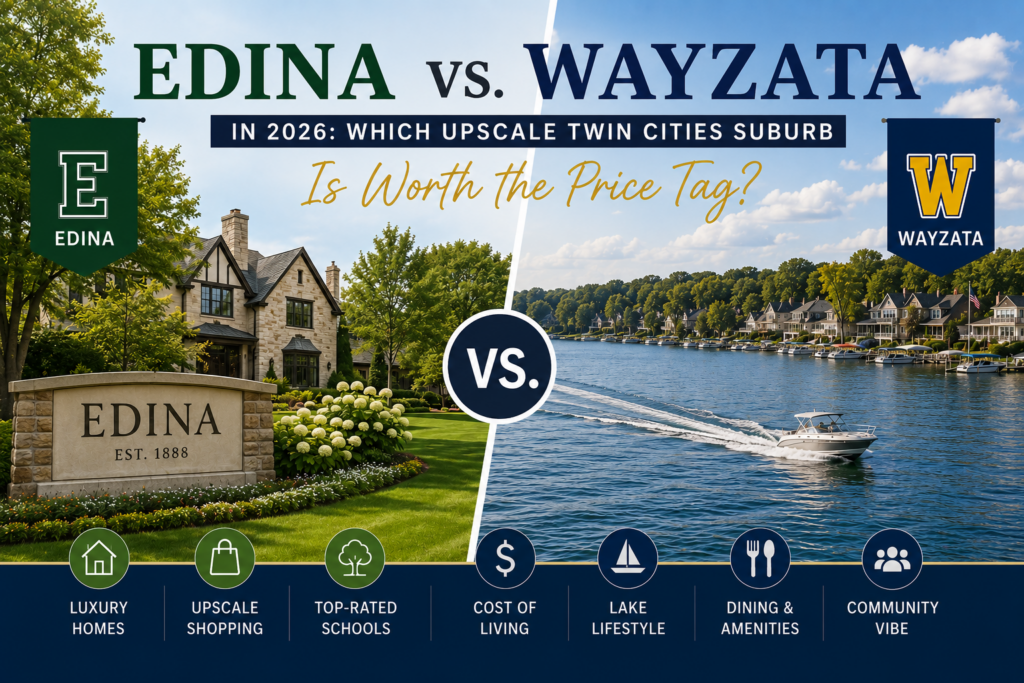
Edina vs. Wayzata in 2026: Which Upscale Twin Cities Suburb Is Worth the Price Tag?

Edina vs. Wayzata in 2026 — comparing luxury homes, lake lifestyle, schools, and cost of living in two upscale Twin Cities suburbs

Two names come up again and again when buyers are shopping the top tier of the Twin Cities market: Edina and Wayzata. Both are prestigious. Both have outstanding schools. Both will cost you. But they’re not the same place, and the right choice depends heavily on how you want to live. If you’re weighing these two upscale Twin Cities suburbs against each other in 2026, here’s what you actually need to know — prices, trade-offs, and all.

The Price Tag: What Homes Actually Cost in Edina vs. Wayzata

Let’s start with the number that matters most. Edina’s median home price is currently around $580,000–$630,000, depending on the month and source — with the most active segment sitting between $400,000 and $600,000. You’ll find entry-level condos near Southdale in the $180,000s and estate properties in Indian Hills pushing well past $3 million. That’s a wide range, which is part of Edina’s appeal: it has more runway for buyers at different budgets.

Wayzata runs considerably higher. Redfin data puts Wayzata’s median sale price at roughly $828,000, and price-per-square-foot figures reflect that premium — Minneapolis Area Realtors data shows Wayzata at approximately $310 per square foot compared to Edina’s $268. When you factor in the lakefront homes and large-lot estates near Lake Minnetonka, the ceiling in Wayzata is essentially unlimited.

Bottom line: if you’re comparing apples to apples in terms of square footage and condition, Wayzata will almost always cost more. The question is whether that premium is worth it to you — and that depends on what you’re buying into beyond the house itself.

Schools: Both Are Elite, but With Different Flavors

School quality is a primary driver for families choosing between these two suburbs, and you genuinely can’t go wrong with either. According to Niche’s 2026 Best School Districts in Minnesota rankings, Wayzata Public Schools ranks #1 in the Twin Cities metro, earning an A+. Edina Public School District follows closely at #3 statewide, also with an A+. Both districts have a strong college-prep culture, dedicated teaching staff, and robust extracurricular programs.

There are some nuanced differences. The Edina district has built a strong reputation around talent development programs, language immersion, and travel-based learning opportunities starting in early childhood. Wayzata schools boast a 96% graduation rate — well above state averages — and a wide range of AP and honors offerings. Wayzata High School itself is physically located in Plymouth, which surprises some buyers; the district boundary doesn’t perfectly match the city limits.

For most families, both districts will deliver an exceptional public school experience. If the small edge in district ranking matters to you, Wayzata has it — but Edina is not far behind by any meaningful measure.

Lifestyle and Location: The Real Differentiator

This is where Edina and Wayzata really diverge. Edina sits right on the border of Minneapolis — about 15 minutes to downtown — and feels like the best of suburban and urban living layered together. You get walkable retail at 50th & France, Centennial Lakes Park, a strong dining and coffee scene, and the kind of neighborhood character that comes from decades of established community. It’s practical, polished, and year-round livable.

Wayzata is a completely different vibe. It’s a small lakefront city on the north shore of Lake Minnetonka, with a compact, walkable downtown built around boutique shops, lakeside dining, and a marina. In summer, it’s magical — boat slips, waterfront promenades, and a community energy that’s hard to replicate. The trade-off is that Wayzata’s downtown appeal is seasonal, and it sits farther west of Minneapolis, adding commute time for those working in the city or eastern suburbs.

Simply put: if you want a suburb that functions efficiently year-round with quick city access, Edina wins. If lake life is central to how you relax and entertain — boating, swimming, watching sunsets over the water — Wayzata’s premium starts to make a lot more sense.

Commute and Convenience: Edina Has the Edge

Edina’s inner-ring location is genuinely one of its most underrated assets. Residents are 15 minutes from downtown Minneapolis, with easy access to major corridors like Highway 100, I-494, and France Avenue. Southdale Center, multiple grocery options, and a dense mix of services make daily errands fast and convenient regardless of the season.

Wayzata is farther west — typically 25 to 35 minutes from downtown Minneapolis depending on traffic — and its smaller size means fewer everyday conveniences within walking or short driving distance. That said, nearby Minnetonka and Plymouth fill in many of those gaps, and buyers who work in the western suburbs or from home often find the commute trade-off entirely acceptable.

If you commute into Minneapolis daily, Edina is the clearer choice. If your work is flexible or based on the west side of the metro, Wayzata becomes much more viable.

So Which One Is Worth It? Here’s How to Decide

There’s no universal right answer here — and anyone who tells you there is probably hasn’t spent much time in both communities. What we can tell you is this: Edina offers more value per dollar for buyers prioritizing proximity to Minneapolis, year-round convenience, and a slightly wider entry point into an upscale market. Its schools are elite, its neighborhoods are established, and its price appreciation has been consistent.

Wayzata commands a premium that’s justified for buyers who want lakefront access, a distinctive small-town atmosphere, and a lifestyle built around Lake Minnetonka. If the lake is a genuine priority — not just a nice-to-have — you’ll feel that difference every weekend from May through October, and the community identity will reward that investment.

According to Minnesota Housing Finance Agency data, both communities have shown long-term price resilience, making either a sound long-term investment for buyers who plan to stay. The real question isn’t which suburb is objectively better — it’s which one fits the way you actually want to live.

That’s where having a local expert in your corner makes all the difference. At MinnMatch, we connect buyers with vetted Twin Cities agents who know both of these markets from the inside — the streets, the neighborhoods, the blocks that hold value, and the ones that don’t. Whether you’re leaning toward Edina or Wayzata, we’ll match you with the right agent to make your move with confidence. Get matched for free →

Eden Prairie MN Real Estate 2026: Why This Suburb Keeps Topping the ‘Best Places to Live’ Lists

Eden Prairie MN real estate 2026 — lakeside homes and parks in one of Minnesota's best suburbs


If you’re researching Eden Prairie MN real estate in 2026, you’ve likely already noticed this suburb’s name appearing on every “best places to live” list in Minnesota — and with good reason. From top-ranked schools and 120+ miles of trails to a tight seller’s market with persistent demand, Eden Prairie delivers across every dimension that matters to buyers and sellers alike. Here’s a grounded look at what’s driving the city’s enduring appeal right now.

Why Eden Prairie MN Keeps Topping the Rankings

Eden Prairie has earned national recognition as one of the best places to live in the country — not once, but repeatedly over many years. MONEY Magazine has ranked it among its “Best Places to Live” in America, and in 2026, Eden Prairie landed at No. 5 on Niche’s Best Places to Live in Minnesota list — one of only a handful of Twin Cities suburbs to consistently place that high.

What drives those rankings? Platforms like Niche weigh public school quality, crime rates, cost of living relative to income, job access, and community amenities. Eden Prairie scores well across all of them — not just strong in one area while sacrificing another, but balanced in a way that’s genuinely hard to replicate at this price point in the metro.

By the Numbers — Eden Prairie 2026

~$453K

Median home price

28–30

Avg. days on market

~3 mo.

Months of supply (seller’s market)

#5

Best places to live in MN (Niche 2026)

Eden Prairie MN Real Estate Market Conditions in 2026

The Eden Prairie MN real estate market in 2026 continues to favor sellers, driven by constrained inventory and persistent demand. With only around 3 months of supply available — well below the 5–6 months that typically signals a balanced market — buyers are competing for a limited pool of homes, and well-priced listings are moving quickly.

Median home prices are hovering in the low-to-mid $400s depending on the source and timing, with active listings averaging closer to $500K–$509K. Single-family homes are running higher — around $565,000 on average — while condos offer entry points near $165,000. That range makes Eden Prairie functional for a wide spectrum of buyers: first-time buyers, move-up families, and empty nesters all find options here. According to Redfin’s Eden Prairie market data, homes are receiving an average of 7 offers and selling in around 30 days — a clear sign of competitive demand.

The spring and early summer window (February through July) has historically been the strongest selling period for Eden Prairie real estate, and that pattern is expected to hold through 2026.

If you’re a buyer navigating this competitive environment, having a local agent who knows the specific neighborhoods — from the Bearpath enclave to the family-friendly pockets near Eden Prairie High School — makes a real difference. That’s exactly the kind of match MinnMatch helps buyers make.

Top-Rated Schools Drive Long-Term Home Values

For families considering Eden Prairie MN real estate, the school district is often the deciding factor. The Eden Prairie Schools district (ISD 272) serves more than 10,200 students and is consistently among the top performers in Minnesota on statewide assessments and college entrance exams. The district is known for its high expectations, innovative curriculum, and strong teaching staff — traits that show up not just in test scores but in the community’s long-term property values.

The private International School of Minnesota (ISM) — a college preparatory school for preschool through grade 12 on a 55-acre campus — adds another layer of educational choice within city limits. Access to Normandale Community College and Hennepin Technical College rounds out the post-secondary options nearby.

Strong school districts don’t just attract families — they anchor home values over time. It’s one of the key reasons Eden Prairie real estate has held up well through broader market fluctuations that have hit other suburbs harder.

“Eden Prairie is a very welcoming city that truly cares about their people. They take care of their roads… there are really good grocery stores and parks and everything you could want.”

— Current Eden Prairie resident, Niche 2026

Jobs Are Close — and They’re Good Ones

One of Eden Prairie’s less-discussed advantages is its employment landscape. The city is home to over 2,200 businesses, including some significant corporate anchors. Fortune 500 company C.H. Robinson — one of the world’s largest freight brokers — is headquartered here. Starkey Hearing Technologies, a globally recognized hearing aid manufacturer, also calls Eden Prairie home. The city benefits from proximity to UnitedHealth Group and Optum, two of the largest employers in the entire Twin Cities metro.

For residents who commute, Eden Prairie sits just 12 miles southwest of Minneapolis with direct access to I-494, Highway 169, and Highway 212. The Southwest Light Rail extension has improved transit connectivity in recent years, reducing commute times for those heading into the city core.

This combination — strong employers within the city and fast access to the broader metro — is part of why Eden Prairie attracts young professionals and established families alike. Over 72% of the city’s population is under age 45, giving it an energy that’s difficult to quantify but easy to feel when you’re there.

Parks and Trails: Eden Prairie’s Real Differentiator

Ask most Eden Prairie residents what they love most about the city and the answer usually circles back to the parks and trails. According to the City of Eden Prairie, the city maintains over 1,000 acres of developed parkland, more than 120 miles of bike trails, and 13 miles of dedicated nature trails — an extraordinary amount of green infrastructure for a suburb of roughly 64,000 people.

Bryant Lake Regional Park — a 170-acre gem on the shore of Bryant Lake — offers hiking, boating, fishing, a sandy beach, disc golf, and winter cross-country skiing. Staring Lake Park is a family staple with its sledding hill, outdoor skating rink, and walking trails. Purgatory Creek Park draws birdwatchers and those seeking a quiet escape. Then there’s the Minnesota River valley corridor winding through the southwestern edge of the city — a genuine nature retreat that feels miles away from the suburbs.

This kind of walkable, bikeable outdoor access has become a major quality-of-life driver in the post-pandemic era, and Eden Prairie built it long before it was fashionable. It’s a big reason why the city doesn’t just attract people — it keeps them.

What Makes Eden Prairie Stand Out


  • Top-ranked schools in Minnesota (ISD 272) — consistently among the state’s best

  • Over 120 miles of bike trails and 1,000+ acres of parkland

  • Major corporate employers including C.H. Robinson, Starkey, and proximity to UnitedHealth

  • 12 miles from Minneapolis with excellent highway and light rail access

  • Diverse housing stock — condos from ~$165K to single-family homes well above $500K

  • Over 2,200 local businesses and a vibrant dining and retail scene

Is It a Good Time to Buy Eden Prairie MN Real Estate?

That depends on your situation, but the market dynamics favor prepared buyers who move decisively. With inventory constrained at around 3 months of supply, homes are not sitting long. Buyers who are pre-approved and working with a knowledgeable local agent are in a substantially better position than those who aren’t.

Mortgage rates hovering between 6.4% and 6.9% continue to shape affordability for many households — a household income of around $100,000 is generally the benchmark for comfortably carrying a home in the median price range with a 25% down payment. For buyers in that range, Eden Prairie still offers strong value relative to the lifestyle and long-term appreciation it provides compared to similar suburbs in other major metros. The Minnesota Housing Finance Agency also offers down payment assistance programs worth exploring if you’re a first-time buyer.

The price softness seen in some data sources reflects normal market correction after a period of outsized appreciation — not a sign of underlying weakness. The fundamentals (jobs, schools, amenities, demand) remain firmly intact.

What About Selling Eden Prairie Real Estate in 2026?

If you own a home in Eden Prairie, conditions are still favorable. Limited supply means your listing faces less competition than it would in a more balanced market, and correctly priced homes are receiving multiple offers. The peak selling window of February through July is when demand peaks, days on market tighten, and sellers see the strongest results.

Presentation and pricing strategy still matter enormously. An experienced local agent — one who has actually sold in Eden Prairie’s specific neighborhoods, not just in the broader southwest metro — will know the micro-level factors that affect how buyers perceive value. That’s not a small thing in a market where perception shapes offers.

MinnMatch connects Eden Prairie sellers with agents who specialize in exactly these markets — vetted, local, and matched to your specific neighborhood and goals. It’s a free service, and the difference the right agent makes on final sale price and timeline is well documented.

How Eden Prairie Compares to Nearby Suburbs

It’s worth understanding Eden Prairie in context, especially if you’re weighing it against other strong southwest metro suburbs. Here’s how it stacks up at a high level:

Suburb Approx. Median Price School Strength Key Draw
Eden Prairie ~$453K–$509K Excellent (ISD 272) Balance of everything
Edina ~$550K+ Excellent Established prestige, retail
Minnetonka ~$450K–$500K Very strong Nature access, mature trees
Plymouth ~$430K–$480K Very strong Newer builds, lake access
Prior Lake ~$400K–$450K Good Lake lifestyle, more space

Eden Prairie’s sweet spot is breadth — it doesn’t lead on any single category, but it doesn’t concede much ground in any of them either. For buyers who don’t want to sacrifice schools for space, or nature access for a short commute, that breadth is the whole point.

Finding the Right Agent for Eden Prairie Real Estate

A market like Eden Prairie rewards buyers and sellers who are well-represented. The difference between a good agent and a great one often comes down to neighborhood-level knowledge — understanding which streets near Riley Creek have the best trail access, how Bearpath compares to the Settlers Ridge area for long-term value, or which parts of town are seeing new construction activity.

MinnMatch is built for exactly this kind of situation. We handpick and vet local agents based on their actual track record in specific Twin Cities communities — then we match you to the right one for your goals, timeline, and neighborhood. There’s no algorithm, no guesswork, and no cost to buyers or sellers. Think of it as having a recruiter who’s already screened the candidates, so you only meet the ones worth your time.

Ready to buy or sell Eden Prairie MN real estate?

We’ll match you with a vetted, local agent who knows this market — for free.

Find My Agent →

The Bottom Line on Eden Prairie MN Real Estate in 2026

Eden Prairie keeps topping the “best places to live” lists because the things that drive those rankings — schools, jobs, safety, outdoor life, community — don’t change year to year based on interest rates or inventory swings. They’re structural, built into the city over decades of smart planning and sustained investment.

The Eden Prairie MN real estate market in 2026 is competitive but navigable for buyers who are prepared, and favorable for sellers who price and present well. Either way, having someone in your corner who truly knows this community isn’t optional — it’s the edge that makes the difference.

Explore more about the Eden Prairie community on MinnMatch, or learn how our agent matching works. If you’re comparing suburbs, our Twin Cities market insights section covers the full southwest metro picture.

Eden Prairie vs. Plymouth: Comparing Homes, Commutes, Parks & Community Feel

Eden Prairie vs Plymouth comparison graphic showing homes, commutes, parks, and community feel in two Twin Cities western suburbs


When families start searching for a home in the western Twin Cities, the same two names come up again and again: Eden Prairie and Plymouth. Comparing Eden Prairie vs Plymouth homes, commutes, parks, and community feel is exactly what this guide is designed to help you do — side by side, category by category, without the fluff. Both suburbs rank among the best places to live in Minnesota, but they are not interchangeable. The differences are real, and choosing the right one for your family comes down to knowing what those differences actually are.

Eden Prairie sits along the Minnesota River bluffs to the southwest of Minneapolis. Plymouth spreads across rolling, lake-dotted terrain to the northwest. Both cities offer excellent schools, low crime, strong property values, and the kind of family infrastructure that’s hard to find combined in a single place. But dig one level deeper and the two cities diverge — in housing character, outdoor lifestyle, commute patterns, and the pace of daily life. Here’s the full breakdown.


🏡 Eden Prairie vs Plymouth Homes & the Housing Market

The homes themselves tell you a lot about each city’s identity — and so do the price tags.

Eden Prairie Homes: Planned, Polished, and Consistently In Demand

Eden Prairie grew up as a master-planned community, and that heritage is visible in the housing stock. Neighborhoods here feel cohesive and well-maintained — you’ll find a lot of two-story colonials and executive-style homes built between the mid-1980s and early 2000s, along with newer construction in pockets near the city’s southern and western edges. Lots tend to be generous, many backing up to wooded buffers or pond views that are genuinely attractive rather than decorative afterthoughts.

The typical family home in Eden Prairie — three or four bedrooms, a finished basement, and a two-car garage — runs in the $550,000 to $750,000 range in 2026, with entry points below $500K if you’re willing to take on a project. Move-in ready homes at the right price generate genuine competition; multiple-offer situations are still common, especially in spring.

One standout characteristic: Eden Prairie homes tend to hold value exceptionally well. The combination of school district reputation, employment proximity, and city-wide maintenance standards creates a floor that buyers can count on over time. According to Minneapolis Area Realtors, the western suburbs have consistently outperformed the broader metro on median price-per-square-foot retention over the past five years — and Eden Prairie sits near the top of that list.

Plymouth Homes: More Range, More Room to Find Your Entry Point

Plymouth’s housing market is broader and more varied — a natural result of the city’s size (it’s one of the largest cities in Minnesota by population) and its patchwork of neighborhoods developed across different eras. You’ll find 1970s ramblers and split-levels in older western neighborhoods, well-built 1990s subdivisions throughout the core, and newer executive construction near the city’s eastern and northeastern edges.

Pricing for Plymouth homes typically runs $480,000 to $700,000 for a comparable family home, with genuine opportunities below $450K in older neighborhoods — something Eden Prairie rarely offers for move-in-ready product. On the upper end, newer construction near Medicine Lake or in premium subdivisions can push well past $800K.

The key variable when buying a Plymouth home is the school district boundary. Because Plymouth spans multiple districts — primarily Wayzata (284) and Osseo (279) — the value of a specific home can vary significantly based on which district it falls in. Homes in the Wayzata district consistently command a premium. Knowing the boundary lines before you start touring is essential, and it’s one of the clearest reasons to work with an agent who knows Plymouth specifically.

Eden Prairie

More uniform housing stock, slightly higher floor, one school district. Excellent long-term value stability.

Plymouth

More variety across eras and price points. Wider entry options. School district boundary research is non-negotiable.

Whether you’re shopping Eden Prairie or Plymouth homes, working with a buyer’s agent who focuses on these specific cities will save you time, money, and the headache of learning pricing nuances on the fly. MinnMatch matches buyers with agents who know these neighborhoods at the street level — not just the zip code.


🚗 Comparing Commutes & Location

Neither Eden Prairie nor Plymouth is going to punish you with a brutal commute — both sit within 25 to 35 minutes of downtown Minneapolis under normal conditions. But the direction, highway access, and what’s nearby differ enough to matter for many buyers.

Eden Prairie Commutes: Southwest Access and Airport Proximity

Eden Prairie sits at the intersection of I-494, Highway 212, and Highway 169 — giving residents flexible options for reaching downtown Minneapolis, the airport corridor, and communities further southwest. The I-494 strip through Eden Prairie is also a major employment hub in its own right, home to corporate campuses that mean some residents barely leave the city for work at all.

The biggest commute advantage Eden Prairie holds is proximity to Minneapolis-St. Paul International Airport. For frequent business travelers, a 15-minute drive to MSP — without fighting through the city — is a genuine quality-of-life upgrade. If your job involves regular flights, this alone can tip the scales.

Transit options are limited, as they are throughout the western suburbs, but express bus routes connect Eden Prairie to downtown. The SWLRT Green Line Extension expanded light rail access closer to the Eden Prairie area, improving connectivity for transit-oriented commuters.

Plymouth Commutes: Northwest Access and Strong Highway Connections

Plymouth benefits from strong access via I-494, Highway 55, and I-394 — the last of which is a particularly efficient corridor straight into downtown Minneapolis and the inner-ring suburbs of St. Louis Park and Golden Valley. Residents heading downtown for work find the commute manageable and predictable outside of peak hours.

Plymouth’s location also makes it a natural base for professionals working in the northwest employment corridor — think Maple Grove, Brooklyn Park, or Rogers. If your job pulls you north rather than south or downtown, Plymouth’s geography is genuinely more convenient than Eden Prairie’s.

Plymouth is further from MSP — roughly 30 to 35 minutes — which matters for frequent flyers. For remote and hybrid workers who commute occasionally, the difference is largely irrelevant.

Route Eden Prairie Plymouth
Downtown Minneapolis 25–35 min via I-494 / Hwy 212 20–30 min via I-394 / Hwy 55
MSP Airport ~15 min ✈️ ~30–35 min
Northwest suburbs 30–40 min 10–20 min ✅
Primary highways I-494, Hwy 212, Hwy 169 I-394, I-494, Hwy 55

🌲 Comparing Parks & Outdoor Access

This is where Eden Prairie vs Plymouth diverges most meaningfully — not in quality, but in character. Both are exceptional for outdoor access. The question is what kind of outdoor lifestyle you’re after.

Eden Prairie Parks: Trails, Bluffs, and a Rare Urban Wilderness

Eden Prairie’s park system is one of the most impressive in the state for a city its size. With over 2,250 acres of parkland and more than 170 miles of interconnected trails, the outdoor infrastructure here is built into the city’s DNA. According to the City of Eden Prairie Parks & Recreation, the trail network is specifically designed to connect neighborhoods to schools, parks, and commercial areas without requiring residents to touch a road.

Staring Lake Park is a beloved anchor — offering kayak rentals, an amphitheater for summer concerts, a skating loop in winter, and trails winding through native prairie. Bryant Lake Regional Park provides swimming, fishing, and boat launch access. Along the city’s southern edge, the Minnesota River bluffs deliver dramatic, wooded topography that few western suburbs can match. The Richard T. Anderson Conservation Area alone contains hundreds of acres of protected habitat.

For families with kids who want to ride to school, or parents who want a running route that actually goes somewhere, Eden Prairie’s connectivity matters enormously.

Plymouth Parks: A Lake Town Through and Through

Plymouth’s outdoor identity is defined by water. With more than 30 lakes within city limits — including Medicine Lake, Parkers Lake, Bass Lake, and Mooney Lake — water access is a fact of life here. Many neighborhoods are built around lakes, with homes backing up to shoreline and residents fishing from their yards or paddling out before breakfast.

Parkers Lake Park is a crown jewel — a well-maintained beach, picnic areas, and a skating rink in winter that draws families from across the city. The Three Rivers Park District manages extensive regional trail corridors through and around Plymouth, connecting to the wider metro-wide trail grid. Plymouth Creek Center serves as a community hub with athletic facilities, indoor recreation, and event space year-round.

Plymouth’s trail network is solid, though not quite as densely woven as Eden Prairie’s. The emphasis here is on lake access, beach time, and water recreation — and on that dimension, Plymouth has no peer in the western metro.

Eden Prairie is your city if…

You want trails out your front door, city-wide connectivity, and access to river bluffs and native prairie that feel genuinely wild.

Plymouth is your city if…

Your version of the perfect Saturday involves a kayak, fishing pole, or paddleboard — and you want lake access woven into your neighborhood, not just nearby.


🏙️ Comparing Community Feel

Numbers and amenities only go so far. What’s it actually like to live in each of these cities?

Eden Prairie Community Feel: Put-Together, Energetic, and Self-Contained

Eden Prairie feels like a city that has its act together. The commercial core around Eden Prairie Center and the surrounding retail corridor is polished and well-maintained. You can handle almost every errand, meal out, and weekend activity without leaving city limits — and many residents do exactly that. The city has cultivated a local dining scene that punches above its weight for a western suburb, and fitness options, youth sports leagues, and family-oriented events fill the calendar year-round.

The demographic skews toward dual-income professional families — many of whom work at the major corporate campuses along the I-494 corridor or commute into Minneapolis. There’s a strong sense of community investment: residents here tend to be engaged in schools, youth sports, and civic life, which keeps the city’s momentum going. Eden Prairie has been recognized nationally as one of the best cities to live in the U.S., and the residents feel that pride.

The trade-off, if there is one, is that Eden Prairie can feel dense with ambition — it’s a high-achieving place, and the culture around school sports, activities, and résumé-building can feel intense at times. For some families, that energy is exactly what they want. For others who prefer a slightly quieter pace, it’s worth noting.

Plymouth Community Feel: Spacious, Neighborly, and a Little More Relaxed

Plymouth is Minnesota’s seventh-largest city by population, but it doesn’t feel like it. The city’s geography — sprawling across rolling terrain with neighborhoods separated by lakes, parks, and open space — creates a more dispersed, lower-density character than Eden Prairie’s tighter layout. It’s a city where people genuinely know their neighbors, where cul-de-sacs feel like small communities, and where the pace of life has a little more breathing room.

Plymouth’s retail and dining scene is solid but more spread out — you’ll often drive to neighboring Wayzata or Minnetonka for a broader restaurant selection or specialty shopping. Many Plymouth residents consider this a feature rather than a bug — the proximity to Wayzata’s charming lakeside village adds destination-quality dining and entertainment without the city needing to replicate it internally.

Community events and city-organized programs are strong — the Hilde Performance Center hosts outdoor concerts and seasonal events, and Plymouth Creek Center anchors a busy schedule of youth sports, fitness classes, and family programming. The community feel is warm and genuinely Minnesotan: involved but not in your face, friendly without being performative.

Plymouth also benefits from a notable degree of diversity compared to many western suburbs, which many families find appealing — especially those moving from larger metro areas or with kids who will benefit from a wider range of backgrounds and perspectives in school.


Eden Prairie vs Plymouth Homes: So Which One Wins?

Neither. And both.

Eden Prairie is the better fit if you want everything in one tightly run package — a single elite school district, a dense trail network, strong employment proximity, and a city that feels polished from end to end. It rewards buyers who want convenience, connectivity, and a high-energy community.

Plymouth homes offer a better fit if outdoor water access matters most to your family, if you want more housing variety and a slightly wider price window, or if you prefer a community that feels a little less intense and a little more spread out. It rewards buyers who do their homework on school district boundaries and aren’t afraid to drive five minutes for a great dinner.

In both cities, the market is competitive and the learning curve for buying is real. Understanding what a home is actually worth — and being positioned to move fast when the right one hits — requires local knowledge that goes beyond what any portal can provide. That’s exactly what the right agent delivers. MinnMatch can help you find one who specializes in the community you’re targeting.

Not sure which suburb is right for you?

MinnMatch connects Twin Cities buyers and sellers with hand-picked, vetted local agents — free, fast, and with no obligation. Tell us what you’re looking for, and we’ll match you with someone who knows Eden Prairie, Plymouth, and the broader western metro inside and out.

Find My Agent →

Lake Minnetonka Community Guide: A Simple Breakdown

Lakefront home on Lake Minnetonka at sunset with a motorboat on the water, a private dock, hydrangeas in the foreground, and mature trees framing the property

Lake Minnetonka isn’t just one place—it’s a collection of distinct communities, each with its own personality, price points, and lifestyle.

If you’re starting your home search, it can feel a little overwhelming. The good news? You don’t need to know everything right away—you just need a simple feel for how the areas differ.

This guide gives you a clean, practical breakdown of all the main Lake Minnetonka communities so you can start narrowing in on what fits you best.

Wayzata

One of the most well-known lake towns, Wayzata offers a walkable downtown right on the water.

What it’s known for:

  • Upscale homes and strong long-term value
  • Restaurants, shops, and lakefront activity
  • A polished, high-demand feel

Best fit: Buyers who want walkability, energy, and a premium location.

Excelsior

Excelsior brings charm, history, and a laid-back lake vibe.

What it’s known for:

  • Small-town feel with local shops and restaurants
  • Community events and lakefront park space
  • Character-filled homes

Best fit: Buyers who value charm, community, and a slower pace.

Minnetonka

Minnetonka offers flexibility, convenience, and a wide range of home options.

What it’s known for:

  • Variety of neighborhoods and price points
  • Easy access to highways and amenities
  • Strong schools and established communities

Best fit: Buyers looking for value, options, and practicality near the lake.

Orono

Orono is known for space, privacy, and high-end lakefront living.

What it’s known for:

  • Large lots and quiet settings
  • Luxury homes and premium shoreline
  • A more secluded, residential feel

Best fit: Buyers prioritizing privacy, views, and long-term lake living.

Tonka Bay

Tonka Bay is small, quiet, and tucked into some of the lake’s most desirable shoreline.

What it’s known for:

  • Peaceful residential feel
  • Access to marinas and lake activity
  • Close proximity to Wayzata

Best fit: Buyers who want a quieter setting without being far from amenities.

Deephaven

Deephaven offers a mix of lake access, community feel, and convenience.

What it’s known for:

  • Strong sense of community
  • Parks, trails, and lake access
  • Blend of older homes and newer builds

Best fit: Buyers looking for a balanced lifestyle near the lake.

Woodland

Woodland is a smaller, upscale community with a quiet, residential feel.

What it’s known for:

  • High-end homes
  • Low density and privacy
  • Close proximity to Wayzata

Best fit: Buyers wanting a premium location with a quieter setting.

Greenwood

Greenwood is one of the smallest communities on the lake, but highly desirable.

What it’s known for:

  • Tight-knit neighborhood feel
  • Mix of lakefront and non-lakefront homes
  • Convenient access to surrounding areas

Best fit: Buyers looking for a small, established community.

Shorewood

Shorewood offers a mix of lake access, neighborhoods, and value.

What it’s known for:

  • More accessible price points (compared to some areas)
  • Family-friendly neighborhoods
  • Proximity to Excelsior

Best fit: Buyers who want to be near the lake with a bit more flexibility on price.

Spring Park

Spring Park is a small lakeside community with a casual, relaxed feel.

What it’s known for:

  • Close connection to the lake
  • Smaller homes and lots
  • A low-key, local vibe

Best fit: Buyers who want a simple, lake-oriented lifestyle.

Mound & Minnetrista

These western communities offer more space and often better value.

What they’re known for:

  • Larger lots and quieter surroundings
  • More affordable entry points into the Lake Minnetonka area
  • Growing interest from buyers seeking space

Best fit: Buyers who want room to spread out and a more relaxed pace.

Victoria

While slightly removed from the main shoreline, Victoria still connects closely to the Lake Minnetonka lifestyle.

What it’s known for:

  • Newer construction and planned communities
  • Parks, trails, and family-friendly feel
  • Access to both Lake Minnetonka and nearby lakes

Best fit: Buyers looking for newer homes and a suburban feel near the lake.

Final Thoughts

Each Lake Minnetonka community offers something a little different. Some are built around walkability and energy. Others focus on privacy, space, or value.

The key is figuring out what matters most to you:

  • Walkability or privacy
  • Lakefront or near-lake
  • Newer homes or established neighborhoods

Once you have clarity on that, the right community usually becomes much easier to spot.

If you’re starting your search, taking the time to explore a few of these areas in person can make all the difference—and help you feel confident about where you ultimately land.

Lake Minnetonka, Real Estate

Explore homes, communities, and lake living around Minnetonka.
Read More

5 Things Buyers Love About Living Near Lake Minnetonka

Illustrated scene of Lake Minnetonka on a sunny summer day with a motorboat, paddleboarder, and sailboat on the water, Adirondack chairs on a dock, and lakefront homes along the wooded shoreline.

There’s a reason so many buyers are drawn to the Lake Minnetonka area. It’s not just about finding a home—it’s about finding a lifestyle that feels different from the typical suburban experience.

From summer days on the water to charming downtowns and long-term value, living near Lake Minnetonka offers a unique mix that’s hard to replicate anywhere else in the Twin Cities.

Here are five things buyers consistently love about living in this area.

1. The Lake Lifestyle

For many buyers, this is the main draw.

Living near Lake Minnetonka means having easy access to:

  • Boating and water activities in the summer
  • Lakeside dining and marinas
  • Sunset views and waterfront parks
  • A general “up north” feel—without leaving the metro

Even if you’re not directly on the lake, just being nearby changes how you spend your time. Weeknights feel more relaxed. Weekends feel like a getaway.

2. Walkable Lake Towns

Areas like Wayzata and Excelsior give buyers something you don’t find in most suburbs—true walkability with character.

Buyers love:

  • Being able to walk to coffee shops, restaurants, and local stores
  • Community events, farmers markets, and lakefront gatherings
  • A small-town feel with upscale amenities

It creates a lifestyle where you don’t always need to hop in the car to enjoy your surroundings.

3. Strong Long-Term Home Values

Lake Minnetonka has long been one of the most desirable areas in the Twin Cities—and that tends to show up in home values.

Buyers are often attracted to:

  • Consistent demand, especially for well-located homes
  • Limited lakefront inventory, which helps support pricing
  • A reputation as a premium location within the metro

While every market has ups and downs, this area has historically held its value well compared to many surrounding communities.

4. Variety of Communities and Home Styles

One of the biggest surprises for many buyers is how much variety exists around the lake.

You’ll find:

  • Walkable downtown living in Wayzata or Excelsior
  • Quiet residential neighborhoods in Minnetonka
  • Private, luxury lakefront homes in Orono or Tonka Bay
  • A mix of older homes, remodeled properties, and newer construction

This gives buyers flexibility to find something that fits both their lifestyle and budget—without having to leave the Lake Minnetonka area.

5. Year-Round Appeal

While summer gets most of the attention, the Lake Minnetonka area isn’t just a seasonal destination.

Buyers appreciate:

  • Fall colors and quieter lake views
  • Winter activities like skating, ice fishing, and snow-covered scenery
  • A slower, more peaceful pace during the colder months
  • A strong sense of community throughout the year

It’s a place that offers something different in every season, which is a big part of its long-term appeal.

Final Thoughts

Living near Lake Minnetonka offers more than just a place to live—it offers a lifestyle that blends nature, community, and convenience in a way that’s hard to match.

For many buyers, once they spend time in the area, it quickly moves to the top of their list.

If you’re considering making a move here, understanding what makes each community unique can help you find the right fit—and ultimately enjoy everything the Lake Minnetonka area has to offer.

Lake Minnetonka, Real Estate

Explore homes, communities, and lake living around Minnetonka.
Read More