
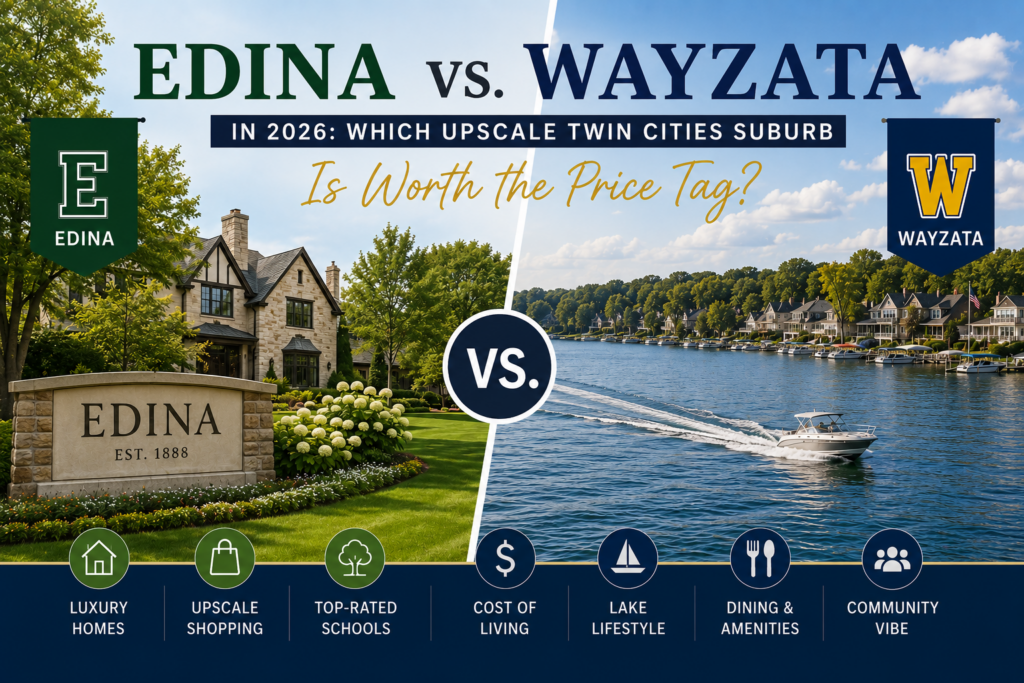
Edina vs. Wayzata in 2026: Which Upscale Twin Cities Suburb Is Worth the Price Tag?

Edina vs. Wayzata in 2026 — comparing luxury homes, lake lifestyle, schools, and cost of living in two upscale Twin Cities suburbs

Two names come up again and again when buyers are shopping the top tier of the Twin Cities market: Edina and Wayzata. Both are prestigious. Both have outstanding schools. Both will cost you. But they’re not the same place, and the right choice depends heavily on how you want to live. If you’re weighing these two upscale Twin Cities suburbs against each other in 2026, here’s what you actually need to know — prices, trade-offs, and all.

The Price Tag: What Homes Actually Cost in Edina vs. Wayzata

Let’s start with the number that matters most. Edina’s median home price is currently around $580,000–$630,000, depending on the month and source — with the most active segment sitting between $400,000 and $600,000. You’ll find entry-level condos near Southdale in the $180,000s and estate properties in Indian Hills pushing well past $3 million. That’s a wide range, which is part of Edina’s appeal: it has more runway for buyers at different budgets.

Wayzata runs considerably higher. Redfin data puts Wayzata’s median sale price at roughly $828,000, and price-per-square-foot figures reflect that premium — Minneapolis Area Realtors data shows Wayzata at approximately $310 per square foot compared to Edina’s $268. When you factor in the lakefront homes and large-lot estates near Lake Minnetonka, the ceiling in Wayzata is essentially unlimited.

Bottom line: if you’re comparing apples to apples in terms of square footage and condition, Wayzata will almost always cost more. The question is whether that premium is worth it to you — and that depends on what you’re buying into beyond the house itself.

Schools: Both Are Elite, but With Different Flavors

School quality is a primary driver for families choosing between these two suburbs, and you genuinely can’t go wrong with either. According to Niche’s 2026 Best School Districts in Minnesota rankings, Wayzata Public Schools ranks #1 in the Twin Cities metro, earning an A+. Edina Public School District follows closely at #3 statewide, also with an A+. Both districts have a strong college-prep culture, dedicated teaching staff, and robust extracurricular programs.

There are some nuanced differences. The Edina district has built a strong reputation around talent development programs, language immersion, and travel-based learning opportunities starting in early childhood. Wayzata schools boast a 96% graduation rate — well above state averages — and a wide range of AP and honors offerings. Wayzata High School itself is physically located in Plymouth, which surprises some buyers; the district boundary doesn’t perfectly match the city limits.

For most families, both districts will deliver an exceptional public school experience. If the small edge in district ranking matters to you, Wayzata has it — but Edina is not far behind by any meaningful measure.

Lifestyle and Location: The Real Differentiator

This is where Edina and Wayzata really diverge. Edina sits right on the border of Minneapolis — about 15 minutes to downtown — and feels like the best of suburban and urban living layered together. You get walkable retail at 50th & France, Centennial Lakes Park, a strong dining and coffee scene, and the kind of neighborhood character that comes from decades of established community. It’s practical, polished, and year-round livable.

Wayzata is a completely different vibe. It’s a small lakefront city on the north shore of Lake Minnetonka, with a compact, walkable downtown built around boutique shops, lakeside dining, and a marina. In summer, it’s magical — boat slips, waterfront promenades, and a community energy that’s hard to replicate. The trade-off is that Wayzata’s downtown appeal is seasonal, and it sits farther west of Minneapolis, adding commute time for those working in the city or eastern suburbs.

Simply put: if you want a suburb that functions efficiently year-round with quick city access, Edina wins. If lake life is central to how you relax and entertain — boating, swimming, watching sunsets over the water — Wayzata’s premium starts to make a lot more sense.

Commute and Convenience: Edina Has the Edge

Edina’s inner-ring location is genuinely one of its most underrated assets. Residents are 15 minutes from downtown Minneapolis, with easy access to major corridors like Highway 100, I-494, and France Avenue. Southdale Center, multiple grocery options, and a dense mix of services make daily errands fast and convenient regardless of the season.

Wayzata is farther west — typically 25 to 35 minutes from downtown Minneapolis depending on traffic — and its smaller size means fewer everyday conveniences within walking or short driving distance. That said, nearby Minnetonka and Plymouth fill in many of those gaps, and buyers who work in the western suburbs or from home often find the commute trade-off entirely acceptable.

If you commute into Minneapolis daily, Edina is the clearer choice. If your work is flexible or based on the west side of the metro, Wayzata becomes much more viable.

So Which One Is Worth It? Here’s How to Decide

There’s no universal right answer here — and anyone who tells you there is probably hasn’t spent much time in both communities. What we can tell you is this: Edina offers more value per dollar for buyers prioritizing proximity to Minneapolis, year-round convenience, and a slightly wider entry point into an upscale market. Its schools are elite, its neighborhoods are established, and its price appreciation has been consistent.

Wayzata commands a premium that’s justified for buyers who want lakefront access, a distinctive small-town atmosphere, and a lifestyle built around Lake Minnetonka. If the lake is a genuine priority — not just a nice-to-have — you’ll feel that difference every weekend from May through October, and the community identity will reward that investment.

According to Minnesota Housing Finance Agency data, both communities have shown long-term price resilience, making either a sound long-term investment for buyers who plan to stay. The real question isn’t which suburb is objectively better — it’s which one fits the way you actually want to live.

That’s where having a local expert in your corner makes all the difference. At MinnMatch, we connect buyers with vetted Twin Cities agents who know both of these markets from the inside — the streets, the neighborhoods, the blocks that hold value, and the ones that don’t. Whether you’re leaning toward Edina or Wayzata, we’ll match you with the right agent to make your move with confidence. Get matched for free →

Buyer’s Market or Seller’s Market? How to Read the Twin Cities Housing Market in 2026

A real estate agent showing the MinnMatch website to a couple on a suburban Twin Cities street

Buyer’s Market or Seller’s Market? How to Read the Twin Cities Housing Market in 2026

The Twin Cities housing market in 2026 is sending mixed signals — and if you’re trying to figure out whether it favors buyers or sellers right now, you’re asking exactly the right question. The answer is nuanced, and understanding the data can make a real difference whether you’re buying, selling, or simply deciding when to make your move.


The Twin Cities Housing Market in 2026: It’s Complicated — But Shifting

The market doesn’t fit neatly into either bucket. After years of an aggressive seller’s market where homes flew off the market in days, the region is experiencing what many local real estate professionals are calling a “great housing reset” — a meaningful transition toward more balanced conditions, even if we haven’t fully arrived there yet. According to the Minneapolis Area REALTORS®, early 2026 data confirms the shift is real and measurable.

Here’s what the latest data tells us:

📊 March 2026 Twin Cities Market Snapshot

  • Median Sales Price~$380,000 (flat YoY)
  • Inventory8,524 units (+3.3%)
  • New Listings6,182 (+1.9%)
  • Pending Sales4,126 (−2.9%)
  • Days on Market62 days (+5.1%)
  • Months Supply2.3 months (+4.5%)

What those numbers add up to: more breathing room for buyers — but sellers still hold an edge in most price ranges.


Why the 2026 Housing Market Still Leans Seller — Just Not Overwhelmingly So

A balanced market typically requires about five to six months of housing supply. At 2.3 months, the Twin Cities is still firmly in seller-favored territory — just far less intensely than it was in 2021–2022, when homes received dozens of offers within hours of listing.

Prices reflect this. The median sales price for single-family detached homes has actually increased 2.9% year-over-year to $429,000, even as overall market conditions soften. Homes that are priced correctly and well-presented are still selling — buyers are simply less willing to waive contingencies or dramatically overpay than they were a few years ago.

The $350,001–$500,000 range remains the sweet spot, moving in a median of just 41 days. At the other end, homes priced below $120,000 are sitting considerably longer — a median of 102 days. For statewide context, the Minnesota Housing Finance Agency tracks affordability trends that help explain why lower price points are lingering.


What’s Changed: The Buyer’s Leverage Is Growing

While sellers maintain the upper hand overall, 2026 has introduced real opportunities for buyers that simply didn’t exist in recent years:

More Time to Decide

With days on market rising and pending sales declining, buyers are no longer forced to write offers the same day they tour a home. You can schedule a proper inspection, compare multiple properties, and make a thoughtful decision without a five-offer bidding war breathing down your neck.

Seller Incentives Are Back

Something that disappeared entirely during the pandemic market frenzy has quietly returned: seller concessions. Builders and motivated sellers are increasingly offering incentives — rate buydowns, closing cost credits, and home warranties — to attract buyers in a more competitive listing environment.

Inventory Has Expanded

New listings are up across the metro, with Ramsey County seeing an 11.3% inventory increase. While supply remains tight, buyers in 2026 have meaningfully more options than they did in 2023 or 2024. That translates to less desperation and more informed decision-making. You can track active listings in real time on Redfin’s Minneapolis market page.


Not All Twin Cities Neighborhoods Are Equal

The Twin Cities metro is large and diverse — and market conditions vary significantly by area. Here’s a general read on how different submarkets are behaving in 2026:

🏙 Minneapolis & St. Paul

Well-maintained homes still generate quick interest — but condition and upgrades matter more than ever. Buyers have options and will pass on homes needing significant work unless the price reflects it.

🏡 South Metro & Apple Valley

Listings generally sell near asking price, but median market times are rising. Sellers need to be realistic; above-list offers are no longer automatic.

🌲 Suburban & Exurban Areas

Buyers are increasingly searching beyond city limits for value and space. Suburban markets are seeing a notable uptick as affordability takes priority over proximity.

📍 Hennepin vs. Ramsey

Hennepin held steady (+0.4% closed sales). Ramsey dipped slightly (−1.9%) but gained the most new inventory (+11.3%). Buyers didn’t disappear — they got selective.


What the Twin Cities Housing Market Means if You’re Buying in 2026

This is a strategic window — not a buyer’s market in the traditional sense, but one where thoughtful, well-prepared buyers have real power that simply wasn’t available a few years ago.

  • Get pre-approved before you start looking.
    Sellers still want certainty, and a strong pre-approval letter signals you’re serious.
  • 🔍
    Don’t skip the inspection.
    Unlike 2021, you no longer have to choose between an inspection and winning a bid. Use it.
  • 📊
    Negotiate with data, not emotion.
    With longer days on market, you have leverage to ask for concessions, repairs, or price reductions — especially on homes that have been sitting.
  • 🤝
    Work with a local expert.
    Neighborhood-level knowledge matters enormously when market conditions vary so widely across the metro.


What the Twin Cities Housing Market Means if You’re Selling in 2026

The market is still in your favor — but the margin for error has narrowed. Overpricing a home in 2026 doesn’t just cost you a few days; it can mean sitting for weeks while buyers scroll past your listing.

  • 💲
    Price it right from day one.
    Buyers are doing their homework and won’t overpay. A well-priced home still sells quickly; an overpriced one lingers.
  • 📸
    Presentation matters more than it used to.
    With more inventory to compare against, buyers are discerning. Professional photos, staging, and addressing obvious repairs are table stakes now.
  • 📅
    Consider strategic timing.
    Late spring and early summer remain peak listing season in Minnesota. Preparing early — not waiting until May — gives you a competitive edge.
  • 🔄
    Be open to negotiation.
    A buyer asking for closing cost assistance or a home warranty isn’t necessarily a bad offer — it may be the best offer you’ll get.

The Bottom Line for Twin Cities Homeowners and Buyers

The Twin Cities housing market in 2026 is best described as a soft seller’s market in transition. Prices are stable, inventory is slowly growing, and buyers are gaining leverage they haven’t had in years — but supply is still tight enough that well-prepared sellers with the right pricing strategy continue to do well.

Whether you’re buying or selling, the biggest mistake you can make right now is treating this market like it was in 2021 or assuming it’s flipped entirely to buyer-friendly territory. The truth is in between — and navigating that nuance is exactly where having the right agent makes all the difference.

Not sure which agent is right for your situation?That’s exactly what MinnMatch does. We match Twin Cities buyers and sellers with vetted, local real estate agents — hand-picked based on your neighborhood, price range, and goals. No algorithms. No guesswork. Just the right agent for you, at no cost.

Find Your Agent at MinnMatch.com →