Wayzata MN August 2026: End-of-Summer Deals & Why Smart Buyers Act Before Labor Day

Boat docked on Lake Minnetonka at sunset in Wayzata, MN with text "Wayzata MN August 2026: End-of-Summer Deals & Why Smart Buyers Act Before Labor Day"

There’s a shift that happens in Wayzata every year right around now, and it has nothing to do with interest rates or inventory reports. It’s the calendar. Boats start coming out of Wayzata Bay a little earlier, school supply lists show up in mailboxes, and the buyers who spent June and July touring open houses on their lunch breaks quietly disappear back into their routines. For Wayzata real estate, that shift is exactly why the next few weeks matter so much. The buyers who stay in the game right now, while everyone else is packing up for Labor Day, are the ones who tend to walk away with the better deal.

What’s Actually Happening in Wayzata Real Estate Right Now

Wayzata has never been a market you can sum up with one number, and that’s truer than usual this year. Depending on which data set you’re looking at, typical sale prices in Wayzata have been landing somewhere in the $800,000s for the broader market, while listing prices skew meaningfully higher once you factor in the town’s mix of downtown condos, Wayzata Highlands homes, and true Lake Minnetonka lakefront estates that can run into the seven figures. That spread is normal for a town this small and this specialized — a handful of high-end closings can swing the “median” considerably from month to month, so it’s worth looking at ranges rather than a single headline price when you’re sizing up the market (per Redfin’s Wayzata market data).

Homes here have generally been taking longer to sell than they did a couple of years ago — often into the 50- to 100-day range rather than the frantic multiple-offer timelines of the pandemic years — which tells you Wayzata has settled into a more balanced, less frenzied market. That’s good news if you’re a buyer who’s been priced out of bidding wars, and it’s a big part of why late summer is worth paying attention to.

Why Smart Buyers Move Before Labor Day

Labor Day functions like an unofficial closing bell on the summer buying season across the Minneapolis Area Realtors footprint, and Wayzata feels it more than most communities because so much of its lifestyle appeal — the lake, the boats, the walkable downtown patios along Lake Street — is tied to warm weather. Once school starts and the calendar flips to fall, a big chunk of the casual buyer pool simply stops looking until spring. That’s not because Wayzata becomes less desirable; it’s because families settle into routines and put the search on pause.

For the buyers who keep going, that pullback in competition is the whole opportunity. Sellers who listed back in May or June and are still on the market by late August are often more motivated than they were at the start of summer — especially if they’ve already bought their next home or have a move tied to the school year. A well-prepared offer in the next few weeks can land with less competition and more room to negotiate than the exact same offer would have gotten in June.

Mortgage rates are part of this equation too. The 30-year fixed rate has been hovering in the mid-6% range this summer, and while that’s not the sub-6% environment some buyers are waiting for, it’s also not moved dramatically week to week — which means there’s little upside in waiting on rates alone (per Freddie Mac’s Primary Mortgage Market Survey). If a home works for your budget today, betting on a materially better rate a few months from now is a gamble, not a strategy.

Where the Deals Tend to Hide in Wayzata This Time of Year

Not every corner of the Wayzata real estate market cools off the same way. True lakefront and lake-view properties on Wayzata Bay tend to hold their value and their pace year-round — that’s a scarce category buyers compete for regardless of season. But in neighborhoods like Locust Hills, Wayzata Highlands, and the areas around Gleason Lake, late-summer listings that have sat for a few weeks are exactly where a patient buyer can find room to negotiate on price, closing costs, or timeline.

Downtown Wayzata condos and townhomes are worth a second look right now as well. They tend to draw a different buyer pool than single-family homes on the west end of the lake, and inventory in that segment often lingers a bit longer in late summer since so much of the demand is seasonal — vacation buyers and empty-nesters who were shopping earlier in the year and have since moved on to other priorities.

If You’re Selling in Wayzata, Don’t Assume the Window Closed

It’s tempting for sellers to assume the buyers still shopping in late August are just “kicking tires,” but the opposite is usually true. Anyone touring homes in Wayzata after the lake traffic thins out is typically serious — they’ve often already lost out on a home or two earlier in the summer and are motivated to close before fall. A well-priced, well-presented listing right now can still move quickly, especially against less competition from other new listings hitting the market.

Whether you’re chasing a late-summer deal in the Wayzata real estate market or trying to get a listing sold before the leaves turn, the agent you work with matters more this time of year than almost any other. MinnMatch personally matches Twin Cities buyers and sellers with vetted local agents who know Wayzata street by street — not an algorithm, and not a stranger from out of state. It’s free, it’s fast, and it’s built for exactly this kind of decision. Find your Wayzata agent match or learn more about how MinnMatch works.

Lake Minnetonka Mid-Summer 2026: Why Serious Buyers Are Still Shopping Right Now

Lakefront patio with docked boats on Lake Minnetonka in mid-summer 2026

It’s the last week of July, the lake is packed with boats, and you’d think buyer interest around Lake Minnetonka would be cooling off along with the crowds after Labor Day. It isn’t. Lake Minnetonka real estate is still moving at a pace that’s catching a lot of house hunters off guard this mid-summer, with tight inventory, rising prices, and sellers still holding the upper hand across most price points. If you’ve been telling yourself you’ll “wait until fall when things calm down,” the numbers suggest that plan needs a second look.

Where Lake Minnetonka Prices Stand This July

Depending on which slice of the market you’re looking at, the numbers vary — which is exactly why it’s worth using ranges instead of a single headline figure. Across the broader Lake Minnetonka region, median sales prices have recently landed in the $790,000 to $835,000 range, up roughly 6% in a single month and closer to 14% over the trailing twelve months, according to Redfin’s market data. That range alone tells you Lake Minnetonka real estate isn’t a single market — it’s several overlapping ones. Move into the true waterfront segment — homes with actual lake frontage or association access — and the range widens dramatically, with average sale prices in 2025 landing around $1.08 million and active luxury listings currently averaging closer to $2.8 million, or roughly $545 per square foot. In plain terms: the “typical” Lake Minnetonka home and the “trophy” Lake Minnetonka home are two very different conversations, and buyers need to know which one they’re shopping in before they start comparing listings.

Why Inventory Still Isn’t Loosening Up

Months of supply around the lake has been sitting in the 3.6 to 3.8 range recently — well under the 5 to 6 months that typically signals a balanced market. That’s a structural issue, not a seasonal blip: shoreline simply doesn’t get created, and the towns that ring Lake Minnetonka (Wayzata, Excelsior, Deephaven, Orono, Tonka Bay, Mound, and the rest) have been supply-constrained for years. New listings have ticked up slightly, and homes are sitting a bit longer than they were a year ago — days on market have stretched into the 60s and 70s in some pockets, up from the high 50s — but longer marketing time hasn’t translated into pricing power for buyers. Sellers are still fielding offers close to asking price, with recent data showing homes selling for roughly 95% of list price on average. Slower doesn’t mean softer — it’s one more sign that Lake Minnetonka real estate is holding its ground even in the slower part of the summer calendar.

What Mortgage Rates Mean for Buyers Right Now

The 30-year fixed rate has been hovering in the mid-6% range through July 2026, landing at 6.58% as of the most recent Freddie Mac Primary Mortgage Market Survey — down noticeably from about 6.74% a year earlier. That’s not a dramatic swing, but for a $1 million-plus lake purchase, even a quarter-point of movement changes the monthly payment by hundreds of dollars. Buyers who locked in financing earlier this summer, or who are working with a lender tracking rates closely, are in a better negotiating position than those still shopping for a mortgage and a house at the same time. This is one more reason serious buyers around Lake Minnetonka aren’t sitting on the sidelines waiting for a “better time” — rate movement this year has rewarded people who stay engaged, not people who pause.

Which Lake Towns Are Seeing the Most Activity

Activity isn’t evenly spread across the lake. Wayzata continues to draw buyers who want walkable downtown access alongside water views, and its bay-facing properties are commanding some of the strongest per-square-foot numbers on the lake. Excelsior is pulling in buyers who want more small-town charm and a shorter commute into the western metro. Deephaven and Tonka Bay are seeing steady interest in their mix of historic cottages and newer builds, while Mound, Spring Park, and Greenwood remain the more accessible entry points for buyers who want lake access without a waterfront price tag. If you’re weighing a couple of these towns against each other, our Lake Minnetonka community page breaks down more of what makes each pocket of the lake different.

Should You Keep Shopping Through August?

If you’re serious about Lake Minnetonka real estate, mid-summer isn’t the lull people assume it is. Inventory is tight, well-priced homes are still fielding competitive offers, and mortgage rates aren’t guaranteed to sit still. The buyers who are winning right now tend to have two things in common: they know exactly which price band and which town they’re targeting, and they’re working with an agent who has real, current knowledge of that specific stretch of shoreline — not just general Twin Cities market experience. Reliable neighborhood-level data is also available through resources like Minnesota Housing if you want to look at financing programs alongside your search.

Lake Minnetonka’s market rewards buyers who move with good information and the right local partner. MinnMatch connects you with a vetted local agent who knows this stretch of shoreline — its towns, its price bands, and its pace — so you’re not guessing your way through a competitive summer market. Curious how the matching process works? See how MinnMatch works.

Wayzata MN in 2026: Schools, Property Values & Why Buyers Keep Coming Back

Tree-lined street in Wayzata, MN leading to Lake Minnetonka, homes on both sides

Ask a dozen Twin Cities agents where their clients want to end up, and Wayzata comes up more than almost anywhere else. It’s not just the lake views or the walkable downtown — it’s the combination of top-tier schools, home values that have held up through a cooling statewide market, and a small-town feel that’s rare this close to Minneapolis. If you’ve been eyeing Wayzata, MN real estate in 2026, here’s an honest look at what’s driving demand, what homes actually cost, and why buyers keep coming back year after year.

Wayzata Schools Are the Draw — And the Numbers Back It Up

For the third year running, Niche has ranked Wayzata Public Schools the number one school district in Minnesota, with an A+ overall grade and the state’s top-ranked high school. The district also lands in the top 1% of all public school districts nationwide out of more than 12,000 districts, with elementary schools like Kimberly Lane, Northwoods, Plymouth Creek, and Meadow Ridge regularly landing among the state’s best. For families relocating to the Twin Cities, that ranking alone explains a huge share of the demand we see for Wayzata property values — buyers aren’t just paying for a house, they’re paying for a school assignment they know will hold its value.

It’s worth noting that “Wayzata schools” is really shorthand for Wayzata Public Schools (ISD 284), which serves a footprint stretching well beyond the city itself — into Plymouth, Medina, and parts of Maple Grove and Corcoran. That’s an important nuance for buyers: you can access the district’s boundaries at a range of price points, not just inside Wayzata city limits, which opens up options for buyers who want the schools without the full lakefront premium.

What Wayzata Homes Actually Cost in 2026

Wayzata is a small, lake-driven market, and pricing varies dramatically block by block — which means any single “median price” headline can be misleading. Broadly, buyers should expect typical single-family homes in Wayzata neighborhoods to range from roughly $600,000 to $4 million or more, with true lakefront estates on Lake Minnetonka regularly exceeding $10 million. Listing data through the first half of 2026 has shown days on market stretching into the 55–60 day range, longer than the frenzied pace of a few years ago, which points to a more balanced market where buyers have a bit more room to negotiate than they’ve had in a while.

That’s a notable shift from the ultra-competitive conditions of 2021–2022. Statewide, Minnesota’s overall housing market has been described by Redfin as trending toward equilibrium, with the typical Minnesota home selling in the $360,000–$380,000 range — a useful reminder of just how far above the statewide median Wayzata sits, and why it’s considered one of the metro’s premium markets alongside Edina, Minnetonka, and Eden Prairie.

Financing also plays a bigger role in Wayzata than in more affordable suburbs, simply because loan amounts are larger. As of early July 2026, Freddie Mac’s weekly survey put the average 30-year fixed mortgage rate at 6.43%, down slightly from earlier in the year. For a $1.5 million-plus purchase, even small rate movements can shift a monthly payment by hundreds of dollars, so buyers at this price point are especially well served by locking in rate quotes early and working with a lender experienced in jumbo loans.

Why Buyers Keep Choosing Wayzata Over Comparable Suburbs

Wayzata’s staying power comes down to a combination few other Twin Cities suburbs can match: direct Lake Minnetonka access, a genuinely walkable downtown with restaurants and shops rather than a strip mall, and a top-ranked school district serving the whole area. Neighborhoods like Locust Hills appeal to buyers who want larger lots and mature trees within walking distance of the lake, while areas closer to Gleason Lake offer a lower entry point for move-up buyers who still want the Wayzata address and school assignment.

There’s also a long-term value argument. Buyers who might otherwise consider a comparably priced home in a suburb without Wayzata’s school ranking or lake access tend to see Wayzata as the safer long-term hold — even when it means paying a premium today.

What This Means If You’re Buying or Selling in Wayzata Right Now

For buyers, 2026’s slightly longer days-on-market and modestly improved inventory mean there’s more room to do real due diligence than in past years — get the inspection, negotiate on repairs, and don’t feel forced into a same-day offer. For sellers, it means presentation and pricing accuracy matter more than they did during the frenzy years; homes priced realistically for their specific neighborhood (rather than the headline lakefront numbers) are still moving well.

Either way, a market this nuanced — where price can swing by millions of dollars between two streets — is exactly where local expertise pays for itself.

Thinking about buying or selling in Wayzata? MinnMatch can connect you with a local agent who knows the difference between a Gleason Lake starter home and a Locust Hills estate — no algorithms, just a real match. Find your Wayzata agent or learn more about how MinnMatch works.

Which Lake Minnetonka Town Fits Your Budget? (2026)

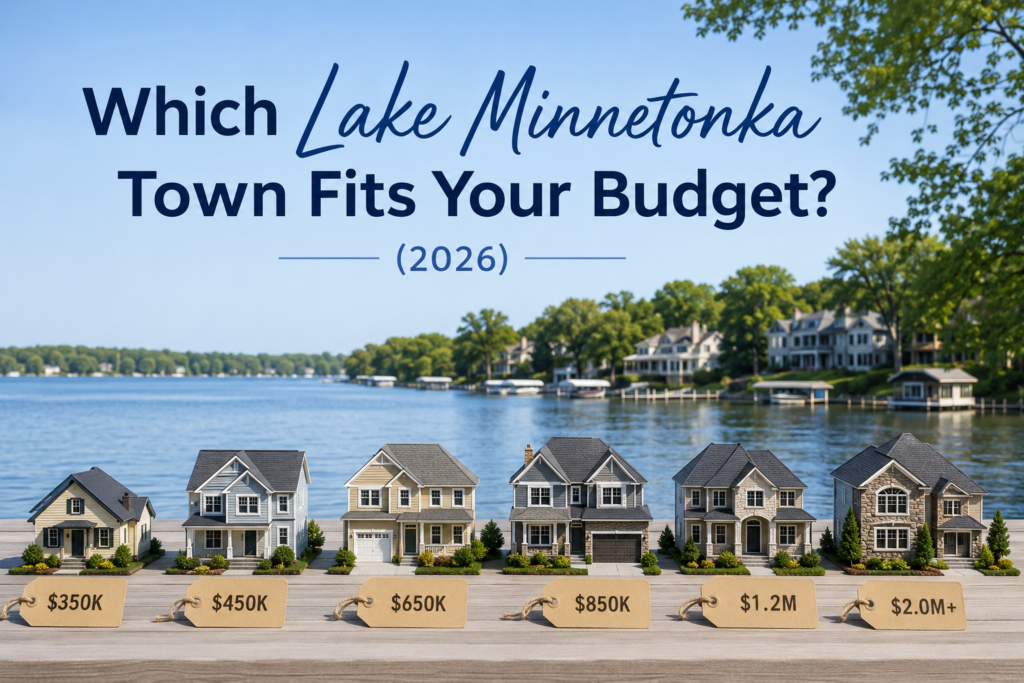
Featured image graphic titled "Which Lake Minnetonka Town Fits Your Budget? (2026)" showing a row of house illustrations with price tags from $350K to $2.0M+ along a Lake Minnetonka shoreline

“Lake Minnetonka” sounds like one market, but it’s really four or five very different ones stitched together around the same shoreline. Excelsior, Wayzata, Mound, and Tonka Bay all sit on or near the lake, all share that unmistakable lake-town feel, and all have wildly different price tags. If you’ve been searching “Lake Minnetonka homes for sale” and getting whiplash between $375K listings and $2 million estates, this is why. Here’s what each town actually costs to buy into right now, and who tends to land where.

Excelsior: The Walkable Lake Town, With a Wide Price Spread

Excelsior has the most range of any town on this list. Recent Redfin data puts the median sale price for homes that closed last month at roughly $375K, while new luxury listings near downtown and the water routinely list well above $1 million. The gap comes down to location within Excelsior: a condo or smaller home a few blocks from the village core can land in the high $300Ks to mid $400Ks, while anything with real lake frontage or a downtown walk score climbs fast. Homes here are also moving briskly, with a median of around a month on market.

Excelsior tends to attract buyers who want the lake lifestyle — coffee shops, restaurants, the Commons, boat access — without committing to full waterfront ownership. If that’s the appeal for you, ask your agent to filter specifically by walk-to-downtown distance, since price per square foot can swing significantly within just a few blocks.

Wayzata: The Premium Address

Wayzata sits at the top of the price ladder among these four towns. Redfin’s most recent figures show a median sale price in the $800Ks for closed sales, while new construction and lakefront listings frequently run well into the $1.5M–$2M range. Homes here also tend to sit on the market longer than in the other towns — often 60 to 100+ days — which actually works in a serious buyer’s favor by allowing more room to negotiate than the headline prices suggest.

Wayzata’s downtown investment in public shoreline access and a more walkable lakefront has reinforced its reputation as the most polished address on the lake. If budget allows, it’s worth touring, but buyers priced out of Wayzata proper often find very similar lake access — at a fraction of the cost — just a few minutes away.

Mound: The Value Play on the Lake

Mound is consistently the most affordable entry point to Lake Minnetonka living. Redfin reports a median sale price in the $385K–$400K range, with single-story and smaller homes often listing in the $340Ks. Homes also move quickly here, frequently selling within three to seven weeks. For buyers who want lake access — boat slips, swim beaches, and trail connections to the Lake Minnetonka Regional Park — without paying Wayzata or Tonka Bay prices, Mound is usually the town worth a closer look first.

The trade-off is that true lakefront in Mound is rarer and competes hard when it does come up — some shared-access neighborhoods with boat slips have sold for under $900K even with renovations, which is a meaningful discount compared to similar access points elsewhere on the lake.

Tonka Bay: Small, Quiet, and Lakefront-Heavy

Tonka Bay is the smallest market of the four, with only a handful of homes for sale at any given time, so pricing here should be read as a range rather than a precise number. Active and recently pending listings cluster heavily in the $1.2M–$1.6M range, reflecting how much of the inventory is waterfront or near-waterfront. Because so few homes change hands here in a given month, it’s worth working with an agent who tracks Tonka Bay closely and can flag a new listing immediately — by the time a Tonka Bay home shows up on a typical portal search, it may already have an offer.

So Which Lake Minnetonka Town Fits Your Budget?

If you’re working with a budget under $450K, Mound and the outer edges of Excelsior are realistically your best entry points to the lake. In the $450K–$900K range, Excelsior’s broader inventory and parts of Wayzata’s market come into play. Above $1M, Wayzata and Tonka Bay both offer true lakefront living, with Tonka Bay leaning even more heavily toward waterfront-only inventory. None of these numbers are fixed — Lake Minnetonka pricing shifts block by block, and the right agent can tell you in five minutes whether a town is realistically in reach or worth stretching for.

Not sure which Lake Minnetonka town actually fits your budget and lifestyle? Find an agent who knows these towns block by block, or learn more about how MinnMatch works to get matched with the right local expert, free.

Minnetonka MN Summer 2026: Parks, Lakes & Why Families Keep Choosing This Suburb

Family walking along a lakeside path in Minnetonka MN with sailboats on the water and a City of Minnetonka sign in summer

If you’ve been spending any time on the west side of the Twin Cities this summer, you already know what makes Minnetonka, MN so hard to leave. Shimmering lakes just minutes from home, trails that wind through serious tree cover, a school district that consistently ranks among the best in the state — and a real estate market that reflects exactly how much families value all of it. Whether you’re seriously considering a move or just starting to explore Minnetonka as a landing spot, summer is the ideal time to see this suburb at its best. Here’s what you need to know.

Parks and Lakes: Minnetonka’s Outdoor Scene Is the Real Draw

Minnetonka sits in one of the most lake-dense pockets of the Twin Cities metro, and residents take full advantage of it from Memorial Day through Labor Day. The city maintains an impressive system of public parks — including Lone Lake Park, Big Willow Park, and the popular Libbs Lake — each offering a mix of trails, open green space, fishing access, and family-friendly amenities. On a warm Tuesday afternoon, these parks don’t feel like afterthoughts; they feel like the center of the community.

Just beyond Minnetonka’s city limits, Lake Minnetonka Regional Park — managed by Three Rivers Park District — gives residents easy access to Lake Minnetonka itself. The park features a nautical-themed play area, a sandy-bottom chlorinated swimming pond, a fishing pier, disc golf, and over three miles of biking and hiking trails. It’s the kind of place you can spend a full summer Saturday without once checking your phone. For families with young kids, the stroller-friendly paved paths and supervised swim area are a particular draw.

Beyond formal parks, Minnetonka’s position adjacent to Lake Minnetonka — one of Minnesota’s largest and most beloved recreational lakes — means boating, paddleboarding, kayaking, and open-water swimming are woven into everyday summer life here. It’s not a weekend-only thing. Residents talk about the lake the way people in other cities talk about their backyard.

Minnetonka Schools: A Top-Ranked District That Families Plan Around

Ask any family why they chose Minnetonka, and the school district comes up almost immediately. Minnetonka Public Schools ranks #2 in Minnesota on Niche’s 2026 Best School Districts list and sits among the top 50 school districts in the entire country. The numbers behind that ranking are hard to argue with: the district’s average testing rank scores in the top 1% of Minnesota public schools, with math proficiency at 76% — compared to the state average of 46%.

Minnetonka High School ranks among the top three high schools in Minnesota, and individual elementary schools like Scenic Heights and Groveland appear in top-60 rankings statewide. Beyond academics, the district is known for its deep arts and music programs, K-12 Spanish and Chinese immersion options, advanced coursework, and a 98% graduation rate. The Minnetonka Class of 2026 held its commencement at US Bank Stadium — which tells you something about the scale and pride of this community.

It’s worth noting that the Minnetonka district is also the most sought-after for open enrollment in Minnesota, drawing nearly 3,600 nonresident students annually. Families who don’t live in the district actively try to get in. Families who do live here tend to stay.

Minnetonka MN Summer 2026 Real Estate: What the Market Looks Like Right Now

The Minnetonka real estate market heading into summer 2026 is active, competitive in desirable neighborhoods, and still fairly tight on inventory. Median home prices in Minnetonka have been running in the $470,000–$550,000 range depending on the data source and time period, reflecting both the quality of housing stock and the premium buyers willingly pay to be in this school district and community. As one industry overview noted, inner-ring suburbs like Minnetonka with strong schools consistently carry medians in the $500,000 to $700,000-plus range.

Homes here are moving in roughly 25–29 days on average, and a meaningful percentage continue to sell above asking price — a sign that buyer demand hasn’t cooled off even as broader inventory has loosened slightly across the state. The sale-to-list price ratio has held near 99.5%, meaning sellers are still commanding close to full price. If you’re buying this summer, come prepared with a pre-approval letter and a clear sense of what you want — well-priced homes in Minnetonka don’t sit.

What does your budget get you? In the $400,000–$500,000 range, expect well-maintained ramblers and split-levels in established neighborhoods — often with mature trees, finished basements, and proximity to parks. Move into the $550,000–$700,000 range and you’ll find newer construction, larger lots, and updated interiors. Above $700,000, Minnetonka offers some of the Twin Cities’ most beautiful executive homes, including properties with lake access or views. Check the Minnetonka market page on Redfin for current listings and pricing trends.

What Living in Minnetonka Actually Feels Like Day-to-Day

Minnetonka occupies a sweet spot in the Twin Cities suburb matrix: it’s suburban enough to offer space, quiet streets, and great schools, but urban enough to have genuine amenity density. The city has its own distinct commercial corridors, a mix of independent restaurants, coffee shops and local businesses alongside larger retail, and a community identity that doesn’t feel like it was designed by committee.

Downtown Minneapolis is about 12 miles from central Minnetonka — a 20-minute drive in non-rush traffic. That proximity matters for residents who work in the city but want the kind of outdoor lifestyle Minnetonka delivers on weekends. The city also sits along Highway 394 and Interstate 494, giving commuters solid options in multiple directions across the metro.

Summer weekends in Minnetonka have a particular rhythm to them: kids riding bikes to the park in the morning, families launching kayaks by afternoon, and neighbors gathering around fire pits after the sun goes down. It’s genuinely one of those places where the lifestyle matches the listing.

Is Minnetonka the Right Fit for Your Family?

Minnetonka tends to attract families with kids, nature-oriented buyers who want lake and trail access baked into daily life, and move-up buyers coming from other Twin Cities suburbs who are ready to settle in somewhere they can stay long-term. It’s also consistently popular with relocating professionals who research school districts before picking a neighborhood — Minnetonka routinely tops those searches.

If Minnetonka is on your radar, summer is the right time to see it in person. Neighborhoods show best when the trees are full, the lakes are busy, and you can get a feel for the parks your kids would actually use. Just don’t expect a leisurely timeline once you find something you like — the market rewards buyers who are ready to move quickly.

For a deeper look at what’s happening across the metro, visit the Minneapolis Area Realtors for the latest market data, or browse our Minnetonka community page for more neighborhood insights.

Ready to Buy in Minnetonka This Summer?

Minnetonka’s market moves fast, and who you work with matters. MinnMatch connects Twin Cities buyers with experienced, vetted local agents who know this neighborhood — the streets, the schools, the price points that make sense. It’s free, it’s personal, and there’s no algorithm deciding your match.

Find a Minnetonka Agent →

Wayzata MN Summer 2026: Boating, Dining & a Real Estate Market That Never Slows Down

Lakefront dining table with wine glass overlooking Lake Minnetonka with sailboat at sunset in Wayzata MN

If you’ve spent even one summer evening in Wayzata — watching sailboats cross Wayzata Bay, the sun dropping behind the tree line over Lake Minnetonka — you already understand why people don’t just visit this town. They try to figure out how to stay. The Wayzata MN real estate market reflects that pull: a small, tightly held inventory of luxury homes in a community where lifestyle, location, and long-term value all point in the same direction. Whether you’re here to boat, to dine, or to seriously consider making a move, summer 2026 is a compelling time to pay attention.

Wayzata on the Water: Why Summer Here Is Unlike Anywhere Else in Minnesota

Lake Minnetonka is the crown jewel of the Twin Cities metro, and Wayzata sits on its northern shore with front-row access. The city’s name itself comes from the Dakota word Waziyata, meaning “north shore” — a fitting origin for a community that has organized itself around the lake for well over a century.

Summer in Wayzata means pontoon boats cutting across calm bays on weekday mornings, regattas drawing weekend crowds to the waterfront, and the steady hum of activity along the Panoway — the community’s lakeside promenade. The pedestrian-only boardwalk has become one of the most popular gathering spots in the western suburbs, a place where families stroll, couples catch sunsets, and locals run into neighbors they haven’t seen since spring.

For boaters, Wayzata Marine and other local outfitters keep the docks busy all season, and the public launch gives access to all 14,000-plus acres of Lake Minnetonka. Each summer, the Wayzata Art Experience transforms the Panoway into a two-day juried art festival featuring more than 150 artists, live music, food vendors, classic wooden boats, and an artisan beer and wine garden — one of the most well-attended outdoor events in the metro. James J. Hill Days rounds out the summer calendar with community celebrations rooted in the city’s railroad heritage.

All of that energy — the water, the events, the walkable downtown — doesn’t just make for a great summer. It builds a community that people actively compete to join, which has a very direct effect on what happens in the Wayzata real estate market.

Dining in Downtown Wayzata: From Casual Dockside to White-Tablecloth Lakefront

One of the quieter compliments Wayzata receives is that its restaurant scene punches well above its population. For a city of roughly 4,000 people, the dining options are genuinely impressive — and in summer, when patios open and the lake becomes part of the backdrop, they’re hard to beat anywhere in Minnesota.

6Smith remains the anchor of the downtown dining scene. Situated just steps from the water with nothing but dock between the restaurant and Lake Minnetonka, it offers a fine-dining experience — fresh seafood, steaks, lobster rolls — that draws visitors from across the metro and earns consistent recognition as one of the best restaurants on the lake. Reservations are encouraged, especially on summer weekends.

CōV brings a different energy: an East Coast-meets-Midwest vibe that the restaurant describes as channeling Nantucket or the Hamptons. The lakefront patio hosts a summer music series, the menu runs from burgers to seafood, and the lobster guacamole has developed a devoted following. On any given summer Friday evening, the patio is exactly as good as it sounds.

Gianni’s Steakhouse has long been a go-to for classic steakhouse fare in a setting that feels occasion-worthy without being stiff. Maggie’s, in contrast, is the town’s beloved no-frills diner — counter service, great pizza and burgers, and the kind of place that feels like it belongs to the community rather than a dining trend.

The combination of lakefront fine dining, lively patio bars, and neighborhood staples makes Wayzata’s food scene one of the genuine lifestyle amenities that buyers factor in when evaluating whether to put down roots here versus in neighboring communities. When clients ask about life in Wayzata, the answer almost always involves at least one restaurant recommendation.

The Wayzata MN Real Estate Market in Summer 2026: What the Numbers Show

Wayzata’s housing market operates at a price point that reflects its status as one of the most desirable addresses in the Twin Cities. Median list prices have hovered near the $2 million range, with active listings this spring showing an average price per square foot above $800, according to current MLS data. Total active inventory in the city typically runs between 70 and 130 homes at any given time — a relatively thin supply for the level of buyer interest the community generates.

For context, Redfin’s Wayzata market data shows median sale prices in the high six figures to low seven figures depending on the time of year and product type — a range heavily influenced by whether lakefront or non-lakefront properties dominate a given month’s closings. When a direct-access Lake Minnetonka home changes hands, it can pull the median significantly higher; when townhomes and interior lots move, the figures moderate.

Days on market in Wayzata tend to run longer than the broader Twin Cities metro — averaging in the range of 80 to 107 days depending on the season, reflecting both the luxury price point and the selective pool of qualified buyers. That doesn’t mean the market is slow in any absolute sense; it means buyers are deliberate and sellers who price correctly still find strong outcomes. Premium lakefront properties — especially those with deeded lake access, private docks, and significant shoreline footage — continue to command top dollar and generate competitive interest when they hit the market.

One well-known characteristic of Wayzata’s highest-end segment: many of the best properties never reach the MLS. Off-market transactions are common, especially in the Ferndale and Bushaway Road areas, where established families hold multi-generational homes that pass quietly through agent networks. If you’re searching Zillow for a Wayzata lakefront home and wondering why inventory looks thin, that’s part of the explanation.

What Makes Wayzata Real Estate Different from Other Lake Minnetonka Communities

Lake Minnetonka has no shortage of desirable communities — Excelsior, Minnetonka Beach, Tonka Bay, Deephaven all have their own loyal followings. But Wayzata occupies a specific niche that sets it apart from almost all of them: it is the only Lake Minnetonka community with a true walkable downtown directly on the water.

That combination — lakefront access, a functioning downtown with shops and restaurants, strong schools in the Wayzata Public Schools district, and reasonable proximity to Minneapolis (roughly 15 miles west on I-394) — is genuinely rare. Buyers who want lake lifestyle without sacrificing urban convenience consistently put Wayzata at the top of their shortlist.

The community also benefits from strong long-term value stability. The desirability of Lake Minnetonka shoreline is not a recent trend — it has anchored generational wealth in the Twin Cities for over 100 years, and there is no structural reason to expect that to change. Buyers purchasing in Wayzata today are making a long-term bet on one of the most consistently valued real estate markets in Minnesota, according to data tracked by Minneapolis Area Realtors.

For those comparing Wayzata to nearby Minnetonka or Eden Prairie, the price premium is real — but it buys something that the neighboring suburbs simply cannot replicate: lake access combined with a downtown that feels alive in every season.

Tips for Buyers Entering the Wayzata Market This Summer

If you’re seriously considering a purchase in Wayzata, a few things are worth understanding before you start your search:

Get pre-approved and prepared to move quickly. At the $1M–$3M+ price range, transactions require serious financial documentation. In a thin-inventory market, arriving unprepared often means watching a property disappear before you can make a competitive offer.

Understand the spectrum of “lake access.” There is a significant difference between a home with deeded lakeshore, a home with association dock access, and a home with no water access at all. Each tier carries very different price points and lifestyle implications. Know which matters most to you before touring.

Don’t rely solely on public listings. As noted above, a meaningful share of Wayzata’s best properties trade off-market. An agent with deep roots in this specific community will have access to opportunities that never hit Zillow or Realtor.com.

Be patient, but not passive. Extended days on market in Wayzata doesn’t mean sellers are desperate — it means the buyer pool is smaller and more selective. Properties priced well and in good condition still move. Being ready to act when the right home appears is more valuable than a fast market.

Ready to Explore Wayzata Real Estate?

Wayzata is a market where who you know matters as much as what you can find online. MinnMatch connects buyers and sellers with experienced, vetted local agents who specialize in Lake Minnetonka communities — including Wayzata’s most coveted streets and off-market opportunities. Our service is free, human-powered, and built for buyers and sellers who want to get it right the first time.

Find a Wayzata Agent

Edina vs. Wayzata in 2026: Which Upscale Twin Cities Suburb Is Worth the Price Tag?

Edina vs. Wayzata in 2026 — comparing luxury homes, lake lifestyle, schools, and cost of living in two upscale Twin Cities suburbs

Two names come up again and again when buyers are shopping the top tier of the Twin Cities market: Edina and Wayzata. Both are prestigious. Both have outstanding schools. Both will cost you. But they’re not the same place, and the right choice depends heavily on how you want to live. If you’re weighing these two upscale Twin Cities suburbs against each other in 2026, here’s what you actually need to know — prices, trade-offs, and all.

The Price Tag: What Homes Actually Cost in Edina vs. Wayzata

Let’s start with the number that matters most. Edina’s median home price is currently around $580,000–$630,000, depending on the month and source — with the most active segment sitting between $400,000 and $600,000. You’ll find entry-level condos near Southdale in the $180,000s and estate properties in Indian Hills pushing well past $3 million. That’s a wide range, which is part of Edina’s appeal: it has more runway for buyers at different budgets.

Wayzata runs considerably higher. Redfin data puts Wayzata’s median sale price at roughly $828,000, and price-per-square-foot figures reflect that premium — Minneapolis Area Realtors data shows Wayzata at approximately $310 per square foot compared to Edina’s $268. When you factor in the lakefront homes and large-lot estates near Lake Minnetonka, the ceiling in Wayzata is essentially unlimited.

Bottom line: if you’re comparing apples to apples in terms of square footage and condition, Wayzata will almost always cost more. The question is whether that premium is worth it to you — and that depends on what you’re buying into beyond the house itself.

Schools: Both Are Elite, but With Different Flavors

School quality is a primary driver for families choosing between these two suburbs, and you genuinely can’t go wrong with either. According to Niche’s 2026 Best School Districts in Minnesota rankings, Wayzata Public Schools ranks #1 in the Twin Cities metro, earning an A+. Edina Public School District follows closely at #3 statewide, also with an A+. Both districts have a strong college-prep culture, dedicated teaching staff, and robust extracurricular programs.

There are some nuanced differences. The Edina district has built a strong reputation around talent development programs, language immersion, and travel-based learning opportunities starting in early childhood. Wayzata schools boast a 96% graduation rate — well above state averages — and a wide range of AP and honors offerings. Wayzata High School itself is physically located in Plymouth, which surprises some buyers; the district boundary doesn’t perfectly match the city limits.

For most families, both districts will deliver an exceptional public school experience. If the small edge in district ranking matters to you, Wayzata has it — but Edina is not far behind by any meaningful measure.

Lifestyle and Location: The Real Differentiator

This is where Edina and Wayzata really diverge. Edina sits right on the border of Minneapolis — about 15 minutes to downtown — and feels like the best of suburban and urban living layered together. You get walkable retail at 50th & France, Centennial Lakes Park, a strong dining and coffee scene, and the kind of neighborhood character that comes from decades of established community. It’s practical, polished, and year-round livable.

Wayzata is a completely different vibe. It’s a small lakefront city on the north shore of Lake Minnetonka, with a compact, walkable downtown built around boutique shops, lakeside dining, and a marina. In summer, it’s magical — boat slips, waterfront promenades, and a community energy that’s hard to replicate. The trade-off is that Wayzata’s downtown appeal is seasonal, and it sits farther west of Minneapolis, adding commute time for those working in the city or eastern suburbs.

Simply put: if you want a suburb that functions efficiently year-round with quick city access, Edina wins. If lake life is central to how you relax and entertain — boating, swimming, watching sunsets over the water — Wayzata’s premium starts to make a lot more sense.

Commute and Convenience: Edina Has the Edge

Edina’s inner-ring location is genuinely one of its most underrated assets. Residents are 15 minutes from downtown Minneapolis, with easy access to major corridors like Highway 100, I-494, and France Avenue. Southdale Center, multiple grocery options, and a dense mix of services make daily errands fast and convenient regardless of the season.

Wayzata is farther west — typically 25 to 35 minutes from downtown Minneapolis depending on traffic — and its smaller size means fewer everyday conveniences within walking or short driving distance. That said, nearby Minnetonka and Plymouth fill in many of those gaps, and buyers who work in the western suburbs or from home often find the commute trade-off entirely acceptable.

If you commute into Minneapolis daily, Edina is the clearer choice. If your work is flexible or based on the west side of the metro, Wayzata becomes much more viable.

So Which One Is Worth It? Here’s How to Decide

There’s no universal right answer here — and anyone who tells you there is probably hasn’t spent much time in both communities. What we can tell you is this: Edina offers more value per dollar for buyers prioritizing proximity to Minneapolis, year-round convenience, and a slightly wider entry point into an upscale market. Its schools are elite, its neighborhoods are established, and its price appreciation has been consistent.

Wayzata commands a premium that’s justified for buyers who want lakefront access, a distinctive small-town atmosphere, and a lifestyle built around Lake Minnetonka. If the lake is a genuine priority — not just a nice-to-have — you’ll feel that difference every weekend from May through October, and the community identity will reward that investment.

According to Minnesota Housing Finance Agency data, both communities have shown long-term price resilience, making either a sound long-term investment for buyers who plan to stay. The real question isn’t which suburb is objectively better — it’s which one fits the way you actually want to live.

That’s where having a local expert in your corner makes all the difference. At MinnMatch, we connect buyers with vetted Twin Cities agents who know both of these markets from the inside — the streets, the neighborhoods, the blocks that hold value, and the ones that don’t. Whether you’re leaning toward Edina or Wayzata, we’ll match you with the right agent to make your move with confidence. Get matched for free →

Summer Is Peak Season on Lake Minnetonka — Here’s Why Smart Sellers List Now

Lakefront home on Lake Minnetonka in summer with a classic wooden boat docked and Adirondack chairs on the deck

If you own a home on or near Lake Minnetonka, you already know what summer feels like out here — boats on the water by 7 a.m., dinner on the deck until dark, neighbors you only see three months a year suddenly everywhere. What you might not fully appreciate is that this exact feeling is what drives buyers to make their move — and why the window between Memorial Day and Labor Day is the single most powerful selling season on the lake. Right now, in June 2026, that window is wide open. And the sellers who list today are the ones positioned to get top dollar before it closes.

Why Summer Is the Season That Defines Lake Minnetonka Real Estate

Lakefront real estate operates on a different calendar than the broader housing market. While spring is often the peak selling season for suburban homes across the Twin Cities, Lake Minnetonka’s peak runs from Memorial Day through mid-August — and for a very simple reason: buyers need to see the lake at its best before they’ll commit to buying on it.

Think about what buyers are actually purchasing when they buy a Lake Minnetonka home. It’s not just square footage and a neighborhood — it’s a lifestyle. They want to picture themselves on the dock, launching from the slip, watching fireworks from the deck. That vision only comes to life in summer. A lakefront home shown in January tells a buyer almost nothing about why the property is worth a premium. A lakefront home shown in June, with the water sparkling and boats in the slip, sells itself.

This isn’t just intuition — it’s reflected in the data. LakePlace.com currently shows 218 active Lake Minnetonka lake property listings with an average listing price of $2.84 million — and that pool of motivated, financially serious buyers is actively browsing right now. The buyers shopping in June aren’t casually clicking through Zillow. They’ve been planning this purchase for months, they’re pre-qualified, and they want to be on the water before summer slips away.

The Numbers Behind the Summer Seller’s Advantage

The broader Twin Cities market is giving sellers real momentum heading into summer 2026. According to Minneapolis Area Realtors®, the metro’s months supply of single-family homes sits at just 2.0 months — firmly in seller’s territory. The median sales price in the region has climbed to $380,000, and closed home sales jumped 46.7% month-over-month from February to March 2026, signaling that buyer activity is accelerating into the warm season. And 2026 has delivered the strongest spring for new listings since 2022, which means buyers have been actively engaged and ready to pull the trigger.

On the lake itself, the premium over broader market prices is substantial. While Hennepin County’s rolling median hovers around $400,000, Lake Minnetonka’s shoreline communities command a completely different price tier. The Minneapolis Area REALTORS® 2024 Annual Housing Report showed median sale prices of $2.29 million in Minnetonka Beach, $1.90 million in Tonka Bay, $1.14 million in Orono, $1.09 million in Wayzata, $1.0 million in Deephaven, and $840,000 in Excelsior. The average Lake Minnetonka lakeshore listing runs $545 per square foot — nearly 2.5x the broader metro average.

Lakefront properties have also shown strong appreciation. Average sales prices on the lake rose roughly 3.9% in 2025, with price per square foot up 5.2% — outpacing the broader market and signaling continued demand that hasn’t softened heading into 2026.

The Window Is Shorter Than You Think

Here’s the truth that catches a lot of Lake Minnetonka sellers off guard: the prime selling window on the lake is about 10 to 12 weeks long. Once you get past mid-August, buyers’ urgency drops off fast. School starts, attention shifts, and the emotional pull of “I need to be on the lake this summer” disappears until next year. What had been a motivated, time-pressed buyer pool becomes a much more patient, deliberate one — and patient buyers negotiate harder.

Sellers who list in late August or September often find themselves chasing the market rather than leading it. They miss the buyers who were ready to act in June. They watch their days on market climb. They start reducing their price in October to attract whatever off-season traffic is left. By contrast, sellers who list in early June catch buyers at peak motivation — when “I want to be here for the rest of this summer” is a real and powerful emotion that translates into faster decisions and stronger offers.

That’s not a minor detail. On a $1.5 million lakefront property, the difference between a strong June offer and a discounted September offer can easily be $75,000 to $150,000 — just from timing alone.

What Smart Lake Minnetonka Sellers Are Doing Right Now

Getting the most out of a summer listing on Lake Minnetonka isn’t just about timing — it’s about showing up ready. A few things that move the needle on lakefront properties specifically:

Price from true lakefront comps, not county averages. The biggest pricing mistake sellers make is benchmarking against Hennepin County’s overall median. Your pricing strategy needs to account for your specific bay location, shoreline footage, dock access, water orientation, and privacy. A home on the coveted west side of the lake with 100 feet of shoreline and a deep-water slip is priced very differently than a deeded-access property two blocks from the water — even if they’re in the same zip code.

Show the lake, not just the house. Professional photography and video should capture the property from the water, not just from the driveway. Drone footage of the bay, the dock, the shoreline approach — this is what lakefront buyers actually want to see, and it’s what makes a listing stand out in a market where buyers are browsing from across the country.

Get the dock and shoreline ready before you list. Buyers will walk the shoreline. A weathered dock, invasive weeds near the water’s edge, or an overgrown bank tells a buyer there’s deferred maintenance — even if the home itself is immaculate. Pressure-washing the dock, trimming the shoreline, and putting the boat lift in service before photos are taken can make a significant difference in first impressions.

Work with an agent who knows the lake — not just the metro. Lake Minnetonka’s 37 bays, 31 channels, and 120+ miles of shoreline create enormous variation in value. An agent who sells homes across the metro may not know the difference in buyer demand between a home on Crystal Bay versus one on Cook’s Bay, or how much a south-facing orientation adds at sunset. You need someone who has negotiated lakefront-specific deals, understands DNR shoreline regulations, and can speak fluently to dock rights and water access.

Find the Right Agent — and Move Before the Season Peaks

If you’re thinking about selling your Lake Minnetonka home this year, the time to act is now — not in August, not after Labor Day, and not “when things slow down.” The buyers are here, the market is strong, and the emotional pull of summer on the lake is working in your favor. Every week you wait is a week of that window closing.

At MinnMatch, we specialize in connecting Lake Minnetonka sellers with agents who actually know this market — people who’ve closed deals on these shores, understand lakefront pricing nuances, and know how to reach the right buyers fast. Our matching process is free, personal, and built around your specific property and goals.

Connect with a Lake Minnetonka listing agent through MinnMatch today — and get your home in front of summer buyers while the season is still working for you.

Lake Minnetonka vs. Prior Lake: Minnesota’s Two Most Popular Lake Markets Compared

Aerial comparison of Lake Minnetonka and Prior Lake waterfront homes in Minnesota

If you’re searching for a lake home in the Twin Cities metro, two names come up again and again: Lake Minnetonka and Prior Lake. Both offer genuine waterfront living, strong community identities, and real estate markets that consistently outperform their landlocked neighbors. But Lake Minnetonka vs. Prior Lake real estate is not an apples-to-apples comparison — and understanding the differences could save you months of searching in the wrong direction.

This guide breaks down both markets across price, lifestyle, buyer profile, and long-term value so you can make a more informed decision — or hand this article to the agent who’s helping you make it.

Not sure which market is right for you? MinnMatch can match you with a vetted local agent who knows both lakes inside and out.

Lake Minnetonka vs. Prior Lake: The Basics

Before comparing the real estate, it helps to understand what you’re actually buying access to.

Lake Minnetonka is the headline act of Minnesota metro lake living. Spanning roughly 14,000 acres across 14 communities in Hennepin County, it’s the largest and most storied lake in the Twin Cities area — a destination that has defined western-suburb prestige for more than a century. Wayzata, Excelsior, Orono, and Deephaven are among the communities that ring its 125 miles of shoreline. The lake sits approximately 12 miles west of downtown Minneapolis.

Prior Lake — technically two connected lakes, Upper and Lower Prior Lake — covers about 1,340 combined acres in Scott County, roughly 20 miles southwest of downtown Minneapolis. It’s smaller in scale but punches well above its size in desirability. The city of Prior Lake has grown significantly in recent decades and is now home to approximately 27,000 residents who have built their community identity around water access, outdoor recreation, and quality schools.

In short: Lake Minnetonka is the prestige play. Prior Lake is the accessible-but-still-aspirational alternative. Both are legitimate lake markets — but they attract meaningfully different buyers.

Price Comparison: What Does a Lake Home Actually Cost?

Lake Minnetonka

Lake Minnetonka is one of the most expensive residential real estate markets in Minnesota, full stop. As of May 2026, there are roughly 218 active waterfront listings on the lake with an average asking price of approximately $2.8 million — and a price per square foot hovering around $545. Typical lakeshore listings average about 4,500 square feet with nearly four bedrooms and four bathrooms.

The range is wide. Entry-level access to Lake Minnetonka shoreline can start around $1 million for a smaller or dated cottage, while high-end estates in Orono or Wayzata regularly list at $10 million and above. At the extreme end, an extraordinary off-market estate was listed at $55 million — more than 29,000 square feet with a wine cave, movie theater, bowling lanes, and multiple docks.

For buyers who want proximity to the lake but not a direct shoreline price tag, the broader communities surrounding the lake — the city of Minnetonka, Wayzata, Excelsior — offer more accessible entry points. The city of Minnetonka’s overall median home value sits around $521,000 as of 2025, reflecting the mix of lakefront luxury and inland residential neighborhoods.

Prior Lake

Prior Lake offers a more accessible price spectrum while still delivering real waterfront value. The citywide median home value is approximately $526,000 as of early 2026 — remarkably close to broader Minnetonka — but the waterfront premium is more moderate.

As of May 2026, there are 57 active lake property listings in Prior Lake with an average listing price of roughly $1.65 million and a price per square foot of $383 — meaningfully below Lake Minnetonka’s $545. The most expensive waterfront listing sits at $17.9 million, while more modest lake-access properties can be found for as little as $135,000 (typically association-access or smaller lots).

For buyers who want lakefront living in the $600,000–$1.2 million range, Prior Lake offers options that simply don’t exist on Lake Minnetonka. That’s a significant differentiator for move-up buyers, growing families, and buyers relocating from out of state.

Side-by-Side Snapshot

Metric Lake Minnetonka Prior Lake
Lake size ~14,000 acres ~1,340 acres
Avg. waterfront listing price ~$2.8M (May 2026) ~$1.65M (May 2026)
Avg. price per sq ft (waterfront) ~$545 ~$383
Citywide median home value ~$521,000 (Minnetonka city) ~$526,000
Distance to Minneapolis ~12 miles west ~20 miles southwest
School district(s) Minnetonka, Wayzata, Orono, Mound Westonka Prior Lake-Savage Area Schools
Communities on the lake 14 1 (city of Prior Lake)

Lifestyle: Two Very Different Lake Vibes

Lake Minnetonka: Established Elegance, Walkable Villages, Deep Roots

Lake Minnetonka has a character that’s hard to replicate — it has been Minnesota’s most coveted lake address for well over a century. The 14 communities surrounding it each have distinct identities. Wayzata is boutique-chic with a vibrant downtown, waterfront dining, and a Metra train connection to Minneapolis. Excelsior has the feel of a classic Midwestern lake town, with independent shops, a public beach, and summer street festivals. Orono and Greenwood offer wooded privacy and estate-scale properties. Deephaven sits somewhere in between — elegantly residential, less commercial, deeply quiet.

The lake itself supports year-round recreation. In summer it’s a full destination: boating, paddleboarding, sailing regattas, and fishing tournaments. In winter, ice fishing shanties dot the bays and the lake is a fixture of the local snowmobile culture. The social fabric around Lake Minnetonka is dense — yacht clubs, community events in Excelsior, the iconic Lord Fletcher’s on the water — and buyers are often as drawn to that community energy as they are to the shoreline itself.

Proximity to Minneapolis is a genuine selling point, too. Most lake towns are a 20–30 minute drive, making it feasible to live a lake-first life without sacrificing urban access.

Prior Lake: Active, Unpretentious, Growing Fast

Prior Lake has a different energy — less legacy prestige, more lived-in vitality. The city has grown considerably over the past two decades, and that growth has attracted a younger demographic of families who want authentic lake access without the stratospheric price tag of the west metro lakes.

Upper Prior Lake tends to attract buyers who want calmer waters, more privacy, and a settled residential character. Lower Prior Lake, with its more open water, draws the boating and water sports crowd. Both are consistently among the most popular recreational lakes in the south metro. The lake hosts strong fishing — walleye, northern pike, largemouth bass, and crappie — and the broader community includes 51 parks, extensive trail networks, and the prestigious Wilds Golf Club adjacent to the lake’s southern neighborhoods.

The Prior Lake Association has worked since 1946 to preserve and promote the water and shoreline, and the city actively monitors water quality and manages aquatic invasive species — a sign that the community takes its lake asset seriously for the long term.

Scott County’s consistent growth has made Prior Lake one of the fastest-growing communities in Minnesota, and the Prior Lake-Savage Area Schools draw strong reviews from families considering the area. For buyers who are prioritizing school quality alongside lake access, Prior Lake checks both boxes at a more attainable price point.

Which Lake Market Is Right for You? Buyer Profiles

Both Lake Minnetonka and Prior Lake attract lake-lifestyle buyers — but the specific buyer profiles diverge in meaningful ways. Here’s a practical breakdown.

Lake Minnetonka Is Typically the Better Fit If:

  • Your budget for waterfront is $1.5 million or above, and ideally $2–5 million for a move-in-ready lakeshore property.
  • You want walkable access to vibrant communities like Wayzata or Excelsior — coffee shops, restaurants, boutiques, right from the boat or the sidewalk.
  • You’re drawn to the prestige and legacy of the address — Lake Minnetonka is a known quantity nationwide and carries status that Prior Lake simply doesn’t match.
  • You work in Minneapolis and want a west-metro commute or access to Wayzata’s Metra rail stop.
  • You prioritize a robust social lake culture — yacht clubs, regattas, and a dense community of other lake residents who share the lifestyle.
  • You’re looking at this as a long-term luxury investment and want the brand-name lake with historical price resilience.

Prior Lake Is Typically the Better Fit If:

  • You want genuine waterfront access with a budget in the $500,000–$1.5 million range — a segment where Lake Minnetonka options are extremely limited.
  • You have school-age children and want a strong, cohesive school district (Prior Lake-Savage) paired with a family-oriented community culture.
  • You prefer a more intimate lake — fewer commercial operators, calmer on summer weekends, a more neighborhood-oriented feel.
  • You work in the south metro (Shakopee, Eden Prairie, Burnsville) and want to minimize commute time while maximizing lifestyle.
  • You’re a first-time lake-home buyer and want to learn the lifestyle before potentially stepping up to a higher-price lake market later.
  • Outdoor recreation — fishing, boating, golf at The Wilds, trail access — matters more to you than proximity to upscale commercial districts.

Market Dynamics: Competition, Inventory, and Days on Market

Lake Minnetonka waterfront is structurally undersupplied — there’s a fixed amount of shoreline, very few new lots, and demand that remains elevated even when broader markets soften. In July 2025, waterfront homes on Lake Minnetonka averaged about 63 days on market, up from 31 days the prior year as buyers exercised more patience at elevated price points. That’s not a sign of weakness so much as a reflection of how selective the buyer pool is at $2–5 million.

Prior Lake is more active in volume terms. The broader Prior Lake market had 52 homes sold in August 2025, up meaningfully from 38 the prior year — and homes in the city sell in roughly 26–40 days depending on the segment. Waterfront properties move faster and with less negotiating room, similar to any lake-adjacent market in the metro.

Both markets benefit from Minnesota’s broader housing dynamics: statewide, inventory remains limited relative to buyer demand, and lake properties in the Twin Cities continue to be treated as lifestyle assets rather than purely transactional purchases. Buyers who hold well-positioned lake homes on either lake tend to hold them — which keeps turnover low and well-priced listings competitive.

What to Watch For in Either Market

Both lake markets have nuances that make local expertise essential. A few things to keep in mind before you make an offer on either lake:

Shoreline rights and dock permits. Not all “lake access” properties are equal. Direct shoreline ownership, deeded dock rights, water depth at the dock, and HOA rules around boat storage vary significantly — even between adjacent properties. Confirm these entitlements before you close, not after.

Aquatic invasive species. Both lakes have documented AIS concerns. Prior Lake manages zebra mussels and Eurasian watermilfoil actively, and Lake Minnetonka has faced similar challenges. This doesn’t diminish the lakes’ value, but it’s worth understanding what ongoing management looks like and how it affects your recreational experience.

Community fit over shoreline metrics. Buyers often get so focused on feet of frontage and water depth that they underweigh the community question: Will you feel at home here? Lake Minnetonka’s 14 distinct communities each have their own social temperature. Prior Lake’s neighborhoods — Sand Pointe, Watzl’s Beach, The Wilds, Jeffers Pond — also differ meaningfully. Touring the community at lake-season pace, not just viewing the house, matters.

Year-round livability. Both lakes support year-round living, but the off-season character is worth experiencing. Lake Minnetonka’s towns maintain energy through winter. Prior Lake is more residential-quiet off-season. Neither is a negative — just a question of what you’re optimizing for.

How MinnMatch Can Help You Choose

Choosing between Lake Minnetonka and Prior Lake isn’t just a price decision — it’s a lifestyle decision, and getting it right means having an agent who actually knows both markets, not just the MLS data.

At MinnMatch, we match buyers and sellers with vetted local agents based on your specific situation — your budget, your lifestyle priorities, your timeline, and which lake genuinely fits the life you’re trying to build. Our matching is personal, not algorithmic. You don’t get sorted into a pool and called by whoever picks up first. You get connected with an agent who has real, recent experience in the market you’re entering.

If you’re exploring lake home options in the Twin Cities — whether that’s Lake Minnetonka, Prior Lake, or somewhere else entirely — start here. The conversation is free, and the guidance is local.

You can also explore our community guides for Lake Minnetonka and Prior Lake for more neighborhood-level detail, or browse our market insights for the latest Twin Cities real estate trends.

For additional context on Minnesota lake markets and statewide housing data, see the Minneapolis Area Realtors monthly market reports, the Minnesota Housing Finance Agency, and property data from Redfin’s Minnesota market overview.


Lake Minnetonka Real Estate in Spring 2026: Why Buyers Are Moving Fast Before Summer

Lake Minnetonka waterfront home for sale in spring 2026 with dock, boat, and tulips in bloom


The Lake Minnetonka real estate market in spring 2026 is moving faster than most buyers expect. Every year, a window opens between the ice going out and the summer social calendar filling up — and buyers who move in that window consistently land better homes at better prices than those who wait. This spring, that window feels narrower than ever. Here’s what’s driving the urgency, what the data shows, and what it means if you’re considering a Lake Minnetonka purchase this year.

Lake Minnetonka Real Estate Spring 2026: Inventory Is Tight and Moving Fast

As of late April 2026, there were 198 active Lake Minnetonka waterfront listings, with an average listing price of just over $3 million. On the surface, that sounds like a lot of options. In practice, well-priced properties in established communities like Wayzata, Minnetonka, and Eden Prairie are moving well before the summer rush — often with multiple offers.

Lakeshore listings average around $563 per square foot, with homes typically offering 3.7 bedrooms, 4.1 bathrooms, and roughly 4,500 square feet of living space. That’s a meaningful investment — which is exactly why getting the right agent before summer demand peaks matters so much. For broader Minnesota housing context, the Minnesota Housing Finance Agency tracks statewide market conditions and affordability trends worth reviewing.

“Well-priced properties on Lake Minnetonka don’t sit — they sell. Spring buyers who move with a plan consistently outperform those who wait for summer to ‘see what’s out there.'”

The $50 Million Listing and What It Signals for the Spring 2026 Market

Lake Minnetonka grabbed national real estate attention this spring when a sprawling 30,000-square-foot estate in the Woodland neighborhood listed for $50 million — which would shatter Minnesota’s all-time home sale record of $17.5 million, set in 2006. The property sits on roughly 8 acres with 650 feet of shoreline and has drawn interest from buyers across the country and internationally.

Ultra-luxury listings like this one don’t just make headlines — they elevate the entire market’s profile and signal sustained demand at every price point. According to data from the Minneapolis Area REALTORS®, the Twin Cities metro continues to see compressed days-on-market figures for well-priced lake properties, reinforcing what local agents already know: hesitation is expensive.

Why Spring Is the Strategic Window for Lake Minnetonka Buyers

There are a few dynamics that make late spring — roughly April through early June — the best time to buy on Lake Minnetonka.

1. Less Competition Than Summer

Summer brings out casual lookers, weekend dreamers, and out-of-town visitors who fall in love with the lake during boating season. Spring buyers are generally more serious and face fewer competing offers on the same homes.

2. Sellers Who Are Ready to Move

Spring sellers tend to be highly motivated — they’ve listed early because they want to close and have their plans in place before summer. That’s a better negotiating environment than peak season, when sellers have the luxury of waiting for the right offer.

3. You Can Still Enjoy the Summer

A buyer who closes in May or June gets to enjoy the full lake season in their new home. Buyers who wait until late summer close in fall and spend winter wondering if they made the right call.

4. Rate Uncertainty Favors Acting Now

Mortgage rates have remained unpredictable in 2025 and into 2026. Locking in your financing before conditions shift further protects your purchasing power — and your peace of mind. Redfin’s housing market tracker is a useful resource for monitoring rate trends and inventory shifts in real time.

Lake Minnetonka Communities to Watch in Spring 2026

The Lake Minnetonka real estate market in spring 2026 spans a diverse set of communities along its more than 125 miles of shoreline — each with its own character, price range, and lifestyle. Here’s a quick snapshot of the communities drawing the most buyer attention this season:

Community Character
Wayzata Upscale village feel, walkable downtown, premier dining and waterfront access
Minnetonka Suburban convenience with excellent schools and lake access
Eden Prairie Family-friendly, highly ranked schools, newer construction options
Plymouth Strong value, growing inventory, easy freeway access to Minneapolis
Prior Lake Lakeside affordability relative to Minnetonka, strong community feel

What Buyers Are Actually Competing For

Not all Lake Minnetonka homes are created equal — and the ones buyers truly compete over share a few consistent traits:

  • Direct lake access — frontage with a private dock or slip is the top driver of both demand and price
  • Updated kitchens and primary suites — buyers at this price point expect move-in condition
  • Proximity to Wayzata or Excelsior — walkability to dining and waterfront activity commands a premium
  • Top school districts — Wayzata, Minnetonka, and Orono district homes attract strong family buyer pools
  • Sunset or south-facing views — a detail that seems minor but significantly impacts offers received

Understanding what makes one home significantly more competitive than another — and being ready to move when the right one surfaces — is where an experienced local agent becomes invaluable. This isn’t a market for guesswork.

The Right Agent Makes the Difference in a Fast Spring Market

Lake Minnetonka is not a market where any licensed agent will do. It’s a highly specialized waterfront market with nuances that take years to learn — shoreline classifications, dock permitting, floodplain considerations, seasonal access, and the subtle community-by-community differences that determine long-term value.

The right agent also brings something no portal or algorithm can replicate: relationships with other local agents and access to homes that haven’t hit the MLS yet. In a tight inventory market, off-market knowledge is a genuine competitive advantage.

That’s exactly what MinnMatch does: we connect buyers with vetted, Lake Minnetonka-specialist agents who know this market from the inside. Not a list of names — a curated recommendation based on your specific situation, timing, and goals. And it’s completely free for buyers.

Ready to Buy on Lake Minnetonka This Spring?

MinnMatch connects you with a handpicked local expert who knows the lake — no pressure, no fees, just the right agent for your search.


Find My Agent →

Don’t Wait for Summer to Get Serious About Lake Minnetonka Real Estate

Every spring, buyers who hesitate end up watching the homes they wanted sell to someone who moved faster. The Lake Minnetonka real estate market in spring 2026 rewards preparation: knowing your budget, understanding the communities, and having an agent who can act quickly and strategically on your behalf.

If a lake home is on your list for 2026, the best time to start was last month. The second best time is right now.

Learn how MinnMatch works for buyers, explore the Lake Minnetonka community guide, or get matched with a local specialist — all free, all human-powered, and all built for this market.