South Minneapolis vs. Edina in 2026: Urban Energy vs. Suburban Comfort

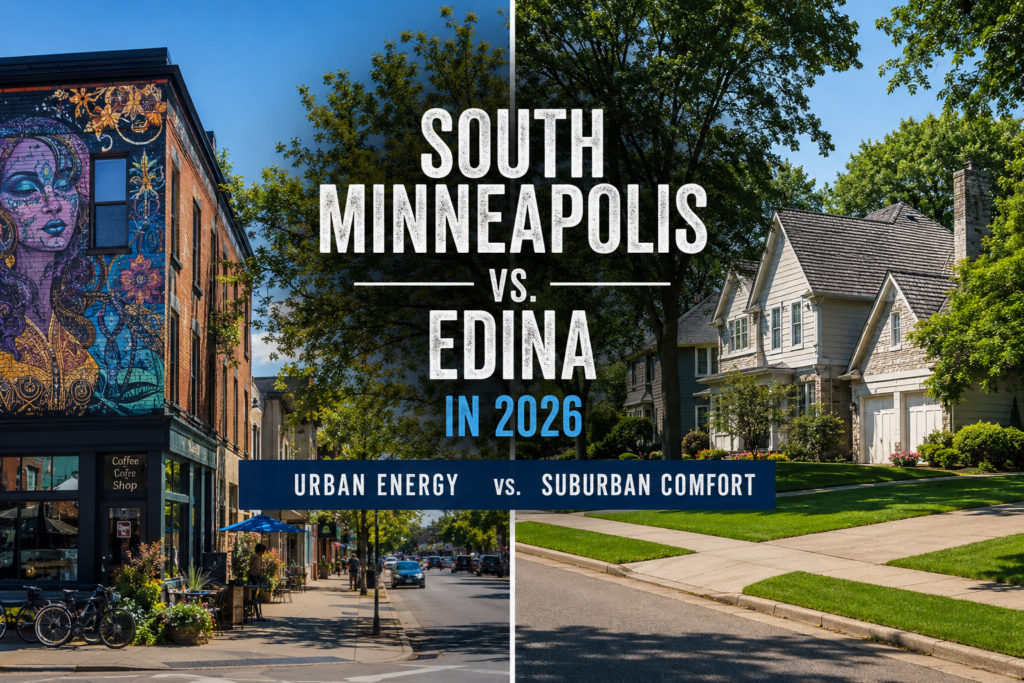
Split image comparing South Minneapolis urban street with mural and coffee shop to Edina suburban street with tree-lined homes, text reads South Minneapolis vs. Edina in 2026, Urban Energy vs. Suburban Comfort

Ten minutes can separate two completely different ways of living in the Twin Cities. Head south from downtown Minneapolis and you land in the city’s lake-chain neighborhoods — Nokomis, Longfellow, Linden Hills — where coffee shops, bike trails, and front-porch culture define daily life. Keep driving west and the city gives way to Edina, where tree-lined cul-de-sacs, top-rated schools, and the polish of 50th & France take over. The South Minneapolis vs Edina question comes up constantly with buyers who love the Twin Cities but can’t decide whether they want to live in the middle of it or a comfortable distance away. Here’s how the two compare in 2026.

South Minneapolis: Urban Energy, Walkability & Culture

South Minneapolis is really a collection of distinct neighborhoods strung along the Chain of Lakes and the Mississippi River, and that variety is part of the draw. Longfellow and Nokomis offer 1920s bungalows a short bike ride from Lake Nokomis and Minnehaha Falls. Linden Hills and Tangletown lean more polished, with walkable retail strips and easy access to Lake Harriet. Powderhorn and Kingfield bring a grittier, more eclectic energy — think independent coffee shops, ethnic restaurants, and a younger buyer pool.

What ties it together is walkability. Many South Minneapolis blocks score in the 70s and 80s on Walk Score, and the neighborhood sits inside the city’s chain of lakes and parkway system, which means green space and water access without leaving the urban grid. Buyers who want restaurants, nightlife, and transit within walking distance — without giving up a yard entirely — tend to land here. It’s a big part of why the South Minneapolis vs Edina debate comes up so often: the two areas sit less than fifteen minutes apart but feel like entirely different cities.

Edina: Suburban Comfort, Space & Top-Rated Schools

Edina trades urban density for space and consistency. Lots tend to be larger, streets are quieter, and the housing stock skews newer or more recently renovated than much of South Minneapolis. The Edina school district is one of the strongest draws for families, which shows up directly in demand and pricing in neighborhoods that feed into it.

Edina isn’t one-note, either. Morningside and the areas near 50th & France offer a more walkable, small-town feel with boutique shopping and restaurants a short walk from home. Country Club and Indian Hills lean more formal and established, with mature trees and larger, architecturally distinct homes. Buyers who want suburban predictability — good schools, quiet streets, easy parking — without driving all the way out to the western suburbs often settle on Edina as the closer-in alternative.

South Minneapolis vs Edina: Price Comparison

South Minneapolis covers a wide price spread depending on the neighborhood. Longfellow and Nokomis have been trading in roughly the $280,000–$400,000 range for typical single-family homes, while Linden Hills and Southwest Minneapolis run considerably higher, often $500,000–$600,000+ for updated homes near the lakes. Citywide, Minneapolis has been trading around a $370,000 median, according to Redfin’s Minneapolis market data.

Edina sits meaningfully higher across the board. Depending on the source and month, Edina’s median sale price has been landing in the $600,000–$750,000 range, with entry-level condos near Southdale starting lower and estate properties well above $1 million. That premium reflects both the school district and the consistency of the housing stock — buyers are paying for predictability as much as square footage. For neighborhood-level detail, the Minneapolis Area REALTORS market reports are a good source for current numbers by ZIP code.

Which Is Right for You?

If daily life without a car, proximity to lakes and restaurants, and a more eclectic neighborhood feel matter most, South Minneapolis usually wins — and it does it at a lower entry price than Edina in most pockets. If top-tier schools, more space, and quieter streets are the priority, and budget allows for the premium, Edina is hard to beat. Plenty of buyers cross-shop both before deciding, especially those coming from out of state who aren’t yet sure how much “city” they actually want.

Either way, the right call in the South Minneapolis vs Edina decision usually comes down to lifestyle fit more than price alone — which is exactly where a local agent who knows both markets earns their keep. According to U.S. Census data, Edina’s population skews slightly older and more family-oriented than the city core, which tracks with what buyers tend to find on the ground. If you’re weighing South Minneapolis against Edina and want an agent who can walk you through both honestly, MinnMatch can match you with someone who knows the trade-offs on both sides of this decision, not just the one they happen to sell in.

Edina vs. Eden Prairie in 2026: Prestige, Price & Practicality Compared

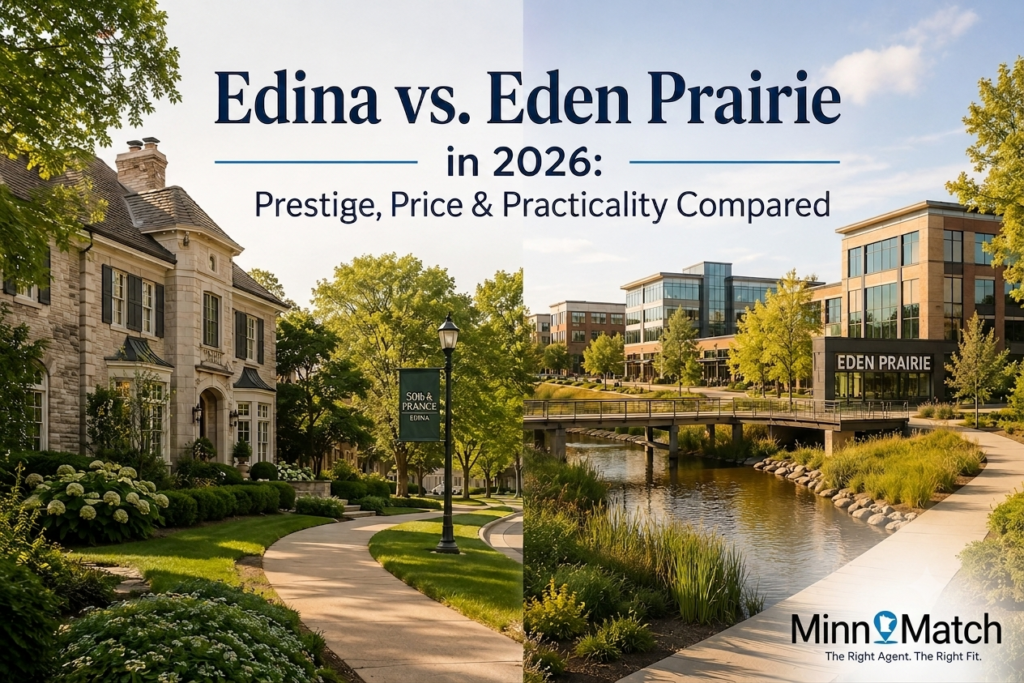
Edina vs. Eden Prairie MN suburb comparison — 50th & France district next to Eden Prairie's downtown walkway

If you’re cross-shopping the west metro, you’ve probably landed on the same two names everyone else does: Edina and Eden Prairie. Both show up on every “best suburbs” list in the Twin Cities, both feed into top-rated school districts, and both are a short hop from downtown Minneapolis. But they’re not interchangeable. When you actually compare Edina vs Eden Prairie, the differences in price, pace, and personality are bigger than the “great suburb” label suggests. Here’s how they really stack up in 2026.

Edina vs Eden Prairie Home Prices & Market Pace

This is where the two suburbs part ways the most. Edina carries a premium: depending on the month and data source, Redfin’s Edina market data and local brokerage reports put the median sale price somewhere in the roughly $650,000 to $750,000 range, with homes running $276–$287 per square foot. Eden Prairie is meaningfully more accessible, with medians typically landing in the $450,000 to $530,000 range and a price-per-square-foot closer to $210.

Pace tells its own story, too. Eden Prairie has been running hot, with homes going under contract in roughly three to four weeks and multiple-offer situations common in move-in-ready price bands. Edina homes, especially in the higher price tiers, tend to sit a bit longer — often 28 to 45 days — simply because there’s a smaller pool of buyers who can compete at that price point. Neither market favors a wandering search; both reward buyers who are pre-approved and ready to move when the right listing appears.

According to Minnesota Housing, statewide affordability pressure has pushed more buyers toward mid-priced suburbs, which helps explain why Eden Prairie’s pace has picked up relative to pricier peers. Put plainly: in the Edina vs Eden Prairie price comparison, Edina buys prestige and Eden Prairie buys breathing room in the budget.

Schools: Two Top-Tier Districts, Different Strengths

You genuinely can’t go wrong on schools here — both districts consistently earn A+ overall grades and rank among Minnesota’s top public school districts year after year. Edina Public Schools has long traded on name recognition and a deep bench of AP and IB offerings, while Eden Prairie Schools has climbed statewide high school rankings in recent years, with Eden Prairie High School routinely landing among the state’s top handful of public high schools. If school quality alone is your deciding factor, the Edina vs Eden Prairie comparison is close to a wash — the bigger question is which building, program, or neighborhood elementary feeds into a fit for your kids.

Lifestyle & Character: Polished Prestige vs. Practical Space

Edina’s identity is built around established prestige. The 50th & France retail district, Country Club neighborhood’s tudor-lined streets, Interlachen’s golf pedigree, and Centennial Lakes Park give it a polished, walkable, almost small-city feel packed into a first-ring suburb. It’s the kind of place where move-up buyers pay for character and location as much as square footage.

Eden Prairie leans more practical. You get newer construction, larger lots, and more house for the dollar, plus an outdoor-recreation identity built around Round Lake, Riley Lake, Purgatory Creek Park, and an extensive trail network. It’s a suburb built for families who want space to spread out — a three-car garage, a finished basement, a backyard for the dog — without sacrificing the school quality or the commute.

Commute & Location: What “Convenient” Really Means in Each Suburb

Edina’s edge here is real but modest: it sits just southwest of Minneapolis, with a downtown commute of roughly 15 minutes and equally quick access to the MSP airport. Eden Prairie adds a few more minutes to that same downtown drive, but it makes up for it with proximity to its own dense job base — Optum, Starkey, and a growing cluster of corporate campuses along the Highway 212 and 169 corridors mean plenty of Eden Prairie buyers aren’t commuting downtown at all. If your job is in the southwest suburbs rather than the city core, Eden Prairie’s location may actually be the more convenient one.

So, Which Suburb Is Right for You?

There’s no wrong answer between Edina and Eden Prairie — just a different set of priorities. If walkable prestige, established character, and the shortest possible commute to downtown top your list, Edina is worth the premium. If you want more space, newer construction, and a lower buy-in with schools that rival Edina’s, Eden Prairie deserves a serious look.

The honest truth is that the “right” choice depends on details a spreadsheet can’t capture — which streets flood the market with listings, which elementary boundary your dream house actually falls into, which neighborhoods are quietly trending up. That’s exactly the kind of local, on-the-ground knowledge a MinnMatch-matched agent brings to the table. Instead of guessing between two great suburbs, tell us what matters most to your family, and we’ll connect you with a Twin Cities agent who specializes in exactly that trade-off. Curious how the matching works? Here’s how it works — it’s free, human-powered, and built for exactly this kind of decision.

South Minneapolis vs. Northeast Minneapolis: Which Urban Neighborhood Should You Buy In?

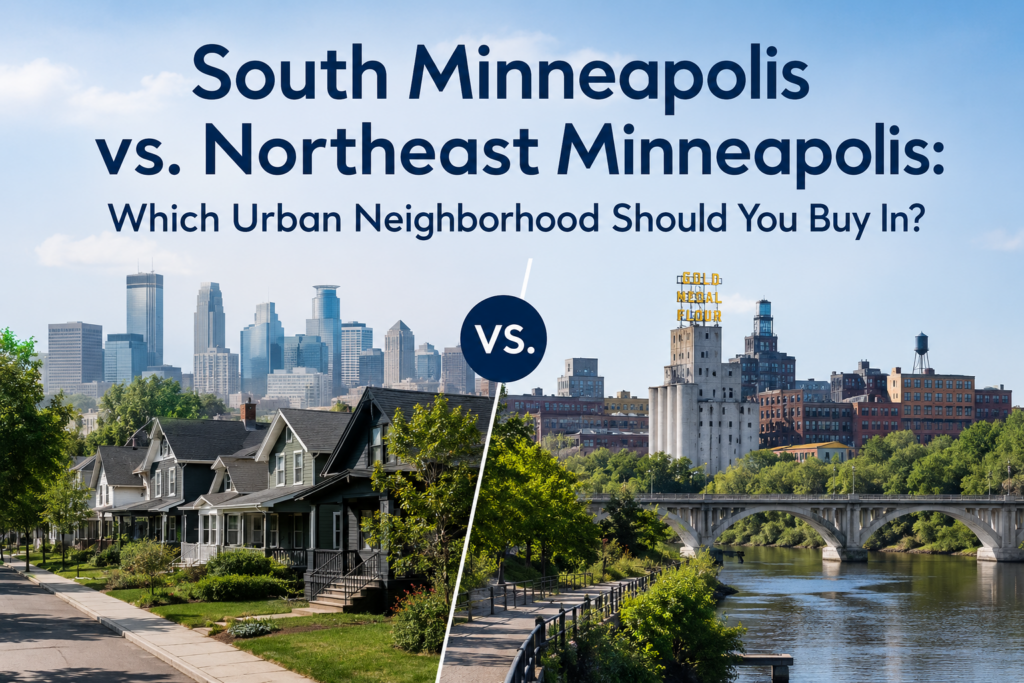
South Minneapolis vs. Northeast Minneapolis split image comparing residential bungalow street to Nordeast riverfront and Stone Arch Bridge

If you’ve decided you want to live inside Minneapolis proper — not out in the suburbs, but in the heart of the city where you can walk to coffee, bike the parkways, and actually know your neighbors — you’ve probably already narrowed your search to two areas: South Minneapolis and Northeast Minneapolis. Both are beloved, both are walkable, and both have passionate residents who will tell you theirs is the better half of the city. The truth is more nuanced than that, and which one is right for you depends less on hype and more on your daily life, your budget, and the kind of energy you want outside your front door.

The Short Version: Two Very Different Personalities

South Minneapolis is the city’s green, lake-laced backbone. It stretches from the Chain of Lakes east through Powderhorn, Nokomis, and Longfellow, and it’s defined by tree-canopied streets, classic bungalows and Cape Cods, and easy access to Lake Nokomis, Minnehaha Falls, and the Mississippi River gorge. Northeast Minneapolis, or “Nordeast” as locals call it, sits across the river from downtown and carries a completely different identity: a former Eastern European immigrant enclave turned arts and brewery district, with a grittier, more industrial edge and some of the most distinctive housing stock in the city.

Neither is “better.” They’re built for different lifestyles, and a lot of buyers who think they want one end up happier in the other once they actually compare them side by side.

What You’ll Pay: Pricing Compared

Pricing across both areas varies a lot by sub-neighborhood, so a single citywide figure doesn’t tell the real story. In South Minneapolis, the lake-adjacent pockets command a premium: Nokomis homes have recently sold in the high $360,000s to $390,000 range, while Longfellow — closer to the river and the light rail — has traded in the low $330,000s to mid $370,000s depending on the month. Powderhorn, the most affordable of South Minneapolis’s core neighborhoods, has recently listed in the $300,000–$320,000 range, making it one of the better entry points into city living south of downtown.

Northeast Minneapolis runs a similar overall range but with a bit more affordability at the median. Recent data puts the typical Northeast home sale around $340,000–$350,000, with homes moving in roughly a month on the market — a touch slower than the most competitive South Minneapolis pockets, but still well within a normal, healthy pace for the Twin Cities. Northeast also has more variation in housing stock condition, since the area mixes century-old worker cottages with recently renovated or new-construction infill, so the price range you’ll actually shop in can swing widely block to block.

Bottom line: if pure affordability is your top priority, Northeast and Powderhorn are both strong entry points into city living. If you want to be a five-minute walk from a lake, South Minneapolis’s Nokomis and Longfellow neighborhoods will cost you more — but you’re paying for the lake.

Daily Life: Lakes and Parkways vs. Arts and Breweries

South Minneapolis is built around its parks system. You’re never far from a lake loop, a bike path, or the Minnehaha Parkway, and the area’s commercial corridors — Lake Street, 38th Street, the Nokomis business district — tend to mix family-friendly restaurants, coffee shops, and small grocers. It’s a neighborhood that rewards a slower pace: morning runs around Lake Nokomis, weekend farmers markets, kids on bikes.

Northeast has a different rhythm entirely. The Northeast Minneapolis Arts District — centered around Central and Hennepin Avenues — has been recognized nationally as one of the best arts districts in the country, and the neighborhood has the highest concentration of breweries anywhere in the city. Add in Eastern European-rooted institutions that have anchored the area for generations, alongside newer Latin American and immigrant-owned businesses along Central Avenue, and you get a neighborhood that feels more layered and more urban-edge than South Minneapolis. If you want a Saturday that involves gallery hopping, a taproom flight, and dinner somewhere you’ve never tried before, Northeast delivers that in a way South Minneapolis generally doesn’t.

Both neighborhoods are highly walkable and well served by Minneapolis Parks, but the texture of that walkability is different: South Minneapolis walking means lakes and tree canopy; Northeast walking means murals, converted warehouses, and a working river.

Housing Stock: What You’re Actually Buying

South Minneapolis is dominated by classic 1900s–1950s housing: bungalows, Cape Cods, and a healthy stock of 1.5- and 2-story single-family homes, often with detached garages and modest yards. It’s consistent and predictable — most buyers know roughly what they’re getting before they walk in.

Northeast is more eclectic. You’ll find small worker cottages from the early 1900s sitting next to renovated duplexes, converted lofts in former industrial buildings, and pockets of new construction infill, especially closer to the river and in areas like Bottineau and Holland. This variety can be a feature or a frustration depending on what you want — buyers looking for character and willing to take on some renovation often gravitate to Northeast, while buyers who want a turnkey, move-in-ready home with fewer surprises often lean South Minneapolis.

Commute and Connectivity

South Minneapolis has the edge for transit, particularly along the Blue Line through Longfellow, which gives quick access to downtown and the airport. Northeast doesn’t have light rail running through its core, but it’s geographically tight to downtown — many Northeast neighborhoods are a five- to ten-minute drive from the city’s office core, often faster than a South Minneapolis commute during peak traffic. If you work downtown and want to minimize windshield time, Northeast’s proximity is genuinely underrated.

So Which One Should You Buy In?

If you want lakes, parkways, consistent housing stock, and a calmer day-to-day pace — and you’re willing to pay a bit more for the neighborhoods closest to the water — South Minneapolis is probably your fit. If you want character, art, breweries, a shorter commute downtown, and a bit more room to find value through renovation, Northeast Minneapolis deserves a serious look. Plenty of buyers end up cross-shopping both, and that’s exactly the kind of decision a local agent who knows the block-by-block differences can help you make with confidence rather than guesswork.

Not Sure Which Minneapolis Neighborhood Fits You?

South Minneapolis and Northeast Minneapolis each have their own micro-markets, and the right one for you depends on details a national site can’t tell you. MinnMatch connects you with a vetted, handpicked Twin Cities agent who knows both areas block by block — for free, with no obligation.

Find your match at MinnMatch →
  |  
See how MinnMatch works →