Eden Prairie MN Summer 2026: Best Parks, Lakes & Outdoor Living That Buyers Love

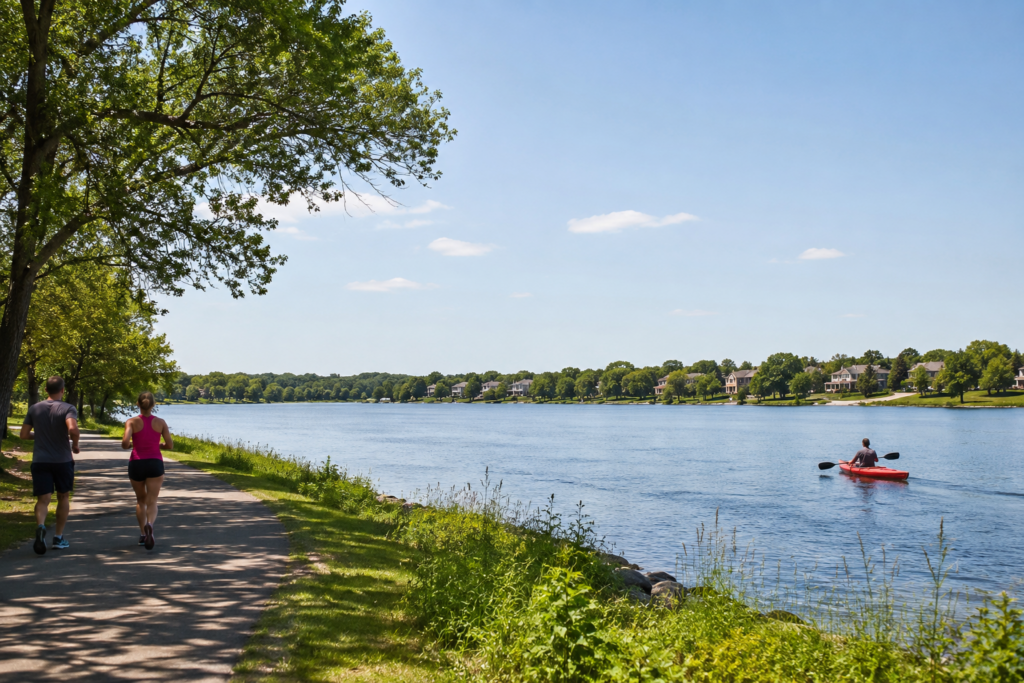
Couple jogging on a lakeside trail in Eden Prairie MN with a kayaker on the water and homes visible across the lake on a sunny summer day

If you’ve ever spent a summer evening at Staring Lake, watching kayakers glide past and kids splash at the beach while the trails hum with joggers and dog-walkers, you already know what Eden Prairie does best. This southwest metro suburb has always punched above its weight on livability — and its outdoor amenities are a huge reason why. For buyers who want a home and a lifestyle, summer 2026 is an ideal time to take a closer look at Eden Prairie. The parks are in full swing, the lakes are calling, and the real estate market rewards buyers who act decisively.

17 Lakes, 4,500 Acres, and More Than 225 Miles of Trails

The numbers tell a striking story. The City of Eden Prairie maintains more than 4,500 acres of open space wetlands, 17 lakes, 100+ ponds, and over 1,000 acres of active parkland — all inside a single suburb. Bikers, hikers, and runners enjoy more than 225 miles of sidewalks and trails that connect neighborhoods to parks, lakes, and open space corridors.

For buyers, that translates into something you can feel the moment you start touring homes: backyards, cul-de-sacs, and neighborhood streets that spill naturally into green space. Whether you’re a runner logging morning miles, a family looking for a safe place to ride bikes after dinner, or a remote worker who needs a noon walk to reset, Eden Prairie’s outdoor living infrastructure is genuinely built in — not bolted on.

The Parks Eden Prairie Buyers Keep Coming Back To

Not all suburban parks are created equal. Eden Prairie’s standouts offer the kind of amenity mix that keeps families returning all season long:

Staring Lake Park is the crown jewel of the city’s park system and one of the most well-loved green spaces in the Twin Cities metro. Set along the lake of the same name, it features a swimming beach, boat and canoe rentals, an off-leash dog park, a boat launch, disc golf, picnic areas, and a full trail loop around the lake. It’s also home to the city’s Outdoor Center, which runs nature programs, family drop-in events, and seasonal workshops for kids and adults throughout the summer.

Bryant Lake Regional Park, operated by Three Rivers Park District, sits on the western edge of Eden Prairie and offers water skiing, sailing, canoeing, and kayaking, plus a swimming beach and a full-service boat launch. It’s a magnet for water sport enthusiasts and one of the few regional parks in the metro where you can launch a sailboat right from the park.

Round Lake Park brings a more neighborhood-friendly vibe — a beach shelter, swimming area, and playgrounds make it a go-to for families with young kids. Riley Lake Park on the southeast side offers its own boat launch and a quieter, less-crowded atmosphere. Purgatory Creek Park and Miller Park round out a parks system that gives nearly every neighborhood in Eden Prairie walkable access to something meaningful.

For buyers with kids, the splash pads at several Eden Prairie parks — including accessible, cushioned-surface playgrounds — have become a summer fixture. These aren’t afterthoughts; they’re the kind of amenities city residents fought for and families plan their weekends around.

Outdoor Living Eden Prairie MN Buyers Are Paying a Premium For

Here’s the honest truth for buyers doing their research: homes near Eden Prairie’s parks and lakes command a premium — and they move quickly. The broader Eden Prairie real estate market reflects this demand. Median home values have hovered in the mid-to-high $400s to low $500s depending on the data source, with homes going to pending in as few as 13–27 days. Homes are selling at approximately 98.7% of asking price, and a meaningful share still close above list.

Inventory remains limited — a consistent challenge in Eden Prairie — which means buyers who wait for the “perfect” listing risk missing it entirely. Summer is actually one of the better windows to buy here: more homes come to market between May and August than at any other point in the year, and sellers motivated to close before fall school year begins tend to price realistically.

If you’re comparing Eden Prairie to other southwest suburbs, keep the outdoor lifestyle factor in your calculation. Few communities in the metro offer this density of lakes, trails, and parkland within a walkable radius of residential neighborhoods. That’s a quality-of-life argument that holds its value across market cycles.

Summer Events and Community Life That Buyers Notice

Beyond the parks themselves, Eden Prairie’s summer programming creates the kind of community energy that’s hard to put in a listing description but easy to feel when you’re here. Outdoor concerts, family drop-in programs at the Outdoor Center, youth sports leagues, and water recreation events fill the parks from June through August. The Richard T. Anderson Conservation Area offers a natural counterpoint — quiet prairie and woodland trails for residents who prefer solitude over spectacle.

Eden Prairie’s parks also benefit from ongoing city investment. Active trail extension projects, bridge replacements at Staring Lake, invasive species removal for habitat restoration, and new trail connections along Valley View Road are all part of the city’s 2026 parks improvement agenda. Buyers who purchase now are buying into a system that’s actively getting better.

For families relocating from outside the metro, this is often one of the first things agents mention about Eden Prairie: the parks aren’t just nice — they’re part of the neighborhood identity. Residents here are protective of that green space, which is part of why the city has worked hard to preserve it.

Why Buyers Love Eden Prairie in Summer 2026

The case for buying in Eden Prairie this summer comes down to a combination that’s genuinely hard to replicate elsewhere in the Twin Cities:

  • Outdoor infrastructure that rivals anything in the metro — 17 lakes, 225+ miles of trails, and multiple beach parks within city limits
  • Strong schools with Eden Prairie Schools consistently ranked among the best in the state (Minneapolis Area Realtors data consistently highlights EP’s performance)
  • Proximity to employment — major employers including General Mills, Optum, and C.H. Robinson have campuses within or adjacent to the city
  • A real estate market with staying power — home values in Eden Prairie have demonstrated long-term stability even when broader markets have softened
  • Summer inventory windows — more homes come to market in June–August, giving buyers a wider selection before fall competition picks back up

If you’ve been thinking about making a move to Eden Prairie, the summer months give you a rare chance to evaluate the community at its most vibrant — and then decide while inventory is at its seasonal peak. Don’t wait until September to start a search that should have started in June.

Ready to buy in Eden Prairie this summer?

MinnMatch connects buyers with experienced, vetted local agents who know Eden Prairie’s neighborhoods, parks, and price trends inside and out. It’s free, personal, and built for the Twin Cities.

Find Your Eden Prairie Agent →

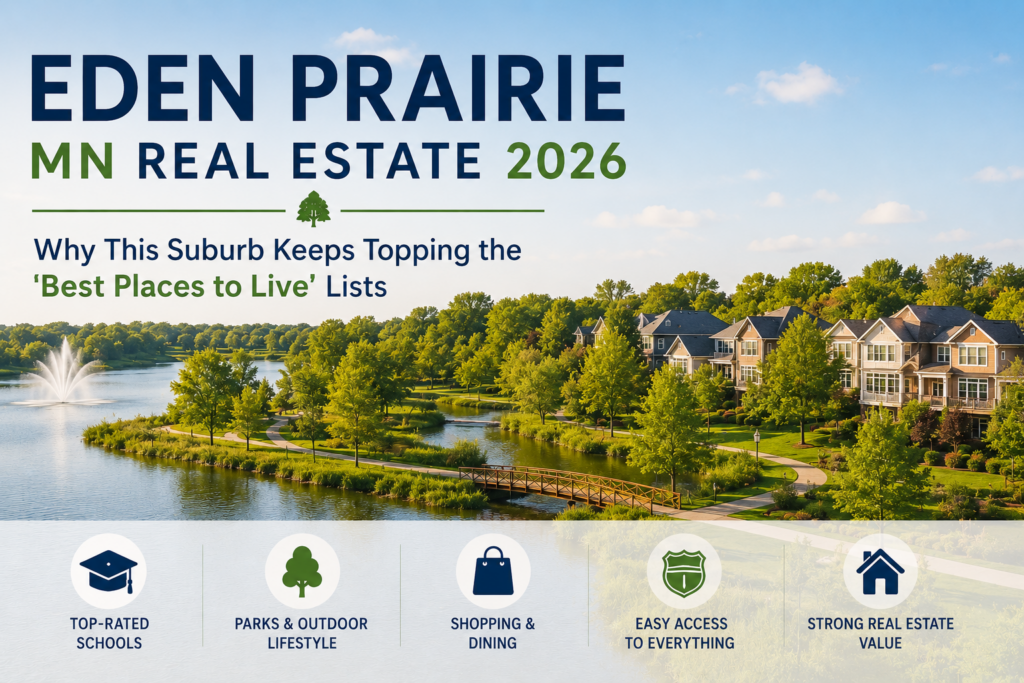
Eden Prairie MN Real Estate 2026: Why This Suburb Keeps Topping the ‘Best Places to Live’ Lists

Eden Prairie MN real estate 2026 — lakeside homes and parks in one of Minnesota's best suburbs


If you’re researching Eden Prairie MN real estate in 2026, you’ve likely already noticed this suburb’s name appearing on every “best places to live” list in Minnesota — and with good reason. From top-ranked schools and 120+ miles of trails to a tight seller’s market with persistent demand, Eden Prairie delivers across every dimension that matters to buyers and sellers alike. Here’s a grounded look at what’s driving the city’s enduring appeal right now.

Why Eden Prairie MN Keeps Topping the Rankings

Eden Prairie has earned national recognition as one of the best places to live in the country — not once, but repeatedly over many years. MONEY Magazine has ranked it among its “Best Places to Live” in America, and in 2026, Eden Prairie landed at No. 5 on Niche’s Best Places to Live in Minnesota list — one of only a handful of Twin Cities suburbs to consistently place that high.

What drives those rankings? Platforms like Niche weigh public school quality, crime rates, cost of living relative to income, job access, and community amenities. Eden Prairie scores well across all of them — not just strong in one area while sacrificing another, but balanced in a way that’s genuinely hard to replicate at this price point in the metro.

By the Numbers — Eden Prairie 2026

~$453K

Median home price

28–30

Avg. days on market

~3 mo.

Months of supply (seller’s market)

#5

Best places to live in MN (Niche 2026)

Eden Prairie MN Real Estate Market Conditions in 2026

The Eden Prairie MN real estate market in 2026 continues to favor sellers, driven by constrained inventory and persistent demand. With only around 3 months of supply available — well below the 5–6 months that typically signals a balanced market — buyers are competing for a limited pool of homes, and well-priced listings are moving quickly.

Median home prices are hovering in the low-to-mid $400s depending on the source and timing, with active listings averaging closer to $500K–$509K. Single-family homes are running higher — around $565,000 on average — while condos offer entry points near $165,000. That range makes Eden Prairie functional for a wide spectrum of buyers: first-time buyers, move-up families, and empty nesters all find options here. According to Redfin’s Eden Prairie market data, homes are receiving an average of 7 offers and selling in around 30 days — a clear sign of competitive demand.

The spring and early summer window (February through July) has historically been the strongest selling period for Eden Prairie real estate, and that pattern is expected to hold through 2026.

If you’re a buyer navigating this competitive environment, having a local agent who knows the specific neighborhoods — from the Bearpath enclave to the family-friendly pockets near Eden Prairie High School — makes a real difference. That’s exactly the kind of match MinnMatch helps buyers make.

Top-Rated Schools Drive Long-Term Home Values

For families considering Eden Prairie MN real estate, the school district is often the deciding factor. The Eden Prairie Schools district (ISD 272) serves more than 10,200 students and is consistently among the top performers in Minnesota on statewide assessments and college entrance exams. The district is known for its high expectations, innovative curriculum, and strong teaching staff — traits that show up not just in test scores but in the community’s long-term property values.

The private International School of Minnesota (ISM) — a college preparatory school for preschool through grade 12 on a 55-acre campus — adds another layer of educational choice within city limits. Access to Normandale Community College and Hennepin Technical College rounds out the post-secondary options nearby.

Strong school districts don’t just attract families — they anchor home values over time. It’s one of the key reasons Eden Prairie real estate has held up well through broader market fluctuations that have hit other suburbs harder.

“Eden Prairie is a very welcoming city that truly cares about their people. They take care of their roads… there are really good grocery stores and parks and everything you could want.”

— Current Eden Prairie resident, Niche 2026

Jobs Are Close — and They’re Good Ones

One of Eden Prairie’s less-discussed advantages is its employment landscape. The city is home to over 2,200 businesses, including some significant corporate anchors. Fortune 500 company C.H. Robinson — one of the world’s largest freight brokers — is headquartered here. Starkey Hearing Technologies, a globally recognized hearing aid manufacturer, also calls Eden Prairie home. The city benefits from proximity to UnitedHealth Group and Optum, two of the largest employers in the entire Twin Cities metro.

For residents who commute, Eden Prairie sits just 12 miles southwest of Minneapolis with direct access to I-494, Highway 169, and Highway 212. The Southwest Light Rail extension has improved transit connectivity in recent years, reducing commute times for those heading into the city core.

This combination — strong employers within the city and fast access to the broader metro — is part of why Eden Prairie attracts young professionals and established families alike. Over 72% of the city’s population is under age 45, giving it an energy that’s difficult to quantify but easy to feel when you’re there.

Parks and Trails: Eden Prairie’s Real Differentiator

Ask most Eden Prairie residents what they love most about the city and the answer usually circles back to the parks and trails. According to the City of Eden Prairie, the city maintains over 1,000 acres of developed parkland, more than 120 miles of bike trails, and 13 miles of dedicated nature trails — an extraordinary amount of green infrastructure for a suburb of roughly 64,000 people.

Bryant Lake Regional Park — a 170-acre gem on the shore of Bryant Lake — offers hiking, boating, fishing, a sandy beach, disc golf, and winter cross-country skiing. Staring Lake Park is a family staple with its sledding hill, outdoor skating rink, and walking trails. Purgatory Creek Park draws birdwatchers and those seeking a quiet escape. Then there’s the Minnesota River valley corridor winding through the southwestern edge of the city — a genuine nature retreat that feels miles away from the suburbs.

This kind of walkable, bikeable outdoor access has become a major quality-of-life driver in the post-pandemic era, and Eden Prairie built it long before it was fashionable. It’s a big reason why the city doesn’t just attract people — it keeps them.

What Makes Eden Prairie Stand Out


  • Top-ranked schools in Minnesota (ISD 272) — consistently among the state’s best

  • Over 120 miles of bike trails and 1,000+ acres of parkland

  • Major corporate employers including C.H. Robinson, Starkey, and proximity to UnitedHealth

  • 12 miles from Minneapolis with excellent highway and light rail access

  • Diverse housing stock — condos from ~$165K to single-family homes well above $500K

  • Over 2,200 local businesses and a vibrant dining and retail scene

Is It a Good Time to Buy Eden Prairie MN Real Estate?

That depends on your situation, but the market dynamics favor prepared buyers who move decisively. With inventory constrained at around 3 months of supply, homes are not sitting long. Buyers who are pre-approved and working with a knowledgeable local agent are in a substantially better position than those who aren’t.

Mortgage rates hovering between 6.4% and 6.9% continue to shape affordability for many households — a household income of around $100,000 is generally the benchmark for comfortably carrying a home in the median price range with a 25% down payment. For buyers in that range, Eden Prairie still offers strong value relative to the lifestyle and long-term appreciation it provides compared to similar suburbs in other major metros. The Minnesota Housing Finance Agency also offers down payment assistance programs worth exploring if you’re a first-time buyer.

The price softness seen in some data sources reflects normal market correction after a period of outsized appreciation — not a sign of underlying weakness. The fundamentals (jobs, schools, amenities, demand) remain firmly intact.

What About Selling Eden Prairie Real Estate in 2026?

If you own a home in Eden Prairie, conditions are still favorable. Limited supply means your listing faces less competition than it would in a more balanced market, and correctly priced homes are receiving multiple offers. The peak selling window of February through July is when demand peaks, days on market tighten, and sellers see the strongest results.

Presentation and pricing strategy still matter enormously. An experienced local agent — one who has actually sold in Eden Prairie’s specific neighborhoods, not just in the broader southwest metro — will know the micro-level factors that affect how buyers perceive value. That’s not a small thing in a market where perception shapes offers.

MinnMatch connects Eden Prairie sellers with agents who specialize in exactly these markets — vetted, local, and matched to your specific neighborhood and goals. It’s a free service, and the difference the right agent makes on final sale price and timeline is well documented.

How Eden Prairie Compares to Nearby Suburbs

It’s worth understanding Eden Prairie in context, especially if you’re weighing it against other strong southwest metro suburbs. Here’s how it stacks up at a high level:

Suburb Approx. Median Price School Strength Key Draw
Eden Prairie ~$453K–$509K Excellent (ISD 272) Balance of everything
Edina ~$550K+ Excellent Established prestige, retail
Minnetonka ~$450K–$500K Very strong Nature access, mature trees
Plymouth ~$430K–$480K Very strong Newer builds, lake access
Prior Lake ~$400K–$450K Good Lake lifestyle, more space

Eden Prairie’s sweet spot is breadth — it doesn’t lead on any single category, but it doesn’t concede much ground in any of them either. For buyers who don’t want to sacrifice schools for space, or nature access for a short commute, that breadth is the whole point.

Finding the Right Agent for Eden Prairie Real Estate

A market like Eden Prairie rewards buyers and sellers who are well-represented. The difference between a good agent and a great one often comes down to neighborhood-level knowledge — understanding which streets near Riley Creek have the best trail access, how Bearpath compares to the Settlers Ridge area for long-term value, or which parts of town are seeing new construction activity.

MinnMatch is built for exactly this kind of situation. We handpick and vet local agents based on their actual track record in specific Twin Cities communities — then we match you to the right one for your goals, timeline, and neighborhood. There’s no algorithm, no guesswork, and no cost to buyers or sellers. Think of it as having a recruiter who’s already screened the candidates, so you only meet the ones worth your time.

Ready to buy or sell Eden Prairie MN real estate?

We’ll match you with a vetted, local agent who knows this market — for free.

Find My Agent →

The Bottom Line on Eden Prairie MN Real Estate in 2026

Eden Prairie keeps topping the “best places to live” lists because the things that drive those rankings — schools, jobs, safety, outdoor life, community — don’t change year to year based on interest rates or inventory swings. They’re structural, built into the city over decades of smart planning and sustained investment.

The Eden Prairie MN real estate market in 2026 is competitive but navigable for buyers who are prepared, and favorable for sellers who price and present well. Either way, having someone in your corner who truly knows this community isn’t optional — it’s the edge that makes the difference.

Explore more about the Eden Prairie community on MinnMatch, or learn how our agent matching works. If you’re comparing suburbs, our Twin Cities market insights section covers the full southwest metro picture.

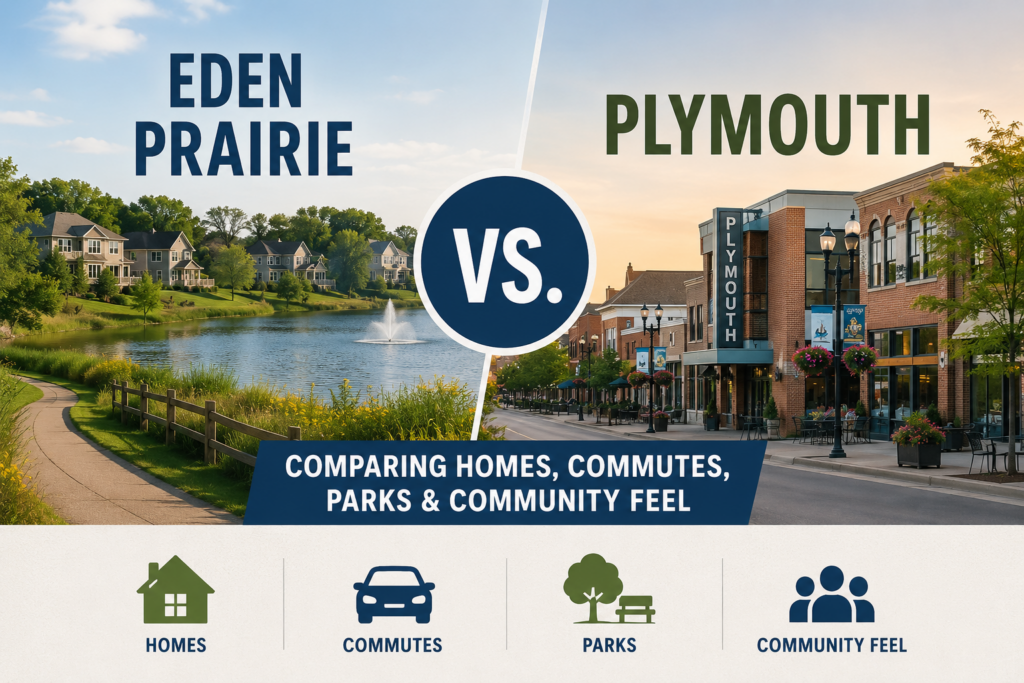
Eden Prairie vs. Plymouth: Comparing Homes, Commutes, Parks & Community Feel

Eden Prairie vs Plymouth comparison graphic showing homes, commutes, parks, and community feel in two Twin Cities western suburbs


When families start searching for a home in the western Twin Cities, the same two names come up again and again: Eden Prairie and Plymouth. Comparing Eden Prairie vs Plymouth homes, commutes, parks, and community feel is exactly what this guide is designed to help you do — side by side, category by category, without the fluff. Both suburbs rank among the best places to live in Minnesota, but they are not interchangeable. The differences are real, and choosing the right one for your family comes down to knowing what those differences actually are.

Eden Prairie sits along the Minnesota River bluffs to the southwest of Minneapolis. Plymouth spreads across rolling, lake-dotted terrain to the northwest. Both cities offer excellent schools, low crime, strong property values, and the kind of family infrastructure that’s hard to find combined in a single place. But dig one level deeper and the two cities diverge — in housing character, outdoor lifestyle, commute patterns, and the pace of daily life. Here’s the full breakdown.


🏡 Eden Prairie vs Plymouth Homes & the Housing Market

The homes themselves tell you a lot about each city’s identity — and so do the price tags.

Eden Prairie Homes: Planned, Polished, and Consistently In Demand

Eden Prairie grew up as a master-planned community, and that heritage is visible in the housing stock. Neighborhoods here feel cohesive and well-maintained — you’ll find a lot of two-story colonials and executive-style homes built between the mid-1980s and early 2000s, along with newer construction in pockets near the city’s southern and western edges. Lots tend to be generous, many backing up to wooded buffers or pond views that are genuinely attractive rather than decorative afterthoughts.

The typical family home in Eden Prairie — three or four bedrooms, a finished basement, and a two-car garage — runs in the $550,000 to $750,000 range in 2026, with entry points below $500K if you’re willing to take on a project. Move-in ready homes at the right price generate genuine competition; multiple-offer situations are still common, especially in spring.

One standout characteristic: Eden Prairie homes tend to hold value exceptionally well. The combination of school district reputation, employment proximity, and city-wide maintenance standards creates a floor that buyers can count on over time. According to Minneapolis Area Realtors, the western suburbs have consistently outperformed the broader metro on median price-per-square-foot retention over the past five years — and Eden Prairie sits near the top of that list.

Plymouth Homes: More Range, More Room to Find Your Entry Point

Plymouth’s housing market is broader and more varied — a natural result of the city’s size (it’s one of the largest cities in Minnesota by population) and its patchwork of neighborhoods developed across different eras. You’ll find 1970s ramblers and split-levels in older western neighborhoods, well-built 1990s subdivisions throughout the core, and newer executive construction near the city’s eastern and northeastern edges.

Pricing for Plymouth homes typically runs $480,000 to $700,000 for a comparable family home, with genuine opportunities below $450K in older neighborhoods — something Eden Prairie rarely offers for move-in-ready product. On the upper end, newer construction near Medicine Lake or in premium subdivisions can push well past $800K.

The key variable when buying a Plymouth home is the school district boundary. Because Plymouth spans multiple districts — primarily Wayzata (284) and Osseo (279) — the value of a specific home can vary significantly based on which district it falls in. Homes in the Wayzata district consistently command a premium. Knowing the boundary lines before you start touring is essential, and it’s one of the clearest reasons to work with an agent who knows Plymouth specifically.

Eden Prairie

More uniform housing stock, slightly higher floor, one school district. Excellent long-term value stability.

Plymouth

More variety across eras and price points. Wider entry options. School district boundary research is non-negotiable.

Whether you’re shopping Eden Prairie or Plymouth homes, working with a buyer’s agent who focuses on these specific cities will save you time, money, and the headache of learning pricing nuances on the fly. MinnMatch matches buyers with agents who know these neighborhoods at the street level — not just the zip code.


🚗 Comparing Commutes & Location

Neither Eden Prairie nor Plymouth is going to punish you with a brutal commute — both sit within 25 to 35 minutes of downtown Minneapolis under normal conditions. But the direction, highway access, and what’s nearby differ enough to matter for many buyers.

Eden Prairie Commutes: Southwest Access and Airport Proximity

Eden Prairie sits at the intersection of I-494, Highway 212, and Highway 169 — giving residents flexible options for reaching downtown Minneapolis, the airport corridor, and communities further southwest. The I-494 strip through Eden Prairie is also a major employment hub in its own right, home to corporate campuses that mean some residents barely leave the city for work at all.

The biggest commute advantage Eden Prairie holds is proximity to Minneapolis-St. Paul International Airport. For frequent business travelers, a 15-minute drive to MSP — without fighting through the city — is a genuine quality-of-life upgrade. If your job involves regular flights, this alone can tip the scales.

Transit options are limited, as they are throughout the western suburbs, but express bus routes connect Eden Prairie to downtown. The SWLRT Green Line Extension expanded light rail access closer to the Eden Prairie area, improving connectivity for transit-oriented commuters.

Plymouth Commutes: Northwest Access and Strong Highway Connections

Plymouth benefits from strong access via I-494, Highway 55, and I-394 — the last of which is a particularly efficient corridor straight into downtown Minneapolis and the inner-ring suburbs of St. Louis Park and Golden Valley. Residents heading downtown for work find the commute manageable and predictable outside of peak hours.

Plymouth’s location also makes it a natural base for professionals working in the northwest employment corridor — think Maple Grove, Brooklyn Park, or Rogers. If your job pulls you north rather than south or downtown, Plymouth’s geography is genuinely more convenient than Eden Prairie’s.

Plymouth is further from MSP — roughly 30 to 35 minutes — which matters for frequent flyers. For remote and hybrid workers who commute occasionally, the difference is largely irrelevant.

Route Eden Prairie Plymouth
Downtown Minneapolis 25–35 min via I-494 / Hwy 212 20–30 min via I-394 / Hwy 55
MSP Airport ~15 min ✈️ ~30–35 min
Northwest suburbs 30–40 min 10–20 min ✅
Primary highways I-494, Hwy 212, Hwy 169 I-394, I-494, Hwy 55

🌲 Comparing Parks & Outdoor Access

This is where Eden Prairie vs Plymouth diverges most meaningfully — not in quality, but in character. Both are exceptional for outdoor access. The question is what kind of outdoor lifestyle you’re after.

Eden Prairie Parks: Trails, Bluffs, and a Rare Urban Wilderness

Eden Prairie’s park system is one of the most impressive in the state for a city its size. With over 2,250 acres of parkland and more than 170 miles of interconnected trails, the outdoor infrastructure here is built into the city’s DNA. According to the City of Eden Prairie Parks & Recreation, the trail network is specifically designed to connect neighborhoods to schools, parks, and commercial areas without requiring residents to touch a road.

Staring Lake Park is a beloved anchor — offering kayak rentals, an amphitheater for summer concerts, a skating loop in winter, and trails winding through native prairie. Bryant Lake Regional Park provides swimming, fishing, and boat launch access. Along the city’s southern edge, the Minnesota River bluffs deliver dramatic, wooded topography that few western suburbs can match. The Richard T. Anderson Conservation Area alone contains hundreds of acres of protected habitat.

For families with kids who want to ride to school, or parents who want a running route that actually goes somewhere, Eden Prairie’s connectivity matters enormously.

Plymouth Parks: A Lake Town Through and Through

Plymouth’s outdoor identity is defined by water. With more than 30 lakes within city limits — including Medicine Lake, Parkers Lake, Bass Lake, and Mooney Lake — water access is a fact of life here. Many neighborhoods are built around lakes, with homes backing up to shoreline and residents fishing from their yards or paddling out before breakfast.

Parkers Lake Park is a crown jewel — a well-maintained beach, picnic areas, and a skating rink in winter that draws families from across the city. The Three Rivers Park District manages extensive regional trail corridors through and around Plymouth, connecting to the wider metro-wide trail grid. Plymouth Creek Center serves as a community hub with athletic facilities, indoor recreation, and event space year-round.

Plymouth’s trail network is solid, though not quite as densely woven as Eden Prairie’s. The emphasis here is on lake access, beach time, and water recreation — and on that dimension, Plymouth has no peer in the western metro.

Eden Prairie is your city if…

You want trails out your front door, city-wide connectivity, and access to river bluffs and native prairie that feel genuinely wild.

Plymouth is your city if…

Your version of the perfect Saturday involves a kayak, fishing pole, or paddleboard — and you want lake access woven into your neighborhood, not just nearby.


🏙️ Comparing Community Feel

Numbers and amenities only go so far. What’s it actually like to live in each of these cities?

Eden Prairie Community Feel: Put-Together, Energetic, and Self-Contained

Eden Prairie feels like a city that has its act together. The commercial core around Eden Prairie Center and the surrounding retail corridor is polished and well-maintained. You can handle almost every errand, meal out, and weekend activity without leaving city limits — and many residents do exactly that. The city has cultivated a local dining scene that punches above its weight for a western suburb, and fitness options, youth sports leagues, and family-oriented events fill the calendar year-round.

The demographic skews toward dual-income professional families — many of whom work at the major corporate campuses along the I-494 corridor or commute into Minneapolis. There’s a strong sense of community investment: residents here tend to be engaged in schools, youth sports, and civic life, which keeps the city’s momentum going. Eden Prairie has been recognized nationally as one of the best cities to live in the U.S., and the residents feel that pride.

The trade-off, if there is one, is that Eden Prairie can feel dense with ambition — it’s a high-achieving place, and the culture around school sports, activities, and résumé-building can feel intense at times. For some families, that energy is exactly what they want. For others who prefer a slightly quieter pace, it’s worth noting.

Plymouth Community Feel: Spacious, Neighborly, and a Little More Relaxed

Plymouth is Minnesota’s seventh-largest city by population, but it doesn’t feel like it. The city’s geography — sprawling across rolling terrain with neighborhoods separated by lakes, parks, and open space — creates a more dispersed, lower-density character than Eden Prairie’s tighter layout. It’s a city where people genuinely know their neighbors, where cul-de-sacs feel like small communities, and where the pace of life has a little more breathing room.

Plymouth’s retail and dining scene is solid but more spread out — you’ll often drive to neighboring Wayzata or Minnetonka for a broader restaurant selection or specialty shopping. Many Plymouth residents consider this a feature rather than a bug — the proximity to Wayzata’s charming lakeside village adds destination-quality dining and entertainment without the city needing to replicate it internally.

Community events and city-organized programs are strong — the Hilde Performance Center hosts outdoor concerts and seasonal events, and Plymouth Creek Center anchors a busy schedule of youth sports, fitness classes, and family programming. The community feel is warm and genuinely Minnesotan: involved but not in your face, friendly without being performative.

Plymouth also benefits from a notable degree of diversity compared to many western suburbs, which many families find appealing — especially those moving from larger metro areas or with kids who will benefit from a wider range of backgrounds and perspectives in school.


Eden Prairie vs Plymouth Homes: So Which One Wins?

Neither. And both.

Eden Prairie is the better fit if you want everything in one tightly run package — a single elite school district, a dense trail network, strong employment proximity, and a city that feels polished from end to end. It rewards buyers who want convenience, connectivity, and a high-energy community.

Plymouth homes offer a better fit if outdoor water access matters most to your family, if you want more housing variety and a slightly wider price window, or if you prefer a community that feels a little less intense and a little more spread out. It rewards buyers who do their homework on school district boundaries and aren’t afraid to drive five minutes for a great dinner.

In both cities, the market is competitive and the learning curve for buying is real. Understanding what a home is actually worth — and being positioned to move fast when the right one hits — requires local knowledge that goes beyond what any portal can provide. That’s exactly what the right agent delivers. MinnMatch can help you find one who specializes in the community you’re targeting.

Not sure which suburb is right for you?

MinnMatch connects Twin Cities buyers and sellers with hand-picked, vetted local agents — free, fast, and with no obligation. Tell us what you’re looking for, and we’ll match you with someone who knows Eden Prairie, Plymouth, and the broader western metro inside and out.

Find My Agent →