Buying a Townhome vs. Single-Family Home in the Twin Cities in 2026: Which Is Right for You?

Townhome vs. single-family home comparison checklist with Twin Cities model homes and keys

If you’re house hunting in the metro this year, you’ve probably found yourself weighing a townhome vs. single-family home more than once. It’s one of the most common forks in the road for Twin Cities buyers, whether you’re a first-timer stretching your budget in Plymouth or a downsizer looking to trade a big yard for a lock-and-leave lifestyle in Eden Prairie. Both options can be the “right” home — it just depends on what you’re actually optimizing for: price, space, maintenance, or long-term flexibility. Here’s how to think through the decision like a local.

What’s the Real Difference Between a Townhome and a Single-Family Home?

A single-family home sits on its own lot, with no shared walls and full control over the structure and land. A townhome typically shares one or two walls with a neighboring unit and is governed by a homeowners association (HOA) that handles things like exterior maintenance, snow removal, and lawn care in exchange for a monthly fee. In the Twin Cities, you’ll find townhomes clustered in newer developments throughout the western and southern suburbs — think Plymouth, Eden Prairie, and Prior Lake — as well as infill projects closer to the urban core. Some townhomes are “fee simple,” meaning you own the land under your unit outright, while others are part of a common interest community (CIC) where the land is shared. That distinction matters for financing, resale, and how much say you have over changes to your property.

Cost Comparison: Townhome vs. Single-Family Home Pricing in the Metro

Price is usually the first thing that pulls buyers toward a townhome. Twin Cities townhomes have consistently sold for tens of thousands of dollars less than single-family homes in the same submarkets, according to data reported by Minneapolis Area Realtors. That gap tends to widen further out in the suburbs and narrow in high-demand urban pockets where land is scarce and townhomes command a premium of their own. You can track current median prices by property type on Redfin’s Twin Cities housing market page to see how the numbers are trending in a specific neighborhood you’re considering.

But the purchase price is only half the equation. Townhomes come with HOA dues that can range from roughly $150 to $500+ per month in the metro, depending on amenities and how much the association covers. Factor that into your monthly budget the same way you would a mortgage payment — a townhome with a low list price and a high HOA fee can end up costing more per month than a single-family home with a slightly higher mortgage. First-time buyers should also check whether they qualify for down payment assistance through the Minnesota Housing Finance Agency, which applies to both property types.

Maintenance and Lifestyle: Who Each Option Actually Fits

This is where the townhome vs. single-family decision usually gets settled for most buyers. If you dread Minnesota winters spent shoveling a driveway or mowing a quarter-acre lot in July, a townhome’s maintenance-free structure is a real quality-of-life upgrade — the HOA handles snow removal, lawn care, and often the roof and siding. That’s a big part of why townhomes have become popular with both young professionals who don’t want weekends eaten up by yard work and empty-nesters looking to downsize without giving up a garage.

On the other hand, a single-family home gives you full control — paint the exterior any color you want, put in a garden, add a fence for the dog, or finish the basement without asking anyone’s permission. Families who need more space, a private yard for kids, or room to grow tend to gravitate toward single-family homes even when it means a bigger commute or a longer renovation to-do list. Neither lifestyle is objectively better; it comes down to how you actually want to spend your time and money as a homeowner.

Where You’ll Find Each Option Across the Twin Cities

Location plays a big role in which type of home makes sense. Plymouth and Eden Prairie both have strong townhome inventory alongside traditional single-family neighborhoods, which makes them good places to compare the two side by side without changing school districts. Prior Lake has seen a wave of newer townhome developments aimed at buyers who want lake-area access without lake-area maintenance. Meanwhile, close-in areas like Edina and parts of Minnetonka tend to have tighter single-family inventory with premium pricing, which pushes some buyers toward a townhome simply to stay in the school district or commute zone they want. If you’re not sure which submarkets fit your budget and priorities, that’s exactly the kind of local knowledge a good buyer’s agent should bring to the table when you’re comparing a townhome vs. single-family home in a specific area.

Frequently Asked Questions

Is a townhome a good investment in the Twin Cities?
Townhomes can appreciate well, especially in high-demand suburbs with limited land for new single-family construction. Resale can be slower than single-family homes in a soft market, so it helps to review how comparable units in the same association have performed before buying.

Do townhomes have HOA fees in Minnesota?
Almost all Twin Cities townhomes are part of an HOA, since the association is what manages shared exterior maintenance, common areas, and sometimes amenities like a clubhouse or pool. Always ask for the HOA’s financials and reserve study before making an offer.

Can first-time buyers get down payment help for either option?
Yes — Minnesota Housing programs generally apply to both townhomes and single-family homes as long as the property and buyer meet program requirements.

Get Matched With an Agent Who Knows Both Markets

There’s no universal right answer in the townhome vs. single-family home debate — the right choice depends on your budget, your tolerance for yard work, and the neighborhoods you have your eye on. What helps most is working with an agent who regularly sells both property types in the specific suburbs you’re considering, so you’re comparing real numbers instead of guesswork. That’s exactly what MinnMatch is built for. Tell us what you’re looking for and we’ll match you with a local agent who can walk you through the trade-offs for your situation, or visit how it works to see how the matching process goes. It’s free, and there’s no pressure to commit to a specific home type before you’ve seen what fits.

Eden Prairie MN Fall 2026: What Buyers Are Finding as the Summer Rush Winds Down

Eden Prairie MN entrance sign in fall with autumn foliage on a neighborhood street

If you toured homes in Eden Prairie this summer, you probably remember the pace: multiple offers, tight showing windows, and homes gone before the yard sign even settled into the ground. That intensity is easing. As Eden Prairie fall real estate activity settles into its usual autumn rhythm, buyers are discovering a market that still rewards preparation — but no longer punishes them for taking a breath. Here’s what’s actually changing on the ground, and what it means if you’re planning to buy in Eden Prairie this September or October.

Eden Prairie Fall Real Estate: The Summer Rush Is Fading

Eden Prairie’s spring and summer market ran hot in 2026, in line with the broader pattern across the Twin Cities. But every fall, the same thing happens: fewer buyers are actively shopping, families have already settled into new homes before the school year, and the properties still on the market tend to be ones that need a second look — from sellers who priced too high in July or listings that simply need a fresh angle. That’s good news if you’re buying in September, because you’re seeing a market with less noise. According to Redfin’s Eden Prairie market data, homes that once fielded five or six offers are now more likely to see one or two serious ones — a meaningful shift for anyone who got outbid all summer.

Inventory Is Sitting Longer, and That’s a Buyer’s Advantage

One of the clearest signs of the Eden Prairie autumn market is days-on-market creeping upward. Homes that would have gone under contract in a week during May are now sitting for two, three, even four weeks. That doesn’t mean quality has dropped — it means the buyer pool has thinned. For anyone shopping this fall, that extra time on market is leverage. You can actually schedule a second showing, bring an inspector back for a closer look, and negotiate on price or closing costs without feeling like you’re about to lose the house to a rushed decision.

Prices Are Holding, But Negotiating Room Has Opened Up

Eden Prairie’s school district reputation and proximity to major employers keep the suburb’s home values fairly resilient even in slower months, so don’t expect a dramatic drop in list prices. What’s changing is what happens after the list price is set. Sellers who watched their home sit through Labor Day are more willing to entertain offers below asking, cover a portion of closing costs, or negotiate on a home warranty and minor repairs. Buying Eden Prairie September homes right now often means paying close to list price on well-priced properties, but having real room to negotiate on anything that’s lingered.

Mortgage Rates Are Still Shaping Buyer Decisions

Rates remain a bigger factor in monthly payment math than the season is. Buyers watching Freddie Mac’s Primary Mortgage Market Survey have seen enough movement week to week that locking a rate at the right moment matters more than trying to time the calendar. A local agent who’s actively working the Eden Prairie autumn market can tell you whether a seller is more motivated by a fast close than by top dollar — a trade that can matter more than a fractional rate difference.

Which Eden Prairie Neighborhoods Are Still Competitive

Not every pocket of Eden Prairie is slowing down at the same rate. Move-in-ready homes near top-rated elementary schools and homes close to Purgatory Creek Park and the Eden Prairie Center corridor are still drawing quick interest, even in fall. The properties sitting longest tend to be higher-priced listings above the suburb’s median, or homes that need cosmetic work. If you’re buying Eden Prairie September homes and want to skip the bidding wars entirely, ask your agent about listings just outside the most in-demand school boundaries — often the same build quality, with far less competition.

Frequently Asked Questions

Is fall a good time to buy a house in Eden Prairie?

Yes, for most buyers fall is one of the more favorable windows of the year. Competition drops sharply from the summer peak, homes spend more time on market, and sellers are often more open to negotiating on price and terms — while Eden Prairie’s home values stay relatively steady thanks to its schools and location.

Are home prices dropping in Eden Prairie this fall?

Prices aren’t dropping dramatically, but the negotiating environment is loosening. Well-priced, move-in-ready homes are still selling close to list price, while homes that sat through the summer are seeing more price reductions and seller concessions.

How long are homes staying on the market in Eden Prairie right now?

Days-on-market have climbed compared to the summer rush, with many listings now taking two to four weeks to find a buyer instead of selling within days — giving fall buyers more time to research and negotiate.

Every Eden Prairie market moves a little differently depending on the neighborhood, price point, and school boundary — and the details that matter most rarely show up in a headline. If you’re weighing a move this fall, connect with a local Eden Prairie agent through MinnMatch who can walk you through exactly what’s happening on the streets you’re actually considering. It’s a free match, and it’s built to save you from guessing. Curious how the matching works first? Take a look at how MinnMatch pairs buyers with the right agent, or browse more on the Eden Prairie community page.

Why Buyers Are Still Competing in One of the Twin Cities’ Top Suburbs

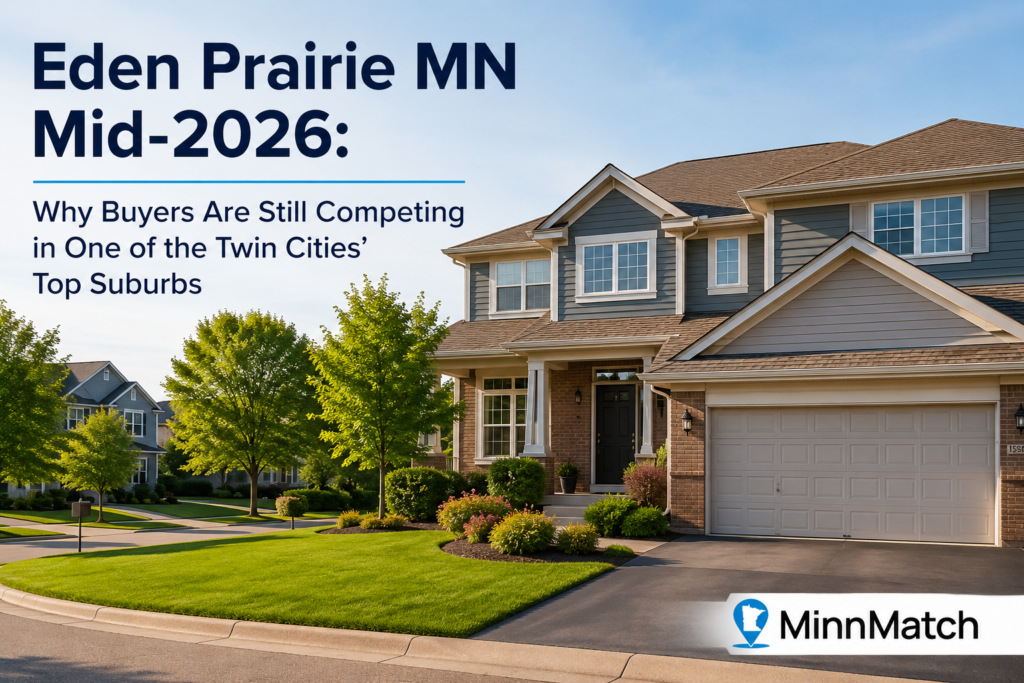
Two-story blue and brick home with manicured lawn in Eden Prairie, MN — mid-2026 housing market update from MinnMatch

Halfway through 2026, the Eden Prairie market is proving it hasn’t lost a step. While some Twin Cities suburbs have cooled off a bit as summer rolls on, Eden Prairie buyers are still writing competitive offers, still facing multiple bids on well-priced homes, and still closing fast when they find the right fit. If you’re house hunting here this summer, it helps to understand exactly why the pace hasn’t slowed — and how to position yourself to win when it counts.

Where the Eden Prairie Market Actually Stands Right Now

Pricing data varies a bit depending on the source and the exact window measured, which is normal for a market this active. Minneapolis Area Realtors® reported a rolling 12-month median sales price in Eden Prairie in the high $470,000s as of early spring, up modestly year over year, with days on market ticking up slightly compared to the ultra-tight conditions of a year ago. Meanwhile, Redfin’s more recent three-month snapshot puts the median sale price closer to $530,000, with homes fielding roughly six offers on average and going under contract in about three and a half weeks. Taken together, the honest picture is a market somewhere in the high-$400,000s to low-$500,000s depending on home type and neighborhood, but with one consistent thread: well-priced, move-in-ready homes are still drawing real competition.

That multiple-offer environment is the headline for mid-2026 buyers. Even as mortgage rates have kept some shoppers on the sidelines nationally, Eden Prairie’s mix of top-rated schools, employment access, and established neighborhoods keeps demand steady enough that inventory rarely sits long.

Why Eden Prairie Keeps Drawing Competition Mid-Summer

A few things set Eden Prairie apart from suburbs that see more seasonal drop-off after the spring rush. It’s home to major employers along the I-494/Highway 212 corridor, which keeps a steady stream of relocation and job-change buyers in the mix all year. Eden Prairie Schools also continues to be a draw for families trying to get settled before the new school year, which adds urgency to the July and August buying window specifically. And unlike some outer suburbs, Eden Prairie’s inventory skews toward well-maintained homes in established neighborhoods — the kind that don’t need much convincing to generate multiple showings in the first weekend.

The result: buyers who assume mid-year means less competition are often surprised when a well-priced listing near Round Lake or the Purgatory Creek area draws several offers within days.

What Buying Eden Prairie This Summer Actually Looks Like

If you’re buying Eden Prairie property this summer, expect a faster pace than a typical fall or winter search. That means having financing fully lined up before you tour — not just a pre-qualification letter, but a firm pre-approval from a lender who can move quickly. It means being ready to see new listings within a day or two of them hitting the market, since homes that check the boxes on schools, updates, and lot size tend not to linger. And it means having a clear sense of your ceiling going in, because the homes generating multiple offers are often the ones that end up selling above list.

None of this means overpaying blindly. It means being prepared enough that when the right home does come along, you’re not scrambling to catch up while someone else’s offer lands first.

How Local Buyers Are Staying Competitive

The buyers having the most success in Eden Prairie’s mid-2026 market tend to have three things in common: an agent who already knows the neighborhoods well enough to spot a good listing before it’s saturated with showings, financing that’s genuinely ready to go, and realistic expectations about what a competitive offer looks like in this price range. A generic, one-size-fits-all approach doesn’t work as well here as it might in a slower market — the difference between winning and losing a home often comes down to local knowledge and speed.

This is exactly where having the right agent matters most. An agent who specializes in the Eden Prairie market will already understand which neighborhoods tend to move fastest, what a fair-but-competitive offer looks like for a given street or school boundary, and how to help you write terms that stand out without stretching you past your comfort zone.

Ready to Compete for Your Eden Prairie Home?

Buying in a competitive market like Eden Prairie’s is a lot easier with a local expert in your corner. MinnMatch connects you with a handpicked, vetted agent who knows the Eden Prairie market inside and out — free of charge, with no algorithm guessing at what you need. Find your Eden Prairie agent match today, or learn more about how MinnMatch works before your next showing.

Eden Prairie vs. Plymouth: Comparing Homes, Commutes, Parks & Community Feel

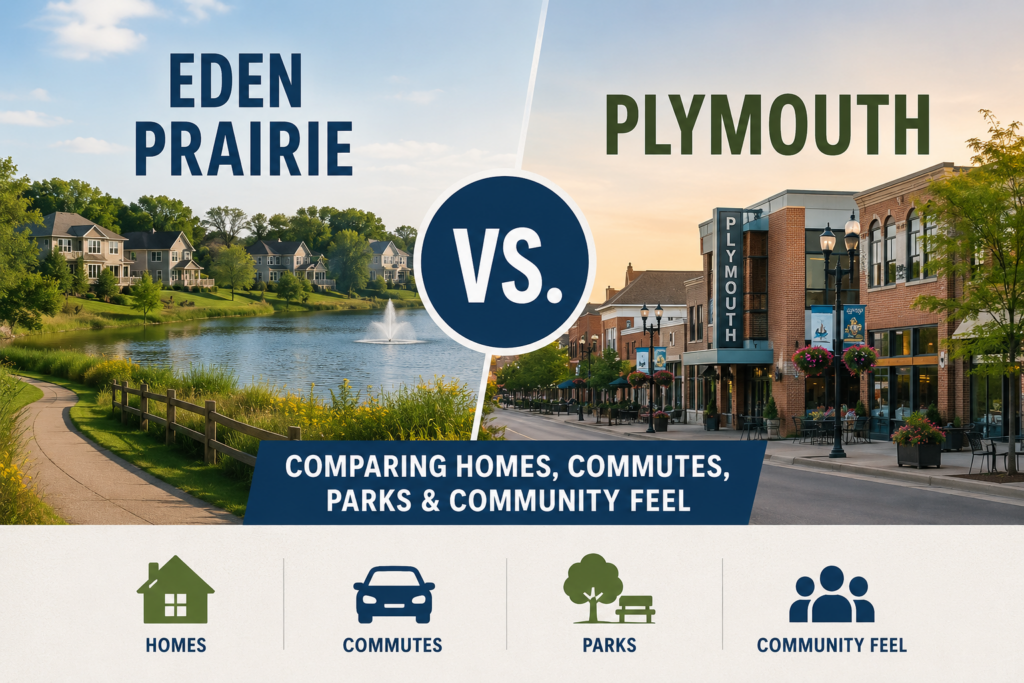
Eden Prairie vs Plymouth comparison graphic showing homes, commutes, parks, and community feel in two Twin Cities western suburbs


When families start searching for a home in the western Twin Cities, the same two names come up again and again: Eden Prairie and Plymouth. Comparing Eden Prairie vs Plymouth homes, commutes, parks, and community feel is exactly what this guide is designed to help you do — side by side, category by category, without the fluff. Both suburbs rank among the best places to live in Minnesota, but they are not interchangeable. The differences are real, and choosing the right one for your family comes down to knowing what those differences actually are.

Eden Prairie sits along the Minnesota River bluffs to the southwest of Minneapolis. Plymouth spreads across rolling, lake-dotted terrain to the northwest. Both cities offer excellent schools, low crime, strong property values, and the kind of family infrastructure that’s hard to find combined in a single place. But dig one level deeper and the two cities diverge — in housing character, outdoor lifestyle, commute patterns, and the pace of daily life. Here’s the full breakdown.


🏡 Eden Prairie vs Plymouth Homes & the Housing Market

The homes themselves tell you a lot about each city’s identity — and so do the price tags.

Eden Prairie Homes: Planned, Polished, and Consistently In Demand

Eden Prairie grew up as a master-planned community, and that heritage is visible in the housing stock. Neighborhoods here feel cohesive and well-maintained — you’ll find a lot of two-story colonials and executive-style homes built between the mid-1980s and early 2000s, along with newer construction in pockets near the city’s southern and western edges. Lots tend to be generous, many backing up to wooded buffers or pond views that are genuinely attractive rather than decorative afterthoughts.

The typical family home in Eden Prairie — three or four bedrooms, a finished basement, and a two-car garage — runs in the $550,000 to $750,000 range in 2026, with entry points below $500K if you’re willing to take on a project. Move-in ready homes at the right price generate genuine competition; multiple-offer situations are still common, especially in spring.

One standout characteristic: Eden Prairie homes tend to hold value exceptionally well. The combination of school district reputation, employment proximity, and city-wide maintenance standards creates a floor that buyers can count on over time. According to Minneapolis Area Realtors, the western suburbs have consistently outperformed the broader metro on median price-per-square-foot retention over the past five years — and Eden Prairie sits near the top of that list.

Plymouth Homes: More Range, More Room to Find Your Entry Point

Plymouth’s housing market is broader and more varied — a natural result of the city’s size (it’s one of the largest cities in Minnesota by population) and its patchwork of neighborhoods developed across different eras. You’ll find 1970s ramblers and split-levels in older western neighborhoods, well-built 1990s subdivisions throughout the core, and newer executive construction near the city’s eastern and northeastern edges.

Pricing for Plymouth homes typically runs $480,000 to $700,000 for a comparable family home, with genuine opportunities below $450K in older neighborhoods — something Eden Prairie rarely offers for move-in-ready product. On the upper end, newer construction near Medicine Lake or in premium subdivisions can push well past $800K.

The key variable when buying a Plymouth home is the school district boundary. Because Plymouth spans multiple districts — primarily Wayzata (284) and Osseo (279) — the value of a specific home can vary significantly based on which district it falls in. Homes in the Wayzata district consistently command a premium. Knowing the boundary lines before you start touring is essential, and it’s one of the clearest reasons to work with an agent who knows Plymouth specifically.

Eden Prairie

More uniform housing stock, slightly higher floor, one school district. Excellent long-term value stability.

Plymouth

More variety across eras and price points. Wider entry options. School district boundary research is non-negotiable.

Whether you’re shopping Eden Prairie or Plymouth homes, working with a buyer’s agent who focuses on these specific cities will save you time, money, and the headache of learning pricing nuances on the fly. MinnMatch matches buyers with agents who know these neighborhoods at the street level — not just the zip code.


🚗 Comparing Commutes & Location

Neither Eden Prairie nor Plymouth is going to punish you with a brutal commute — both sit within 25 to 35 minutes of downtown Minneapolis under normal conditions. But the direction, highway access, and what’s nearby differ enough to matter for many buyers.

Eden Prairie Commutes: Southwest Access and Airport Proximity

Eden Prairie sits at the intersection of I-494, Highway 212, and Highway 169 — giving residents flexible options for reaching downtown Minneapolis, the airport corridor, and communities further southwest. The I-494 strip through Eden Prairie is also a major employment hub in its own right, home to corporate campuses that mean some residents barely leave the city for work at all.

The biggest commute advantage Eden Prairie holds is proximity to Minneapolis-St. Paul International Airport. For frequent business travelers, a 15-minute drive to MSP — without fighting through the city — is a genuine quality-of-life upgrade. If your job involves regular flights, this alone can tip the scales.

Transit options are limited, as they are throughout the western suburbs, but express bus routes connect Eden Prairie to downtown. The SWLRT Green Line Extension expanded light rail access closer to the Eden Prairie area, improving connectivity for transit-oriented commuters.

Plymouth Commutes: Northwest Access and Strong Highway Connections

Plymouth benefits from strong access via I-494, Highway 55, and I-394 — the last of which is a particularly efficient corridor straight into downtown Minneapolis and the inner-ring suburbs of St. Louis Park and Golden Valley. Residents heading downtown for work find the commute manageable and predictable outside of peak hours.

Plymouth’s location also makes it a natural base for professionals working in the northwest employment corridor — think Maple Grove, Brooklyn Park, or Rogers. If your job pulls you north rather than south or downtown, Plymouth’s geography is genuinely more convenient than Eden Prairie’s.

Plymouth is further from MSP — roughly 30 to 35 minutes — which matters for frequent flyers. For remote and hybrid workers who commute occasionally, the difference is largely irrelevant.

Route Eden Prairie Plymouth
Downtown Minneapolis 25–35 min via I-494 / Hwy 212 20–30 min via I-394 / Hwy 55
MSP Airport ~15 min ✈️ ~30–35 min
Northwest suburbs 30–40 min 10–20 min ✅
Primary highways I-494, Hwy 212, Hwy 169 I-394, I-494, Hwy 55

🌲 Comparing Parks & Outdoor Access

This is where Eden Prairie vs Plymouth diverges most meaningfully — not in quality, but in character. Both are exceptional for outdoor access. The question is what kind of outdoor lifestyle you’re after.

Eden Prairie Parks: Trails, Bluffs, and a Rare Urban Wilderness

Eden Prairie’s park system is one of the most impressive in the state for a city its size. With over 2,250 acres of parkland and more than 170 miles of interconnected trails, the outdoor infrastructure here is built into the city’s DNA. According to the City of Eden Prairie Parks & Recreation, the trail network is specifically designed to connect neighborhoods to schools, parks, and commercial areas without requiring residents to touch a road.

Staring Lake Park is a beloved anchor — offering kayak rentals, an amphitheater for summer concerts, a skating loop in winter, and trails winding through native prairie. Bryant Lake Regional Park provides swimming, fishing, and boat launch access. Along the city’s southern edge, the Minnesota River bluffs deliver dramatic, wooded topography that few western suburbs can match. The Richard T. Anderson Conservation Area alone contains hundreds of acres of protected habitat.

For families with kids who want to ride to school, or parents who want a running route that actually goes somewhere, Eden Prairie’s connectivity matters enormously.

Plymouth Parks: A Lake Town Through and Through

Plymouth’s outdoor identity is defined by water. With more than 30 lakes within city limits — including Medicine Lake, Parkers Lake, Bass Lake, and Mooney Lake — water access is a fact of life here. Many neighborhoods are built around lakes, with homes backing up to shoreline and residents fishing from their yards or paddling out before breakfast.

Parkers Lake Park is a crown jewel — a well-maintained beach, picnic areas, and a skating rink in winter that draws families from across the city. The Three Rivers Park District manages extensive regional trail corridors through and around Plymouth, connecting to the wider metro-wide trail grid. Plymouth Creek Center serves as a community hub with athletic facilities, indoor recreation, and event space year-round.

Plymouth’s trail network is solid, though not quite as densely woven as Eden Prairie’s. The emphasis here is on lake access, beach time, and water recreation — and on that dimension, Plymouth has no peer in the western metro.

Eden Prairie is your city if…

You want trails out your front door, city-wide connectivity, and access to river bluffs and native prairie that feel genuinely wild.

Plymouth is your city if…

Your version of the perfect Saturday involves a kayak, fishing pole, or paddleboard — and you want lake access woven into your neighborhood, not just nearby.


🏙️ Comparing Community Feel

Numbers and amenities only go so far. What’s it actually like to live in each of these cities?

Eden Prairie Community Feel: Put-Together, Energetic, and Self-Contained

Eden Prairie feels like a city that has its act together. The commercial core around Eden Prairie Center and the surrounding retail corridor is polished and well-maintained. You can handle almost every errand, meal out, and weekend activity without leaving city limits — and many residents do exactly that. The city has cultivated a local dining scene that punches above its weight for a western suburb, and fitness options, youth sports leagues, and family-oriented events fill the calendar year-round.

The demographic skews toward dual-income professional families — many of whom work at the major corporate campuses along the I-494 corridor or commute into Minneapolis. There’s a strong sense of community investment: residents here tend to be engaged in schools, youth sports, and civic life, which keeps the city’s momentum going. Eden Prairie has been recognized nationally as one of the best cities to live in the U.S., and the residents feel that pride.

The trade-off, if there is one, is that Eden Prairie can feel dense with ambition — it’s a high-achieving place, and the culture around school sports, activities, and résumé-building can feel intense at times. For some families, that energy is exactly what they want. For others who prefer a slightly quieter pace, it’s worth noting.

Plymouth Community Feel: Spacious, Neighborly, and a Little More Relaxed

Plymouth is Minnesota’s seventh-largest city by population, but it doesn’t feel like it. The city’s geography — sprawling across rolling terrain with neighborhoods separated by lakes, parks, and open space — creates a more dispersed, lower-density character than Eden Prairie’s tighter layout. It’s a city where people genuinely know their neighbors, where cul-de-sacs feel like small communities, and where the pace of life has a little more breathing room.

Plymouth’s retail and dining scene is solid but more spread out — you’ll often drive to neighboring Wayzata or Minnetonka for a broader restaurant selection or specialty shopping. Many Plymouth residents consider this a feature rather than a bug — the proximity to Wayzata’s charming lakeside village adds destination-quality dining and entertainment without the city needing to replicate it internally.

Community events and city-organized programs are strong — the Hilde Performance Center hosts outdoor concerts and seasonal events, and Plymouth Creek Center anchors a busy schedule of youth sports, fitness classes, and family programming. The community feel is warm and genuinely Minnesotan: involved but not in your face, friendly without being performative.

Plymouth also benefits from a notable degree of diversity compared to many western suburbs, which many families find appealing — especially those moving from larger metro areas or with kids who will benefit from a wider range of backgrounds and perspectives in school.


Eden Prairie vs Plymouth Homes: So Which One Wins?

Neither. And both.

Eden Prairie is the better fit if you want everything in one tightly run package — a single elite school district, a dense trail network, strong employment proximity, and a city that feels polished from end to end. It rewards buyers who want convenience, connectivity, and a high-energy community.

Plymouth homes offer a better fit if outdoor water access matters most to your family, if you want more housing variety and a slightly wider price window, or if you prefer a community that feels a little less intense and a little more spread out. It rewards buyers who do their homework on school district boundaries and aren’t afraid to drive five minutes for a great dinner.

In both cities, the market is competitive and the learning curve for buying is real. Understanding what a home is actually worth — and being positioned to move fast when the right one hits — requires local knowledge that goes beyond what any portal can provide. That’s exactly what the right agent delivers. MinnMatch can help you find one who specializes in the community you’re targeting.

Not sure which suburb is right for you?

MinnMatch connects Twin Cities buyers and sellers with hand-picked, vetted local agents — free, fast, and with no obligation. Tell us what you’re looking for, and we’ll match you with someone who knows Eden Prairie, Plymouth, and the broader western metro inside and out.

Find My Agent →