Buying a Home with a Well and Septic System in Minnesota

Well water samples, a water test kit and a site plan showing a home’s well and septic drainfield, with a Minnesota lake and fall trees in the background.

Head a few miles past the last sewer line in the Twin Cities metro — the wooded lots outside Prior Lake, the horse country around Independence and Medina, the acreage near Lake Elmo and Afton — and you’ll start seeing listings that say “private well” and “septic” in the details. Buying a home with well and septic in Minnesota is very doable, and plenty of people love the space and privacy that come with it. But it adds a few steps most city buyers never think about: a state well disclosure, water testing, and a septic inspection that may or may not be required depending on which county you’re buying in. Here’s what to know before you write an offer.

What Minnesota Requires When You Buy a Home with Well and Septic

Minnesota puts the disclosure burden on the seller for both systems. On the well side, the seller must give you a written well disclosure before you sign a purchase agreement. According to the Minnesota Department of Health’s well disclosure guidance, that statement includes a map of every well on the property and whether each one is in use, not in use, or sealed. At closing, a Well Disclosure Certificate is filed with the deed, along with a $54 fee that the buyer provides.

Pay close attention to that “not in use” box. If an old, unused well isn’t sealed, returned to service, or covered by a maintenance permit before closing, that responsibility passes to you. Many lenders want unused wells sealed by a licensed contractor, so it’s worth negotiating who handles it up front.

Septic works similarly. Sellers must disclose in writing how sewage is handled, where the system (and any abandoned system) is located, and whether — to their knowledge — it complies with state rules. The Minnesota Pollution Control Agency is clear, though, that a disclosure is not an inspection. It’s the seller’s best knowledge, not a professional evaluation.

Septic Compliance Inspections: It Depends on the County

This is where a lot of buyers get tripped up. Minnesota doesn’t require a septic compliance inspection at sale statewide — but many counties, cities, and townships do, especially in shoreland areas. The difference across the metro is real:

  • Washington County requires a compliance inspection when a property with septic is sold, unless a recent inspection or new-system certificate is already on file.
  • Scott County (home to the rural areas around Prior Lake) does not require one at sale — though the county notes many buyers order one anyway, and lenders sometimes require it.
  • Other counties and cities each set their own rules, so the answer for a hobby farm in Corcoran may differ from a lake lot in Chisago County.

Our advice: if you’re buying a home with well and septic, even where an inspection isn’t required, make your offer contingent on a compliance inspection by an MPCA-licensed inspector. A certificate of compliance is generally good for three years on an existing system and five years on a new one. If a system is found failing, local rules set the repair timeline, and an imminent threat to public health typically has to be fixed within months — not years.

One timely note for fall and winter buyers: frozen ground can complicate a septic evaluation. If you’re shopping between now and spring, ask early how the local county handles winter inspections so it doesn’t stall your closing.

Testing the Well Water Before You Close

Minnesota doesn’t require a water test at sale, and a standard home inspection usually doesn’t cover the well. That makes this step entirely up to you — and it’s one you shouldn’t skip. The Minnesota Department of Health recommends that private well owners test for:

  • Coliform bacteria — every year
  • Nitrate — every year
  • Arsenic, lead, and manganese — at least once

Arsenic and manganese occur naturally in groundwater across parts of Minnesota, so a one-time test during your purchase is the perfect moment to check. Use an accredited lab, and ask the seller for past test results, well construction records, and details on any water softener or treatment system. Your agent can also look the well up in the Minnesota Well Index — though wells drilled before 1974 often have no public record at all.

Budgeting for Life with a Private Well and Septic System

The trade-off for rural living is that you’re your own utility. You won’t get a city water and sewer bill, but you’ll take on maintenance that city homeowners never see:

  • Septic pumping every two to three years, plus periodic inspections.
  • Annual water testing for bacteria and nitrate.
  • Well pump and pressure tank repairs or replacement over time.
  • A septic replacement fund. A failed system — especially one that needs a mound because of soil or groundwater conditions — can run well into five figures.

If an inspection turns up a failing system, that’s not automatically a deal-breaker. It’s a negotiation point: a price reduction, a seller-paid replacement, or an escrow holdback can all work. This is exactly where an agent who’s closed rural deals before earns their keep.

FAQ: Buying a Home with Well and Septic in Minnesota

Is a septic inspection required to sell a house in Minnesota?

Not statewide. Requirements are set locally — Washington County requires one at sale, for example, while Scott County does not. Lenders may require one either way, and buyers can always make their offer contingent on one.

Does a home inspection cover the well and septic?

Usually not in any depth. Plan on a separate septic compliance inspection by an MPCA-licensed inspector and a water test through an accredited lab. A licensed well contractor can evaluate the well itself if there are concerns.

Who pays to seal an unused well?

It’s negotiable. If the seller doesn’t address an unused well before closing, the responsibility transfers to the buyer, so settle it in the purchase agreement.

Find an Agent Who Knows Rural Twin Cities Properties

A home with well and septic can give you the room, quiet, and land that’s hard to find closer in — as long as you go in with the right inspections, contingencies, and expectations. Not every agent has walked a buyer through a septic compliance report or a well disclosure certificate, and that experience matters. MinnMatch personally connects buyers with vetted local agents who know the exurban edges of the metro, from Scott County to the St. Croix Valley. See how our matching works, or get matched with an agent who’s done this before — it’s free for buyers. For more first-step guidance, visit our buyer resources.

Buying a Townhome vs. Single-Family Home in the Twin Cities in 2026: Which Is Right for You?

Townhome vs. single-family home comparison checklist with Twin Cities model homes and keys

If you’re house hunting in the metro this year, you’ve probably found yourself weighing a townhome vs. single-family home more than once. It’s one of the most common forks in the road for Twin Cities buyers, whether you’re a first-timer stretching your budget in Plymouth or a downsizer looking to trade a big yard for a lock-and-leave lifestyle in Eden Prairie. Both options can be the “right” home — it just depends on what you’re actually optimizing for: price, space, maintenance, or long-term flexibility. Here’s how to think through the decision like a local.

What’s the Real Difference Between a Townhome and a Single-Family Home?

A single-family home sits on its own lot, with no shared walls and full control over the structure and land. A townhome typically shares one or two walls with a neighboring unit and is governed by a homeowners association (HOA) that handles things like exterior maintenance, snow removal, and lawn care in exchange for a monthly fee. In the Twin Cities, you’ll find townhomes clustered in newer developments throughout the western and southern suburbs — think Plymouth, Eden Prairie, and Prior Lake — as well as infill projects closer to the urban core. Some townhomes are “fee simple,” meaning you own the land under your unit outright, while others are part of a common interest community (CIC) where the land is shared. That distinction matters for financing, resale, and how much say you have over changes to your property.

Cost Comparison: Townhome vs. Single-Family Home Pricing in the Metro

Price is usually the first thing that pulls buyers toward a townhome. Twin Cities townhomes have consistently sold for tens of thousands of dollars less than single-family homes in the same submarkets, according to data reported by Minneapolis Area Realtors. That gap tends to widen further out in the suburbs and narrow in high-demand urban pockets where land is scarce and townhomes command a premium of their own. You can track current median prices by property type on Redfin’s Twin Cities housing market page to see how the numbers are trending in a specific neighborhood you’re considering.

But the purchase price is only half the equation. Townhomes come with HOA dues that can range from roughly $150 to $500+ per month in the metro, depending on amenities and how much the association covers. Factor that into your monthly budget the same way you would a mortgage payment — a townhome with a low list price and a high HOA fee can end up costing more per month than a single-family home with a slightly higher mortgage. First-time buyers should also check whether they qualify for down payment assistance through the Minnesota Housing Finance Agency, which applies to both property types.

Maintenance and Lifestyle: Who Each Option Actually Fits

This is where the townhome vs. single-family decision usually gets settled for most buyers. If you dread Minnesota winters spent shoveling a driveway or mowing a quarter-acre lot in July, a townhome’s maintenance-free structure is a real quality-of-life upgrade — the HOA handles snow removal, lawn care, and often the roof and siding. That’s a big part of why townhomes have become popular with both young professionals who don’t want weekends eaten up by yard work and empty-nesters looking to downsize without giving up a garage.

On the other hand, a single-family home gives you full control — paint the exterior any color you want, put in a garden, add a fence for the dog, or finish the basement without asking anyone’s permission. Families who need more space, a private yard for kids, or room to grow tend to gravitate toward single-family homes even when it means a bigger commute or a longer renovation to-do list. Neither lifestyle is objectively better; it comes down to how you actually want to spend your time and money as a homeowner.

Where You’ll Find Each Option Across the Twin Cities

Location plays a big role in which type of home makes sense. Plymouth and Eden Prairie both have strong townhome inventory alongside traditional single-family neighborhoods, which makes them good places to compare the two side by side without changing school districts. Prior Lake has seen a wave of newer townhome developments aimed at buyers who want lake-area access without lake-area maintenance. Meanwhile, close-in areas like Edina and parts of Minnetonka tend to have tighter single-family inventory with premium pricing, which pushes some buyers toward a townhome simply to stay in the school district or commute zone they want. If you’re not sure which submarkets fit your budget and priorities, that’s exactly the kind of local knowledge a good buyer’s agent should bring to the table when you’re comparing a townhome vs. single-family home in a specific area.

Frequently Asked Questions

Is a townhome a good investment in the Twin Cities?
Townhomes can appreciate well, especially in high-demand suburbs with limited land for new single-family construction. Resale can be slower than single-family homes in a soft market, so it helps to review how comparable units in the same association have performed before buying.

Do townhomes have HOA fees in Minnesota?
Almost all Twin Cities townhomes are part of an HOA, since the association is what manages shared exterior maintenance, common areas, and sometimes amenities like a clubhouse or pool. Always ask for the HOA’s financials and reserve study before making an offer.

Can first-time buyers get down payment help for either option?
Yes — Minnesota Housing programs generally apply to both townhomes and single-family homes as long as the property and buyer meet program requirements.

Get Matched With an Agent Who Knows Both Markets

There’s no universal right answer in the townhome vs. single-family home debate — the right choice depends on your budget, your tolerance for yard work, and the neighborhoods you have your eye on. What helps most is working with an agent who regularly sells both property types in the specific suburbs you’re considering, so you’re comparing real numbers instead of guesswork. That’s exactly what MinnMatch is built for. Tell us what you’re looking for and we’ll match you with a local agent who can walk you through the trade-offs for your situation, or visit how it works to see how the matching process goes. It’s free, and there’s no pressure to commit to a specific home type before you’ve seen what fits.

Prior Lake MN Fall 2026: Waterfront Properties, Prices & What the Off-Season Looks Like

Fall lake home checklist and books on a Prior Lake dock table with a sailboat model and coffee mug

If you’ve been watching Prior Lake fall real estate activity this year, you’ve probably noticed the pace feels different than it did in July. The pontoons are coming out of the water, the “for sale” signs on the lakefront blocks are lingering a little longer, and buyers who missed out during peak boating season are quietly circling back. Prior Lake’s off-season isn’t a dead market — it’s a different one, with its own rhythm, its own pricing logic, and in many cases, its own advantages for the right buyer or seller.

Prior Lake Fall Real Estate 2026: What’s Actually Changing

Every fall, Prior Lake’s market shifts from the frenzy of summer showings to something calmer. Buyers touring homes on Upper and Lower Prior Lake in September and October are no longer competing with families racing to close before the school year — that wave has already passed. What’s left is a mix of serious, motivated buyers and sellers who are either newly listing for strategic reasons (a job move, an estate, a downsizing decision) or who’ve been sitting on the market since summer and are starting to feel the calendar. According to Redfin, Prior Lake’s citywide median sale price sat in the $490,000–$495,000 range through late summer, up modestly year over year, while Zillow’s broader home value index for the city has climbed to roughly $526,000. Those numbers describe the overall market — waterfront homes on Prior Lake itself typically run well above that, and fall is exactly when the gap between “average Prior Lake home” and “Prior Lake lake home” becomes most visible.

Waterfront Properties: How Prices Behave in the Off-Season

Waterfront pricing on Prior Lake doesn’t crash in the fall, but it does get more negotiable — and more varied. During peak season, a well-priced lake home with decent frontage can draw multiple offers within days. By September and October, that urgency fades. Sellers who listed in June or July and are still on the market by fall are often more open to price conversations, especially if a home needs cosmetic work or sits on a smaller lot. Buyers who show up with financing ready and a realistic offer can find real leverage that simply doesn’t exist in May. That said, this isn’t a fire sale — genuinely turnkey waterfront homes with good frontage and dock rights still command a premium even in the off-season, because true lakeshore inventory on Prior Lake is limited no matter the month. The practical takeaway for anyone tracking Prior Lake fall real estate trends: expect price ranges to widen, not necessarily prices to drop across the board.

Prior Lake Market Snapshot — Fall 2026

$526K

Average home value, up 3.2% year over year

$490K–$495K

Citywide median sale price, trailing month

~185

Active listings citywide heading into fall

33–90+

Days on market, closed sales vs. lingering active listings

Sources: Redfin, Zillow, NorthstarMLS-based listing data. Ranges reflect citywide figures; waterfront segments vary.

Why Off-Season Timing Matters More on the Water

Lake property is seasonal in a way that a standard suburban home simply isn’t. Buyers want to picture themselves on the dock, and it’s harder to do that when the boat lifts are already stored for winter. That psychological pull is part of why waterfront listings that miss the summer window sometimes sit longer than comparable non-waterfront homes — not because the home isn’t desirable, but because the buyer pool that’s actively looking in October is smaller and more deliberate. For sellers, that means fall listings benefit from staging that emphasizes the four-season value of the property: a heated garage, a finished walkout, proximity to the Prior Lake–Savage school district, or winter access to the lake for ice fishing and skating. For buyers, it means less competition and more room to negotiate on things like closing timelines, inspection items, and price per square foot — which, per recent listing data, has been running around $310 per square foot across active Prior Lake inventory this fall.

What to Expect This Off-Season

1

Fewer showings, more serious buyers

Casual lookers thin out by October. The people touring Prior Lake homes in the fall are typically closer to making a decision.

2

Wider negotiating room on price and terms

Homes still listed since summer often have sellers who are more flexible than they were in June.

3

Waterfront still commands a premium

True lakeshore with good frontage and dock access rarely gets cheap, even in the off-season — it just gets more negotiable at the margins.

4

Financing conditions matter as much as the calendar

Mortgage rate movement can shape fall buyer activity as much as lake-season timing does — worth checking current guidance from Minnesota Housing before you shop.

Prior Lake Fall Real Estate: Common Questions

Is fall a good time to buy a waterfront home in Prior Lake?
For many buyers, yes. Less competition and more negotiating room often outweigh the fact that you can’t test the dock before winter. Just budget extra due diligence time for anything you can’t fully inspect until spring.

Do Prior Lake home prices actually drop in the off-season?
Not dramatically. Citywide averages tend to hold steady or dip only slightly. What changes more is negotiating leverage — sellers become more willing to move on price, terms, or repairs than they were mid-summer.

How long are homes sitting on the market in Prior Lake right now?
Recently closed sales have averaged in the 30s for days on market, but active listings heading into fall — a mix that includes homes that lingered through summer — are averaging closer to 90 days, which is typical for this time of year.

Thinking About Prior Lake This Fall?

Whether you’re chasing off-season leverage on a lake home or trying to price a listing that’s been sitting since summer, timing and local knowledge matter more in the fall than in any other season. MinnMatch can match you with a Prior Lake–area agent who knows exactly how this market moves once the boats come out of the water — no algorithm, no guesswork, just a real local match. Curious how the process works? See how MinnMatch works, or browse more on our Prior Lake community page.

Sources: Redfin Prior Lake Housing Market, Zillow Prior Lake Home Values, Minnesota Housing Finance Agency.

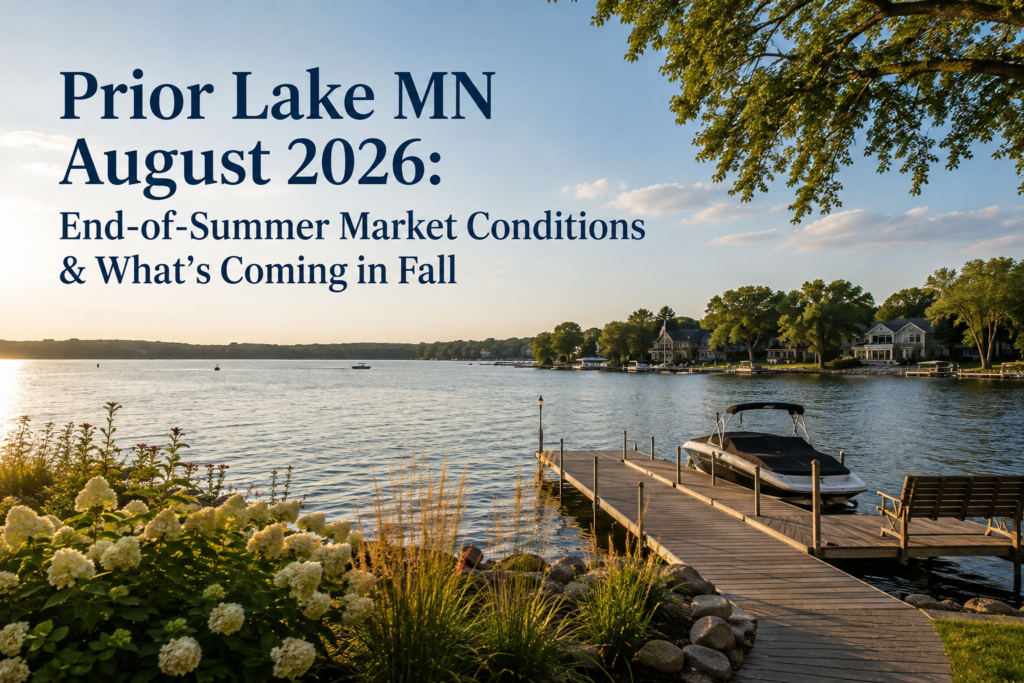
Prior Lake MN August 2026: End-of-Summer Market Conditions & What’s Coming in Fall

Prior Lake MN lakefront dock at sunset with boat, late summer 2026

Labor Day is closing in, the kids are back in school, and the Prior Lake real estate market is settling into the pattern it follows every year at this point in the calendar: still busy, still competitive in the right price bands, but noticeably calmer than the frenzy of June. If you’ve been watching Prior Lake and Spring Lake listings all summer and wondering whether to make a move now or wait for fall, here’s what’s actually happening on the ground in Scott County right now — and what the next couple of months are likely to bring.

Where the Prior Lake Real Estate Market Stands in Late Summer

Depending on which data source and which slice of the past year you’re looking at, Prior Lake’s median sale price has landed anywhere from the high $400,000s to the mid $500,000s, with per-square-foot pricing hovering around $190–$230. That spread isn’t a red flag — it’s just what happens in a city this size when the sample includes everything from starter townhomes near Downtown Prior Lake to sprawling lakefront estates on the water. Homes are typically going under contract in a little over a month, which is longer than the sprint pace of April and May, but still faster than a truly balanced market. According to Redfin’s Prior Lake market data, home prices are still running ahead of where they were a year ago, even as the pace of sales has eased off its summer peak.

Why Things Feel Different Than They Did in June

This slowdown isn’t a sign of trouble — it’s the same seasonal rhythm Prior Lake sees every year. Families with school-age kids raced to close before the first day of class, which pulled a lot of demand forward into June and July. Once school starts, that urgency evaporates, showings thin out on weeknights, and sellers who list in late August tend to be more serious and more motivated than the ones who tested the market back in spring. For buyers, that combination — fewer competing offers, more realistic sellers — is one of the more underrated windows of the year to actually get an accepted offer without an escalation clause attached.

Waterfront Considerations on Prior Lake and Spring Lake

Prior Lake’s identity as a lake town shapes its housing market more than almost anything else. The city sits on two connected recreational lakes, and homes with direct lake access, especially on the main body of Prior Lake, routinely command a premium over otherwise comparable properties a few blocks inland. Late summer is a particularly telling time to shop the waterfront segment: sellers who list a lake home in August are usually motivated to close before the boat comes out of the water for the season, and buyers get to see the property at its best, dock and all, rather than imagining it under snow. If lake living is the whole point of your search, this is a stretch of the calendar worth paying close attention to.

What’s Likely Coming as Fall Sets In

Expect the usual fall pattern for the Prior Lake real estate market: new listings will slow down through September and October, days on market will stretch out a bit further, and price growth should moderate compared to the spring run-up. Mortgage rates remain the wildcard — Freddie Mac’s weekly rate survey is worth bookmarking if you’re timing a purchase, since even modest rate moves change what a given monthly payment buys in a market where inventory is still relatively tight. Prior Lake isn’t likely to see a dramatic shift in either direction; it’s more a gradual cooling than a reset, which is exactly the kind of environment where a well-prepared buyer can find real leverage.

Should You Buy Now or Wait for Fall?

There’s no single right answer, but the case for acting in the next few weeks is a reasonable one: less competition than spring, sellers who are increasingly ready to negotiate, and lake properties still showing well before the season turns. The case for waiting until true fall is just as reasonable if you want even more negotiating room and don’t mind a smaller pool of listings to choose from. Either way, the Prior Lake real estate market rewards buyers who understand its seasonal cadence rather than treating every month like it’s June. For current, verified listing activity, the Minneapolis Area REALTORS MLS data is the most reliable source of truth beyond the national aggregators.

If you’re weighing a move in Prior Lake this fall — whether that’s a lakefront listing on Spring Lake or a starter home closer to downtown — a local agent who actually knows this submarket makes the difference between guessing and knowing. MinnMatch can connect you with a vetted Prior Lake specialist for free — no algorithm, just a real match based on what you’re actually trying to do. Find your Prior Lake agent match here.

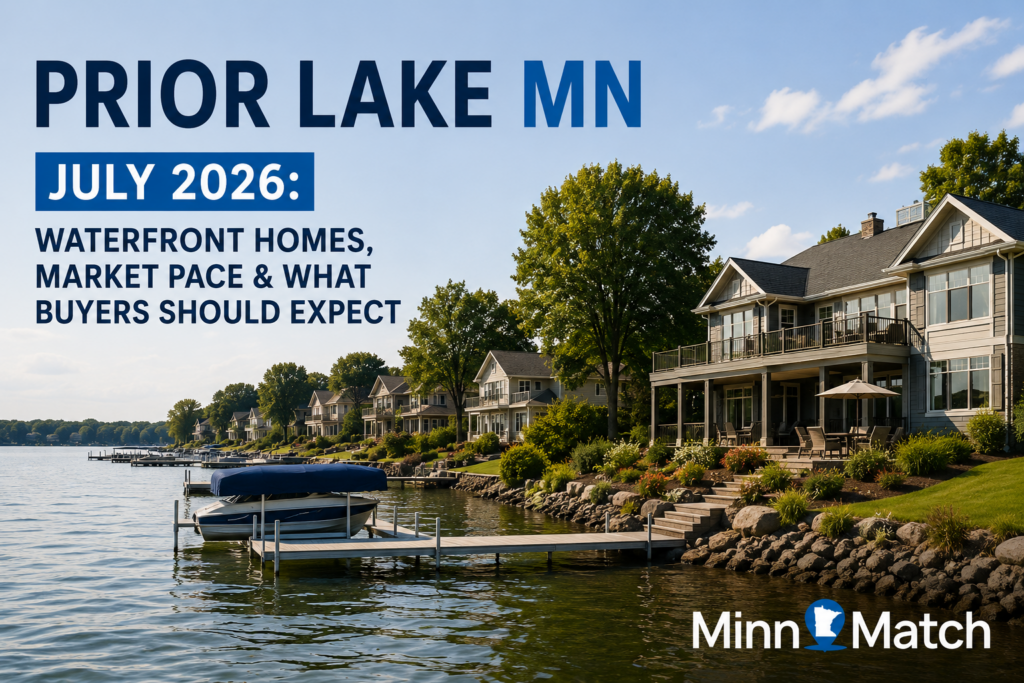
Prior Lake MN July 2026: Waterfront Homes, Market Pace & What Buyers Should Expect

Waterfront homes with private docks on Prior Lake, MN in July 2026

July in Prior Lake looks the way it always does at the height of lake season: boats parked at every third dock along Spring Lake and Upper Prior Lake, kids riding bikes down to the beach at Sand Point Beach Park, and a steady trickle of new listings hitting the market as sellers try to catch peak-summer buyer attention. But if you’ve been watching from the sidelines since spring, the Prior Lake MN summer market 2026 has shifted in a few ways worth knowing before you make an offer, especially if a lake lot is on your wish list. Here’s what’s actually happening with pace, pricing, and waterfront inventory this month, and what it means if you’re buying in Scott County right now.

The Prior Lake MN Summer Market 2026: How Fast Is It Moving?

The short answer: slower than it was in the spring, but still active. Homes in Prior Lake are currently averaging somewhere in the 60- to 90-day range on market, up noticeably from the 20-day pace you’ll see quoted for the core Twin Cities metro. That gap matters. Prior Lake has always sold on its own clock, partly because it draws a buyer who’s willing to wait for the right lot, the right view, or the right price rather than settling for the first available house. Inventory has also grown heading into summer, with active listings roughly doubling since early spring as more sellers list to catch the seasonal wave of lake-life shoppers. More homes on the market plus a slower pace usually adds up to one thing for buyers: a little more breathing room to negotiate than you’d have found in April or May.

Waterfront Homes: What’s Listed and What They’re Selling For

Waterfront is where Prior Lake earns its reputation, and July is when that inventory tends to look its best. Right now, active lakefront and lake-adjacent listings span a wide range: mid-range walkout homes on lake-access lots in the $600,000s, larger two-story properties directly on the water pushing toward $1 million, and a handful of estate-style parcels on acreage near Credit River well above that. That spread is normal for a lake market. A three-season porch, a swimmable shoreline versus a bog-heavy one, and dock access all move the number more than square footage alone. If you’re shopping waterfront specifically, expect list prices to hold firmer than the rest of the market, since sellers with genuine lake frontage know exactly how limited that inventory is, even when the broader Prior Lake market is giving buyers a bit more room.

Why Prices Are Cooling Compared to Earlier This Year

Median sold prices in Prior Lake have been easing off their spring peak, with recent monthly figures landing in the roughly $420,000 to $460,000 range depending on the mix of homes that closed. That’s a meaningful step down from the highs reported earlier in the year, and it’s paired with more homes selling below their original list price than we saw over the winter. None of this means Prior Lake is a soft market, homes are still closing close to asking on average, but it does mean sellers are pricing more realistically and buyers have slightly more leverage to negotiate on non-waterfront properties than they did a few months ago. For broader context on how this compares to the rest of the metro, Minneapolis Area Realtors’ market data shows the wider Twin Cities region holding steadier, which suggests Prior Lake’s shift is more local supply catching up to demand than a metro-wide slowdown.

What Buyers Should Expect This Summer

If you’re actively house hunting in Prior Lake this month, a few things are worth planning around. First, expect competition to stay concentrated on the best waterfront and lake-view lots, those still move quickly and sometimes with multiple offers, even while the broader market softens. Second, non-waterfront homes priced sensibly are a different story: with days on market stretching out and inventory up, you have more room to ask for closing cost help, request repairs, or simply take a weekend to think before writing an offer. Third, if financing is part of your plan, it’s worth checking current down payment assistance options through Minnesota Housing before you start touring, since program terms can shift year to year and it’s easier to know your numbers upfront than to scramble mid-negotiation. And if you’re weighing Prior Lake against nearby options, comparing current asking prices on Redfin’s Prior Lake listings alongside what’s happening in Eden Prairie or Lake Minnetonka communities can help you sanity-check whether Prior Lake’s pricing still fits your budget for the lake lifestyle you’re after.

The Bottom Line for This Summer

Prior Lake in July 2026 is a market with two speeds: waterfront lots that still move on their own urgency, and everything else that’s giving buyers a little more time and negotiating room than earlier this year. Reading that difference correctly, and knowing which category the home you’re looking at falls into, is exactly the kind of local read that makes or breaks an offer in a lake community like this one. That’s where having an agent who actually works this specific market pays off. Every agent in our Prior Lake network tracks these shifts street by street, not just citywide, so you’re not guessing whether a listing is priced to move or priced to test the market. If you’re ready to start touring, find your Prior Lake match today, or read more about how MinnMatch works to see how the process fits into your summer home search.

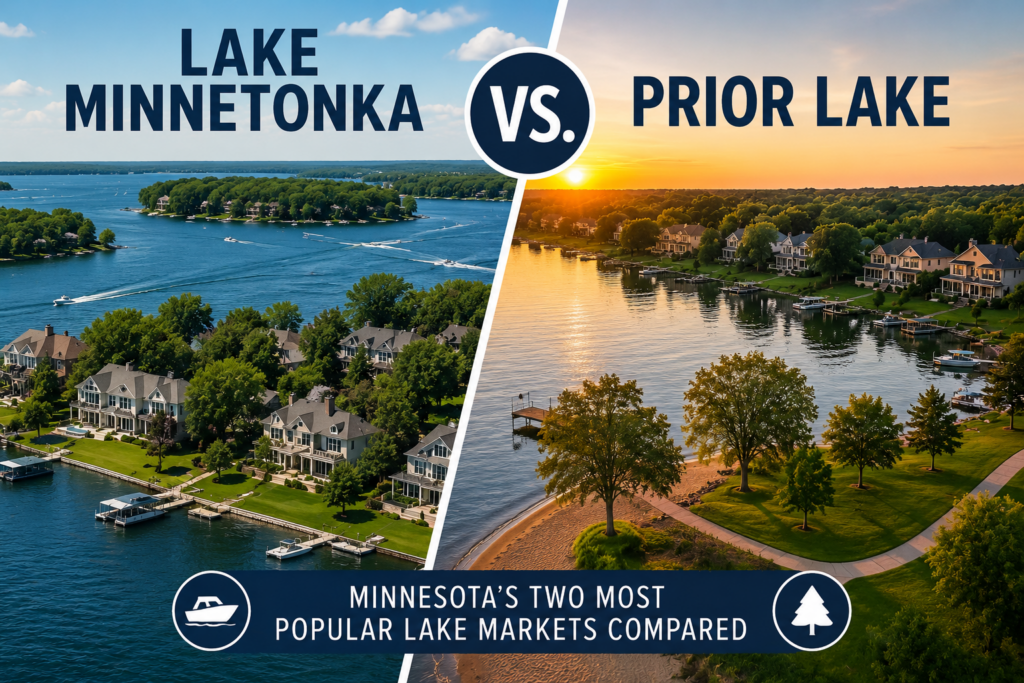
Lake Minnetonka vs. Prior Lake: Minnesota’s Two Most Popular Lake Markets Compared

Aerial comparison of Lake Minnetonka and Prior Lake waterfront homes in Minnesota

If you’re searching for a lake home in the Twin Cities metro, two names come up again and again: Lake Minnetonka and Prior Lake. Both offer genuine waterfront living, strong community identities, and real estate markets that consistently outperform their landlocked neighbors. But Lake Minnetonka vs. Prior Lake real estate is not an apples-to-apples comparison — and understanding the differences could save you months of searching in the wrong direction.

This guide breaks down both markets across price, lifestyle, buyer profile, and long-term value so you can make a more informed decision — or hand this article to the agent who’s helping you make it.

Not sure which market is right for you? MinnMatch can match you with a vetted local agent who knows both lakes inside and out.

Lake Minnetonka vs. Prior Lake: The Basics

Before comparing the real estate, it helps to understand what you’re actually buying access to.

Lake Minnetonka is the headline act of Minnesota metro lake living. Spanning roughly 14,000 acres across 14 communities in Hennepin County, it’s the largest and most storied lake in the Twin Cities area — a destination that has defined western-suburb prestige for more than a century. Wayzata, Excelsior, Orono, and Deephaven are among the communities that ring its 125 miles of shoreline. The lake sits approximately 12 miles west of downtown Minneapolis.

Prior Lake — technically two connected lakes, Upper and Lower Prior Lake — covers about 1,340 combined acres in Scott County, roughly 20 miles southwest of downtown Minneapolis. It’s smaller in scale but punches well above its size in desirability. The city of Prior Lake has grown significantly in recent decades and is now home to approximately 27,000 residents who have built their community identity around water access, outdoor recreation, and quality schools.

In short: Lake Minnetonka is the prestige play. Prior Lake is the accessible-but-still-aspirational alternative. Both are legitimate lake markets — but they attract meaningfully different buyers.

Price Comparison: What Does a Lake Home Actually Cost?

Lake Minnetonka

Lake Minnetonka is one of the most expensive residential real estate markets in Minnesota, full stop. As of May 2026, there are roughly 218 active waterfront listings on the lake with an average asking price of approximately $2.8 million — and a price per square foot hovering around $545. Typical lakeshore listings average about 4,500 square feet with nearly four bedrooms and four bathrooms.

The range is wide. Entry-level access to Lake Minnetonka shoreline can start around $1 million for a smaller or dated cottage, while high-end estates in Orono or Wayzata regularly list at $10 million and above. At the extreme end, an extraordinary off-market estate was listed at $55 million — more than 29,000 square feet with a wine cave, movie theater, bowling lanes, and multiple docks.

For buyers who want proximity to the lake but not a direct shoreline price tag, the broader communities surrounding the lake — the city of Minnetonka, Wayzata, Excelsior — offer more accessible entry points. The city of Minnetonka’s overall median home value sits around $521,000 as of 2025, reflecting the mix of lakefront luxury and inland residential neighborhoods.

Prior Lake

Prior Lake offers a more accessible price spectrum while still delivering real waterfront value. The citywide median home value is approximately $526,000 as of early 2026 — remarkably close to broader Minnetonka — but the waterfront premium is more moderate.

As of May 2026, there are 57 active lake property listings in Prior Lake with an average listing price of roughly $1.65 million and a price per square foot of $383 — meaningfully below Lake Minnetonka’s $545. The most expensive waterfront listing sits at $17.9 million, while more modest lake-access properties can be found for as little as $135,000 (typically association-access or smaller lots).

For buyers who want lakefront living in the $600,000–$1.2 million range, Prior Lake offers options that simply don’t exist on Lake Minnetonka. That’s a significant differentiator for move-up buyers, growing families, and buyers relocating from out of state.

Side-by-Side Snapshot

Metric Lake Minnetonka Prior Lake
Lake size ~14,000 acres ~1,340 acres
Avg. waterfront listing price ~$2.8M (May 2026) ~$1.65M (May 2026)
Avg. price per sq ft (waterfront) ~$545 ~$383
Citywide median home value ~$521,000 (Minnetonka city) ~$526,000
Distance to Minneapolis ~12 miles west ~20 miles southwest
School district(s) Minnetonka, Wayzata, Orono, Mound Westonka Prior Lake-Savage Area Schools
Communities on the lake 14 1 (city of Prior Lake)

Lifestyle: Two Very Different Lake Vibes

Lake Minnetonka: Established Elegance, Walkable Villages, Deep Roots

Lake Minnetonka has a character that’s hard to replicate — it has been Minnesota’s most coveted lake address for well over a century. The 14 communities surrounding it each have distinct identities. Wayzata is boutique-chic with a vibrant downtown, waterfront dining, and a Metra train connection to Minneapolis. Excelsior has the feel of a classic Midwestern lake town, with independent shops, a public beach, and summer street festivals. Orono and Greenwood offer wooded privacy and estate-scale properties. Deephaven sits somewhere in between — elegantly residential, less commercial, deeply quiet.

The lake itself supports year-round recreation. In summer it’s a full destination: boating, paddleboarding, sailing regattas, and fishing tournaments. In winter, ice fishing shanties dot the bays and the lake is a fixture of the local snowmobile culture. The social fabric around Lake Minnetonka is dense — yacht clubs, community events in Excelsior, the iconic Lord Fletcher’s on the water — and buyers are often as drawn to that community energy as they are to the shoreline itself.

Proximity to Minneapolis is a genuine selling point, too. Most lake towns are a 20–30 minute drive, making it feasible to live a lake-first life without sacrificing urban access.

Prior Lake: Active, Unpretentious, Growing Fast

Prior Lake has a different energy — less legacy prestige, more lived-in vitality. The city has grown considerably over the past two decades, and that growth has attracted a younger demographic of families who want authentic lake access without the stratospheric price tag of the west metro lakes.

Upper Prior Lake tends to attract buyers who want calmer waters, more privacy, and a settled residential character. Lower Prior Lake, with its more open water, draws the boating and water sports crowd. Both are consistently among the most popular recreational lakes in the south metro. The lake hosts strong fishing — walleye, northern pike, largemouth bass, and crappie — and the broader community includes 51 parks, extensive trail networks, and the prestigious Wilds Golf Club adjacent to the lake’s southern neighborhoods.

The Prior Lake Association has worked since 1946 to preserve and promote the water and shoreline, and the city actively monitors water quality and manages aquatic invasive species — a sign that the community takes its lake asset seriously for the long term.

Scott County’s consistent growth has made Prior Lake one of the fastest-growing communities in Minnesota, and the Prior Lake-Savage Area Schools draw strong reviews from families considering the area. For buyers who are prioritizing school quality alongside lake access, Prior Lake checks both boxes at a more attainable price point.

Which Lake Market Is Right for You? Buyer Profiles

Both Lake Minnetonka and Prior Lake attract lake-lifestyle buyers — but the specific buyer profiles diverge in meaningful ways. Here’s a practical breakdown.

Lake Minnetonka Is Typically the Better Fit If:

  • Your budget for waterfront is $1.5 million or above, and ideally $2–5 million for a move-in-ready lakeshore property.
  • You want walkable access to vibrant communities like Wayzata or Excelsior — coffee shops, restaurants, boutiques, right from the boat or the sidewalk.
  • You’re drawn to the prestige and legacy of the address — Lake Minnetonka is a known quantity nationwide and carries status that Prior Lake simply doesn’t match.
  • You work in Minneapolis and want a west-metro commute or access to Wayzata’s Metra rail stop.
  • You prioritize a robust social lake culture — yacht clubs, regattas, and a dense community of other lake residents who share the lifestyle.
  • You’re looking at this as a long-term luxury investment and want the brand-name lake with historical price resilience.

Prior Lake Is Typically the Better Fit If:

  • You want genuine waterfront access with a budget in the $500,000–$1.5 million range — a segment where Lake Minnetonka options are extremely limited.
  • You have school-age children and want a strong, cohesive school district (Prior Lake-Savage) paired with a family-oriented community culture.
  • You prefer a more intimate lake — fewer commercial operators, calmer on summer weekends, a more neighborhood-oriented feel.
  • You work in the south metro (Shakopee, Eden Prairie, Burnsville) and want to minimize commute time while maximizing lifestyle.
  • You’re a first-time lake-home buyer and want to learn the lifestyle before potentially stepping up to a higher-price lake market later.
  • Outdoor recreation — fishing, boating, golf at The Wilds, trail access — matters more to you than proximity to upscale commercial districts.

Market Dynamics: Competition, Inventory, and Days on Market

Lake Minnetonka waterfront is structurally undersupplied — there’s a fixed amount of shoreline, very few new lots, and demand that remains elevated even when broader markets soften. In July 2025, waterfront homes on Lake Minnetonka averaged about 63 days on market, up from 31 days the prior year as buyers exercised more patience at elevated price points. That’s not a sign of weakness so much as a reflection of how selective the buyer pool is at $2–5 million.

Prior Lake is more active in volume terms. The broader Prior Lake market had 52 homes sold in August 2025, up meaningfully from 38 the prior year — and homes in the city sell in roughly 26–40 days depending on the segment. Waterfront properties move faster and with less negotiating room, similar to any lake-adjacent market in the metro.

Both markets benefit from Minnesota’s broader housing dynamics: statewide, inventory remains limited relative to buyer demand, and lake properties in the Twin Cities continue to be treated as lifestyle assets rather than purely transactional purchases. Buyers who hold well-positioned lake homes on either lake tend to hold them — which keeps turnover low and well-priced listings competitive.

What to Watch For in Either Market

Both lake markets have nuances that make local expertise essential. A few things to keep in mind before you make an offer on either lake:

Shoreline rights and dock permits. Not all “lake access” properties are equal. Direct shoreline ownership, deeded dock rights, water depth at the dock, and HOA rules around boat storage vary significantly — even between adjacent properties. Confirm these entitlements before you close, not after.

Aquatic invasive species. Both lakes have documented AIS concerns. Prior Lake manages zebra mussels and Eurasian watermilfoil actively, and Lake Minnetonka has faced similar challenges. This doesn’t diminish the lakes’ value, but it’s worth understanding what ongoing management looks like and how it affects your recreational experience.

Community fit over shoreline metrics. Buyers often get so focused on feet of frontage and water depth that they underweigh the community question: Will you feel at home here? Lake Minnetonka’s 14 distinct communities each have their own social temperature. Prior Lake’s neighborhoods — Sand Pointe, Watzl’s Beach, The Wilds, Jeffers Pond — also differ meaningfully. Touring the community at lake-season pace, not just viewing the house, matters.

Year-round livability. Both lakes support year-round living, but the off-season character is worth experiencing. Lake Minnetonka’s towns maintain energy through winter. Prior Lake is more residential-quiet off-season. Neither is a negative — just a question of what you’re optimizing for.

How MinnMatch Can Help You Choose

Choosing between Lake Minnetonka and Prior Lake isn’t just a price decision — it’s a lifestyle decision, and getting it right means having an agent who actually knows both markets, not just the MLS data.

At MinnMatch, we match buyers and sellers with vetted local agents based on your specific situation — your budget, your lifestyle priorities, your timeline, and which lake genuinely fits the life you’re trying to build. Our matching is personal, not algorithmic. You don’t get sorted into a pool and called by whoever picks up first. You get connected with an agent who has real, recent experience in the market you’re entering.

If you’re exploring lake home options in the Twin Cities — whether that’s Lake Minnetonka, Prior Lake, or somewhere else entirely — start here. The conversation is free, and the guidance is local.

You can also explore our community guides for Lake Minnetonka and Prior Lake for more neighborhood-level detail, or browse our market insights for the latest Twin Cities real estate trends.

For additional context on Minnesota lake markets and statewide housing data, see the Minneapolis Area Realtors monthly market reports, the Minnesota Housing Finance Agency, and property data from Redfin’s Minnesota market overview.