

October 2026 Twin Cities Housing Market Report: Fall Inventory, Price Trends & Year-End Outlook

October 2026 report folder with house keys, model home, pumpkins, and fall leaves on a desk facing the Minneapolis skyline

Fall has a way of sorting out the serious buyers from the casual browsers, and this year that sorting is happening faster than usual. The Twin Cities housing market heads into October 2026 with more homes for sale than at any point in several years, prices that are holding steady rather than climbing, and mortgage rates that just crossed 7% for the first time since early 2025. If you’ve been waiting for the market to tilt a little more in your favor as a buyer, this is it. If you’re selling, the playbook has changed, but well-priced homes are still moving.

Here’s the latest data, what it means in plain terms, and what to watch as we head toward the end of the year.

Twin Cities Market Snapshot: Fall 2026

$404,950

Median sale price (August), up 1.2% year over year

11,970

Homes for sale (mid-September), up 9.1% from last year

45 days

Median days on market (August), up from 42 a year ago

7.03%

Average 30-year fixed mortgage rate (Sept. 24)

Sources: Minneapolis Area REALTORS® weekly market report (published Sept. 21, 2026); Freddie Mac Primary Mortgage Market Survey (Sept. 24, 2026).

Fall Inventory: The Twin Cities Housing Market Finally Has Room to Breathe

For most of the last five years, the story around here was simple: not enough houses. That story is changing. According to the latest Minneapolis Area REALTORS® weekly report, there were 11,970 homes for sale across the Twin Cities region in mid-September, a 9.1% jump from the same week last year. Months of supply rose to 3.1 in August, up nearly 11% from a year ago.

Meanwhile, buyer activity has cooled. Pending sales for the week ending September 12 were down 15.9% year over year, and showing activity in late September ran about 12.6% below last year’s pace. Sellers are still listing at a normal clip, but fewer buyers are signing purchase agreements. That gap is what creates leverage for the people who are still shopping.

It isn’t uniform, though. Homes in the $250,000 to $350,000 range remain the tightest part of the market, and that’s where first-time buyers still run into multiple offers. At the very top, homes over $1 million have slipped into buyer’s-market territory, which matters if you’re shopping in places like Edina or around Lake Minnetonka. Most of the middle sits somewhere close to balanced.

Price Trends and Rates: Steady Values, Real Negotiating Room

More inventory hasn’t pushed prices down. It has just slowed their climb. The metro median sale price was $404,950 in August, up 1.2% from last year. That’s a long way from the double-digit gains of 2021 and 2022, but it’s also not the price drop some people keep predicting. Within the city of Minneapolis, Redfin’s market data put the typical sale price around $375,000 in August.

Where you see the shift is in negotiation. Sellers received 98.2% of their original list price on average in August, a bit lower than last year, and homes are sitting about three days longer. In practice, that means buyers can ask for inspection repairs, closing-cost help, or a rate buydown without automatically losing the house to someone else.

The bigger wildcard is borrowing costs. The Federal Reserve raised its benchmark rate in mid-September for the first time in more than three years, and mortgage rates followed. The Freddie Mac weekly survey showed the 30-year fixed at 7.03% on September 24, up from 6.30% a year earlier. On a $400,000 loan, that difference adds roughly $190 to a monthly payment. It’s a real cost, and it explains much of the slowdown in pending sales. If you’re buying, it’s worth comparing lenders and asking about lock options before you write an offer. Our buyer resources walk through what to line up first.

Year-End Outlook: What to Watch Through December

The fourth quarter in Minnesota always brings a seasonal slowdown. Fewer listings come on once the leaves drop, and the holidays thin out the buyer pool. Here’s what’s likely to shape the rest of 2026 across the Twin Cities:

1

Inventory should peak, then thin out. Expect active listings to stay elevated through October before new listings taper in November and December. Buyers who shop now get the widest selection of the season.

2

Prices likely stay flat to slightly up. With supply still around three months, there’s no sign of a broad price drop. Year-over-year gains in the low single digits look like the most realistic finish for 2026.

3

Rates are the swing factor. If rates settle back under 7%, some of the buyers who paused in September will come back quickly. If they keep climbing, expect the slowdown to deepen into the holidays.

4

Price reductions will keep showing up. Homes that listed high in late summer are now adjusting. For sellers, pricing right on day one matters more than it has in years, and our seller guides cover how to get it right.

5

Local differences will widen. Entry-level homes in close-in suburbs will stay competitive, while luxury and condo segments favor buyers. Checking the numbers for your specific community matters more than metro-wide averages.

For month-by-month context, you can follow every update in our market insights section.

Twin Cities Housing Market FAQ: October 2026

Is it a buyer’s or seller’s market in the Twin Cities right now?

It’s close to balanced overall, with about 3.1 months of supply in August. Entry-level homes under $350,000 still lean toward sellers, while homes over $1 million and many condos now favor buyers.

Are home prices dropping in Minneapolis–St. Paul?

No. The metro median sale price rose 1.2% year over year to $404,950 in August. Prices are rising slowly rather than falling, though individual listings are seeing more reductions as days on market grow.

Is fall a good time to buy a home in Minnesota?

For many buyers, yes. Inventory is the highest it’s been in years, competition is lighter than in spring, and sellers are more open to negotiating. Higher mortgage rates are the trade-off, so get pre-approved and compare loan options early.

Making the Most of a Fall Market

A more balanced Twin Cities housing market rewards people who know their local numbers. Knowing which listings have room to negotiate, which neighborhoods are still competitive, and how to structure an offer when rates are moving all come down to having the right agent beside you. That’s exactly what MinnMatch does: we personally connect you with a vetted local agent who knows your part of the metro, and it’s free for buyers and sellers.

Curious how it works? Take a look at our matching process, or get matched with a Twin Cities agent and start your fall move with someone who knows this market inside and out.

Plymouth MN Fall 2026: Market Conditions, Prices & Why Autumn Is a Smart Time to Buy

Plymouth MN welcome sign framed by fall foliage, with text reading "Plymouth MN Fall 2026: Market Conditions, Prices & Why Autumn Is a Smart Time to Buy"

Labor Day has come and gone, the kids are back in school, and Plymouth’s housing market is settling into its fall rhythm. If you’ve been watching from the sidelines all summer, Plymouth MN fall real estate is worth a fresh look right now — inventory is up, competition has cooled from its spring peak, and mortgage rates have held roughly steady for weeks. None of that means the market has gone soft; Plymouth remains one of the most in-demand suburbs in the west metro. It just means the rules of engagement have shifted a little, and buyers who understand that shift can move with real confidence this September.

$475K–$520K
Plymouth median sale price range

6.66%
30-year fixed mortgage rate

~28–32 days
Typical days on market

11,805 homes
For sale, 7-county Twin Cities area

Sources: Redfin, Zillow, and Movoto market data (Plymouth); Freddie Mac Primary Mortgage Market Survey, week of August 27, 2026; Minneapolis Area Realtors®/Jeff Anderson weekly market update, August 28, 2026.

Plymouth MN Fall Real Estate: Where Prices and Inventory Stand

Ask three different sources what a home in Plymouth is selling for right now and you’ll get three different numbers — which is exactly why we’re giving you a range instead of a single figure. Depending on the data source and the mix of homes that closed that month, recent reports have put Plymouth’s median sale price anywhere from the high $400,000s to just over $520,000, with price per square foot generally trending up modestly year over year. Redfin’s Plymouth market data and other public reports agree on the bigger picture even when the exact dollar figures don’t line up: Plymouth is still selling briskly by national standards, with well-prepared homes typically going under contract within a month.

Inventory is the more consistent story behind Plymouth MN fall real estate this year. Across the seven-county Twin Cities area, roughly 11,805 homes were on the market in late August 2026, up from about 10,835 at the same point last year, and Minneapolis Area Realtors® has described 2026 inventory as sitting at its highest level in seven years. Plymouth has followed that same pattern: more listings, a bit more breathing room for buyers, and less of the frantic, multiple-offer scramble that defined the market a few years ago.

Why September Feels Different in Plymouth

Every year, Plymouth’s market goes through the same seasonal shift once the school year starts. Families who spent the summer touring open houses either close on a home or press pause until spring, and the buyers left in the market this time of year tend to be more serious: relocating professionals, move-up buyers who’ve finally sold their current home, and people whose timelines are driven by a job change rather than a school calendar. That shift in who’s shopping changes how negotiations play out, even when prices themselves haven’t moved much.

Rates are also part of the September story. According to the Freddie Mac Primary Mortgage Market Survey, the 30-year fixed rate averaged 6.66% for the week of August 27, 2026, essentially flat over the past month and only modestly higher than a year ago. That kind of stability, even at a rate that isn’t the lowest borrowers have ever seen, tends to bring more confident buyers off the sidelines than a market where rates are jumping around week to week.

3 Reasons Autumn Is a Smart Time to Buy in Plymouth

1
Less competition for the same neighborhoods

Spring and early summer bring the biggest wave of buyers into Plymouth, especially for family-friendly pockets near top-rated schools. By September, that wave has largely moved through, so a well-priced home in a sought-after neighborhood is more likely to attract a handful of serious offers instead of a bidding war with a dozen competitors.

2
Sellers on the market are more motivated

A homeowner who lists in late September or October is often working against a real deadline — a job relocation, a closing on a new build, or a desire to be settled before winter. That tends to make fall sellers more open to negotiating on price, closing timelines, and repairs than a seller who listed in April with all summer to wait for the right offer.

3
You can see a house at its most honest

Fall showings reveal things spring landscaping can hide: how a yard drains after a heavy rain, whether gutters and grading are doing their job, and how a furnace actually sounds when it kicks on for the first time that season. Buying in Plymouth this time of year gives you a more realistic picture of what you’re getting, before the snow covers it up.

If You’re Selling in Plymouth This Fall

Plymouth MN fall real estate isn’t just a buyer’s story. Fewer buyers touring on a Sunday afternoon doesn’t mean fewer buyers who are ready to write an offer. Homes that are priced accurately for today’s Plymouth market — not last spring’s market — and staged to feel warm and move-in ready tend to sell efficiently even as the leaves turn. The bigger risk for fall sellers is holding onto spring pricing expectations while inventory across the metro continues to climb; buyers this time of year are doing their homework and won’t overpay just because the calendar says September.

If you’re planning a fall sale, our seller resources walk through pricing strategy, timing, and what to expect from today’s slower-paced showings compared to spring.

Finding the Right Plymouth Agent This Fall

Plymouth is a big, varied suburb — the pace and pricing in neighborhoods near Medicine Lake and the western developments can look very different from what’s happening near the eastern edge closer to Golden Valley. An agent who works Plymouth every week will know which pockets are still moving fast this fall and which ones have more room to negotiate. That’s exactly the kind of local, hyperlocal matching MinnMatch was built for: we’re not an algorithm guessing at a list of agents, we personally match you with someone who knows Plymouth’s fall market cold. If you’re weighing your options, our free agent-matching service is a good place to start, whether you’re buying, selling, or just testing the market this season.

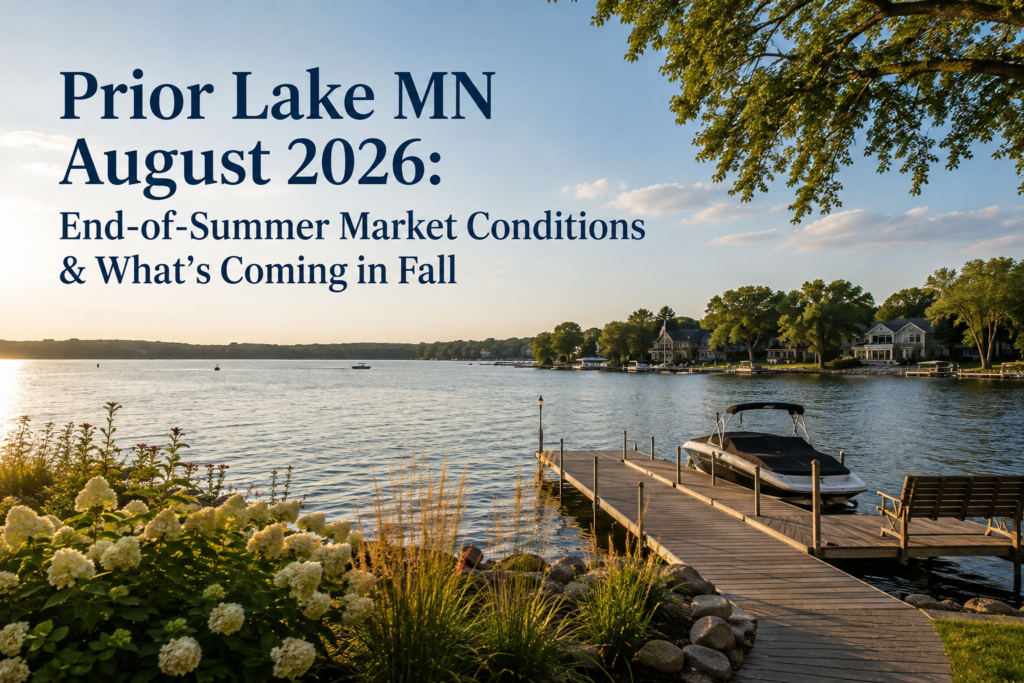
Prior Lake MN August 2026: End-of-Summer Market Conditions & What’s Coming in Fall

Prior Lake MN lakefront dock at sunset with boat, late summer 2026

Labor Day is closing in, the kids are back in school, and the Prior Lake real estate market is settling into the pattern it follows every year at this point in the calendar: still busy, still competitive in the right price bands, but noticeably calmer than the frenzy of June. If you’ve been watching Prior Lake and Spring Lake listings all summer and wondering whether to make a move now or wait for fall, here’s what’s actually happening on the ground in Scott County right now — and what the next couple of months are likely to bring.

Where the Prior Lake Real Estate Market Stands in Late Summer

Depending on which data source and which slice of the past year you’re looking at, Prior Lake’s median sale price has landed anywhere from the high $400,000s to the mid $500,000s, with per-square-foot pricing hovering around $190–$230. That spread isn’t a red flag — it’s just what happens in a city this size when the sample includes everything from starter townhomes near Downtown Prior Lake to sprawling lakefront estates on the water. Homes are typically going under contract in a little over a month, which is longer than the sprint pace of April and May, but still faster than a truly balanced market. According to Redfin’s Prior Lake market data, home prices are still running ahead of where they were a year ago, even as the pace of sales has eased off its summer peak.

Why Things Feel Different Than They Did in June

This slowdown isn’t a sign of trouble — it’s the same seasonal rhythm Prior Lake sees every year. Families with school-age kids raced to close before the first day of class, which pulled a lot of demand forward into June and July. Once school starts, that urgency evaporates, showings thin out on weeknights, and sellers who list in late August tend to be more serious and more motivated than the ones who tested the market back in spring. For buyers, that combination — fewer competing offers, more realistic sellers — is one of the more underrated windows of the year to actually get an accepted offer without an escalation clause attached.

Waterfront Considerations on Prior Lake and Spring Lake

Prior Lake’s identity as a lake town shapes its housing market more than almost anything else. The city sits on two connected recreational lakes, and homes with direct lake access, especially on the main body of Prior Lake, routinely command a premium over otherwise comparable properties a few blocks inland. Late summer is a particularly telling time to shop the waterfront segment: sellers who list a lake home in August are usually motivated to close before the boat comes out of the water for the season, and buyers get to see the property at its best, dock and all, rather than imagining it under snow. If lake living is the whole point of your search, this is a stretch of the calendar worth paying close attention to.

What’s Likely Coming as Fall Sets In

Expect the usual fall pattern for the Prior Lake real estate market: new listings will slow down through September and October, days on market will stretch out a bit further, and price growth should moderate compared to the spring run-up. Mortgage rates remain the wildcard — Freddie Mac’s weekly rate survey is worth bookmarking if you’re timing a purchase, since even modest rate moves change what a given monthly payment buys in a market where inventory is still relatively tight. Prior Lake isn’t likely to see a dramatic shift in either direction; it’s more a gradual cooling than a reset, which is exactly the kind of environment where a well-prepared buyer can find real leverage.

Should You Buy Now or Wait for Fall?

There’s no single right answer, but the case for acting in the next few weeks is a reasonable one: less competition than spring, sellers who are increasingly ready to negotiate, and lake properties still showing well before the season turns. The case for waiting until true fall is just as reasonable if you want even more negotiating room and don’t mind a smaller pool of listings to choose from. Either way, the Prior Lake real estate market rewards buyers who understand its seasonal cadence rather than treating every month like it’s June. For current, verified listing activity, the Minneapolis Area REALTORS MLS data is the most reliable source of truth beyond the national aggregators.

If you’re weighing a move in Prior Lake this fall — whether that’s a lakefront listing on Spring Lake or a starter home closer to downtown — a local agent who actually knows this submarket makes the difference between guessing and knowing. MinnMatch can connect you with a vetted Prior Lake specialist for free — no algorithm, just a real match based on what you’re actually trying to do. Find your Prior Lake agent match here.