Plymouth vs. Minnetonka: Which Suburb Delivers More for Your Money in 2026?

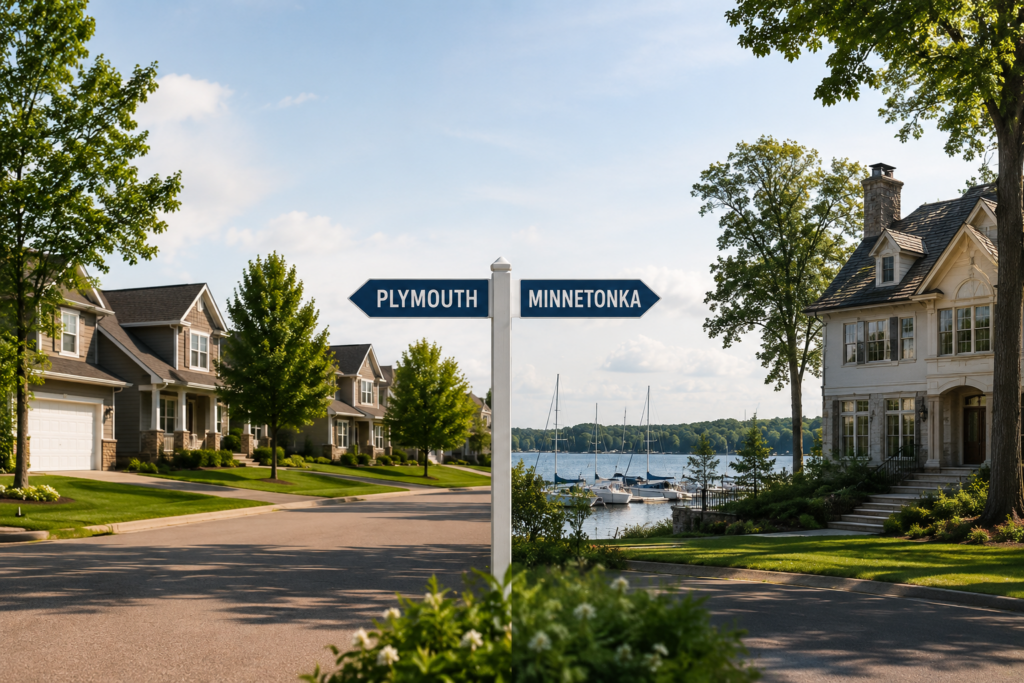
Street sign pointing toward Plymouth suburban homes and Minnetonka lakefront living in the Twin Cities

If you’re searching for a home in the western Twin Cities suburbs, Plymouth and Minnetonka are probably both on your list — and for good reason. Both sit within a short drive of downtown Minneapolis, both offer excellent schools, and both are packed with parks, lakes, and the kind of quiet neighborhood feel that draws families out of the city. But they’re not the same place, and in 2026, the differences between them matter. Price points, lifestyle, lot sizes, commute dynamics, and school district lines all play a role in the Plymouth vs. Minnetonka comparison. Here’s what you need to know before you decide.

Home Prices: What Does Your Budget Actually Buy in Each Suburb?

This is where the Plymouth vs. Minnetonka conversation gets real. According to data from Minneapolis Area Realtors®, Minnetonka’s median sales price in April 2026 was approximately $507,500 — up about 1.3% year-over-year. Plymouth, by comparison, has a median closer to $485,000–$500,000 in recent months, depending on the data source and time period. That gap may sound modest, but in practice, it plays out in meaningful ways across different price bands.

In Plymouth, buyers in the $400,000–$500,000 range can typically access a solid four-bedroom single-family home in an established neighborhood, often with a larger lot. Minnetonka at the same price point trends toward townhomes, smaller ramblers, or older homes that need updating — especially in neighborhoods closest to the lake. Buyers willing to go north of $600,000 in either city will find more overlap, but Minnetonka still commands a premium in its most coveted pockets.

Market pace differs as well. Minnetonka is running hot — Redfin data shows many homes going pending in around 17 days, and roughly a third of homes selling above asking price in recent months. Plymouth is somewhat more measured, with homes averaging closer to 30–55 days on market depending on price point and neighborhood, and sale-to-list ratios just under 100%. That means Plymouth buyers may have slightly more room to negotiate, while Minnetonka buyers should be ready to move quickly and compete.

Schools: Two of Minnesota’s Best Districts — but Different Ones

If schools are driving your suburb search, this section matters enormously — because Plymouth and Minnetonka are served by different districts, and both rank at the very top of Minnesota’s rankings.

Most of Plymouth falls within the Wayzata Public School District (ISD 284), which Niche named the #1 school district in Minnesota for 2026 — the third consecutive year it has earned that ranking. Wayzata High School, which is actually located in Plymouth, consistently ranks among the state’s top public high schools. The district earned A+ ratings across nearly every Niche category and places in the top 1% of all public school districts statewide based on test scores.

Minnetonka is served by the Minnetonka Public School District (ISD 276), which Niche ranked #2 in Minnesota for 2026. Minnetonka Senior High School ranks #3 among all public high schools in the state. The district serves more than 10,900 students and is the most sought-after for open enrollment in Minnesota — a meaningful signal of its reputation. With programs including International Baccalaureate, AP courses, K-12 language immersion, and over 100 clubs and activities, it’s an academically rich environment.

Bottom line: you’re splitting hairs here. Both districts are genuinely elite. Families may find the tie-breaker comes down to specific program offerings, proximity, or which high school campus feels right for their kids.

One important note: a portion of Plymouth falls within the Robbinsdale School District (ISD 281) rather than Wayzata. Always verify school boundaries by address before making any decisions based on school district.

Location and Commute: Closer to the Lake vs. Closer to the City

Plymouth and Minnetonka sit about 9 miles apart — and both are positioned for a reasonable commute to downtown Minneapolis. Plymouth, located approximately 12 miles northwest of downtown, connects quickly via I-394 and Highway 55, with a typical non-rush commute of around 20 minutes. Minnetonka sits about 12–15 miles west of downtown, also served by I-394, with similar commute times to much of the city — though western Minnetonka neighborhoods closer to Lake Minnetonka will add a few more minutes.

Plymouth also benefits from its own transit system — Plymouth Metrolink — which runs direct bus routes to downtown Minneapolis and the University of Minnesota on weekdays. It’s a useful option for households that prefer to leave one car behind on their commute days.

Where Minnetonka pulls ahead is proximity to Lake Minnetonka itself. For buyers who want easy access to the lake — whether that’s a boat slip, shoreline walks, or dining on the water at Excelsior or Wayzata — southern Minnetonka neighborhoods put you closest to all of it. Plymouth has its own exceptional park system and Medicine Lake to enjoy, but if the lake lifestyle is central to your vision, Minnetonka’s geography serves that better.

Lifestyle and Character: Two Suburbs, Two Distinct Feels

Plymouth is one of the Twin Cities’ most populous suburbs — home to more than 80,000 residents — and that scale comes with real advantages. The city has invested heavily in its park and trail system, offers Medicine Lake for swimming and non-motorized boating, and hosts a well-rounded retail and restaurant scene. It tends to attract families who want a well-organized, community-oriented suburb with newer housing stock, strong civic infrastructure, and a feeling of continued growth.

Minnetonka has a different rhythm. It’s a more established suburb, with a diverse mix of housing — from modest mid-century homes to sprawling custom builds — spread across a geography shaped by creeks, wetlands, and the rolling terrain of the Lake Minnetonka watershed. Neighborhoods like Ridgedale, Glen Lake, and Minnetonka Mills each have their own character. Minnetonka also sits adjacent to Ridgedale Center and Ridgedale-area dining, making it feel connected and convenient despite its more tucked-in residential feel.

Both suburbs score well for safety, green space, and quality of life. The deciding factor usually comes down to personal preference: Plymouth buyers often value scale, newer construction, and a more expansive park system. Minnetonka buyers tend to be drawn by neighborhood character, lake proximity, and the feel of a suburb that’s already grown into itself.

Which Suburb Delivers More for Your Money in 2026?

Strictly on a price-per-square-foot and value basis, Plymouth offers a slight edge — particularly for buyers in the $400,000–$550,000 range who prioritize square footage, newer builds, and the #1-ranked school district in Minnesota. You’ll generally find more home for your dollar, a somewhat less competitive market, and newer neighborhoods that offer consistent quality across a wide range of price points.

Minnetonka earns its premium for buyers who want lake-area lifestyle, neighborhood character, and proximity to the communities along Lake Minnetonka. The Minnetonka school district is the second-best in Minnesota and among the strongest in the country. And if you’re drawn to a suburb that feels more layered and established, Minnetonka has a lot to offer.

For most families making a purely financial decision, Plymouth is likely the stronger value play in 2026. For buyers where lifestyle and lake access weigh heavily, Minnetonka may be worth the higher entry price. In either case, knowing which neighborhoods within each city match your budget and priorities makes all the difference — and that’s exactly where working with a local agent pays off.

Not Sure Which Suburb Is Right for You?

MinnMatch connects Twin Cities buyers with local agents who know Plymouth and Minnetonka inside and out — the right neighborhoods, the right price points, and the right fit for your family. It’s free, it’s personal, and it’s built for Minnesota.

Find Your Agent — It’s Free

Plymouth MN Summer 2026: The Neighborhoods Where Buyers Are Competing Hardest

Plymouth MN lakeside neighborhood in summer 2026 with homes, walking path, and real estate sign reading High Demand Limited Inventory

If you’ve been searching for a home in Plymouth this summer, you already know: the right listing at the right price doesn’t wait around. Plymouth is one of the Twin Cities’ most consistently sought-after suburbs — ranked among the best places to live in Minnesota year after year — and the summer 2026 market is showing exactly why. While the city overall is operating close to balanced conditions, certain Plymouth neighborhoods are drawing multiple offers, fast closes, and buyers who came prepared. Whether you’re just starting your search or have already lost a home to another offer, understanding where competition is highest in Plymouth right now can change how you approach your next move.

Why Plymouth Is Still a Top Target for Twin Cities Buyers

Plymouth’s appeal has never been one thing — it’s everything stacking together. The city sits in the western metro with easy freeway access to Minneapolis via I-394 and I-494, a trail system stretching over 90 miles, Medicine Lake, and dozens of well-maintained parks. But the single biggest driver of buyer demand, especially among families relocating from out of state, is the school district.

The majority of Plymouth falls within Wayzata Public Schools (ISD 284), which has been ranked the #1 school district in Minnesota for 2024, 2025, and 2026 by Niche. That reputation doesn’t just matter to families with kids in school — it matters to every buyer thinking about resale value down the road. Homes within ISD 284 boundaries consistently carry a valuation premium, and that premium is one reason why certain Plymouth neighborhoods see faster-moving, more competitive conditions than others.

City-wide, Plymouth’s median home sale price sits around $478,000–$500,000 heading into summer 2026, with the Plymouth-Wayzata corridor — where Wayzata school district properties are concentrated — tracking closer to $641,000 at the median. Homes are generally spending between 32 and 56 days on market across the city, though well-priced properties in the neighborhoods below are moving considerably faster.

The Plymouth Neighborhoods Where Competition Is Sharpest

Not every corner of Plymouth is equally competitive — and knowing the difference can save you weeks of frustration. Here are the areas drawing the most buyer interest this summer:

Hollydale

Hollydale is Plymouth’s newest luxury neighborhood — and one of the most talked-about communities in the western metro right now. Built on the former Hollydale Golf Course, it features newer construction homes with open floor plans, high-end finishes, and a setting of mature trees and wetlands that gives it an almost resort-like feel. It’s located just five minutes from Wayzata High School, sits within ISD 284, and includes community amenities like a pool, clubhouse, pickleball court, and playground. Custom homes here from builders like Gonyea, Swanson, and Hanson regularly list from the $900s into the $3M+ range, and move quickly at those price points — a signal of how much demand exists in this pocket. If you’re shopping in Hollydale, being pre-approved and ready to move is non-negotiable.

Plymouth-Wayzata Corridor (West Plymouth)

The stretch of western Plymouth closest to Wayzata — sometimes called the Plymouth-Wayzata neighborhood — is where you’ll find some of the city’s most established, high-value residential streets. Larger lots, custom-built homes, and consistent proximity to both Wayzata’s lakefront amenities and Plymouth’s trail networks make this area extremely attractive. With median sale prices in this corridor running around $641,000 and homes spending about 32–56 days on market, well-priced homes here are not sitting. Buyers competing in this area are often move-up buyers with significant equity or relocating professionals with strong budgets — which means your offer needs to be clean and credible.

The Medicine Lake Area

Homes near Medicine Lake offer something relatively rare in Plymouth: lakefront or lake-adjacent living without Lake Minnetonka price tags. Properties along the lake and within a few blocks of the shoreline — especially Craftsman-style homes on larger, tree-lined lots — draw buyers looking for a lifestyle upgrade alongside their real estate purchase. Inventory near the lake is limited by geography, which creates natural scarcity. When a well-maintained lake-adjacent home hits the market here, it typically doesn’t stay listed long. Buyers interested in this area should monitor new listings closely and be ready to act within days, not weeks.

Cimarron Ponds and Southwest Plymouth

Southwest Plymouth — including neighborhoods like Cimarron Ponds — tends to be one of the more affordable entry points into the city, with single-family homes typically pricing in the mid-$400s to low-$500s. That relative affordability, combined with good access to Bass Lake Road, Rockford Road Plaza, and French Regional Park, makes these neighborhoods popular with first-time buyers and families stretching their budgets to get into Plymouth’s school district. Competition in this price range can be fierce precisely because there are fewer options: when a move-in-ready home hits the $430,000–$490,000 range, multiple buyers often show up. These aren’t luxury listings, but don’t underestimate them.

High-End Townhome Communities (Bassett Creek Crossing, Wyndemere Farms, The Courts of Nantree)

Plymouth’s premium townhome market — particularly communities like Bassett Creek Crossing, Wyndemere Farms, and The Courts of Nantree near the former Hollydale Golf Course — is attracting a specific kind of buyer: downsizers leaving larger single-family homes who want low-maintenance living without leaving Plymouth, and relocating professionals who want quality square footage without yard and exterior upkeep. These communities range from roughly $400,000 to $750,000 and typically offer around 3,000–3,500 square feet of living space. When a well-updated unit opens up, it often draws multiple interested parties quickly.

What’s Driving Competition in Plymouth’s Hottest Pockets?

Across all these neighborhoods, the competition comes down to a few consistent pressures:

  • Low inventory in the most desirable pockets. Even as overall Plymouth inventory has grown modestly in 2026, the ISD 284-zoned, well-finished homes buyers most want remain scarce. City-wide supply sits under 1 month — meaning the best listings get absorbed fast.
  • The Wayzata schools pull. For families relocating to Minnesota, the “where to live” question is often answered by one question: “Can I get into ISD 284?” That funnels significant demand into a defined geographic zone — raising competition within it.
  • Rate-sensitive buyers off the sidelines. As mortgage rates have shown modest improvement heading into summer 2026, buyers who had been waiting are re-entering the market — adding more demand to the same limited supply of well-priced homes.
  • Summer timing. Summer is always Plymouth’s highest-activity season, driven by families wanting to be settled before the school year. June and July consistently see more offers, faster decisions, and less room to negotiate.

How to Compete Successfully in Plymouth This Summer

Knowing which neighborhoods are competitive is only useful if you’re prepared to act when the right home appears. A few things that separate successful buyers in Plymouth’s tighter pockets:

  • Pre-approval is the starting point, not the finish line. In competitive pockets, a lender call within the past 30 days and a fully underwritten pre-approval puts you far ahead of a buyer with just a letter on file.
  • Know your walk-away number before you see the house. In a multiple-offer situation, emotion sets the price — knowing your ceiling in advance keeps you in control.
  • Work with an agent who has Plymouth-specific experience. Neighborhood nuances — like which streets carry ISD 284 zoning, where new construction may be coming, or which listings are likely to generate multiple offers — are things an experienced local agent knows before you do.
  • Be strategic about contingencies. This doesn’t mean waiving everything — it means structuring your offer thoughtfully so it stands out without unnecessary risk.

For more on how the broader Plymouth market compares to other West Metro suburbs, Redfin’s Plymouth market data is updated regularly. The Minneapolis Area Realtors market reports are also a reliable benchmark for tracking citywide and metro-level trends.

Find a Plymouth Agent Who Knows These Neighborhoods Cold

Competing in Plymouth’s summer market isn’t just about speed — it’s about working with someone who already knows which neighborhoods are moving fast, which listings are worth pursuing, and how to write an offer that holds up under pressure. At MinnMatch, we connect buyers with experienced, locally grounded Plymouth agents who know the city street by street — not just zip code by zip code.

Tell us what you’re looking for and we’ll match you with a Plymouth agent who can help you compete — and win — this summer.

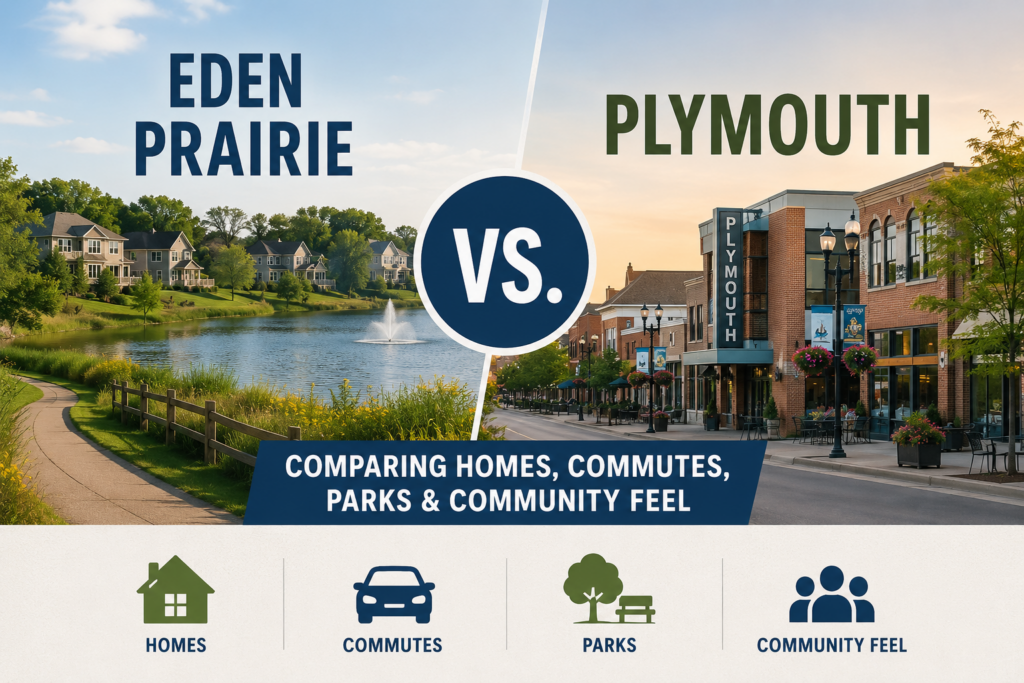
Eden Prairie vs. Plymouth: Comparing Homes, Commutes, Parks & Community Feel

Eden Prairie vs Plymouth comparison graphic showing homes, commutes, parks, and community feel in two Twin Cities western suburbs


When families start searching for a home in the western Twin Cities, the same two names come up again and again: Eden Prairie and Plymouth. Comparing Eden Prairie vs Plymouth homes, commutes, parks, and community feel is exactly what this guide is designed to help you do — side by side, category by category, without the fluff. Both suburbs rank among the best places to live in Minnesota, but they are not interchangeable. The differences are real, and choosing the right one for your family comes down to knowing what those differences actually are.

Eden Prairie sits along the Minnesota River bluffs to the southwest of Minneapolis. Plymouth spreads across rolling, lake-dotted terrain to the northwest. Both cities offer excellent schools, low crime, strong property values, and the kind of family infrastructure that’s hard to find combined in a single place. But dig one level deeper and the two cities diverge — in housing character, outdoor lifestyle, commute patterns, and the pace of daily life. Here’s the full breakdown.


🏡 Eden Prairie vs Plymouth Homes & the Housing Market

The homes themselves tell you a lot about each city’s identity — and so do the price tags.

Eden Prairie Homes: Planned, Polished, and Consistently In Demand

Eden Prairie grew up as a master-planned community, and that heritage is visible in the housing stock. Neighborhoods here feel cohesive and well-maintained — you’ll find a lot of two-story colonials and executive-style homes built between the mid-1980s and early 2000s, along with newer construction in pockets near the city’s southern and western edges. Lots tend to be generous, many backing up to wooded buffers or pond views that are genuinely attractive rather than decorative afterthoughts.

The typical family home in Eden Prairie — three or four bedrooms, a finished basement, and a two-car garage — runs in the $550,000 to $750,000 range in 2026, with entry points below $500K if you’re willing to take on a project. Move-in ready homes at the right price generate genuine competition; multiple-offer situations are still common, especially in spring.

One standout characteristic: Eden Prairie homes tend to hold value exceptionally well. The combination of school district reputation, employment proximity, and city-wide maintenance standards creates a floor that buyers can count on over time. According to Minneapolis Area Realtors, the western suburbs have consistently outperformed the broader metro on median price-per-square-foot retention over the past five years — and Eden Prairie sits near the top of that list.

Plymouth Homes: More Range, More Room to Find Your Entry Point

Plymouth’s housing market is broader and more varied — a natural result of the city’s size (it’s one of the largest cities in Minnesota by population) and its patchwork of neighborhoods developed across different eras. You’ll find 1970s ramblers and split-levels in older western neighborhoods, well-built 1990s subdivisions throughout the core, and newer executive construction near the city’s eastern and northeastern edges.

Pricing for Plymouth homes typically runs $480,000 to $700,000 for a comparable family home, with genuine opportunities below $450K in older neighborhoods — something Eden Prairie rarely offers for move-in-ready product. On the upper end, newer construction near Medicine Lake or in premium subdivisions can push well past $800K.

The key variable when buying a Plymouth home is the school district boundary. Because Plymouth spans multiple districts — primarily Wayzata (284) and Osseo (279) — the value of a specific home can vary significantly based on which district it falls in. Homes in the Wayzata district consistently command a premium. Knowing the boundary lines before you start touring is essential, and it’s one of the clearest reasons to work with an agent who knows Plymouth specifically.

Eden Prairie

More uniform housing stock, slightly higher floor, one school district. Excellent long-term value stability.

Plymouth

More variety across eras and price points. Wider entry options. School district boundary research is non-negotiable.

Whether you’re shopping Eden Prairie or Plymouth homes, working with a buyer’s agent who focuses on these specific cities will save you time, money, and the headache of learning pricing nuances on the fly. MinnMatch matches buyers with agents who know these neighborhoods at the street level — not just the zip code.


🚗 Comparing Commutes & Location

Neither Eden Prairie nor Plymouth is going to punish you with a brutal commute — both sit within 25 to 35 minutes of downtown Minneapolis under normal conditions. But the direction, highway access, and what’s nearby differ enough to matter for many buyers.

Eden Prairie Commutes: Southwest Access and Airport Proximity

Eden Prairie sits at the intersection of I-494, Highway 212, and Highway 169 — giving residents flexible options for reaching downtown Minneapolis, the airport corridor, and communities further southwest. The I-494 strip through Eden Prairie is also a major employment hub in its own right, home to corporate campuses that mean some residents barely leave the city for work at all.

The biggest commute advantage Eden Prairie holds is proximity to Minneapolis-St. Paul International Airport. For frequent business travelers, a 15-minute drive to MSP — without fighting through the city — is a genuine quality-of-life upgrade. If your job involves regular flights, this alone can tip the scales.

Transit options are limited, as they are throughout the western suburbs, but express bus routes connect Eden Prairie to downtown. The SWLRT Green Line Extension expanded light rail access closer to the Eden Prairie area, improving connectivity for transit-oriented commuters.

Plymouth Commutes: Northwest Access and Strong Highway Connections

Plymouth benefits from strong access via I-494, Highway 55, and I-394 — the last of which is a particularly efficient corridor straight into downtown Minneapolis and the inner-ring suburbs of St. Louis Park and Golden Valley. Residents heading downtown for work find the commute manageable and predictable outside of peak hours.

Plymouth’s location also makes it a natural base for professionals working in the northwest employment corridor — think Maple Grove, Brooklyn Park, or Rogers. If your job pulls you north rather than south or downtown, Plymouth’s geography is genuinely more convenient than Eden Prairie’s.

Plymouth is further from MSP — roughly 30 to 35 minutes — which matters for frequent flyers. For remote and hybrid workers who commute occasionally, the difference is largely irrelevant.

Route Eden Prairie Plymouth
Downtown Minneapolis 25–35 min via I-494 / Hwy 212 20–30 min via I-394 / Hwy 55
MSP Airport ~15 min ✈️ ~30–35 min
Northwest suburbs 30–40 min 10–20 min ✅
Primary highways I-494, Hwy 212, Hwy 169 I-394, I-494, Hwy 55

🌲 Comparing Parks & Outdoor Access

This is where Eden Prairie vs Plymouth diverges most meaningfully — not in quality, but in character. Both are exceptional for outdoor access. The question is what kind of outdoor lifestyle you’re after.

Eden Prairie Parks: Trails, Bluffs, and a Rare Urban Wilderness

Eden Prairie’s park system is one of the most impressive in the state for a city its size. With over 2,250 acres of parkland and more than 170 miles of interconnected trails, the outdoor infrastructure here is built into the city’s DNA. According to the City of Eden Prairie Parks & Recreation, the trail network is specifically designed to connect neighborhoods to schools, parks, and commercial areas without requiring residents to touch a road.

Staring Lake Park is a beloved anchor — offering kayak rentals, an amphitheater for summer concerts, a skating loop in winter, and trails winding through native prairie. Bryant Lake Regional Park provides swimming, fishing, and boat launch access. Along the city’s southern edge, the Minnesota River bluffs deliver dramatic, wooded topography that few western suburbs can match. The Richard T. Anderson Conservation Area alone contains hundreds of acres of protected habitat.

For families with kids who want to ride to school, or parents who want a running route that actually goes somewhere, Eden Prairie’s connectivity matters enormously.

Plymouth Parks: A Lake Town Through and Through

Plymouth’s outdoor identity is defined by water. With more than 30 lakes within city limits — including Medicine Lake, Parkers Lake, Bass Lake, and Mooney Lake — water access is a fact of life here. Many neighborhoods are built around lakes, with homes backing up to shoreline and residents fishing from their yards or paddling out before breakfast.

Parkers Lake Park is a crown jewel — a well-maintained beach, picnic areas, and a skating rink in winter that draws families from across the city. The Three Rivers Park District manages extensive regional trail corridors through and around Plymouth, connecting to the wider metro-wide trail grid. Plymouth Creek Center serves as a community hub with athletic facilities, indoor recreation, and event space year-round.

Plymouth’s trail network is solid, though not quite as densely woven as Eden Prairie’s. The emphasis here is on lake access, beach time, and water recreation — and on that dimension, Plymouth has no peer in the western metro.

Eden Prairie is your city if…

You want trails out your front door, city-wide connectivity, and access to river bluffs and native prairie that feel genuinely wild.

Plymouth is your city if…

Your version of the perfect Saturday involves a kayak, fishing pole, or paddleboard — and you want lake access woven into your neighborhood, not just nearby.


🏙️ Comparing Community Feel

Numbers and amenities only go so far. What’s it actually like to live in each of these cities?

Eden Prairie Community Feel: Put-Together, Energetic, and Self-Contained

Eden Prairie feels like a city that has its act together. The commercial core around Eden Prairie Center and the surrounding retail corridor is polished and well-maintained. You can handle almost every errand, meal out, and weekend activity without leaving city limits — and many residents do exactly that. The city has cultivated a local dining scene that punches above its weight for a western suburb, and fitness options, youth sports leagues, and family-oriented events fill the calendar year-round.

The demographic skews toward dual-income professional families — many of whom work at the major corporate campuses along the I-494 corridor or commute into Minneapolis. There’s a strong sense of community investment: residents here tend to be engaged in schools, youth sports, and civic life, which keeps the city’s momentum going. Eden Prairie has been recognized nationally as one of the best cities to live in the U.S., and the residents feel that pride.

The trade-off, if there is one, is that Eden Prairie can feel dense with ambition — it’s a high-achieving place, and the culture around school sports, activities, and résumé-building can feel intense at times. For some families, that energy is exactly what they want. For others who prefer a slightly quieter pace, it’s worth noting.

Plymouth Community Feel: Spacious, Neighborly, and a Little More Relaxed

Plymouth is Minnesota’s seventh-largest city by population, but it doesn’t feel like it. The city’s geography — sprawling across rolling terrain with neighborhoods separated by lakes, parks, and open space — creates a more dispersed, lower-density character than Eden Prairie’s tighter layout. It’s a city where people genuinely know their neighbors, where cul-de-sacs feel like small communities, and where the pace of life has a little more breathing room.

Plymouth’s retail and dining scene is solid but more spread out — you’ll often drive to neighboring Wayzata or Minnetonka for a broader restaurant selection or specialty shopping. Many Plymouth residents consider this a feature rather than a bug — the proximity to Wayzata’s charming lakeside village adds destination-quality dining and entertainment without the city needing to replicate it internally.

Community events and city-organized programs are strong — the Hilde Performance Center hosts outdoor concerts and seasonal events, and Plymouth Creek Center anchors a busy schedule of youth sports, fitness classes, and family programming. The community feel is warm and genuinely Minnesotan: involved but not in your face, friendly without being performative.

Plymouth also benefits from a notable degree of diversity compared to many western suburbs, which many families find appealing — especially those moving from larger metro areas or with kids who will benefit from a wider range of backgrounds and perspectives in school.


Eden Prairie vs Plymouth Homes: So Which One Wins?

Neither. And both.

Eden Prairie is the better fit if you want everything in one tightly run package — a single elite school district, a dense trail network, strong employment proximity, and a city that feels polished from end to end. It rewards buyers who want convenience, connectivity, and a high-energy community.

Plymouth homes offer a better fit if outdoor water access matters most to your family, if you want more housing variety and a slightly wider price window, or if you prefer a community that feels a little less intense and a little more spread out. It rewards buyers who do their homework on school district boundaries and aren’t afraid to drive five minutes for a great dinner.

In both cities, the market is competitive and the learning curve for buying is real. Understanding what a home is actually worth — and being positioned to move fast when the right one hits — requires local knowledge that goes beyond what any portal can provide. That’s exactly what the right agent delivers. MinnMatch can help you find one who specializes in the community you’re targeting.

Not sure which suburb is right for you?

MinnMatch connects Twin Cities buyers and sellers with hand-picked, vetted local agents — free, fast, and with no obligation. Tell us what you’re looking for, and we’ll match you with someone who knows Eden Prairie, Plymouth, and the broader western metro inside and out.

Find My Agent →

Plymouth MN Real Estate: Hot Neighborhoods, Prices & What’s Selling Fast

Market Report · Spring 2026

Plymouth MN Real Estate Spring 2026:
Hot Neighborhoods, Prices & What’s Selling Fast

A ground-level look at one of Minnesota’s most in-demand suburban markets — and what it means for buyers and sellers this season.

May 2026  ·  MinnMatch Local Intel  ·  Plymouth, MN

$519K
Median List Price
April 2026
$641K
Wayzata Corridor
Feb 2026 · Redfin
23 days
Days on Market
Active listings
~98%
Sale-to-List Ratio
Balanced market
#1
Best Place to Live MN
U.S. News & World Report

The Big Picture

Plymouth MN Real Estate Spring 2026: What You Need to Know

The Plymouth MN real estate market in spring 2026 has reached a rare equilibrium. After years of frenzied bidding wars and suppressed inventory, Plymouth home prices have held firm while the pace of competition has settled into what analysts are calling a “normalization” phase — meaningful stability rather than a downturn. Both buyers and sellers can now come to the table with realistic expectations. For anyone considering buying or selling a home in Plymouth, MN this spring, the timing is worth paying close attention to.

That doesn’t mean every home is the same story. In Plymouth’s most coveted pockets — particularly those zoned for Wayzata Public Schools and near the Medicine Lake trail network — well-priced listings are still attracting multiple offers and going pending in as little as 9 days. The days of panic-buying may be over, but strategic buyers and prepared sellers are still winning big in the Plymouth MN real estate market this spring.

Plymouth has earned the top spot on U.S. News & World Report’s Best Places to Live in Minnesota list. Strong schools, exceptional parks and trails, easy freeway access (Hwy 55, I-494, Hwy 169), and a diverse housing stock from starter townhomes to luxury estates make this the west metro’s most complete community.

“Plymouth blends established executive neighborhoods, strong public schools, trail connectivity, and proximity to Medicine Lake — all without the price premiums of immediate lakefront enclaves.”

— Local Market Analysis, February 2026

— ◆ —

Neighborhood Spotlight

Plymouth MN Spring 2026: Where Buyers Are Competing Right Now

Plymouth spans a large geographic footprint, and not all neighborhoods are created equal. Here are the Plymouth MN neighborhoods drawing the most buyer attention this spring — and why.

🔥 Most In-Demand

Plymouth-Wayzata Corridor

Homes in the Wayzata School District (ISD 284) command consistent premiums and the fastest sales velocity in Plymouth MN real estate this spring. Neighborhoods like Wayzata Woods, Copperwood, Taylor Creek, Parker’s Lake, and Bonaire attract families for whom school quality is non-negotiable. Hot homes here can sell for ~3% above list price and go pending in roughly 9 days.

$641K
Median Sale
~9 days
Hot Homes

⭐ New Construction Hotspot

Hollydale & Northwest Plymouth

The northwest quadrant is Plymouth’s most active new-construction zone. Hollydale — just five minutes from Wayzata High School — features luxury custom homes starting around $1M+, surrounded by mature trees, wetlands, a neighborhood pool, and pickleball courts. Buyers seeking modern layouts and strong resale fundamentals gravitate here.

$1M+
Starting From
New Build
Inventory

💧 Lifestyle Location

Medicine Lake Area

Homes near Medicine Lake carry a lifestyle premium that translates into long-term value. Even without direct lakefront access, proximity to Clifton E. French Regional Park, sandy beach areas, and the trail network adds measurable appeal. Year-round activity — paddleboarding and fishing in summer, skating in winter — makes these Plymouth MN addresses especially sought-after.

High
Demand
Stable
Long-Term Value

🏠 Value Entry Point

Southeast Plymouth (Hwy 55 / 494)

For buyers seeking more square footage for their dollar, southeast Plymouth offers family-friendly subdivisions with strong commuter access. These established neighborhoods — many developed in the 1990s and early 2000s — feature larger lots, three-car garages, and brick façades at price points below the Wayzata corridor premium.

Better
$/Sq Ft Value
Quick
Commute

🏠 Low-Maintenance Living

Parker’s Lake & Townhome Communities

Detached townhomes and villa communities near Parker’s Lake remain a standout option for downsizers and relocating professionals. The Luce Line Trail runs directly through this area. The Villas at Timbers Edge (Bergeron Homes, Wayzata district) offers new construction starting in the $600s–$700s with full HOA snow and lawn care — a rare combination of value and low maintenance in Plymouth MN.

$600s+
New Villas
Trail Access
Luce Line Trail

✨ Boutique Community

The Highlands on Dunkirk

An intimate enclave of just 21 homesites by Charles Cudd Co., designed for main-floor luxury living adjacent to parks and trails. HOA-maintained lawns and snow removal appeal to empty nesters and executives who want a refined, low-effort lifestyle. Limited inventory means when a home is available, it doesn’t last long.

21
Homesites
Rare
Availability

— ◆ —

Price Landscape

Plymouth MN Home Prices Spring 2026: What Your Budget Gets You

Plymouth’s housing stock spans a wide range — from accessible townhomes to multi-million-dollar estates. According to Redfin’s Plymouth market data, here’s how prices stack up by tier this spring:

Entry Level
$350K–$480K

Townhomes, condos, and smaller single-family homes. Strong demand from first-time buyers and downsizers. Wayzata district access possible at the higher end.

Mid-Range
$480K–$650K

Established single-family homes, 3–4 bedrooms. The core of Plymouth’s market. Median sale prices cluster here. Competitive but negotiable.

Move-Up
$650K–$1M

Executive homes, new construction villas, premier school districts. Wayzata corridor, Parker’s Lake detached townhomes, and The Villas at Timbers Edge.

Luxury
$1M+

Custom estates, lakeside retreats, Hollydale builds. Buyers often pay cash. Patience required; inventory is thin but quality is exceptional.

Data aggregated from Houzeo, Redfin, Movoto, and Realtor.com. Individual prices vary. Always get a current CMA from a local agent.

— ◆ —

Sales Velocity

Plymouth MN Real Estate Spring 2026: What’s Selling Fast — and What’s Sitting

Not every Plymouth listing moves at the same speed. Knowing which property types are flying off the market gives buyers and sellers a real edge this spring.

🏫 Wayzata School District homes, priced right

Hot Homes in this Plymouth MN corridor go pending in about 9 days and can sell for ~3% above list price. District boundaries are the single biggest driver of accelerated sales velocity in Plymouth real estate this spring.

🆕 Move-in ready new construction

Buyers are willing to pay a premium to skip renovation headaches. Developments like Hollydale, Weston Woods, and The Villas at Timbers Edge are absorbing qualified buyers quickly, particularly in the $600K–$1M range.

🛤 Trail-adjacent and park-proximity homes

The Luce Line Trail and access to Clifton E. French Regional Park and Medicine Lake are tangible value-adds. Homes within walking distance of these amenities consistently outperform their immediate comparables.

🔑 Turnkey 3- and 4-bedroom homes, $480K–$700K

The core family market is where competition remains sharpest in Plymouth MN spring 2026. Updated kitchens, finished lower levels, and three-car garages are the features buyers are fighting over most.

⌛ Overpriced or dated listings

Sitting. Plymouth buyers are well-informed and increasingly resistant to aspirational pricing. Homes requiring significant updates or priced above justified comps are seeing 60–70+ days on market and price reductions.

— ◆ —

Actionable Guidance

Tips for Plymouth MN Buyers & Sellers This Spring

In a balanced market, execution matters more than ever. Here’s what smart Plymouth buyers and sellers are doing right now:

🏠 For Buyers

Get Pre-Approved Before You Browse

In competitive Plymouth MN pockets, sellers are moving fast. Having a lender letter in hand — and a strong local agent who knows off-market activity — is the difference between winning and losing your ideal home.

🏷 For Sellers

Price to the Comps, Not Your Dreams

Plymouth MN buyers are data-savvy. Homes priced at current comps are moving in under 30 days; overpriced homes are sitting and often selling for less than they would have at a realistic launch price.

📍 For Buyers

Know Your District Before You Fall in Love

Plymouth spans multiple school districts. Confirm Wayzata ISD 284 assignment for any home you’re serious about — boundaries don’t always align with a map, and the premium is real.

📷 For Sellers

Presentation Is Non-Negotiable

Professional photography, thoughtful staging, and a pre-listing inspection can dramatically accelerate your sale. The first weekend of showings is often decisive — make it count.

🤝 For Buyers

Consider New Construction Windows

Some Plymouth MN builders are offering closing cost incentives of $5,000–$10,000 to use preferred lenders. If new construction fits your timeline, the value equation may be better than it appears at first glance.

📊 For Sellers

Spring Is Your Window — Don’t Delay

Buyer demand in Plymouth MN real estate peaks in May and June. The next 6–8 weeks represent peak traffic and competition. Inventory is growing modestly, so early movers have the advantage.

🔗 Related MinnMatch Resources

Exploring the Twin Cities? Check out our guides for nearby communities: Wayzata, Eden Prairie, and Minnetonka. Or browse our full Twin Cities market insights and learn how MinnMatch works to connect you with the right local agent — free.

Find the Right Plymouth Agent — Free

MinnMatch hand-picks and vets local Plymouth agents based on your specific situation. No algorithms. No call centers. Just a real match from someone who knows the Plymouth MN real estate market.

Get Matched Today

Free for buyers and sellers  ·  Exclusively Twin Cities agents  ·  No obligation

Market data sourced from Redfin, Houzeo, Movoto, and Realtor.com. Figures represent aggregated market estimates and may vary. Not intended as financial or legal advice. Consult a licensed real estate professional for property-specific guidance. © 2026 MinnMatch.com