Twin Cities Suburbs Ranked: The Best Places to Buy a Home in 2026

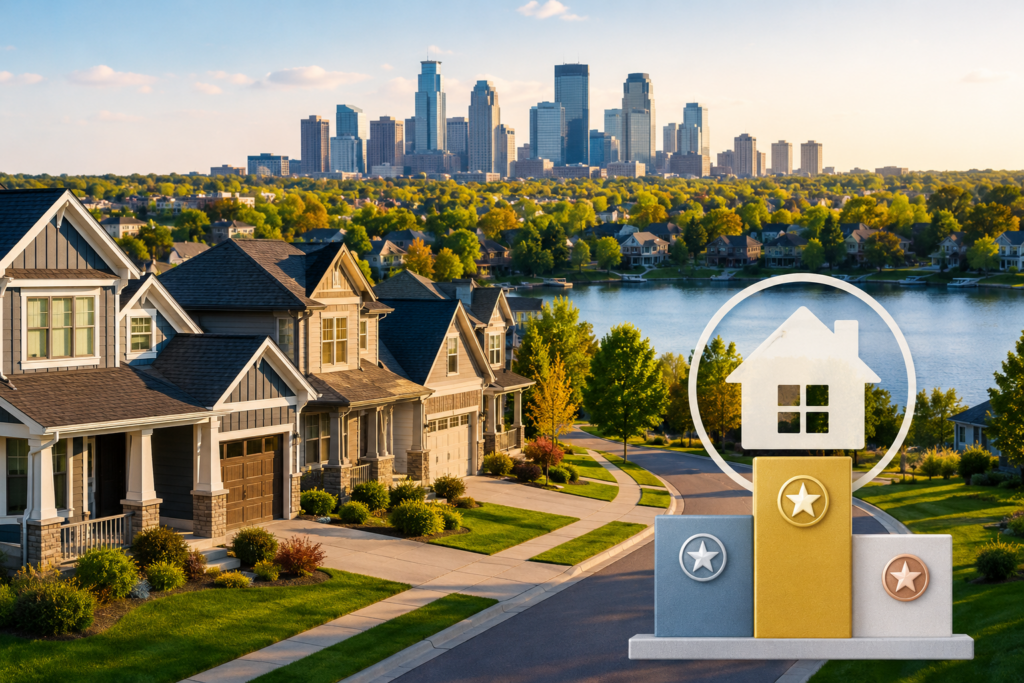
Twin Cities suburbs ranked best places to buy a home in 2026, with Minneapolis skyline in background

Shopping for a home in the Twin Cities in 2026? You’re not alone — and you’re not without options. Despite higher mortgage rates and lingering affordability pressures across the country, the Minneapolis–St. Paul metro still has suburbs that offer real value, strong schools, and communities worth putting down roots in. Whether you’re a first-time buyer chasing square footage, a growing family eyeing top-rated districts, or a move-up buyer ready to upgrade, there’s a suburb on this list for you. We’ve pulled together the best places to buy a home in the Twin Cities suburbs right now, based on home prices, market trends, livability, and what buyers are actually prioritizing in 2026. If you want help finding an agent who knows these neighborhoods inside and out, MinnMatch can match you with a vetted local expert — for free.

How We Ranked These Twin Cities Suburbs

This isn’t a purely algorithmic list. We looked at a combination of real market data — median home prices, days on market, price trends from sources like Redfin’s Minnesota market reports and the Minneapolis Area Association of Realtors’ 2025 Annual Housing Market Report — along with livability factors like school quality, community character, commute access, and what buyers are actually asking for right now. The result is a practical guide to the best places to buy a home in the Twin Cities suburbs in 2026, across a range of price points.

One important note on context: the statewide median home sale price in Minnesota was around $354,500 as of March 2026, according to Redfin. Everything below is measured relative to that baseline — and to what your money actually buys you on the ground.

1. Maple Grove — Best Overall Value in the Northwest Metro

Maple Grove consistently earns high marks for livability, and 2026 is no different. With a median home price hovering around $390,000–$405,000, it sits comfortably above the state median while offering a level of amenity and polish that’s hard to beat at that price point. Think big-box convenience, fantastic parks like Elm Creek Park Reserve, highly rated Osseo-area schools, and neighborhoods that feel genuinely cared for.

The market here moves relatively fast — homes are typically going under contract within 31 to 35 days — which tells you demand is still healthy even if prices have softened slightly from their peak. For families who want a suburb that has it all without venturing into the $500K+ range, Maple Grove remains one of the best places to buy a home in the Twin Cities.

Best for: Families, first-time move-up buyers, anyone who wants suburban amenities without the luxury price tag.

2. Eden Prairie — Polished Living on the Southwest Side

Eden Prairie is one of those suburbs that earns its reputation year after year. With a median sale price around $438,000–$462,000 depending on the month, it’s priced noticeably above the county median of $376,000 — but buyers consistently find the value proposition compelling. Over 41% of Eden Prairie sellers received at or above their original asking price in 2025, according to NorthstarMLS data, one of the stronger close-price ratios in the metro.

Beyond the numbers: Eden Prairie offers Bryant Lake Regional Park, the Eden Prairie Center, a highly regarded school district, and convenient access to Highway 212 and I-494. It’s a suburb that functions well as a long-term place to live — not just a financial bet. Homes here are classified as “very competitive” by Redfin, typically selling in about 25 to 30 days, so buyers should come prepared to move quickly.

Best for: Buyers who want a well-rounded southwest suburb with strong resale value and quality schools. Explore the Eden Prairie community page for more local info.

3. Lakeville — Dakota County’s Growth Story

Lakeville has been one of the Twin Cities’ fastest-growing suburbs for years, and for good reason. With a median home price around $450,000–$467,000 as of early 2026, it’s priced competitively for what you get: newer construction, spacious lots, a well-regarded school district (ISD 194), and a small-town downtown that still has real character. The city is consistently ranked among the best places to raise a family in Minnesota.

Lakeville tends to attract buyers who prioritize space and newer builds over urban proximity. The commute to downtown Minneapolis is longer than some west-metro options — plan on 40–45 minutes without traffic — but many buyers consider that a worthwhile tradeoff for the square footage and lot sizes you get. Sales volume in early 2026 has been notably strong, with hundreds of transactions per month, suggesting robust buyer interest remains.

Best for: Families who want newer homes, bigger yards, and Dakota County’s excellent schools without leaving the metro.

4. Woodbury — The East Metro’s Consistent Performer

Woodbury doesn’t get as much attention as its west-metro counterparts, but buyers who discover it tend to stay loyal. The average home value sits around $457,000, up slightly year over year — a sign of steady, if not flashy, appreciation. What Woodbury delivers is reliability: well-planned neighborhoods, South Washington County Schools (consistently strong performers), low crime, and access to both St. Paul and downtown Minneapolis via I-94.

For buyers who work in St. Paul or the east metro — or who want to be closer to the Wisconsin border — Woodbury is often the first suburb they look at, and frequently the one they choose. Niche’s 2026 rankings highlighted it as one of the Twin Cities’ standout communities for housing stability, a factor that matters when you’re making a long-term investment.

Best for: East metro commuters, families, and buyers who value stability and long-term appreciation over flash.

5. Plymouth — The Premium West Metro Option

Plymouth commands some of the higher price points on this list — median values in the $520,000–$535,000 range — but it earns them. It’s one of the best places to buy a home in the Twin Cities if your priorities include lake access, top-tier Wayzata School District schools, and a suburban experience that genuinely borders on luxurious. Medicine Lake, Parkers Lake, and French Regional Park are all right there. And with Hwy 55, I-494, and Hwy 169 all converging nearby, Plymouth is one of the better-connected suburbs in the metro.

Buyers who stretch their budget for Plymouth tend to be rewarded — both in the quality of life and in resale performance. The Wayzata School District is one of the most coveted in the state, and homes in Plymouth routinely receive strong offers. If the price is within reach, it’s a community worth serious consideration. Check out MinnMatch’s Plymouth community page for neighborhood details.

Best for: Move-up buyers and families willing to invest more for the Wayzata School District and west-metro lake access.

6. Edina — Prestige, Proximity, and a Price to Match

Edina is in a different category than the rest of this list — and that’s by design. With a median home price around $750,000, it’s firmly luxury territory, but it’s included here because it consistently attracts buyers who are weighing the southwest suburbs and want to understand the full spectrum. What Edina offers is unmatched in the Twin Cities: proximity to Minneapolis, the 50th & France shopping district, Edina Public Schools (one of the most respected districts in Minnesota), and a density of amenities that suburban buyers rarely get at any price.

If your budget allows it, Edina functions almost like an urban neighborhood with suburban square footage. If Edina is on your radar, visit MinnMatch’s Edina community page and talk to an agent who specializes in the area — competition is real and strategy matters.

Best for: Luxury buyers who want the feel of a walkable, upscale community with full suburban amenities.

What to Keep in Mind as You Search in 2026

The Twin Cities suburbs market in 2026 is more nuanced than it was during the pandemic frenzy — and that’s actually a good thing for buyers who are patient and prepared. Inventory is slowly improving in many communities. Days on market have stretched in some suburbs, giving buyers a bit more breathing room. But well-priced homes in desirable neighborhoods are still moving quickly, often within a few weeks of listing.

One factor worth watching: property tax rates can vary meaningfully across these suburbs, even between cities with similar home prices. According to Minnesota Department of Revenue data, municipal tax rates differ notably across Hennepin County communities, and school district levies add another layer. Make sure you’re asking your agent for parcel-level tax estimates — not just city averages — before making a final decision. The Minnesota Housing Finance Agency also offers programs that may help with down payment assistance for qualifying buyers.

The other thing to keep in mind: ranking lists and market data tell part of the story, but every buyer’s situation is different. A suburb that’s objectively “ranked #1” might not be the right fit for your commute, your school priorities, or your lifestyle. That’s where a knowledgeable local agent makes all the difference.

Find the Right Twin Cities Suburb — With the Right Agent

At MinnMatch, we connect Twin Cities homebuyers with handpicked, vetted local agents who actually know the neighborhoods — not just the zip codes. Whether you’re eyeing Maple Grove’s value, Plymouth’s schools, or Lakeville’s space, we’ll match you with someone who can help you navigate the market with confidence. It’s free, it’s human-powered, and it works. See how MinnMatch works or get matched with an agent today.

Home Inspection Checklist for Twin Cities Buyers in 2026: What to Look for Room by Room

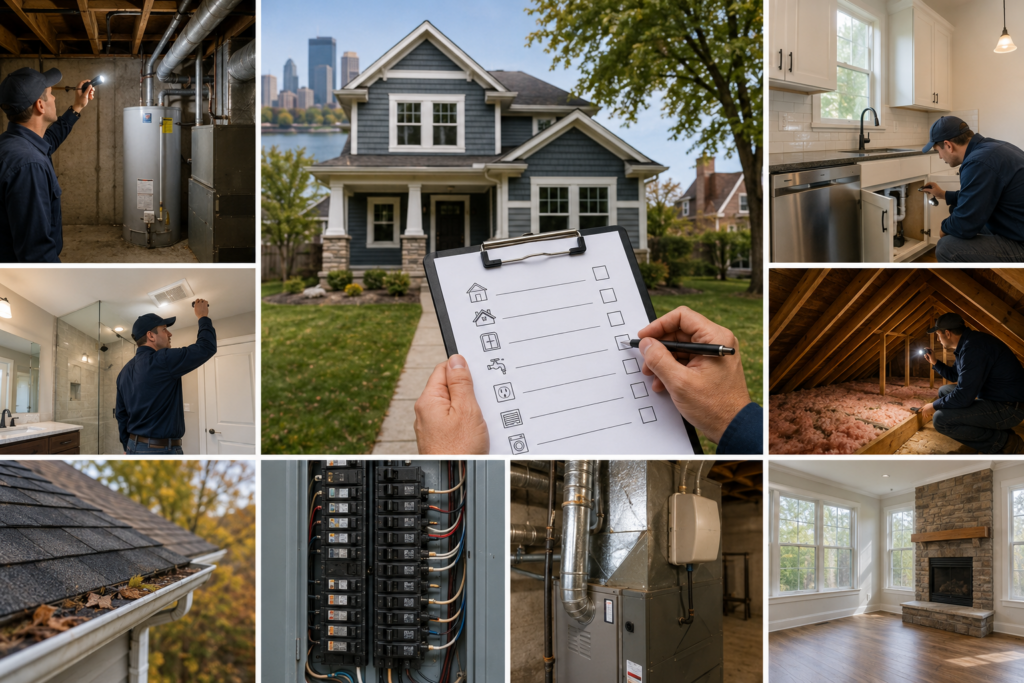
Home inspection checklist for Twin Cities buyers — inspector examining basement, attic, electrical, and HVAC systems

You’ve found a home you love, your offer was accepted, and now it’s time for one of the most important steps in the buying process: the home inspection. For Twin Cities buyers in 2026, having a solid home inspection checklist isn’t just helpful — it’s essential. Minnesota homes come with quirks that buyers in other parts of the country never deal with: freeze-thaw foundation stress, aging boilers, ice dam damage, and basements that have seen decades of harsh winters. This room-by-room guide will help you know what to look for, what questions to ask, and when to walk away.

Why Home Inspections Matter More in Minnesota

Minnesota’s climate is genuinely hard on homes. We’re talking about temperature swings that can exceed 100°F between January and July, snowmelt that tests every foundation and window seal, and frost lines that go 42–48 inches deep. A home that looks pristine in April might be hiding moisture intrusion, cracked masonry, or HVAC systems that were pushed to the limit all winter long.

The Minneapolis Area Realtors consistently report that inspection contingencies remain one of the most negotiated points in local purchase agreements — meaning local buyers use them, and sellers know it. Don’t waive your inspection to win a bidding war if you can avoid it. A few thousand dollars of repairs you didn’t see coming can become a $30,000 problem fast.

Before the Inspection: How to Prepare

Hire a licensed Minnesota home inspector — not just anyone with a flashlight and a checklist. Look for inspectors certified through InterNACHI or ASHI with direct Twin Cities experience. Ask how many inspections they’ve done on older Minneapolis or St. Paul homes — pre-1980 construction has its own set of considerations.

Plan to attend the inspection in person. A good inspector will walk you through every finding live, and you’ll understand the report far better when you’ve seen the issue with your own eyes. Block out 2.5–4 hours depending on home size. Bring this checklist and take your own notes.

Your agent should also be there — or at least available by phone. A good local agent knows which inspection findings are deal-breakers versus which ones are standard negotiating points in this market. If you’re still looking for the right agent fit, see how MinnMatch connects you with vetted Twin Cities agents who specialize in exactly this kind of guidance.

Room-by-Room Home Inspection Checklist for Twin Cities Buyers

Basement & Foundation

This is ground zero for Minnesota home inspections. The basement tells the real story of how a home has weathered our winters.

  • Foundation cracks: Horizontal cracks are a serious red flag — they indicate lateral soil pressure. Vertical or diagonal hairline cracks are more common and often manageable, but worth monitoring.
  • Water staining or efflorescence: Those white chalky mineral deposits on basement walls signal past moisture intrusion. Ask if there’s a sump pump and when it was last serviced.
  • Sump pump condition: In Minnesota, a functioning sump pump is non-negotiable in most homes. Check if it has a battery backup — essential during spring thaw when power outages and flooding coincide.
  • Egress windows: If the basement is finished or used as a bedroom, egress windows are required by Minnesota building code. Confirm they’re present and open properly.
  • Radon: Minnesota has some of the highest radon levels in the country. If a radon test wasn’t included in your inspection, add it. Mitigation systems cost $800–$2,500 but are highly effective.

Roof & Attic

Minnesota roofs take a beating. Snow load, ice dams, and UV degradation all shorten a roof’s lifespan faster than in moderate climates.

  • Shingle condition: Look for curling, missing, or granule-losing shingles. Ask the age of the roof — asphalt shingles in Minnesota typically last 20–25 years due to our freeze-thaw cycles.
  • Ice dam damage: Check the eaves and the attic ceiling below them for water staining. Ice dams are a symptom of poor attic insulation — a fix that can run $3,000–$10,000+.
  • Attic ventilation and insulation: Inadequate attic insulation causes ice dams and spikes your heating bill. Minnesota code recommends R-49 to R-60 in attics.
  • Flashing around chimneys, vents, and skylights: This is one of the most common sources of roof leaks. Gaps or rust in the flashing are negotiating points.
  • Gutters and downspouts: Make sure they’re clear, properly pitched, and directing water away from the foundation. Improper drainage is a top cause of basement water issues.

HVAC, Plumbing & Electrical

These are the big-ticket systems that buyers most often underestimate. A failing furnace in December is a crisis — not a budget line item.

  • Furnace age and condition: Minnesota furnaces work hard. A furnace over 15–20 years old is approaching end of life. Ask for service records and note the filter condition — a dirty filter signals deferred maintenance.
  • Boiler systems: Many older Twin Cities homes — especially in South Minneapolis, Edina, and St. Paul — have boiler heat. Have a specialist inspect boilers; standard inspectors may not evaluate them fully.
  • Central A/C: Inspect the compressor and check refrigerant levels. Many older homes have had central air added as an afterthought — make sure it’s properly sized.
  • Water heater: Note the age (stamped on the unit). Water heaters last 8–12 years. A 10-year-old tank is a near-term replacement.
  • Plumbing material: Pre-1990 homes may have galvanized steel or polybutylene pipes, both of which are prone to failure. Copper and PEX are preferred.
  • Electrical panel: Look for Federal Pacific or Zinsco panels — these are known fire risks and may affect your homeowner’s insurance. Knob-and-tube wiring in older homes is another red flag. Make sure the panel is properly labeled and has no double-tapped breakers.

Kitchen & Bathrooms

  • Under-sink moisture: Run every faucet and check under sinks immediately. Slow leaks cause mold and rot that sellers may have covered up cosmetically.
  • Exhaust fans: Bathroom fans should vent to the exterior — not just into the attic. Attic-vented fans are a code violation and a direct cause of moisture and mold.
  • Grout and caulk around tubs and showers: Gaps here allow water to work behind tile. Minor caulking is cheap; water damage behind the wall is not.
  • Toilet function: Flush every toilet and check for rocking or soft flooring around the base — both signal a failed wax seal and potential subfloor rot.
  • GFCI outlets: All outlets within 6 feet of water sources should be GFCI-protected. Missing GFCI outlets near sinks are a safety issue and a code item.

Living Areas, Windows & Doors

  • Window seals: Fogged or cloudy double-pane windows have failed seals — the insulating gas has escaped. In Minnesota winters, this is a real comfort and energy issue, not just cosmetic.
  • Window operation: Open and close every window. Painted-shut or swollen windows that won’t open are fire egress issues.
  • Door operation and weatherstripping: Doors that stick can signal foundation settlement. Check all exterior weatherstripping — gaps are direct heat loss in our winters.
  • Ceilings and walls: Look for water stains (brown rings), cracks at corners, or nail pops — all can indicate moisture, settling, or poor workmanship.
  • Fireplace and chimney: Ask if the fireplace has been inspected recently. Chimney liners, dampers, and firebox condition are all worth a closer look — especially in older Twin Cities homes where woodburning fireplaces are common.

Garage & Exterior

  • Garage door auto-reverse: The door should reverse when it meets resistance. This is a required safety feature.
  • CO detector in attached garages: If the garage is attached, make sure there’s proper fire separation and CO protection into the living space.
  • Driveway and walkway condition: Cracks and heaving from freeze-thaw cycles are extremely common in Minnesota. Not always a dealbreaker, but factor in the cost.
  • Grading and drainage: The ground around the foundation should slope away from the home. Flat or inward-sloping grade is a basement water risk.
  • Deck and stairs: Check for rot, loose railings, and proper ledger board attachment. Deck failures cause injuries — don’t skip this.

What Happens After the Inspection in a Twin Cities Transaction

Once you have the report, you have options: ask the seller to make repairs, request a price reduction, request a credit at closing, or — if the issues are severe enough — walk away under your inspection contingency. In the current Twin Cities market, sellers expect some negotiation on inspection findings, but prioritize the items that affect safety, structural integrity, and major systems over cosmetic issues.

Your agent’s experience matters enormously here. A great local agent has seen hundreds of inspection reports and knows which findings are likely to come up on any comparable home in this market, which ones sellers will budge on, and which ones are worth drawing a line over. Minnesota Housing also offers resources for first-time buyers navigating purchase agreements and inspection contingencies if you want additional guidance.

According to Redfin’s Minneapolis market data, homes in the Twin Cities have remained competitive even as inventory shifts — meaning inspection strategy can genuinely affect whether your deal closes on favorable terms.

Work With an Agent Who Knows What to Watch For

A great home inspection checklist is a start — but the right buyer’s agent is what ties it all together. MinnMatch connects Twin Cities buyers with handpicked local agents who know the neighborhoods, the common issues in local housing stock, and how to negotiate inspection findings effectively. It’s free, personal, and built entirely around your needs.


Find Your Agent — It’s Free →

The Real Cost of Buying a Home in the Twin Cities in 2026: What You’ll Actually Spend

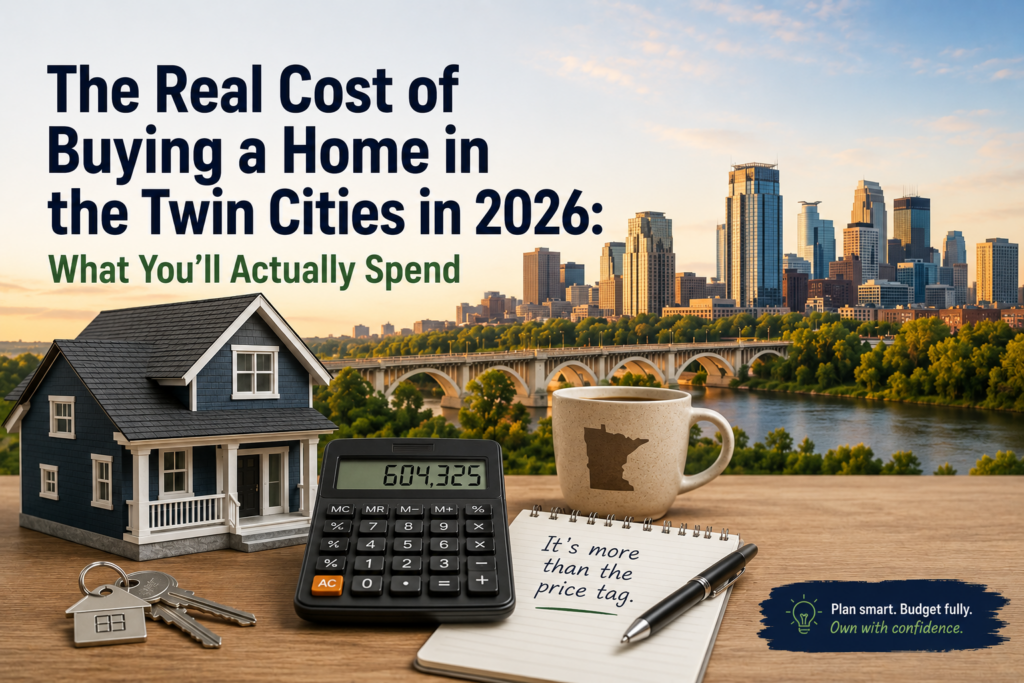
Calculator, house keys, and a model home on a desk with the Minneapolis skyline in the background, illustrating the real cost of buying a home in the Twin Cities in 2026


If you’re researching the cost of buying a home in the Twin Cities in 2026, the purchase price is only part of the story. You’ve saved up a down payment, gotten pre-approved, and you’re ready to start house hunting — but if you’re only thinking about the listing price, you’re missing a significant chunk of what you’ll actually spend. Between closing costs, inspections, insurance, property taxes, and a dozen smaller line items, the real cost of buying a home in the Twin Cities can run $30,000 to $60,000 more than the number on the listing. Here’s what to expect — broken down clearly — so there are no surprises at the closing table.

What Are Homes Actually Selling For Right Now?

Before digging into the costs layered on top, it helps to know where prices actually stand. According to Minneapolis Area Realtors® data from April 2026, the overall Twin Cities metro median sales price is $390,000 — up about 2.1% from the prior year. Single-family detached homes are running higher, with a median closer to $429,000.

Within the city of Minneapolis itself, Redfin’s Minneapolis market data puts the March 2026 median sale price at around $355,000. So depending on where you’re shopping — a condo in South Minneapolis versus a single-family home in Eden Prairie or Plymouth — your baseline number will look quite different.

For the cost examples below, we’ll use $390,000 as our reference price — a realistic midpoint for much of the metro. Adjust the percentages to your actual price range as needed.

Quick Snapshot: Total Out-of-Pocket on a $390,000 Home

Down payment (10%) + closing costs + pre-paid items + inspection fees + immediate move-in costs can realistically total $55,000–$75,000 or more before you turn the key. Planning for the full number — not just the down payment — is the difference between a smooth closing and a stressful scramble.

Down Payment: The Big One

The down payment is typically the largest single amount you’ll bring to the table when buying a home in the Twin Cities. How much you put down depends on your loan type, your lender, and your financial goals.

Loan Type Min. Down Payment On a $390,000 Home Notes
Conventional 3%–5% $11,700–$19,500 PMI required under 20% down
FHA Loan 3.5% $13,650 Mortgage insurance premium (MIP) required
VA / USDA 0% $0 Eligibility requirements apply
Conventional (20%) 20% $78,000 No PMI; lower monthly payment

If you’re not quite at 20%, private mortgage insurance (PMI) typically adds 0.5%–1% of your loan amount annually — roughly $150–$300/month on a $350,000 loan — until you build sufficient equity. That’s a meaningful monthly cost worth factoring in. Minnesota Housing also offers down payment assistance programs for eligible buyers, which your agent can help you explore.

Earnest Money: Cash You Need Before Closing

When your offer is accepted, you’ll put down earnest money — typically 1%–2% of the purchase price in the Twin Cities — to show you’re a serious buyer. On a $390,000 home, that’s roughly $3,900–$7,800, due within a few days of offer acceptance.

This isn’t an additional cost — it gets applied toward your down payment or closing costs at closing. But you do need that cash liquid and ready immediately when your offer is accepted, which catches some buyers off guard.

Closing Costs: What Buyers Pay in Minnesota

Minnesota buyers typically pay 2%–5% of the purchase price in closing costs. On a $390,000 home, that’s a range of roughly $7,800–$19,500. Most Twin Cities buyers land somewhere in the middle of that range — plan on $10,000–$15,000 as a realistic working estimate.

Minnesota has a couple of state-specific fees that make the cost of buying a home here slightly higher than in some other states:

Mortgage Registry Tax
About 0.23% of your loan amount. Unique to Minnesota — on a $350,000 loan, that’s roughly $805.
Lender Fees
Origination, processing, and underwriting fees. Origination typically runs 0.5%–1% of the loan, plus flat fees that vary by lender. Shop at least two lenders and request written Loan Estimates.
Title & Settlement Fees
Minnesota closings are handled by title companies. Expect title search, exam, and lender’s title insurance (required) plus optional owner’s title insurance (strongly recommended).
Appraisal
Twin Cities appraisals typically run $400–$800, with higher costs for larger or complex homes and condos.
Recording Fees
Relatively standardized across Minnesota — many counties charge around $46 per recorded document.
Hennepin & Ramsey Note
Buyers closing in Hennepin or Ramsey County face an additional Environmental Response Fund tax on both deeds and mortgages — making Twin Cities closings slightly more expensive than elsewhere in Minnesota.

One piece of good news: in today’s market, sellers are increasingly offering concessions. It’s not uncommon for buyers to negotiate seller-paid closing cost contributions — median concessions can exceed $5,000. A skilled local agent knows how to structure these negotiations effectively.

Pre-Paid Items: The Costs People Forget

Pre-paid items aren’t fees — they’re real costs that you’d pay anyway, just due upfront at closing. They often catch buyers off guard because they don’t show up in initial closing cost estimates as clearly as lender fees do.

Homeowners Insurance

Your lender requires you to prepay the first year of homeowners insurance at closing. In Minneapolis, homeowners pay an average of about $2,637 annually for a $300,000 dwelling policy — roughly $220/month. Policies vary significantly, so shop around. Burnsville, notably, has some of the highest premiums in the state.

Prepaid Mortgage Interest

You’ll pay interest from your closing date through the end of that calendar month. If you close on the 5th, you’ll prepay 25–26 days of interest. On a $350,000 loan at a 6.5% rate, that’s roughly $40/day — so closing later in the month can save you a few hundred dollars.

Escrow Account Funding

Most lenders require 2–3 months of property taxes and homeowners insurance upfront to seed your escrow account. Minnesota’s average property tax rate is around 1.01–1.16%, but it varies considerably by county. On a $390,000 home, that could mean $1,600–$2,000 sitting in escrow from day one.

Minnesota Tax Timing Tip: Minnesota property taxes are paid in large installments — typically in May and October. Depending on when you close, your escrow requirements can shift significantly. Your lender and title company will calculate the exact proration, but it’s worth asking about early in your planning.

Inspection Costs: Non-Negotiable in the Twin Cities

A home inspection is one of the smartest investments you’ll make. In the Twin Cities, many homes are older — and with age comes a higher likelihood of needing sewer scope and chimney inspections on top of a standard general inspection.

Inspection Type Typical Cost
General Home Inspection $350–$600
Sewer Scope $150–$300
Chimney Inspection $100–$250
Radon Testing $100–$200
Mold or Air Quality $200–$500

Budget $600–$1,200 for inspections on a typical single-family home, and more if the property is older or larger. Radon is particularly worth testing for in Minnesota — the state has elevated radon levels compared to the national average. Your agent can recommend reputable, independent inspectors.

Moving Costs and Immediate Repairs

These costs don’t show up on any closing disclosure, but they’re real — and they hit right when your cash reserves are already depleted.

Moving: A local Twin Cities move with a professional company typically runs $800–$2,500. Moving across town with a large household — furniture, appliances, garage — can push well past $3,000.

Immediate repairs and updates: Even a well-maintained home usually needs a few things before it feels like yours — paint, new locks, a deep clean, or a small fix the inspector flagged. Budget $1,000–$5,000 as a minimum reserve.

Appliances and fixtures: Not every home comes with all appliances. A washer, dryer, or refrigerator can each run $600–$1,500 new.


What It All Adds Up To: The True Cost of Buying a Home in the Twin Cities

Let’s put it together for a buyer purchasing a $390,000 home with 10% down in Hennepin County:

Cost Item Estimated Amount
Down Payment (10%) $39,000
Closing Costs (est. 3%) $11,700
Prepaid Homeowners Insurance (1 year) $2,637
Escrow Seed (taxes + insurance, ~3 months) $2,000
Prepaid Mortgage Interest $600
Inspections (general + sewer + radon) $900
Moving Costs $1,500
Immediate Repairs / Move-In Reserve $2,500
Estimated Total Out-of-Pocket ~$60,837

Note: This is an illustrative estimate. Actual costs vary based on lender, county, loan type, and negotiated terms. Does not include ongoing monthly costs like your mortgage payment, PMI, taxes, and insurance.

How to Reduce What You Spend

You can’t eliminate these costs, but you can manage them strategically. Here are the most effective ways Twin Cities buyers reduce their home buying costs:

Negotiate seller concessions. In today’s market, sellers are more willing to contribute toward closing costs. A strong offer can still include a request for 2%–3% in seller-paid concessions — your agent’s job is to structure that ask in the most competitive way possible.

Shop your lender. Lender fees vary more than most buyers realize. Getting two or three Loan Estimates — which lenders are required to provide within three business days of your application — can save you thousands.

Look into down payment assistance. Minnesota Housing, plus individual counties and cities, offer assistance programs for eligible buyers. First-time buyers especially should explore these before assuming they need a large down payment.

Close toward the end of the month. It reduces your prepaid interest. A small adjustment, but it can save a few hundred dollars.

Work with an agent who knows the numbers. An experienced Twin Cities buyer’s agent doesn’t just find you homes — they help you understand the full cost of buying a home in the Twin Cities before you’re under contract, structure offers strategically, and flag costs before they catch you off guard.

Ready to Plan Your Home Purchase?

Every buyer’s situation is different — your loan type, your target neighborhood, and your timeline all affect what you’ll actually spend. The right agent helps you understand the full picture before you’re under contract, not after. MinnMatch connects Twin Cities buyers with vetted, local agents who know this market inside and out.

Find Your Agent — It’s Free

You can also explore more on our site: learn how MinnMatch works, browse resources for buyers, or check out our community guides for neighborhoods across the metro — including Edina, Eden Prairie, Plymouth, and Lake Minnetonka.

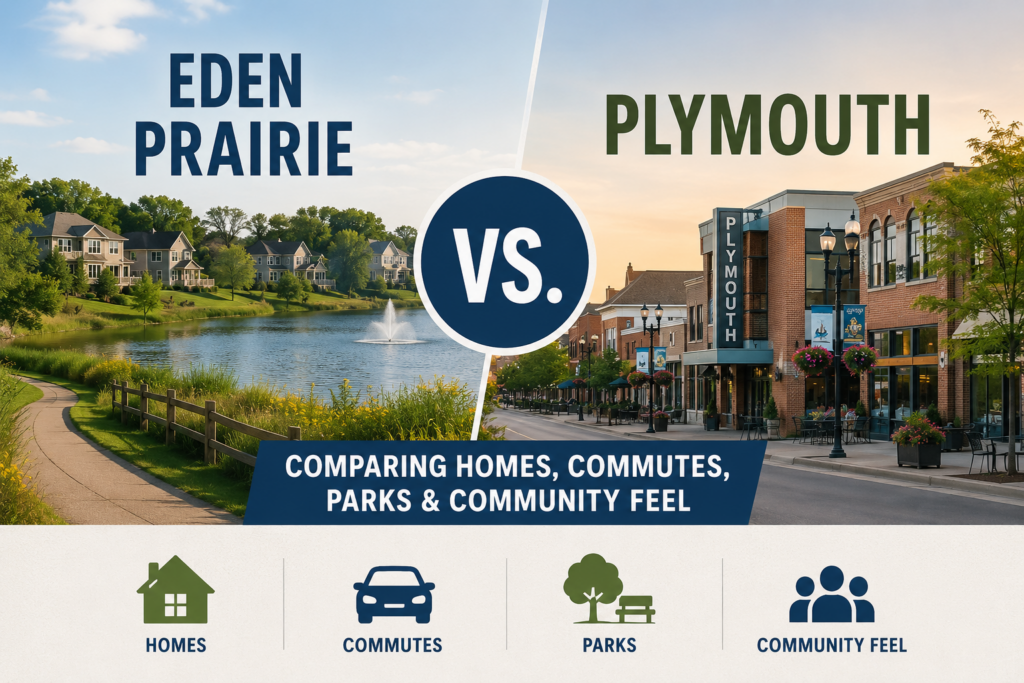
Eden Prairie vs. Plymouth: Comparing Homes, Commutes, Parks & Community Feel

Eden Prairie vs Plymouth comparison graphic showing homes, commutes, parks, and community feel in two Twin Cities western suburbs


When families start searching for a home in the western Twin Cities, the same two names come up again and again: Eden Prairie and Plymouth. Comparing Eden Prairie vs Plymouth homes, commutes, parks, and community feel is exactly what this guide is designed to help you do — side by side, category by category, without the fluff. Both suburbs rank among the best places to live in Minnesota, but they are not interchangeable. The differences are real, and choosing the right one for your family comes down to knowing what those differences actually are.

Eden Prairie sits along the Minnesota River bluffs to the southwest of Minneapolis. Plymouth spreads across rolling, lake-dotted terrain to the northwest. Both cities offer excellent schools, low crime, strong property values, and the kind of family infrastructure that’s hard to find combined in a single place. But dig one level deeper and the two cities diverge — in housing character, outdoor lifestyle, commute patterns, and the pace of daily life. Here’s the full breakdown.


🏡 Eden Prairie vs Plymouth Homes & the Housing Market

The homes themselves tell you a lot about each city’s identity — and so do the price tags.

Eden Prairie Homes: Planned, Polished, and Consistently In Demand

Eden Prairie grew up as a master-planned community, and that heritage is visible in the housing stock. Neighborhoods here feel cohesive and well-maintained — you’ll find a lot of two-story colonials and executive-style homes built between the mid-1980s and early 2000s, along with newer construction in pockets near the city’s southern and western edges. Lots tend to be generous, many backing up to wooded buffers or pond views that are genuinely attractive rather than decorative afterthoughts.

The typical family home in Eden Prairie — three or four bedrooms, a finished basement, and a two-car garage — runs in the $550,000 to $750,000 range in 2026, with entry points below $500K if you’re willing to take on a project. Move-in ready homes at the right price generate genuine competition; multiple-offer situations are still common, especially in spring.

One standout characteristic: Eden Prairie homes tend to hold value exceptionally well. The combination of school district reputation, employment proximity, and city-wide maintenance standards creates a floor that buyers can count on over time. According to Minneapolis Area Realtors, the western suburbs have consistently outperformed the broader metro on median price-per-square-foot retention over the past five years — and Eden Prairie sits near the top of that list.

Plymouth Homes: More Range, More Room to Find Your Entry Point

Plymouth’s housing market is broader and more varied — a natural result of the city’s size (it’s one of the largest cities in Minnesota by population) and its patchwork of neighborhoods developed across different eras. You’ll find 1970s ramblers and split-levels in older western neighborhoods, well-built 1990s subdivisions throughout the core, and newer executive construction near the city’s eastern and northeastern edges.

Pricing for Plymouth homes typically runs $480,000 to $700,000 for a comparable family home, with genuine opportunities below $450K in older neighborhoods — something Eden Prairie rarely offers for move-in-ready product. On the upper end, newer construction near Medicine Lake or in premium subdivisions can push well past $800K.

The key variable when buying a Plymouth home is the school district boundary. Because Plymouth spans multiple districts — primarily Wayzata (284) and Osseo (279) — the value of a specific home can vary significantly based on which district it falls in. Homes in the Wayzata district consistently command a premium. Knowing the boundary lines before you start touring is essential, and it’s one of the clearest reasons to work with an agent who knows Plymouth specifically.

Eden Prairie

More uniform housing stock, slightly higher floor, one school district. Excellent long-term value stability.

Plymouth

More variety across eras and price points. Wider entry options. School district boundary research is non-negotiable.

Whether you’re shopping Eden Prairie or Plymouth homes, working with a buyer’s agent who focuses on these specific cities will save you time, money, and the headache of learning pricing nuances on the fly. MinnMatch matches buyers with agents who know these neighborhoods at the street level — not just the zip code.


🚗 Comparing Commutes & Location

Neither Eden Prairie nor Plymouth is going to punish you with a brutal commute — both sit within 25 to 35 minutes of downtown Minneapolis under normal conditions. But the direction, highway access, and what’s nearby differ enough to matter for many buyers.

Eden Prairie Commutes: Southwest Access and Airport Proximity

Eden Prairie sits at the intersection of I-494, Highway 212, and Highway 169 — giving residents flexible options for reaching downtown Minneapolis, the airport corridor, and communities further southwest. The I-494 strip through Eden Prairie is also a major employment hub in its own right, home to corporate campuses that mean some residents barely leave the city for work at all.

The biggest commute advantage Eden Prairie holds is proximity to Minneapolis-St. Paul International Airport. For frequent business travelers, a 15-minute drive to MSP — without fighting through the city — is a genuine quality-of-life upgrade. If your job involves regular flights, this alone can tip the scales.

Transit options are limited, as they are throughout the western suburbs, but express bus routes connect Eden Prairie to downtown. The SWLRT Green Line Extension expanded light rail access closer to the Eden Prairie area, improving connectivity for transit-oriented commuters.

Plymouth Commutes: Northwest Access and Strong Highway Connections

Plymouth benefits from strong access via I-494, Highway 55, and I-394 — the last of which is a particularly efficient corridor straight into downtown Minneapolis and the inner-ring suburbs of St. Louis Park and Golden Valley. Residents heading downtown for work find the commute manageable and predictable outside of peak hours.

Plymouth’s location also makes it a natural base for professionals working in the northwest employment corridor — think Maple Grove, Brooklyn Park, or Rogers. If your job pulls you north rather than south or downtown, Plymouth’s geography is genuinely more convenient than Eden Prairie’s.

Plymouth is further from MSP — roughly 30 to 35 minutes — which matters for frequent flyers. For remote and hybrid workers who commute occasionally, the difference is largely irrelevant.

Route Eden Prairie Plymouth
Downtown Minneapolis 25–35 min via I-494 / Hwy 212 20–30 min via I-394 / Hwy 55
MSP Airport ~15 min ✈️ ~30–35 min
Northwest suburbs 30–40 min 10–20 min ✅
Primary highways I-494, Hwy 212, Hwy 169 I-394, I-494, Hwy 55

🌲 Comparing Parks & Outdoor Access

This is where Eden Prairie vs Plymouth diverges most meaningfully — not in quality, but in character. Both are exceptional for outdoor access. The question is what kind of outdoor lifestyle you’re after.

Eden Prairie Parks: Trails, Bluffs, and a Rare Urban Wilderness

Eden Prairie’s park system is one of the most impressive in the state for a city its size. With over 2,250 acres of parkland and more than 170 miles of interconnected trails, the outdoor infrastructure here is built into the city’s DNA. According to the City of Eden Prairie Parks & Recreation, the trail network is specifically designed to connect neighborhoods to schools, parks, and commercial areas without requiring residents to touch a road.

Staring Lake Park is a beloved anchor — offering kayak rentals, an amphitheater for summer concerts, a skating loop in winter, and trails winding through native prairie. Bryant Lake Regional Park provides swimming, fishing, and boat launch access. Along the city’s southern edge, the Minnesota River bluffs deliver dramatic, wooded topography that few western suburbs can match. The Richard T. Anderson Conservation Area alone contains hundreds of acres of protected habitat.

For families with kids who want to ride to school, or parents who want a running route that actually goes somewhere, Eden Prairie’s connectivity matters enormously.

Plymouth Parks: A Lake Town Through and Through

Plymouth’s outdoor identity is defined by water. With more than 30 lakes within city limits — including Medicine Lake, Parkers Lake, Bass Lake, and Mooney Lake — water access is a fact of life here. Many neighborhoods are built around lakes, with homes backing up to shoreline and residents fishing from their yards or paddling out before breakfast.

Parkers Lake Park is a crown jewel — a well-maintained beach, picnic areas, and a skating rink in winter that draws families from across the city. The Three Rivers Park District manages extensive regional trail corridors through and around Plymouth, connecting to the wider metro-wide trail grid. Plymouth Creek Center serves as a community hub with athletic facilities, indoor recreation, and event space year-round.

Plymouth’s trail network is solid, though not quite as densely woven as Eden Prairie’s. The emphasis here is on lake access, beach time, and water recreation — and on that dimension, Plymouth has no peer in the western metro.

Eden Prairie is your city if…

You want trails out your front door, city-wide connectivity, and access to river bluffs and native prairie that feel genuinely wild.

Plymouth is your city if…

Your version of the perfect Saturday involves a kayak, fishing pole, or paddleboard — and you want lake access woven into your neighborhood, not just nearby.


🏙️ Comparing Community Feel

Numbers and amenities only go so far. What’s it actually like to live in each of these cities?

Eden Prairie Community Feel: Put-Together, Energetic, and Self-Contained

Eden Prairie feels like a city that has its act together. The commercial core around Eden Prairie Center and the surrounding retail corridor is polished and well-maintained. You can handle almost every errand, meal out, and weekend activity without leaving city limits — and many residents do exactly that. The city has cultivated a local dining scene that punches above its weight for a western suburb, and fitness options, youth sports leagues, and family-oriented events fill the calendar year-round.

The demographic skews toward dual-income professional families — many of whom work at the major corporate campuses along the I-494 corridor or commute into Minneapolis. There’s a strong sense of community investment: residents here tend to be engaged in schools, youth sports, and civic life, which keeps the city’s momentum going. Eden Prairie has been recognized nationally as one of the best cities to live in the U.S., and the residents feel that pride.

The trade-off, if there is one, is that Eden Prairie can feel dense with ambition — it’s a high-achieving place, and the culture around school sports, activities, and résumé-building can feel intense at times. For some families, that energy is exactly what they want. For others who prefer a slightly quieter pace, it’s worth noting.

Plymouth Community Feel: Spacious, Neighborly, and a Little More Relaxed

Plymouth is Minnesota’s seventh-largest city by population, but it doesn’t feel like it. The city’s geography — sprawling across rolling terrain with neighborhoods separated by lakes, parks, and open space — creates a more dispersed, lower-density character than Eden Prairie’s tighter layout. It’s a city where people genuinely know their neighbors, where cul-de-sacs feel like small communities, and where the pace of life has a little more breathing room.

Plymouth’s retail and dining scene is solid but more spread out — you’ll often drive to neighboring Wayzata or Minnetonka for a broader restaurant selection or specialty shopping. Many Plymouth residents consider this a feature rather than a bug — the proximity to Wayzata’s charming lakeside village adds destination-quality dining and entertainment without the city needing to replicate it internally.

Community events and city-organized programs are strong — the Hilde Performance Center hosts outdoor concerts and seasonal events, and Plymouth Creek Center anchors a busy schedule of youth sports, fitness classes, and family programming. The community feel is warm and genuinely Minnesotan: involved but not in your face, friendly without being performative.

Plymouth also benefits from a notable degree of diversity compared to many western suburbs, which many families find appealing — especially those moving from larger metro areas or with kids who will benefit from a wider range of backgrounds and perspectives in school.


Eden Prairie vs Plymouth Homes: So Which One Wins?

Neither. And both.

Eden Prairie is the better fit if you want everything in one tightly run package — a single elite school district, a dense trail network, strong employment proximity, and a city that feels polished from end to end. It rewards buyers who want convenience, connectivity, and a high-energy community.

Plymouth homes offer a better fit if outdoor water access matters most to your family, if you want more housing variety and a slightly wider price window, or if you prefer a community that feels a little less intense and a little more spread out. It rewards buyers who do their homework on school district boundaries and aren’t afraid to drive five minutes for a great dinner.

In both cities, the market is competitive and the learning curve for buying is real. Understanding what a home is actually worth — and being positioned to move fast when the right one hits — requires local knowledge that goes beyond what any portal can provide. That’s exactly what the right agent delivers. MinnMatch can help you find one who specializes in the community you’re targeting.

Not sure which suburb is right for you?

MinnMatch connects Twin Cities buyers and sellers with hand-picked, vetted local agents — free, fast, and with no obligation. Tell us what you’re looking for, and we’ll match you with someone who knows Eden Prairie, Plymouth, and the broader western metro inside and out.

Find My Agent →

Minnetonka MN Spring 2026: What $350K, $500K & $700K Gets You Right Now

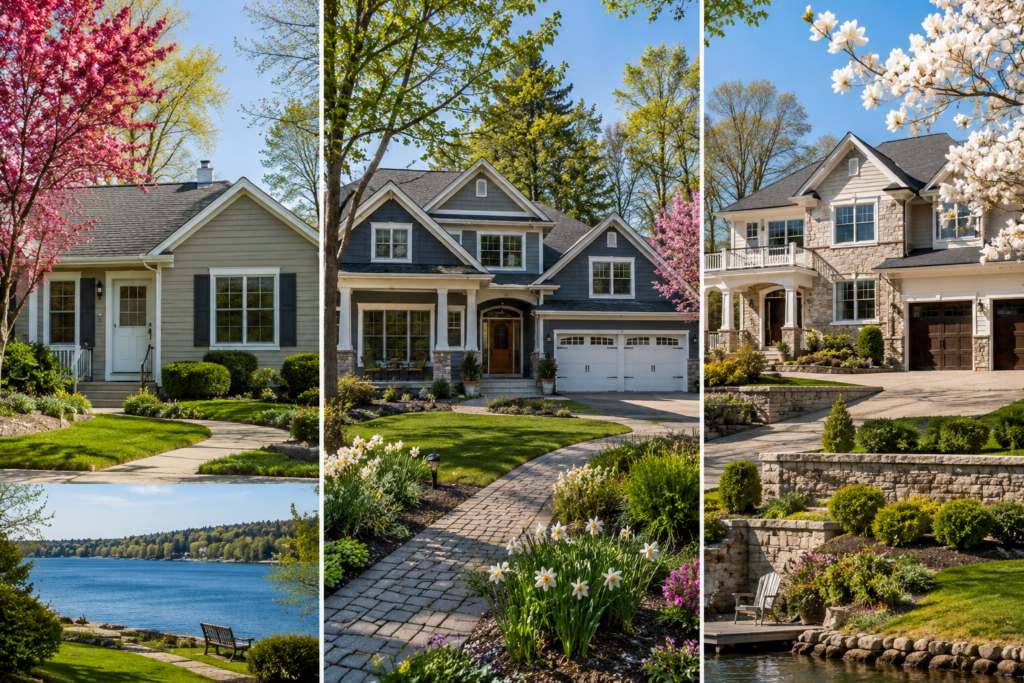
Three Minnetonka MN homes in spring representing $350K, $500K, and $700K price tiers, with lake view


Minnetonka Market Report  ·  Spring 2026

Minnetonka MN Spring 2026: What $350K, $500K & $700K Gets You Right Now

If you’re searching Minnetonka MN homes for sale in 2026, you already know this market doesn’t wait around. Strong schools, wooded lots, quick freeway access, and that proximity to Lake Minnetonka make this one of the Twin Cities’ most consistently competitive suburbs. But what does your budget actually buy right now? The average Minnetonka home is trading near $508,000, inventory is tight, and well-priced homes move fast. This guide breaks down three realistic price tiers — $350K, $500K, and $700K — so you know exactly what to expect before you start your search.

Quick Market Snapshot — Spring 2026

  • Median list price: ~$585,000 (March 2026)
  • Average sale price: ~$508,000 (up ~18.7% year-over-year)
  • Typical home value: ~$440,000
  • Median days on market: ~27 days
  • Market feel: Competitive — scoring 76 out of 100 on Redfin’s competitiveness scale
  • Price per sq ft: ~$238–$242

Sources: Redfin, Movoto, Zillow, MLS data — Spring 2026

$350K

Price Tier One

The Entry Point — and It’s Real

Minnetonka Homes for Sale Under $400K: What to Expect

At $350,000 you’re working near the bottom of Minnetonka’s active market — but that doesn’t mean you’re getting the short end of the stick. With a price per square foot around $238–$242, your budget stretches to roughly 1,400–1,500 square feet of finished living space. According to the Minnesota Housing Finance Agency, Hennepin County suburbs like Minnetonka consistently offer strong long-term value relative to statewide averages.

At this tier, expect:

  • 2–3 bedrooms, 2 bathrooms — often a rambler, twin home, or older split-level
  • A condo or townhome with resort-style HOA amenities (pools, sauna, exercise rooms) in communities like Woodhill or Brenwood II near Hwy 394
  • Older construction (1960s–1990s) with solid bones but potential for cosmetic updates — hardwood under the carpet, functional kitchens ready for a refresh
  • Lots within the Minnetonka School District — that’s the real value at this price
  • Convenient access to Hwy 7, Hwy 101, or I-494 — easy commutes in any direction

What to Watch Out For

Competition here is real. Anything priced under $400K in Minnetonka that’s move-in ready draws multiple offers fast — sometimes within the first weekend. If you’re in this range, get pre-approved, move decisively, and lean on a local agent who knows what’s coming to market before the public does. HOA fees on condos in this bracket can run $400–$600/month, so factor that into your monthly cost calculation.

MinnMatch Insight: The $350K buyer in Minnetonka is often choosing between a condo with great amenities or an older detached home with more upside. The right call depends on your lifestyle and how handy you are. A vetted local agent makes all the difference here — let us match you with one.

$500K

Price Tier Two

The Sweet Spot — Right at the Heart of the Market

Minnetonka MN Homes for Sale in the $500K Range

Half a million dollars puts you right at Minnetonka’s median — and that’s genuinely a good place to be. Your budget opens up to 2,000–2,400 square feet of finished space, often in a well-established neighborhood with mature trees, quiet cul-de-sacs, and real charm. Minneapolis Area REALTORS® data consistently shows the western suburbs, including Minnetonka, outperforming metro-wide appreciation averages at this price point.

At this tier, expect:

  • 3–4 bedrooms, 2–3 bathrooms — typically a two-story or walkout rambler on a private wooded lot
  • Updated kitchens with granite or quartz countertops, stainless steel appliances, and open layouts flowing into family rooms
  • Gas fireplaces, hardwood floors, and vaulted ceilings in move-in ready homes
  • A main-level primary suite in some ramblers — popular with buyers wanting single-floor living flexibility
  • Twin homes and townhomes with 2,300+ sq ft, vaulted ceilings, Alder cabinetry, and granite — like listings near Hwy 7 and Hwy 101
  • Proximity to Ridgedale, Whole Foods, Trader Joe’s, and major commuter routes

The Competition Reality

This is the most contested bracket in Minnetonka. Homes priced at $475K–$530K that are updated and well-located routinely see multiple offers. The 27-day median market time doesn’t tell the full story — the best homes go much faster. Sellers here have leverage, and buyers who aren’t prepared to move on Day 1 are learning that lesson the hard way this spring.

MinnMatch Insight: If you’re a buyer in the $500K range, understanding exactly what neighborhoods and streets command the best long-term value in Minnetonka is a real edge. That’s hyper-local knowledge — the kind a hand-matched agent brings to your search from day one.

$700K

Price Tier Three

The Move-Up Buy — Where Minnetonka Really Opens Up

2026 Minnetonka Homes for Sale at $700K: Executive-Level Buying

At $700,000, Minnetonka starts delivering the lifestyle it’s best known for. You’re in genuine executive-home territory — larger lots, higher-end finishes, more space, and in some cases a home that borders the Wayzata School District without the Wayzata price tag.

At this tier, expect:

  • 4–5 bedrooms, 4+ bathrooms — substantial two-story or custom homes with 3,200–4,400+ sq ft of finished living space
  • Half-acre+ private lots with mature trees, often backing to woods or wetlands — that “retreat in the city” feel Minnetonka does better than almost any other first-ring suburb
  • Fully remodeled or newer-construction homes with quartz islands, custom cabinetry, tile backsplash, spa-inspired primary baths, and three-car garages
  • Walkout lower levels with second living spaces, wet bars, or in-law suites
  • Features common in the 2024–2026 build cycle: 10-foot main-level ceilings, LVP flooring, smart home integration, oversized windows
  • Newer construction in established Minnetonka neighborhoods bordering Wayzata — without the waterfront premium
  • Award-winning Minnetonka or Wayzata school districts depending on exact location

What Sellers Expect at This Level

Homes in the $650K–$750K range in Minnetonka still move — but buyers have slightly more room to negotiate than in the mid-market. Days on market tend to run a bit longer at this tier, particularly for homes that need any updating. Sellers of truly turn-key homes still command strong prices and short timelines. If you’re a seller in this range, presentation and pricing precision matter enormously.

MinnMatch Insight: At $700K, the gap between an agent who truly knows Minnetonka’s luxury pockets — Sherwood Forest, Coventry Road, the Wayzata border neighborhoods — and one who doesn’t is measurable in dollars. The right match here isn’t optional, it’s the strategy.

Side-by-Side: What Each Budget Delivers

Feature ~$350K ~$500K ~$700K
Sq Footage (est.) 1,200–1,500 1,900–2,400 3,200–4,400+
Bedrooms / Baths 2–3 BR / 2 BA 3–4 BR / 2–3 BA 4–5 BR / 4+ BA
Home Type Condo / Twin / Older rambler Detached 2-story or walkout Executive 2-story / custom
Lot Size Small / shared Typical suburban lot ½ acre+ wooded
Kitchen Finishes Functional / dated or updated Granite/quartz, SS appliances Custom cabinetry, quartz island
Garage 1 car or underground 2 car attached 3 car attached
Finished Lower Level Varies Often yes Yes — bar, BR, rec room
School District Minnetonka ISD Minnetonka ISD Minnetonka or Wayzata ISD
Competition Level Very High Very High Moderate–High

The Bigger Picture: Spring 2026 Market Context

Minnesota’s housing market entered spring 2026 in a transitional posture. The Federal Reserve held rates steady at its most recent meeting, with tariff-driven inflation and global uncertainty keeping cuts off the table — at least for now. That means mortgage rates remain elevated, which has cooled some buyer demand at the margins but hasn’t meaningfully dented Minnetonka’s core appeal.

The statewide housing affordability index sits around 126 (March 2026), modestly above last year’s 123 — meaning purchasing power has actually improved slightly despite high rates, driven by wage growth. Minnesota Housing tracks this index as a key indicator of market accessibility statewide. But Minnetonka is above the state average in every price metric, and inventory remains constrained.

What does this mean practically? Sellers in all three price tiers still hold leverage on well-presented, well-located homes. Buyers need local market knowledge, speed, and smart strategy — not just financing approval.

Explore Nearby Communities

Minnetonka shares borders and school districts with some of the metro’s most sought-after communities. Depending on your budget and priorities, these might also be worth a look:

The Bottom Line on Minnetonka MN Homes for Sale in 2026

Minnetonka is one of the Twin Cities metro’s most durable real estate markets — not flashy, just consistently strong. Whether you’re stretching to get into the $350K range or ready to step into a $700K custom home on a private half-acre lot, you’re buying into excellent schools, mature neighborhoods, and a community with genuine staying power.

The question isn’t whether Minnetonka MN homes for sale are worth pursuing. It’s whether you have the right agent in your corner to help you win in a market that moves this fast. Browse current listings on Redfin’s Minnetonka page to get a feel for what’s active — then come back and let us match you with someone who knows every street.

Free — No Obligation

Ready to Buy or Sell in Minnetonka?

MinnMatch hand-picks a vetted, local Minnetonka agent based on your specific situation — not whoever’s next on a rotation list. It’s how real estate matchmaking should work.

Get Matched With a Minnetonka Agent →

Related Reading

Market data sourced from Redfin, Zillow, Movoto, MLS GRID, and City of Minnetonka public records — Spring 2026. All figures are approximations based on currently available data and should be independently verified. MinnMatch is a free agent-matching service for Minnesota buyers and sellers. We are not a brokerage.

Understanding Minnesota Market Conditions | Twin Cities Guide

Two-story brick and shake siding home with a two-car garage, arched entryway, and landscaped front yard representing a typical Twin Cities residential property

A Plain-Language Guide to How the Minnesota Housing Market Really Works

Real estate headlines often talk about “the market” as if it is one thing. In reality, Minnesota housing conditions vary widely by city, neighborhood, price point, and time of year.

This guide helps Minnesota buyers and sellers understand what market conditions mean, how they affect pricing and negotiation, and why local context matters far more than national averages.


1. What Are Market Conditions?

Market conditions describe the balance between buyers and sellers at a given moment in time.

They are shaped by:

  • Supply (how many homes are for sale)
  • Demand (how many buyers are actively looking)
  • Interest rates and affordability
  • Local economic factors
  • Seasonality

Understanding where the market stands helps set realistic expectations and informs strategy.


2. Buyer’s Market, Seller’s Market, and Balanced Market

These common terms describe different market environments.

Seller’s Market:

  • Fewer homes available
  • More buyer competition
  • Homes sell quickly
  • Prices may rise
  • Sellers often have more leverage

Buyer’s Market:

  • More homes available
  • Fewer buyers
  • Longer days on market
  • More negotiating power for buyers

Balanced Market:

  • Supply and demand are relatively even
  • Negotiations are more balanced
  • Pricing tends to be stable

Different Twin Cities communities can experience different market types at the same time.


3. Why Minnesota Is a Micro-Market State

Minnesota real estate is extremely local.

Market conditions can vary based on:

  • City vs. suburb vs. lake community
  • School districts
  • Commute patterns
  • Housing age and style
  • Price point

For example, entry-level homes in some suburbs may be highly competitive, while higher-priced homes nearby may move more slowly. Lake-area homes often follow different seasonal patterns than urban neighborhoods.


4. Inventory Levels and Months of Supply

One key metric professionals use is “months of supply.”

This measures how long it would take to sell all available homes at the current pace of sales.

General guidelines:

  • 0 to 3 months: Seller’s market
  • 4 to 6 months: Balanced market
  • 6+ months: Buyer’s market

Your agent can explain how this metric applies to your specific area and price range.


5. Pricing Trends and Comparable Sales

Pricing trends are based on recent comparable sales, not list prices.

Important factors include:

  • Sale price vs. list price
  • Days on market
  • Price reductions
  • Seasonal patterns

In Minnesota, spring and early summer often see stronger pricing due to increased demand, while late fall and winter may favor buyers in some segments.


6. Interest Rates and Buyer Behavior

Interest rates directly impact affordability and buyer activity.

When rates:

  • Decrease: buyer demand often increases
  • Increase: buyers may become more selective

Rate changes can affect different price ranges differently. Entry-level buyers are often the most sensitive to rate shifts.


7. How Market Conditions Affect Buyers

For buyers, market conditions influence:

  • Offer strategy
  • Pricing flexibility
  • Inspection negotiations
  • Timing decisions

In competitive markets, buyers may need to act quickly and write strong offers. In slower markets, buyers may have more leverage and time to evaluate options.


8. How Market Conditions Affect Sellers

For sellers, market conditions impact:

  • Pricing strategy
  • Preparation level
  • Negotiation flexibility
  • Marketing approach

Understanding local conditions helps sellers avoid overpricing and missed opportunities.


9. Why Local Expertise Matters More Than Headlines

National real estate headlines often lag behind or oversimplify what is happening locally.

A knowledgeable Minnesota agent understands:

  • Neighborhood-level data
  • Seasonal patterns
  • Buyer expectations
  • Current competition

This local insight leads to better decisions and smoother transactions.


How MinnMatch Helps

MinnMatch connects Minnesota buyers and sellers with trusted local real estate professionals who understand current market conditions at the neighborhood level.

Our matching process is human-reviewed and locally informed, so you are paired with an agent who can explain what the market means for your specific situation.

There is no cost and no pressure. Just clear guidance and a carefully matched local expert when you are ready.

Get Matched

Mortgage & Financing Basics in Minnesota | Twin Cities Guide

Person logging into an online banking app on a smartphone, representing mortgage and financing research for Twin Cities home buyers


Understanding mortgage basics in Minnesota is one of the most important steps you can take before buying a home in the Twin Cities. Whether you’re a first-time buyer in Eden Prairie or upgrading to a lake home near Wayzata, knowing your loan options, down payment requirements, and what lenders look for will save you time, money, and stress — and put you in a much stronger position when the right home hits the market.

Types of Mortgage Loans Available in Minnesota

Minnesota buyers have access to a wide range of loan products. Choosing the right one depends on your credit profile, how much you’ve saved, and whether you’re buying in an urban or suburban market.

Conventional Loans

Not government-backed. Typically require a 620+ credit score and 3–20% down. Best for buyers with solid credit and stable income. Widely available from Twin Cities lenders and credit unions.

FHA Loans

Backed by the Federal Housing Administration. Allow down payments as low as 3.5% with a 580+ credit score. A popular choice for first-time buyers in South Minneapolis, Plymouth, and other competitive suburbs.

VA Loans

Available to eligible veterans, active-duty service members, and surviving spouses. No down payment required, no PMI, and competitive rates. Minnesota has a large military community — this is an excellent option if you qualify.

USDA Loans

Designed for rural and some suburban areas. No down payment required if the property is in an eligible zone. Some communities on the outskirts of the metro — including parts of Prior Lake — may qualify.

Jumbo Loans

For homes priced above the conforming loan limit (~$806,500 in 2025). Common in high-value markets like Lake Minnetonka, Edina, and Wayzata. Require stronger credit and larger reserves.

Fixed vs. Adjustable Rate

Fixed-rate mortgages lock in your rate for the life of the loan (15 or 30 years). ARMs offer a lower initial rate that adjusts after a set period. Most Minnesota buyers in long-term homes prefer fixed-rate for predictability.

Minnesota Down Payment Assistance Programs

Coming up with a down payment is the #1 barrier most buyers face. The good news: Minnesota has some of the country’s most robust down payment assistance (DPA) programs, particularly for first-time and moderate-income buyers.

Key Programs to Know

  • MN Housing Start Up — Offers below-market interest rates plus optional DPA for first-time buyers statewide. Income and purchase price limits apply.
  • MN Housing Step Up — For repeat buyers or those with higher incomes who still need help. Flexible income limits and loan types.
  • Monthly Payment Loan (MPL) — A second mortgage from Minnesota Housing to cover the down payment and closing costs, repaid monthly alongside your first mortgage.
  • Deferred Payment Loan (DPL) — Zero interest, no monthly payments required. Due only when you sell, refinance, or pay off the home. Income-restricted.
  • Local City/County Programs — Many Twin Cities municipalities (including Minneapolis, Saint Paul, and Hennepin County) offer their own layered DPA grants.

Eligibility rules, income limits, and program availability change regularly. Always verify details directly through Minnesota Housing Finance Agency (mnhousing.gov) or ask your lender.

Getting Pre-Approved: What Minnesota Lenders Look For

Pre-approval is non-negotiable in the Twin Cities market. In competitive neighborhoods like Edina or Minnetonka, sellers routinely reject offers that don’t come with one. Here’s what lenders evaluate:

  1. Credit Score — Most conventional lenders want 620+; FHA allows 580+. Higher scores unlock better rates. Pull your free report at AnnualCreditReport.com and dispute any errors before you apply.
  2. Debt-to-Income Ratio (DTI) — Your total monthly debt payments divided by gross monthly income. Most lenders cap this at 43–50%. Pay down revolving debt before applying if possible.
  3. Employment & Income History — Two years of steady employment in the same field is the gold standard. Self-employed buyers will need two years of tax returns and a profit-and-loss statement.
  4. Assets & Reserves — Lenders want to see enough savings for your down payment, closing costs (typically 2–3% of the purchase price in Minnesota), and a few months of mortgage payments in reserve.
  5. Property Type — Condos, multi-family homes, and rural properties can come with additional underwriting requirements. Your lender should flag these early.

💡 Pro Tip: Get pre-approved — not just pre-qualified. Pre-qualification is a quick estimate; pre-approval involves verified documentation and carries far more weight with sellers. In multiple-offer situations, it can be the difference between winning and losing.

Understanding Mortgage Rates in Minnesota

Mortgage rates in Minnesota generally track national averages set by broader economic conditions and Federal Reserve policy — but your personal rate depends on your credit score, loan type, down payment size, loan term, and the lender you choose.

A few things to keep in mind when comparing rates:

  • APR vs. Interest Rate — The APR includes fees and gives a truer picture of the total cost. Always compare APRs, not just headline rates.
  • Discount Points — You can pay upfront points to buy down your rate. This makes sense if you plan to stay in the home long-term.
  • Rate Locks — Once you find a home, locking your rate protects you from increases during underwriting. Most locks run 30–60 days.
  • Shop Multiple Lenders — Rates vary meaningfully between banks, credit unions, and mortgage brokers. Getting 3–5 quotes can save you thousands over the life of the loan. Use resources like Redfin Mortgage or local Minnesota credit unions to compare.

Closing Costs in Minnesota: What to Budget For

Closing costs are separate from your down payment and are easy to underestimate. In Minnesota, buyers typically pay 2–3% of the purchase price at closing. On a $450,000 home, that’s $9,000–$13,500.

Cost Item Typical Range Notes
Loan Origination Fee 0.5–1% of loan Negotiable with some lenders
Appraisal $500–$800 Required by lender to confirm value
Title Insurance $1,000–$2,500 Protects lender (and optionally you) from title defects
Home Inspection $400–$600 Strongly recommended; paid before closing
Prepaid Interest Varies Interest accrued from closing date to first payment
Property Tax Escrow 2–3 months Collected upfront to fund escrow account
Recording Fees (MN) $100–$300 Paid to county to record the deed and mortgage

Some sellers in slower markets may agree to cover part of your closing costs — a great negotiating point your agent can help you work into an offer. Learn more about what to expect as a buyer on our Buyers page.

First-Time Homebuyer Resources in Minnesota

If this is your first home purchase, you’re in good company — and there’s substantial support available to you in the Twin Cities.

  • Homebuyer Education Course — Required for many DPA programs. Minnesota Housing-approved courses can be taken online or in person. They cover budgeting, the purchase process, and long-term homeownership. Visit mnhousing.gov to find approved providers.
  • Minneapolis Area REALTORS® — Publishes monthly market data and resources for local buyers. Helpful for understanding current inventory and pricing trends. See mplsrealtor.com.
  • HUD-Approved Housing Counselors — Free or low-cost counseling from nonprofit agencies certified by the Department of Housing and Urban Development. They can review your credit, help you build a savings plan, and walk you through loan options.
  • MinnMatch Agent Matching — Once your financing picture is clearer, pairing with the right buyer’s agent makes a real difference. Our free matching service connects you with vetted, local agents who know your target neighborhoods inside and out.

Mortgage Basics Minnesota: Common Questions Answered

How much do I need to put down in Minnesota?

It depends on the loan type. Conventional loans can go as low as 3%, FHA at 3.5%, and VA/USDA at 0%. A larger down payment (20%+) eliminates private mortgage insurance (PMI) and reduces your monthly payment, but it’s not required. Many successful Twin Cities buyers close with 5–10% down.

What’s the difference between pre-qualification and pre-approval?

Pre-qualification is an informal estimate based on self-reported numbers. Pre-approval involves submitting documentation — pay stubs, tax returns, bank statements — and a hard credit pull. Pre-approval letters carry real weight with sellers. In a competitive market, don’t skip this step.

Can I use a gift for my down payment?

Yes, most loan programs allow gifted funds from family members. You’ll need a gift letter stating the money doesn’t need to be repaid. FHA and conventional loans both permit this; your lender will guide you through documentation requirements.

Is it better to use a local Minnesota lender or a national bank?

Both can work well. Local credit unions and mortgage brokers often offer competitive rates and more personalized service — and they understand Minnesota-specific programs like MN Housing products. National banks may have streamlined apps and consistent processes. The best choice is the lender who gives you the right rate, clear communication, and can close on time.

What credit score do I need to buy a home in Minnesota?

Most conventional loans require a 620 minimum. FHA loans go as low as 580 (with 3.5% down) or even 500 (with 10% down). VA and USDA loans don’t have a set minimum, but most lenders apply an internal floor around 620–640. The higher your score, the better your rate — every 20-point improvement can meaningfully reduce your monthly payment.

Ready to Start Your Home Search in the Twin Cities?

Getting your financing in order is step one. Step two is finding an agent who knows your market. MinnMatch connects Minnesota buyers with handpicked, vetted local agents — completely free.

Find Your Agent

This article is intended for general informational purposes. Loan programs, income limits, and rates change frequently. Always consult with a licensed mortgage professional for advice specific to your situation.

Buying a Home in Minnesota

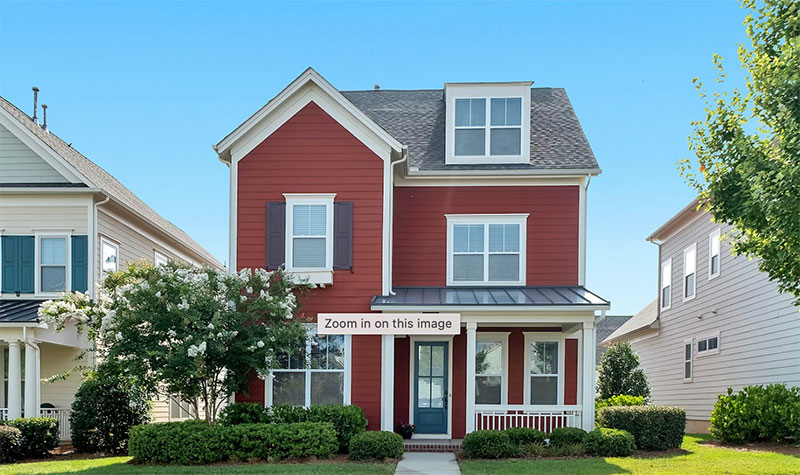
Two-story red craftsman-style home with white trim, dark shutters, a covered front porch, and a dormer window, representing a typical single-family home for sale in Minnesota

A Clear, Practical Guide for Minnesota Buyers Backed by Local Expertise

Buying a home in Minnesota is exciting, but it can also feel complex. From understanding local market conditions to navigating inspections and negotiations, small details can make a meaningful difference in outcomes.

This guide gives Minnesota buyers a clear, plain-language overview of the home buying process so you can make informed decisions and work confidently with the right local real estate professional.


1. Understanding the Minnesota Housing Market

Minnesota real estate is highly local. Market conditions can vary widely between the Twin Cities, first-ring suburbs, outer suburbs, and lake communities.

  • Inventory levels and available homes
  • Interest rates and affordability
  • Seasonal patterns, especially spring and early summer competition
  • Local demand by neighborhood and school district

In many Twin Cities communities, well-priced homes can still receive multiple offers. In others, buyers may have more room to negotiate. Understanding the dynamics of your specific area is critical.

This is where knowledgeable local guidance becomes invaluable.


2. Getting Financially Prepared

Before touring homes, it is important to understand your financial position.

  • Review your credit and monthly budget
  • Get pre-approved with a reputable lender
  • Understand down payment and closing cost requirements

Minnesota buyers often work with local mortgage professionals who understand state programs, property tax structures, and appraisal norms.

A strong pre-approval strengthens your offer and signals seriousness to sellers.


3. Choosing the Right Location

Minnesota offers a wide range of living environments, from urban neighborhoods to suburban communities and lake-area homes.

  • Commute and transportation options
  • Schools and amenities
  • Property taxes and assessments
  • Long-term resale potential
  • Lifestyle fit such as walkability or lake access

What works in Minneapolis may not apply in Edina, Wayzata, Prior Lake, or Lake Minnetonka. Local pricing patterns and buyer expectations differ by community.


4. Touring Homes and Evaluating Properties

  • Overall condition and maintenance
  • Layout and functionality
  • Age of major systems such as roof and HVAC
  • Traffic patterns and lot features

In Minnesota, seasonal conditions matter. Snow and frozen ground can conceal issues, making professional inspections especially important.


5. Making an Offer in Minnesota

A Minnesota purchase agreement typically includes:

  • Purchase price
  • Earnest money
  • Inspection and financing contingencies
  • Closing date
  • Included personal property
  • Additional terms or addenda

In competitive situations, strategy matters. Local insight can guide escalation clauses, inspection timing, and non-price terms.


6. Inspections and Due Diligence

  • General home inspection
  • Radon testing, very common in Minnesota
  • Sewer line inspection
  • Well and septic inspections where applicable

Based on results, buyers may proceed as-is, request repairs, renegotiate terms, or withdraw if contingencies allow.


7. Appraisal and Final Financing

The lender orders an appraisal to confirm value. If it meets expectations, the transaction proceeds. If it comes in low, additional negotiation may be required.

The lender completes underwriting before issuing clear-to-close approval.


8. Closing on Your Minnesota Home

  • Final walkthrough
  • Signing documents with title company or attorney
  • Funding down payment and closing costs
  • Recording of the deed

Once completed, the home is officially yours.


Why Local Guidance Matters

  • Neighborhood-specific pricing
  • Competitive offer strategy
  • Inspection norms
  • Negotiation expectations
  • Avoiding costly missteps

Online information is helpful, but buying a home is rarely one-size-fits-all.


How MinnMatch Helps

MinnMatch connects Minnesota buyers with trusted, experienced local real estate professionals through a thoughtful, human-reviewed matching process. There is no cost and no pressure. Just clear guidance and a carefully matched local expert when you are ready.

Get Matched