
Lock Your Rate or Float? What Minnesota Home Buyers Should Know About Mortgage Rates in 2026

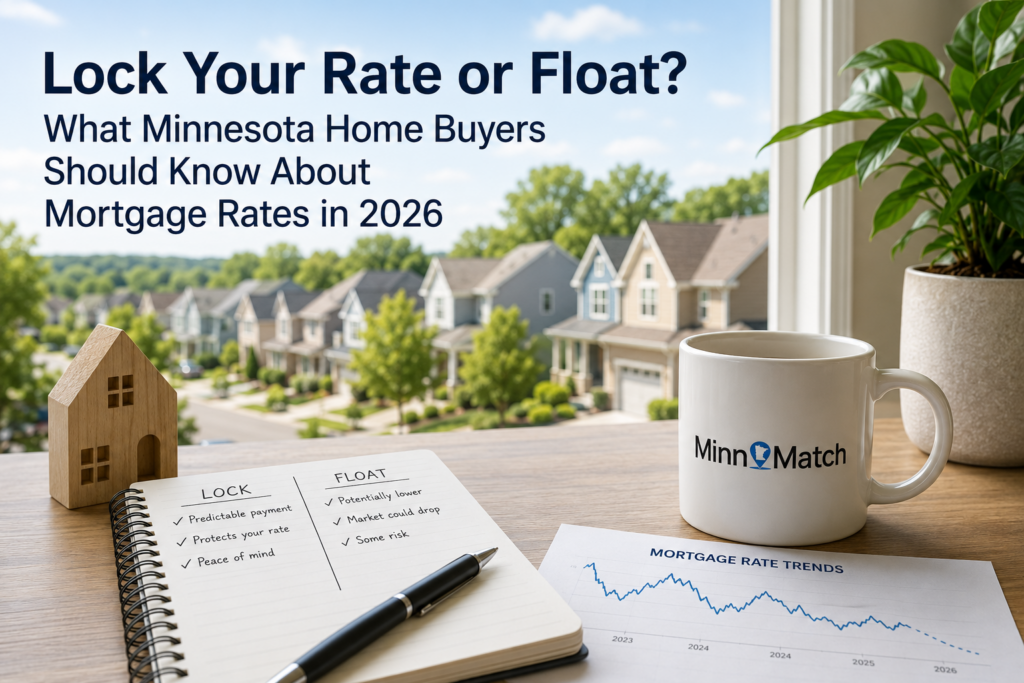
Notebook comparing lock vs. float mortgage rate options with MinnMatch mug and Twin Cities homes

If you’re shopping for a home in the Twin Cities right now, you’ve probably noticed mortgage rates have been anything but boring lately. They ticked up two weeks in a row through late July, and the Federal Reserve’s next meeting could nudge them further in either direction. That leaves a lot of Minnesota buyers asking the same question: should you lock your mortgage rate the moment you get an offer, or float it and hope for a better number before closing? There’s no universal right answer, but there is a smart way to think through it — and that’s what we’re walking through here.

Where Minnesota Mortgage Rates Stand Right Now

As of the most recent Freddie Mac Primary Mortgage Market Survey, the average 30-year fixed rate mortgage sits at 6.58%, up slightly from 6.55% the week before and 6.49% the week before that. Compare that to a year ago, when the 30-year average was running closer to 6.74%, and you can see rates have actually improved a bit over the past twelve months even with this recent upward drift. The 15-year fixed rate, often used by move-up buyers and downsizers here in the Twin Cities, is averaging just under 6%.

What does that mean if you’re house hunting in Eden Prairie, Plymouth, or South Minneapolis this summer? Mostly that rates have been trading in a fairly narrow band for a couple of months, but the direction has tilted upward recently rather than the steady drift downward a lot of buyers were hoping for. That’s exactly the kind of environment where a mortgage rate lock decision actually matters.

Locking vs. Floating: What Each Choice Really Means

A rate lock is an agreement with your lender that guarantees a specific interest rate for a set period — typically 30, 45, or 60 days — while your loan moves through underwriting to closing. Once locked, your rate won’t change even if the broader market moves, whether that’s good news or bad news for you. Most Minnesota lenders don’t charge extra for a standard lock window, though longer locks (say, 90 days for new construction) sometimes come with a small fee or slightly higher rate.

Floating means you’re choosing not to lock yet, betting that rates will drop before you need to commit. Some lenders also offer a “float-down” option, which lets you lock now but still capture a lower rate if one becomes available before closing — usually for an added fee. Floating without any safety net at all is the riskiest version of this strategy, since there’s nothing protecting you if rates move the other direction while you wait.

Why the Fed’s Late-July Meeting Matters for Your Rate Strategy

The Federal Reserve’s Federal Open Market Committee meets July 28-29, and it’s one of the more closely watched meetings of the year for anyone weighing a mortgage rate lock decision. The Fed has held its benchmark rate steady through multiple meetings in 2026, and most market pricing points to another hold this time around, though a modest increase hasn’t been ruled out given persistent inflation. Mortgage rates don’t move in lockstep with the Fed’s overnight rate, but Fed commentary and inflation data both tend to ripple through to the 30-year fixed rate within days.

Practically speaking, if you’re closing on a Twin Cities home in the next few weeks, this meeting sits right in the middle of your process. That’s a strong argument for locking sooner rather than later if you’re already comfortable with today’s rate and don’t want to be surprised by a rate hike mid-transaction. Floating through a Fed meeting is a real bet, not a guaranteed win.

How to Decide: Questions Minnesota Buyers Should Ask

There’s no single formula for the lock-or-float decision, but a few questions tend to clarify it fast:

  • How far out is your closing? The further away, the more time rates have to move — in either direction.
  • Would a small rate increase change whether the home is affordable? If your budget is tight, locking removes that variable entirely.
  • Does your lender offer a float-down option? This can be a reasonable middle ground if you want some downside protection.
  • How do you feel about today’s rate on its own merits? If it works for your monthly payment and long-term plans, waiting for a “maybe” is rarely worth the stress.

If affordability is tight either way, it’s also worth asking your lender whether you qualify for a Minnesota Housing fixed-rate loan program, which can sometimes offer more favorable terms than a standard conventional loan. Most Minnesota loan officers will tell you the same thing: rate locks exist to remove uncertainty, not to time the market perfectly. If today’s rate lets you comfortably afford the home you want, locking it in is rarely a mistake — even if rates dip slightly afterward. Chasing the absolute bottom of the market is a gamble, not a strategy.

Get Rate Guidance From an Agent Who Knows the Twin Cities Market

Mortgage rate decisions don’t happen in a vacuum — they’re tied to your timeline, your target neighborhoods, and how competitive the market is for the home you want. A great local agent will loop in a trusted lender and help you weigh the lock-or-float question against your actual purchase timeline, not just the headlines. That’s exactly the kind of personal guidance MinnMatch was built to provide. Tell us what you’re looking for and where, and we’ll hand-match you with a vetted Twin Cities agent who can help you navigate financing decisions alongside everything else. Find your agent match today, or visit how MinnMatch works to see the process from start to finish.
The Real Cost of Buying a Home in the Twin Cities in 2026: What You’ll Actually Spend

Calculator, house keys, and a model home on a desk with the Minneapolis skyline in the background, illustrating the real cost of buying a home in the Twin Cities in 2026


If you’re researching the cost of buying a home in the Twin Cities in 2026, the purchase price is only part of the story. You’ve saved up a down payment, gotten pre-approved, and you’re ready to start house hunting — but if you’re only thinking about the listing price, you’re missing a significant chunk of what you’ll actually spend. Between closing costs, inspections, insurance, property taxes, and a dozen smaller line items, the real cost of buying a home in the Twin Cities can run $30,000 to $60,000 more than the number on the listing. Here’s what to expect — broken down clearly — so there are no surprises at the closing table.

What Are Homes Actually Selling For Right Now?

Before digging into the costs layered on top, it helps to know where prices actually stand. According to Minneapolis Area Realtors® data from April 2026, the overall Twin Cities metro median sales price is $390,000 — up about 2.1% from the prior year. Single-family detached homes are running higher, with a median closer to $429,000.

Within the city of Minneapolis itself, Redfin’s Minneapolis market data puts the March 2026 median sale price at around $355,000. So depending on where you’re shopping — a condo in South Minneapolis versus a single-family home in Eden Prairie or Plymouth — your baseline number will look quite different.

For the cost examples below, we’ll use $390,000 as our reference price — a realistic midpoint for much of the metro. Adjust the percentages to your actual price range as needed.

Quick Snapshot: Total Out-of-Pocket on a $390,000 Home

Down payment (10%) + closing costs + pre-paid items + inspection fees + immediate move-in costs can realistically total $55,000–$75,000 or more before you turn the key. Planning for the full number — not just the down payment — is the difference between a smooth closing and a stressful scramble.

Down Payment: The Big One

The down payment is typically the largest single amount you’ll bring to the table when buying a home in the Twin Cities. How much you put down depends on your loan type, your lender, and your financial goals.

Loan Type Min. Down Payment On a $390,000 Home Notes
Conventional 3%–5% $11,700–$19,500 PMI required under 20% down
FHA Loan 3.5% $13,650 Mortgage insurance premium (MIP) required
VA / USDA 0% $0 Eligibility requirements apply
Conventional (20%) 20% $78,000 No PMI; lower monthly payment

If you’re not quite at 20%, private mortgage insurance (PMI) typically adds 0.5%–1% of your loan amount annually — roughly $150–$300/month on a $350,000 loan — until you build sufficient equity. That’s a meaningful monthly cost worth factoring in. Minnesota Housing also offers down payment assistance programs for eligible buyers, which your agent can help you explore.

Earnest Money: Cash You Need Before Closing

When your offer is accepted, you’ll put down earnest money — typically 1%–2% of the purchase price in the Twin Cities — to show you’re a serious buyer. On a $390,000 home, that’s roughly $3,900–$7,800, due within a few days of offer acceptance.

This isn’t an additional cost — it gets applied toward your down payment or closing costs at closing. But you do need that cash liquid and ready immediately when your offer is accepted, which catches some buyers off guard.

Closing Costs: What Buyers Pay in Minnesota

Minnesota buyers typically pay 2%–5% of the purchase price in closing costs. On a $390,000 home, that’s a range of roughly $7,800–$19,500. Most Twin Cities buyers land somewhere in the middle of that range — plan on $10,000–$15,000 as a realistic working estimate.

Minnesota has a couple of state-specific fees that make the cost of buying a home here slightly higher than in some other states:

Mortgage Registry Tax
About 0.23% of your loan amount. Unique to Minnesota — on a $350,000 loan, that’s roughly $805.
Lender Fees
Origination, processing, and underwriting fees. Origination typically runs 0.5%–1% of the loan, plus flat fees that vary by lender. Shop at least two lenders and request written Loan Estimates.
Title & Settlement Fees
Minnesota closings are handled by title companies. Expect title search, exam, and lender’s title insurance (required) plus optional owner’s title insurance (strongly recommended).
Appraisal
Twin Cities appraisals typically run $400–$800, with higher costs for larger or complex homes and condos.
Recording Fees
Relatively standardized across Minnesota — many counties charge around $46 per recorded document.
Hennepin & Ramsey Note
Buyers closing in Hennepin or Ramsey County face an additional Environmental Response Fund tax on both deeds and mortgages — making Twin Cities closings slightly more expensive than elsewhere in Minnesota.

One piece of good news: in today’s market, sellers are increasingly offering concessions. It’s not uncommon for buyers to negotiate seller-paid closing cost contributions — median concessions can exceed $5,000. A skilled local agent knows how to structure these negotiations effectively.

Pre-Paid Items: The Costs People Forget

Pre-paid items aren’t fees — they’re real costs that you’d pay anyway, just due upfront at closing. They often catch buyers off guard because they don’t show up in initial closing cost estimates as clearly as lender fees do.

Homeowners Insurance

Your lender requires you to prepay the first year of homeowners insurance at closing. In Minneapolis, homeowners pay an average of about $2,637 annually for a $300,000 dwelling policy — roughly $220/month. Policies vary significantly, so shop around. Burnsville, notably, has some of the highest premiums in the state.

Prepaid Mortgage Interest

You’ll pay interest from your closing date through the end of that calendar month. If you close on the 5th, you’ll prepay 25–26 days of interest. On a $350,000 loan at a 6.5% rate, that’s roughly $40/day — so closing later in the month can save you a few hundred dollars.

Escrow Account Funding

Most lenders require 2–3 months of property taxes and homeowners insurance upfront to seed your escrow account. Minnesota’s average property tax rate is around 1.01–1.16%, but it varies considerably by county. On a $390,000 home, that could mean $1,600–$2,000 sitting in escrow from day one.

Minnesota Tax Timing Tip: Minnesota property taxes are paid in large installments — typically in May and October. Depending on when you close, your escrow requirements can shift significantly. Your lender and title company will calculate the exact proration, but it’s worth asking about early in your planning.

Inspection Costs: Non-Negotiable in the Twin Cities

A home inspection is one of the smartest investments you’ll make. In the Twin Cities, many homes are older — and with age comes a higher likelihood of needing sewer scope and chimney inspections on top of a standard general inspection.

Inspection Type Typical Cost
General Home Inspection $350–$600
Sewer Scope $150–$300
Chimney Inspection $100–$250
Radon Testing $100–$200
Mold or Air Quality $200–$500

Budget $600–$1,200 for inspections on a typical single-family home, and more if the property is older or larger. Radon is particularly worth testing for in Minnesota — the state has elevated radon levels compared to the national average. Your agent can recommend reputable, independent inspectors.

Moving Costs and Immediate Repairs

These costs don’t show up on any closing disclosure, but they’re real — and they hit right when your cash reserves are already depleted.

Moving: A local Twin Cities move with a professional company typically runs $800–$2,500. Moving across town with a large household — furniture, appliances, garage — can push well past $3,000.

Immediate repairs and updates: Even a well-maintained home usually needs a few things before it feels like yours — paint, new locks, a deep clean, or a small fix the inspector flagged. Budget $1,000–$5,000 as a minimum reserve.

Appliances and fixtures: Not every home comes with all appliances. A washer, dryer, or refrigerator can each run $600–$1,500 new.


What It All Adds Up To: The True Cost of Buying a Home in the Twin Cities

Let’s put it together for a buyer purchasing a $390,000 home with 10% down in Hennepin County:

Cost Item Estimated Amount
Down Payment (10%) $39,000
Closing Costs (est. 3%) $11,700
Prepaid Homeowners Insurance (1 year) $2,637
Escrow Seed (taxes + insurance, ~3 months) $2,000
Prepaid Mortgage Interest $600
Inspections (general + sewer + radon) $900
Moving Costs $1,500
Immediate Repairs / Move-In Reserve $2,500
Estimated Total Out-of-Pocket ~$60,837

Note: This is an illustrative estimate. Actual costs vary based on lender, county, loan type, and negotiated terms. Does not include ongoing monthly costs like your mortgage payment, PMI, taxes, and insurance.

How to Reduce What You Spend

You can’t eliminate these costs, but you can manage them strategically. Here are the most effective ways Twin Cities buyers reduce their home buying costs:

Negotiate seller concessions. In today’s market, sellers are more willing to contribute toward closing costs. A strong offer can still include a request for 2%–3% in seller-paid concessions — your agent’s job is to structure that ask in the most competitive way possible.

Shop your lender. Lender fees vary more than most buyers realize. Getting two or three Loan Estimates — which lenders are required to provide within three business days of your application — can save you thousands.

Look into down payment assistance. Minnesota Housing, plus individual counties and cities, offer assistance programs for eligible buyers. First-time buyers especially should explore these before assuming they need a large down payment.

Close toward the end of the month. It reduces your prepaid interest. A small adjustment, but it can save a few hundred dollars.

Work with an agent who knows the numbers. An experienced Twin Cities buyer’s agent doesn’t just find you homes — they help you understand the full cost of buying a home in the Twin Cities before you’re under contract, structure offers strategically, and flag costs before they catch you off guard.

Ready to Plan Your Home Purchase?

Every buyer’s situation is different — your loan type, your target neighborhood, and your timeline all affect what you’ll actually spend. The right agent helps you understand the full picture before you’re under contract, not after. MinnMatch connects Twin Cities buyers with vetted, local agents who know this market inside and out.

Find Your Agent — It’s Free

You can also explore more on our site: learn how MinnMatch works, browse resources for buyers, or check out our community guides for neighborhoods across the metro — including Edina, Eden Prairie, Plymouth, and Lake Minnetonka.