
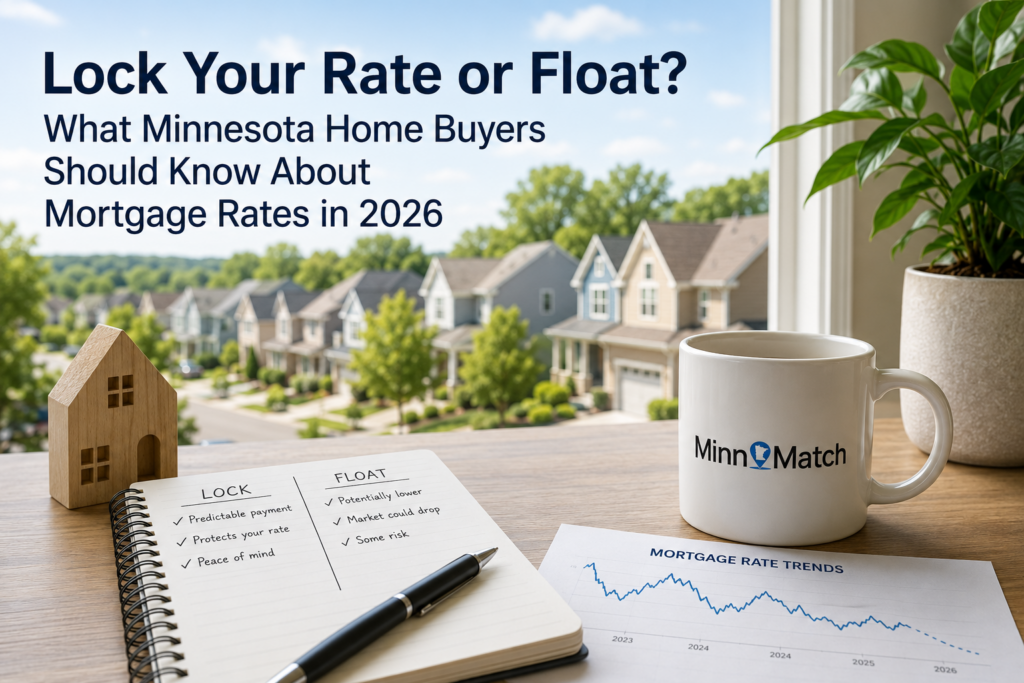
If you’re shopping for a home in the Twin Cities right now, you’ve probably noticed mortgage rates have been anything but boring lately. They ticked up two weeks in a row through late July, and the Federal Reserve’s next meeting could nudge them further in either direction. That leaves a lot of Minnesota buyers asking the same question: should you lock your mortgage rate the moment you get an offer, or float it and hope for a better number before closing? There’s no universal right answer, but there is a smart way to think through it — and that’s what we’re walking through here.
Where Minnesota Mortgage Rates Stand Right Now
As of the most recent Freddie Mac Primary Mortgage Market Survey, the average 30-year fixed rate mortgage sits at 6.58%, up slightly from 6.55% the week before and 6.49% the week before that. Compare that to a year ago, when the 30-year average was running closer to 6.74%, and you can see rates have actually improved a bit over the past twelve months even with this recent upward drift. The 15-year fixed rate, often used by move-up buyers and downsizers here in the Twin Cities, is averaging just under 6%.
What does that mean if you’re house hunting in Eden Prairie, Plymouth, or South Minneapolis this summer? Mostly that rates have been trading in a fairly narrow band for a couple of months, but the direction has tilted upward recently rather than the steady drift downward a lot of buyers were hoping for. That’s exactly the kind of environment where a mortgage rate lock decision actually matters.
Locking vs. Floating: What Each Choice Really Means
A rate lock is an agreement with your lender that guarantees a specific interest rate for a set period — typically 30, 45, or 60 days — while your loan moves through underwriting to closing. Once locked, your rate won’t change even if the broader market moves, whether that’s good news or bad news for you. Most Minnesota lenders don’t charge extra for a standard lock window, though longer locks (say, 90 days for new construction) sometimes come with a small fee or slightly higher rate.
Floating means you’re choosing not to lock yet, betting that rates will drop before you need to commit. Some lenders also offer a “float-down” option, which lets you lock now but still capture a lower rate if one becomes available before closing — usually for an added fee. Floating without any safety net at all is the riskiest version of this strategy, since there’s nothing protecting you if rates move the other direction while you wait.
Why the Fed’s Late-July Meeting Matters for Your Rate Strategy
The Federal Reserve’s Federal Open Market Committee meets July 28-29, and it’s one of the more closely watched meetings of the year for anyone weighing a mortgage rate lock decision. The Fed has held its benchmark rate steady through multiple meetings in 2026, and most market pricing points to another hold this time around, though a modest increase hasn’t been ruled out given persistent inflation. Mortgage rates don’t move in lockstep with the Fed’s overnight rate, but Fed commentary and inflation data both tend to ripple through to the 30-year fixed rate within days.
Practically speaking, if you’re closing on a Twin Cities home in the next few weeks, this meeting sits right in the middle of your process. That’s a strong argument for locking sooner rather than later if you’re already comfortable with today’s rate and don’t want to be surprised by a rate hike mid-transaction. Floating through a Fed meeting is a real bet, not a guaranteed win.
How to Decide: Questions Minnesota Buyers Should Ask
There’s no single formula for the lock-or-float decision, but a few questions tend to clarify it fast:
- How far out is your closing? The further away, the more time rates have to move — in either direction.
- Would a small rate increase change whether the home is affordable? If your budget is tight, locking removes that variable entirely.
- Does your lender offer a float-down option? This can be a reasonable middle ground if you want some downside protection.
- How do you feel about today’s rate on its own merits? If it works for your monthly payment and long-term plans, waiting for a “maybe” is rarely worth the stress.
If affordability is tight either way, it’s also worth asking your lender whether you qualify for a Minnesota Housing fixed-rate loan program, which can sometimes offer more favorable terms than a standard conventional loan. Most Minnesota loan officers will tell you the same thing: rate locks exist to remove uncertainty, not to time the market perfectly. If today’s rate lets you comfortably afford the home you want, locking it in is rarely a mistake — even if rates dip slightly afterward. Chasing the absolute bottom of the market is a gamble, not a strategy.
Get Rate Guidance From an Agent Who Knows the Twin Cities Market
Mortgage rate decisions don’t happen in a vacuum — they’re tied to your timeline, your target neighborhoods, and how competitive the market is for the home you want. A great local agent will loop in a trusted lender and help you weigh the lock-or-float question against your actual purchase timeline, not just the headlines. That’s exactly the kind of personal guidance MinnMatch was built to provide. Tell us what you’re looking for and where, and we’ll hand-match you with a vetted Twin Cities agent who can help you navigate financing decisions alongside everything else. Find your agent match today, or visit how MinnMatch works to see the process from start to finish.