End-of-Summer Home Buying: Why Late August Is a Smart Window in the Twin Cities

Home for sale sign on a tree-lined Twin Cities street, illustrating late summer home buying advantages

If you’ve been sitting on the sidelines waiting for the “right time” to buy, late summer home buying in the Twin Cities might be it. Inventory just hit its highest point in seven years, sellers who missed the spring rush are getting realistic about price, and the wave of fall buyers hasn’t shown up yet. That combination — more homes, more motivated sellers, less competition — doesn’t happen very often in this market, and it tends to close fast once Labor Day passes and back-to-school routines take over everyone’s attention.

The Numbers Behind Late Summer Home Buying in the Twin Cities

Here’s what’s actually happening in the market right now, heading into the final days of August 2026:

11,586
Homes on the market Twin Cities-wide — a seven-year high
3.0 months
Supply of homes in the metro area
$408,000
Twin Cities median sale price, July 2026
6.66%
Average 30-year mortgage rate, week of Aug 27

Sources: Minneapolis Area Realtors, Freddie Mac Primary Mortgage Market Survey

Twin Cities inventory rose 6.7% in July, pushing the metro to roughly three months of supply — still shy of the five to six months that would tip the scales fully toward buyers, but a real shift from the ultra-tight market of the past few years. Minneapolis proper saw sales jump 9.8% year-over-year, while Saint Paul actually softened, which tells you conditions vary block by block. That’s exactly the kind of nuance a local agent tracks closely, and exactly why Minneapolis Area Realtors’ market data is worth checking before you assume the whole metro is moving the same direction.

Why Late-August Sellers Are Different From Spring Sellers

A home still sitting on the market in late August has usually been through a few showings, a few open houses, and maybe a price drop already. The sellers behind those listings aren’t testing the water anymore — they’ve got a mortgage payment due next month and, in a lot of cases, a closing timeline tied to a job, a move, or kids starting school somewhere new. That’s a very different mindset than the multiple-offer energy of April and May.

Late summer home buying works in your favor here because motivated sellers are more open to covering closing costs, tossing in a home warranty, or negotiating on repairs after inspection — concessions that were almost unheard of during the peak-competition years. Builders and some sellers are even offering mortgage rate buydowns to make a deal pencil out at today’s Freddie Mac-reported rates in the mid-6% range.

Your Negotiating Leverage Right Now

With inventory up and days on market stretching longer than they have in years, buyers shopping the Twin Cities right now have room to actually negotiate instead of waiving contingencies to compete. A few things worth asking for if you’re house hunting this week:

  • Seller-paid closing costs — increasingly common again as concessions trend upward
  • A price reduction if the home has sat for 45+ days without an accepted offer
  • A mortgage rate buydown instead of (or in addition to) a price cut
  • Flexibility on closing date if the seller needs more time to move

None of this means you should lowball every listing — homes priced right in good neighborhoods are still moving quickly. But for late summer home buying specifically, the data supports coming to the table with realistic, well-researched offers rather than assuming you have to overpay to win.

The Window Closes Fast After Labor Day

Once school is back in session and Labor Day passes, two things tend to happen: a fresh round of sellers lists their homes for the fall push, and buyer attention shifts to holidays and year-end plans. That doesn’t kill the market — plenty of good deals show up in October and November too — but the specific mix that makes late summer home buying attractive right now (record-high inventory paired with sellers who are already tired of showings) starts to reset as new listings hit the market. If a home has checked your boxes and sat for a month and a half, this is the window to make a serious offer rather than waiting to see what September brings.

Move on This Window With the Right Agent

Timing a market shift like this well comes down to having an agent who’s watching days-on-market data street by street, not just citywide averages. If you’re ready to take advantage of late summer home buying conditions before they shift, MinnMatch can match you with a local agent who knows exactly which listings in your target neighborhood are sitting — and which sellers are ready to deal. Curious how the matching process works first? Here’s how MinnMatch works, start to finish.

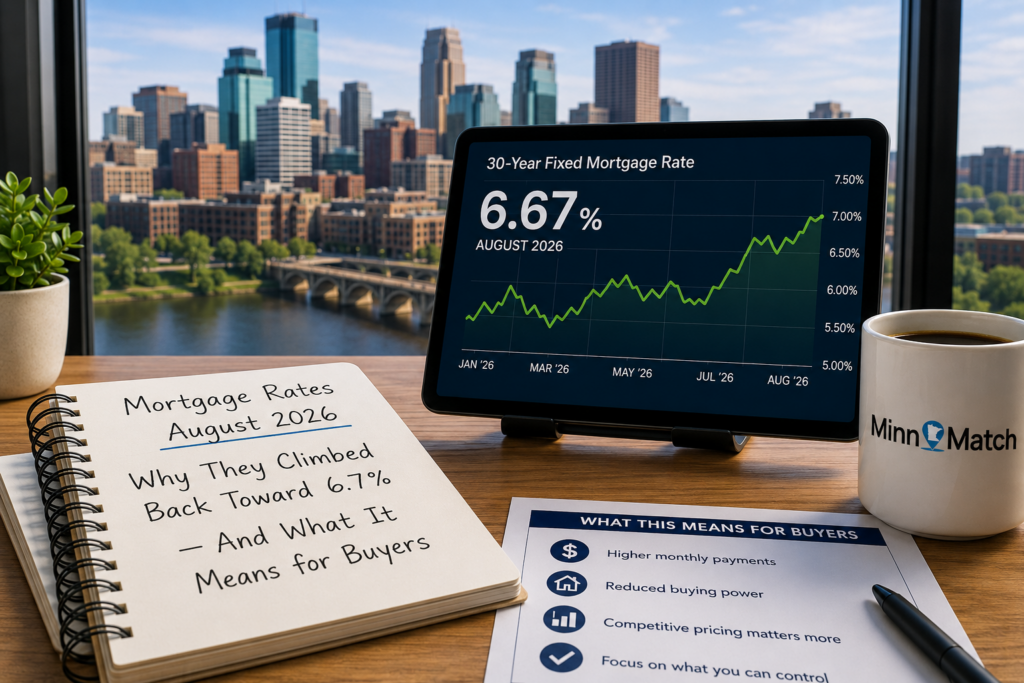
Twin Cities Mortgage Rates in August 2026: Why They Climbed Back Toward 6.7% — And What It Means for Buyers

Twin Cities mortgage rates chart showing 6.67% 30-year fixed rate climbing from January to August 2026, MinnMatch mug on desk with Minneapolis skyline

Twin Cities mortgage rates have had a wild ride in 2026. Back in late February, the 30-year fixed rate briefly dropped below 6% for the first time in three and a half years, giving buyers real hope for an easier spring. Since then, rates have climbed steadily back up, landing at 6.66% as of the most recent Freddie Mac survey in late July. If you’ve been tracking Twin Cities mortgage rates while sitting on the sidelines, here’s what actually happened, and what it means if you’re buying in the Minneapolis–Saint Paul metro right now.

Where Twin Cities Mortgage Rates Stand Right Now

According to the latest Freddie Mac Primary Mortgage Market Survey, the 30-year fixed-rate mortgage averaged 6.66% as of July 30, 2026, up from 6.58% the week before. The 15-year fixed averaged 6.04% over the same period. Day-to-day lender averages have bounced around a similar range through early August, with some daily readings pushing closer to 6.9%. For context, a year ago at this time the 30-year rate was actually a touch higher, at 6.72%, so despite the recent climb, today’s rates aren’t out of line with where things stood in the summer of 2025.

Why Rates Dropped, Then Climbed Right Back Up

The dip below 6% in late February came alongside slower economic data and improving housing inventory nationally, which briefly pulled rates down to their lowest point since 2022. That window didn’t last. As tensions escalated in the Middle East earlier this year, oil prices climbed, and higher oil prices tend to feed directly into inflation expectations, which pushes mortgage rates back up. The Federal Reserve has held its benchmark rate steady through the summer, but a handful of policymakers have pushed for a hike rather than a cut, a sign that the inflation picture is still murky enough to keep rates elevated for now. Most major forecasters, including the Mortgage Bankers Association and Fannie Mae, expect 30-year rates to hover in the mid-6% range through the rest of 2026 rather than returning to February’s lows anytime soon.

What This Means for Twin Cities Buyers Today

Locally, the swing hasn’t cooled the market as much as you might expect. Twin Cities inventory is still tight in many popular suburbs, and homes are continuing to sell quickly with multiple offers in competitive price ranges. The practical takeaway for buyers is that a rate in the mid-6% range is likely to be the reality for the next several months, not a temporary spike to wait out. Getting pre-approved now, with a clear sense of what a payment looks like at today’s rates, puts you in a much stronger position than holding out for a rate environment that may not arrive this year.

It’s also worth talking to your lender about rate locks and buydown options. With rates this volatile week to week, a temporary or permanent buydown can sometimes soften the blow more effectively than trying to time a market that even economists are struggling to predict. You can also check the Minnesota Housing Finance Agency for current down payment assistance and first-time buyer loan programs, which can help offset some of the added cost of today’s rates.

Should You Wait or Buy Now?

There’s no universal answer, but the pattern this year is a useful reminder: rates can move quickly in either direction based on global events well outside anyone’s control. Twin Cities mortgage rates dropped almost a full point between last summer and this February, then climbed most of the way back within a few months. Buyers who wait for a “perfect” rate often end up waiting through a market that keeps shifting instead. If your finances are ready and you find a home that fits your needs, current rates shouldn’t be a reason to sit out entirely, especially with refinancing always an option down the road if rates do ease later.

Not sure how today’s rates affect your budget or timeline? A local Twin Cities agent can help you weigh the numbers and figure out what actually makes sense for your situation. Find your agent match for free through MinnMatch, or learn more about our process on the How It Works page.

Lake Minnetonka Mid-Summer 2026: Why Serious Buyers Are Still Shopping Right Now

Lakefront patio with docked boats on Lake Minnetonka in mid-summer 2026

It’s the last week of July, the lake is packed with boats, and you’d think buyer interest around Lake Minnetonka would be cooling off along with the crowds after Labor Day. It isn’t. Lake Minnetonka real estate is still moving at a pace that’s catching a lot of house hunters off guard this mid-summer, with tight inventory, rising prices, and sellers still holding the upper hand across most price points. If you’ve been telling yourself you’ll “wait until fall when things calm down,” the numbers suggest that plan needs a second look.

Where Lake Minnetonka Prices Stand This July

Depending on which slice of the market you’re looking at, the numbers vary — which is exactly why it’s worth using ranges instead of a single headline figure. Across the broader Lake Minnetonka region, median sales prices have recently landed in the $790,000 to $835,000 range, up roughly 6% in a single month and closer to 14% over the trailing twelve months, according to Redfin’s market data. That range alone tells you Lake Minnetonka real estate isn’t a single market — it’s several overlapping ones. Move into the true waterfront segment — homes with actual lake frontage or association access — and the range widens dramatically, with average sale prices in 2025 landing around $1.08 million and active luxury listings currently averaging closer to $2.8 million, or roughly $545 per square foot. In plain terms: the “typical” Lake Minnetonka home and the “trophy” Lake Minnetonka home are two very different conversations, and buyers need to know which one they’re shopping in before they start comparing listings.

Why Inventory Still Isn’t Loosening Up

Months of supply around the lake has been sitting in the 3.6 to 3.8 range recently — well under the 5 to 6 months that typically signals a balanced market. That’s a structural issue, not a seasonal blip: shoreline simply doesn’t get created, and the towns that ring Lake Minnetonka (Wayzata, Excelsior, Deephaven, Orono, Tonka Bay, Mound, and the rest) have been supply-constrained for years. New listings have ticked up slightly, and homes are sitting a bit longer than they were a year ago — days on market have stretched into the 60s and 70s in some pockets, up from the high 50s — but longer marketing time hasn’t translated into pricing power for buyers. Sellers are still fielding offers close to asking price, with recent data showing homes selling for roughly 95% of list price on average. Slower doesn’t mean softer — it’s one more sign that Lake Minnetonka real estate is holding its ground even in the slower part of the summer calendar.

What Mortgage Rates Mean for Buyers Right Now

The 30-year fixed rate has been hovering in the mid-6% range through July 2026, landing at 6.58% as of the most recent Freddie Mac Primary Mortgage Market Survey — down noticeably from about 6.74% a year earlier. That’s not a dramatic swing, but for a $1 million-plus lake purchase, even a quarter-point of movement changes the monthly payment by hundreds of dollars. Buyers who locked in financing earlier this summer, or who are working with a lender tracking rates closely, are in a better negotiating position than those still shopping for a mortgage and a house at the same time. This is one more reason serious buyers around Lake Minnetonka aren’t sitting on the sidelines waiting for a “better time” — rate movement this year has rewarded people who stay engaged, not people who pause.

Which Lake Towns Are Seeing the Most Activity

Activity isn’t evenly spread across the lake. Wayzata continues to draw buyers who want walkable downtown access alongside water views, and its bay-facing properties are commanding some of the strongest per-square-foot numbers on the lake. Excelsior is pulling in buyers who want more small-town charm and a shorter commute into the western metro. Deephaven and Tonka Bay are seeing steady interest in their mix of historic cottages and newer builds, while Mound, Spring Park, and Greenwood remain the more accessible entry points for buyers who want lake access without a waterfront price tag. If you’re weighing a couple of these towns against each other, our Lake Minnetonka community page breaks down more of what makes each pocket of the lake different.

Should You Keep Shopping Through August?

If you’re serious about Lake Minnetonka real estate, mid-summer isn’t the lull people assume it is. Inventory is tight, well-priced homes are still fielding competitive offers, and mortgage rates aren’t guaranteed to sit still. The buyers who are winning right now tend to have two things in common: they know exactly which price band and which town they’re targeting, and they’re working with an agent who has real, current knowledge of that specific stretch of shoreline — not just general Twin Cities market experience. Reliable neighborhood-level data is also available through resources like Minnesota Housing if you want to look at financing programs alongside your search.

Lake Minnetonka’s market rewards buyers who move with good information and the right local partner. MinnMatch connects you with a vetted local agent who knows this stretch of shoreline — its towns, its price bands, and its pace — so you’re not guessing your way through a competitive summer market. Curious how the matching process works? See how MinnMatch works.

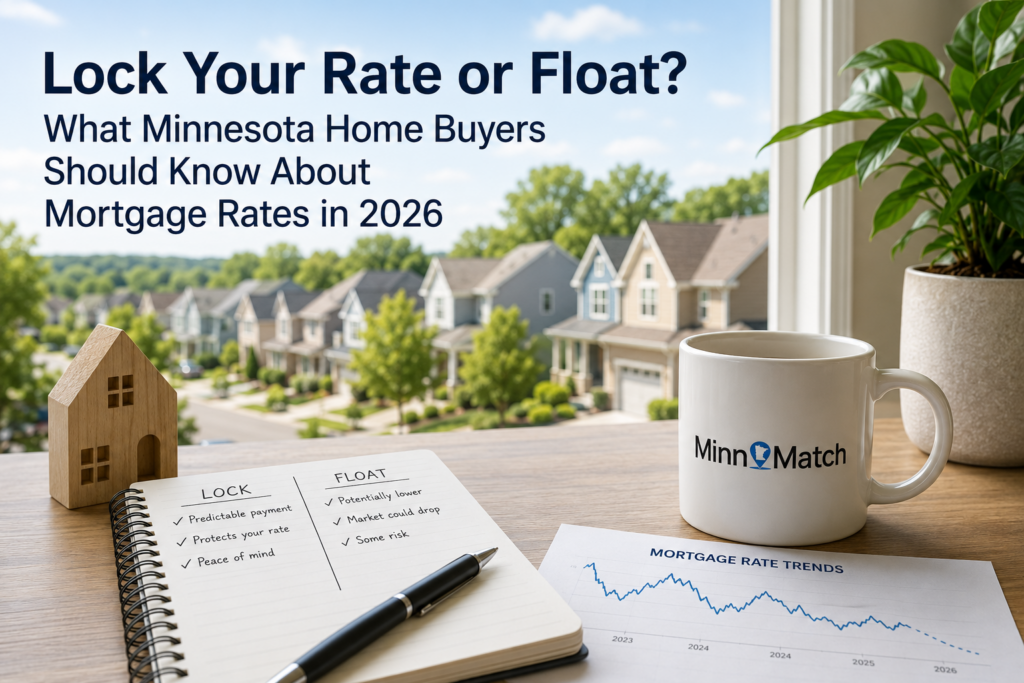
Lock Your Rate or Float? What Minnesota Home Buyers Should Know About Mortgage Rates in 2026

Notebook comparing lock vs. float mortgage rate options with MinnMatch mug and Twin Cities homes

If you’re shopping for a home in the Twin Cities right now, you’ve probably noticed mortgage rates have been anything but boring lately. They ticked up two weeks in a row through late July, and the Federal Reserve’s next meeting could nudge them further in either direction. That leaves a lot of Minnesota buyers asking the same question: should you lock your mortgage rate the moment you get an offer, or float it and hope for a better number before closing? There’s no universal right answer, but there is a smart way to think through it — and that’s what we’re walking through here.

Where Minnesota Mortgage Rates Stand Right Now

As of the most recent Freddie Mac Primary Mortgage Market Survey, the average 30-year fixed rate mortgage sits at 6.58%, up slightly from 6.55% the week before and 6.49% the week before that. Compare that to a year ago, when the 30-year average was running closer to 6.74%, and you can see rates have actually improved a bit over the past twelve months even with this recent upward drift. The 15-year fixed rate, often used by move-up buyers and downsizers here in the Twin Cities, is averaging just under 6%.

What does that mean if you’re house hunting in Eden Prairie, Plymouth, or South Minneapolis this summer? Mostly that rates have been trading in a fairly narrow band for a couple of months, but the direction has tilted upward recently rather than the steady drift downward a lot of buyers were hoping for. That’s exactly the kind of environment where a mortgage rate lock decision actually matters.

Locking vs. Floating: What Each Choice Really Means

A rate lock is an agreement with your lender that guarantees a specific interest rate for a set period — typically 30, 45, or 60 days — while your loan moves through underwriting to closing. Once locked, your rate won’t change even if the broader market moves, whether that’s good news or bad news for you. Most Minnesota lenders don’t charge extra for a standard lock window, though longer locks (say, 90 days for new construction) sometimes come with a small fee or slightly higher rate.

Floating means you’re choosing not to lock yet, betting that rates will drop before you need to commit. Some lenders also offer a “float-down” option, which lets you lock now but still capture a lower rate if one becomes available before closing — usually for an added fee. Floating without any safety net at all is the riskiest version of this strategy, since there’s nothing protecting you if rates move the other direction while you wait.

Why the Fed’s Late-July Meeting Matters for Your Rate Strategy

The Federal Reserve’s Federal Open Market Committee meets July 28-29, and it’s one of the more closely watched meetings of the year for anyone weighing a mortgage rate lock decision. The Fed has held its benchmark rate steady through multiple meetings in 2026, and most market pricing points to another hold this time around, though a modest increase hasn’t been ruled out given persistent inflation. Mortgage rates don’t move in lockstep with the Fed’s overnight rate, but Fed commentary and inflation data both tend to ripple through to the 30-year fixed rate within days.

Practically speaking, if you’re closing on a Twin Cities home in the next few weeks, this meeting sits right in the middle of your process. That’s a strong argument for locking sooner rather than later if you’re already comfortable with today’s rate and don’t want to be surprised by a rate hike mid-transaction. Floating through a Fed meeting is a real bet, not a guaranteed win.

How to Decide: Questions Minnesota Buyers Should Ask

There’s no single formula for the lock-or-float decision, but a few questions tend to clarify it fast:

  • How far out is your closing? The further away, the more time rates have to move — in either direction.
  • Would a small rate increase change whether the home is affordable? If your budget is tight, locking removes that variable entirely.
  • Does your lender offer a float-down option? This can be a reasonable middle ground if you want some downside protection.
  • How do you feel about today’s rate on its own merits? If it works for your monthly payment and long-term plans, waiting for a “maybe” is rarely worth the stress.

If affordability is tight either way, it’s also worth asking your lender whether you qualify for a Minnesota Housing fixed-rate loan program, which can sometimes offer more favorable terms than a standard conventional loan. Most Minnesota loan officers will tell you the same thing: rate locks exist to remove uncertainty, not to time the market perfectly. If today’s rate lets you comfortably afford the home you want, locking it in is rarely a mistake — even if rates dip slightly afterward. Chasing the absolute bottom of the market is a gamble, not a strategy.

Get Rate Guidance From an Agent Who Knows the Twin Cities Market

Mortgage rate decisions don’t happen in a vacuum — they’re tied to your timeline, your target neighborhoods, and how competitive the market is for the home you want. A great local agent will loop in a trusted lender and help you weigh the lock-or-float question against your actual purchase timeline, not just the headlines. That’s exactly the kind of personal guidance MinnMatch was built to provide. Tell us what you’re looking for and where, and we’ll hand-match you with a vetted Twin Cities agent who can help you navigate financing decisions alongside everything else. Find your agent match today, or visit how MinnMatch works to see the process from start to finish.