If you’ve been house hunting in the Twin Cities this fall, you’ve probably noticed the same home costing more each month, even though the price never changed. That’s because mortgage rates have climbed for six straight weeks, and the link between interest rates and buying power is the single biggest factor in what you can afford right now. This guide breaks down what a rate change actually does to your monthly payment, why your rate won’t match the headline number, and what you can do to protect your budget, all in plain English with real Twin Cities numbers.
How Interest Rates and Buying Power Are Connected
Buying power is simply the most house you can afford for a monthly payment you’re comfortable with. Most buyers don’t shop by price first. They shop by payment, and lenders approve you based on how that payment compares to your income. The interest rate sits right in the middle of that equation.
When rates go up, more of every payment goes to interest instead of paying down the loan. So the same $2,500 a month borrows less money. When rates fall, that same payment stretches further. A handy rule of thumb: every one-percentage-point change in mortgage rates shifts your buying power by roughly 10%. That’s how closely interest rates and buying power move together, and it’s why a change that sounds small in the headlines can take a whole tier of homes off (or back onto) your list.
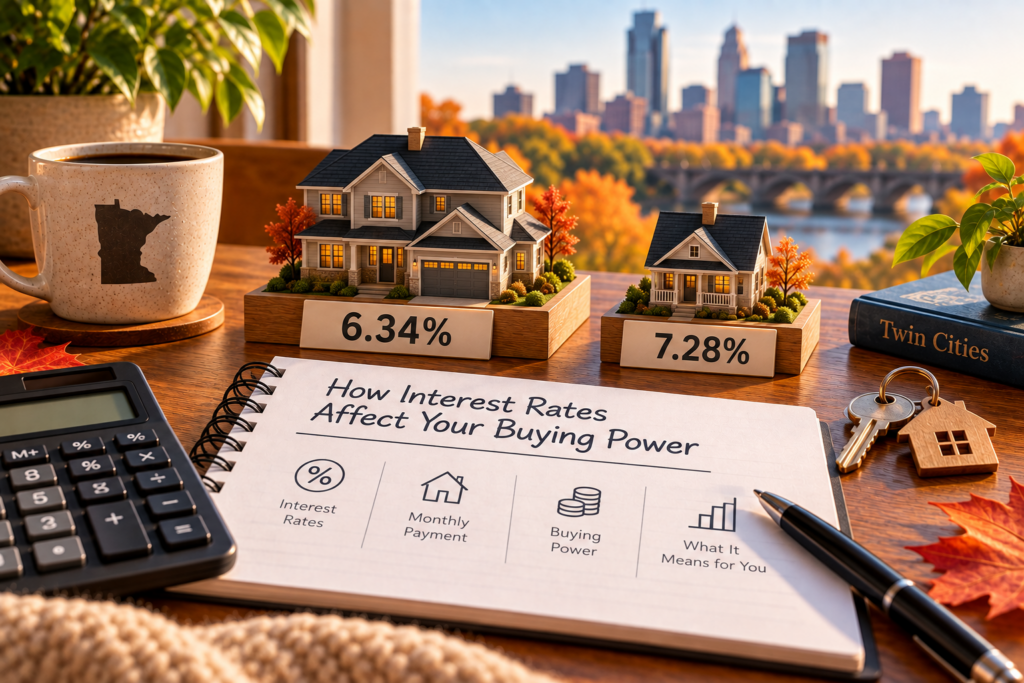
As of October 1, 2026, the average 30-year fixed rate hit 7.28%, according to Freddie Mac’s weekly mortgage survey. That’s up from 7.03% the week before and 6.34% a year ago, and it’s the highest reading in about three years.
The Twin Cities Math: What Today’s Rates Mean for Your Budget
Let’s make this real. The Twin Cities median sale price was right around $405,000 in August, according to Minneapolis Area REALTORS®. Here’s what that home looks like with 10% down at different rates:
A $405,000 Twin Cities Home at a Glance
$2,266
Monthly principal & interest at 6.34% (a year ago)
$2,494
Monthly principal & interest at 7.28% (today)
+$228
More per month, or about $2,700 more per year
~$82,000
Extra interest over a full 30-year loan
Assumes a $364,500 loan (10% down), 30-year fixed. Principal and interest only; property taxes, homeowners insurance, mortgage insurance, and HOA dues are extra. Rates: Freddie Mac PMMS, Oct. 1, 2026. Price: Minneapolis Area REALTORS®, August 2026 median sale price.
Now flip it around. Say your comfortable principal-and-interest budget is $2,500 a month. Here’s how much home that budget buys, again with 10% down:
| 30-Year Rate | Home Price Your $2,500 Buys | Difference vs. Today |
|---|---|---|
| 6.00% | ~$463,000 | +$57,000 |
| 6.34% (a year ago) | ~$447,000 | +$41,000 |
| 7.00% | ~$418,000 | +$12,000 |
| 7.28% (today) | ~$406,000 | — |
In other words, a buyer with the exact same income and budget can afford about $41,000 less house than they could last fall. In Twin Cities terms, that can be the difference between a three-bedroom in Plymouth and a townhome a few exits farther out. Even last week’s quarter-point jump added about $62 a month to that median-priced home.
One more Minnesota-specific wrinkle: property taxes here vary a lot from city to city, and they come out of the same monthly budget. Two homes at the same price in neighboring suburbs can carry noticeably different total payments, so always compare the full monthly cost, not just the rate.
Why Your Rate Won’t Match the Headline Number
The 7.28% you see in the news is a national average for a fairly specific borrower: excellent credit, 20% down, and a conventional loan. Your actual quote could land above or below it depending on a handful of things:
- Credit score. Even a 20- to 40-point improvement can bump you into a better pricing tier.
- Down payment. Putting more down usually lowers your rate and can eliminate mortgage insurance.
- Loan type. FHA, VA, and conventional loans are each priced differently, and the best fit depends on your situation.
- Points. Paying an upfront fee to “buy down” your rate can make sense if you plan to stay put for years.
- The lender itself. Quotes on the same day for the same borrower can differ meaningfully, so it pays to compare at least two or three.
First-time buyers should also look at Minnesota Housing, which offers home loans and down payment help for eligible buyers. Those programs won’t change the national rate, but they can lower the amount you need to borrow, and that boosts your buying power just as surely. Our buyer resources are a good place to start sorting through options.
How to Protect Your Buying Power When Rates Rise
Higher rates have a silver lining this fall: fewer buyers are competing. In mid-September, pending sales across the Twin Cities were down nearly 16% from a year earlier while homes for sale were up about 9%, per Minneapolis Area REALTORS® weekly data. That shift gives prepared buyers room to negotiate. A few ways to use it:
- Ask for seller-paid rate buydowns. Instead of a price cut, a seller credit used to buy down your rate can lower your monthly payment more than the same dollars taken off the price.
- Widen your map. Neighboring suburbs can offer similar schools and commutes for less. Comparing areas like Eden Prairie and Minnetonka side by side can uncover real savings.
- Get a fresh pre-approval. If your pre-approval is from the summer, the number on it may no longer be accurate at today’s rates. Update it before you write an offer.
- Shop the payment, not just the price. Factor in taxes, insurance, and HOA dues so you know your true monthly number before you fall in love with a house.
- Be cautious about “refinance later.” Refinancing if rates drop is a real option, but it isn’t guaranteed and it comes with closing costs. Buy a home whose payment works for you today.
Interest Rates and Buying Power: Common Questions
How much does a 1% rate change affect my buying power?
Roughly 10%. On a $2,500 monthly principal-and-interest budget, dropping from 7.28% to about 6.3% raises what you can afford from around $406,000 to around $447,000.
Will a Federal Reserve rate cut lower mortgage rates?
Not directly. Mortgage rates tend to follow the 10-year Treasury yield, which reacts to inflation, the job market, and investor expectations. A Fed cut can help, but mortgage rates sometimes move before the Fed does, or in a different direction entirely.
Should I wait for rates to drop before buying?
Nobody can reliably predict rates. Waiting can pay off, but if rates fall, more buyers usually jump back in and competition (and prices) can rise with them. The better question is whether the payment works for your budget and you plan to stay at least five years. If both answers are yes, the timing is often less important than finding the right home.
Make Every Dollar Count With the Right Agent
When it comes to interest rates and buying power, high-rate markets leave a thinner margin for error. A strong local agent knows which sellers are open to rate buydowns, which suburbs give you the most home per dollar, and how to structure an offer that keeps your monthly payment where it needs to be. That kind of guidance can easily be worth more than a quarter-point on your rate.
MinnMatch connects Twin Cities buyers with handpicked, vetted agents who know their local markets inside and out, and it’s completely free. Tell us what you’re looking for and your budget, and we’ll match you with an agent who can help you make the most of your buying power. Curious how it works? Here’s the quick rundown.