
The Hidden Costs of Buying a Home in Minnesota That Nobody Warns You About in 2026

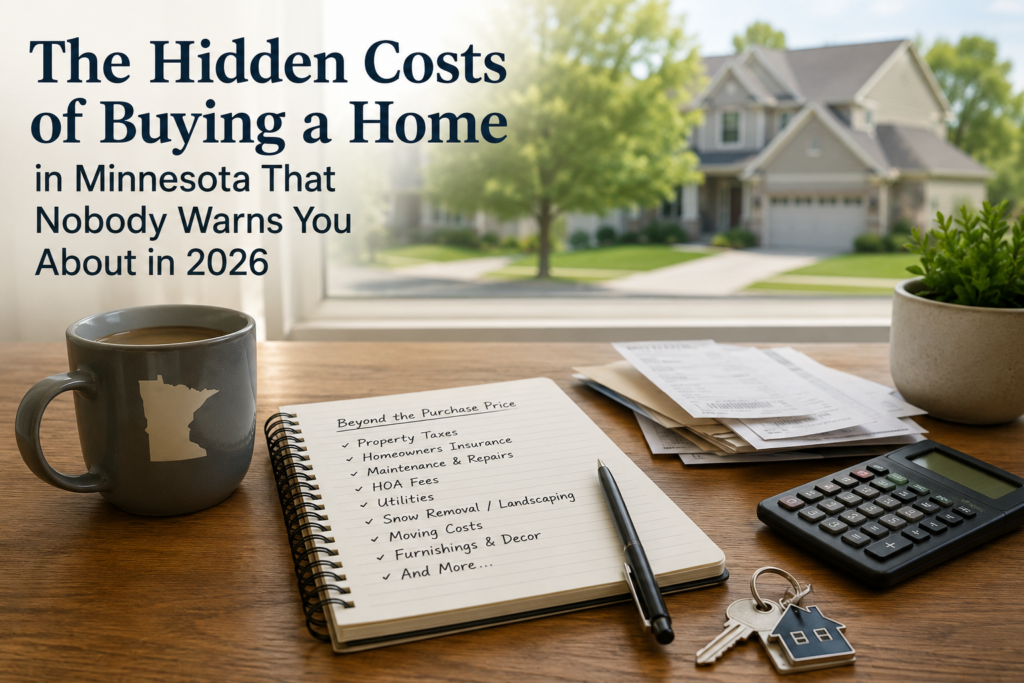
Notebook checklist of hidden home buying costs in Minnesota with coffee mug, calculator, and house keys

By the time you’ve saved for a down payment and budgeted for closing costs, you probably feel like you’ve covered the bases. But the hidden costs of buying a home in Minnesota — the ones nobody puts on a checklist — tend to show up after those two big numbers are already spent — in the weeks before closing, on moving day, and during that first, expensive year of ownership. None of them are secret, exactly. They’re just easy to miss when every guide (including a few of our own) focuses on the down payment and the closing statement. Here’s what actually catches Twin Cities buyers off guard, and what to set aside for it.

Homeowners Insurance Costs More Than Most Buyers Plan For

Minnesota’s hail, wind, and tornado exposure has pushed homeowners insurance premiums up sharply over the past two years, and published 2026 estimates for the state land anywhere from about $2,500 to $3,500+ a year depending on the source, your dwelling coverage, and your ZIP code — noticeably higher than a lot of buyers expect when they’re penciling out a monthly payment. Your lender will require proof of coverage before closing, and your first year’s premium is typically collected upfront and folded into escrow, which means it’s due before you’ve unpacked a single box. If your home has an older roof, a walkout basement prone to water issues, or sits in a hail-prone western suburb, get quotes early — some insurers are getting pickier about older roofs and claims history, and a surprise decline a week before closing is a headache nobody wants. Checking recent sold listings on a site like Redfin can also give you a sense of a neighborhood’s typical home age and construction, which insurers factor into their quotes.

Two riders are also worth budgeting for separately, since they’re not always included by default: sewer/sump pump backup coverage (common and cheap to add, but a real gap if skipped in a state full of basements) and, for lakefront or low-lying properties, flood coverage through a separate policy.

Testing You Didn’t Know You’d Pay For

A standard home inspection covers the basics, but several common Minnesota add-ons are among the most overlooked hidden costs of buying a home in this market — separate line items — and they’re almost always the buyer’s expense during the inspection period. Radon testing runs roughly $100–$175 if your inspector doesn’t already include it, and it’s worth doing: the Minnesota Department of Health estimates that a large share of homes statewide test above the action level, largely because of our soil composition and how tightly we seal homes against the cold. If levels come back high, mitigation systems typically cost $1,000–$2,000 to install — a number worth knowing before you’re negotiating repairs.

If you’re buying a home with a private well or septic system — common in the outer suburbs and lake communities — add well water testing and a septic inspection to your budget as well; together these can run several hundred dollars, and septic issues in particular can turn into a much bigger negotiation if the system is aging. A sewer line scope (checking for tree roots or breaks in older neighborhoods like South Minneapolis) is another optional add-on, typically $200–$300, that’s cheap insurance against a very expensive surprise.

Moving Day Isn’t Free — and Minnesota Weather Doesn’t Help

Local movers in the Twin Cities generally charge by the hour, and a typical in-metro move lands somewhere between $500 and $1,800 depending on home size, crew count, and how much stuff you’re hauling — more if you’re moving during the busy May–September stretch, when demand (and pricing) both climb. Add in supplies, a storage unit if your closing and move-out dates don’t line up, and tips for the crew, and it’s easy to spend $1,000+ that never showed up on a closing cost worksheet. If you’re closing in winter, budget a little extra flexibility too: a snowstorm on moving day is a Minnesota rite of passage, and rescheduling a crew last-minute rarely comes cheap.

The First-Year Cash Crunch: More Hidden Costs of Buying a Home in Minnesota

This is where a lot of the real hidden costs show up — not at closing, but in the months after. A few to plan for:

Escrow shortfalls. Your lender estimates your first year of property taxes and insurance when they set up escrow, but if your home’s assessed value jumps at reassessment — common after a purchase, since the sale price often resets the county’s valuation with the local assessor’s office — your escrow account can come up short. You’ll either owe a lump sum or see your monthly payment increase to cover the gap. (We’ve covered the mechanics of Minnesota property taxes in more detail if you want the full picture.)

HOA and association costs. If you’re buying a townhome, condo, or a house in a covenant community, ask for the HOA’s reserve study and meeting minutes before you close — not just the current dues. A thin reserve fund is often a warning sign of a special assessment coming down the line, and those can run into the thousands per unit with little notice.

The stuff that isn’t “broken,” just old. Inspections flag safety and functionality issues, not a water heater that’s simply nearing the end of its expected life or a furnace that’s fine today but 18 years old. A general rule of thumb: set aside 1–2% of your home’s value annually for maintenance and eventual replacements, even if nothing’s wrong at closing.

The Small Stuff That Adds Up

None of these break the bank alone, but together they’re often a few hundred to a thousand-plus dollars in the first month: rekeying or replacing locks, utility deposits (especially if you’re new to the area and don’t have an established account history with Xcel Energy or CenterPoint), a Minnesota-grade snow blower or roof rake if you don’t already own one, and basic yard equipment if you’re moving from a place where someone else handled the lawn. It’s worth building a simple “move-in fund” separate from your down payment and closing costs — even a few thousand dollars in reserve takes the pressure off that first month considerably. If you’re a first-time buyer working with a tight budget, it’s also worth checking whether you still qualify for down payment or closing cost assistance through Minnesota Housing — some programs can free up cash specifically for these first-year costs.

None of these hidden costs should scare you off buying — they’re manageable when you know they’re coming. The buyers who get blindsided are usually the ones who only budgeted for the numbers on the purchase agreement. A local agent who works this market regularly can walk you through what to expect for your specific home, neighborhood, and situation before you’re locked into a closing date. MinnMatch can connect you with one, free of charge — no pressure, just a second set of eyes on the numbers.
The Real Cost of Buying a Home in the Twin Cities in 2026: What You’ll Actually Spend

Calculator, house keys, and a model home on a desk with the Minneapolis skyline in the background, illustrating the real cost of buying a home in the Twin Cities in 2026


If you’re researching the cost of buying a home in the Twin Cities in 2026, the purchase price is only part of the story. You’ve saved up a down payment, gotten pre-approved, and you’re ready to start house hunting — but if you’re only thinking about the listing price, you’re missing a significant chunk of what you’ll actually spend. Between closing costs, inspections, insurance, property taxes, and a dozen smaller line items, the real cost of buying a home in the Twin Cities can run $30,000 to $60,000 more than the number on the listing. Here’s what to expect — broken down clearly — so there are no surprises at the closing table.

What Are Homes Actually Selling For Right Now?

Before digging into the costs layered on top, it helps to know where prices actually stand. According to Minneapolis Area Realtors® data from April 2026, the overall Twin Cities metro median sales price is $390,000 — up about 2.1% from the prior year. Single-family detached homes are running higher, with a median closer to $429,000.

Within the city of Minneapolis itself, Redfin’s Minneapolis market data puts the March 2026 median sale price at around $355,000. So depending on where you’re shopping — a condo in South Minneapolis versus a single-family home in Eden Prairie or Plymouth — your baseline number will look quite different.

For the cost examples below, we’ll use $390,000 as our reference price — a realistic midpoint for much of the metro. Adjust the percentages to your actual price range as needed.

Quick Snapshot: Total Out-of-Pocket on a $390,000 Home

Down payment (10%) + closing costs + pre-paid items + inspection fees + immediate move-in costs can realistically total $55,000–$75,000 or more before you turn the key. Planning for the full number — not just the down payment — is the difference between a smooth closing and a stressful scramble.

Down Payment: The Big One

The down payment is typically the largest single amount you’ll bring to the table when buying a home in the Twin Cities. How much you put down depends on your loan type, your lender, and your financial goals.

Loan Type Min. Down Payment On a $390,000 Home Notes
Conventional 3%–5% $11,700–$19,500 PMI required under 20% down
FHA Loan 3.5% $13,650 Mortgage insurance premium (MIP) required
VA / USDA 0% $0 Eligibility requirements apply
Conventional (20%) 20% $78,000 No PMI; lower monthly payment

If you’re not quite at 20%, private mortgage insurance (PMI) typically adds 0.5%–1% of your loan amount annually — roughly $150–$300/month on a $350,000 loan — until you build sufficient equity. That’s a meaningful monthly cost worth factoring in. Minnesota Housing also offers down payment assistance programs for eligible buyers, which your agent can help you explore.

Earnest Money: Cash You Need Before Closing

When your offer is accepted, you’ll put down earnest money — typically 1%–2% of the purchase price in the Twin Cities — to show you’re a serious buyer. On a $390,000 home, that’s roughly $3,900–$7,800, due within a few days of offer acceptance.

This isn’t an additional cost — it gets applied toward your down payment or closing costs at closing. But you do need that cash liquid and ready immediately when your offer is accepted, which catches some buyers off guard.

Closing Costs: What Buyers Pay in Minnesota

Minnesota buyers typically pay 2%–5% of the purchase price in closing costs. On a $390,000 home, that’s a range of roughly $7,800–$19,500. Most Twin Cities buyers land somewhere in the middle of that range — plan on $10,000–$15,000 as a realistic working estimate.

Minnesota has a couple of state-specific fees that make the cost of buying a home here slightly higher than in some other states:

Mortgage Registry Tax
About 0.23% of your loan amount. Unique to Minnesota — on a $350,000 loan, that’s roughly $805.
Lender Fees
Origination, processing, and underwriting fees. Origination typically runs 0.5%–1% of the loan, plus flat fees that vary by lender. Shop at least two lenders and request written Loan Estimates.
Title & Settlement Fees
Minnesota closings are handled by title companies. Expect title search, exam, and lender’s title insurance (required) plus optional owner’s title insurance (strongly recommended).
Appraisal
Twin Cities appraisals typically run $400–$800, with higher costs for larger or complex homes and condos.
Recording Fees
Relatively standardized across Minnesota — many counties charge around $46 per recorded document.
Hennepin & Ramsey Note
Buyers closing in Hennepin or Ramsey County face an additional Environmental Response Fund tax on both deeds and mortgages — making Twin Cities closings slightly more expensive than elsewhere in Minnesota.

One piece of good news: in today’s market, sellers are increasingly offering concessions. It’s not uncommon for buyers to negotiate seller-paid closing cost contributions — median concessions can exceed $5,000. A skilled local agent knows how to structure these negotiations effectively.

Pre-Paid Items: The Costs People Forget

Pre-paid items aren’t fees — they’re real costs that you’d pay anyway, just due upfront at closing. They often catch buyers off guard because they don’t show up in initial closing cost estimates as clearly as lender fees do.

Homeowners Insurance

Your lender requires you to prepay the first year of homeowners insurance at closing. In Minneapolis, homeowners pay an average of about $2,637 annually for a $300,000 dwelling policy — roughly $220/month. Policies vary significantly, so shop around. Burnsville, notably, has some of the highest premiums in the state.

Prepaid Mortgage Interest

You’ll pay interest from your closing date through the end of that calendar month. If you close on the 5th, you’ll prepay 25–26 days of interest. On a $350,000 loan at a 6.5% rate, that’s roughly $40/day — so closing later in the month can save you a few hundred dollars.

Escrow Account Funding

Most lenders require 2–3 months of property taxes and homeowners insurance upfront to seed your escrow account. Minnesota’s average property tax rate is around 1.01–1.16%, but it varies considerably by county. On a $390,000 home, that could mean $1,600–$2,000 sitting in escrow from day one.

Minnesota Tax Timing Tip: Minnesota property taxes are paid in large installments — typically in May and October. Depending on when you close, your escrow requirements can shift significantly. Your lender and title company will calculate the exact proration, but it’s worth asking about early in your planning.

Inspection Costs: Non-Negotiable in the Twin Cities

A home inspection is one of the smartest investments you’ll make. In the Twin Cities, many homes are older — and with age comes a higher likelihood of needing sewer scope and chimney inspections on top of a standard general inspection.

Inspection Type Typical Cost
General Home Inspection $350–$600
Sewer Scope $150–$300
Chimney Inspection $100–$250
Radon Testing $100–$200
Mold or Air Quality $200–$500

Budget $600–$1,200 for inspections on a typical single-family home, and more if the property is older or larger. Radon is particularly worth testing for in Minnesota — the state has elevated radon levels compared to the national average. Your agent can recommend reputable, independent inspectors.

Moving Costs and Immediate Repairs

These costs don’t show up on any closing disclosure, but they’re real — and they hit right when your cash reserves are already depleted.

Moving: A local Twin Cities move with a professional company typically runs $800–$2,500. Moving across town with a large household — furniture, appliances, garage — can push well past $3,000.

Immediate repairs and updates: Even a well-maintained home usually needs a few things before it feels like yours — paint, new locks, a deep clean, or a small fix the inspector flagged. Budget $1,000–$5,000 as a minimum reserve.

Appliances and fixtures: Not every home comes with all appliances. A washer, dryer, or refrigerator can each run $600–$1,500 new.


What It All Adds Up To: The True Cost of Buying a Home in the Twin Cities

Let’s put it together for a buyer purchasing a $390,000 home with 10% down in Hennepin County:

Cost Item Estimated Amount
Down Payment (10%) $39,000
Closing Costs (est. 3%) $11,700
Prepaid Homeowners Insurance (1 year) $2,637
Escrow Seed (taxes + insurance, ~3 months) $2,000
Prepaid Mortgage Interest $600
Inspections (general + sewer + radon) $900
Moving Costs $1,500
Immediate Repairs / Move-In Reserve $2,500
Estimated Total Out-of-Pocket ~$60,837

Note: This is an illustrative estimate. Actual costs vary based on lender, county, loan type, and negotiated terms. Does not include ongoing monthly costs like your mortgage payment, PMI, taxes, and insurance.

How to Reduce What You Spend

You can’t eliminate these costs, but you can manage them strategically. Here are the most effective ways Twin Cities buyers reduce their home buying costs:

Negotiate seller concessions. In today’s market, sellers are more willing to contribute toward closing costs. A strong offer can still include a request for 2%–3% in seller-paid concessions — your agent’s job is to structure that ask in the most competitive way possible.

Shop your lender. Lender fees vary more than most buyers realize. Getting two or three Loan Estimates — which lenders are required to provide within three business days of your application — can save you thousands.

Look into down payment assistance. Minnesota Housing, plus individual counties and cities, offer assistance programs for eligible buyers. First-time buyers especially should explore these before assuming they need a large down payment.

Close toward the end of the month. It reduces your prepaid interest. A small adjustment, but it can save a few hundred dollars.

Work with an agent who knows the numbers. An experienced Twin Cities buyer’s agent doesn’t just find you homes — they help you understand the full cost of buying a home in the Twin Cities before you’re under contract, structure offers strategically, and flag costs before they catch you off guard.

Ready to Plan Your Home Purchase?

Every buyer’s situation is different — your loan type, your target neighborhood, and your timeline all affect what you’ll actually spend. The right agent helps you understand the full picture before you’re under contract, not after. MinnMatch connects Twin Cities buyers with vetted, local agents who know this market inside and out.

Find Your Agent — It’s Free

You can also explore more on our site: learn how MinnMatch works, browse resources for buyers, or check out our community guides for neighborhoods across the metro — including Edina, Eden Prairie, Plymouth, and Lake Minnetonka.