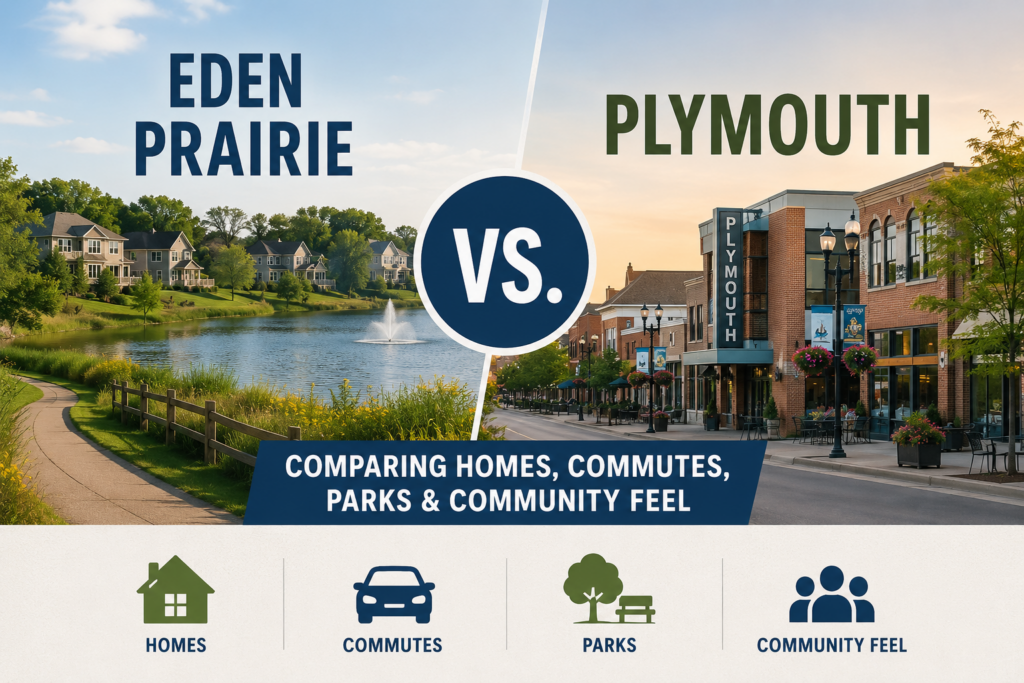
When families start searching for a home in the western Twin Cities, the same two names come up again and again: Eden Prairie and Plymouth. Comparing Eden Prairie vs Plymouth homes, commutes, parks, and community feel is exactly what this guide is designed to help you do — side by side, category by category, without the fluff. Both suburbs rank among the best places to live in Minnesota, but they are not interchangeable. The differences are real, and choosing the right one for your family comes down to knowing what those differences actually are.
Eden Prairie sits along the Minnesota River bluffs to the southwest of Minneapolis. Plymouth spreads across rolling, lake-dotted terrain to the northwest. Both cities offer excellent schools, low crime, strong property values, and the kind of family infrastructure that’s hard to find combined in a single place. But dig one level deeper and the two cities diverge — in housing character, outdoor lifestyle, commute patterns, and the pace of daily life. Here’s the full breakdown.
🏡 Eden Prairie vs Plymouth Homes & the Housing Market
The homes themselves tell you a lot about each city’s identity — and so do the price tags.
Eden Prairie Homes: Planned, Polished, and Consistently In Demand
Eden Prairie grew up as a master-planned community, and that heritage is visible in the housing stock. Neighborhoods here feel cohesive and well-maintained — you’ll find a lot of two-story colonials and executive-style homes built between the mid-1980s and early 2000s, along with newer construction in pockets near the city’s southern and western edges. Lots tend to be generous, many backing up to wooded buffers or pond views that are genuinely attractive rather than decorative afterthoughts.
The typical family home in Eden Prairie — three or four bedrooms, a finished basement, and a two-car garage — runs in the $550,000 to $750,000 range in 2026, with entry points below $500K if you’re willing to take on a project. Move-in ready homes at the right price generate genuine competition; multiple-offer situations are still common, especially in spring.
One standout characteristic: Eden Prairie homes tend to hold value exceptionally well. The combination of school district reputation, employment proximity, and city-wide maintenance standards creates a floor that buyers can count on over time. According to Minneapolis Area Realtors, the western suburbs have consistently outperformed the broader metro on median price-per-square-foot retention over the past five years — and Eden Prairie sits near the top of that list.
Plymouth Homes: More Range, More Room to Find Your Entry Point
Plymouth’s housing market is broader and more varied — a natural result of the city’s size (it’s one of the largest cities in Minnesota by population) and its patchwork of neighborhoods developed across different eras. You’ll find 1970s ramblers and split-levels in older western neighborhoods, well-built 1990s subdivisions throughout the core, and newer executive construction near the city’s eastern and northeastern edges.
Pricing for Plymouth homes typically runs $480,000 to $700,000 for a comparable family home, with genuine opportunities below $450K in older neighborhoods — something Eden Prairie rarely offers for move-in-ready product. On the upper end, newer construction near Medicine Lake or in premium subdivisions can push well past $800K.
The key variable when buying a Plymouth home is the school district boundary. Because Plymouth spans multiple districts — primarily Wayzata (284) and Osseo (279) — the value of a specific home can vary significantly based on which district it falls in. Homes in the Wayzata district consistently command a premium. Knowing the boundary lines before you start touring is essential, and it’s one of the clearest reasons to work with an agent who knows Plymouth specifically.
Eden Prairie
More uniform housing stock, slightly higher floor, one school district. Excellent long-term value stability.
Plymouth
More variety across eras and price points. Wider entry options. School district boundary research is non-negotiable.
Whether you’re shopping Eden Prairie or Plymouth homes, working with a buyer’s agent who focuses on these specific cities will save you time, money, and the headache of learning pricing nuances on the fly. MinnMatch matches buyers with agents who know these neighborhoods at the street level — not just the zip code.
🚗 Comparing Commutes & Location
Neither Eden Prairie nor Plymouth is going to punish you with a brutal commute — both sit within 25 to 35 minutes of downtown Minneapolis under normal conditions. But the direction, highway access, and what’s nearby differ enough to matter for many buyers.
Eden Prairie Commutes: Southwest Access and Airport Proximity
Eden Prairie sits at the intersection of I-494, Highway 212, and Highway 169 — giving residents flexible options for reaching downtown Minneapolis, the airport corridor, and communities further southwest. The I-494 strip through Eden Prairie is also a major employment hub in its own right, home to corporate campuses that mean some residents barely leave the city for work at all.
The biggest commute advantage Eden Prairie holds is proximity to Minneapolis-St. Paul International Airport. For frequent business travelers, a 15-minute drive to MSP — without fighting through the city — is a genuine quality-of-life upgrade. If your job involves regular flights, this alone can tip the scales.
Transit options are limited, as they are throughout the western suburbs, but express bus routes connect Eden Prairie to downtown. The SWLRT Green Line Extension expanded light rail access closer to the Eden Prairie area, improving connectivity for transit-oriented commuters.
Plymouth Commutes: Northwest Access and Strong Highway Connections
Plymouth benefits from strong access via I-494, Highway 55, and I-394 — the last of which is a particularly efficient corridor straight into downtown Minneapolis and the inner-ring suburbs of St. Louis Park and Golden Valley. Residents heading downtown for work find the commute manageable and predictable outside of peak hours.
Plymouth’s location also makes it a natural base for professionals working in the northwest employment corridor — think Maple Grove, Brooklyn Park, or Rogers. If your job pulls you north rather than south or downtown, Plymouth’s geography is genuinely more convenient than Eden Prairie’s.
Plymouth is further from MSP — roughly 30 to 35 minutes — which matters for frequent flyers. For remote and hybrid workers who commute occasionally, the difference is largely irrelevant.
| Route |
Eden Prairie |
Plymouth |
| Downtown Minneapolis |
25–35 min via I-494 / Hwy 212 |
20–30 min via I-394 / Hwy 55 |
| MSP Airport |
~15 min ✈️ |
~30–35 min |
| Northwest suburbs |
30–40 min |
10–20 min ✅ |
| Primary highways |
I-494, Hwy 212, Hwy 169 |
I-394, I-494, Hwy 55 |
🌲 Comparing Parks & Outdoor Access
This is where Eden Prairie vs Plymouth diverges most meaningfully — not in quality, but in character. Both are exceptional for outdoor access. The question is what kind of outdoor lifestyle you’re after.
Eden Prairie Parks: Trails, Bluffs, and a Rare Urban Wilderness
Eden Prairie’s park system is one of the most impressive in the state for a city its size. With over 2,250 acres of parkland and more than 170 miles of interconnected trails, the outdoor infrastructure here is built into the city’s DNA. According to the City of Eden Prairie Parks & Recreation, the trail network is specifically designed to connect neighborhoods to schools, parks, and commercial areas without requiring residents to touch a road.
Staring Lake Park is a beloved anchor — offering kayak rentals, an amphitheater for summer concerts, a skating loop in winter, and trails winding through native prairie. Bryant Lake Regional Park provides swimming, fishing, and boat launch access. Along the city’s southern edge, the Minnesota River bluffs deliver dramatic, wooded topography that few western suburbs can match. The Richard T. Anderson Conservation Area alone contains hundreds of acres of protected habitat.
For families with kids who want to ride to school, or parents who want a running route that actually goes somewhere, Eden Prairie’s connectivity matters enormously.
Plymouth Parks: A Lake Town Through and Through
Plymouth’s outdoor identity is defined by water. With more than 30 lakes within city limits — including Medicine Lake, Parkers Lake, Bass Lake, and Mooney Lake — water access is a fact of life here. Many neighborhoods are built around lakes, with homes backing up to shoreline and residents fishing from their yards or paddling out before breakfast.
Parkers Lake Park is a crown jewel — a well-maintained beach, picnic areas, and a skating rink in winter that draws families from across the city. The Three Rivers Park District manages extensive regional trail corridors through and around Plymouth, connecting to the wider metro-wide trail grid. Plymouth Creek Center serves as a community hub with athletic facilities, indoor recreation, and event space year-round.
Plymouth’s trail network is solid, though not quite as densely woven as Eden Prairie’s. The emphasis here is on lake access, beach time, and water recreation — and on that dimension, Plymouth has no peer in the western metro.
Eden Prairie is your city if…
You want trails out your front door, city-wide connectivity, and access to river bluffs and native prairie that feel genuinely wild.
Plymouth is your city if…
Your version of the perfect Saturday involves a kayak, fishing pole, or paddleboard — and you want lake access woven into your neighborhood, not just nearby.
🏙️ Comparing Community Feel
Numbers and amenities only go so far. What’s it actually like to live in each of these cities?
Eden Prairie Community Feel: Put-Together, Energetic, and Self-Contained
Eden Prairie feels like a city that has its act together. The commercial core around Eden Prairie Center and the surrounding retail corridor is polished and well-maintained. You can handle almost every errand, meal out, and weekend activity without leaving city limits — and many residents do exactly that. The city has cultivated a local dining scene that punches above its weight for a western suburb, and fitness options, youth sports leagues, and family-oriented events fill the calendar year-round.
The demographic skews toward dual-income professional families — many of whom work at the major corporate campuses along the I-494 corridor or commute into Minneapolis. There’s a strong sense of community investment: residents here tend to be engaged in schools, youth sports, and civic life, which keeps the city’s momentum going. Eden Prairie has been recognized nationally as one of the best cities to live in the U.S., and the residents feel that pride.
The trade-off, if there is one, is that Eden Prairie can feel dense with ambition — it’s a high-achieving place, and the culture around school sports, activities, and résumé-building can feel intense at times. For some families, that energy is exactly what they want. For others who prefer a slightly quieter pace, it’s worth noting.
Plymouth Community Feel: Spacious, Neighborly, and a Little More Relaxed
Plymouth is Minnesota’s seventh-largest city by population, but it doesn’t feel like it. The city’s geography — sprawling across rolling terrain with neighborhoods separated by lakes, parks, and open space — creates a more dispersed, lower-density character than Eden Prairie’s tighter layout. It’s a city where people genuinely know their neighbors, where cul-de-sacs feel like small communities, and where the pace of life has a little more breathing room.
Plymouth’s retail and dining scene is solid but more spread out — you’ll often drive to neighboring Wayzata or Minnetonka for a broader restaurant selection or specialty shopping. Many Plymouth residents consider this a feature rather than a bug — the proximity to Wayzata’s charming lakeside village adds destination-quality dining and entertainment without the city needing to replicate it internally.
Community events and city-organized programs are strong — the Hilde Performance Center hosts outdoor concerts and seasonal events, and Plymouth Creek Center anchors a busy schedule of youth sports, fitness classes, and family programming. The community feel is warm and genuinely Minnesotan: involved but not in your face, friendly without being performative.
Plymouth also benefits from a notable degree of diversity compared to many western suburbs, which many families find appealing — especially those moving from larger metro areas or with kids who will benefit from a wider range of backgrounds and perspectives in school.
Eden Prairie vs Plymouth Homes: So Which One Wins?
Neither. And both.
Eden Prairie is the better fit if you want everything in one tightly run package — a single elite school district, a dense trail network, strong employment proximity, and a city that feels polished from end to end. It rewards buyers who want convenience, connectivity, and a high-energy community.
Plymouth homes offer a better fit if outdoor water access matters most to your family, if you want more housing variety and a slightly wider price window, or if you prefer a community that feels a little less intense and a little more spread out. It rewards buyers who do their homework on school district boundaries and aren’t afraid to drive five minutes for a great dinner.
In both cities, the market is competitive and the learning curve for buying is real. Understanding what a home is actually worth — and being positioned to move fast when the right one hits — requires local knowledge that goes beyond what any portal can provide. That’s exactly what the right agent delivers. MinnMatch can help you find one who specializes in the community you’re targeting.
Not sure which suburb is right for you?
MinnMatch connects Twin Cities buyers and sellers with hand-picked, vetted local agents — free, fast, and with no obligation. Tell us what you’re looking for, and we’ll match you with someone who knows Eden Prairie, Plymouth, and the broader western metro inside and out.
Find My Agent →