

Plymouth MN Back-to-School 2026: Why Families Keep Choosing This Suburb Year After Year

Family walking to school past the Welcome to Plymouth Minnesota sign

Every August, the same pattern plays out across the Twin Cities: moving trucks show up in Plymouth driveways just as school supply lists start circulating. It’s not a coincidence. Plymouth MN families have made this suburb one of the most requested destinations for buyers with kids, and the back-to-school season is when that demand is easiest to see. Between top-ranked schools, a deep bench of parks and community programming, and a housing stock built around family life, Plymouth keeps earning repeat consideration from parents who could choose almost anywhere in the western metro.

Why Plymouth MN Families Keep Choosing the Schools

Most of Plymouth is served by Wayzata Public Schools, and the district’s reputation is a big part of why so many parents start their search here. SchoolDigger ranks Wayzata High School among the top handful of high schools in Minnesota, and independent ranking sites consistently place it at or near the top statewide for academics and student outcomes. Niche.com rates the district’s overall performance highly as well, with strong marks across academics and student life. A smaller slice of Plymouth falls into the Robbinsdale district, so it’s worth confirming your specific address before you fall in love with a listing — school boundaries in Plymouth don’t always follow city lines.

For families weighing a move, the practical takeaway is this: strong schools support long-term home values, and they also shape day-to-day life for a family with kids — sports, activities, and the friend groups that form in elementary school and often stick around through graduation.

Parks and Programming Built Around Kids

Schools get families in the door, but it’s the everyday infrastructure that keeps them here. The Plymouth Community Center is the anchor — its K.U.B.E. Indoor Playground, sensory room, walking track, and year-round classes give parents a go-to option no matter the weather. Plymouth Creek Park adds nearly 100 acres of playgrounds, a skate park, a disc golf course, and one of the state’s first hard-surface pump tracks. Add in Medicine Lake for paddling and picnics, an active Hennepin County Library branch, and seasonal programming through Three Rivers Park District, and it’s easy to see why families with young kids describe Plymouth as a suburb built for their stage of life rather than retrofitted for it.

What Plymouth Homes Are Actually Selling For This Summer

Pricing in Plymouth varies quite a bit depending on the data source, the specific neighborhood, and home type, so it’s worth looking at a range rather than a single number. Redfin’s citywide figures put the recent median sale price around $505,000, up roughly 5% year over year, while other trackers show Plymouth medians landing anywhere from the high $400,000s to the mid-$600,000s depending on the month and the mix of homes that sold. Smaller submarkets like the Plymouth-Wayzata border area tend to run higher, often into the $600,000s, reflecting proximity to Wayzata schools and lake access.

The practical advice for a family shopping right now: don’t anchor on one headline number from a single site. Ask your agent to pull comps for the specific neighborhood and school boundary you’re targeting, since Plymouth’s price ranges shift block by block more than the citywide averages suggest.

Timing a Move Around the School Calendar

Late summer is a tricky window for Plymouth MN families trying to move before the first day of school. Inventory tends to thin out compared to spring, and homes zoned for the most in-demand elementary schools can move quickly when they do hit the market. If a hard start-of-school deadline matters to your family, it’s worth getting pre-approved and touring early, rather than waiting until August to start looking seriously. Families who move mid-year, after the school year has already started, generally find the transition easier if they prioritize proximity to their new school over shaving a few dollars off the sale price.

Finding the Right Neighborhood, Not Just the Right House

Plymouth is a big suburb, and “moving to Plymouth” can mean very different things depending on which elementary school boundary, which park system, and which commute pattern you land in. A house that looks perfect online might sit in a school boundary that doesn’t match what your family needs, or a 20-minute drive from the parks and activities you actually plan to use every week. This is where local knowledge matters more than a listing photo — and it’s exactly the kind of match a good local agent is built for.

If you’re weighing a move to Plymouth this back-to-school season, MinnMatch can match you with a local agent who actually knows which streets feed which schools, which parks your kids will use most, and which Plymouth neighborhoods fit your family’s budget and timeline. It’s a free, human conversation — not a listing feed — and it’s built for exactly this kind of decision.
Plymouth MN in 2026: A Complete Guide to Every Major Neighborhood for Today’s Buyers

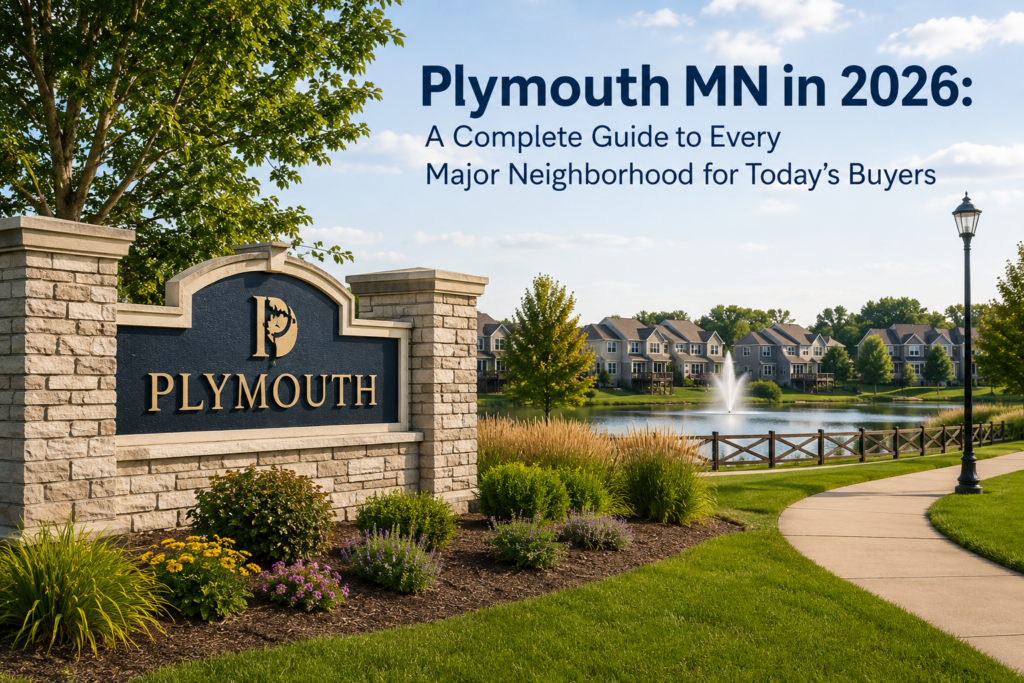
Stone Plymouth, MN entrance sign beside a landscaped pond with townhomes in the background

If you’ve started house hunting in Plymouth, you already know the challenge: this is not a one-size-fits-all suburb. Minnesota’s seventh-largest city stretches across more than 36 square miles northwest of Minneapolis, and it’s genuinely a patchwork of distinct Plymouth MN neighborhoods — from wooded lakeside enclaves near Medicine Lake to newer family developments closer to Maple Grove and Corcoran. Some areas feed into Wayzata schools, others into Robbinsdale, Hopkins, or Osseo. Some are walkable to Parkers Lake Park; others are built around cul-de-sacs and three-car garages. Knowing which pocket of Plymouth fits your life — and your budget — makes all the difference. Here’s a neighborhood-by-neighborhood breakdown to help you buy smart in 2026.

Why Plymouth MN Neighborhoods Vary So Much

Plymouth is home to roughly 80,000 residents, making it one of the largest suburbs in the Twin Cities metro. That size is exactly why it can’t be described as a single market. The city was built out over decades, so you’ll find 1960s and ’70s ramblers and split-levels in older sections mixed with sprawling new construction in areas that were farmland just twenty years ago. Four different school districts touch Plymouth — Wayzata, Robbinsdale, Hopkins, and Osseo — which means the “best” neighborhood really depends on your school priorities, commute, and price point, not just the city limits on a map.

Across Plymouth MN neighborhoods, the citywide median sale price sits around $505,000 as of spring 2026, according to Redfin’s Plymouth market data — but that number hides a lot. Depending on the neighborhood, you’ll find everything from condos and townhomes in the $200,000s to executive homes well north of $1 million. Let’s walk through the major pockets.

East Plymouth: Medicine Lake & Shelard Park

The eastern edge of Plymouth, closest to Minneapolis and Golden Valley, is built around Medicine Lake and the well-established Shelard Park and Hidden Valley areas. This part of town tends to have older housing stock — think mature trees, smaller lots, and more modest square footage than you’ll find further west — which makes it one of the more accessible entry points into Plymouth for first-time buyers. It’s also the most connected part of the city for commuters, with quick access to Highway 55 and I-394 into downtown Minneapolis.

Medicine Lake itself is a genuine amenity here — swimming beaches, a regional trail, and boat access — and French Regional Park sits right along its shore with year-round programming. The City of Plymouth’s planning maps are a handy free resource if you want to see exact neighborhood and zoning boundaries before you start touring. If proximity to the city and a lower entry price matter more to you than a brand-new kitchen, this corner of Plymouth deserves a look.

Central Plymouth: Parkers Lake & Northwood West

The middle of the city, anchored by Parkers Lake Park, is where a lot of Plymouth’s family-driven demand concentrates. Neighborhoods like Northwood West offer a mix of well-kept single-family homes and townhomes, and the whole area benefits from the Northwest Greenway trail system that laces through central and western Plymouth, connecting parks, schools, and neighborhoods for walkers and bikers.

Don’t expect a shopping district at the actual corner of County Road 6 and Vicksburg Lane, though — that intersection is limited to a Domino’s Pizza and Vicksburg Liquor, not a retail cluster. For groceries, restaurants, and bigger-box shopping, residents in this part of Plymouth typically drive a few minutes to retail corridors elsewhere in the city. Central Plymouth spans multiple school boundaries, so if district assignment is a dealbreaker for your family, confirm the specific address before you fall in love with a listing.

West Plymouth: The Luxury Corridor Near Wayzata

The stretch of Plymouth closest to Wayzata carries the city’s highest price points, and it’s where you’ll hear names like Hollydale, Hampton Hills, and Plymouth Preserve come up often. These neighborhoods sit inside the Wayzata School District, which is consistently one of the draws for buyers willing to pay a premium. In this stretch, Redfin has tracked median sale prices well above the citywide figure — in the $600,000s in early 2026 for the Plymouth-Wayzata submarket — reflecting larger lots, executive-style homes, and closer proximity to Lake Minnetonka’s western communities.

Hampton Hills, for example, sits near Parkers Lake Park with wooded, walkable streets, while Plymouth Preserve is known for newer executive construction near the Northwest Greenway. If you’re comparing this part of Plymouth against nearby options, our Wayzata community guide and Minnetonka neighborhood breakdown are worth a look side by side.

North & Northwest Plymouth: New Construction Territory

The northern and northwestern edges of Plymouth — bordering Maple Grove, Corcoran, and Medina — are where most of the city’s newer development has happened over the last decade. Buyers here are typically looking for new-build or near-new single-family homes, larger floor plans, and modern amenities, often at a lower price per square foot than the equivalent home closer to Wayzata. This part of the city also tends to overlap with the Osseo school district rather than Wayzata, so it’s worth double-checking boundaries if a specific school is part of your decision.

This is generally the part of Plymouth where you’ll get the most new-construction options if that’s a priority, though it also means fewer mature trees and established landscaping compared to the city’s older neighborhoods.

So Which Plymouth Neighborhood Is Right for You?

Comparing Plymouth MN neighborhoods side by side, there’s no single “best” answer — it genuinely depends on what you’re optimizing for. Want the shortest commute into Minneapolis and a lower entry price? Look east, near Medicine Lake. Want walkability to parks and trails? Central Plymouth around Parkers Lake is hard to beat. Chasing the Wayzata School District and willing to pay for it? The western corridor near Hollydale and Hampton Hills is where to focus. Prioritizing new construction and more square footage per dollar? Start north.

Because Plymouth spans four school districts and such a wide range of price points, it’s easy to fall in love with a house and only later discover it’s in the “wrong” pocket for your commute or your kids’ school. If financing is part of your planning, the Minnesota Housing Finance Agency is worth a look for first-time buyer programs that can apply anywhere in Plymouth. But the neighborhood-level nuance is exactly the kind of thing a Plymouth-focused agent should walk you through before you write an offer, not after.

Not sure which of Plymouth’s neighborhoods actually fits your budget and priorities? MinnMatch connects you with a vetted local agent who knows these neighborhoods block by block — free for buyers, no algorithm involved. See how the matching process works and get paired with the right agent for your search.

Plymouth MN Summer 2026: The Neighborhoods Where Buyers Are Competing Hardest

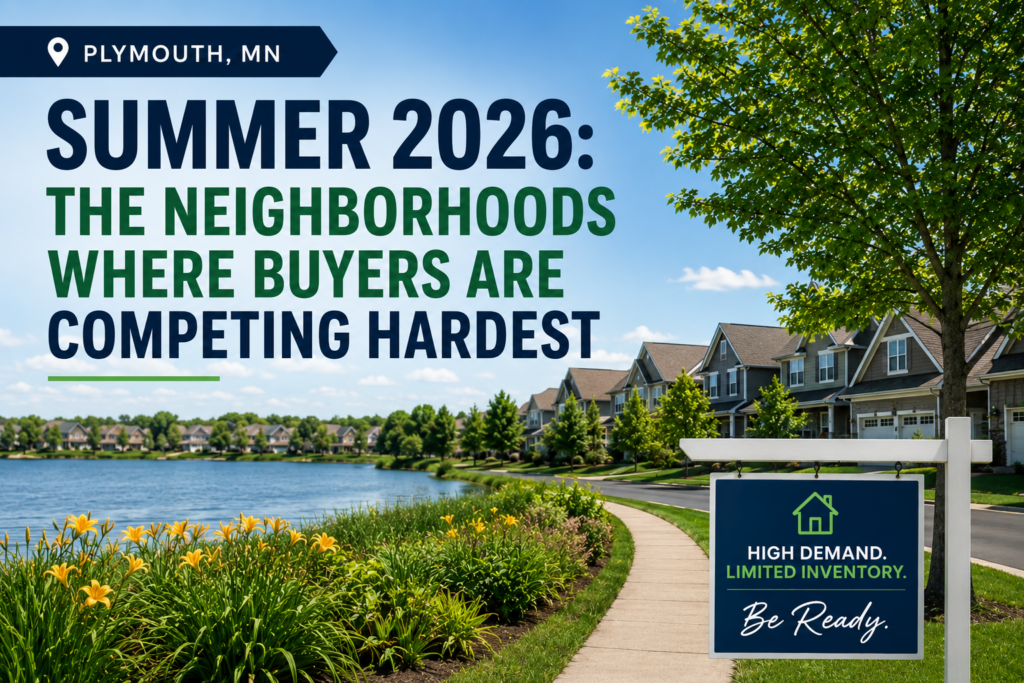
Plymouth MN lakeside neighborhood in summer 2026 with homes, walking path, and real estate sign reading High Demand Limited Inventory

If you’ve been searching for a home in Plymouth this summer, you already know: the right listing at the right price doesn’t wait around. Plymouth is one of the Twin Cities’ most consistently sought-after suburbs — ranked among the best places to live in Minnesota year after year — and the summer 2026 market is showing exactly why. While the city overall is operating close to balanced conditions, certain Plymouth neighborhoods are drawing multiple offers, fast closes, and buyers who came prepared. Whether you’re just starting your search or have already lost a home to another offer, understanding where competition is highest in Plymouth right now can change how you approach your next move.

Why Plymouth Is Still a Top Target for Twin Cities Buyers

Plymouth’s appeal has never been one thing — it’s everything stacking together. The city sits in the western metro with easy freeway access to Minneapolis via I-394 and I-494, a trail system stretching over 90 miles, Medicine Lake, and dozens of well-maintained parks. But the single biggest driver of buyer demand, especially among families relocating from out of state, is the school district.

The majority of Plymouth falls within Wayzata Public Schools (ISD 284), which has been ranked the #1 school district in Minnesota for 2024, 2025, and 2026 by Niche. That reputation doesn’t just matter to families with kids in school — it matters to every buyer thinking about resale value down the road. Homes within ISD 284 boundaries consistently carry a valuation premium, and that premium is one reason why certain Plymouth neighborhoods see faster-moving, more competitive conditions than others.

City-wide, Plymouth’s median home sale price sits around $478,000–$500,000 heading into summer 2026, with the Plymouth-Wayzata corridor — where Wayzata school district properties are concentrated — tracking closer to $641,000 at the median. Homes are generally spending between 32 and 56 days on market across the city, though well-priced properties in the neighborhoods below are moving considerably faster.

The Plymouth Neighborhoods Where Competition Is Sharpest

Not every corner of Plymouth is equally competitive — and knowing the difference can save you weeks of frustration. Here are the areas drawing the most buyer interest this summer:

Hollydale

Hollydale is Plymouth’s newest luxury neighborhood — and one of the most talked-about communities in the western metro right now. Built on the former Hollydale Golf Course, it features newer construction homes with open floor plans, high-end finishes, and a setting of mature trees and wetlands that gives it an almost resort-like feel. It’s located just five minutes from Wayzata High School, sits within ISD 284, and includes community amenities like a pool, clubhouse, pickleball court, and playground. Custom homes here from builders like Gonyea, Swanson, and Hanson regularly list from the $900s into the $3M+ range, and move quickly at those price points — a signal of how much demand exists in this pocket. If you’re shopping in Hollydale, being pre-approved and ready to move is non-negotiable.

Plymouth-Wayzata Corridor (West Plymouth)

The stretch of western Plymouth closest to Wayzata — sometimes called the Plymouth-Wayzata neighborhood — is where you’ll find some of the city’s most established, high-value residential streets. Larger lots, custom-built homes, and consistent proximity to both Wayzata’s lakefront amenities and Plymouth’s trail networks make this area extremely attractive. With median sale prices in this corridor running around $641,000 and homes spending about 32–56 days on market, well-priced homes here are not sitting. Buyers competing in this area are often move-up buyers with significant equity or relocating professionals with strong budgets — which means your offer needs to be clean and credible.

The Medicine Lake Area

Homes near Medicine Lake offer something relatively rare in Plymouth: lakefront or lake-adjacent living without Lake Minnetonka price tags. Properties along the lake and within a few blocks of the shoreline — especially Craftsman-style homes on larger, tree-lined lots — draw buyers looking for a lifestyle upgrade alongside their real estate purchase. Inventory near the lake is limited by geography, which creates natural scarcity. When a well-maintained lake-adjacent home hits the market here, it typically doesn’t stay listed long. Buyers interested in this area should monitor new listings closely and be ready to act within days, not weeks.

Cimarron Ponds and Southwest Plymouth

Southwest Plymouth — including neighborhoods like Cimarron Ponds — tends to be one of the more affordable entry points into the city, with single-family homes typically pricing in the mid-$400s to low-$500s. That relative affordability, combined with good access to Bass Lake Road, Rockford Road Plaza, and French Regional Park, makes these neighborhoods popular with first-time buyers and families stretching their budgets to get into Plymouth’s school district. Competition in this price range can be fierce precisely because there are fewer options: when a move-in-ready home hits the $430,000–$490,000 range, multiple buyers often show up. These aren’t luxury listings, but don’t underestimate them.

High-End Townhome Communities (Bassett Creek Crossing, Wyndemere Farms, The Courts of Nantree)

Plymouth’s premium townhome market — particularly communities like Bassett Creek Crossing, Wyndemere Farms, and The Courts of Nantree near the former Hollydale Golf Course — is attracting a specific kind of buyer: downsizers leaving larger single-family homes who want low-maintenance living without leaving Plymouth, and relocating professionals who want quality square footage without yard and exterior upkeep. These communities range from roughly $400,000 to $750,000 and typically offer around 3,000–3,500 square feet of living space. When a well-updated unit opens up, it often draws multiple interested parties quickly.

What’s Driving Competition in Plymouth’s Hottest Pockets?

Across all these neighborhoods, the competition comes down to a few consistent pressures:

  • Low inventory in the most desirable pockets. Even as overall Plymouth inventory has grown modestly in 2026, the ISD 284-zoned, well-finished homes buyers most want remain scarce. City-wide supply sits under 1 month — meaning the best listings get absorbed fast.
  • The Wayzata schools pull. For families relocating to Minnesota, the “where to live” question is often answered by one question: “Can I get into ISD 284?” That funnels significant demand into a defined geographic zone — raising competition within it.
  • Rate-sensitive buyers off the sidelines. As mortgage rates have shown modest improvement heading into summer 2026, buyers who had been waiting are re-entering the market — adding more demand to the same limited supply of well-priced homes.
  • Summer timing. Summer is always Plymouth’s highest-activity season, driven by families wanting to be settled before the school year. June and July consistently see more offers, faster decisions, and less room to negotiate.

How to Compete Successfully in Plymouth This Summer

Knowing which neighborhoods are competitive is only useful if you’re prepared to act when the right home appears. A few things that separate successful buyers in Plymouth’s tighter pockets:

  • Pre-approval is the starting point, not the finish line. In competitive pockets, a lender call within the past 30 days and a fully underwritten pre-approval puts you far ahead of a buyer with just a letter on file.
  • Know your walk-away number before you see the house. In a multiple-offer situation, emotion sets the price — knowing your ceiling in advance keeps you in control.
  • Work with an agent who has Plymouth-specific experience. Neighborhood nuances — like which streets carry ISD 284 zoning, where new construction may be coming, or which listings are likely to generate multiple offers — are things an experienced local agent knows before you do.
  • Be strategic about contingencies. This doesn’t mean waiving everything — it means structuring your offer thoughtfully so it stands out without unnecessary risk.

For more on how the broader Plymouth market compares to other West Metro suburbs, Redfin’s Plymouth market data is updated regularly. The Minneapolis Area Realtors market reports are also a reliable benchmark for tracking citywide and metro-level trends.

Find a Plymouth Agent Who Knows These Neighborhoods Cold

Competing in Plymouth’s summer market isn’t just about speed — it’s about working with someone who already knows which neighborhoods are moving fast, which listings are worth pursuing, and how to write an offer that holds up under pressure. At MinnMatch, we connect buyers with experienced, locally grounded Plymouth agents who know the city street by street — not just zip code by zip code.

Tell us what you’re looking for and we’ll match you with a Plymouth agent who can help you compete — and win — this summer.