
What Happens After Your Offer Is Accepted in Minnesota? A Step-by-Step 2026 Guide

Purchase agreement marked offer accepted with an earnest money envelope, home inspection checklist, house keys, and calendar

You did it — the seller said yes. That rush of relief is real, but here’s the part nobody tells you at the open house: what happens after your offer is accepted is where most of the actual work of buying a home gets done. In Minnesota, the stretch between “accepted” and “here are your keys” usually runs 30 to 45 days, and it’s packed with deadlines that can make or break the deal. This guide walks you through each step in order, with the Twin Cities-specific details that generic checklists skip.

A Quick Timeline: What Happens After Your Offer Is Accepted

Every purchase agreement sets its own dates, so treat this as a typical roadmap rather than a rulebook. Your agent and lender will give you the exact deadlines for your deal.

Typical Minnesota Timeline (30–45 Days)

Days 1–2: Deliver earnest money and finalize your mortgage application

Days 1–10: Home inspection, radon test, and repair negotiations

Weeks 2–4: Appraisal, loan underwriting, title work, and homeowners insurance

3+ days before closing: Review your Closing Disclosure

Closing week: Final walk-through, wire funds, sign, and get keys

After closing: File for homestead, change locks, set up utilities

Week One: Earnest Money, Inspections, and the Contingency Clock

Earnest money comes first. Most Minnesota purchase agreements require your earnest money deposit — commonly 1% to 2% of the price in the Twin Cities — within a couple of business days of final acceptance. It’s held in a trust account by the listing brokerage or title company and gets credited toward your down payment and closing costs at the end. Miss that deadline and you hand the seller an easy reason to walk.

Lock in your loan. If you were preapproved, your lender now needs the signed purchase agreement to open the full application. Expect a Loan Estimate within three business days, and talk with your lender about whether to lock your rate now or float it.

Schedule the inspection immediately. Inspection contingency windows in Minnesota often run 7 to 10 days, and good inspectors book up fast — especially in spring and early fall. Add a radon test while you’re at it; Minnesota has some of the highest radon levels in the country, and a 48-hour test can usually run alongside the inspection. If the home is in Minneapolis, Bloomington, Richfield, or another city with a point-of-sale requirement, ask your agent for the city inspection report, too. Once results are in, you’ll decide whether to accept the home as-is, ask for repairs or a credit, or cancel within your contingency period.

Weeks Two to Four: Appraisal, Underwriting, and Minnesota Title Work

The appraisal. Your lender orders an appraisal to confirm the home is worth what you’re paying. If it comes in low, you typically have three options: renegotiate the price, cover the gap with extra cash, or use your financing contingency to exit. In competitive pockets like Edina and South Minneapolis, it’s worth knowing ahead of time how much of a gap you could handle.

Underwriting — and why you should stay boring. This is when the lender verifies everything: income, assets, debts, and credit. The golden rule after your offer is accepted? Don’t change jobs, open new credit cards, finance a new truck, or buy a living room set on a store card. Even a small change to your debt-to-income ratio can delay or derail your approval. Answer your lender’s document requests the same day if you can.

Title work, Minnesota-style. The title company researches the property’s ownership history to make sure the seller can legally transfer it free of liens or claims. Minnesota is unusual here: properties are recorded either under the traditional abstract system or the Torrens system, and Hennepin and Ramsey counties have a large share of Torrens property. Your title company handles the difference, but it can affect timing and paperwork. You’ll also decide on an owner’s title insurance policy during this stage.

Homeowners insurance. Your lender will require proof of coverage before closing. With hail and wind claims pushing Minnesota premiums higher, shop for quotes early in this window — not the week before closing.

Closing Week in Minnesota: Walk-Through, Wires, and Signing

Review your Closing Disclosure. Federal rules require your lender to deliver your Closing Disclosure at least three business days before closing. Compare it line by line with your Loan Estimate. Expect Minnesota-specific items like the mortgage registration tax, which runs about 0.24% of your loan amount and is typically paid by the buyer.

Protect your wire. Wire fraud targeting homebuyers is real. Before sending your down payment, call your title company at a phone number you’ve verified independently — never one from an email — to confirm the wiring instructions.

Do the final walk-through. Usually within 24 hours of closing, you’ll confirm agreed-upon repairs were made, included items are still there, and nothing new has broken. For a fall or winter closing, run the furnace, check the water heater, and look at the ceilings for signs of leaks. It’s your last chance to raise an issue before you sign.

Sign and get your keys. Twin Cities closings usually happen at the title company’s office and take about an hour. Bring a government-issued photo ID. In most Minnesota transactions, possession transfers at closing, so you can often head straight to your new place.

After Closing: The Minnesota To-Do List Most Buyers Miss

The paperwork doesn’t quite end at the closing table. A few Minnesota-specific tasks can save you real money and headaches:

  • File for homestead. If the home is your primary residence, apply for homestead classification with your county. It can lower your property taxes, and the deadline is December 15 for the credit to start next year. Hennepin County’s homestead page explains the process; other counties work similarly. Closing this fall? Put it on your calendar now.
  • Change the locks and garage codes. You don’t know how many keys are floating around.
  • Transfer utilities. Set up electric and gas service (Xcel Energy or CenterPoint in much of the metro), plus water, trash, and internet.
  • Check your alarms. Minnesota law requires carbon monoxide alarms within 10 feet of sleeping rooms, so test every smoke and CO alarm on move-in day.
  • Keep your closing packet. Store your settlement statement and deed somewhere safe — you’ll want them at tax time and when you sell someday.

First-time buyer using down payment assistance? Minnesota Housing loan programs may have their own requirements to keep on track, so check in with your lender. You can find more step-by-step help on our buyers page and in our resource library.

Frequently Asked Questions

How long does it take to close after your offer is accepted in Minnesota?

Most financed purchases in the Twin Cities close in about 30 to 45 days. Cash deals can close in as little as one to two weeks, depending on how quickly title work and any inspections wrap up.

Can a seller back out after accepting an offer in Minnesota?

Once a purchase agreement is fully signed, it’s a binding contract. A seller generally can only cancel if a contingency in the agreement allows it — for example, if the deal depends on the seller finding their next home. Talk to your agent or a real estate attorney about your specific agreement.

Do I get my earnest money back if the deal falls through?

If you cancel within a valid contingency — like inspection or financing — and follow the agreement’s notice requirements, your earnest money is typically refunded. If you walk away without a contractual reason, you may forfeit it.

The Right Agent Makes the Next 30 Days Easier

Getting to “accepted” is a milestone, but the weeks that follow are where a great agent earns their keep — tracking every deadline, coordinating inspectors and lenders, and catching problems before they cost you. If you’re starting your search and want someone who knows Minnesota’s process inside and out, MinnMatch can help. We personally match you with a vetted local agent who fits your neighborhood, price range, and style — at no cost to you. Find your Twin Cities agent today.
Plymouth vs. Minnetonka: Which Suburb Delivers More for Your Money in 2026?

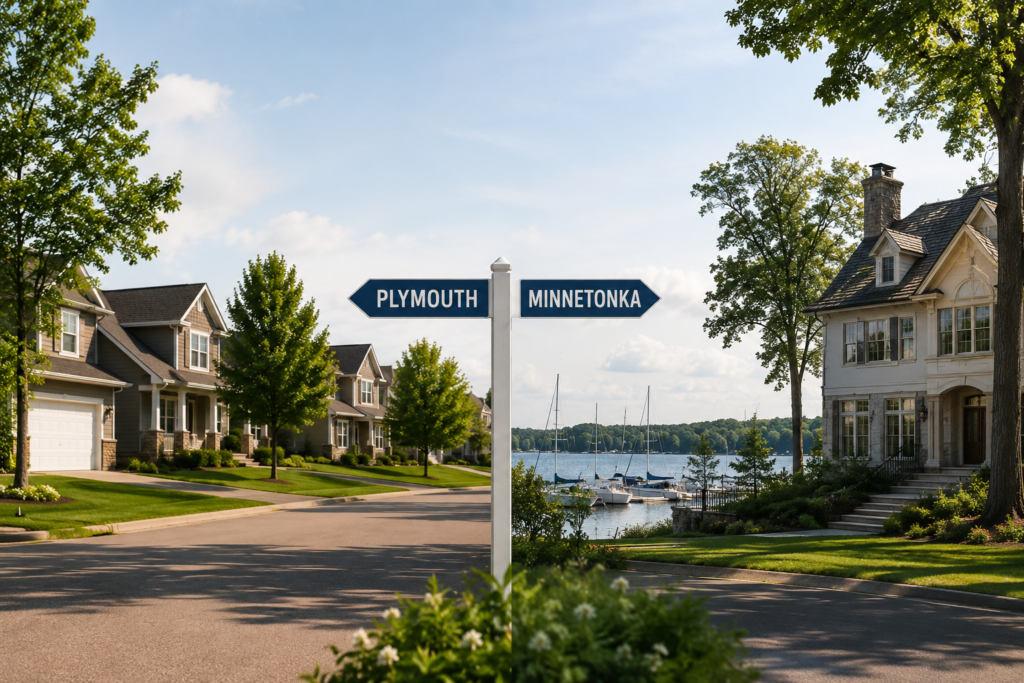
Street sign pointing toward Plymouth suburban homes and Minnetonka lakefront living in the Twin Cities

If you’re searching for a home in the western Twin Cities suburbs, Plymouth and Minnetonka are probably both on your list — and for good reason. Both sit within a short drive of downtown Minneapolis, both offer excellent schools, and both are packed with parks, lakes, and the kind of quiet neighborhood feel that draws families out of the city. But they’re not the same place, and in 2026, the differences between them matter. Price points, lifestyle, lot sizes, commute dynamics, and school district lines all play a role in the Plymouth vs. Minnetonka comparison. Here’s what you need to know before you decide.

Home Prices: What Does Your Budget Actually Buy in Each Suburb?

This is where the Plymouth vs. Minnetonka conversation gets real. According to data from Minneapolis Area Realtors®, Minnetonka’s median sales price in April 2026 was approximately $507,500 — up about 1.3% year-over-year. Plymouth, by comparison, has a median closer to $485,000–$500,000 in recent months, depending on the data source and time period. That gap may sound modest, but in practice, it plays out in meaningful ways across different price bands.

In Plymouth, buyers in the $400,000–$500,000 range can typically access a solid four-bedroom single-family home in an established neighborhood, often with a larger lot. Minnetonka at the same price point trends toward townhomes, smaller ramblers, or older homes that need updating — especially in neighborhoods closest to the lake. Buyers willing to go north of $600,000 in either city will find more overlap, but Minnetonka still commands a premium in its most coveted pockets.

Market pace differs as well. Minnetonka is running hot — Redfin data shows many homes going pending in around 17 days, and roughly a third of homes selling above asking price in recent months. Plymouth is somewhat more measured, with homes averaging closer to 30–55 days on market depending on price point and neighborhood, and sale-to-list ratios just under 100%. That means Plymouth buyers may have slightly more room to negotiate, while Minnetonka buyers should be ready to move quickly and compete.

Schools: Two of Minnesota’s Best Districts — but Different Ones

If schools are driving your suburb search, this section matters enormously — because Plymouth and Minnetonka are served by different districts, and both rank at the very top of Minnesota’s rankings.

Most of Plymouth falls within the Wayzata Public School District (ISD 284), which Niche named the #1 school district in Minnesota for 2026 — the third consecutive year it has earned that ranking. Wayzata High School, which is actually located in Plymouth, consistently ranks among the state’s top public high schools. The district earned A+ ratings across nearly every Niche category and places in the top 1% of all public school districts statewide based on test scores.

Minnetonka is served by the Minnetonka Public School District (ISD 276), which Niche ranked #2 in Minnesota for 2026. Minnetonka Senior High School ranks #3 among all public high schools in the state. The district serves more than 10,900 students and is the most sought-after for open enrollment in Minnesota — a meaningful signal of its reputation. With programs including International Baccalaureate, AP courses, K-12 language immersion, and over 100 clubs and activities, it’s an academically rich environment.

Bottom line: you’re splitting hairs here. Both districts are genuinely elite. Families may find the tie-breaker comes down to specific program offerings, proximity, or which high school campus feels right for their kids.

One important note: a portion of Plymouth falls within the Robbinsdale School District (ISD 281) rather than Wayzata. Always verify school boundaries by address before making any decisions based on school district.

Location and Commute: Closer to the Lake vs. Closer to the City

Plymouth and Minnetonka sit about 9 miles apart — and both are positioned for a reasonable commute to downtown Minneapolis. Plymouth, located approximately 12 miles northwest of downtown, connects quickly via I-394 and Highway 55, with a typical non-rush commute of around 20 minutes. Minnetonka sits about 12–15 miles west of downtown, also served by I-394, with similar commute times to much of the city — though western Minnetonka neighborhoods closer to Lake Minnetonka will add a few more minutes.

Plymouth also benefits from its own transit system — Plymouth Metrolink — which runs direct bus routes to downtown Minneapolis and the University of Minnesota on weekdays. It’s a useful option for households that prefer to leave one car behind on their commute days.

Where Minnetonka pulls ahead is proximity to Lake Minnetonka itself. For buyers who want easy access to the lake — whether that’s a boat slip, shoreline walks, or dining on the water at Excelsior or Wayzata — southern Minnetonka neighborhoods put you closest to all of it. Plymouth has its own exceptional park system and Medicine Lake to enjoy, but if the lake lifestyle is central to your vision, Minnetonka’s geography serves that better.

Lifestyle and Character: Two Suburbs, Two Distinct Feels

Plymouth is one of the Twin Cities’ most populous suburbs — home to more than 80,000 residents — and that scale comes with real advantages. The city has invested heavily in its park and trail system, offers Medicine Lake for swimming and non-motorized boating, and hosts a well-rounded retail and restaurant scene. It tends to attract families who want a well-organized, community-oriented suburb with newer housing stock, strong civic infrastructure, and a feeling of continued growth.

Minnetonka has a different rhythm. It’s a more established suburb, with a diverse mix of housing — from modest mid-century homes to sprawling custom builds — spread across a geography shaped by creeks, wetlands, and the rolling terrain of the Lake Minnetonka watershed. Neighborhoods like Ridgedale, Glen Lake, and Minnetonka Mills each have their own character. Minnetonka also sits adjacent to Ridgedale Center and Ridgedale-area dining, making it feel connected and convenient despite its more tucked-in residential feel.

Both suburbs score well for safety, green space, and quality of life. The deciding factor usually comes down to personal preference: Plymouth buyers often value scale, newer construction, and a more expansive park system. Minnetonka buyers tend to be drawn by neighborhood character, lake proximity, and the feel of a suburb that’s already grown into itself.

Which Suburb Delivers More for Your Money in 2026?

Strictly on a price-per-square-foot and value basis, Plymouth offers a slight edge — particularly for buyers in the $400,000–$550,000 range who prioritize square footage, newer builds, and the #1-ranked school district in Minnesota. You’ll generally find more home for your dollar, a somewhat less competitive market, and newer neighborhoods that offer consistent quality across a wide range of price points.

Minnetonka earns its premium for buyers who want lake-area lifestyle, neighborhood character, and proximity to the communities along Lake Minnetonka. The Minnetonka school district is the second-best in Minnesota and among the strongest in the country. And if you’re drawn to a suburb that feels more layered and established, Minnetonka has a lot to offer.

For most families making a purely financial decision, Plymouth is likely the stronger value play in 2026. For buyers where lifestyle and lake access weigh heavily, Minnetonka may be worth the higher entry price. In either case, knowing which neighborhoods within each city match your budget and priorities makes all the difference — and that’s exactly where working with a local agent pays off.

Not Sure Which Suburb Is Right for You?

MinnMatch connects Twin Cities buyers with local agents who know Plymouth and Minnetonka inside and out — the right neighborhoods, the right price points, and the right fit for your family. It’s free, it’s personal, and it’s built for Minnesota.

Find Your Agent — It’s Free