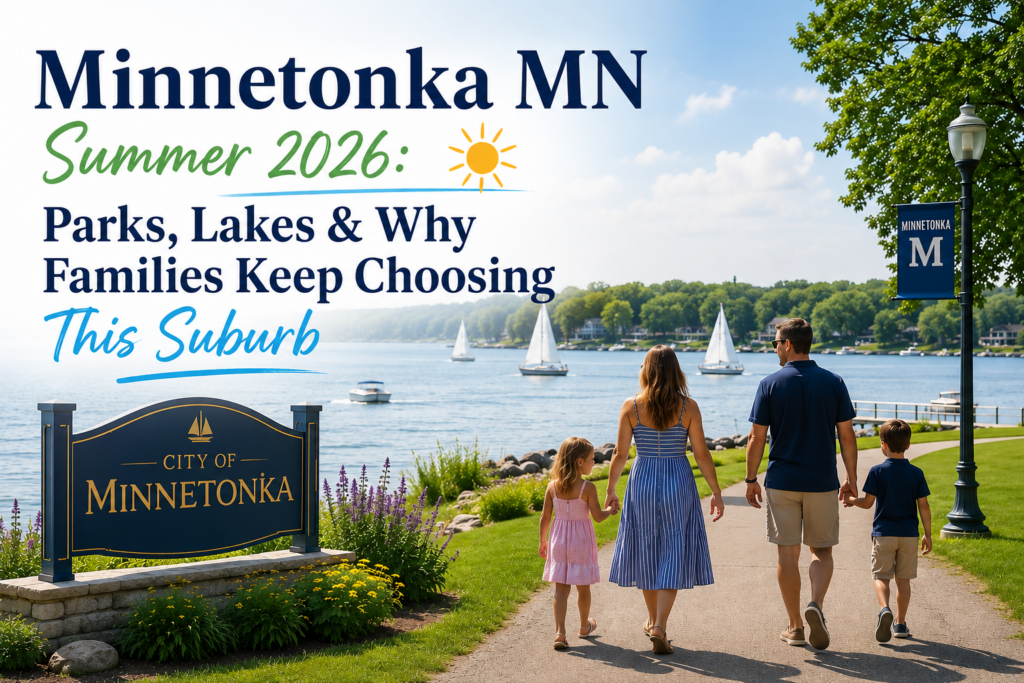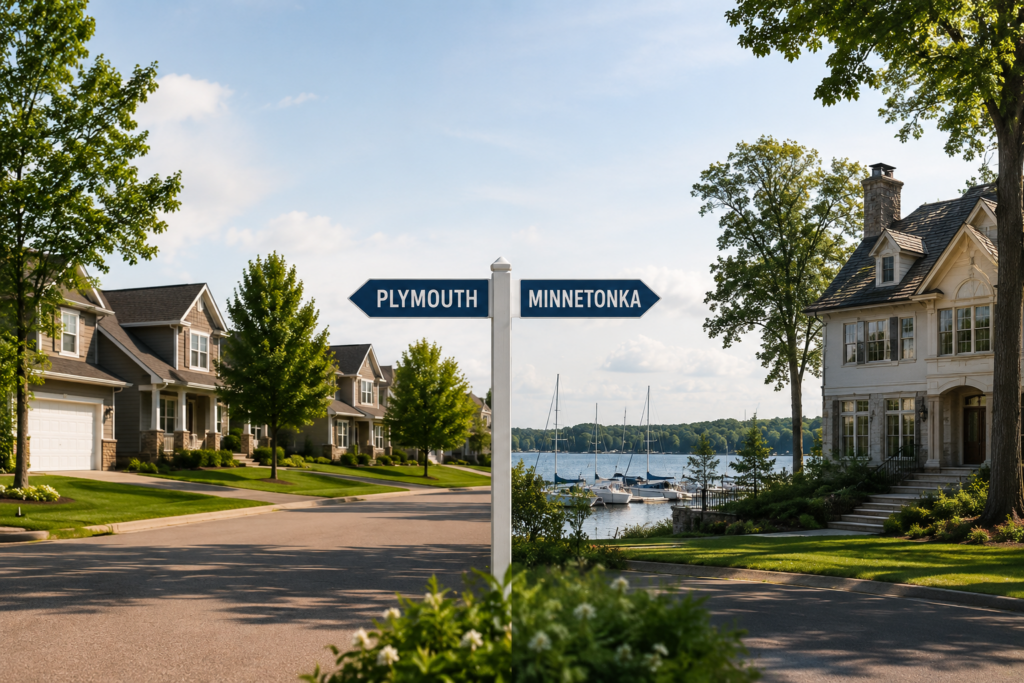
If you’re searching for a home in the western Twin Cities suburbs, Plymouth and Minnetonka are probably both on your list — and for good reason. Both sit within a short drive of downtown Minneapolis, both offer excellent schools, and both are packed with parks, lakes, and the kind of quiet neighborhood feel that draws families out of the city. But they’re not the same place, and in 2026, the differences between them matter. Price points, lifestyle, lot sizes, commute dynamics, and school district lines all play a role in the Plymouth vs. Minnetonka comparison. Here’s what you need to know before you decide.
Home Prices: What Does Your Budget Actually Buy in Each Suburb?
This is where the Plymouth vs. Minnetonka conversation gets real. According to data from Minneapolis Area Realtors®, Minnetonka’s median sales price in April 2026 was approximately $507,500 — up about 1.3% year-over-year. Plymouth, by comparison, has a median closer to $485,000–$500,000 in recent months, depending on the data source and time period. That gap may sound modest, but in practice, it plays out in meaningful ways across different price bands.
In Plymouth, buyers in the $400,000–$500,000 range can typically access a solid four-bedroom single-family home in an established neighborhood, often with a larger lot. Minnetonka at the same price point trends toward townhomes, smaller ramblers, or older homes that need updating — especially in neighborhoods closest to the lake. Buyers willing to go north of $600,000 in either city will find more overlap, but Minnetonka still commands a premium in its most coveted pockets.
Market pace differs as well. Minnetonka is running hot — Redfin data shows many homes going pending in around 17 days, and roughly a third of homes selling above asking price in recent months. Plymouth is somewhat more measured, with homes averaging closer to 30–55 days on market depending on price point and neighborhood, and sale-to-list ratios just under 100%. That means Plymouth buyers may have slightly more room to negotiate, while Minnetonka buyers should be ready to move quickly and compete.
Schools: Two of Minnesota’s Best Districts — but Different Ones
If schools are driving your suburb search, this section matters enormously — because Plymouth and Minnetonka are served by different districts, and both rank at the very top of Minnesota’s rankings.
Most of Plymouth falls within the Wayzata Public School District (ISD 284), which Niche named the #1 school district in Minnesota for 2026 — the third consecutive year it has earned that ranking. Wayzata High School, which is actually located in Plymouth, consistently ranks among the state’s top public high schools. The district earned A+ ratings across nearly every Niche category and places in the top 1% of all public school districts statewide based on test scores.
Minnetonka is served by the Minnetonka Public School District (ISD 276), which Niche ranked #2 in Minnesota for 2026. Minnetonka Senior High School ranks #3 among all public high schools in the state. The district serves more than 10,900 students and is the most sought-after for open enrollment in Minnesota — a meaningful signal of its reputation. With programs including International Baccalaureate, AP courses, K-12 language immersion, and over 100 clubs and activities, it’s an academically rich environment.
Bottom line: you’re splitting hairs here. Both districts are genuinely elite. Families may find the tie-breaker comes down to specific program offerings, proximity, or which high school campus feels right for their kids.
One important note: a portion of Plymouth falls within the Robbinsdale School District (ISD 281) rather than Wayzata. Always verify school boundaries by address before making any decisions based on school district.
Location and Commute: Closer to the Lake vs. Closer to the City
Plymouth and Minnetonka sit about 9 miles apart — and both are positioned for a reasonable commute to downtown Minneapolis. Plymouth, located approximately 12 miles northwest of downtown, connects quickly via I-394 and Highway 55, with a typical non-rush commute of around 20 minutes. Minnetonka sits about 12–15 miles west of downtown, also served by I-394, with similar commute times to much of the city — though western Minnetonka neighborhoods closer to Lake Minnetonka will add a few more minutes.
Plymouth also benefits from its own transit system — Plymouth Metrolink — which runs direct bus routes to downtown Minneapolis and the University of Minnesota on weekdays. It’s a useful option for households that prefer to leave one car behind on their commute days.
Where Minnetonka pulls ahead is proximity to Lake Minnetonka itself. For buyers who want easy access to the lake — whether that’s a boat slip, shoreline walks, or dining on the water at Excelsior or Wayzata — southern Minnetonka neighborhoods put you closest to all of it. Plymouth has its own exceptional park system and Medicine Lake to enjoy, but if the lake lifestyle is central to your vision, Minnetonka’s geography serves that better.
Lifestyle and Character: Two Suburbs, Two Distinct Feels
Plymouth is one of the Twin Cities’ most populous suburbs — home to more than 80,000 residents — and that scale comes with real advantages. The city has invested heavily in its park and trail system, offers Medicine Lake for swimming and non-motorized boating, and hosts a well-rounded retail and restaurant scene. It tends to attract families who want a well-organized, community-oriented suburb with newer housing stock, strong civic infrastructure, and a feeling of continued growth.
Minnetonka has a different rhythm. It’s a more established suburb, with a diverse mix of housing — from modest mid-century homes to sprawling custom builds — spread across a geography shaped by creeks, wetlands, and the rolling terrain of the Lake Minnetonka watershed. Neighborhoods like Ridgedale, Glen Lake, and Minnetonka Mills each have their own character. Minnetonka also sits adjacent to Ridgedale Center and Ridgedale-area dining, making it feel connected and convenient despite its more tucked-in residential feel.
Both suburbs score well for safety, green space, and quality of life. The deciding factor usually comes down to personal preference: Plymouth buyers often value scale, newer construction, and a more expansive park system. Minnetonka buyers tend to be drawn by neighborhood character, lake proximity, and the feel of a suburb that’s already grown into itself.
Which Suburb Delivers More for Your Money in 2026?
Strictly on a price-per-square-foot and value basis, Plymouth offers a slight edge — particularly for buyers in the $400,000–$550,000 range who prioritize square footage, newer builds, and the #1-ranked school district in Minnesota. You’ll generally find more home for your dollar, a somewhat less competitive market, and newer neighborhoods that offer consistent quality across a wide range of price points.
Minnetonka earns its premium for buyers who want lake-area lifestyle, neighborhood character, and proximity to the communities along Lake Minnetonka. The Minnetonka school district is the second-best in Minnesota and among the strongest in the country. And if you’re drawn to a suburb that feels more layered and established, Minnetonka has a lot to offer.
For most families making a purely financial decision, Plymouth is likely the stronger value play in 2026. For buyers where lifestyle and lake access weigh heavily, Minnetonka may be worth the higher entry price. In either case, knowing which neighborhoods within each city match your budget and priorities makes all the difference — and that’s exactly where working with a local agent pays off.
Not Sure Which Suburb Is Right for You?
MinnMatch connects Twin Cities buyers with local agents who know Plymouth and Minnetonka inside and out — the right neighborhoods, the right price points, and the right fit for your family. It’s free, it’s personal, and it’s built for Minnesota.