
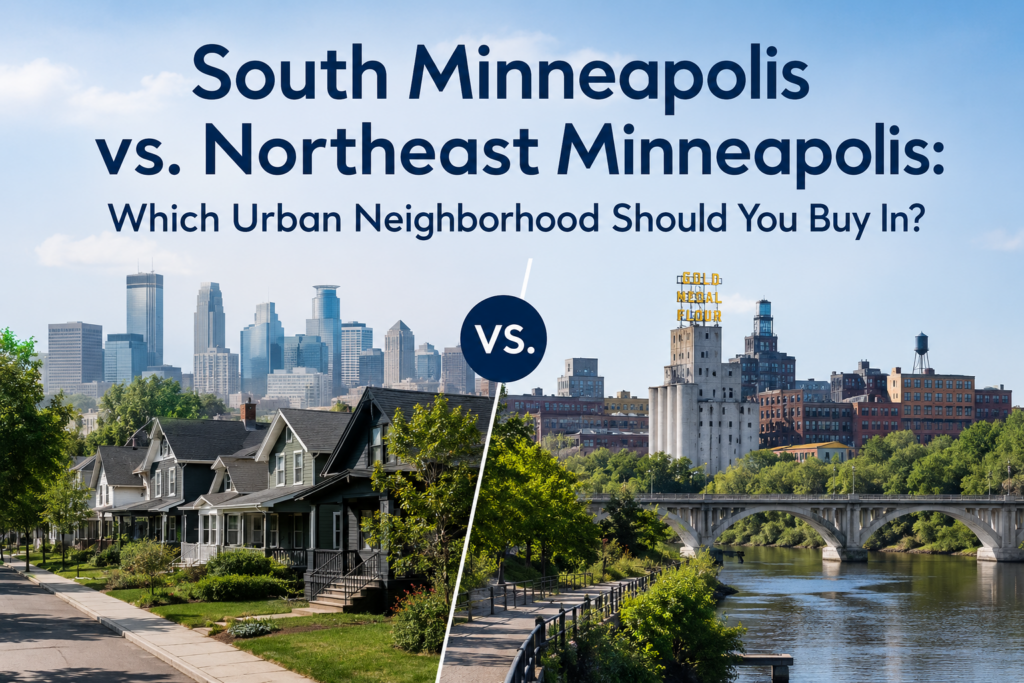
If you’ve decided you want to live inside Minneapolis proper — not out in the suburbs, but in the heart of the city where you can walk to coffee, bike the parkways, and actually know your neighbors — you’ve probably already narrowed your search to two areas: South Minneapolis and Northeast Minneapolis. Both are beloved, both are walkable, and both have passionate residents who will tell you theirs is the better half of the city. The truth is more nuanced than that, and which one is right for you depends less on hype and more on your daily life, your budget, and the kind of energy you want outside your front door.
The Short Version: Two Very Different Personalities
South Minneapolis is the city’s green, lake-laced backbone. It stretches from the Chain of Lakes east through Powderhorn, Nokomis, and Longfellow, and it’s defined by tree-canopied streets, classic bungalows and Cape Cods, and easy access to Lake Nokomis, Minnehaha Falls, and the Mississippi River gorge. Northeast Minneapolis, or “Nordeast” as locals call it, sits across the river from downtown and carries a completely different identity: a former Eastern European immigrant enclave turned arts and brewery district, with a grittier, more industrial edge and some of the most distinctive housing stock in the city.
Neither is “better.” They’re built for different lifestyles, and a lot of buyers who think they want one end up happier in the other once they actually compare them side by side.
What You’ll Pay: Pricing Compared
Pricing across both areas varies a lot by sub-neighborhood, so a single citywide figure doesn’t tell the real story. In South Minneapolis, the lake-adjacent pockets command a premium: Nokomis homes have recently sold in the high $360,000s to $390,000 range, while Longfellow — closer to the river and the light rail — has traded in the low $330,000s to mid $370,000s depending on the month. Powderhorn, the most affordable of South Minneapolis’s core neighborhoods, has recently listed in the $300,000–$320,000 range, making it one of the better entry points into city living south of downtown.
Northeast Minneapolis runs a similar overall range but with a bit more affordability at the median. Recent data puts the typical Northeast home sale around $340,000–$350,000, with homes moving in roughly a month on the market — a touch slower than the most competitive South Minneapolis pockets, but still well within a normal, healthy pace for the Twin Cities. Northeast also has more variation in housing stock condition, since the area mixes century-old worker cottages with recently renovated or new-construction infill, so the price range you’ll actually shop in can swing widely block to block.
Bottom line: if pure affordability is your top priority, Northeast and Powderhorn are both strong entry points into city living. If you want to be a five-minute walk from a lake, South Minneapolis’s Nokomis and Longfellow neighborhoods will cost you more — but you’re paying for the lake.
Daily Life: Lakes and Parkways vs. Arts and Breweries
South Minneapolis is built around its parks system. You’re never far from a lake loop, a bike path, or the Minnehaha Parkway, and the area’s commercial corridors — Lake Street, 38th Street, the Nokomis business district — tend to mix family-friendly restaurants, coffee shops, and small grocers. It’s a neighborhood that rewards a slower pace: morning runs around Lake Nokomis, weekend farmers markets, kids on bikes.
Northeast has a different rhythm entirely. The Northeast Minneapolis Arts District — centered around Central and Hennepin Avenues — has been recognized nationally as one of the best arts districts in the country, and the neighborhood has the highest concentration of breweries anywhere in the city. Add in Eastern European-rooted institutions that have anchored the area for generations, alongside newer Latin American and immigrant-owned businesses along Central Avenue, and you get a neighborhood that feels more layered and more urban-edge than South Minneapolis. If you want a Saturday that involves gallery hopping, a taproom flight, and dinner somewhere you’ve never tried before, Northeast delivers that in a way South Minneapolis generally doesn’t.
Both neighborhoods are highly walkable and well served by Minneapolis Parks, but the texture of that walkability is different: South Minneapolis walking means lakes and tree canopy; Northeast walking means murals, converted warehouses, and a working river.
Housing Stock: What You’re Actually Buying
South Minneapolis is dominated by classic 1900s–1950s housing: bungalows, Cape Cods, and a healthy stock of 1.5- and 2-story single-family homes, often with detached garages and modest yards. It’s consistent and predictable — most buyers know roughly what they’re getting before they walk in.
Northeast is more eclectic. You’ll find small worker cottages from the early 1900s sitting next to renovated duplexes, converted lofts in former industrial buildings, and pockets of new construction infill, especially closer to the river and in areas like Bottineau and Holland. This variety can be a feature or a frustration depending on what you want — buyers looking for character and willing to take on some renovation often gravitate to Northeast, while buyers who want a turnkey, move-in-ready home with fewer surprises often lean South Minneapolis.
Commute and Connectivity
South Minneapolis has the edge for transit, particularly along the Blue Line through Longfellow, which gives quick access to downtown and the airport. Northeast doesn’t have light rail running through its core, but it’s geographically tight to downtown — many Northeast neighborhoods are a five- to ten-minute drive from the city’s office core, often faster than a South Minneapolis commute during peak traffic. If you work downtown and want to minimize windshield time, Northeast’s proximity is genuinely underrated.
So Which One Should You Buy In?
If you want lakes, parkways, consistent housing stock, and a calmer day-to-day pace — and you’re willing to pay a bit more for the neighborhoods closest to the water — South Minneapolis is probably your fit. If you want character, art, breweries, a shorter commute downtown, and a bit more room to find value through renovation, Northeast Minneapolis deserves a serious look. Plenty of buyers end up cross-shopping both, and that’s exactly the kind of decision a local agent who knows the block-by-block differences can help you make with confidence rather than guesswork.
Not Sure Which Minneapolis Neighborhood Fits You?
South Minneapolis and Northeast Minneapolis each have their own micro-markets, and the right one for you depends on details a national site can’t tell you. MinnMatch connects you with a vetted, handpicked Twin Cities agent who knows both areas block by block — for free, with no obligation.