Renting vs. Buying in the Twin Cities in 2026: A No-BS Cost Breakdown

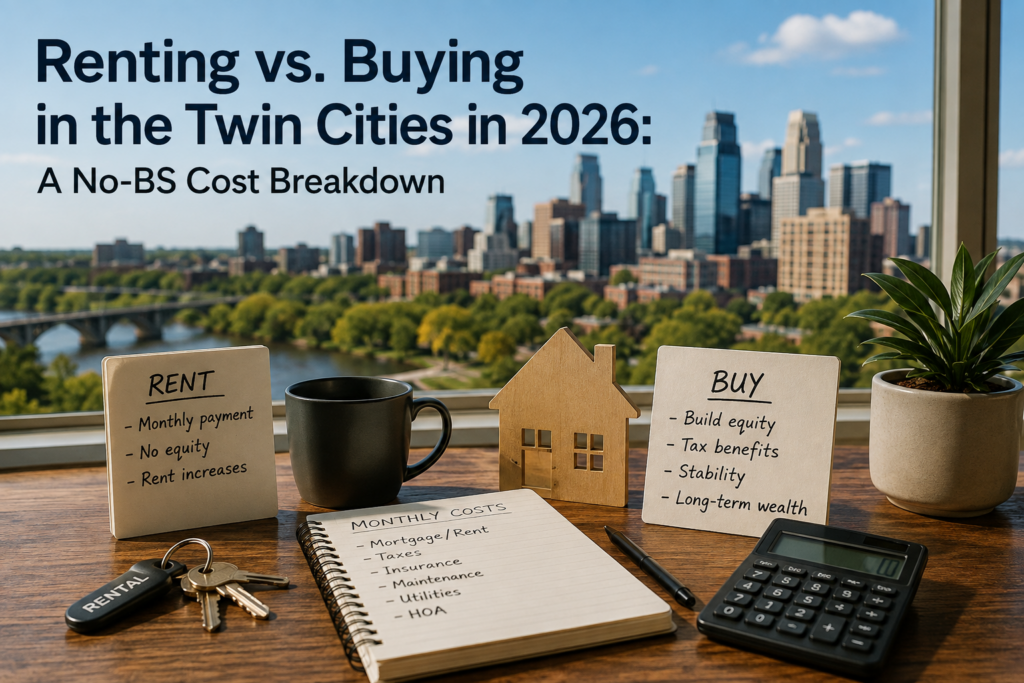
Rent vs. buy comparison notes with Minneapolis skyline, house model, and calculator on desk

Every spring and fall, the same debate fires back up around Twin Cities kitchen tables: is it actually smarter to keep renting, or is it finally time to buy? Most articles on this topic stop at “here’s what a mortgage payment looks like versus rent” and call it a day. That’s not the full picture. The real question isn’t just what you’ll pay each month — it’s how long you’d need to stay in a home before buying actually beats renting on a dollar-for-dollar basis. That’s called the break-even point, and once you know yours, the rent-vs-buy decision gets a lot less confusing.

3–5 Years
Typical break-even point for Twin Cities buyers before ownership costs outpace renting
2–5%
Typical closing costs as a share of purchase price in Minnesota
1–2%
Annual home value typically set aside for maintenance and repairs
6.5–7%
Range for 30-year fixed mortgage rates in the Twin Cities in 2026
Sources: Freddie Mac Primary Mortgage Market Survey, Minneapolis Area REALTORS® (MAAR), Minnesota Housing Finance Agency

The Real Monthly Cost: Renting vs. Buying Side by Side

On paper, a mortgage payment on a median-priced Twin Cities home can look similar to — or even lower than — rent on a comparable property. But that comparison only tells half the story. A rent check is usually the entire cost of housing for the month. A mortgage payment is just the beginning. Once you add property taxes, homeowners insurance, PMI (if your down payment is under 20%), and a realistic maintenance reserve, the true monthly cost of owning is almost always higher than the mortgage payment alone — especially in the first few years.

That doesn’t mean buying is a bad move. It means the comparison has to include the full cost stack, not just the headline mortgage number, before you can honestly say which option wins for your situation.

Hidden Costs Nobody Warns You About

These are the line items that rarely make it into a quick online rent vs. buy calculator, but they matter a lot when you’re figuring out your actual break-even point.

1
Closing Costs on the Way In
Buyers in Minnesota typically pay 2–5% of the purchase price in closing costs — loan origination fees, title insurance, appraisal, and recording fees. On a $375,000 home, that’s roughly $7,500 to $18,750 before you’ve unpacked a single box.

2
Maintenance and Repairs
Plan on setting aside 1–2% of your home’s value every year for upkeep. Minnesota’s freeze-thaw cycles are especially hard on roofs, driveways, and foundations, so this isn’t a line item to skip.

3
Selling Costs on the Way Out
When you eventually sell, expect to pay roughly 6–8% of the sale price in agent commissions, closing costs, and any pre-sale repairs. This is the cost that makes short-term ownership expensive — you’re paying to get in and paying to get out.

4
Opportunity Cost of Your Down Payment
Money tied up in a down payment isn’t earning returns elsewhere. That’s not a reason to avoid buying — but it is a real cost that a simple rent-vs-mortgage comparison leaves out entirely.

Calculating Your Break-Even Point

Here’s the simplified version: add up your buying costs in and out (closing costs plus selling costs), and figure out how many months or years of “savings” versus rent it takes to cover that gap. For most Twin Cities buyers in 2026, that break-even point lands somewhere between three and five years, depending on the neighborhood, loan terms, and how fast local home values are appreciating.

If you’re confident you’ll stay put for five-plus years, buying tends to win comfortably — you have time to build equity and let appreciation absorb the transaction costs. If you might relocate for a job or life change within two to three years, renting is often the more financially sound move, even if the monthly numbers look close. You can check current sale price trends by neighborhood on Redfin’s Minneapolis housing market page to get a sense of appreciation in your target area.

When Renting Actually Wins in 2026

There’s no shame in renting being the smarter move — sometimes it just is. Renting tends to come out ahead when you’re not sure how long you’ll stay in the Twin Cities, when your down payment savings are thin (making PMI or a higher rate eat into your monthly budget), or when you’re in a season of life where flexibility matters more than building equity. It can also be the better call in neighborhoods where rents are unusually low relative to purchase prices — worth checking against current listing data before assuming buying is automatically the “grown-up” choice.

First-time buyers who do want to move forward despite a thinner down payment should also look into Minnesota-specific assistance programs through the Minnesota Housing Finance Agency, which can shift the math in your favor even without a full 20% down payment.

So, Rent or Buy in 2026?

The honest answer is: it depends on your break-even point, not just your monthly budget. Run your own numbers — how long you plan to stay, what a comparable rental actually costs, and what closing and selling costs look like for the neighborhoods you’re considering. According to Minneapolis Area REALTORS®, local market conditions can shift that break-even window by a year or more depending on the suburb, so this isn’t a one-size-fits-all calculation.

If you’re leaning toward buying and want to know what your break-even point would realistically look like in a specific Twin Cities neighborhood, that’s exactly the kind of conversation a local agent can walk you through in five minutes flat. MinnMatch connects you with a vetted local agent — free, no algorithm, no pressure — who can run the real numbers for your situation and help you decide with confidence. If you’re earlier in the process and just want to understand how matching works, our how it works page walks through it in two minutes.

Fixer-Upper vs. Move-In Ready in the Twin Cities in 2026: Which Is the Better Investment?

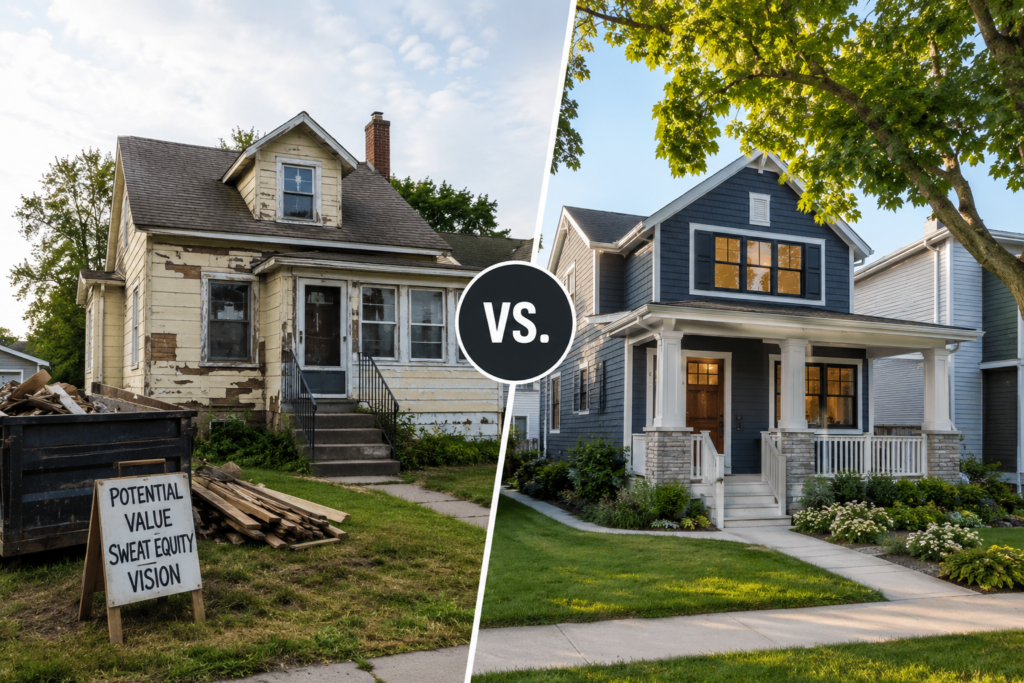
Fixer-upper vs. move-in ready home comparison in the Twin Cities

If you’re house hunting in the Twin Cities this year, you’ve probably stood in a dated kitchen at some point and wondered: is this a diamond in the rough, or a money pit with new carpet? The fixer-upper vs. move-in ready question is one of the most common forks in the road for Minnesota buyers in 2026, and with mortgage rates still hovering in the mid-6% range and metro inventory finally loosening up, the answer isn’t as obvious as it used to be. Whether the better investment is the home that needs work or the one that’s already done depends on your budget, your timeline, and how much Minnesota winter you’re willing to spend under a tarp.

What “Fixer-Upper” and “Move-In Ready” Actually Mean Right Now

In the Twin Cities, a huge share of the housing stock dates back to the 1950s through the 1980s, which means “fixer-upper” can mean anything from a home that just needs cosmetic updates — paint, flooring, a kitchen refresh — to a full gut job with knob-and-tube wiring or a leaking cast iron sewer line hiding behind the walls. Move-in ready, meanwhile, typically means a home where the roof, mechanicals, and major systems have already been updated, even if the finishes aren’t your personal style. The metro’s inventory has grown noticeably this year, with the number of homes for sale climbing to roughly 10,900 across the 13-county area, giving buyers more of both types to choose from than they’ve seen in years.

That added supply matters, because it means buyers weighing fixer-upper vs. move-in ready options aren’t forced into a single lane the way they were in tighter markets. You have room to actually compare, rather than grabbing whatever hits the market first.

The Math: Renovation Costs vs. the Price Premium for Move-In Ready

This is where a lot of buyers get tripped up, because renovation math in the Twin Cities doesn’t always match what you’ll see on national remodeling shows. Local kitchen remodels commonly run $50,000 to $175,000 or more depending on scope and finishes, bathroom remodels typically land between $30,000 and $85,000, and a basement finish can run $45,000 to $200,000+. Twin Cities pricing tends to run higher than national averages, partly because of an older housing stock that often needs electrical panel or plumbing updates before the “pretty” work can even start.

On the resale side, a mid-range kitchen remodel has historically recouped somewhere in the 75–85% range at resale, while smaller, cosmetic-only updates can return 90% or more. Compare that to the current metro median sale price of around $400,000–$410,000, and you can start running your own back-of-napkin math: is the discount on the fixer-upper larger than what you’d spend to bring it up to move-in-ready condition, plus a buffer for surprises? In most cases in this market, the discount needs to be meaningful — not just a few thousand dollars — for a fixer-upper to pencil out as the better investment.

Financing the Gap: Rates, Renovation Loans, and Timeline Reality

Financing is where the fixer-upper vs. move-in ready decision gets real. As of late July 2026, the 30-year fixed mortgage rate has been sitting around 6.58%, a level that’s held fairly steady over the past several weeks. For a fixer-upper, you’re often financing two things at once — the purchase and the renovation — which usually means a renovation-specific loan product (like an FHA 203(k) or a conventional renovation loan) rather than just a standard purchase mortgage. These loans typically carry more paperwork, more inspections, and a longer closing timeline than a conventional purchase, so budget extra weeks, not days.

Move-in ready homes skip that complexity entirely — you close, you move in, and your mortgage payment is your only monthly wildcard. If your timeline is tight (a job relocation, a lease ending, kids starting school), that predictability alone can outweigh a lower purchase price on a project home.

Where Fixer-Uppers Make Sense in the Twin Cities — and Where They Don’t

Location changes this calculus quite a bit. In established, high-demand areas where land and lot value carry a lot of the price, a dated home on a great block can be a smart renovation candidate, because you’re paying primarily for location and can add value through updates. In faster-moving suburban markets with newer housing stock, the “fixer-uppers” you find are often outliers for a reason — deferred maintenance that’s more expensive to fix than the discount suggests. It’s also worth noting that months of supply varies a lot by price range in the metro right now, with mid-priced homes moving faster than either the lower or upper ends, which affects how much negotiating room you’ll actually have on a project home.

The honest answer to fixer-upper vs. move-in ready isn’t universal — it’s specific to the suburb, the price range, and the individual house. A local agent who knows which streets have aging infrastructure and which renovations actually hold their value in your target neighborhood is worth far more here than a national rule of thumb.

Fixer-Upper vs. Move-In Ready: Which Is the Better Investment for You?

There’s no universal winner in the fixer-upper vs. move-in ready debate — just a better fit for your budget, your timeline, and your appetite for a construction dumpster in the driveway through a Minnesota winter. What matters most is running the real numbers on a specific house, not a hypothetical one, before you fall in love with either the discount or the granite countertops.

That’s exactly the kind of judgment call a good local agent helps with every day. If you’re trying to figure out whether a specific fixer-upper is a smart bet or a slow-motion budget blowout, MinnMatch can match you with a Twin Cities agent who knows the renovation history and resale patterns of the neighborhoods you’re considering — for free. Curious how the matching process works? Here’s how MinnMatch works.

Sources: Freddie Mac Primary Mortgage Market Survey, Minneapolis Area Realtors Market Data, Redfin Minneapolis Housing Market.

Moving to Minnesota from Out of State in 2026: Your Complete Real Estate Survival Guide

Moving truck with "Welcome Home" Minnesota decal parked at a Twin Cities house, skyline across the lake, MinnMatch logo

If you’re moving to Minnesota this year, you’re part of a trend that’s finally reversed after nearly a decade. For the first time since 2018, more people moved into Minnesota from other states than left — and a good number of them are landing right here in the Twin Cities. Whether you’re relocating for a job at one of the metro’s major employers, chasing a lower cost of living than the coasts, or simply ready for a change of scenery, buying a home in an unfamiliar market is a very different experience than buying in your hometown. This guide walks you through what out-of-state buyers need to know about Minnesota real estate in 2026 — from current prices and rates to the paperwork nobody warns you about.

Why People Are Moving to Minnesota Right Now

Minnesota spent years watching more residents pack up for other states than it gained in return. That changed with the most recent U.S. Census Bureau data, which showed a net gain of roughly 8,300 residents from domestic migration between mid-2024 and mid-2025 — the state’s first positive domestic migration total since 2018. It’s a modest number in the grand scheme, and it doesn’t erase the tens of thousands of residents Minnesota lost during the pandemic-era exodus to lower-tax, warmer-weather states. But the direction matters. Working-age adults and families relocating for jobs in health care, tech, and manufacturing are a meaningful part of that shift, and many of them are choosing the Twin Cities metro specifically for its job market, school systems, and relative affordability compared to the coasts.

If you’re relocating to Minnesota from a higher-cost state, you’ll likely notice the difference immediately in what your budget buys. That said, don’t assume Minnesota is uniformly cheap — some Twin Cities suburbs carry price tags that rival coastal markets, while others offer real value. Understanding those neighborhood-level differences before you start touring homes will save you a lot of second-guessing.

What It Costs to Buy a Home After Moving to Minnesota

As of June 2026, the median home price across the Twin Cities metro sat at roughly $410,000, up about 2 percent from a year earlier, according to Minneapolis Area Realtors data. Statewide, the median was closer to $375,000. Inventory has also loosened up considerably — the Twin Cities metro ended June with nearly 10,900 homes on the market, a seven-year high for the region, and homes were sitting for an average of about six weeks before selling. That’s a real shift from the frenzied, multiple-offer market of a few years ago, and it means out-of-state buyers arriving in 2026 generally have more room to shop, negotiate, and think before making an offer than buyers did in 2021 or 2022.

Mortgage rates are the other half of the budgeting picture. Freddie Mac’s Primary Mortgage Market Survey put the average 30-year fixed rate at 6.55% in mid-July 2026, with 15-year rates near 5.93%. Rates like these mean it’s worth getting pre-approved before you start touring homes in the Twin Cities, since your budget on paper can shift meaningfully with even a quarter-point move in rate. If you haven’t worked with a Minnesota lender before, ask any agent you connect with locally for a few reputable recommendations — out-of-state pre-approvals from a national online lender don’t always move as smoothly through Minnesota’s closing process as one from a lender who works here regularly.

The Minnesota-Specific Checklist Out-of-State Buyers Miss

Buying a home is only part of relocating to Minnesota — there’s a set of state-specific administrative steps that catch a lot of newcomers off guard:

  • Driver’s license and vehicle registration: New Minnesota residents are required to transfer their driver’s license and register their vehicle in the state within a set window after establishing residency. Plan a trip to Minnesota Driver and Vehicle Services early — it’s rarely a same-day process.
  • Homestead classification: Once you close on a Minnesota home and it becomes your primary residence, apply for homestead classification with your county assessor. It can meaningfully lower your property tax bill compared to a non-homesteaded property, but it isn’t automatic — you have to file for it.
  • Winter prep isn’t optional: If you’re coming from a warm-weather state, budget for real winter gear, a home with a functioning furnace and roof (have both inspected carefully), and — if your new home has one — a driveway and walkway you’re prepared to keep clear from November through March.
  • School enrollment timing: Twin Cities school districts often have enrollment windows and open-enrollment deadlines that run well ahead of the school year. If you’re moving with kids, start that process as soon as you have an address, not after you’ve unpacked.

None of this is meant to be discouraging — it’s simply the paperwork layer that a local agent will walk you through as a matter of course, but that out-of-state buyers often have to piece together themselves.

Choosing Where to Land in the Twin Cities

One of the hardest parts of moving to Minnesota from out of state is that you don’t have decades of local knowledge to draw on when picking a community. Families relocating for schools and space often land in suburbs like Plymouth, Eden Prairie, or Minnetonka. Buyers drawn to lake life and a slower pace tend to look toward Wayzata and the broader Lake Minnetonka area, while those who want walkable urban living gravitate toward neighborhoods in South Minneapolis. If budget is more flexible and top-tier schools and amenities are the priority, Edina consistently draws relocating buyers willing to pay for it.

The honest answer is that no article can tell you which of these fits your life — that’s a conversation, not a checklist. It depends on your commute, your kids’ ages, whether you want a yard or a patio, and how much winter driving you’re willing to do. This is exactly the kind of decision where a few good questions from someone who knows these towns block by block save you months of guessing.

You Don’t Have to Figure Out the Twin Cities Alone

Moving to Minnesota from out of state means buying a home in a market you didn’t grow up watching — you don’t have the neighborhood instincts a local buyer has, and that’s completely normal. That’s exactly the gap MinnMatch was built to close. Instead of searching for an agent and hoping they understand what matters to a newcomer, tell us about your move — your job, your must-haves, your timeline — and we’ll personally match you with a Twin Cities agent who knows the specific communities you’re considering and has helped other relocating buyers navigate the same learning curve. It’s a free service for buyers, and it takes the guesswork out of picking both a neighborhood and an agent at the same time. See how the matching process works, or go ahead and find your Twin Cities agent today.

How to Price Your Twin Cities Home in 2026: What the Comps Actually Tell You

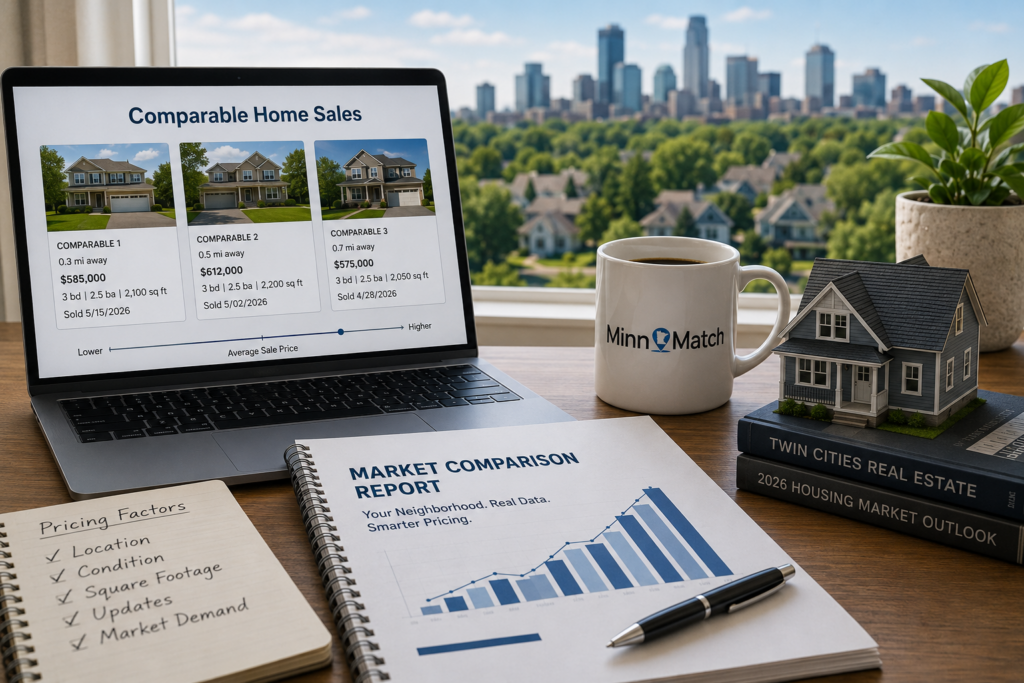
Laptop showing comparable home sales data next to a Twin Cities market comparison report and pricing checklist

If you’ve pulled up recent sales near your house and thought “okay, but what does this actually mean for MY price,” you’re asking the right question. Comps aren’t a magic number—they’re a starting point that still needs a trained eye to interpret. And in the Twin Cities right now, that eye matters more than usual. Inventory across Minnesota just hit a seven-year high, with metro listings up more than 5% from a year ago, while Minneapolis Area Realtors data shows homes are still moving in around six weeks and selling close to full asking price. That combination—more choices for buyers, but a market that still rewards accurate pricing—is exactly why so many Twin Cities sellers get this step wrong. Here’s how to price your Twin Cities home using the comps in front of you, not just the number a website spits out.

Why Raw Comps Rarely Match Your Home Exactly

A comp is only useful once you’ve adjusted it for what’s actually different. Two three-bedroom ramblers a block apart in Richfield can sell $40,000 apart because one has a finished basement and the other doesn’t, or one closed in April during peak buyer competition and the other closed in a slower month. When you price your Twin Cities home, the goal isn’t to average the comps—it’s to figure out which ones are honestly similar and which ones need adjusting up or down for square footage, lot size, garage stalls, updates, and condition.

A good local agent does this adjustment work as part of a full comparative market analysis, weighing not just sale price but days on market, concessions, and how many offers each comp actually received. That last part rarely shows up on a public listing site, but it changes everything about what a comp is really telling you.

What the Current Twin Cities Numbers Actually Say

As of the most recent Minnesota Realtors report, the Twin Cities metro median sale price sits around $410,000, up roughly 2% from last year, with homes averaging in the low-to-mid 40s for days on market and sellers typically receiving close to 99.6% of their final list price. That last figure is the one worth sitting with: it means well-priced homes are still selling close to ask, but the margin for error has narrowed compared to the tightest years of the pandemic-era market. Overprice a home today and it doesn’t just sit—it often ends up selling for less than if it had been priced accurately from day one, because buyers start to wonder what’s wrong with it after a few weeks of silence.

Inventory is also a bigger factor in your pricing than it was a year or two ago. With more listings for buyers to compare against, your home is competing directly with the comp down the street that’s still active—not just the ones that already closed. Redfin’s local market data shows homes across the metro still selling in around three weeks on average, but that pace varies a lot by suburb, price point, and condition, which is exactly why a one-size-fits-all number from an online estimator can miss so badly.

The Overpricing Trap Twin Cities Sellers Keep Falling Into

It’s tempting to price high and “see what happens”—especially if you’ve heard stories about bidding wars from a few years back. But in a market with rising inventory, that strategy usually backfires. The first two weeks after listing get the most buyer traffic and the most showings your home will ever see. Price too high during that window, and you burn through your best shot at multiple offers. By the time you drop the price, the buyers who were originally excited have often moved on to something else, and the new price can look like a red flag rather than a fresh opportunity.

This is especially true in suburbs like Eden Prairie, Minnetonka, and Plymouth, where buyers are actively cross-shopping similar homes across neighboring suburbs. If your price doesn’t line up with what the comps in those areas support, buyers will simply move to the next listing on their tour.

Adjusting for Your Home’s Real Condition

Comps also assume a level of updating and condition that your home may or may not match. An original 1998 kitchen isn’t the same as one updated in 2023, even if the square footage and bedroom count are identical. When you price your Twin Cities home, be honest about where it falls on that spectrum—not to talk yourself down, but to set a number buyers will actually believe once they walk through the door. A price that matches what buyers see in person tends to hold up through inspection and appraisal; a price that only makes sense from the street often doesn’t.

This is also where local financing conditions matter more than people expect. With the 30-year fixed mortgage rate hovering in the mid-6% range this summer according to Freddie Mac’s weekly survey, monthly payment sensitivity is real for a lot of Twin Cities buyers. A home priced even $10,000–$15,000 above what the comps support can push a buyer’s payment past their comfort zone entirely, shrinking your pool of interested offers before a single showing happens.

The Smartest Way to Price Your Twin Cities Home

Automated home value estimates are a fine starting point, but they’re pulling from public records and broad averages—they don’t know that your street floods a little in spring, that your neighbor’s finished basement isn’t permitted, or that a comp two doors down included a $15,000 seller credit that never showed up in the headline sale price. An agent who works your specific pocket of the Twin Cities day in and day out will catch those details, because they’re the ones who negotiated some of those deals themselves.

That’s really what it takes to price your Twin Cities home well: reading the comps the way someone who knows your neighborhood would, not the way a spreadsheet does. If you want a second opinion before you land on a listing price, MinnMatch can connect you with a local agent who knows your specific street, your specific suburb, and exactly how your comps stack up—free, with no obligation. It’s a quick way to find out whether the number you’re considering will actually hold up once real buyers start walking through the door.