
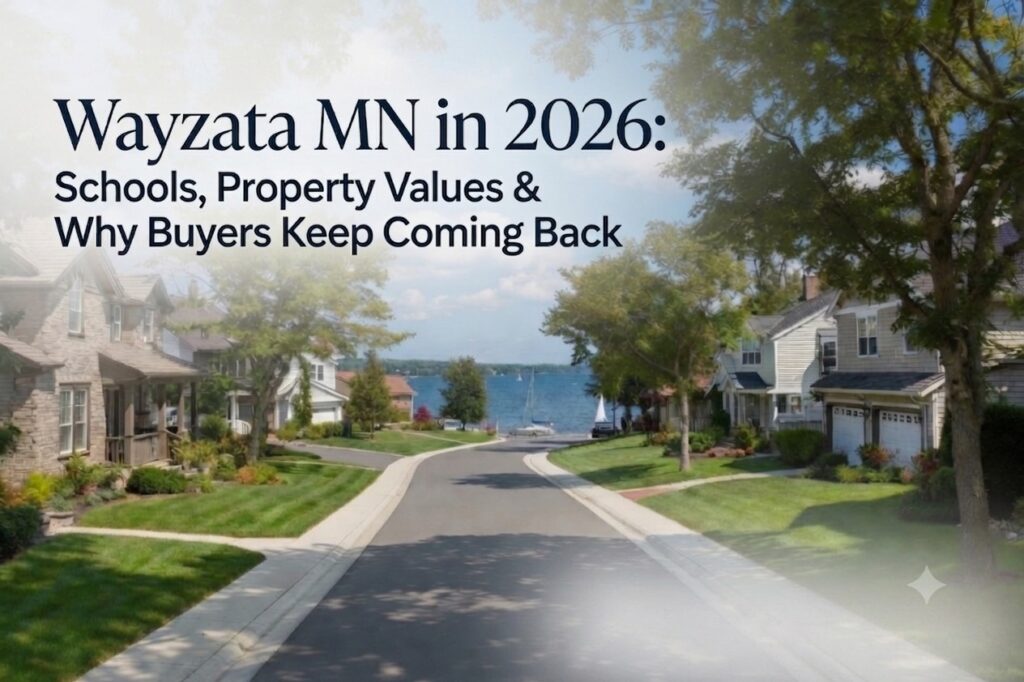
Ask a dozen Twin Cities agents where their clients want to end up, and Wayzata comes up more than almost anywhere else. It’s not just the lake views or the walkable downtown — it’s the combination of top-tier schools, home values that have held up through a cooling statewide market, and a small-town feel that’s rare this close to Minneapolis. If you’ve been eyeing Wayzata, MN real estate in 2026, here’s an honest look at what’s driving demand, what homes actually cost, and why buyers keep coming back year after year.
Wayzata Schools Are the Draw — And the Numbers Back It Up
For the third year running, Niche has ranked Wayzata Public Schools the number one school district in Minnesota, with an A+ overall grade and the state’s top-ranked high school. The district also lands in the top 1% of all public school districts nationwide out of more than 12,000 districts, with elementary schools like Kimberly Lane, Northwoods, Plymouth Creek, and Meadow Ridge regularly landing among the state’s best. For families relocating to the Twin Cities, that ranking alone explains a huge share of the demand we see for Wayzata property values — buyers aren’t just paying for a house, they’re paying for a school assignment they know will hold its value.
It’s worth noting that “Wayzata schools” is really shorthand for Wayzata Public Schools (ISD 284), which serves a footprint stretching well beyond the city itself — into Plymouth, Medina, and parts of Maple Grove and Corcoran. That’s an important nuance for buyers: you can access the district’s boundaries at a range of price points, not just inside Wayzata city limits, which opens up options for buyers who want the schools without the full lakefront premium.
What Wayzata Homes Actually Cost in 2026
Wayzata is a small, lake-driven market, and pricing varies dramatically block by block — which means any single “median price” headline can be misleading. Broadly, buyers should expect typical single-family homes in Wayzata neighborhoods to range from roughly $600,000 to $4 million or more, with true lakefront estates on Lake Minnetonka regularly exceeding $10 million. Listing data through the first half of 2026 has shown days on market stretching into the 55–60 day range, longer than the frenzied pace of a few years ago, which points to a more balanced market where buyers have a bit more room to negotiate than they’ve had in a while.
That’s a notable shift from the ultra-competitive conditions of 2021–2022. Statewide, Minnesota’s overall housing market has been described by Redfin as trending toward equilibrium, with the typical Minnesota home selling in the $360,000–$380,000 range — a useful reminder of just how far above the statewide median Wayzata sits, and why it’s considered one of the metro’s premium markets alongside Edina, Minnetonka, and Eden Prairie.
Financing also plays a bigger role in Wayzata than in more affordable suburbs, simply because loan amounts are larger. As of early July 2026, Freddie Mac’s weekly survey put the average 30-year fixed mortgage rate at 6.43%, down slightly from earlier in the year. For a $1.5 million-plus purchase, even small rate movements can shift a monthly payment by hundreds of dollars, so buyers at this price point are especially well served by locking in rate quotes early and working with a lender experienced in jumbo loans.
Why Buyers Keep Choosing Wayzata Over Comparable Suburbs
Wayzata’s staying power comes down to a combination few other Twin Cities suburbs can match: direct Lake Minnetonka access, a genuinely walkable downtown with restaurants and shops rather than a strip mall, and a top-ranked school district serving the whole area. Neighborhoods like Locust Hills appeal to buyers who want larger lots and mature trees within walking distance of the lake, while areas closer to Gleason Lake offer a lower entry point for move-up buyers who still want the Wayzata address and school assignment.
There’s also a long-term value argument. Buyers who might otherwise consider a comparably priced home in a suburb without Wayzata’s school ranking or lake access tend to see Wayzata as the safer long-term hold — even when it means paying a premium today.
What This Means If You’re Buying or Selling in Wayzata Right Now
For buyers, 2026’s slightly longer days-on-market and modestly improved inventory mean there’s more room to do real due diligence than in past years — get the inspection, negotiate on repairs, and don’t feel forced into a same-day offer. For sellers, it means presentation and pricing accuracy matter more than they did during the frenzy years; homes priced realistically for their specific neighborhood (rather than the headline lakefront numbers) are still moving well.
Either way, a market this nuanced — where price can swing by millions of dollars between two streets — is exactly where local expertise pays for itself.
Thinking about buying or selling in Wayzata? MinnMatch can connect you with a local agent who knows the difference between a Gleason Lake starter home and a Locust Hills estate — no algorithms, just a real match. Find your Wayzata agent or learn more about how MinnMatch works.