
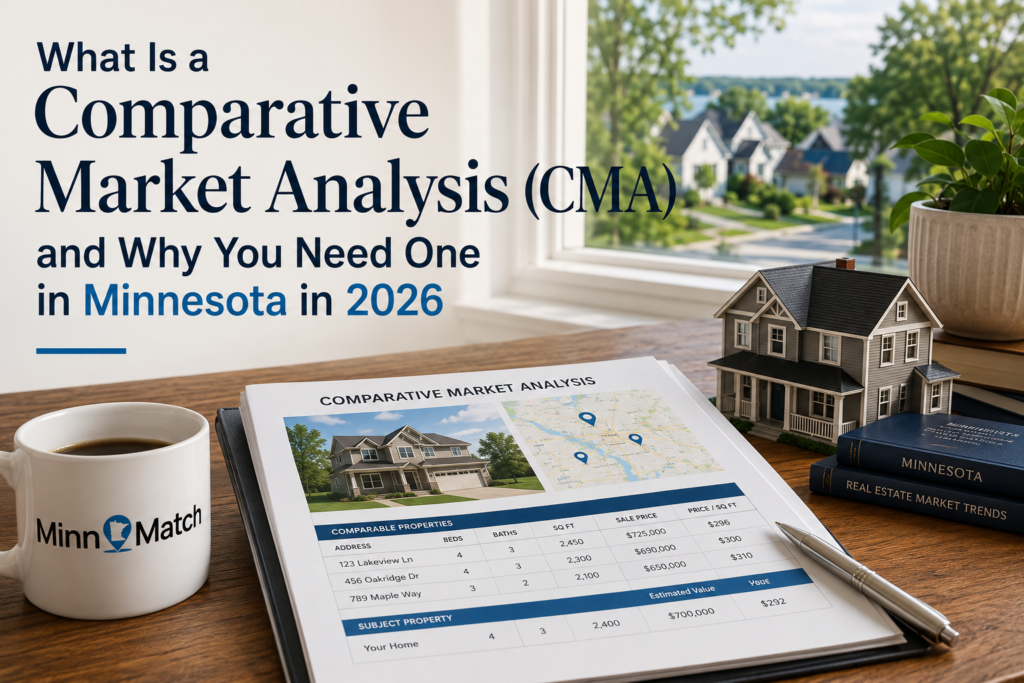
If you’ve spent any time talking to a Twin Cities real estate agent, you’ve probably heard the term “CMA” thrown around. It sounds technical, but it’s really one of the most useful documents you’ll encounter as a buyer or seller in Minnesota’s 2026 market. A comparative market analysis takes the guesswork out of pricing by showing you, in black and white, what similar homes in your area have actually sold for. Whether you’re getting ready to list a home in Edina or you’re trying to figure out if a listing in Plymouth is priced fairly, understanding what a CMA is — and how to read one — puts you in a much stronger position.
What Exactly Is a Comparative Market Analysis?
A comparative market analysis is a report, usually prepared by a licensed real estate agent, that estimates a home’s current market value by comparing it to similar properties — often called “comps” — that have recently sold, are currently listed, or went under contract in the same area. A good CMA looks at square footage, lot size, bedroom and bathroom count, age, condition, and location, then adjusts for differences between the subject property and each comp.
In a market like the Twin Cities, where prices can shift block by block — a rambler in South Minneapolis can behave very differently than one in Prior Lake — a comparative market analysis grounds your expectations in local data instead of national headlines or a Zillow estimate. According to Minneapolis Area Realtors, local market conditions vary significantly by neighborhood and price tier, which is exactly why a CMA needs to be built from nearby, recent, and truly comparable sales rather than a citywide average.
CMA vs. Appraisal: They’re Not the Same Thing
It’s easy to confuse a comparative market analysis with a home appraisal, but they serve different purposes and come from different people. A CMA is typically prepared by your real estate agent, is free, and is meant to help set a listing price or shape an offer. An appraisal is completed by a state-licensed, independent appraiser, usually costs a few hundred dollars, and is required by your lender before closing to confirm the home is worth what you’re paying for it.
Think of it this way: a CMA is a strategic estimate built for decision-making before you list or offer, while an appraisal is a formal, regulated valuation used to protect the lender’s investment. The two often land in a similar range, but they’re not interchangeable, and a CMA is never a substitute for the appraisal your mortgage will require.
Why Sellers Should Start Here, Not With a Number They Have in Mind
Plenty of Twin Cities sellers walk into the process with a price already in their head, often based on what a neighbor’s house sold for years ago or what a home improvement show made pricing look like. A comparative market analysis replaces that gut feeling with current, local evidence. It’s the starting point for a listing strategy — before staging decisions, before marketing photos, before the “For Sale” sign goes in the yard.
We’ll go deep on pricing strategy and how to interpret specific comps in an upcoming article, but the short version is this: a CMA is the foundation everything else gets built on. If you’re weighing whether to list this year, our seller resources page is a good next stop, and connecting with a local agent through MinnMatch’s free agent-matching service is the easiest way to get a CMA built specifically for your address, not a generic estimate.
Buyers Need a CMA Too — Here’s Why
A comparative market analysis isn’t just a seller’s tool. Before you write an offer on a home in Minnetonka or Eden Prairie, a buyer’s agent can run a CMA to tell you whether the asking price actually lines up with what similar homes have sold for recently. That’s especially valuable in a market where a well-staged listing photo or an eager seller’s price can make a home look like a deal — or a stretch — when the comps tell a different story.
A buyer-side CMA also gives you real leverage in negotiations. Instead of an offer based on a feeling, you can point to actual recent sales nearby. If you’re just starting to look, our buyer resources page walks through what else to expect, and Redfin can be a helpful place to sanity-check recent sale prices in a neighborhood you’re considering, alongside the more detailed comps your agent pulls.
Getting an Accurate CMA in the Twin Cities Market
The accuracy of a comparative market analysis depends entirely on the person building it. An agent who knows a specific pocket of the Twin Cities — the difference between a Wayzata lake lot and one a few blocks off the water, or why one South Minneapolis block sells faster than the one next to it — will build a far more useful CMA than an automated online estimate ever could. Housing conditions can also shift with financing programs and affordability trends; resources like the Minnesota Housing Finance Agency track statewide affordability data that can add helpful context to a hyper-local CMA.
This is really where local expertise makes or breaks the number. An out-of-area agent, or a generic online tool, simply won’t know the nuances that move value street by street across the metro.
Get a CMA From an Agent Who Knows Your Neighborhood
Whether you’re preparing to sell or trying to make sense of a listing price, a comparative market analysis is only as good as the agent behind it. MinnMatch connects Twin Cities buyers and sellers with handpicked local agents — for free — so you get a CMA built on real neighborhood knowledge, not guesswork. Find your agent match today and get a clear, accurate picture of what your home — or your next one — is really worth.