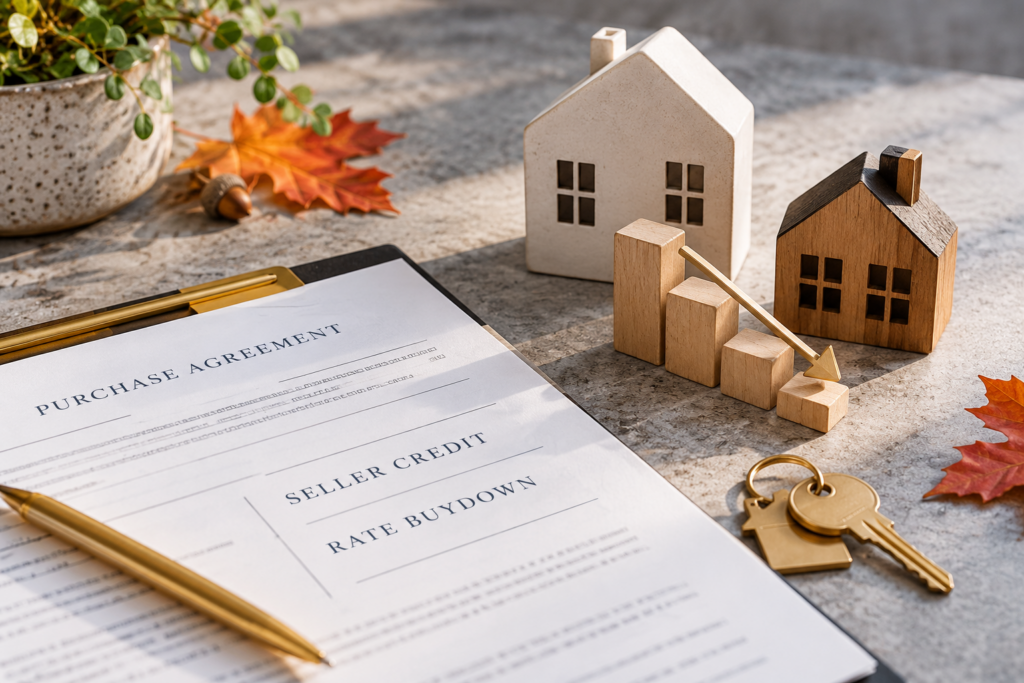
With the 30-year mortgage rate climbing back above 7% this fall, a lot of Twin Cities buyers are running the numbers and wincing. Here’s the good news: one of the most effective tools for lowering your monthly payment isn’t a lower price at all. It’s a seller-paid rate buydown, where the seller puts money toward reducing your interest rate instead of (or alongside) knocking a few thousand off the price. In a market where homes are sitting a little longer and sellers are more willing to negotiate, this is one of the smartest asks a Minnesota buyer can make in 2026.
What Is a Seller-Paid Rate Buydown?
A seller-paid rate buydown is exactly what it sounds like: the seller pays your lender an upfront fee at closing, and in exchange, your interest rate goes down. It’s handled as a seller concession, the same bucket as seller-paid closing costs, so it’s written into your purchase agreement rather than negotiated separately.
There are two main flavors:
- Temporary buydown (most often a 2-1): Your rate is 2 percentage points lower in year one, 1 point lower in year two, then settles at the full note rate for the rest of the loan. The seller’s money sits in an escrow account and covers the difference each month.
- Permanent buydown (discount points): The seller pays for “points” that lower your rate for the entire life of the loan. One point equals 1% of the loan amount, and each point typically trims your rate by somewhere around a quarter of a percentage point, though lender pricing varies day to day.
Either way, the seller is spending money to make your monthly payment smaller. The question is which structure gives you the most value for the dollars on the table.
Why Fall 2026 Is Buydown Season in the Twin Cities
Two things are happening at once. Rates have jumped: Freddie Mac’s weekly survey showed the 30-year fixed averaging 7.28% as of October 1, up from 6.71% in early September and about 6.34% a year ago. And the local market has loosened up. According to Minnesota Realtors’ monthly housing reports, statewide inventory is at a seven-year high and August was the most balanced August for Minnesota buyers and sellers since 2017.
Fall 2026 Snapshot
7.28%
Avg. 30-year fixed rate (Oct 1)
$408,000
Twin Cities median sales price (July)
40 days
Median cumulative days on market, metro (July)
99.1%
Share of list price received, metro (July)
Sources: Freddie Mac Primary Mortgage Market Survey; Minnesota Realtors July 2026 residential market activity (16-county Twin Cities region).
Translation: sellers still get close to asking price, but they’re waiting longer and facing more competition from other listings. That’s the sweet spot for a buydown request. A seller who would bristle at a $15,000 price cut is often more comfortable with a concession that keeps their sale price intact, and as fall turns into the slower November and December stretch, motivation tends to grow. You can follow the latest local numbers on our market insights page.
2-1 Buydown vs. Permanent Buydown: Running the Real Numbers
Let’s use a realistic Twin Cities example: a $410,000 home with 10% down, for a $369,000 loan at a 7.25% note rate. Principal and interest comes to about $2,517 a month. Now imagine the seller agrees to roughly $8,700 in concessions. Here’s what that same money buys three different ways:
| How the ~$8,700 is used | Monthly P&I | Monthly savings |
|---|---|---|
| Price cut (loan drops about $7,800) | ~$2,464 | ~$53 for the life of the loan |
| 2-1 temporary buydown (5.25% → 6.25% → 7.25%) | ~$2,038 yr 1 / ~$2,272 yr 2 | ~$480/mo yr 1, ~$245/mo yr 2 |
| Permanent buydown (about 2 points, roughly 6.75%) | ~$2,393 | ~$124 for the life of the loan |
The price cut is the weakest option for your monthly budget by a wide margin. Between the two buydowns, the right pick depends on your plans:
- Choose a 2-1 if you expect rates to come down and plan to refinance within a couple of years, or if you need breathing room early on while you furnish the house, finish the basement, or wait for a raise to kick in.
- Choose a permanent buydown if you plan to stay put and keep the loan long term. In our example, the break-even on points lands around five years, and every month after that is pure savings.
These figures are illustrative, so have your lender price both options on the actual day you write your offer.
How Much Can a Seller Contribute? Know Your Loan’s Limits
Every loan program caps how much a seller can put toward your costs, and a buydown counts against that cap along with any seller-paid closing costs. Asking for more than your loan allows is a common way deals hit snags late in the process. General guidelines:
- Conventional loans: Under Fannie Mae’s interested-party contribution rules, the limit is 3% of the price with less than 10% down, 6% with 10% to 25% down, and 9% with more than 25% down (2% for investment properties).
- FHA loans: Up to 6% of the sales price.
- VA loans: Concessions are generally capped at 4%, with normal closing costs handled separately.
One more important detail: with a 2-1 temporary buydown on a conventional loan, you still qualify at the full note rate, not the year-one teaser rate. A buydown makes the payment easier to live with; it doesn’t stretch your approval amount. If you’re using a Minnesota Housing first-time buyer program or down payment assistance, check with your lender on how a seller concession fits alongside it. Our buyer resources walk through more of the financing basics.
How to Ask for a Seller-Paid Rate Buydown in Your Offer
Getting a seller-paid rate buydown approved is part strategy, part paperwork. A few things that make a real difference in Minnesota deals:
- Talk to your lender first. Get both a 2-1 and a points quote before you write, so the dollar amount you request matches exactly what the buydown costs.
- Ask for a dollar amount, not a vague favor. Your agent will write it into the purchase agreement as a seller contribution toward buyer costs, which your lender then applies to the buydown.
- Target the right listings. Homes past 30 days on market, listings with a recent price reduction, and new construction are the likeliest candidates. Many Twin Cities builders are already advertising buydown incentives through their preferred lenders.
- Mind the appraisal. If you offer full price plus a concession, the home still has to appraise at that price. A good agent will gauge whether the comps support it.
- Show sellers the math. Framing it as “keep your list price and help me with the rate” often lands better than a straight price reduction.
This is where your agent earns their keep. Knowing which sellers are open to it, and how to structure the ask so it doesn’t spook the other side, comes from local experience. If you’re on the selling side, it’s worth knowing that offering a buydown upfront can make your listing stand out to payment-conscious buyers. See our seller resources for more.
Frequently Asked Questions
What happens to a 2-1 buydown if I refinance early?
With most conventional loans, any unused buydown funds left in escrow aren’t lost. They’re typically applied toward your loan balance when you refinance or sell. Confirm the specifics with your lender before closing, since handling can vary by loan program.
Is a rate buydown better than a price reduction?
For lowering your monthly payment, usually yes. The same dollars spent on a buydown typically save you several times more per month than a matching price cut. A price reduction does lower your property taxes and the amount you borrow, so it can make sense if you’re paying cash or plan to sell soon.
Will sellers in Minnesota actually agree to pay for a buydown?
Many will in today’s market, especially on homes that have been listed a few weeks or have seen a price drop. Rising inventory and longer market times across the Twin Cities this fall have given buyers more room to negotiate concessions than they’ve had in years.
Make Your Monthly Payment Work for You This Fall
A 7% rate doesn’t have to mean a 7% payment. A well-structured seller-paid rate buydown can save you hundreds a month in the early years, or meaningful money for as long as you own the home, all without the seller giving up their list price. The key is pairing the right lender quote with an agent who knows how to negotiate it in today’s Twin Cities market.
That’s where MinnMatch comes in. We personally match buyers with vetted local agents who know which neighborhoods, listings, and sellers have room to deal this fall, at no cost to you. Get matched with a Twin Cities agent, or learn more about how MinnMatch works.