
South Minneapolis Neighborhoods: A Complete 2026 Guide

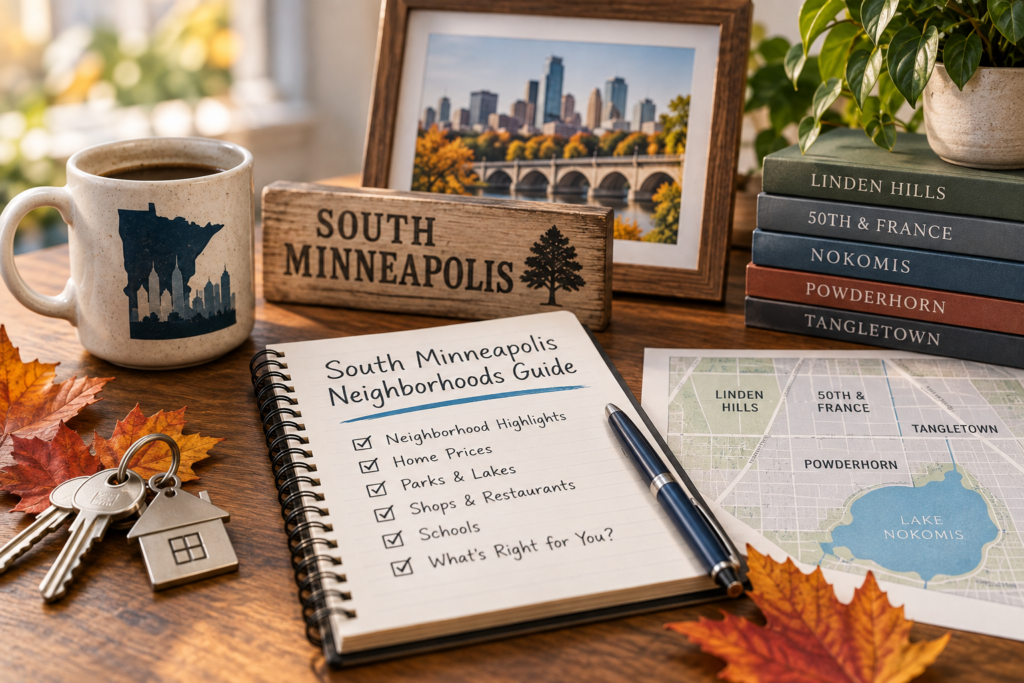
South Minneapolis neighborhoods guide notebook with map of Nokomis, Powderhorn, Linden Hills, and Tangletown

If you’ve spent any time house-hunting in the Twin Cities, you’ve probably heard someone say they’re “looking in South Minneapolis” without ever pinning down exactly where that is. It’s one of the most talked-about, most searched, and most misunderstood areas in the metro. South Minneapolis isn’t a single neighborhood — it’s a whole side of the city, made up of a dozen distinct pockets with their own personality, price points, and pace of life. Whether you’re a first-time buyer drawn to the lakes and bike trails, or a seller wondering how your block compares to the one three streets over, here’s what you actually need to know about South Minneapolis in 2026.

What Areas Actually Make Up South Minneapolis?

Ask ten Minneapolis locals to draw the boundaries of South Minneapolis and you’ll get ten slightly different maps. Broadly, it covers the area south of Interstate 94 and I-35W down to the city’s southern border, roughly spanning zip codes like 55407, 55408, 55409, 55417, and 55419. Within that stretch, you’ll find the Powderhorn, Longfellow, and Nokomis communities, along with well-known neighborhoods such as Kingfield, Tangletown, Standish, Ericsson, Corcoran, and the areas hugging the Mississippi River and Minnehaha Creek. It’s technically distinct from “Southwest Minneapolis,” which covers the Linden Hills, Lynnhurst, and Fulton side of town, though plenty of buyers use the terms loosely. Confused about which side of a boundary your target home falls on? That’s exactly the kind of local detail a South Minneapolis-focused agent can clear up in about five minutes. (For general city demographic context, the U.S. Census Bureau’s Minneapolis QuickFacts page is a useful reference.)

The Neighborhoods Buyers Are Watching Right Now

Not every South Minneapolis neighborhood moves the same way. Here’s a quick rundown of the ones generating the most buyer interest heading into fall 2026:

1

Longfellow

Riverfront trails, the Sabo Bridge, and easy access to the Midtown Greenway make this a favorite for young professionals and outdoor-minded buyers.

2

Nokomis

Anchored by Lake Nokomis and Minnehaha Falls, this pocket appeals to families who want a quieter, more suburban feel without leaving the city.

3

Kingfield & Tangletown

Charming bungalows, walkable Nicollet Avenue businesses, and a steady stream of buyers looking for classic city character close to Lake Harriet.

4

Powderhorn Park

One of the city’s most diverse and eclectic areas, with a strong sense of community and some of the metro’s best value for buyers who want an early foothold.

South Minneapolis by the Numbers

Pricing across South Minneapolis varies quite a bit by neighborhood, so it pays to look at the specific pocket you’re considering rather than a single citywide number.

$300K–$425K

Typical neighborhood median sale price range

~20 days

Average time on market, Minneapolis-wide

~2–3

Average offers per home in competitive pockets

$375K

Minneapolis citywide median sale price

Sources: Redfin Minneapolis housing data, neighborhood-level Redfin figures for Longfellow and Nokomis, 2026.

Why Buyers (and Sellers) Keep Choosing South Minneapolis

The pull of South Minneapolis comes down to a mix that’s hard to find elsewhere in the metro: genuine walkability, a chain of lakes and parkways right outside your door, and housing stock — Craftsman bungalows, foursquares, postwar ramblers — with real character. You get the bike lanes, the coffee shops, and the Chain of Lakes access that usually come with a much higher price tag in neighboring suburbs, but without giving up the tree-lined, front-porch feel that makes a block actually feel like a neighborhood. For sellers, that same mix is a selling point in itself: buyers moving out of pricier Southwest Minneapolis or the western suburbs often land in South Minneapolis precisely because it delivers a similar lifestyle at a more approachable price point. According to the Minneapolis Area Realtors, demand for walkable, lake-adjacent neighborhoods has stayed resilient even as rates have shifted buyer behavior elsewhere in the metro.

Frequently Asked Questions

What’s the difference between South Minneapolis and Southwest Minneapolis?

South Minneapolis generally refers to the Longfellow, Nokomis, and Powderhorn communities on the city’s south side, while Southwest Minneapolis covers areas like Linden Hills, Lynnhurst, and Fulton closer to Lake Harriet and Lake Calhoun. The two overlap in feel but differ noticeably in price point and housing stock.

Is South Minneapolis a good place to buy in 2026?

For buyers who want walkability, lake access, and character housing without a suburban price tag, yes — South Minneapolis remains one of the metro’s most in-demand areas, though pricing and competition vary a lot by specific neighborhood.

Which South Minneapolis neighborhood is best for families?

Nokomis is typically the top pick for families, thanks to its quieter streets, larger lots, and proximity to Lake Nokomis and Minnehaha Falls, though Kingfield and Tangletown also draw plenty of family buyers who want to stay closer to the city center.

However you define its borders, South Minneapolis isn’t a place you can shop by spreadsheet alone — the right block, school, or commute trade-off comes down to local knowledge block by block. That’s where a matched, South Minneapolis-savvy agent makes the difference between guessing and knowing. Find your South Minneapolis match and let MinnMatch connect you with an agent who already knows which streets to watch.
South Minneapolis August 2026: Prices, Pace & the Neighborhoods Getting the Most Attention

Tree-lined South Minneapolis street with front-porch homes, featured image for August 2026 market update

August in South Minneapolis usually means the market starts to exhale a little — and 2026 is no exception. But “slower” doesn’t mean “slow.” Minneapolis home prices are still edging upward, well-priced homes are still moving fast in the right pockets, and buyers who spent the spring getting outbid are finding a market that’s finally giving them a little room to breathe. Here’s where South Minneapolis real estate actually stands this month — prices, pace, and which neighborhoods are pulling the most buyer attention right now.

South Minneapolis Real Estate Prices This Month

Citywide, Minneapolis homes have sold for a median price in the $370,000–$375,000 range over the past several months, roughly 2–3% above where the market stood a year ago. But that number flattens a lot of very different realities across South Minneapolis, so it’s more useful as a floor than a forecast.

The southwest lake corridor — Linden Hills, Fulton, Lynnhurst, and Tangletown — continues to trade well above the citywide median, with single-family homes commonly landing in the $600,000s and up, and lakefront or lake-adjacent properties regularly clearing $1 million. Kingfield and the blocks just east of Lake Harriet run 15–25% below that southwest tier for comparable homes, which is exactly why buyers priced out of Linden Hills keep landing there. Nokomis and Longfellow sit further below the citywide median, offering 1920s-era bungalows and Tudors with genuine lake or park access at a price point that’s simply out of reach in the lake district. Powderhorn remains one of the most attainable entry points in the city for buyers who want South Minneapolis character without the southwest-corner price tag.

Because sample sizes shrink fast once you narrow to a single neighborhood in a single month, treat any specific block-by-block number as a range rather than gospel — and lean on an agent who’s actually tracking that pocket of the South Minneapolis real estate market for a real read.

Market Pace: Who’s Moving Fast, Who’s Taking Their Time

Pace is where South Minneapolis really splits into two markets. Well-priced homes in the southwest corner — Linden Hills, Fulton, and the streets ringing Lake Harriet — are still routinely going pending within the first weekend or two, with multiple offers common on anything move-in ready. Longfellow and the neighborhoods east of the Mississippi typically take a bit longer, often two to four weeks to pending, which gives buyers more time to actually see a house twice before deciding.

Zoom out to the metro level and the pace has cooled from the frenzy of a few years ago: Minneapolis homes are selling in around three weeks on average, with roughly three offers per listing and a sale-to-list ratio just above 100% — meaning the typical home is still selling slightly above asking, but nowhere near the bidding-war intensity of peak 2021–2022. Minneapolis Area Realtors reported inventory hitting its highest level in seven years heading into August, which is giving buyers more to choose from and taking some of the sharpest edges off the competition — even in neighborhoods that are still moving quickly.

The Neighborhoods Getting the Most Attention Right Now

Three pockets stand out for buyer attention this August:

Kingfield has become a real destination rather than a fallback. Buyers who can’t stretch to Linden Hills or Fulton prices are landing here on purpose, drawn by the same walkable dining and 1920s housing stock at a meaningfully lower entry point. Listings that show well are getting serious, fast attention.

Longfellow is pulling families priced out of the lake district who still want Craftsman character and genuine park access — Minnehaha Falls and the regional park are a real draw, not just a listing bullet point. It’s showing up more often as a second-choice-turned-favorite for buyers who started their search further west.

Nokomis continues to offer the best combination of lake access and price restraint in South Minneapolis. It won’t match Linden Hills dollar-for-dollar, but for buyers who want to live near water without a water-view price tag, it’s consistently one of the first neighborhoods agents point to.

What This Means If You’re Buying or Selling

According to Minnesota Housing, statewide inventory growth is part of a broader trend toward more balanced conditions heading into fall — South Minneapolis is simply an earlier example of it. If you’re selling in the southwest corner, the market still rewards you — but rising inventory means pricing accurately from day one matters more than it did a year ago. Overpriced listings are starting to sit, even in Linden Hills. If you’re buying in Longfellow, Nokomis, or Kingfield, August’s slightly thinner competition and longer decision windows are a real opening compared to what buyers faced in April and May.

Either way, South Minneapolis real estate isn’t one market — it’s a handful of them stacked next to each other, each with its own price tier and pace. That’s exactly why matching with an agent who knows your specific neighborhood, not just the citywide averages, makes the difference between a smooth close and a frustrating summer. MinnMatch can connect you with a vetted South Minneapolis agent who already knows which blocks are moving fast this month — free for buyers and sellers, no algorithm guesswork involved.

South Minneapolis Mid-2026: The Neighborhoods Driving the Most Appreciation Right Now

Tree-lined South Minneapolis residential street with historic homes and downtown Minneapolis skyline in the background, MinnMatch branded featured image

Halfway through 2026, South Minneapolis is proving that not all neighborhoods move at the same pace. While the Minneapolis Area Realtors citywide median has crept up only modestly this year, a handful of South Minneapolis pockets are quietly outperforming — and buyers who’ve been house-hunting since spring have probably already noticed it in the multiple-offer situations popping up around Lake Nokomis and along the Longfellow bluff. If you’re weighing where to buy for long-term value, or wondering whether now’s the right time to sell, here’s an honest look at which South Minneapolis neighborhoods are driving the most South Minneapolis appreciation right now — and which ones are still flying under the radar.

Nokomis: Lake Access Is Still the Biggest Appreciation Driver

Nokomis has been one of the more talked-about pockets of South Minneapolis appreciation this year, and the pattern makes sense once you look at what’s driving it. Homes within walking distance of Lake Nokomis or Lake Hiawatha continue to pull a premium, and price-per-square-foot figures for the neighborhood have climbed at a noticeably faster clip than the citywide average, according to Redfin’s Nokomis market data. Median sale prices have bounced around month to month — which is typical for a neighborhood where sales volume is thinner than in the citywide numbers — but the 1920s bungalows and Tudors near Minnehaha Parkway are consistently drawing multiple offers when they’re priced right. If you’re buying here for appreciation potential, the blocks closest to the parkway loop tend to hold their premium best.

Longfellow: Steady, Sustainable Growth Along the River

Longfellow’s appreciation story looks a little different — less of a spike, more of a steady climb. The neighborhood’s proximity to Minnehaha Falls, the river trails, and a walkable commercial strip along E 42nd Street has made it a consistent draw for buyers who want character housing without the price tag of Linden Hills or Fulton. Recent Redfin data for Longfellow has shown the neighborhood posting some of the more reliable year-over-year gains among South Minneapolis submarkets, and homes here are still landing well under $450,000 in most cases — a meaningful gap compared to the lake-adjacent neighborhoods on the city’s west side. That combination of below-median entry pricing and above-average appreciation is exactly what makes a neighborhood worth watching for the next few years, not just this one.

Kingfield: The Walkable Value Play With Momentum

Kingfield doesn’t get talked about as much as its neighbor Linden Hills, but it’s arguably become one of the smarter buys in South Minneapolis for exactly that reason. Prices here have typically run well below the Linden Hills and Fulton corridor for comparable 1920s-1940s housing stock, while still delivering the same walkable dining and tree-lined streets buyers pay a premium for a few blocks west. That price gap has been narrowing over the past several years as more buyers get priced out of the southwest corner and shift their search east — and Kingfield has quietly posted above-average appreciation over that stretch as a result. For buyers who want the “southwest Minneapolis feel” without the southwest Minneapolis price, this is one of the more compelling corners of the market right now.

Powderhorn and the Value Tier: Worth Watching, Not Yet Racing Ahead

Not every South Minneapolis neighborhood is heating up at the same rate, and that’s worth saying plainly. Powderhorn, for example, has had a softer stretch in recent months, with sale prices near the $300,000-to-$325,000 range and less of the appreciation momentum showing up in Nokomis or Longfellow. That’s not necessarily a bad thing for buyers — it means there’s still relative value in a neighborhood with strong park access and an increasingly active local dining and arts scene around Powderhorn Park. Neighborhoods like this tend to move in waves as adjacent areas price buyers out, so it’s one worth keeping on your radar even if it isn’t leading the pack today.

South Minneapolis Appreciation: What It Means If You’re Buying or Selling Right Now

The bigger picture: South Minneapolis appreciation isn’t happening evenly across the map, and generic citywide statistics can hide a lot of what’s actually going on block by block. Understanding where South Minneapolis appreciation is concentrated right now can make a real difference in both your offer strategy and your timeline. That’s exactly the kind of nuance that’s hard to get from a national listing site and easy to miss if you’re not watching the market closely all year. If you’re trying to figure out whether Nokomis, Longfellow, Kingfield, or one of the value-tier neighborhoods makes the most sense for your goals, MinnMatch can connect you with a local agent who works these specific pockets of South Minneapolis every day and can tell you, block by block, where the momentum really is. It’s a free service, and matching you with the right local expert — rather than whoever happens to answer the phone first — is the whole point. Curious how the process works? Here’s a quick look at how MinnMatch matches you with an agent.