
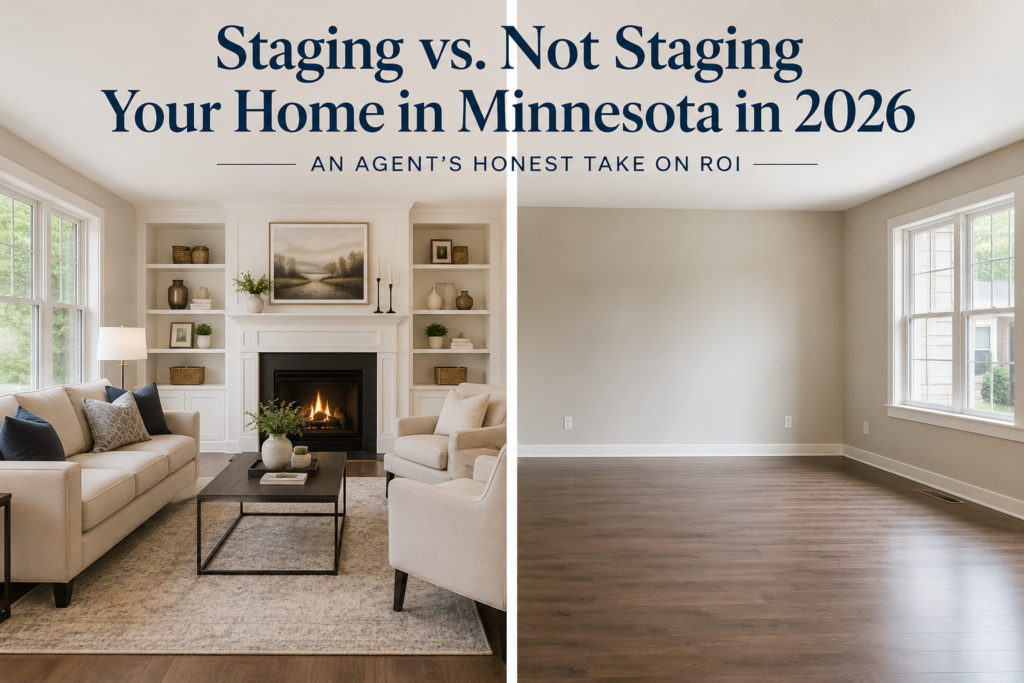
Staging vs. Not Staging Your Home in Minnesota in 2026: An Agent’s Honest Take on ROI

Split image comparing a professionally staged living room with furniture and decor to the same style empty living room, illustrating home staging ROI in Minnesota

Every seller asks some version of the same question: “Do I actually need to stage this place?” It’s a fair question, especially when a full staging job can run into the thousands of dollars. After watching staged and unstaged homes hit the market across the Twin Cities all year, I can tell you the honest answer isn’t yes or no — it’s “it depends on your home, your price point, and your competition.” Let’s talk through the real home staging ROI picture for Minnesota sellers in 2026, without the sales pitch.

What Staging Actually Costs in the Twin Cities

Full-service staging (a professional coming in and furnishing empty or awkward rooms) typically runs $2,000–$6,000 for a first month in a mid-size Twin Cities home, depending on square footage and how many rooms need furniture versus a simple refresh. Consultation-only staging, where a stager walks through your already-furnished home and tells you what to move, remove, or rearrange, is far cheaper — often $150–$400 for a two-hour visit. Vacant homes cost the most to stage because everything from the sofa to the artwork has to be brought in and rented monthly.

For context on how these costs measure against typical resale numbers, Redfin’s housing market data is a solid, current benchmark for Twin Cities price trends by neighborhood.

The Case for Staging: Where It Pays Off

Staging earns its keep in a few very specific situations. Vacant homes are the clearest case — empty rooms photograph poorly, make spaces feel smaller than they are, and give buyers nothing to picture their own life inside. Higher-priced listings ($500K and up) are another spot where staging tends to pay for itself, because buyers at that price point expect a move-in-ready, magazine-quality presentation and will mentally deduct for anything that looks dated or unfinished. Awkward layouts — a bonus room with no obvious purpose, a basement that’s half-finished, a formal dining room nobody uses anymore — also benefit from staging, since a stager’s job is essentially to answer the buyer’s unspoken question: “what would I even do with this space?”

When Staging Isn’t Worth the Money

On the flip side, I’ve watched plenty of sellers spend money on staging that didn’t move the needle. If your home is already tastefully furnished and decluttered, a full staging job is often overkill — a two-hour consultation to fine-tune what you already have will get you 90% of the benefit for a fraction of the cost. Starter homes and homes priced under roughly $300K in competitive Twin Cities suburbs like Plymouth or Prior Lake also tend to sell fast on price and location alone; buyers in that range are often more forgiving of a lived-in look, especially in a tight inventory market. And if your timeline is short or your home is going to sell primarily on land value or a teardown/renovation basis, staging dollars are usually better spent elsewhere — like a fresh coat of paint or fixing a known inspection issue.

4 Factors That Actually Determine Your Staging ROI

1

Whether the Home Is Vacant or Occupied

Vacant homes see the biggest lift from staging because there’s simply nothing for buyers to compare their imagination against. Occupied homes usually need editing, not furnishing.

2

Price Point and Buyer Expectations

The higher the price, the more polish buyers expect. A $700K Edina listing and a $280K Prior Lake starter home are playing by different rules entirely.

3

How Competitive Your Local Market Is

In neighborhoods with tight inventory, buyers will look past cosmetic flaws. In slower or more saturated pockets, staging becomes a real differentiator against similar listings.

4

The Home’s Layout and Quirks

Unusual or ambiguous spaces benefit most from staging’s core job: showing buyers exactly how to use a room they wouldn’t otherwise know what to do with.

DIY Staging: Getting 80% of the Benefit for Almost Nothing

If a full staging budget isn’t in the cards, you can get most of the visual benefit yourself. Declutter aggressively — pack away a third of what’s in every room, including closets, since buyers open them. Depersonalize by putting away family photos and strong personal decor choices so buyers can picture themselves there instead of you. Fix the small stuff a stager would flag anyway: burnt-out bulbs, scuffed walls, cluttered countertops. And don’t underestimate curb appeal — for many Twin Cities buyers, the first impression happens in the driveway, not the entryway. None of this requires a stager’s invoice, just a weekend and a willingness to pack a few boxes early.

So, Should You Stage?

The honest answer: it depends on your specific home, price range, and market — which is exactly the kind of judgment call a good local agent should be helping you make, not a blanket rule from a blog post. An agent who knows your neighborhood’s current competition can tell you in five minutes whether staging dollars will come back to you at closing or whether that money is better spent elsewhere. If you’re getting ready to sell and want a second opinion on staging (or anything else in your prep list), MinnMatch can connect you with a vetted local agent who’ll walk your home and give you a straight answer — free, with no pressure to hire the first person you talk to.

For more on how the Minneapolis Area Realtors track local market conditions that influence pricing and presentation decisions, visit mplsrealtor.com.
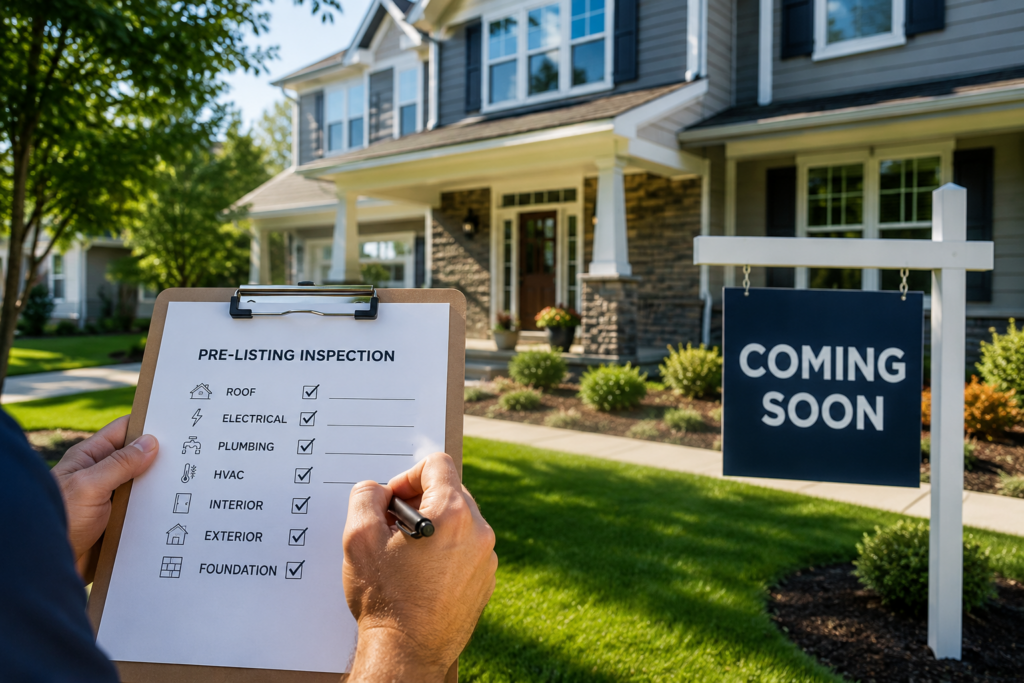
Why Twin Cities Sellers Are Getting a Pre-Listing Inspection Before They List in 2026

Person holding a "Pre-Listing Inspection" checklist clipboard in front of a Twin Cities home with a "Coming Soon" real estate sign

If you’re getting ready to sell a home in the Twin Cities this year, there’s a decision that comes up long before your first showing: should you pay for a pre-listing inspection? It’s not required, and plenty of Minnesota sellers skip it. But more and more agents around the metro are recommending it upfront, especially in a market where buyers are cautious and inspection-related renegotiations can derail a deal. Here’s what a pre-listing inspection actually does for you, what it tends to cost, and how to decide if it’s worth it for your sale.

What Is a Pre-Listing Inspection, Exactly?

A pre-listing inspection is the same type of general home inspection a buyer would order, except you hire the inspector yourself, before the home ever hits the market. A licensed inspector walks the property top to bottom — roof, foundation, electrical, plumbing, HVAC, windows, and more — and hands you a full report of what they find. Some Twin Cities sellers stop there. Others use the report to get ahead of repairs, adjust their price, or simply have documentation ready to share with buyers.

It’s a growing trend, but it’s still very much optional in Minnesota. Nothing in state law requires a seller to have their home inspected before listing — Minneapolis Area Realtors notes that the decision is entirely up to the seller and their agent’s recommendation based on the home’s age and condition.

The Real Benefit: Fewer Surprises After You’re Under Contract

The biggest advantage of a pre-listing inspection isn’t the report itself — it’s timing. When a buyer’s inspector finds a cracked heat exchanger or an aging roof three weeks into a purchase agreement, you’re negotiating repairs or a price reduction under pressure, often with a closing date already on the calendar. When you get that same information before you list, you get to decide, on your own timeline, whether to fix it, price around it, or disclose it and move forward.

That matters a lot in the Twin Cities right now. Inventory has been tight enough in several suburbs that sellers don’t want to lose a buyer over a repair negotiation that could have been settled — or avoided entirely — before the home ever went live.

Pricing Confidence and Fewer Renegotiations

A home’s condition is a pricing input, not just a disclosure issue. Sellers who complete a pre-listing inspection often price their home more accurately from day one, because they’re not guessing at what a buyer’s inspector might turn up. If the report comes back clean, that’s a selling point you can lean into. If it surfaces a few items, you can factor those into your list price rather than getting hit with a lowball renegotiation after you’ve already accepted an offer.

It also tends to shorten the path to closing. Buyers and their agents read confidence into a seller who’s already done the homework — it signals there’s nothing being hidden, which can mean fewer contingencies and a smoother path to the closing table.

What It Costs and How to Fit It Into Your Timeline

Most general home inspections in the Twin Cities run somewhere between $300 and $600, depending on the size and age of the home, with additional cost for add-ons like radon testing or a sewer scope — both common requests in older Minnesota housing stock. Plan on scheduling it 2–4 weeks before you intend to list, which gives you time to review the report, get repair quotes if needed, and decide on next steps without rushing.

One thing to flag with your agent: Minnesota’s seller disclosure law still requires you to disclose known material defects, whether or not you order a pre-listing inspection. Getting one doesn’t create new disclosure obligations — it just means you’re finding out about issues on your own schedule instead of a buyer’s.

Is a Pre-Listing Inspection Right for Your Sale?

It’s not a fit for every seller. If your home is newer, well-maintained, and you’re confident in its condition, the added cost may not move the needle much. But for older homes, homes that have been rented for years, or homes where you suspect there could be deferred maintenance, a pre-listing inspection can be the difference between a smooth sale and a stressful renegotiation. According to Redfin’s seller resources, inspection issues remain one of the most common reasons a deal falls through or gets re-negotiated after going under contract — which is exactly the scenario a pre-listing inspection is designed to prevent.

The best way to decide is to talk it through with an agent who knows your specific home and neighborhood — not a generic rule of thumb.

Get Matched With an Agent Who’ll Give You a Straight Answer

Whether a pre-listing inspection makes sense for your home depends on its age, condition, and your local market — the kind of judgment call a good local agent is built for. MinnMatch can match you with a vetted Twin Cities agent who’ll walk through your specific situation and help you decide whether a pre-listing inspection is worth it before you list. Curious how the matching process works? Here’s how it works — and it’s free for sellers.