

Radon and Buying a Home in Minnesota in 2026: Testing, Disclosure Rules & Mitigation Costs

Continuous radon monitor on a Minnesota basement counter beside a radon test report, floor plan, and white mitigation pipe

If you’re buying a home anywhere in the Twin Cities this year, radon belongs on your checklist right next to the furnace, the roof, and the foundation. Radon in Minnesota isn’t a rare, worst-case problem. It’s common, it’s invisible, and it shows up in brand-new builds in Plymouth just as easily as 1920s bungalows in South Minneapolis. The good news is that it’s easy to test for, Minnesota has clear disclosure rules, and fixing it is usually a one-day job. Here’s what every buyer (and seller) should know in 2026.

Radon at a Glance

2 in 5

Minnesota homes with radon at levels that pose a significant health risk

4 pCi/L

EPA action level where mitigation is recommended

48 hrs

Minimum length of a real estate radon test

$1,500–$3,000

Typical cost range for a mitigation system

Source: Minnesota Department of Health

Why Radon in Minnesota Is a Bigger Deal Than Most Buyers Expect

Radon is a naturally occurring radioactive gas that seeps up from the soil and into homes through foundation cracks, sump pits, floor drains, and gaps around pipes. You can’t see it, smell it, or taste it. Our glacial soils make this state a hot spot: according to the Minnesota Department of Health, more than two in five homes here have radon at levels that pose a significant health risk, and the average level statewide runs more than three times the national figure.

Why does that matter? Radon is the leading cause of lung cancer among nonsmokers. And Minnesota living makes exposure worse in a very specific way: we keep our homes sealed up tight for five or six months a year, and many of us spend a lot of that time in finished basements, which is exactly where radon levels tend to be highest. Your neighbor’s test results also tell you very little. Two houses on the same Edina block can test completely differently, so the only way to know is to test the home you’re buying.

What Minnesota’s Radon Disclosure Rules Actually Require

Since January 1, 2014, the Minnesota Radon Awareness Act (Minn. Stat. § 144.496) has required sellers of residential property to disclose what they know about radon before a purchase agreement is signed. Those rules are unchanged heading into 2026. In writing, the seller must share:

  • Whether the home has ever been tested for radon
  • The most current test records and results
  • Any mitigation or remediation that’s been done
  • Information and documentation on any installed mitigation system
  • A required radon warning statement, plus a copy of the MDH publication Radon in Real Estate Transactions

Here’s the part that surprises a lot of buyers: the law does not require anyone to test. Sellers only have to disclose what they already know. If they’ve never tested, the disclosure simply says so. If a seller knowingly hides radon information, a buyer can take legal action within two years of closing. Also note that some sales are exempt, including foreclosures and transfers to heirs, so if you’re eyeing a bank-owned or estate property, you may get no radon disclosure at all. For more on the broader disclosure picture, our buyer resources walk through what to expect in a Minnesota transaction.

How to Test for Radon When You’re Buying a Home

Because testing isn’t automatic, it’s up to you to build it into your offer, usually alongside your home inspection contingency. MDH’s real estate radon guidance lays out how a proper test should be done:

  • Use a licensed pro. Under the Minnesota Radon Licensing Act, anyone testing a home they don’t own or rent must be licensed by MDH. Many home inspectors carry the license and can run the test during your inspection.
  • Test for at least 48 hours. That means a calibrated continuous radon monitor or two short-term kits placed side by side.
  • Keep the house closed up. Windows and doors stay shut except for normal coming and going, with heating or cooling running as usual.
  • Test the lowest livable level. In most Twin Cities homes, that’s the basement.

Timing matters. A 48-hour test plus results can eat up a good chunk of a short inspection window, so get it scheduled the day your offer is accepted. And yes, test new construction too. Minnesota has required new homes to be built radon-resistant since 2009, but the standard setup is a passive pipe with no fan. It helps, but it doesn’t guarantee a low reading. The upside is that if levels come back high, adding a fan to an existing passive system is usually simpler and cheaper than starting from scratch.

Selling? MDH notes that sellers can benefit from testing before listing. A pre-listing test lets you mitigate on your own timeline instead of negotiating under pressure mid-deal. Our seller resources cover other ways to get ahead of inspection surprises.

Radon Mitigation Costs in Minnesota (and Who Pays)

If the test comes back at or above 4 pCi/L, MDH recommends installing a mitigation system. Between 2 and 4 pCi/L, it’s worth considering. According to MDH’s mitigation guidance, costs generally range from $1,500 to $3,000, depending on how the home is built and which type of system it needs:

  • Sub-slab suction – the most common setup for basement and slab homes
  • Drain tile suction – uses an existing drain tile system to pull radon away
  • Sub-membrane – for crawl spaces, sealing a membrane over the soil

All three work the same basic way: a fan runs continuously, pulling radon from beneath the home and venting it out a pipe above the roofline. A well-installed system should bring levels below 4 pCi/L, and often below 2. Mitigators must be MDH-licensed and attach an MDH tag to finished systems, and most installs need an electrical permit for the fan. Once it’s running, wait at least 24 hours and retest to confirm it’s working.

Who pays is negotiable, and a high radon result rarely needs to kill a deal. Common outcomes include the seller installing a system before closing, a closing credit so the buyer can hire their own mitigator, or a price adjustment. If the home already has a system, ask for the documentation, look for the MDH tag, and know that MDH offers a free inspection for systems installed after June 2020.

Radon in Minnesota: Quick Answers to Common Questions

Do Minnesota home sellers have to test for radon?

No. Sellers must disclose any radon testing, results, and mitigation they know about, and provide the required MDH publication, but they aren’t required to test. Testing is the buyer’s call.

Should I walk away from a house with high radon?

Usually not. Elevated radon is common here and is one of the more predictable fixes in a home purchase. A typical system costs $1,500 to $3,000 and can be installed quickly, so most buyers negotiate a fix or credit rather than walking.

Do newer homes still need a radon test?

Yes. Homes built since 2009 include radon-resistant features, but most use a passive system without a fan. Testing tells you whether that’s enough or whether a fan upgrade makes sense.

The Right Agent Makes Radon a Non-Event

Handled well, radon is a line item, not a crisis. The difference usually comes down to your agent: someone who writes testing into your offer, keeps the inspection timeline on track, and knows how to turn a high reading into a fair fix or credit without derailing the deal. Experienced local agents deal with radon in Minnesota on nearly every transaction, from Prior Lake to Wayzata.

That’s exactly the kind of agent MinnMatch connects you with. We personally match buyers and sellers with vetted Twin Cities agents who know the local details, and it’s free. See how our matching works, or find your agent and walk into your next home purchase with one less thing to worry about.
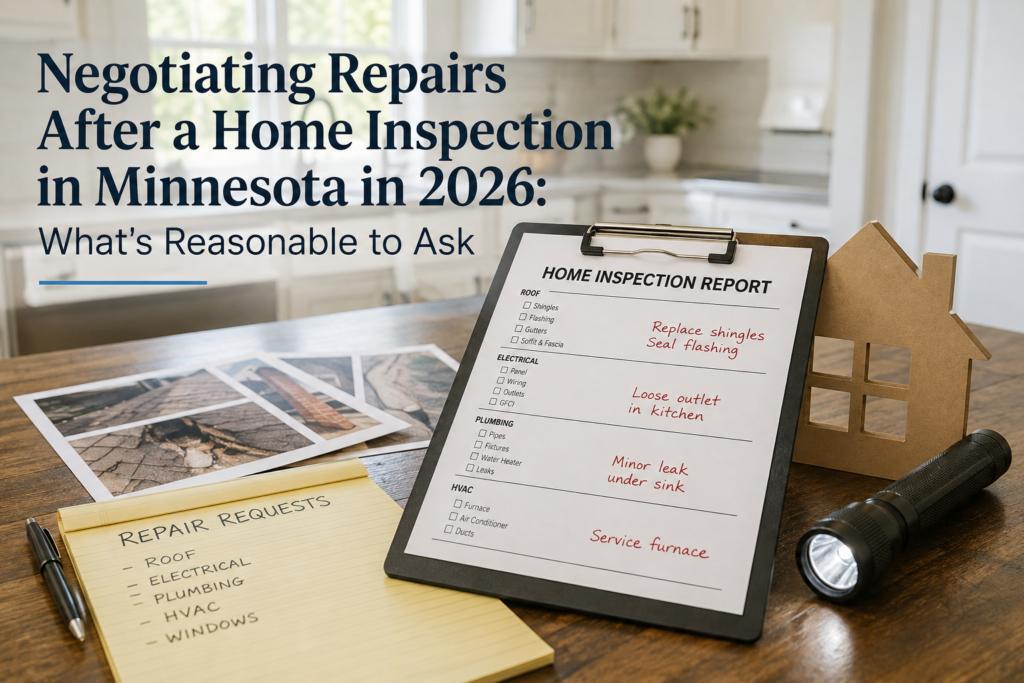
Negotiating Repairs After a Home Inspection in Minnesota in 2026: What’s Reasonable to Ask

Home inspection report on clipboard with handwritten repair requests for roof, electrical, plumbing, and HVAC in a Minnesota kitchen

The inspection is done, the report has landed in your inbox, and it’s twelve pages of photos, moisture readings, and phrases like “recommend further evaluation.” Take a breath. Almost every Minnesota home inspection turns up something — that’s what inspectors are for. The real skill isn’t finding a home with zero issues; it’s knowing which ones are worth a fight and which ones you should let go so the deal, and the relationship with your seller, stays intact. Negotiating repairs after inspection is one of the most consequential — and most misunderstood — steps in buying a house here, and getting it right takes a mix of local knowledge and a level head.

What “Reasonable” Actually Means When Negotiating Repairs After Inspection

Minnesota’s standard inspection contingency isn’t a punch list — it’s a safety valve. It exists so a buyer isn’t stuck closing on a house with a cracked foundation or knob-and-tube wiring they didn’t know about. That framing matters when you’re deciding what to negotiate. Safety issues, code violations, and anything affecting the structure, roof, electrical, plumbing, or major systems are almost always fair game. Peeling paint on a 1920s trim board, a scuffed garage floor, or a dated bathroom vanity generally aren’t — those are things you accounted for (or should have) when you made your offer.

A useful gut check: would this issue affect whether the home is safe, habitable, or insurable? If yes, it belongs in your repair request. If it’s really about taste or wear you noticed after the fact, it’s better handled with a contractor after closing than with a seller before it. This is the mental filter to run through every item on the report before you start negotiating repairs after inspection with the seller.

The Issues Minnesota Inspectors Flag Most Often

Some findings show up again and again in Twin Cities inspection reports, and each one carries its own negotiating logic:

Radon. This is the one that catches out-of-state buyers off guard. Roughly two in five Minnesota homes test above the EPA’s action level of 4.0 pCi/L, largely because of the uranium-bearing glacial soils under most of the state. A high radon reading isn’t a reason to panic or walk — mitigation systems typically run in the low four figures and work well. It is, however, a completely standard and reasonable thing to ask a seller to install or credit before closing.

Roof and ice dam damage. Our freeze-thaw winters are hard on roofs, and inspectors regularly flag ice-dam-related shingle damage, soffit rot, or inadequate attic ventilation. If a roof is at or near the end of its life, or there’s evidence of active water intrusion, that’s a legitimate repair or credit request — not a nitpick.

Aging mechanicals. A furnace, water heater, or electrical panel that’s original to a 1970s or ’80s home and clearly failing is fair to negotiate. One that’s simply older but still functioning and passing inspection usually isn’t — you can’t ask a seller to replace something just because it’s not new.

Sump pumps and water intrusion. With our water table and clay-heavy soils in parts of the metro, a nonfunctional sump pump or signs of past basement water are worth addressing before closing, especially in homes near lakes or in low-lying areas.

Older wiring and plumbing. In pre-1960s homes across South Minneapolis, St. Paul, and other established neighborhoods, knob-and-tube wiring or galvanized plumbing can affect insurability, which gives you real negotiating leverage — insurers sometimes won’t write a policy until it’s addressed.

Repairs, Credits, or a Price Reduction: Choosing Your Ask

Once you’ve decided what’s worth raising, you generally have three ways to ask for it, and each has trade-offs:

Ask the seller to complete the repair. This works well for defined, licensed-contractor jobs — a radon mitigation system, an electrical panel upgrade — where you want it done correctly before you own the problem. The trade-off is quality control: you’re trusting the seller to hire someone competent on a deadline, and you should ask for receipts or a licensed contractor’s invoice as proof.

Ask for a closing cost credit. This is often the cleanest option — the seller reduces what they’re contributing at closing, and you handle the repair yourself with a contractor you trust, on your own timeline. It’s usually the preferred route for anything where quality of work matters more than speed.

Ask for a straight price reduction. Less common, but sometimes used for bigger-ticket items where both sides just want to simplify and move forward without haggling over contractor estimates.

Whichever route you choose, get a couple of contractor quotes before you name a number. A repair request backed by a real estimate is taken far more seriously than one based on a guess — and it’s one of the simplest ways to strengthen your position when negotiating repairs after inspection.

Structuring the Ask Without Blowing Up the Deal

Minnesota purchase agreements built on the standard Minnesota Association of REALTORS® forms give you a defined inspection contingency window, and your repair request typically goes to the seller as a formal amendment within that timeframe. A few habits make the process smoother for everyone:

Prioritize your list. Leading with three or four legitimate, well-documented issues lands better than a fifteen-item wish list that buries the real concerns in cosmetic noise. Sellers — and their agents — tend to respond defensively to a laundry list and reasonably to a short, specific one.

Know your walk-away point before you send the request. If the seller declines or only partially agrees, Minnesota’s inspection contingency generally allows you to cancel the purchase agreement and have your earnest money returned, provided you’re acting within the contingency period. Deciding in advance what you’d actually walk away from keeps the negotiation from becoming personal.

Expect some back-and-forth. In a balanced or buyer-leaning market, sellers are often willing to address safety and major-system items to keep the deal moving. In a competitive, multiple-offer market, buyers sometimes waive repair requests entirely to stay attractive — which is exactly why it’s worth thinking through your inspection strategy before you write an offer, not after. Redfin’s market data can give you a read on how much negotiating leverage buyers currently have in your area before you decide how hard to push.

Let Someone Who Negotiates This Weekly Handle It

Reading an inspection report is one thing; knowing what a Wayzata seller will actually agree to versus what a St. Paul seller will, or how a listing agent typically responds to a radon credit request, is a different kind of knowledge — the kind that comes from doing this negotiation dozens of times a year in your specific market. That’s exactly the gap a locally connected buyer’s agent closes. MinnMatch’s free agent-matching service connects you with a vetted Twin Cities agent who knows how repair negotiations actually play out neighborhood by neighborhood — not just what the contract allows, but what’s realistic to ask for and win. If you’re not sure how the matching process works, our how it works page walks through it in a couple of minutes, and there’s never a cost to you as a buyer.