End-of-Summer Home Buying: Why Late August Is a Smart Window in the Twin Cities

Home for sale sign on a tree-lined Twin Cities street, illustrating late summer home buying advantages

If you’ve been sitting on the sidelines waiting for the “right time” to buy, late summer home buying in the Twin Cities might be it. Inventory just hit its highest point in seven years, sellers who missed the spring rush are getting realistic about price, and the wave of fall buyers hasn’t shown up yet. That combination — more homes, more motivated sellers, less competition — doesn’t happen very often in this market, and it tends to close fast once Labor Day passes and back-to-school routines take over everyone’s attention.

The Numbers Behind Late Summer Home Buying in the Twin Cities

Here’s what’s actually happening in the market right now, heading into the final days of August 2026:

11,586
Homes on the market Twin Cities-wide — a seven-year high
3.0 months
Supply of homes in the metro area
$408,000
Twin Cities median sale price, July 2026
6.66%
Average 30-year mortgage rate, week of Aug 27

Sources: Minneapolis Area Realtors, Freddie Mac Primary Mortgage Market Survey

Twin Cities inventory rose 6.7% in July, pushing the metro to roughly three months of supply — still shy of the five to six months that would tip the scales fully toward buyers, but a real shift from the ultra-tight market of the past few years. Minneapolis proper saw sales jump 9.8% year-over-year, while Saint Paul actually softened, which tells you conditions vary block by block. That’s exactly the kind of nuance a local agent tracks closely, and exactly why Minneapolis Area Realtors’ market data is worth checking before you assume the whole metro is moving the same direction.

Why Late-August Sellers Are Different From Spring Sellers

A home still sitting on the market in late August has usually been through a few showings, a few open houses, and maybe a price drop already. The sellers behind those listings aren’t testing the water anymore — they’ve got a mortgage payment due next month and, in a lot of cases, a closing timeline tied to a job, a move, or kids starting school somewhere new. That’s a very different mindset than the multiple-offer energy of April and May.

Late summer home buying works in your favor here because motivated sellers are more open to covering closing costs, tossing in a home warranty, or negotiating on repairs after inspection — concessions that were almost unheard of during the peak-competition years. Builders and some sellers are even offering mortgage rate buydowns to make a deal pencil out at today’s Freddie Mac-reported rates in the mid-6% range.

Your Negotiating Leverage Right Now

With inventory up and days on market stretching longer than they have in years, buyers shopping the Twin Cities right now have room to actually negotiate instead of waiving contingencies to compete. A few things worth asking for if you’re house hunting this week:

  • Seller-paid closing costs — increasingly common again as concessions trend upward
  • A price reduction if the home has sat for 45+ days without an accepted offer
  • A mortgage rate buydown instead of (or in addition to) a price cut
  • Flexibility on closing date if the seller needs more time to move

None of this means you should lowball every listing — homes priced right in good neighborhoods are still moving quickly. But for late summer home buying specifically, the data supports coming to the table with realistic, well-researched offers rather than assuming you have to overpay to win.

The Window Closes Fast After Labor Day

Once school is back in session and Labor Day passes, two things tend to happen: a fresh round of sellers lists their homes for the fall push, and buyer attention shifts to holidays and year-end plans. That doesn’t kill the market — plenty of good deals show up in October and November too — but the specific mix that makes late summer home buying attractive right now (record-high inventory paired with sellers who are already tired of showings) starts to reset as new listings hit the market. If a home has checked your boxes and sat for a month and a half, this is the window to make a serious offer rather than waiting to see what September brings.

Move on This Window With the Right Agent

Timing a market shift like this well comes down to having an agent who’s watching days-on-market data street by street, not just citywide averages. If you’re ready to take advantage of late summer home buying conditions before they shift, MinnMatch can match you with a local agent who knows exactly which listings in your target neighborhood are sitting — and which sellers are ready to deal. Curious how the matching process works first? Here’s how MinnMatch works, start to finish.
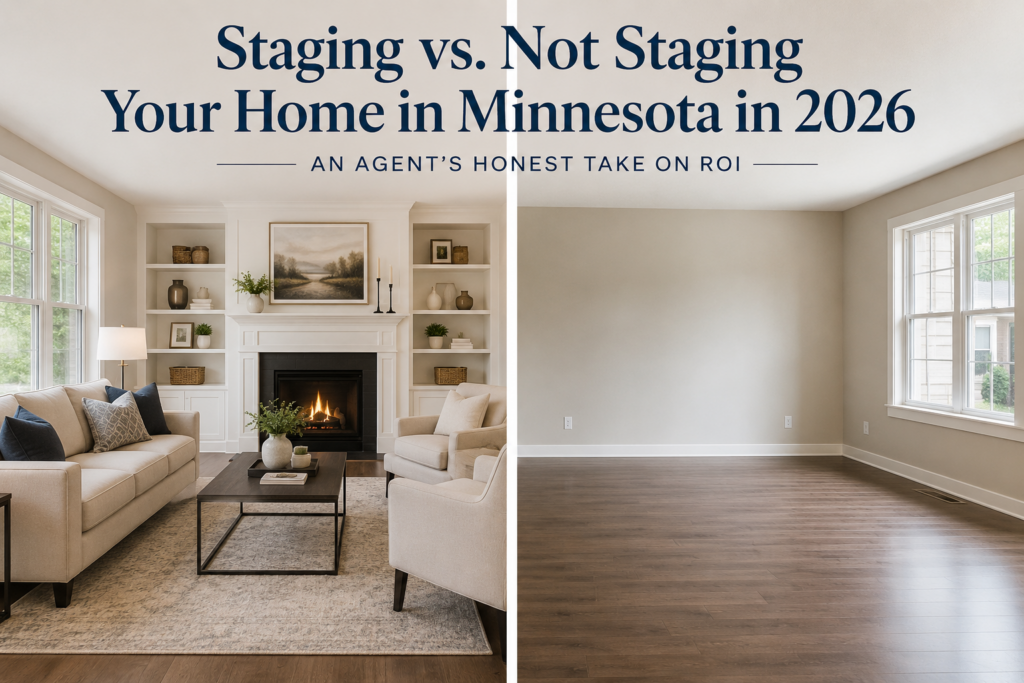
Staging vs. Not Staging Your Home in Minnesota in 2026: An Agent’s Honest Take on ROI

Split image comparing a professionally staged living room with furniture and decor to the same style empty living room, illustrating home staging ROI in Minnesota

Every seller asks some version of the same question: “Do I actually need to stage this place?” It’s a fair question, especially when a full staging job can run into the thousands of dollars. After watching staged and unstaged homes hit the market across the Twin Cities all year, I can tell you the honest answer isn’t yes or no — it’s “it depends on your home, your price point, and your competition.” Let’s talk through the real home staging ROI picture for Minnesota sellers in 2026, without the sales pitch.

What Staging Actually Costs in the Twin Cities

Full-service staging (a professional coming in and furnishing empty or awkward rooms) typically runs $2,000–$6,000 for a first month in a mid-size Twin Cities home, depending on square footage and how many rooms need furniture versus a simple refresh. Consultation-only staging, where a stager walks through your already-furnished home and tells you what to move, remove, or rearrange, is far cheaper — often $150–$400 for a two-hour visit. Vacant homes cost the most to stage because everything from the sofa to the artwork has to be brought in and rented monthly.

For context on how these costs measure against typical resale numbers, Redfin’s housing market data is a solid, current benchmark for Twin Cities price trends by neighborhood.

The Case for Staging: Where It Pays Off

Staging earns its keep in a few very specific situations. Vacant homes are the clearest case — empty rooms photograph poorly, make spaces feel smaller than they are, and give buyers nothing to picture their own life inside. Higher-priced listings ($500K and up) are another spot where staging tends to pay for itself, because buyers at that price point expect a move-in-ready, magazine-quality presentation and will mentally deduct for anything that looks dated or unfinished. Awkward layouts — a bonus room with no obvious purpose, a basement that’s half-finished, a formal dining room nobody uses anymore — also benefit from staging, since a stager’s job is essentially to answer the buyer’s unspoken question: “what would I even do with this space?”

When Staging Isn’t Worth the Money

On the flip side, I’ve watched plenty of sellers spend money on staging that didn’t move the needle. If your home is already tastefully furnished and decluttered, a full staging job is often overkill — a two-hour consultation to fine-tune what you already have will get you 90% of the benefit for a fraction of the cost. Starter homes and homes priced under roughly $300K in competitive Twin Cities suburbs like Plymouth or Prior Lake also tend to sell fast on price and location alone; buyers in that range are often more forgiving of a lived-in look, especially in a tight inventory market. And if your timeline is short or your home is going to sell primarily on land value or a teardown/renovation basis, staging dollars are usually better spent elsewhere — like a fresh coat of paint or fixing a known inspection issue.

4 Factors That Actually Determine Your Staging ROI

1

Whether the Home Is Vacant or Occupied

Vacant homes see the biggest lift from staging because there’s simply nothing for buyers to compare their imagination against. Occupied homes usually need editing, not furnishing.

2

Price Point and Buyer Expectations

The higher the price, the more polish buyers expect. A $700K Edina listing and a $280K Prior Lake starter home are playing by different rules entirely.

3

How Competitive Your Local Market Is

In neighborhoods with tight inventory, buyers will look past cosmetic flaws. In slower or more saturated pockets, staging becomes a real differentiator against similar listings.

4

The Home’s Layout and Quirks

Unusual or ambiguous spaces benefit most from staging’s core job: showing buyers exactly how to use a room they wouldn’t otherwise know what to do with.

DIY Staging: Getting 80% of the Benefit for Almost Nothing

If a full staging budget isn’t in the cards, you can get most of the visual benefit yourself. Declutter aggressively — pack away a third of what’s in every room, including closets, since buyers open them. Depersonalize by putting away family photos and strong personal decor choices so buyers can picture themselves there instead of you. Fix the small stuff a stager would flag anyway: burnt-out bulbs, scuffed walls, cluttered countertops. And don’t underestimate curb appeal — for many Twin Cities buyers, the first impression happens in the driveway, not the entryway. None of this requires a stager’s invoice, just a weekend and a willingness to pack a few boxes early.

So, Should You Stage?

The honest answer: it depends on your specific home, price range, and market — which is exactly the kind of judgment call a good local agent should be helping you make, not a blanket rule from a blog post. An agent who knows your neighborhood’s current competition can tell you in five minutes whether staging dollars will come back to you at closing or whether that money is better spent elsewhere. If you’re getting ready to sell and want a second opinion on staging (or anything else in your prep list), MinnMatch can connect you with a vetted local agent who’ll walk your home and give you a straight answer — free, with no pressure to hire the first person you talk to.

For more on how the Minneapolis Area Realtors track local market conditions that influence pricing and presentation decisions, visit mplsrealtor.com.

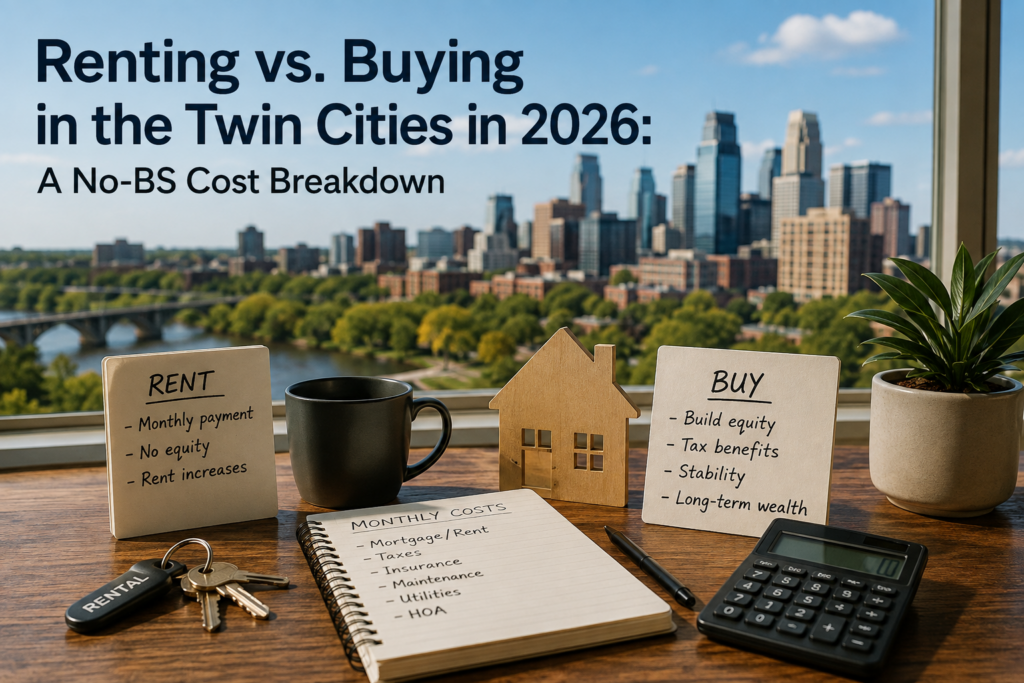
Renting vs. Buying in the Twin Cities in 2026: A No-BS Cost Breakdown

Rent vs. buy comparison notes with Minneapolis skyline, house model, and calculator on desk

Every spring and fall, the same debate fires back up around Twin Cities kitchen tables: is it actually smarter to keep renting, or is it finally time to buy? Most articles on this topic stop at “here’s what a mortgage payment looks like versus rent” and call it a day. That’s not the full picture. The real question isn’t just what you’ll pay each month — it’s how long you’d need to stay in a home before buying actually beats renting on a dollar-for-dollar basis. That’s called the break-even point, and once you know yours, the rent-vs-buy decision gets a lot less confusing.

3–5 Years
Typical break-even point for Twin Cities buyers before ownership costs outpace renting
2–5%
Typical closing costs as a share of purchase price in Minnesota
1–2%
Annual home value typically set aside for maintenance and repairs
6.5–7%
Range for 30-year fixed mortgage rates in the Twin Cities in 2026
Sources: Freddie Mac Primary Mortgage Market Survey, Minneapolis Area REALTORS® (MAAR), Minnesota Housing Finance Agency

The Real Monthly Cost: Renting vs. Buying Side by Side

On paper, a mortgage payment on a median-priced Twin Cities home can look similar to — or even lower than — rent on a comparable property. But that comparison only tells half the story. A rent check is usually the entire cost of housing for the month. A mortgage payment is just the beginning. Once you add property taxes, homeowners insurance, PMI (if your down payment is under 20%), and a realistic maintenance reserve, the true monthly cost of owning is almost always higher than the mortgage payment alone — especially in the first few years.

That doesn’t mean buying is a bad move. It means the comparison has to include the full cost stack, not just the headline mortgage number, before you can honestly say which option wins for your situation.

Hidden Costs Nobody Warns You About

These are the line items that rarely make it into a quick online rent vs. buy calculator, but they matter a lot when you’re figuring out your actual break-even point.

1
Closing Costs on the Way In
Buyers in Minnesota typically pay 2–5% of the purchase price in closing costs — loan origination fees, title insurance, appraisal, and recording fees. On a $375,000 home, that’s roughly $7,500 to $18,750 before you’ve unpacked a single box.

2
Maintenance and Repairs
Plan on setting aside 1–2% of your home’s value every year for upkeep. Minnesota’s freeze-thaw cycles are especially hard on roofs, driveways, and foundations, so this isn’t a line item to skip.

3
Selling Costs on the Way Out
When you eventually sell, expect to pay roughly 6–8% of the sale price in agent commissions, closing costs, and any pre-sale repairs. This is the cost that makes short-term ownership expensive — you’re paying to get in and paying to get out.

4
Opportunity Cost of Your Down Payment
Money tied up in a down payment isn’t earning returns elsewhere. That’s not a reason to avoid buying — but it is a real cost that a simple rent-vs-mortgage comparison leaves out entirely.

Calculating Your Break-Even Point

Here’s the simplified version: add up your buying costs in and out (closing costs plus selling costs), and figure out how many months or years of “savings” versus rent it takes to cover that gap. For most Twin Cities buyers in 2026, that break-even point lands somewhere between three and five years, depending on the neighborhood, loan terms, and how fast local home values are appreciating.

If you’re confident you’ll stay put for five-plus years, buying tends to win comfortably — you have time to build equity and let appreciation absorb the transaction costs. If you might relocate for a job or life change within two to three years, renting is often the more financially sound move, even if the monthly numbers look close. You can check current sale price trends by neighborhood on Redfin’s Minneapolis housing market page to get a sense of appreciation in your target area.

When Renting Actually Wins in 2026

There’s no shame in renting being the smarter move — sometimes it just is. Renting tends to come out ahead when you’re not sure how long you’ll stay in the Twin Cities, when your down payment savings are thin (making PMI or a higher rate eat into your monthly budget), or when you’re in a season of life where flexibility matters more than building equity. It can also be the better call in neighborhoods where rents are unusually low relative to purchase prices — worth checking against current listing data before assuming buying is automatically the “grown-up” choice.

First-time buyers who do want to move forward despite a thinner down payment should also look into Minnesota-specific assistance programs through the Minnesota Housing Finance Agency, which can shift the math in your favor even without a full 20% down payment.

So, Rent or Buy in 2026?

The honest answer is: it depends on your break-even point, not just your monthly budget. Run your own numbers — how long you plan to stay, what a comparable rental actually costs, and what closing and selling costs look like for the neighborhoods you’re considering. According to Minneapolis Area REALTORS®, local market conditions can shift that break-even window by a year or more depending on the suburb, so this isn’t a one-size-fits-all calculation.

If you’re leaning toward buying and want to know what your break-even point would realistically look like in a specific Twin Cities neighborhood, that’s exactly the kind of conversation a local agent can walk you through in five minutes flat. MinnMatch connects you with a vetted local agent — free, no algorithm, no pressure — who can run the real numbers for your situation and help you decide with confidence. If you’re earlier in the process and just want to understand how matching works, our how it works page walks through it in two minutes.

Is the Twin Cities Real Estate Market Going to Shift in Fall 2026? What the Data Says

Notebook reading "Twin Cities Real Estate Market Fall 2026 Outlook" with Minnesota cutout, coffee, and market trend charts

Every August, the same question starts popping up in group chats and open houses across the metro: is the market finally about to turn? With fall right around the corner, the Twin Cities real estate market fall 2026 outlook is getting a lot of attention — and this year, there’s actually some real data behind the question, not just seasonal nerves. Let’s walk through what’s happening right now, what the numbers say is coming, and what it means whether you’re buying, selling, or just watching from the sidelines.

$370K
Minneapolis median sale price
6.65%
30-year fixed mortgage rate
7-Yr High
Twin Cities housing inventory
20-45
Days on market (by area)

Sources: Redfin, Freddie Mac PMMS, Minneapolis Area Realtors (as of August 2026)

What the Data Is Actually Showing Heading Into Fall

Let’s start with what we know for sure. According to Redfin, Minneapolis homes sold for a median of $370,000 over the three months ending in June 2026, up about 2.5% from the same period last year, with the typical home going under contract in around three weeks. At the same time, Minneapolis Area Realtors reported that Twin Cities inventory hit a seven-year high in July, even as new listings and closed sales climbed to four-year highs for the month. That’s an unusual combination — more homes for sale AND more homes selling, all while mortgage rates stayed elevated.

Mortgage rates, meanwhile, have been drifting in a narrow band. Freddie Mac’s weekly survey put the 30-year fixed rate at 6.65% as of late August, slightly higher than the 6.58% average from a year ago. Rates haven’t collapsed, but they haven’t spiked either — and that steadiness is a big part of why this fall doesn’t look like a repeat of the whiplash years of 2022 and 2023.

Four Signs the Twin Cities Real Estate Market Fall 2026 Shift Is Real

1
Inventory keeps climbing
Seven-year-high inventory means buyers have more to choose from than they’ve had in a long time. More choices usually means less pressure to overbid, which nudges a market toward balance.

2
Days on market are stretching out
Depending on the source and submarket, homes are taking anywhere from about three to six-plus weeks to sell. That’s still competitive in some pockets, but it’s a real change from the multiple-offers-in-48-hours pace of a few years ago.

3
Seller incentives are creeping back
Closing cost help and rate buydowns are showing up in more listings across the metro. Sellers offering incentives is usually a sign they’ve noticed buyers have leverage again — a hallmark of a shifting market.

4
Rates are steady, not falling
Steady-but-elevated rates keep some would-be buyers on the sidelines through fall, which tends to slow demand just enough to let inventory keep building rather than getting soaked up.

What a “Shift” Would (and Wouldn’t) Look Like

Here’s the part that gets lost in a lot of the fall real estate headlines: a shift in the Twin Cities real estate market doesn’t mean a crash. Prices are still up year-over-year almost everywhere in the metro. What’s shifting is the balance of power between buyers and sellers, not the value of homes themselves. A more balanced market usually looks like: homes sitting for a few extra weeks, sellers pricing more realistically instead of banking on bidding wars, and buyers actually having room to negotiate on things like inspection repairs or closing dates. That’s very different from the kind of correction that shows up in a recession — and nothing in the current data points to that.

What This Means If You’re Buying This Fall

If you’ve been priced out or burned out from competing on offers the past couple of years, this fall is genuinely one of the more forgiving windows we’ve seen in a while. More inventory means more time to actually see a home before deciding, and sellers who’ve been sitting on the market a bit are often more open to covering closing costs or negotiating on price. That said, well-priced homes in popular areas like Edina, Eden Prairie, and parts of South Minneapolis are still moving fast — this isn’t a market where you can assume every listing will wait for you.

What This Means If You’re Selling This Fall

Selling in a market with rising inventory means you’re competing with more listings than sellers faced a year or two ago. Pricing accurately from day one matters more than it used to — homes that come out overpriced tend to sit, get stale, and eventually chase the market down with price cuts. On the flip side, buyer activity is still solid, and homes priced right for their neighborhood are still selling in a reasonable timeframe. The sellers who do best this fall tend to be the ones working with an agent who understands their specific submarket, not just metro-wide averages.

Navigating Whatever the Market Does Next

The honest answer is that the Twin Cities real estate market fall 2026 data points to a gradual rebalancing, not a dramatic shift in either direction. That’s actually good news — it means there’s time to make a thoughtful decision instead of a rushed one. The trickiest part is that conditions vary a lot block by block and suburb by suburb, which is exactly why so many buyers and sellers lean on a local agent instead of trying to read national headlines. Whatever the Twin Cities real estate market fall 2026 numbers end up doing month to month, the smartest move is still the same: work with someone who knows your neighborhood cold. If you want a clearer read on what’s happening in your specific neighborhood, MinnMatch can match you with a vetted local agent who tracks these numbers block by block, not just at the metro level. And if you’re curious how the matching process works before you commit to anything, our how it works page walks through it step by step.

Edina MN August 2026: Market Snapshot & Why High-End Buyers Are Still Active

Edina MN luxury home on tree-lined street with landscaped front yard


Minnesota’s housing market spent this summer loosening up — inventory just hit its highest point in seven years, and buyers across the metro finally have room to breathe. But drive through Country Club, Indian Hills, or Interlachen Bluff on a Saturday afternoon and you’ll see something that doesn’t quite match the statewide headline: for-sale signs coming down almost as fast as they go up. Edina’s luxury market isn’t following the same script as the rest of the Twin Cities, and understanding why is the key to making a smart move here before fall.

Here’s where the Edina real estate market actually stands heading into late summer 2026 — and why high-end buyers are still writing offers when so much of the metro has gone quiet.

The August 2026 Numbers for the Edina Real Estate Market

Statewide, Minnesota’s housing supply just reached a seven-year high, and July’s data confirmed what agents have felt on the ground all summer: buyers have options again. Minnesota’s median sale price climbed to roughly $375,000, and across the Twin Cities metro the median rose to about $408,000 — up modestly year-over-year even as more homes sit on the market longer.

Months of supply across the metro now sits close to 2.8, and mortgage rates hovering near 6.7% are keeping plenty of would-be buyers on the sidelines, particularly at the entry level. That’s the backdrop. But Edina’s luxury tier — generally the $900K-and-up range — is quietly absorbing that same environment differently. Well-prepared homes in the city’s premier pockets are still fielding multiple showings in the first week and closing at or above list, even as days-on-market averages tick upward metro-wide.

August 2026 Snapshot — Twin Cities & Edina

$408,000

Twin Cities Median Sale Price

7-Year High

Statewide Housing Inventory

2.8 mo.

Twin Cities Months of Supply

~6.7%

Average Mortgage Rate

Sources: Minneapolis Area Realtors, Minnesota Housing Market Report, July 2026

Why Edina Luxury Buyers Aren’t Waiting for Fall

Every year there’s a theory that buyers will pull back once school starts and pumpkin spice season hits. In most price tiers, activity does taper. But the late-summer luxury buyer in Edina tends to be moving for reasons that don’t bend around the calendar the way a typical move does:

1

Executive Relocations on a Corporate Clock

A meaningful share of Edina’s upper-bracket buyers are relocating for corporate roles with start dates that don’t care about the season. When a company sets a September start, the home search follows that timeline, not the Realtor calendar — and it puts these buyers in a position to move decisively on the right property.

2

Families Racing the School Year

Edina Public Schools remain one of the biggest draws to the city, and families who want their kids enrolled and settled before the first bell will push hard through August rather than wait. That urgency shows up directly in offer timelines — buyers touring on a Tuesday and writing by the weekend.

3

Cash and Low Rate-Sensitivity

A rate near 6.7% changes the math dramatically at $450,000. It barely moves the needle at $1.4 million, especially for buyers paying cash or putting down 40%+. That insulation from rate pressure is a big part of why Edina’s top tier keeps transacting while entry-level activity cools.

4

Empty Nesters Downsizing on Their Own Timeline

Longtime Edina homeowners moving into single-level living or a smaller footprint aren’t tied to a school calendar at all. Many intentionally list and buy in late summer specifically to avoid competing with the spring rush — a quieter market can mean less noise and more serious buyers on both sides of the transaction.

Where the Activity Is Concentrated Right Now

Indian Hills and Interlachen Bluff continue to draw buyers seeking privacy, mature landscaping, and proximity to Interlachen Country Club — inventory here is thin enough that well-marketed listings are still generating competing offers even in August.

Concord and Creek Valley remain the go-to for families prioritizing school proximity, offering some of the most reliable resale performance in the city thanks to consistent demand from the school-year-motivated buyer pool described above.

Country Club is holding its position as Edina’s flagship address, and late-summer listings here have skewed toward relocation and executive buyers who need to close quickly and don’t have the luxury of waiting for a better-timed spring launch.

Data from Redfin’s Edina listings shows most homes across the city are still moving within roughly 45 days and fielding multiple offers — but that pace is meaningfully faster in these pocket neighborhoods than the city-wide average suggests, which is exactly the kind of nuance a generic online estimate will never surface.

“Minnesota’s housing market continued building momentum in July as both buyer and seller activity trended toward a more balanced market.”

— Minneapolis Area Realtors, August 2026 Market Report

What This Means If You’re Selling in Edina This Month

A metro-wide inventory surge sounds like bad news for sellers, and in many price bands it is — more competition, longer market times, softer negotiating position. But if your Edina home is priced and prepared for the luxury tier, the buyer pool right now skews toward people who need to move, not people who are casually browsing. That’s a favorable dynamic, provided the home is genuinely ready to show.

The risk is pricing off spring comps that no longer reflect where the broader market has landed. With statewide inventory at a seven-year high, buyers touring your home have more alternatives than they did in March — which makes accurate, hyperlocal pricing more important than ever, not less.

If you’re weighing whether to list now or wait until next spring, the MinnMatch seller process starts by connecting you with a vetted Edina agent who can walk your home and give you a straight answer based on what’s actually moving in your specific neighborhood right now.

What This Means If You’re Buying in Edina This Month

August has a reputation as a quiet buying window, and for most of the metro that reputation is fair. In Edina’s luxury tier, don’t count on it. The buyers you’re competing against are frequently pre-approved, motivated by a hard deadline, and less price-sensitive than a typical buyer in this rate environment — which means a home you love could still see a competing offer within days.

The upside: rising metro-wide inventory does mean more choices overall, and sellers who’ve been sitting on market since spring are more willing to negotiate on price, closing costs, or timeline than they were a few months ago. An agent who knows which Edina listings are genuinely motivated versus just testing the market is worth their weight in this environment.

Explore the Edina community guide or see how MinnMatch helps buyers get matched with a vetted local agent, free of charge.

Local Expertise Matters More When the Market Splits Like This

The gap between “Minnesota inventory hits a seven-year high” and “Country Club homes are still fielding multiple offers” is exactly the kind of nuance that a national headline or an algorithmic home-value estimate will flatten out completely. Edina isn’t one market moving in one direction — it’s a collection of neighborhoods, each responding to the same statewide data in a different way.

That’s why MinnMatch doesn’t rely on an algorithm to pair you with an agent. We act as a recruiter or matchmaker, evaluating your specific situation — neighborhood, price range, timeline — and connecting you with a handpicked Edina agent from our vetted local network. It’s free for buyers and sellers, and it starts with a conversation, not a form. See how it works.

Thinking about a move in Edina before fall?

MinnMatch matches you with a vetted, local Edina real estate agent — at no cost to you. No algorithms, no generic referrals. Just the right agent for your specific situation.

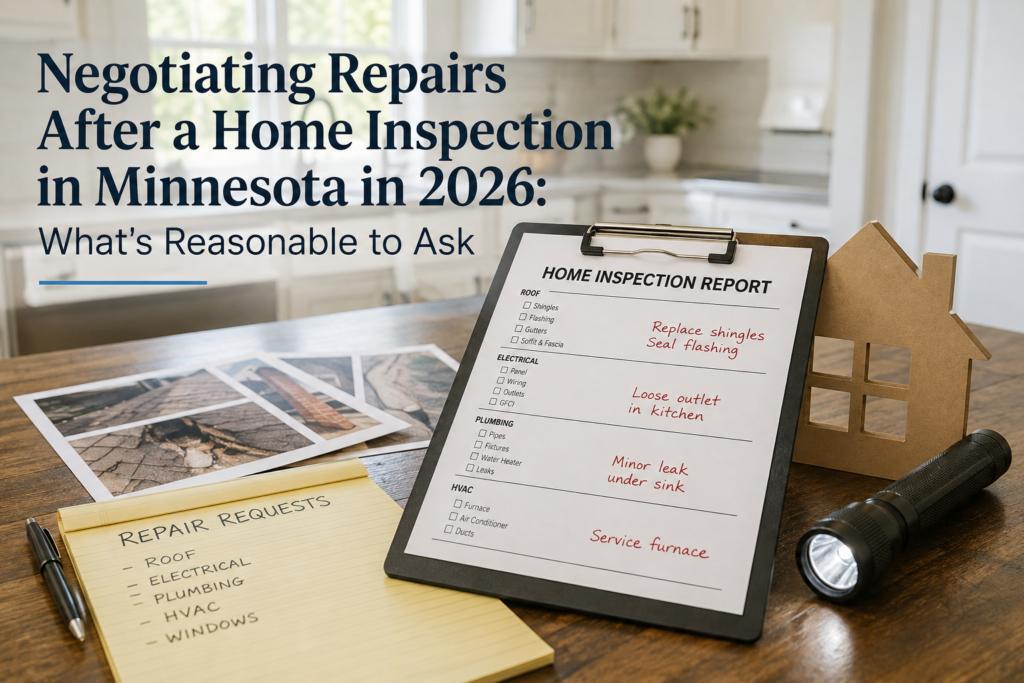
Negotiating Repairs After a Home Inspection in Minnesota in 2026: What’s Reasonable to Ask

Home inspection report on clipboard with handwritten repair requests for roof, electrical, plumbing, and HVAC in a Minnesota kitchen

The inspection is done, the report has landed in your inbox, and it’s twelve pages of photos, moisture readings, and phrases like “recommend further evaluation.” Take a breath. Almost every Minnesota home inspection turns up something — that’s what inspectors are for. The real skill isn’t finding a home with zero issues; it’s knowing which ones are worth a fight and which ones you should let go so the deal, and the relationship with your seller, stays intact. Negotiating repairs after inspection is one of the most consequential — and most misunderstood — steps in buying a house here, and getting it right takes a mix of local knowledge and a level head.

What “Reasonable” Actually Means When Negotiating Repairs After Inspection

Minnesota’s standard inspection contingency isn’t a punch list — it’s a safety valve. It exists so a buyer isn’t stuck closing on a house with a cracked foundation or knob-and-tube wiring they didn’t know about. That framing matters when you’re deciding what to negotiate. Safety issues, code violations, and anything affecting the structure, roof, electrical, plumbing, or major systems are almost always fair game. Peeling paint on a 1920s trim board, a scuffed garage floor, or a dated bathroom vanity generally aren’t — those are things you accounted for (or should have) when you made your offer.

A useful gut check: would this issue affect whether the home is safe, habitable, or insurable? If yes, it belongs in your repair request. If it’s really about taste or wear you noticed after the fact, it’s better handled with a contractor after closing than with a seller before it. This is the mental filter to run through every item on the report before you start negotiating repairs after inspection with the seller.

The Issues Minnesota Inspectors Flag Most Often

Some findings show up again and again in Twin Cities inspection reports, and each one carries its own negotiating logic:

Radon. This is the one that catches out-of-state buyers off guard. Roughly two in five Minnesota homes test above the EPA’s action level of 4.0 pCi/L, largely because of the uranium-bearing glacial soils under most of the state. A high radon reading isn’t a reason to panic or walk — mitigation systems typically run in the low four figures and work well. It is, however, a completely standard and reasonable thing to ask a seller to install or credit before closing.

Roof and ice dam damage. Our freeze-thaw winters are hard on roofs, and inspectors regularly flag ice-dam-related shingle damage, soffit rot, or inadequate attic ventilation. If a roof is at or near the end of its life, or there’s evidence of active water intrusion, that’s a legitimate repair or credit request — not a nitpick.

Aging mechanicals. A furnace, water heater, or electrical panel that’s original to a 1970s or ’80s home and clearly failing is fair to negotiate. One that’s simply older but still functioning and passing inspection usually isn’t — you can’t ask a seller to replace something just because it’s not new.

Sump pumps and water intrusion. With our water table and clay-heavy soils in parts of the metro, a nonfunctional sump pump or signs of past basement water are worth addressing before closing, especially in homes near lakes or in low-lying areas.

Older wiring and plumbing. In pre-1960s homes across South Minneapolis, St. Paul, and other established neighborhoods, knob-and-tube wiring or galvanized plumbing can affect insurability, which gives you real negotiating leverage — insurers sometimes won’t write a policy until it’s addressed.

Repairs, Credits, or a Price Reduction: Choosing Your Ask

Once you’ve decided what’s worth raising, you generally have three ways to ask for it, and each has trade-offs:

Ask the seller to complete the repair. This works well for defined, licensed-contractor jobs — a radon mitigation system, an electrical panel upgrade — where you want it done correctly before you own the problem. The trade-off is quality control: you’re trusting the seller to hire someone competent on a deadline, and you should ask for receipts or a licensed contractor’s invoice as proof.

Ask for a closing cost credit. This is often the cleanest option — the seller reduces what they’re contributing at closing, and you handle the repair yourself with a contractor you trust, on your own timeline. It’s usually the preferred route for anything where quality of work matters more than speed.

Ask for a straight price reduction. Less common, but sometimes used for bigger-ticket items where both sides just want to simplify and move forward without haggling over contractor estimates.

Whichever route you choose, get a couple of contractor quotes before you name a number. A repair request backed by a real estimate is taken far more seriously than one based on a guess — and it’s one of the simplest ways to strengthen your position when negotiating repairs after inspection.

Structuring the Ask Without Blowing Up the Deal

Minnesota purchase agreements built on the standard Minnesota Association of REALTORS® forms give you a defined inspection contingency window, and your repair request typically goes to the seller as a formal amendment within that timeframe. A few habits make the process smoother for everyone:

Prioritize your list. Leading with three or four legitimate, well-documented issues lands better than a fifteen-item wish list that buries the real concerns in cosmetic noise. Sellers — and their agents — tend to respond defensively to a laundry list and reasonably to a short, specific one.

Know your walk-away point before you send the request. If the seller declines or only partially agrees, Minnesota’s inspection contingency generally allows you to cancel the purchase agreement and have your earnest money returned, provided you’re acting within the contingency period. Deciding in advance what you’d actually walk away from keeps the negotiation from becoming personal.

Expect some back-and-forth. In a balanced or buyer-leaning market, sellers are often willing to address safety and major-system items to keep the deal moving. In a competitive, multiple-offer market, buyers sometimes waive repair requests entirely to stay attractive — which is exactly why it’s worth thinking through your inspection strategy before you write an offer, not after. Redfin’s market data can give you a read on how much negotiating leverage buyers currently have in your area before you decide how hard to push.

Let Someone Who Negotiates This Weekly Handle It

Reading an inspection report is one thing; knowing what a Wayzata seller will actually agree to versus what a St. Paul seller will, or how a listing agent typically responds to a radon credit request, is a different kind of knowledge — the kind that comes from doing this negotiation dozens of times a year in your specific market. That’s exactly the gap a locally connected buyer’s agent closes. MinnMatch’s free agent-matching service connects you with a vetted Twin Cities agent who knows how repair negotiations actually play out neighborhood by neighborhood — not just what the contract allows, but what’s realistic to ask for and win. If you’re not sure how the matching process works, our how it works page walks through it in a couple of minutes, and there’s never a cost to you as a buyer.

South Minneapolis August 2026: Prices, Pace & the Neighborhoods Getting the Most Attention

Tree-lined South Minneapolis street with front-porch homes, featured image for August 2026 market update

August in South Minneapolis usually means the market starts to exhale a little — and 2026 is no exception. But “slower” doesn’t mean “slow.” Minneapolis home prices are still edging upward, well-priced homes are still moving fast in the right pockets, and buyers who spent the spring getting outbid are finding a market that’s finally giving them a little room to breathe. Here’s where South Minneapolis real estate actually stands this month — prices, pace, and which neighborhoods are pulling the most buyer attention right now.

South Minneapolis Real Estate Prices This Month

Citywide, Minneapolis homes have sold for a median price in the $370,000–$375,000 range over the past several months, roughly 2–3% above where the market stood a year ago. But that number flattens a lot of very different realities across South Minneapolis, so it’s more useful as a floor than a forecast.

The southwest lake corridor — Linden Hills, Fulton, Lynnhurst, and Tangletown — continues to trade well above the citywide median, with single-family homes commonly landing in the $600,000s and up, and lakefront or lake-adjacent properties regularly clearing $1 million. Kingfield and the blocks just east of Lake Harriet run 15–25% below that southwest tier for comparable homes, which is exactly why buyers priced out of Linden Hills keep landing there. Nokomis and Longfellow sit further below the citywide median, offering 1920s-era bungalows and Tudors with genuine lake or park access at a price point that’s simply out of reach in the lake district. Powderhorn remains one of the most attainable entry points in the city for buyers who want South Minneapolis character without the southwest-corner price tag.

Because sample sizes shrink fast once you narrow to a single neighborhood in a single month, treat any specific block-by-block number as a range rather than gospel — and lean on an agent who’s actually tracking that pocket of the South Minneapolis real estate market for a real read.

Market Pace: Who’s Moving Fast, Who’s Taking Their Time

Pace is where South Minneapolis really splits into two markets. Well-priced homes in the southwest corner — Linden Hills, Fulton, and the streets ringing Lake Harriet — are still routinely going pending within the first weekend or two, with multiple offers common on anything move-in ready. Longfellow and the neighborhoods east of the Mississippi typically take a bit longer, often two to four weeks to pending, which gives buyers more time to actually see a house twice before deciding.

Zoom out to the metro level and the pace has cooled from the frenzy of a few years ago: Minneapolis homes are selling in around three weeks on average, with roughly three offers per listing and a sale-to-list ratio just above 100% — meaning the typical home is still selling slightly above asking, but nowhere near the bidding-war intensity of peak 2021–2022. Minneapolis Area Realtors reported inventory hitting its highest level in seven years heading into August, which is giving buyers more to choose from and taking some of the sharpest edges off the competition — even in neighborhoods that are still moving quickly.

The Neighborhoods Getting the Most Attention Right Now

Three pockets stand out for buyer attention this August:

Kingfield has become a real destination rather than a fallback. Buyers who can’t stretch to Linden Hills or Fulton prices are landing here on purpose, drawn by the same walkable dining and 1920s housing stock at a meaningfully lower entry point. Listings that show well are getting serious, fast attention.

Longfellow is pulling families priced out of the lake district who still want Craftsman character and genuine park access — Minnehaha Falls and the regional park are a real draw, not just a listing bullet point. It’s showing up more often as a second-choice-turned-favorite for buyers who started their search further west.

Nokomis continues to offer the best combination of lake access and price restraint in South Minneapolis. It won’t match Linden Hills dollar-for-dollar, but for buyers who want to live near water without a water-view price tag, it’s consistently one of the first neighborhoods agents point to.

What This Means If You’re Buying or Selling

According to Minnesota Housing, statewide inventory growth is part of a broader trend toward more balanced conditions heading into fall — South Minneapolis is simply an earlier example of it. If you’re selling in the southwest corner, the market still rewards you — but rising inventory means pricing accurately from day one matters more than it did a year ago. Overpriced listings are starting to sit, even in Linden Hills. If you’re buying in Longfellow, Nokomis, or Kingfield, August’s slightly thinner competition and longer decision windows are a real opening compared to what buyers faced in April and May.

Either way, South Minneapolis real estate isn’t one market — it’s a handful of them stacked next to each other, each with its own price tier and pace. That’s exactly why matching with an agent who knows your specific neighborhood, not just the citywide averages, makes the difference between a smooth close and a frustrating summer. MinnMatch can connect you with a vetted South Minneapolis agent who already knows which blocks are moving fast this month — free for buyers and sellers, no algorithm guesswork involved.

Working with a Buyer’s Agent in Minnesota in 2026: What to Expect from Search to Close

Buyer's agent meeting with a couple at a kitchen table, reviewing home listings and paperwork in Minnesota

If you’ve never bought a home before — or it’s been a decade since the last one — you might picture a buyer’s agent as someone who mostly unlocks doors and emails listings. In practice, working with a buyer’s agent in Minnesota looks a lot more like having a project manager, a negotiator, and a translator for state-specific paperwork all rolled into one person. And in a 2026 market where Twin Cities inventory is still tight in the most popular suburbs, having someone who knows the local playbook can be the difference between losing three offers and landing the right home on the first or second try. Here’s what the relationship actually looks like, stage by stage, from your first conversation to the day you get your keys.

What a Buyer’s Agent in Minnesota Actually Does for You

In Minnesota, a buyer’s agent represents your interests — not the seller’s — throughout the transaction, and in the vast majority of cases that representation costs you nothing directly, since the fee is typically built into the deal and paid out of the seller’s proceeds. Beyond scheduling showings, a good buyer’s agent in Minnesota tracks new listings before they hit the major search sites, pulls comparable sales to help you land on a fair offer price, and flags red flags in a home’s history — things like a past well or septic issue, an old truth-in-housing report, or a neighborhood with pending assessments. They also coordinate with your lender, the title company, and the listing agent so you’re not the one chasing down paperwork on a deadline.

Getting Started: Your First Meeting with a Buyer’s Agent

The first real conversation with a buyer’s agent in Minnesota usually covers three things: your budget and financing, your must-haves versus nice-to-haves, and your timeline. This is also when most agents will ask whether you’re pre-approved yet — and if you’re not, a good one will point you toward a local lender before you tour a single home, since Minnesota sellers rarely take an offer seriously without a pre-approval letter attached. Some agents will ask you to sign a buyer representation agreement at this stage, which is standard practice in Minnesota and simply spells out how you’re working together and how the agent gets paid. It’s worth reading closely and asking questions before you sign — a trustworthy agent will walk you through it line by line rather than rush you past it.

The Home Search: How Your Agent Narrows the Field

Once your search criteria are set, your buyer’s agent should be doing real filtering work — not just forwarding every listing that technically matches your search filters. That means factoring in things generic portals miss: which Plymouth or Eden Prairie streets flood in spring, which Prior Lake school boundaries are about to shift, or which South Minneapolis blocks have seen the most recent renovation activity. This is also where local market knowledge pays off in dollars. An agent who’s active in your target suburb will have a feel for which homes are priced to move and which are testing the market, and can help you avoid wasting a Saturday touring a house that’s going to sit — or missing one that will sell in 48 hours.

Making an Offer and Negotiating in Minnesota’s 2026 Market

Once you’re ready to write an offer, your agent should walk you through the Minnesota purchase agreement clause by clause — not just the purchase price, but the earnest money amount (commonly 1–2% of the purchase price and due within a day or two of an accepted offer), the inspection contingency window, and the closing date. Minnesota buyers typically have around ten days to complete inspections once an offer is accepted, so your agent should already have inspector recommendations lined up before you’re under contract, not scrambling afterward. If multiple offers come in on the same home, this is where an experienced buyer’s agent earns their keep — helping you decide where to be flexible (closing date, minor repair credits) and where to hold firm, rather than simply advising you to offer more money every time.

From Accepted Offer to Closing Day: What Happens Next

Between an accepted offer and closing, most Minnesota transactions run about 30 to 45 days, and a lot happens behind the scenes: the inspection, the appraisal, loan underwriting, and title work. Minnesota doesn’t require an attorney at closing — a title company can handle it — but your buyer’s agent should be able to tell you when bringing one in makes sense, such as for a complicated title issue or an unusual contract. In the final days before closing, your agent should schedule your final walk-through, confirm your Closing Disclosure matches what you expected, and make sure you know exactly what to bring to the table. Closing itself typically takes an hour or two, and then the keys are yours.

Finding the Right Buyer’s Agent for You

Not every buyer’s agent in Minnesota is a fit for every buyer — someone who’s excellent for a Wayzata lakefront purchase may not be the right person for a first-time buyer eyeing a starter home in South Minneapolis. That’s the exact problem MinnMatch was built to solve: instead of guessing from a list of strangers online, you talk with a real person who matches you with a local, vetted agent based on your suburb, price range, and what you’re actually looking for — at no cost to you. If you’re getting ready to start your search, you can get matched with a Twin Cities buyer’s agent in just a few minutes.

Sources: Minnesota Attorney General’s Home Buyer’s Handbook, Minneapolis Area Realtors, Redfin Minneapolis Market Data

South Minneapolis vs. Edina in 2026: Urban Energy vs. Suburban Comfort

Split image comparing South Minneapolis urban street with mural and coffee shop to Edina suburban street with tree-lined homes, text reads South Minneapolis vs. Edina in 2026, Urban Energy vs. Suburban Comfort

Ten minutes can separate two completely different ways of living in the Twin Cities. Head south from downtown Minneapolis and you land in the city’s lake-chain neighborhoods — Nokomis, Longfellow, Linden Hills — where coffee shops, bike trails, and front-porch culture define daily life. Keep driving west and the city gives way to Edina, where tree-lined cul-de-sacs, top-rated schools, and the polish of 50th & France take over. The South Minneapolis vs Edina question comes up constantly with buyers who love the Twin Cities but can’t decide whether they want to live in the middle of it or a comfortable distance away. Here’s how the two compare in 2026.

South Minneapolis: Urban Energy, Walkability & Culture

South Minneapolis is really a collection of distinct neighborhoods strung along the Chain of Lakes and the Mississippi River, and that variety is part of the draw. Longfellow and Nokomis offer 1920s bungalows a short bike ride from Lake Nokomis and Minnehaha Falls. Linden Hills and Tangletown lean more polished, with walkable retail strips and easy access to Lake Harriet. Powderhorn and Kingfield bring a grittier, more eclectic energy — think independent coffee shops, ethnic restaurants, and a younger buyer pool.

What ties it together is walkability. Many South Minneapolis blocks score in the 70s and 80s on Walk Score, and the neighborhood sits inside the city’s chain of lakes and parkway system, which means green space and water access without leaving the urban grid. Buyers who want restaurants, nightlife, and transit within walking distance — without giving up a yard entirely — tend to land here. It’s a big part of why the South Minneapolis vs Edina debate comes up so often: the two areas sit less than fifteen minutes apart but feel like entirely different cities.

Edina: Suburban Comfort, Space & Top-Rated Schools

Edina trades urban density for space and consistency. Lots tend to be larger, streets are quieter, and the housing stock skews newer or more recently renovated than much of South Minneapolis. The Edina school district is one of the strongest draws for families, which shows up directly in demand and pricing in neighborhoods that feed into it.

Edina isn’t one-note, either. Morningside and the areas near 50th & France offer a more walkable, small-town feel with boutique shopping and restaurants a short walk from home. Country Club and Indian Hills lean more formal and established, with mature trees and larger, architecturally distinct homes. Buyers who want suburban predictability — good schools, quiet streets, easy parking — without driving all the way out to the western suburbs often settle on Edina as the closer-in alternative.

South Minneapolis vs Edina: Price Comparison

South Minneapolis covers a wide price spread depending on the neighborhood. Longfellow and Nokomis have been trading in roughly the $280,000–$400,000 range for typical single-family homes, while Linden Hills and Southwest Minneapolis run considerably higher, often $500,000–$600,000+ for updated homes near the lakes. Citywide, Minneapolis has been trading around a $370,000 median, according to Redfin’s Minneapolis market data.

Edina sits meaningfully higher across the board. Depending on the source and month, Edina’s median sale price has been landing in the $600,000–$750,000 range, with entry-level condos near Southdale starting lower and estate properties well above $1 million. That premium reflects both the school district and the consistency of the housing stock — buyers are paying for predictability as much as square footage. For neighborhood-level detail, the Minneapolis Area REALTORS market reports are a good source for current numbers by ZIP code.

Which Is Right for You?

If daily life without a car, proximity to lakes and restaurants, and a more eclectic neighborhood feel matter most, South Minneapolis usually wins — and it does it at a lower entry price than Edina in most pockets. If top-tier schools, more space, and quieter streets are the priority, and budget allows for the premium, Edina is hard to beat. Plenty of buyers cross-shop both before deciding, especially those coming from out of state who aren’t yet sure how much “city” they actually want.

Either way, the right call in the South Minneapolis vs Edina decision usually comes down to lifestyle fit more than price alone — which is exactly where a local agent who knows both markets earns their keep. According to U.S. Census data, Edina’s population skews slightly older and more family-oriented than the city core, which tracks with what buyers tend to find on the ground. If you’re weighing South Minneapolis against Edina and want an agent who can walk you through both honestly, MinnMatch can match you with someone who knows the trade-offs on both sides of this decision, not just the one they happen to sell in.

Prior Lake MN August 2026: End-of-Summer Market Conditions & What’s Coming in Fall

Prior Lake MN lakefront dock at sunset with boat, late summer 2026

Labor Day is closing in, the kids are back in school, and the Prior Lake real estate market is settling into the pattern it follows every year at this point in the calendar: still busy, still competitive in the right price bands, but noticeably calmer than the frenzy of June. If you’ve been watching Prior Lake and Spring Lake listings all summer and wondering whether to make a move now or wait for fall, here’s what’s actually happening on the ground in Scott County right now — and what the next couple of months are likely to bring.

Where the Prior Lake Real Estate Market Stands in Late Summer

Depending on which data source and which slice of the past year you’re looking at, Prior Lake’s median sale price has landed anywhere from the high $400,000s to the mid $500,000s, with per-square-foot pricing hovering around $190–$230. That spread isn’t a red flag — it’s just what happens in a city this size when the sample includes everything from starter townhomes near Downtown Prior Lake to sprawling lakefront estates on the water. Homes are typically going under contract in a little over a month, which is longer than the sprint pace of April and May, but still faster than a truly balanced market. According to Redfin’s Prior Lake market data, home prices are still running ahead of where they were a year ago, even as the pace of sales has eased off its summer peak.

Why Things Feel Different Than They Did in June

This slowdown isn’t a sign of trouble — it’s the same seasonal rhythm Prior Lake sees every year. Families with school-age kids raced to close before the first day of class, which pulled a lot of demand forward into June and July. Once school starts, that urgency evaporates, showings thin out on weeknights, and sellers who list in late August tend to be more serious and more motivated than the ones who tested the market back in spring. For buyers, that combination — fewer competing offers, more realistic sellers — is one of the more underrated windows of the year to actually get an accepted offer without an escalation clause attached.

Waterfront Considerations on Prior Lake and Spring Lake

Prior Lake’s identity as a lake town shapes its housing market more than almost anything else. The city sits on two connected recreational lakes, and homes with direct lake access, especially on the main body of Prior Lake, routinely command a premium over otherwise comparable properties a few blocks inland. Late summer is a particularly telling time to shop the waterfront segment: sellers who list a lake home in August are usually motivated to close before the boat comes out of the water for the season, and buyers get to see the property at its best, dock and all, rather than imagining it under snow. If lake living is the whole point of your search, this is a stretch of the calendar worth paying close attention to.

What’s Likely Coming as Fall Sets In

Expect the usual fall pattern for the Prior Lake real estate market: new listings will slow down through September and October, days on market will stretch out a bit further, and price growth should moderate compared to the spring run-up. Mortgage rates remain the wildcard — Freddie Mac’s weekly rate survey is worth bookmarking if you’re timing a purchase, since even modest rate moves change what a given monthly payment buys in a market where inventory is still relatively tight. Prior Lake isn’t likely to see a dramatic shift in either direction; it’s more a gradual cooling than a reset, which is exactly the kind of environment where a well-prepared buyer can find real leverage.

Should You Buy Now or Wait for Fall?

There’s no single right answer, but the case for acting in the next few weeks is a reasonable one: less competition than spring, sellers who are increasingly ready to negotiate, and lake properties still showing well before the season turns. The case for waiting until true fall is just as reasonable if you want even more negotiating room and don’t mind a smaller pool of listings to choose from. Either way, the Prior Lake real estate market rewards buyers who understand its seasonal cadence rather than treating every month like it’s June. For current, verified listing activity, the Minneapolis Area REALTORS MLS data is the most reliable source of truth beyond the national aggregators.

If you’re weighing a move in Prior Lake this fall — whether that’s a lakefront listing on Spring Lake or a starter home closer to downtown — a local agent who actually knows this submarket makes the difference between guessing and knowing. MinnMatch can connect you with a vetted Prior Lake specialist for free — no algorithm, just a real match based on what you’re actually trying to do. Find your Prior Lake agent match here.