Prior Lake MN Summer 2026: Why This Scott County City Is Still Minnesota’s Best-Kept Secret

Couple walking along a lakeside trail in Prior Lake MN with homes, docks, and a pontoon boat visible across the water on a sunny summer evening

If you’ve spent any time exploring the Twin Cities’ south metro, you already know that Prior Lake punches above its weight. Anchored by two interconnected recreational lakes, surrounded by trails and parks, and priced noticeably below the Lake Minnetonka corridor, Prior Lake MN summer 2026 has quietly become one of the most compelling buyer markets in Scott County. Whether you’re chasing waterfront living, top-rated schools, or simply more square footage for your dollar, this city rewards buyers who take it seriously.

Prior Lake MN Summer 2026: What the Market Actually Looks Like

The Prior Lake housing market heading into summer 2026 remains active and competitive, though the pace is more measured than the frenzied years of 2021–2022. Average home values in Prior Lake sit around $526,000, up roughly 3% over the past year — steady appreciation without the volatility that rattled many other metro markets. Median sold prices have been running in the low-to-mid $490s depending on the month and product type, with list prices for move-up and waterfront properties trending higher.

Inventory remains tight. In early 2026, Prior Lake was tracking around 1.8 months of supply — well below the 4–6 months that typically signals a balanced market. That means well-priced, move-in-ready homes are still moving quickly, and buyers who show up prepared with financing lined up are the ones landing the deals. Days on market have been running in the 33–48 day range depending on price point, which tells a nuanced story: the right home in the right condition still generates real competition, while overpriced listings sit longer than sellers expect.

Scott County’s overall affordability edge compared to Hennepin County remains one of Prior Lake’s strongest selling points. Buyers priced out of Edina, Minnetonka, or Wayzata often discover they can get more space — and in many cases actual lake access — by shifting their search south and west. That dynamic continues to drive demand into 2026. For current listings and market data, Minneapolis Area Realtors publishes monthly updates for the broader metro.

The Lakes: Why Summer in Prior Lake Is Something Different

Prior Lake’s name isn’t metaphorical — the city genuinely revolves around its water. Upper and Lower Prior Lake connect to form the largest lake system in the south metro, and Spring Lake sits just upstream. Together these three bodies of water support a summer lifestyle that most Twin Cities suburbs simply can’t replicate at Prior Lake’s price point.

On the water, residents and visitors have access to boating, fishing, paddleboarding, kayaking, and sunset cruising. The city maintains two public swimming beaches — Sand Point Beach and Watzl’s Beach, both on Lower Prior Lake — along with six public fishing docks scattered around the lake system. Sand Point sits adjacent to the primary DNR boat launch, making it one of the busiest and most family-friendly spots on the lake all summer long.

Beyond the main lakes, Cleary Lake Regional Park — operated jointly by Scott County and the Three Rivers Park District — offers a motor-free lake experience with canoe, kayak, and paddleboard rentals, a swimming beach, a campground, a 9-hole golf course, and a 28-acre off-leash dog area. It’s the kind of place that makes Prior Lake feel like a destination rather than just a bedroom community.

Worth knowing for buyers eyeing lakefront property: Lower Prior Lake and Spring Lake have permanent slow no-wake zones within 150 feet of shore, enforced by the Scott County Sheriff’s Office. That regulation tends to keep the lake quieter and more family-friendly than some comparable markets — a genuine lifestyle factor worth weighing.

Community Life: What Summer Actually Feels Like Here

One of the things buyers discover after moving to Prior Lake is how much the community actually does together. Summer has a rhythm here that’s hard to find in newer, more sprawling suburbs.

The Prior Lake Farmers Market runs Saturdays from 8 a.m. to noon, May through early October, giving residents a reliable anchor to the weekend. Free summer concerts at Lakefront Park run through the season — the 2026 lineup includes performances in May, June, July, and August, held at Lakefront Park (5000 Kop Parkway SE). Lakefront Music Fest in July is the signature event, drawing crowds from across the south metro for headliner performances and family activities.

Prior Lake Days, the city’s beloved late-summer festival, brings live music, food trucks, local vendors, a Kids’ Zone, and the fan-favorite Cornhole Tournament to Main Street. And for families, Valleyfair in neighboring Shakopee is a 15-minute drive — close enough for a spontaneous Tuesday, far enough that it doesn’t overwhelm the neighborhood.

Downtown Prior Lake — centered on Main Avenue SE — has held onto a genuine walking strip in an era when many suburbs have lost theirs. Boathouse Brothers, Charlie’s on Prior, PLate, and local shops anchor the strip. The Prior Lake Farmers Market is a Saturday-morning ritual for much of the city. It’s the kind of downtown that new residents discover and then can’t imagine living without.

Schools, Parks, and the Infrastructure Buyers Care About

Prior Lake is served by Prior Lake-Savage Area Schools (PLSAS), an E-STEM district that earned an overall A grade from Niche for 2026 and ranks among the top 20 school districts in Minnesota. Prior Lake High School, located in Savage, holds an A-minus grade from Niche and ranks #32 among the best public high schools in Minnesota — with nearly 2,900 students, a 21:1 student-teacher ratio, and a 49% AP participation rate. Elementary standouts include Hamilton Ridge, Jeffers Pond, and Twin Oaks Middle School.

As with many districts post-pandemic, PLSAS has faced budget pressures and community debate — Niche reviews reflect a range of parent perspectives. Buyers with school-age children are encouraged to tour schools and speak with current families before drawing conclusions from any single data source.

On parks, the city has approved a $60 million parks investment plan for improvements over the next 20-plus years — a meaningful signal about the community’s commitment to long-term livability. Prior Lake currently maintains 51 parks, including Lakefront Park, which hosts trails, tennis and pickleball courts, an ice rink, a sledding hill, playgrounds, fishing docks, and kayak rentals. For families drawn to the outdoors, this is genuinely one of the better-equipped park systems in the south metro.

What Buyers Should Know Before Making an Offer

Prior Lake is not a market where buyers can afford to be casual. With inventory running well below balanced levels and summer typically bringing renewed competition, preparation matters.

Get pre-approved before you start touring. In this market, waiting until you’ve found “the one” to call a lender is too slow. A fully underwritten pre-approval letter — not just a pre-qualification — makes a real difference when you’re competing against other buyers.

Understand what you’re buying on lakefront. Waterfront properties in Prior Lake vary significantly based on deeded lake access, shoreline footage, dock rights, and applicable slow no-wake regulations. An agent who knows the Prior Lake lake market isn’t a luxury — it’s a necessity. The difference between direct frontage and association-managed access can be tens of thousands of dollars and an entirely different lifestyle.

First-time buyers: check your MHFA options. Minnesota Housing Finance Agency programs — including the Start Up loan and various down payment assistance programs — are available to eligible buyers in Scott County. These programs can meaningfully reduce the upfront cost of entry. See current programs at mnhousing.gov.

Price-per-square-foot awareness helps. Median price per square foot in Prior Lake has been running around $189–$241 depending on property type and location — a meaningful range. Knowing where a specific home falls within that range helps buyers assess value quickly rather than relying on list price alone.

For a deeper look at how Prior Lake compares to other lake markets, check out our Lake Minnetonka vs. Prior Lake comparison — it breaks down price, lifestyle, and commute tradeoffs side by side. And if you’re exploring other south metro options, our Prior Lake community page has neighborhood detail and agent resources.

Ready to explore Prior Lake? The right agent makes a genuine difference in a market this specific — especially if you’re eyeing lake access, navigating school district boundaries, or trying to move quickly when the right home appears.

Connect with a vetted Prior Lake agent through MinnMatch → It’s free, there’s no obligation, and we only work with agents who know this market well.
Plymouth vs. Minnetonka: Which Suburb Delivers More for Your Money in 2026?

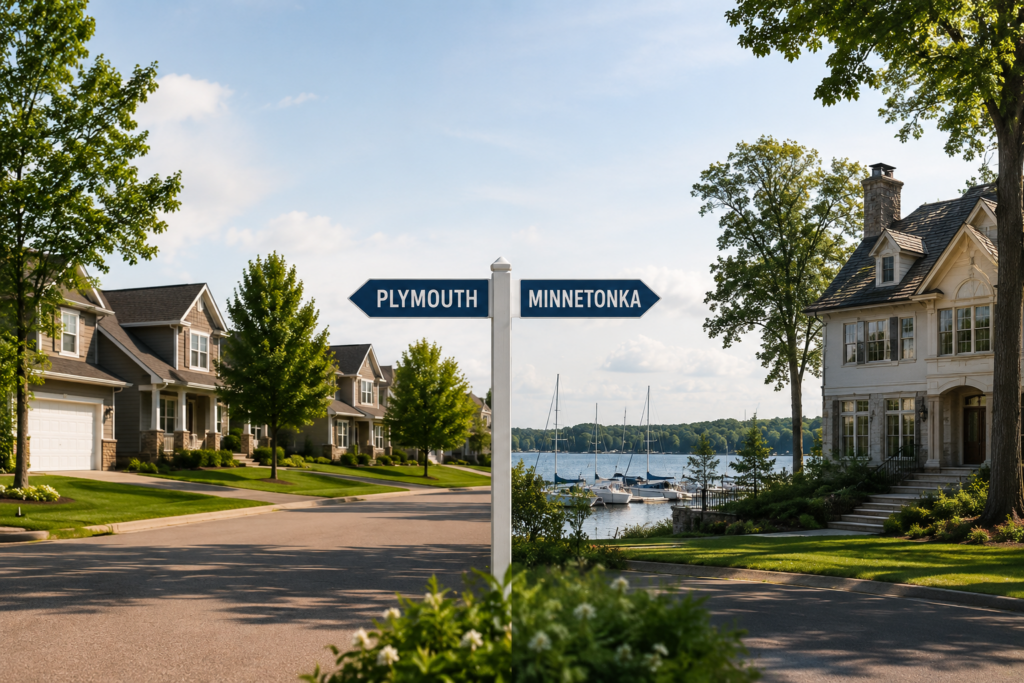
Street sign pointing toward Plymouth suburban homes and Minnetonka lakefront living in the Twin Cities

If you’re searching for a home in the western Twin Cities suburbs, Plymouth and Minnetonka are probably both on your list — and for good reason. Both sit within a short drive of downtown Minneapolis, both offer excellent schools, and both are packed with parks, lakes, and the kind of quiet neighborhood feel that draws families out of the city. But they’re not the same place, and in 2026, the differences between them matter. Price points, lifestyle, lot sizes, commute dynamics, and school district lines all play a role in the Plymouth vs. Minnetonka comparison. Here’s what you need to know before you decide.

Home Prices: What Does Your Budget Actually Buy in Each Suburb?

This is where the Plymouth vs. Minnetonka conversation gets real. According to data from Minneapolis Area Realtors®, Minnetonka’s median sales price in April 2026 was approximately $507,500 — up about 1.3% year-over-year. Plymouth, by comparison, has a median closer to $485,000–$500,000 in recent months, depending on the data source and time period. That gap may sound modest, but in practice, it plays out in meaningful ways across different price bands.

In Plymouth, buyers in the $400,000–$500,000 range can typically access a solid four-bedroom single-family home in an established neighborhood, often with a larger lot. Minnetonka at the same price point trends toward townhomes, smaller ramblers, or older homes that need updating — especially in neighborhoods closest to the lake. Buyers willing to go north of $600,000 in either city will find more overlap, but Minnetonka still commands a premium in its most coveted pockets.

Market pace differs as well. Minnetonka is running hot — Redfin data shows many homes going pending in around 17 days, and roughly a third of homes selling above asking price in recent months. Plymouth is somewhat more measured, with homes averaging closer to 30–55 days on market depending on price point and neighborhood, and sale-to-list ratios just under 100%. That means Plymouth buyers may have slightly more room to negotiate, while Minnetonka buyers should be ready to move quickly and compete.

Schools: Two of Minnesota’s Best Districts — but Different Ones

If schools are driving your suburb search, this section matters enormously — because Plymouth and Minnetonka are served by different districts, and both rank at the very top of Minnesota’s rankings.

Most of Plymouth falls within the Wayzata Public School District (ISD 284), which Niche named the #1 school district in Minnesota for 2026 — the third consecutive year it has earned that ranking. Wayzata High School, which is actually located in Plymouth, consistently ranks among the state’s top public high schools. The district earned A+ ratings across nearly every Niche category and places in the top 1% of all public school districts statewide based on test scores.

Minnetonka is served by the Minnetonka Public School District (ISD 276), which Niche ranked #2 in Minnesota for 2026. Minnetonka Senior High School ranks #3 among all public high schools in the state. The district serves more than 10,900 students and is the most sought-after for open enrollment in Minnesota — a meaningful signal of its reputation. With programs including International Baccalaureate, AP courses, K-12 language immersion, and over 100 clubs and activities, it’s an academically rich environment.

Bottom line: you’re splitting hairs here. Both districts are genuinely elite. Families may find the tie-breaker comes down to specific program offerings, proximity, or which high school campus feels right for their kids.

One important note: a portion of Plymouth falls within the Robbinsdale School District (ISD 281) rather than Wayzata. Always verify school boundaries by address before making any decisions based on school district.

Location and Commute: Closer to the Lake vs. Closer to the City

Plymouth and Minnetonka sit about 9 miles apart — and both are positioned for a reasonable commute to downtown Minneapolis. Plymouth, located approximately 12 miles northwest of downtown, connects quickly via I-394 and Highway 55, with a typical non-rush commute of around 20 minutes. Minnetonka sits about 12–15 miles west of downtown, also served by I-394, with similar commute times to much of the city — though western Minnetonka neighborhoods closer to Lake Minnetonka will add a few more minutes.

Plymouth also benefits from its own transit system — Plymouth Metrolink — which runs direct bus routes to downtown Minneapolis and the University of Minnesota on weekdays. It’s a useful option for households that prefer to leave one car behind on their commute days.

Where Minnetonka pulls ahead is proximity to Lake Minnetonka itself. For buyers who want easy access to the lake — whether that’s a boat slip, shoreline walks, or dining on the water at Excelsior or Wayzata — southern Minnetonka neighborhoods put you closest to all of it. Plymouth has its own exceptional park system and Medicine Lake to enjoy, but if the lake lifestyle is central to your vision, Minnetonka’s geography serves that better.

Lifestyle and Character: Two Suburbs, Two Distinct Feels

Plymouth is one of the Twin Cities’ most populous suburbs — home to more than 80,000 residents — and that scale comes with real advantages. The city has invested heavily in its park and trail system, offers Medicine Lake for swimming and non-motorized boating, and hosts a well-rounded retail and restaurant scene. It tends to attract families who want a well-organized, community-oriented suburb with newer housing stock, strong civic infrastructure, and a feeling of continued growth.

Minnetonka has a different rhythm. It’s a more established suburb, with a diverse mix of housing — from modest mid-century homes to sprawling custom builds — spread across a geography shaped by creeks, wetlands, and the rolling terrain of the Lake Minnetonka watershed. Neighborhoods like Ridgedale, Glen Lake, and Minnetonka Mills each have their own character. Minnetonka also sits adjacent to Ridgedale Center and Ridgedale-area dining, making it feel connected and convenient despite its more tucked-in residential feel.

Both suburbs score well for safety, green space, and quality of life. The deciding factor usually comes down to personal preference: Plymouth buyers often value scale, newer construction, and a more expansive park system. Minnetonka buyers tend to be drawn by neighborhood character, lake proximity, and the feel of a suburb that’s already grown into itself.

Which Suburb Delivers More for Your Money in 2026?

Strictly on a price-per-square-foot and value basis, Plymouth offers a slight edge — particularly for buyers in the $400,000–$550,000 range who prioritize square footage, newer builds, and the #1-ranked school district in Minnesota. You’ll generally find more home for your dollar, a somewhat less competitive market, and newer neighborhoods that offer consistent quality across a wide range of price points.

Minnetonka earns its premium for buyers who want lake-area lifestyle, neighborhood character, and proximity to the communities along Lake Minnetonka. The Minnetonka school district is the second-best in Minnesota and among the strongest in the country. And if you’re drawn to a suburb that feels more layered and established, Minnetonka has a lot to offer.

For most families making a purely financial decision, Plymouth is likely the stronger value play in 2026. For buyers where lifestyle and lake access weigh heavily, Minnetonka may be worth the higher entry price. In either case, knowing which neighborhoods within each city match your budget and priorities makes all the difference — and that’s exactly where working with a local agent pays off.

Not Sure Which Suburb Is Right for You?

MinnMatch connects Twin Cities buyers with local agents who know Plymouth and Minnetonka inside and out — the right neighborhoods, the right price points, and the right fit for your family. It’s free, it’s personal, and it’s built for Minnesota.

Find Your Agent — It’s Free

Renting vs. Buying in the Twin Cities in 2026: An Honest Cost Comparison

Renting vs. buying in the Twin Cities in 2026 — apartment building on the left, suburban home on the right, Minneapolis skyline and river bridge in the background

It’s one of the most common questions in personal finance — and in the Twin Cities in 2026, it’s especially loaded. Should you keep renting, or is it finally time to buy? The honest answer depends on more than a monthly payment comparison. It hinges on how long you plan to stay, what you can put down, and what your alternatives to a down payment would earn elsewhere. This guide cuts through the noise and lays out what renting vs. buying in the Twin Cities in 2026 actually costs — line by line — so you can make the call with clear eyes.

What Renting Actually Costs in the Twin Cities Right Now

Renting in the Twin Cities remains meaningfully below the national average, which gives the metro a genuine affordability advantage for renters — at least on the surface. Here’s what the market looks like as of mid-2026:

Unit Type Minneapolis Avg. St. Paul Avg.
Studio ~$1,210/mo ~$1,095/mo
1 Bedroom ~$1,259–$1,512/mo ~$1,149/mo
2 Bedroom ~$1,745–$2,086/mo ~$1,466–$1,764/mo
3 Bedroom ~$2,446/mo ~$2,497/mo

The wide range in Minneapolis reflects the city’s neighborhood-by-neighborhood variation — a one-bedroom in Ventura Village or Camden can be had for well under $1,000, while the same unit in Cedar-Isles-Dean or Linden Hills runs $2,500 or more. Rent across Minneapolis has climbed roughly 4% year-over-year, according to recent tracking data, while St. Paul has been comparatively flat.

For suburban renters, the picture shifts. Renting a two-bedroom house or townhome in Plymouth, Minnetonka, or Eden Prairie typically runs $1,800–$2,400 per month — territory where the buy-vs.-rent math starts to tighten considerably.

It’s also worth noting what renting doesn’t cost you: no property taxes, no homeowners insurance (renters insurance is typically $15–$20/month), no maintenance bills, and no down payment tying up capital. These are real financial advantages, not footnotes.

What Buying Actually Costs in the Twin Cities in 2026

The median home price across Minnesota came in at around $358,700 in early 2026, according to recent MLS data. In the Twin Cities metro specifically, the picture has varied by data source, but most tracking points to a range of $355,000–$390,000 depending on the submarket and property type. The Minneapolis Area Realtors annual report put the 2025 metro median sales price at $390,000 — still well above pre-pandemic levels despite a slowdown in appreciation. Condos and attached townhomes offer lower entry points, often in the $190,000–$280,000 range, while single-family homes in competitive suburbs push well above the metro median.

Here’s what a realistic monthly cost of ownership looks like on a $375,000 home with a 10% down payment ($37,500) and a 6.5% fixed 30-year mortgage rate:

Cost Category Monthly Estimate
Principal & Interest (6.5%, 30yr, $337,500 loan) ~$2,133
Property Taxes (est. 1.12% effective rate) ~$350
Homeowners Insurance (est. avg. ~$165–$200/mo) ~$185
PMI (required under 20% down, est.) ~$125
Maintenance reserve (est. 1% of home value/yr) ~$313
Estimated Total Monthly Cost of Ownership ~$3,106

Estimates are illustrative. Actual costs vary based on purchase price, credit score, loan type, county, HOA fees (if applicable), and individual insurance quotes. Mortgage rates fluctuate — check current rates with an MHFA-approved lender.

At roughly $3,100/month all-in, buying a median-priced Twin Cities home on a 10% down payment runs noticeably higher than renting a comparable unit. That gap is real — and for some households, it’s the right reason to keep renting for now. But the monthly payment comparison is only part of the story.

The Costs That Don’t Show Up in the Monthly Numbers

A fair rent-vs.-buy comparison has to account for costs on both sides that don’t appear in the monthly payment.

Buying: Upfront costs are significant. Closing costs in Minnesota typically run 2–3% of the purchase price — on a $375,000 home, that’s $7,500–$11,250 out of pocket before you move in, on top of your down payment. Buyers using MHFA programs like the Monthly Payment Loan or Deferred Payment Loan can offset some of this, but it remains a meaningful hurdle. Learn more about homebuying resources on MinnMatch, including how to use state programs to reduce these costs.

Renting: Your down payment has opportunity cost. The $37,500 that stays in your pocket as a renter (the 10% down payment in our example) can be invested. At a conservative 6–8% annual return, that capital compounds significantly over time. Renters who invest the difference between rent and what ownership would cost are often better off financially — at least in the short run.

Buying: You build equity. Every mortgage payment builds ownership stake in an asset that, historically, appreciates. Twin Cities home values have risen meaningfully over time, even accounting for periods of volatility. Renters build no equity; 100% of rent goes to the landlord.

Renting: Maintenance is not your problem. A new HVAC system, a roof replacement, a failed water heater — these are landlord expenses when you rent. Homeowners absorb them. The 1% annual maintenance estimate in the table above is a long-run average; in any given year, actual costs can swing dramatically higher.

Buying: Rent increases don’t apply to you. A fixed-rate mortgage payment stays the same for 30 years. Minneapolis rents climbed roughly 4% last year. Over a decade, that compounding rent growth adds up — and can eventually make a fixed mortgage look very cheap by comparison.

The Break-Even Horizon: How Long Before Buying Makes Sense?

The single most important variable in any rent-vs.-buy analysis is how long you plan to stay. Buying a home and selling it within two to three years almost always results in a financial loss, once you account for closing costs on both ends and the front-loaded interest on your mortgage.

As a general framework for the Twin Cities market in 2026:

  • Under 3 years: Renting almost always wins. Transaction costs alone consume most or all of the appreciation you’d gain.
  • 3–5 years: The math becomes situational. Buyers who put 20% down, found a well-priced home in a stable neighborhood, and see modest appreciation may come out ahead — but it’s not guaranteed.
  • 5–7+ years: Buying tends to win, assuming typical appreciation and rent increases. The equity you’ve built, combined with rising rent comparisons, increasingly tilts the long-run calculus toward ownership.

It’s worth noting that in 2025, by mid-year, the typical first-time buyer in the U.S. was 40 years old — a record high, according to the Minneapolis Area Realtors annual report. Buyers are taking longer to pull the trigger, often because the monthly cost gap is real. But many of those same buyers are finding that continued renting delays the equity clock — and the longer you wait, the further prices tend to move.

Scenarios Where Renting Still Makes More Sense

Buying isn’t always the right move, regardless of what the long-run math says. Renting tends to be the smarter choice when:

  • You’re uncertain about your job stability or expect a relocation within two to three years
  • Your credit score is below 640 and you’d qualify for a less favorable rate — buying time to improve it often pays off
  • You don’t have enough saved for a down payment plus closing costs plus a maintenance reserve
  • You’re new to the Twin Cities and haven’t yet figured out which neighborhood or suburb fits your life
  • You genuinely value flexibility — career pivots, family changes, lifestyle exploration — and ownership would constrain that

None of these make you financially unsophisticated. They make you realistic — and renting intentionally while building toward ownership is a completely sound strategy. The Minnesota Housing Finance Agency (mnhousing.gov) offers homebuyer education and pre-purchase counseling that can help you build a clear timeline even if you’re 12–24 months out from being ready.

Scenarios Where Buying Makes More Sense in 2026

Conversely, 2026 presents genuine buying opportunities for the right household:

  • You plan to stay in the Twin Cities for five or more years and have found a neighborhood that fits your life
  • You’re currently paying $2,000+ per month in rent for a unit that’s smaller than what you’d buy — the monthly gap narrows considerably at that level
  • You qualify for MHFA programs that can meaningfully reduce your upfront costs and down payment burden
  • You’re building a family and want stability, control over your space, and a fixed housing cost
  • You want to lock in a rate before potential policy or market shifts affect affordability further

In suburbs like Plymouth, Minnetonka, and Eden Prairie — where quality rental housing in family-appropriate sizes runs $2,000–$2,400/month — the monthly gap between renting and buying shrinks considerably. At that level, the equity you’d build as an owner starts to look a lot more compelling. Explore our community guides for Plymouth, Minnetonka, and Eden Prairie to see what the current market looks like in each suburb.

Not Sure If You’re Ready to Buy? Let’s Figure It Out Together.

MinnMatch connects Twin Cities buyers with experienced local agents who can walk you through the real numbers in your specific situation — no pressure, no generic advice. Whether you’re ready to move now or planning for a year from now, a quick conversation can clarify a lot.

See How MinnMatch Works →

Eden Prairie MN Summer 2026: Best Parks, Lakes & Outdoor Living That Buyers Love

Couple jogging on a lakeside trail in Eden Prairie MN with a kayaker on the water and homes visible across the lake on a sunny summer day

If you’ve ever spent a summer evening at Staring Lake, watching kayakers glide past and kids splash at the beach while the trails hum with joggers and dog-walkers, you already know what Eden Prairie does best. This southwest metro suburb has always punched above its weight on livability — and its outdoor amenities are a huge reason why. For buyers who want a home and a lifestyle, summer 2026 is an ideal time to take a closer look at Eden Prairie. The parks are in full swing, the lakes are calling, and the real estate market rewards buyers who act decisively.

17 Lakes, 4,500 Acres, and More Than 225 Miles of Trails

The numbers tell a striking story. The City of Eden Prairie maintains more than 4,500 acres of open space wetlands, 17 lakes, 100+ ponds, and over 1,000 acres of active parkland — all inside a single suburb. Bikers, hikers, and runners enjoy more than 225 miles of sidewalks and trails that connect neighborhoods to parks, lakes, and open space corridors.

For buyers, that translates into something you can feel the moment you start touring homes: backyards, cul-de-sacs, and neighborhood streets that spill naturally into green space. Whether you’re a runner logging morning miles, a family looking for a safe place to ride bikes after dinner, or a remote worker who needs a noon walk to reset, Eden Prairie’s outdoor living infrastructure is genuinely built in — not bolted on.

The Parks Eden Prairie Buyers Keep Coming Back To

Not all suburban parks are created equal. Eden Prairie’s standouts offer the kind of amenity mix that keeps families returning all season long:

Staring Lake Park is the crown jewel of the city’s park system and one of the most well-loved green spaces in the Twin Cities metro. Set along the lake of the same name, it features a swimming beach, boat and canoe rentals, an off-leash dog park, a boat launch, disc golf, picnic areas, and a full trail loop around the lake. It’s also home to the city’s Outdoor Center, which runs nature programs, family drop-in events, and seasonal workshops for kids and adults throughout the summer.

Bryant Lake Regional Park, operated by Three Rivers Park District, sits on the western edge of Eden Prairie and offers water skiing, sailing, canoeing, and kayaking, plus a swimming beach and a full-service boat launch. It’s a magnet for water sport enthusiasts and one of the few regional parks in the metro where you can launch a sailboat right from the park.

Round Lake Park brings a more neighborhood-friendly vibe — a beach shelter, swimming area, and playgrounds make it a go-to for families with young kids. Riley Lake Park on the southeast side offers its own boat launch and a quieter, less-crowded atmosphere. Purgatory Creek Park and Miller Park round out a parks system that gives nearly every neighborhood in Eden Prairie walkable access to something meaningful.

For buyers with kids, the splash pads at several Eden Prairie parks — including accessible, cushioned-surface playgrounds — have become a summer fixture. These aren’t afterthoughts; they’re the kind of amenities city residents fought for and families plan their weekends around.

Outdoor Living Eden Prairie MN Buyers Are Paying a Premium For

Here’s the honest truth for buyers doing their research: homes near Eden Prairie’s parks and lakes command a premium — and they move quickly. The broader Eden Prairie real estate market reflects this demand. Median home values have hovered in the mid-to-high $400s to low $500s depending on the data source, with homes going to pending in as few as 13–27 days. Homes are selling at approximately 98.7% of asking price, and a meaningful share still close above list.

Inventory remains limited — a consistent challenge in Eden Prairie — which means buyers who wait for the “perfect” listing risk missing it entirely. Summer is actually one of the better windows to buy here: more homes come to market between May and August than at any other point in the year, and sellers motivated to close before fall school year begins tend to price realistically.

If you’re comparing Eden Prairie to other southwest suburbs, keep the outdoor lifestyle factor in your calculation. Few communities in the metro offer this density of lakes, trails, and parkland within a walkable radius of residential neighborhoods. That’s a quality-of-life argument that holds its value across market cycles.

Summer Events and Community Life That Buyers Notice

Beyond the parks themselves, Eden Prairie’s summer programming creates the kind of community energy that’s hard to put in a listing description but easy to feel when you’re here. Outdoor concerts, family drop-in programs at the Outdoor Center, youth sports leagues, and water recreation events fill the parks from June through August. The Richard T. Anderson Conservation Area offers a natural counterpoint — quiet prairie and woodland trails for residents who prefer solitude over spectacle.

Eden Prairie’s parks also benefit from ongoing city investment. Active trail extension projects, bridge replacements at Staring Lake, invasive species removal for habitat restoration, and new trail connections along Valley View Road are all part of the city’s 2026 parks improvement agenda. Buyers who purchase now are buying into a system that’s actively getting better.

For families relocating from outside the metro, this is often one of the first things agents mention about Eden Prairie: the parks aren’t just nice — they’re part of the neighborhood identity. Residents here are protective of that green space, which is part of why the city has worked hard to preserve it.

Why Buyers Love Eden Prairie in Summer 2026

The case for buying in Eden Prairie this summer comes down to a combination that’s genuinely hard to replicate elsewhere in the Twin Cities:

  • Outdoor infrastructure that rivals anything in the metro — 17 lakes, 225+ miles of trails, and multiple beach parks within city limits
  • Strong schools with Eden Prairie Schools consistently ranked among the best in the state (Minneapolis Area Realtors data consistently highlights EP’s performance)
  • Proximity to employment — major employers including General Mills, Optum, and C.H. Robinson have campuses within or adjacent to the city
  • A real estate market with staying power — home values in Eden Prairie have demonstrated long-term stability even when broader markets have softened
  • Summer inventory windows — more homes come to market in June–August, giving buyers a wider selection before fall competition picks back up

If you’ve been thinking about making a move to Eden Prairie, the summer months give you a rare chance to evaluate the community at its most vibrant — and then decide while inventory is at its seasonal peak. Don’t wait until September to start a search that should have started in June.

Ready to buy in Eden Prairie this summer?

MinnMatch connects buyers with experienced, vetted local agents who know Eden Prairie’s neighborhoods, parks, and price trends inside and out. It’s free, personal, and built for the Twin Cities.

Find Your Eden Prairie Agent →

Understanding Closing Costs in Minnesota in 2026: What You’ll Pay and How to Negotiate

Closing costs checklist with calculator, house keys, and Minnesota state outline for 2026

Closing day is exciting — but the stack of fees that comes with it can catch buyers and sellers off guard. If you’re buying or selling a home in the Twin Cities or greater Minnesota in 2026, understanding closing costs ahead of time is one of the smartest moves you can make. Between Minnesota’s unique state taxes, lender fees, and negotiable charges, the numbers add up faster than most people expect. Here’s a plain-English breakdown of what you’ll actually pay — and where you might have room to negotiate.

What Are Closing Costs in Minnesota?

Closing costs are the fees and taxes paid at the end of a real estate transaction — on top of the purchase price and down payment. They cover everything from lender processing to title transfers, government recording, inspections, and prepaid insurance. In Minnesota, both buyers and sellers pay closing costs, but the split is decidedly unequal.

According to Edina Realty, the median sales price for a Minnesota home hit approximately $380,000 in early 2026. At that price point, buyers can expect to pay somewhere between $7,600 and $22,800 in closing costs, while sellers are typically looking at $22,800 to $38,000 — a figure that includes real estate commissions.

It’s also important to understand that closing costs and cash to close are not the same thing. Cash to close includes your down payment, prepaid property taxes, homeowners insurance, and initial escrow funding on top of closing costs. The full amount you bring to the table on closing day is typically higher than closing costs alone.

What Minnesota Buyers Pay at Closing

Buyers typically cover the lender-related fees and a handful of government charges. Plan to budget roughly 2% to 5% of the purchase price for closing costs as a buyer — on a $380,000 home, that’s approximately $7,600 to $19,000. Here’s where that money goes:

  • Loan origination fee: Charged by your lender for processing the mortgage. Usually 0.5% to 1% of the loan amount.
  • Appraisal fee: Your lender requires a professional appraisal to confirm the home’s value. Typically $400–$600 in the Twin Cities.
  • Home inspection fee: Not lender-required, but strongly recommended. Expect $350–$500 for a standard single-family home inspection.
  • Mortgage Registry Tax (MRT): This is one of Minnesota’s unique closing costs. Buyers pay a state tax of 0.23% of the loan amount when recording a mortgage. In Hennepin and Ramsey counties, a small additional levy applies. On a $300,000 loan, that’s roughly $690 at the base rate.
  • Title insurance (lender’s policy): Protects the lender against title defects. Required by virtually every mortgage lender.
  • Recording fees: The county charges a fee to officially record the deed and mortgage. Amounts vary by county.
  • Prepaid costs: These aren’t really fees — they’re future costs paid upfront, including homeowners insurance, prepaid mortgage interest, and the initial deposit into your escrow account for property taxes and insurance.

Minnesota’s property tax timing is worth flagging separately. Property taxes in Minnesota are paid in two installments — May 15 and October 15 — and the proration at closing can significantly affect how much cash you bring to the table, depending on when you close. Closing close to one of those due dates can noticeably increase your cash-to-close figure.

What Minnesota Sellers Pay at Closing

Sellers carry the heavier load at closing, primarily because real estate commissions come out of sale proceeds. When commissions are included, Minnesota sellers typically pay 6% to 10% of the sale price in total closing costs. Here’s the breakdown:

  • Real estate commissions: Fully negotiable, but average listing agent fees in Minnesota run around 2.96%, and many sellers still offer to cover the buyer’s agent fee as well. This is often the single largest cost at closing.
  • State Deed Tax (transfer tax): Minnesota charges $1.65 per $500 of the sale price (approximately 0.33%) when transferring the title to a new owner. On a $380,000 home, that’s roughly $1,254 — paid by the seller.
  • Title service fees: The seller typically pays for the title search and transfer, averaging around 0.29%–0.30% of the sale price in Minnesota.
  • Owner’s title insurance: In Minnesota, it’s more common for the seller to purchase the owner’s title insurance policy that protects the buyer. Cost varies based on the sale price.
  • Prorated property taxes: Sellers owe property taxes for the portion of the year they owned the home. This amount is credited to the buyer at closing.
  • Recording fees: Approximately $46 on average in Minnesota, though this varies by county.
  • Escrow/settlement fees: Sellers may pay $500 to $2,000 depending on the provider, property value, and transaction complexity.

If you’re selling in a competitive suburb like Edina, Wayzata, or Eden Prairie, market conditions affect how much of these costs you’ll actually absorb versus shift to the buyer. In a strong seller’s market, you may not need to offer concessions at all.

Minnesota’s Unique Closing Cost Features

Minnesota has a few state-specific closing cost characteristics that differ from many other states — and can surprise first-time buyers and out-of-state relocators:

The Mortgage Registry Tax (MRT). Most states don’t charge buyers a recording tax on their mortgage amount. Minnesota does. At 0.23% of the loan amount (with a small surcharge in Hennepin and Ramsey counties), this is a fixed, non-negotiable cost — but it’s predictable, and you can calculate it exactly once you know your loan amount. For reference, on a $320,000 mortgage, the base MRT is approximately $736.

The State Deed Tax. Minnesota’s deed transfer tax — paid by the seller — is calculated at $1.65 per $500 of the purchase price. It’s one of the non-negotiable, fixed costs that sellers can’t avoid, but they can sometimes negotiate with a buyer to share it.

Two-installment property taxes. Minnesota’s May and October property tax due dates mean that depending on when you close, the proration can feel like a significant unexpected expense — especially for buyers closing in the spring. Review the closing disclosure carefully to understand exactly what you’re prepaying.

For more detail on Minnesota’s transfer and deed taxes, you can reference the Minnesota Department of Revenue.

How to Negotiate Closing Costs in Minnesota

The good news: while state taxes and government fees are fixed, many closing costs are negotiable — or at least shoppable. Here’s where buyers and sellers actually have leverage:

For buyers:

  • Ask for seller concessions. In a buyer-friendly market, sellers can agree to pay a portion of your closing costs — either as a credit at closing or by absorbing certain fees directly. In a competitive market, this is harder to get, but always worth asking.
  • Shop your title company. You have the right to shop for title and settlement services in Minnesota. Get quotes from two or three providers — fees can vary meaningfully.
  • Compare lender fees. Loan origination fees, underwriting fees, and processing fees vary between lenders. Get multiple Loan Estimates and compare Section A and Section B of each one carefully. These are the fees you can negotiate most directly.
  • Consider a lender credit. Some lenders will offer a closing cost credit in exchange for a slightly higher interest rate. Whether this makes sense depends on how long you plan to stay in the home — run the math with your lender.
  • Ask about MHFA programs. The Minnesota Housing Finance Agency (MHFA) offers down payment and closing cost assistance programs for qualifying buyers. If you’re purchasing your first home — or haven’t owned in the past three years — it’s worth checking eligibility.

For sellers:

  • Negotiate your agent’s commission. Real estate commissions are fully negotiable in Minnesota. In a strong seller’s market, there may be room to discuss the rate — especially if your home is priced to move quickly.
  • Review your closing statement carefully. Escrow and settlement fees can vary between providers. Ask your agent to review the closing disclosure line by line — some fees are negotiable or may be in error.
  • Use market conditions as leverage. If you’re selling in a hot market, you may not need to offer buyer incentives at all. In softer conditions, offering to cover a portion of buyer closing costs can be more effective than a price reduction.

Quick Closing Cost Estimates for Twin Cities Home Prices

Here’s a rough snapshot of what buyers and sellers might expect at various Twin Cities price points in 2026, using the typical percentage ranges. These are estimates — your actual costs will vary based on lender, county, and what gets negotiated.

Home Price Buyer Closing Costs (2–5%) Seller Closing Costs (6–10%)
$300,000 $6,000 – $15,000 $18,000 – $30,000
$380,000 $7,600 – $19,000 $22,800 – $38,000
$500,000 $10,000 – $25,000 $30,000 – $50,000
$700,000 $14,000 – $35,000 $42,000 – $70,000

Estimates based on typical Minnesota closing cost ranges. Seller figures include agent commissions. Individual costs will vary.

Work with an Agent Who Knows the Numbers

A great local agent doesn’t just negotiate the purchase price — they help you understand every line on the closing disclosure, flag fees that might be negotiable, and position your offer (or listing) strategically from day one. MinnMatch connects Twin Cities buyers and sellers with vetted, local agents who know the Minneapolis–Saint Paul market inside and out. The service is completely free.

Find Your Agent →

What Does a Real Estate Agent Actually Do? A Minnesota Seller’s Complete Guide

A real estate agent meets with home sellers outside a Minnesota home to discuss the listing process

If you’re getting ready to sell your home in Minnesota, you’ve probably heard that you need a real estate agent — but you may be wondering exactly what a real estate agent does to earn their commission. It’s a fair question. Selling a home is likely the largest financial transaction of your life, and understanding what your listing agent actually does for you is key to making a smart decision. The short answer: a great listing agent does a lot more than put a sign in your yard. Here’s a complete, honest look at the role of a seller’s agent in the Twin Cities — and why the right one makes a real difference.

Pricing Your Home: The Most Important Job a Listing Agent Has

One of the first — and most consequential — things a listing agent does is help you arrive at the right asking price. This isn’t guesswork. Your agent will prepare a Comparative Market Analysis (CMA): a detailed look at recently sold homes in your neighborhood that are similar in size, age, condition, and features to yours. They’ll pull data from the MLS, account for current inventory levels, and factor in local demand conditions.

In the Twin Cities, pricing strategy is everything. The current Minnesota market has roughly 1.4 months of housing inventory — solidly in seller’s market territory — but that doesn’t mean you can price freely. Overpriced homes sit. They accumulate days on market, attract lowball offers, and often sell for less than correctly priced homes would have. An experienced agent knows the difference between a home that’s worth $485,000 and one that needs to be listed at $479,900 to generate the right buyer energy — and that knowledge is worth real money at closing.

Your agent will also provide a seller’s net sheet: an estimate of what you’ll actually walk away with after commissions, closing costs, and any agreed-upon concessions. No surprises at the closing table.

Pre-Listing Prep: What to Fix, Stage, and Skip

Before your home ever hits the market, a good listing agent walks through it with experienced eyes — and tells you the truth. That means identifying which improvements will move the needle with buyers and which ones won’t earn back their cost. In most Twin Cities markets, fresh paint, decluttered spaces, and updated light fixtures deliver far better ROI than a kitchen renovation you started three weeks before listing.

Your agent will advise on staging — whether that means rearranging your existing furniture, bringing in a professional stager, or simply removing personal items to help buyers picture themselves in the space. Staging isn’t decoration; it’s strategy. A well-staged home photographs better, shows better, and typically sells faster and for more money than a comparable home that wasn’t prepared.

They’ll also help you complete your Minnesota Seller’s Property Disclosure Statement — a required document in which you disclose known material defects. Getting this right protects you legally. Agents who know Minnesota disclosure law can guide you through each section and help you avoid costly mistakes down the road.

Marketing Your Home: More Than Just the MLS

This is where listing agents earn significant value — and where there’s a wide range in quality between agents. Listing on the Minneapolis Area Realtors MLS is table stakes. What distinguishes a strong listing agent is how they present and promote your home beyond that baseline.

A full-service listing agent typically coordinates or manages:

  • Professional photography — the single most important marketing asset your listing has. Quality photos drive clicks, showings, and offers. Don’t accept a listing agent who shoots with their phone.
  • MLS listing copy — well-written descriptions that highlight your home’s best features and speak to what Twin Cities buyers in your price range actually care about.
  • Syndication — your listing automatically feeds to Zillow, Redfin, Realtor.com, and hundreds of other sites once it’s on the MLS.
  • Social media and digital advertising — targeted Facebook and Instagram campaigns that reach qualified buyers in your area.
  • Agent-to-agent networking — veteran agents have relationships with buyer’s agents across the metro and sometimes bring buyers to a property before it officially hits the market.
  • Open houses and showings — coordinating and hosting open houses, fielding showing requests, and gathering feedback from buyers after tours.

The goal of all this activity is simple: get as many qualified buyers through the door as possible, as quickly as possible. More competition among buyers means stronger offers for you.

Offer Review and Negotiation: Where Good Agents Pay for Themselves

When offers come in, your agent doesn’t just hand them to you and say “take it or leave it.” They analyze each offer’s full picture: price, earnest money, financing contingencies, inspection contingency terms, proposed closing date, and any special requests or conditions. In a competitive market, you might receive multiple offers — and the highest number on paper isn’t always the best offer.

Your agent advises on which offer structures are strongest, when to counter and how, and whether to ask for a highest-and-best round from multiple buyers. They understand financing red flags (an offer with a weak pre-approval from an unknown lender deserves more scrutiny than a cash offer or a well-documented conventional loan), and they know how to negotiate terms — not just price — to protect your interests throughout.

Post-inspection negotiations are equally important. When a buyer’s inspector flags issues, your agent helps you decide what to repair, what to credit, and what to push back on — without letting the deal fall apart unnecessarily.

Managing the Transaction: From Accepted Offer to Closing Day

Getting an offer accepted is the midpoint of the transaction, not the finish line. There’s a lot of moving parts between a signed purchase agreement and a successful closing — and your listing agent is the project manager for all of it.

This includes tracking contingency deadlines, coordinating with the buyer’s lender and their agent, working with the title company, scheduling the final walkthrough, and making sure all disclosures and required documents are properly signed and delivered. In Minnesota, the transaction typically closes within 30–45 days of a signed purchase agreement, and a lot can happen in that window. An experienced agent keeps the process on track — and knows how to problem-solve when something unexpected comes up.

For more on what the overall home selling process looks like in the Twin Cities, our Minnesota home selling guide walks through pricing, timing, and staging strategies from start to finish.

What About FSBO? What Sellers Take On Without an Agent

Some Minnesota sellers choose to list “For Sale By Owner” (FSBO) to avoid paying a listing commission. It’s legal — and it works for some people in some situations. But it’s worth understanding what you’re taking on. Without an agent, you’re responsible for pricing research, MLS access (via a flat-fee service), professional photography, marketing, showing coordination, offer review, negotiations, all required disclosures, and transaction management through closing. You’d also be negotiating directly against buyers who are usually represented by experienced agents.

Research consistently suggests that FSBO homes sell for measurably less than agent-listed homes. For most Minnesota sellers, the commission paid to a listing agent is recovered — and then some — through better pricing, stronger marketing, and more skilled negotiation. The math often works out in favor of professional representation, especially in a competitive metro like the Twin Cities.

What to Look for in a Twin Cities Listing Agent

Not all agents are created equal. When evaluating listing agents for your Twin Cities home sale, the most important things to look for include:

  • Demonstrated local expertise — do they actually know your neighborhood, your price range, and your competition? An agent who lives and works in your market brings insight no algorithm can replicate.
  • Recent, relevant sales history — how many homes have they listed and sold in the past 12 months? In your price range? In your area?
  • A clear marketing plan — ask specifically what they’ll do to market your home. Professional photography, paid digital advertising, and agent networking should all be part of the answer.
  • Communication style that matches yours — you’ll be in regular contact with this person for 60–90 days. Make sure their communication style works for you.
  • Membership and credentials — look for agents affiliated with the Minneapolis Area Realtors and, if relevant, specialized certifications like Seller Representative Specialist (SRS).

The interview process matters. A strong listing agent will welcome your questions — about their pricing strategy, their marketing approach, their typical list-to-sale ratio, and what they’d do differently for your specific property.

Ready to Find the Right Listing Agent for Your Twin Cities Home?

MinnMatch connects Minnesota sellers with vetted, experienced local agents who know your market — no searching, no guessing. Tell us about your home and we’ll match you with the right agent for free.

Find Your Listing Agent →

Selling a home in the Twin Cities is a complex process — but it doesn’t have to be stressful. The right listing agent brings local expertise, a proven marketing strategy, and skilled negotiation to every transaction. If you want to understand more about how MinnMatch works or explore resources for sellers, we’re here to help. You can also learn more about selling your home in Minnesota on our seller resources page.

What Does a Real Estate Agent Actually Do? A Minnesota Buyer’s Complete Guide

A Minnesota real estate agent meeting with home buyers at a table to discuss the home buying process

If you’re thinking about buying a home in the Twin Cities and wondering whether you really need a real estate agent — or what one even does all day — you’re not alone. It’s one of the most common questions first-time buyers ask. The short answer is that a good buyer’s real estate agent does a lot more than unlock doors and hand you paperwork. In a competitive market like Minneapolis–St. Paul, having the right agent in your corner can make the difference between landing your dream home in Eden Prairie and watching it go to someone else. Here’s a plain-English breakdown of what a buyer’s agent actually does for you from start to finish.

They Start With Your Goals, Not a List of Listings

Before a good Minnesota buyer’s agent sends you a single Zillow link, they sit down and actually listen. That means a real conversation about your budget, your must-haves, your commute, your school district priorities, and the kind of neighborhood where you’d genuinely be happy. Are you drawn to walkable South Minneapolis bungalows or newer construction in Woodbury? Do you need a home office, a big yard, or easy highway access?

This intake process matters because it shapes everything that follows. A skilled agent will also help you get clear on your financing situation early — connecting you with lenders if needed, reviewing your pre-approval, and making sure you’re searching in a realistic price range before you fall in love with something out of reach.

They Know the Twin Cities Market in Ways Algorithms Don’t

Real estate search tools are everywhere, but they don’t tell you that one block in Plymouth feeds a different elementary school than the next, or that a listing’s “updated kitchen” actually means laminate counters and builder-grade cabinets. Your agent brings local knowledge that no app can replicate.

Experienced Twin Cities agents track inventory levels, average days on market, and neighborhood pricing trends week to week. They know which Edina zip codes tend to see multiple offers within 48 hours, and which pockets of Maple Grove are quietly undervalued. They’ll also monitor the Minneapolis Area Realtors monthly market reports and share relevant data with you as you search.

Beyond the data, agents have access to the Regional MLS — and sometimes hear about listings before they go live. That off-market and pre-market intel can be invaluable when inventory is tight.

They Represent You Legally — and Have a Fiduciary Duty to You

This is where a lot of buyers are surprised: when you sign a Buyer Representation Agreement with a Minnesota agent, that agent is legally required to act in your best interest. Under Minnesota Statute 82.67, a buyer’s broker owes you fiduciary duties — including loyalty, confidentiality, disclosure of material facts, and a legal obligation to put your interests first.

This means your agent can’t share your budget ceiling with the seller’s agent. They have to tell you if they learn something about the property that could affect your decision. And they have to advocate for you — not for the commission, not for the seller, not for a quick close.

As of August 2024, Minnesota buyers are now required to sign a written Buyer Representation Agreement before touring homes with an agent. This change — part of the national NAR settlement — made compensation conversations more transparent, and it reinforced what was already true: your agent works for you.

They Write and Negotiate Offers Strategically

When you find a home you want to buy, your real estate agent becomes your strategist. This is one of the most important things they do. Writing a strong offer in the Twin Cities isn’t just about the price — it involves structuring contingencies, deciding on an earnest money amount, choosing a closing date that appeals to the seller, and sometimes writing an escalation clause to beat out competing bids.

Your agent will pull recent comparable sales (called “comps”) to help you decide what the home is actually worth — and whether the asking price is fair, high, or a bargain. In hot markets like Edina or Wayzata, where desirable homes regularly attract multiple offers, that pricing analysis and offer strategy can directly save or cost you tens of thousands of dollars.

And once you’re under contract, negotiation doesn’t stop. If the inspection reveals issues — a cracked heat exchanger, outdated electrical, a leaking roof — your agent handles the repair requests or credits, keeping the conversation professional and focused on your interests.

They Coordinate the Whole Transaction Behind the Scenes

Buying a home involves a small army of professionals: lenders, inspectors, title companies, appraisers, and sometimes contractors. Your buyer’s agent manages all of it. They schedule your inspection, track contingency deadlines, communicate with the listing agent, follow up with your lender on the appraisal, and make sure nothing slips through the cracks.

Minnesota real estate transactions have a lot of moving parts — purchase agreements, financing contingencies, title searches, final walk-throughs — and there are legally binding deadlines throughout. A missing signature or a missed deadline can cost you your earnest money or, in a worst case, the home entirely. Your agent keeps the timeline on track so you don’t have to stress about what’s due when.

They also serve as your translator. Purchase agreements and title documents can be dense. Your agent explains what you’re signing — and flags anything that looks unusual or worth asking your attorney about.

What About the Cost? Here’s What Minnesota Buyers Need to Know

Under the updated commission rules that took effect in August 2024, buyer’s agent compensation is now negotiated directly and disclosed upfront in your Buyer Representation Agreement — rather than being bundled invisibly into the transaction. In most Twin Cities deals, buyers can still request that the seller contribute toward buyer’s agent compensation as part of the purchase offer, and many sellers agree to it.

The bottom line: working with a buyer’s agent is often effectively free to you when you negotiate seller concessions — and even when it isn’t, the guidance on pricing, strategy, and negotiation typically returns far more value than the cost. For first-time buyers especially, having an experienced professional in your corner is worth it.

If you’re exploring down payment assistance, Minnesota Housing Finance Agency (MHFA) also offers programs that can reduce upfront costs — and a good agent will know which ones apply to your situation.

The Right Agent Makes All the Difference

Not all buyer’s agents are equal. Experience level, local specialization, communication style, and negotiating skill vary widely. An agent who mostly works the suburbs may not know South Minneapolis the way someone who’s sold there for a decade does. An agent who handles volume may not give you the hands-on attention a first-time buyer needs.

That’s exactly the problem MinnMatch was built to solve. We match Twin Cities buyers with vetted, local agents based on your specific needs, your target neighborhoods, and your buying timeline — completely free of charge. No cold calls, no algorithm-assigned strangers, no guesswork. Just a personally matched agent who knows your market and is ready to work for you.

Whether you’re buying in Eden Prairie, Plymouth, Minnetonka, or anywhere else in the metro, find your agent through MinnMatch and start your home search with a professional who’s genuinely in your corner.

Ready to Find Your Agent?

MinnMatch connects Twin Cities buyers with vetted local agents — personally matched, always free.

Find My Agent

Minnetonka MN Summer 2026: Parks, Lakes & Why Families Keep Choosing This Suburb

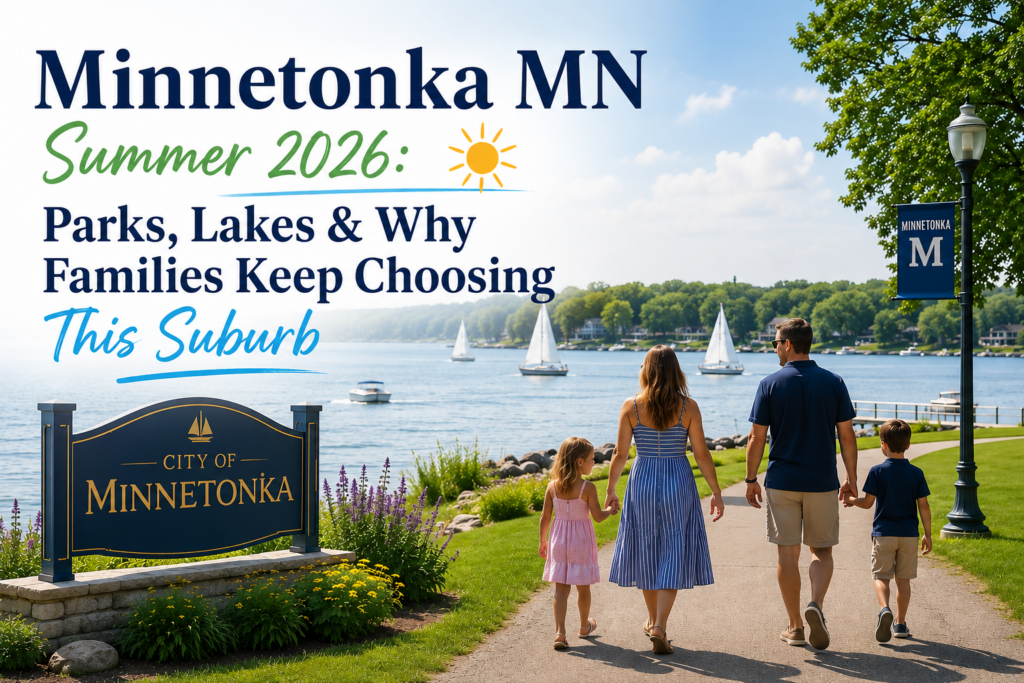
Family walking along a lakeside path in Minnetonka MN with sailboats on the water and a City of Minnetonka sign in summer

If you’ve been spending any time on the west side of the Twin Cities this summer, you already know what makes Minnetonka, MN so hard to leave. Shimmering lakes just minutes from home, trails that wind through serious tree cover, a school district that consistently ranks among the best in the state — and a real estate market that reflects exactly how much families value all of it. Whether you’re seriously considering a move or just starting to explore Minnetonka as a landing spot, summer is the ideal time to see this suburb at its best. Here’s what you need to know.

Parks and Lakes: Minnetonka’s Outdoor Scene Is the Real Draw

Minnetonka sits in one of the most lake-dense pockets of the Twin Cities metro, and residents take full advantage of it from Memorial Day through Labor Day. The city maintains an impressive system of public parks — including Lone Lake Park, Big Willow Park, and the popular Libbs Lake — each offering a mix of trails, open green space, fishing access, and family-friendly amenities. On a warm Tuesday afternoon, these parks don’t feel like afterthoughts; they feel like the center of the community.

Just beyond Minnetonka’s city limits, Lake Minnetonka Regional Park — managed by Three Rivers Park District — gives residents easy access to Lake Minnetonka itself. The park features a nautical-themed play area, a sandy-bottom chlorinated swimming pond, a fishing pier, disc golf, and over three miles of biking and hiking trails. It’s the kind of place you can spend a full summer Saturday without once checking your phone. For families with young kids, the stroller-friendly paved paths and supervised swim area are a particular draw.

Beyond formal parks, Minnetonka’s position adjacent to Lake Minnetonka — one of Minnesota’s largest and most beloved recreational lakes — means boating, paddleboarding, kayaking, and open-water swimming are woven into everyday summer life here. It’s not a weekend-only thing. Residents talk about the lake the way people in other cities talk about their backyard.

Minnetonka Schools: A Top-Ranked District That Families Plan Around

Ask any family why they chose Minnetonka, and the school district comes up almost immediately. Minnetonka Public Schools ranks #2 in Minnesota on Niche’s 2026 Best School Districts list and sits among the top 50 school districts in the entire country. The numbers behind that ranking are hard to argue with: the district’s average testing rank scores in the top 1% of Minnesota public schools, with math proficiency at 76% — compared to the state average of 46%.

Minnetonka High School ranks among the top three high schools in Minnesota, and individual elementary schools like Scenic Heights and Groveland appear in top-60 rankings statewide. Beyond academics, the district is known for its deep arts and music programs, K-12 Spanish and Chinese immersion options, advanced coursework, and a 98% graduation rate. The Minnetonka Class of 2026 held its commencement at US Bank Stadium — which tells you something about the scale and pride of this community.

It’s worth noting that the Minnetonka district is also the most sought-after for open enrollment in Minnesota, drawing nearly 3,600 nonresident students annually. Families who don’t live in the district actively try to get in. Families who do live here tend to stay.

Minnetonka MN Summer 2026 Real Estate: What the Market Looks Like Right Now

The Minnetonka real estate market heading into summer 2026 is active, competitive in desirable neighborhoods, and still fairly tight on inventory. Median home prices in Minnetonka have been running in the $470,000–$550,000 range depending on the data source and time period, reflecting both the quality of housing stock and the premium buyers willingly pay to be in this school district and community. As one industry overview noted, inner-ring suburbs like Minnetonka with strong schools consistently carry medians in the $500,000 to $700,000-plus range.

Homes here are moving in roughly 25–29 days on average, and a meaningful percentage continue to sell above asking price — a sign that buyer demand hasn’t cooled off even as broader inventory has loosened slightly across the state. The sale-to-list price ratio has held near 99.5%, meaning sellers are still commanding close to full price. If you’re buying this summer, come prepared with a pre-approval letter and a clear sense of what you want — well-priced homes in Minnetonka don’t sit.

What does your budget get you? In the $400,000–$500,000 range, expect well-maintained ramblers and split-levels in established neighborhoods — often with mature trees, finished basements, and proximity to parks. Move into the $550,000–$700,000 range and you’ll find newer construction, larger lots, and updated interiors. Above $700,000, Minnetonka offers some of the Twin Cities’ most beautiful executive homes, including properties with lake access or views. Check the Minnetonka market page on Redfin for current listings and pricing trends.

What Living in Minnetonka Actually Feels Like Day-to-Day

Minnetonka occupies a sweet spot in the Twin Cities suburb matrix: it’s suburban enough to offer space, quiet streets, and great schools, but urban enough to have genuine amenity density. The city has its own distinct commercial corridors, a mix of independent restaurants, coffee shops and local businesses alongside larger retail, and a community identity that doesn’t feel like it was designed by committee.

Downtown Minneapolis is about 12 miles from central Minnetonka — a 20-minute drive in non-rush traffic. That proximity matters for residents who work in the city but want the kind of outdoor lifestyle Minnetonka delivers on weekends. The city also sits along Highway 394 and Interstate 494, giving commuters solid options in multiple directions across the metro.

Summer weekends in Minnetonka have a particular rhythm to them: kids riding bikes to the park in the morning, families launching kayaks by afternoon, and neighbors gathering around fire pits after the sun goes down. It’s genuinely one of those places where the lifestyle matches the listing.

Is Minnetonka the Right Fit for Your Family?

Minnetonka tends to attract families with kids, nature-oriented buyers who want lake and trail access baked into daily life, and move-up buyers coming from other Twin Cities suburbs who are ready to settle in somewhere they can stay long-term. It’s also consistently popular with relocating professionals who research school districts before picking a neighborhood — Minnetonka routinely tops those searches.

If Minnetonka is on your radar, summer is the right time to see it in person. Neighborhoods show best when the trees are full, the lakes are busy, and you can get a feel for the parks your kids would actually use. Just don’t expect a leisurely timeline once you find something you like — the market rewards buyers who are ready to move quickly.

For a deeper look at what’s happening across the metro, visit the Minneapolis Area Realtors for the latest market data, or browse our Minnetonka community page for more neighborhood insights.

Ready to Buy in Minnetonka This Summer?

Minnetonka’s market moves fast, and who you work with matters. MinnMatch connects Twin Cities buyers with experienced, vetted local agents who know this neighborhood — the streets, the schools, the price points that make sense. It’s free, it’s personal, and there’s no algorithm deciding your match.

Find a Minnetonka Agent →

Bidding Wars in the Twin Cities in 2026: How to Win Without Overpaying

Twin Cities home with "Multiple Offers – Best & Final Due Today" sign in front yard, Minneapolis skyline in background

If you’ve been house hunting in the Twin Cities this summer, you already know the feeling: you find the right house, fall in love with it — and then find out three other buyers have too. Bidding wars are a real part of the Twin Cities housing market in 2026, even as conditions have shifted compared to the frenzy of a few years ago. The good news? Winning a competitive offer situation doesn’t have to mean throwing caution to the wind. With the right strategy, you can stand out from the competition and protect yourself from overpaying.

What’s Driving Competition in the Twin Cities Right Now

The Twin Cities market in 2026 is more nuanced than it was in 2021 or 2022, but that doesn’t mean it’s easy out there for buyers. Inventory has improved — new listings were up nearly 9% across Minnesota earlier this year — but well-priced, move-in-ready homes in desirable suburbs like Eden Prairie, Plymouth, and Edina still routinely draw multiple offers.

According to data from Redfin, roughly 31% of Minnesota homes sold above list price in April 2026. That’s down slightly from a year ago — but it still means nearly one in three sales is competitive. And in the most in-demand ZIP codes across the metro, that number is higher.

What’s changed is where the competition is concentrated. Homes that are well-priced and well-prepared still generate strong interest fast. Overpriced listings, or homes that need significant work, are sitting longer. That means buyers who target the right homes in the right condition need to come in ready — because those are exactly the homes drawing multiple offers.

Step One: Get Your Financing Locked Down Before You Need It

In a competitive offer situation, a basic pre-approval letter is the bare minimum. If you’re serious about winning in a bidding war in the Twin Cities, consider going further and getting fully underwritten before you make an offer. Some lenders now offer “verified approval” or “credit-approved” status — meaning your income, assets, and credit have all been reviewed in advance. To a seller, that’s nearly as reassuring as a cash offer.

Local lenders often carry weight here too. A seller and their agent are more likely to be confident in an offer backed by a lender they recognize and have worked with. Ask your buyer’s agent for recommendations — they’ll know which local lenders close cleanly and on time.

How to Structure a Competitive Offer Without Blowing Your Budget

Once you’re pre-approved, the offer itself is where strategy really matters. Here are the tools experienced Twin Cities buyers and their agents use to compete effectively:

Escalation clauses. An escalation clause tells the seller: “I’ll pay $X, but I’m willing to automatically increase my offer by $Y increments above any competing offer, up to a maximum of $Z.” For example, you might offer $415,000 with an escalation clause up to $435,000 in $2,500 increments. This keeps you competitive without leading with your ceiling — but be sure to require proof of any competing offer that triggers the escalation. Your agent can build this into the purchase agreement.

Increased earnest money. Standard earnest money in Minnesota is typically 1–2% of the purchase price. In a competitive situation, bumping that to 3–5% signals serious commitment. It tells the seller: this buyer isn’t going to walk away over small stuff. Just know that earnest money is at risk if you back out for non-contingency reasons.

Appraisal gap coverage. When you offer above list price, there’s always a risk the home appraises for less than what you offered. Lenders will only finance up to the appraised value — meaning if you offered $430,000 and it appraises at $415,000, you need to cover that $15,000 gap out of pocket or renegotiate. Agreeing in writing to cover an appraisal gap up to a specific amount can be the difference between winning and losing in a multiple-offer situation.

Seller-friendly terms. Price isn’t everything. Flexibility on closing date — whether the seller needs a quick close or extra time to find their next home — can make your offer more attractive even if it’s not the highest number. Ask your agent what the seller’s situation is before structuring your offer.

Non-round offer numbers. It sounds small, but offers like $412,500 stand out from a pile of round numbers. The logic: it suggests the buyer has done careful analysis rather than just guessing.

What About Contingencies? Know What’s Safe to Modify

One of the biggest questions buyers face in a bidding war is which contingencies to keep and which to modify. The short answer: never fully waive the inspection contingency unless you truly know what you’re walking into. A better approach is to shorten the inspection window to 5–7 days, or add an “informational only” clause — meaning you’ll get an inspection but commit to not requesting repairs for minor cosmetic issues. That shows the seller you’re reasonable without leaving yourself exposed to major unknowns.

The financing contingency protects you if your loan falls through, and in most cases, you want to keep it — especially if you’re not waiving the appraisal contingency too. That said, a fully underwritten pre-approval (as mentioned above) can give sellers more confidence in your financing even with the contingency intact.

The Agent Advantage: Why Your Representation Matters Most in a Bidding War

In a competitive offer situation, your agent isn’t just submitting paperwork — they’re your strategist, your relationship builder with the listing agent, and your real-time advisor when things move fast. The best Twin Cities buyer’s agents know how to read a listing agent’s cues, ask the right questions about what the seller actually needs, and structure an offer that addresses those needs beyond just price.

Speed matters too. In a multiple-offer situation, getting your offer in promptly — with a clean, complete package — can matter as much as the numbers themselves. An experienced agent who handles competitive markets regularly will have these systems down.

For additional data on how the broader Minnesota market is performing, Minneapolis Area Realtors publishes regular market reports that are worth reviewing with your agent before you write an offer.

Don’t Chase — Protect Yourself from Overbidding

Bidding wars create real psychological pressure, and it’s easy to let emotion drive you past a number that actually makes sense for your budget and the market. A few guardrails to keep in mind:

Set your cap before the offer, not during it. Decide your absolute maximum price before you’re in the heat of a bidding situation. Write it down. Your agent can help you use comparable sales to anchor that number in real market data — not emotion.

Understand the appraisal risk before offering above list. If you’re offering significantly above asking, make sure you know roughly what comparable homes have sold for nearby. If you’re covered by cash reserves for a gap, fine — if not, know your risk.

Sometimes the right move is to let it go. In 2026’s Twin Cities market, the right home at the right price will come along. Overpaying under pressure is a decision that follows you for years. Your agent should be your voice of reason, not just your advocate.

Look at homes that have been sitting. Not every opportunity is a bidding war. Homes that have been on the market for 3–4 weeks or longer — especially those with cosmetic issues or awkward floor plans — often have motivated sellers and little competition. Your agent can help you identify these and evaluate whether they’re worth pursuing.

Ready to compete — and win — in the Twin Cities market?

The difference between winning a bidding war and losing one often comes down to the agent in your corner. MinnMatch connects Twin Cities buyers with experienced, vetted local agents who know how to write offers that win — without putting you at financial risk. The service is completely free for buyers.

Find Your Agent — It’s Free

Wayzata MN Summer 2026: Boating, Dining & a Real Estate Market That Never Slows Down

Lakefront dining table with wine glass overlooking Lake Minnetonka with sailboat at sunset in Wayzata MN

If you’ve spent even one summer evening in Wayzata — watching sailboats cross Wayzata Bay, the sun dropping behind the tree line over Lake Minnetonka — you already understand why people don’t just visit this town. They try to figure out how to stay. The Wayzata MN real estate market reflects that pull: a small, tightly held inventory of luxury homes in a community where lifestyle, location, and long-term value all point in the same direction. Whether you’re here to boat, to dine, or to seriously consider making a move, summer 2026 is a compelling time to pay attention.

Wayzata on the Water: Why Summer Here Is Unlike Anywhere Else in Minnesota

Lake Minnetonka is the crown jewel of the Twin Cities metro, and Wayzata sits on its northern shore with front-row access. The city’s name itself comes from the Dakota word Waziyata, meaning “north shore” — a fitting origin for a community that has organized itself around the lake for well over a century.

Summer in Wayzata means pontoon boats cutting across calm bays on weekday mornings, regattas drawing weekend crowds to the waterfront, and the steady hum of activity along the Panoway — the community’s lakeside promenade. The pedestrian-only boardwalk has become one of the most popular gathering spots in the western suburbs, a place where families stroll, couples catch sunsets, and locals run into neighbors they haven’t seen since spring.

For boaters, Wayzata Marine and other local outfitters keep the docks busy all season, and the public launch gives access to all 14,000-plus acres of Lake Minnetonka. Each summer, the Wayzata Art Experience transforms the Panoway into a two-day juried art festival featuring more than 150 artists, live music, food vendors, classic wooden boats, and an artisan beer and wine garden — one of the most well-attended outdoor events in the metro. James J. Hill Days rounds out the summer calendar with community celebrations rooted in the city’s railroad heritage.

All of that energy — the water, the events, the walkable downtown — doesn’t just make for a great summer. It builds a community that people actively compete to join, which has a very direct effect on what happens in the Wayzata real estate market.

Dining in Downtown Wayzata: From Casual Dockside to White-Tablecloth Lakefront

One of the quieter compliments Wayzata receives is that its restaurant scene punches well above its population. For a city of roughly 4,000 people, the dining options are genuinely impressive — and in summer, when patios open and the lake becomes part of the backdrop, they’re hard to beat anywhere in Minnesota.

6Smith remains the anchor of the downtown dining scene. Situated just steps from the water with nothing but dock between the restaurant and Lake Minnetonka, it offers a fine-dining experience — fresh seafood, steaks, lobster rolls — that draws visitors from across the metro and earns consistent recognition as one of the best restaurants on the lake. Reservations are encouraged, especially on summer weekends.

CōV brings a different energy: an East Coast-meets-Midwest vibe that the restaurant describes as channeling Nantucket or the Hamptons. The lakefront patio hosts a summer music series, the menu runs from burgers to seafood, and the lobster guacamole has developed a devoted following. On any given summer Friday evening, the patio is exactly as good as it sounds.

Gianni’s Steakhouse has long been a go-to for classic steakhouse fare in a setting that feels occasion-worthy without being stiff. Maggie’s, in contrast, is the town’s beloved no-frills diner — counter service, great pizza and burgers, and the kind of place that feels like it belongs to the community rather than a dining trend.

The combination of lakefront fine dining, lively patio bars, and neighborhood staples makes Wayzata’s food scene one of the genuine lifestyle amenities that buyers factor in when evaluating whether to put down roots here versus in neighboring communities. When clients ask about life in Wayzata, the answer almost always involves at least one restaurant recommendation.

The Wayzata MN Real Estate Market in Summer 2026: What the Numbers Show

Wayzata’s housing market operates at a price point that reflects its status as one of the most desirable addresses in the Twin Cities. Median list prices have hovered near the $2 million range, with active listings this spring showing an average price per square foot above $800, according to current MLS data. Total active inventory in the city typically runs between 70 and 130 homes at any given time — a relatively thin supply for the level of buyer interest the community generates.

For context, Redfin’s Wayzata market data shows median sale prices in the high six figures to low seven figures depending on the time of year and product type — a range heavily influenced by whether lakefront or non-lakefront properties dominate a given month’s closings. When a direct-access Lake Minnetonka home changes hands, it can pull the median significantly higher; when townhomes and interior lots move, the figures moderate.

Days on market in Wayzata tend to run longer than the broader Twin Cities metro — averaging in the range of 80 to 107 days depending on the season, reflecting both the luxury price point and the selective pool of qualified buyers. That doesn’t mean the market is slow in any absolute sense; it means buyers are deliberate and sellers who price correctly still find strong outcomes. Premium lakefront properties — especially those with deeded lake access, private docks, and significant shoreline footage — continue to command top dollar and generate competitive interest when they hit the market.

One well-known characteristic of Wayzata’s highest-end segment: many of the best properties never reach the MLS. Off-market transactions are common, especially in the Ferndale and Bushaway Road areas, where established families hold multi-generational homes that pass quietly through agent networks. If you’re searching Zillow for a Wayzata lakefront home and wondering why inventory looks thin, that’s part of the explanation.

What Makes Wayzata Real Estate Different from Other Lake Minnetonka Communities

Lake Minnetonka has no shortage of desirable communities — Excelsior, Minnetonka Beach, Tonka Bay, Deephaven all have their own loyal followings. But Wayzata occupies a specific niche that sets it apart from almost all of them: it is the only Lake Minnetonka community with a true walkable downtown directly on the water.

That combination — lakefront access, a functioning downtown with shops and restaurants, strong schools in the Wayzata Public Schools district, and reasonable proximity to Minneapolis (roughly 15 miles west on I-394) — is genuinely rare. Buyers who want lake lifestyle without sacrificing urban convenience consistently put Wayzata at the top of their shortlist.

The community also benefits from strong long-term value stability. The desirability of Lake Minnetonka shoreline is not a recent trend — it has anchored generational wealth in the Twin Cities for over 100 years, and there is no structural reason to expect that to change. Buyers purchasing in Wayzata today are making a long-term bet on one of the most consistently valued real estate markets in Minnesota, according to data tracked by Minneapolis Area Realtors.

For those comparing Wayzata to nearby Minnetonka or Eden Prairie, the price premium is real — but it buys something that the neighboring suburbs simply cannot replicate: lake access combined with a downtown that feels alive in every season.

Tips for Buyers Entering the Wayzata Market This Summer

If you’re seriously considering a purchase in Wayzata, a few things are worth understanding before you start your search:

Get pre-approved and prepared to move quickly. At the $1M–$3M+ price range, transactions require serious financial documentation. In a thin-inventory market, arriving unprepared often means watching a property disappear before you can make a competitive offer.

Understand the spectrum of “lake access.” There is a significant difference between a home with deeded lakeshore, a home with association dock access, and a home with no water access at all. Each tier carries very different price points and lifestyle implications. Know which matters most to you before touring.

Don’t rely solely on public listings. As noted above, a meaningful share of Wayzata’s best properties trade off-market. An agent with deep roots in this specific community will have access to opportunities that never hit Zillow or Realtor.com.

Be patient, but not passive. Extended days on market in Wayzata doesn’t mean sellers are desperate — it means the buyer pool is smaller and more selective. Properties priced well and in good condition still move. Being ready to act when the right home appears is more valuable than a fast market.

Ready to Explore Wayzata Real Estate?

Wayzata is a market where who you know matters as much as what you can find online. MinnMatch connects buyers and sellers with experienced, vetted local agents who specialize in Lake Minnetonka communities — including Wayzata’s most coveted streets and off-market opportunities. Our service is free, human-powered, and built for buyers and sellers who want to get it right the first time.

Find a Wayzata Agent