Why Local Expertise Still Matters More Than Anything When Choosing a Twin Cities Agent in 2026

Desk with Twin Cities community books, a wooden Minnesota cutout, model home, and a local real estate agent checklist

Every year there’s a new app, a new AI tool, or a new national brokerage promising to make agents optional. And every year, Twin Cities buyers and sellers keep learning the same lesson: the single biggest advantage you can have in a move is a local real estate agent who genuinely knows the ground you’re standing on. Not “licensed in Minnesota” local. Knows-which-side-of-the-street-feeds-into-which-school local. Here’s why that still matters more than anything in 2026, and how to tell whether an agent really has it.

The Twin Cities Market Isn’t One Market. It’s Hundreds.

Headlines talk about “the Minneapolis market” as if it moves in one direction. It doesn’t. Look at two parts of the very same city over the three months ending August 2026, according to Redfin:

Southwest Minneapolis Central Minneapolis
Median sale price ~$590K ~$355K
Typical days on market ~14 days ~73 days
Average offers per home ~3 ~1

Source: Redfin neighborhood data for Southwest Minneapolis and Central Minneapolis, three months ending August 2026.

Same city, same mortgage rates, same season, and two completely different playbooks. In one area, a buyer who waits a weekend to “think about it” loses the house. In the other, there’s room to negotiate on price, repairs, or closing costs. A buyer or seller using the wrong strategy for their specific neighborhood can leave tens of thousands of dollars on the table without ever realizing it.

The same pattern plays out across the suburbs. A split-level in one corner of Plymouth can behave nothing like a similar home a few miles away, partly because Plymouth is served by several different school districts. Around Lake Minnetonka, two homes with identical square footage can be worlds apart depending on the bay, the water depth off the dock, and which direction the shoreline faces. National averages can’t see any of that. A local agent sees it immediately.

What a Local Real Estate Agent Knows That Online Tools Don’t

Online estimates and AI tools are great starting points. But they’re built on what’s already been recorded, and a lot of what actually drives a Twin Cities deal never shows up in a data feed. A seasoned local real estate agent brings:

  • City-by-city rules. Minneapolis requires a Truth in Sale of Housing (TISH) evaluation before a house can even be shown, and some other metro cities have their own versions while many don’t require one at all. Lake properties add shoreland ordinances and dock rules that differ from city to city. Getting this wrong can delay a listing or saddle a buyer with required repairs.
  • Minnesota-specific condition know-how. Ice dams, aging sewer lines in older Minneapolis and St. Paul neighborhoods, radon, basement moisture after a wet spring. A local agent knows what to look for on a showing and which inspectors and contractors to call.
  • Real pricing context. Why that house two streets over sold for $40K more (a finished lower level? a better school boundary? a bidding war on a sunny April weekend?). Algorithms see the number. Local agents know the story behind it.
  • Relationships. In a metro this connected, agents often know each other. A listing agent who trusts that your agent’s deals close cleanly may favor your offer when it’s close. That’s not in any database.
  • Early awareness. Local agents tend to hear about coming-soon listings, price reductions, and sellers who are “thinking about spring” before the rest of the market does.

For sellers, this matters just as much. Pricing a home in the Twin Cities is part math, part timing, and part knowing exactly who your buyer is. If you’re getting ready to list, our seller resources walk through how local pricing and prep decisions play out.

How to Tell If an Agent Is Truly Local

Almost every agent will tell you they know the area. Here’s how to separate genuine neighborhood expertise from a good sales pitch. Ask:

  • “How many homes have you helped buy or sell in this specific area in the last 12 months?” Not the metro. This neighborhood or suburb.
  • “Walk me through three recent sales near here.” A true local can explain why each one sold where it did, often without pulling up a screen.
  • “What would worry you about this house or this block?” Local expertise includes knowing the downsides: traffic noise, flight paths, flood-prone low spots, a pending road project.
  • “Who do you call for inspections, lending, and repairs?” Strong local agents have a trusted bench, and they’ll tell you why they trust them.

If the answers are vague or lean heavily on “I cover the whole metro,” that’s a signal. Covering everywhere often means specializing nowhere. You can also browse our community guides and market insights to get a feel for what a knowledgeable answer should sound like before you start interviewing.

Frequently Asked Questions About Hiring a Local Real Estate Agent

Does it really matter if my agent lives in the neighborhood?

Living there helps, but what matters most is recent, repeated transaction experience in that area. An agent who has closed a dozen deals in Edina this year likely knows the market better than someone who just happens to live there.

Can’t I just use online home values and an app to buy or sell?

Online tools are useful for research, but they can’t read a specific block, a school boundary, or a city’s point-of-sale rules. In fast-moving Twin Cities neighborhoods, those details often decide who wins the house and at what price.

How do I find a local agent who specializes in my area?

Ask for neighborhood-specific sales history and interview more than one agent. Or skip the guesswork: MinnMatch personally matches you with a vetted agent who works your exact part of the metro, free for buyers and sellers.

Finding the Right Local Real Estate Agent, Without the Guesswork

Technology will keep changing how we search for homes. What it won’t change is that every Twin Cities neighborhood has its own rhythm, its own rules, and its own buyers. The people who navigate that best are the ones who live and work in it every day.

That’s exactly why MinnMatch exists. Instead of an algorithm handing your name to whoever pays for leads, a real person learns what you need and connects you with a handpicked agent who specializes in the neighborhoods you care about, whether that’s South Minneapolis, the western suburbs, or the lake. See how the matching process works, or when you’re ready, get matched with a local agent. It’s free, and there’s no obligation.


How to Handle Multiple Offers on Your Twin Cities Home in 2026: A Seller’s Strategy Guide

Four home purchase offers on a desk with a model house, keys, a loon mug, and a checklist for handling multiple offers

Getting more than one offer on your house feels like winning the lottery, right up until you’re staring at three purchase agreements with different prices, contingencies, and closing dates, and a deadline to respond. Handling multiple offers well is less about grabbing the biggest number and more about choosing the buyer most likely to actually get to the closing table. Here’s how Twin Cities sellers can stay calm, compare offers the smart way, and walk away with the best overall deal in today’s market.

Why Multiple Offers Still Happen in the Twin Cities in 2026

The metro has cooled from the frenzy of a few years ago. Inventory is at a multi-year high and the average home now takes longer to sell than it did last year. But “cooler” doesn’t mean “cold.” Single-family homes are still sitting well under the supply level that would signal a true buyer’s market, and a well-priced, move-in-ready house in a sought-after neighborhood can still pull in a crowd the first weekend.

Twin Cities Seller Snapshot

$405,000

Twin Cities median sales price, August 2026 (up 1.3% year over year)

2.7 months

Supply of single-family homes metro-wide, still tilted toward sellers

3 offers

Average number of offers per Minneapolis home over the three months ending July 2026

~6 days

Time for Minneapolis’s hottest homes to go pending, often about 2% over list

Sources: Minnesota Realtors / Minneapolis Area Realtors (NorthstarMLS data, August 2026); Redfin Minneapolis market data (three months ending July 2026).

In other words, the market has split. Homes that are priced right and show well still attract competition; homes that are overpriced or need work sit. You can track the monthly numbers yourself through Minneapolis Area Realtors’ market data hub, or check neighborhood-level trends on Redfin’s Minneapolis housing market page. For our local take, visit MinnMatch Market Insights.

Look Past the Price: How to Compare Competing Offers

The highest offer isn’t automatically the best one. A $15,000-higher bid that falls apart three weeks in costs you far more than it earns, especially if your house then goes back on the market in November, when buyer traffic thins out. When you line offers up side by side, weigh these five things alongside price:

1

Financing strength. Cash beats conventional, and a fully underwritten pre-approval beats a quick pre-qualification letter. Ask your agent to call each buyer’s lender. How confident the lender sounds tells you a lot.

2

Appraisal protection. If the price climbs above what comparable sales support, the appraisal may come in low. An offer with appraisal-gap coverage (the buyer agrees to cover some or all of any shortfall) protects your number.

3

Contingencies. Fewer contingencies mean fewer exits. A buyer who has to sell their own home first, or who wants a long inspection window, is a bigger risk than one who’s ready to go.

4

Earnest money. A larger deposit signals commitment and gives the buyer real skin in the game.

5

Closing date and possession. If you’re buying your next place, a closing date or rent-back that fits your timeline can be worth thousands in avoided double moves, storage, and stress.

Also watch the buyer’s costs: seller-paid closing costs or concessions come straight out of your proceeds, so compare offers on net, not gross. And keep an eye on rates. Buyers’ budgets move with mortgage rates, which you can follow through Freddie Mac’s weekly rate survey.

Handling Multiple Offers: Your Options as a Seller

Once the offers are in, you have a few ways to play it. The right choice depends on how far apart the offers are and how much risk you’re comfortable with.

Accept the strongest offer outright. If one offer is clearly ahead on price and terms, don’t overthink it. Pushing for more can backfire if a buyer feels squeezed and walks.

Counter your favorite. If one buyer is close but not quite there, a targeted counteroffer, such as adjusting the closing date or trimming a contingency, keeps things moving without starting a free-for-all.

Call for “highest and best.” When several offers are bunched together, your agent can invite every buyer to submit their final, best terms by a set deadline. It’s fair, it’s clean, and it often shakes loose better terms, but some buyers will simply drop out rather than bid again.

Keep a backup. If you accept one offer, ask whether your runner-up would sign a backup offer. If your first deal falls through on inspection or financing, you’re not starting over.

A few common mistakes to avoid: letting offers sit unanswered (buyers move on fast), setting an offer deadline so early that serious buyers haven’t had a chance to tour, and assuming an escalation clause means the buyer will pay any price. Escalations usually have a cap and require proof of a competing offer. Handling multiple offers also means handling people. Every buyer deserves a timely, professional response, even the ones you turn down. You can find more seller guidance on our sellers page.

Frequently Asked Questions About Multiple Offers

Do I have to tell buyers there are other offers?

No, but it’s often in your interest. With your permission, your agent can let buyers know other offers exist, which usually encourages stronger bids. Sharing the specific terms of one buyer’s offer with another is a different matter, and it’s something to decide carefully with your agent.

Should I always take the highest offer?

Not always. A slightly lower offer with cash or strong financing, appraisal-gap coverage, and few contingencies is often the better bet, because it’s far more likely to actually close.

How long should I give buyers to respond to a highest-and-best request?

Typically 24 to 48 hours. That’s enough time for buyers to talk with their lender and agent, but short enough to keep the momentum going.

The Right Listing Agent Makes the Difference

Handling multiple offers is where a listing agent earns their fee. The best ones know how to price your home to draw competition in the first place, set up a fair offer process, vet lenders with a quick phone call, and read which buyer is truly committed. That experience looks different in a Plymouth split-level than it does in an Edina rambler or a South Minneapolis bungalow, which is why local expertise matters.

If you’re planning to sell and want an agent who knows your neighborhood and has navigated competitive offers before, MinnMatch can help. We personally match Twin Cities sellers with vetted local agents, and it’s free for you. See how our matching works, or get matched with a listing agent who’ll help you pick the right offer, not just the biggest one.

MinnMatch vs. Referrals vs. Online Reviews: The Best Way to Find an Agent in Minnesota in 2026

MinnMatch homepage on a laptop next to a notebook checklist comparing MinnMatch, referrals, and online reviews for finding a Minnesota real estate agent

If you’re getting ready to buy or sell a home in the Twin Cities, one of the very first decisions you’ll make has nothing to do with square footage or school districts — it’s who’s going to represent you. Most Minnesotans lean on one of three approaches to find an agent in Minnesota: ask a friend or family member for a referral, scroll through online reviews and directories, or use a local matching service like MinnMatch. They can feel like variations on the same idea, but they work very differently once you dig in. Here’s an honest look at how the three compare in 2026, and why the method you pick can shape everything from your negotiating leverage to how smoothly closing day goes.

The Three Most Common Ways to Find an Agent in Minnesota

Before comparing the details, it helps to see the full landscape. According to the National Association of Realtors’ most recent Profile of Home Buyers and Sellers, referrals are still the single most common way buyers find an agent nationally — but that doesn’t automatically make a referral the right fit, especially in a market as varied as the Twin Cities, where a fantastic agent in Wayzata isn’t necessarily the right match for a first-time buyer in South Minneapolis.

1
Referrals

Ask a friend, family member, or coworker who they used and hope your situation matches theirs.

2
Online Reviews & Directories

Search national platforms for star ratings and agent profiles, then reach out cold.

3
MinnMatch

Get personally matched, for free, with a vetted local agent based on your actual needs.

Referrals: Personal, But Only as Good as Your Network

For a lot of Minnesotans, asking around is still the default way to find an agent in Minnesota, and it’s easy to see why: a recommendation from someone you trust feels safer than picking a name off a website. If your sister loved her agent, there’s a good chance you will too.

The catch is that referrals only work as well as the referrer’s experience matches yours. The agent who helped your coworker sell a starter home in Eden Prairie may have never listed a lake property on Lake Minnetonka, negotiated a new-construction contract in Plymouth, or worked with a first-time buyer using an MN Housing down payment assistance program. Referrals also dry up fast if nobody in your circle has bought or sold recently, which leaves you back at square one with no local guidance at all.

Online Reviews and Directories: Easy to Browse, Hard to Verify

National directories and review sites are the second-most common starting point, and they’re genuinely useful for a first look — you can browse dozens of agent profiles in the time it would take to make one phone call. But star ratings tell you very little about fit. A five-star average can be built on five reviews from a single referral network, and a directory listing rarely tells you whether an agent actually knows the difference between negotiating in a competitive Edina bidding war and pricing a slower-moving listing in the south metro.

There’s also no one on the other end helping you interpret what you’re seeing. You’re left comparing headshots and star counts on your own, then reaching out cold and hoping the first call goes well. It’s a reasonable way to research the market generally — sites like Redfin are great for browsing listings and price history — but it’s a thin way to choose the person who’ll represent your interests in what’s likely a six-figure transaction.

The Best Way to Find an Agent in Minnesota: How MinnMatch Compares

MinnMatch was built to close the gap between “ask a friend” and “search a directory.” Instead of an algorithm sorting agents by keyword or zip code, a real person reviews what you’re looking for — your target neighborhoods, your timeline, whether you’re a first-time buyer or downsizing empty-nester, whether you need someone who specializes in lake property or new construction — and matches you with a vetted agent from our curated Twin Cities network who actually fits. It’s free for buyers and sellers, and there’s no algorithm deciding who rises to the top of a directory page.

Think of it less like a search engine and more like a recruiter for real estate. If you’ve already got a referral you trust, that’s a great starting point — you can always tell us about your search and we’ll compare notes. And if you’re starting from zero, our how it works page walks through exactly what the matching process looks like, whether you’re buying near Plymouth or anywhere else in the metro.

Frequently Asked Questions

Is MinnMatch really free to use?

Yes. There’s no cost to buyers or sellers. MinnMatch is compensated by the agent network, not by the people we match — so the recommendation is based on fit, not a fee.

How is this different from a “find an agent” tool on a national site?

Those tools are usually built around lead-generation algorithms and ad spend, not local vetting. MinnMatch is Twin Cities-only, and every agent in our network has been personally reviewed rather than ranked by who paid for placement.

I already have a referral — can I still use MinnMatch?

Absolutely. Plenty of people use MinnMatch as a second opinion alongside a referral, especially if the referred agent doesn’t specialize in their specific neighborhood or price point.

Referrals and online reviews both have a place in the process — they’re just not built to account for how different Minnesota’s neighborhoods, price points, and buyer situations really are. If you’d rather skip the guesswork, find an agent through MinnMatch and let a real person do the matching for you.

What Every Minnesota Home Seller Needs to Know About Capital Gains Tax in 2026

Minnesota home sale checklist with capital gains tax books, a model house, and a "Sold" keychain on a desk

If you’re getting ready to sell your house this year, there’s a good chance the capital gains tax on a home sale has crossed your mind — especially if your Twin Cities home has appreciated significantly since you bought it. The good news is that most Minnesota sellers won’t owe a dime in federal tax on their profit. The less-good news is that Minnesota does things a little differently at the state level, and it’s worth understanding both sides before you list. Here’s a plain-English breakdown of what every Minnesota home seller needs to know about capital gains tax in 2026.

How the Federal Home Sale Exclusion Works

Under IRS Section 121, most homeowners can exclude a large chunk of their profit from federal capital gains tax when they sell a primary residence. Single filers can exclude up to $250,000 of gain, and married couples filing jointly can exclude up to $500,000 — with no age requirement and no rule that you have to buy another home afterward. To qualify for the full exclusion, you generally need to have owned and lived in the home for at least two of the five years before the sale, and the two years don’t need to be consecutive.

For a lot of Twin Cities sellers — especially anyone who bought a starter home in Plymouth, Eden Prairie, or South Minneapolis a decade or more ago — this exclusion covers the entire profit, and no federal tax is owed at all. If your gain does exceed the exclusion, the amount above it is taxed at the long-term capital gains rate (0%, 15%, or 20%, depending on your income), and higher earners may also owe the 3.8% Net Investment Income Tax.

Does Minnesota Charge Its Own Capital Gains Tax on a Home Sale?

This is where Minnesota diverges from the federal approach, and it’s the piece that catches sellers off guard. Minnesota does not offer a special, lower rate for long-term capital gains the way the federal government does. Instead, any taxable gain — meaning whatever is left over after the federal $250,000/$500,000 exclusion — gets folded into your ordinary Minnesota taxable income and taxed at the state’s regular graduated rates, which range from 5.35% up to 9.85%. High earners with very large investment income (above $1 million) can also be subject to an additional 1% state surtax.

In practice, this means the Minnesota capital gains tax picture is a two-layer system: the federal exclusion does most of the heavy lifting for typical home sales, but any gain that spills over the exclusion is taxed twice — once by the IRS at capital gains rates, and again by the state at Minnesota’s regular income tax rates. You can confirm current-year rates and thresholds directly with the Minnesota Department of Revenue.

What Counts as Your Primary Residence?

The exclusion only applies to a home you’ve genuinely lived in — not a lake cabin ‘up north’ you visit on weekends, and not a rental property you never occupied. To pass the “ownership and use” tests, you need to have owned the home for at least two of the last five years and lived in it as your main residence for at least two of those five years. You also can’t have used the exclusion on a different home sale within the past two years.

Life doesn’t always fit neatly into those boxes, and the IRS knows it. Partial exclusions are available if you’re selling early because of a job relocation, a health issue, divorce, military orders, or other unforeseen circumstances. If any of these apply to you, it’s worth a quick conversation with a CPA before you list — the difference between a full and partial exclusion can be significant.

Smart Moves for Twin Cities Sellers

A few habits can meaningfully lower the taxable gain on your Minnesota home sale:

Track your cost basis carefully. Your taxable gain isn’t just sale price minus purchase price — it’s sale price minus your adjusted basis, which includes the original purchase price plus qualifying capital improvements (a new roof, a finished basement, a kitchen remodel) minus any depreciation claimed. Keep receipts and permits for major projects; they can meaningfully shrink your gain when it’s time to sell.

Watch your ownership timeline. If you’re close to hitting the two-year ownership and use mark, it’s often worth waiting to list rather than selling a few months early and losing part of the exclusion.

Loop in a tax professional early — not after closing. A CPA can model your specific numbers, factor in Minnesota’s ordinary income treatment of any excess gain, and flag strategies (like timing a sale across tax years) that are much harder to use retroactively. Current market pricing data from a source like Redfin can also help you and your CPA estimate your likely sale price and gain well before you list.

This is also where the right listing agent earns their keep. An experienced local agent won’t give you tax advice, but a good one will help you time your sale, document improvements that support your basis, and structure the transaction in a way that makes your CPA’s job easier.

Frequently Asked Questions

Do I have to pay capital gains tax if I sell my Minnesota home at a loss?
No. Capital gains tax only applies to profit. If you sell for less than your adjusted cost basis, there’s no federal or Minnesota capital gains tax owed on the sale.

Does Minnesota have a separate capital gains tax rate for home sales?
No. Minnesota doesn’t have a distinct capital gains tax rate. Any taxable gain left after the federal exclusion is simply added to your other income and taxed at Minnesota’s regular graduated income tax rates.

What if I inherited the home I’m selling?
Inherited homes usually get a “stepped-up” basis to fair market value as of the date of death, which can significantly reduce or eliminate taxable gain. The rules here get technical fast, so this is a case where a CPA’s input is especially valuable.

This article is for general information only and isn’t a substitute for advice from a CPA or tax attorney about your specific situation. For the current federal rules, see IRS Topic 701.

Taxes are just one piece of a smart home sale. Pricing, timing, and knowing your local market matter just as much when it comes to walking away with the most money possible. If you’re planning to sell in the Twin Cities and want an agent who understands both the local market and how to set you up for a smooth closing, MinnMatch can match you with a vetted local agent for free — no algorithms, just a real person who knows your neighborhood. Curious how the matching process works? Visit our how it works page to see what to expect.

Open House in 2026: Is It Still Worth It in the Twin Cities? Here’s What Agents Say

Couple following a real estate agent into an open house in the Twin Cities in 2026

If you’re selling a home this year, you’ve probably wondered whether hosting an open house in the Twin Cities is still worth the hassle. Between online listings, 3D tours, and buyers scrolling through photos on their phones before they ever leave the couch, it’s a fair question. We asked local agents across the metro what they’re seeing in 2026 — and the answer isn’t a flat yes or no. It depends on your home, your neighborhood, and how the open house is actually run.

Why the Question Even Comes Up

A decade ago, an open house was one of the only ways buyers got a real look at a home before making an offer. Today, buyers can walk through a listing virtually, check the school ratings, and compare price-per-square-foot to three other houses on the block — all before deciding whether an in-person visit is worth their Sunday afternoon. That shift has some sellers assuming open houses are outdated. Twin Cities agents we talked to say that’s only half the story.

What the Data Actually Shows

According to Minneapolis Area Realtors (MAAR), most Twin Cities buyers still say they find their eventual home through their agent or online search — but open houses remain one of the top ways buyers first discover a listing that ends up on their shortlist. Agents describe them less as a place where offers get written on the spot, and more as a low-pressure entry point that gets a home in front of buyers who weren’t actively watching it yet.

Market conditions matter too. In a tighter, faster-moving market, a well-timed open house can create the kind of foot traffic that turns into multiple offers in a single weekend. In a slower market, the same open house might mostly attract neighbors and window-shoppers. Twin Cities agents tracking Redfin’s local market data say pacing your open house to actual buyer activity — not just a fixed weekend on the calendar — makes a real difference.

When an Open House Is Worth It in the Twin Cities

Agents pointed to a few situations where an open house still pulls real weight:

  • Move-in-ready homes in walkable or high-demand pockets — think Edina, Wayzata, or South Minneapolis — where buyers are already circling the neighborhood.
  • Homes with standout features that photograph well but feel even better in person, like a renovated kitchen, a finished lower level, or lake access.
  • The first two weekends on market, when buyer interest and urgency are naturally at their highest.

On the flip side, agents were candid that an open house on a busy street, during a holiday weekend, or scheduled a month after the listing has gone stale usually isn’t worth the prep work. In those cases, targeted showings and strong online marketing tend to do more.

What Twin Cities Agents Are Doing Differently This Year

The agents we spoke with described a more strategic approach to open houses in 2026 compared to a few years ago. Instead of a generic Sunday-afternoon open house, many are running shorter, more targeted events — sometimes a Thursday evening for nearby commuters, or a Saturday morning slot timed around a new price or a fresh round of photos. Several also mentioned pairing the open house with a digital push: local social ads, a short video walkthrough, and outreach to buyers already touring similar homes in the area.

The consistent theme: an open house works best when it’s one piece of a bigger plan, not a standalone tactic. A skilled local agent will usually know within the first weekend or two whether it’s pulling its weight — and adjust from there.

Frequently Asked Questions

Do open houses still lead to offers in the Twin Cities?
They can, especially in the first couple weeks on market or in high-demand neighborhoods, but most agents treat them as one lead-generation tool among several rather than a guaranteed path to an offer.

How many open houses should I do when selling my home?
Many Twin Cities agents recommend one or two well-timed open houses early in the listing period, rather than a standing weekly event, so each one still feels like fresh news to buyers.

Is it worth doing an open house in a slow market?
It depends on the home and location — agents suggest weighing recent local buyer traffic before committing, since a quiet market can mean a quiet open house.

Not Sure If an Open House Fits Your Home?

Whether an open house makes sense for your listing really comes down to your home, your neighborhood, and your timeline — and that’s exactly the kind of call a good local agent should be helping you make. If you’re getting ready to sell and want a straight answer on strategy, MinnMatch can connect you with a vetted Twin Cities agent who knows your area and won’t push a one-size-fits-all playbook. Curious how the matching process works? Here’s how it works.

Real Estate Agents vs. Realtors vs. Brokers in Minnesota: What’s the Difference in 2026?

Real estate agent, Realtor, and broker in Minnesota standing together in front of the Minneapolis skyline, 2026

If you’ve started shopping for help buying or selling a home in the Twin Cities, you’ve probably noticed the titles don’t seem to mean the same thing from one business card to the next. One person calls themselves an agent, another says Realtor, and a third goes by broker. Are they all doing the same job? Not quite. In Minnesota, these three terms describe different levels of licensing and different professional memberships, and knowing the difference can help you understand exactly who’s handling your transaction and what they’re qualified to do.

What Is a Real Estate Agent in Minnesota, Exactly?

“Real estate agent” is the everyday term most Minnesotans use, but it isn’t actually a license category the state issues. Minnesota’s Department of Commerce licenses people as real estate salespersons. To hold that license, a person has to complete pre-license coursework, pass the state exam, and — this is the part a lot of buyers and sellers don’t realize — affiliate with a licensed broker before they can legally represent anyone in a transaction. A newly licensed salesperson in Minnesota cannot hang out their own shingle; they work under a broker’s supervision, and that broker is legally responsible for their conduct.

Licensees also have ongoing obligations once they’re working. Minnesota requires 30 hours of continuing education every two-year renewal cycle, including required coursework on agency law and fair housing. So when someone in the Twin Cities says “my real estate agent,” they almost always mean a licensed salesperson working for a brokerage — the most common professional role in the industry, and the one most buyers and sellers interact with directly.

So What Does “Realtor” Actually Mean?

Here’s the part that surprises a lot of people: Realtor isn’t a license at all. It’s a trademarked title that belongs to the National Association of Realtors (NAR), and only dues-paying NAR members are legally allowed to use it. A licensed agent or broker in Minnesota can choose to join their local Realtor association — locally, that’s most often the Minneapolis Area Association of Realtors (MAAR) — and once they do, they agree to follow NAR’s Code of Ethics on top of whatever the state already requires of them.

That Code of Ethics covers things like honesty in advertising, disclosure obligations, and how Realtors are expected to treat other parties in a deal — even people they’re not representing. It’s a meaningful professional standard, but it’s a membership choice, not a state licensing requirement. In practice, a large share of the agents and brokers working across the Twin Cities do carry the Realtor designation, but it’s worth knowing the two words aren’t interchangeable, even though people use them that way in everyday conversation.

Where a Broker Fits Into the Picture

A broker in Minnesota has cleared a noticeably higher bar. To even sit for the broker’s exam, a salesperson needs at least three years of active licensed experience within the previous five years, plus additional coursework beyond the original licensing classes. Once licensed, a broker can operate independently, supervise other agents, and — in the case of a “designated” or managing broker — take on legal responsibility for an entire brokerage’s transactions and trust accounts.

Not every broker runs a big office, though. Plenty of experienced agents earn a broker’s license simply for the added credibility and independence it allows, then continue working directly with buyers and sellers day to day, much like an agent would. So seeing “broker” on someone’s card in the Twin Cities tells you they’ve put in extra years and extra coursework — it doesn’t necessarily mean they’re managing a whole company.

Real Estate Agent vs. Realtor vs. Broker: Does the Title Matter When You’re Hiring?

Honestly, less than most people assume. The title on a business card tells you about licensing level and association membership, but it doesn’t tell you whether that person actually knows the Wayzata lake market, has closed deals in your price range, or communicates the way you need them to during a stressful negotiation. A newer agent working closely with a strong broker can be a great fit for a first-time buyer, while a seasoned Realtor with deep neighborhood experience might be exactly what a seller needs in a competitive listing situation.

That’s really the question worth asking before you sign with anyone: not “are they an agent, a Realtor, or a broker,” but “is this the right person for my specific move.” That’s exactly the gap MinnMatch is built to close. Instead of guessing based on a title, you tell us what you’re trying to do — buy your first home in Plymouth, sell a lake property in Excelsior, navigate a tricky relocation — and we match you with a vetted local professional whose track record actually fits. Find your match here, and see how it works at minnmatch.com/how-it-works.

Frequently Asked Questions

Is a Realtor better than a regular real estate agent in Minnesota?

Not automatically. Realtor means the person has joined NAR and agreed to its Code of Ethics, which is a meaningful professional commitment, but it doesn’t measure skill or local experience on its own. Plenty of excellent agents in the Twin Cities are also Realtors, and the two often go hand in hand — but the title alone isn’t a substitute for checking someone’s actual track record.

Can a real estate agent in Minnesota work without a broker?

No. Minnesota law requires every licensed salesperson to be affiliated with a supervising broker. Only someone who has earned a broker’s license — which requires several years of experience beyond the initial salesperson license — can operate independently or manage their own brokerage.

How do I know which title my agent actually holds?

You can look up any Minnesota real estate license through the Minnesota Department of Commerce, and Realtor membership is searchable through the local association a person belongs to, like MAAR. Or, skip the research entirely — every agent in the MinnMatch network is vetted before we ever recommend them, so you already know you’re working with someone qualified. See how we match buyers and sellers here.

What Is Title Insurance in Minnesota and Do You Need It in 2026?

Title insurance in Minnesota guide with Minneapolis skyline, house model, and keys on desk

If you’re buying a home in the Twin Cities this year, you’ve probably seen “title insurance” listed somewhere on your closing disclosure and wondered what it actually is — and whether you’re required to pay for it. Title insurance in Minnesota protects you and your lender from financial loss if a problem with the property’s ownership history turns up after closing, and while it’s not legally mandated in every case, nearly every Minnesota home purchase includes it for good reason. Let’s walk through what it covers, what it costs, and how to think about it as a 2026 buyer.

What Does Title Insurance Actually Cover?

Title insurance protects against defects in a property’s chain of ownership that a standard title search might miss. That includes things like an unpaid contractor’s lien from years ago, a forged signature on a prior deed, an heir who was never properly notified of a sale, or old boundary disputes that resurface. In a state like Minnesota, where many homes — especially in older neighborhoods around Minneapolis and St. Paul — have changed hands multiple times over decades, these hidden issues are more common than people expect.

There are two separate policies involved in most transactions: a lender’s policy and an owner’s policy. The lender’s policy protects the bank’s financial interest in the property and is almost always required if you’re financing your purchase. The owner’s policy protects you, the buyer, and is optional — but it’s the one that actually has your name on it.

Is Title Insurance Required in Minnesota?

Minnesota doesn’t have a state law forcing buyers to purchase an owner’s title insurance policy. However, if you’re getting a mortgage, your lender will almost certainly require a lender’s title policy before they’ll fund the loan — that part isn’t really optional in practice. The owner’s policy is the piece you get to decide on, and it’s worth understanding the difference before you’re sitting at the closing table trying to make a quick decision.

Some Minnesota counties use an “abstract” property system rather than Torrens, which affects how title searches are conducted and can influence how much scrutiny a title company applies. Your closer or title company will know which system applies to your specific property, and it’s a good question to ask early rather than at the last minute.

What Does Title Insurance Cost in the Twin Cities?

Unlike homeowners insurance, title insurance is a one-time premium paid at closing rather than an ongoing annual cost. For a typical Twin Cities home purchase, buyers can expect the combined lender’s and owner’s policies to run roughly $1,000–$2,500, though the exact number depends on your purchase price, loan amount, and title company. Minnesota is also a state where it’s common — and negotiable — for the seller to cover some or all of the owner’s policy cost, so it’s worth raising during purchase agreement negotiations rather than assuming it’s automatically on your side of the ledger.

Because the owner’s policy is a single upfront cost that protects you for as long as you (or your heirs) own the property, many buyers find the cost-to-protection ratio makes sense compared to fighting a title dispute out of pocket later, which can run into tens of thousands of dollars in legal fees alone.

Should You Get an Owner’s Policy in 2026?

For most buyers, the answer is yes — especially on older homes, properties that have had multiple owners, or homes purchased at a discount where the seller may have limited funds to cover a future claim. New construction can sometimes carry lower title risk since there’s no prior ownership chain to untangle, but even then, boundary and permitting issues can surface. A good local real estate agent will walk you through your specific property’s history and flag anything unusual before you’re at the closing table.

This is exactly the kind of decision where having an experienced, locally connected agent in your corner pays off — someone who’s closed dozens of Twin Cities transactions and knows which title companies are thorough, responsive, and fairly priced. If you’re not sure where to start, MinnMatch can match you with a vetted local agent who’ll walk you through title insurance and every other line item on your closing disclosure, at no cost to you.

Frequently Asked Questions

Do I have to buy title insurance in Minnesota?
An owner’s title insurance policy isn’t legally required, but a lender’s policy almost always is if you’re financing your purchase. Most Minnesota buyers choose to add the owner’s policy for their own protection.

How much does title insurance cost in Minnesota?
Combined lender’s and owner’s title insurance policies typically cost between $1,000 and $2,500 for a Twin Cities home purchase, depending on the purchase price and title company.

Can the seller pay for title insurance in Minnesota?
Yes — it’s common in Minnesota for sellers to cover part or all of the owner’s title insurance premium, though this is negotiated between buyer and seller rather than required.

Get the Right Guidance for Your Closing

Title insurance is one of those closing costs that’s easy to skim past, but it can save you from a genuinely painful financial surprise down the road. The good news is you don’t have to sort through it alone. MinnMatch’s free matching service connects you with a hand-picked Twin Cities agent who can explain every part of your closing disclosure, negotiate who covers what, and make sure nothing catches you off guard on closing day.

Sources: Minnesota Housing Finance Agency, Minneapolis Area Realtors (MAAR), Redfin

How to Interview a Real Estate Agent in 2026: The Exact Questions Smart Buyers Ask

Couple interviewing a smiling real estate agent at a table, with a checklist of experience, local expertise, communication, negotiation, strategy, and goals on a chalkboard behind her

If you’re getting ready to buy a home in the Twin Cities, you’re going to spend a lot of time with whoever you choose as your agent — so it’s worth treating the process like the important decision it is. Learning how to interview a real estate agent before you sign anything can save you thousands of dollars, weeks of frustration, and at least one bad Sunday spent touring houses that were never right for you in the first place. In 2026, buyers are asked to sign a representation agreement earlier in the process than they used to, which makes the interview step more important than ever. Here’s exactly what to ask, what to watch for, and how to walk away with an agent you actually trust.

Why It Pays to Interview a Real Estate Agent Before You Commit

Minnesota buyers are now typically asked to sign a buyer representation agreement before an agent will show them homes, a shift that followed the 2024 national settlement over how agent commissions are disclosed and negotiated. That agreement can lock you into working with one agent for weeks or months, so it’s not something to sign on the spot after a single phone call. Treating the first conversation as an interview — rather than a formality — gives you a real chance to compare communication style, local knowledge, and negotiation approach before you’re contractually tied to anyone. According to the Minneapolis Area REALTORS® (MAAR), buyer representation agreements now spell out services, duration, and compensation up front, which means the questions you ask at the interview stage carry more weight than they used to.

The Exact Questions Smart Buyers Ask

When you sit down to interview a real estate agent, aim for specific, direct questions rather than general chit-chat. Here’s the list we recommend to every buyer who comes through MinnMatch:

1
How many buyer transactions have you closed in this specific area this year?
General experience is good, but recent, hyper-local experience in the suburb or neighborhood you’re targeting matters more. An agent who closed 20 deals in Edina tells you something different than one who closed 20 deals scattered across the entire metro.
2
What does your buyer representation agreement actually commit me to?
Ask about the length of the term, whether it locks you to a specific geographic area, and what it takes to end the relationship if it’s not working out. A good agent will walk you through this without getting defensive.
3
How is your compensation structured, and who pays it?
Since the commission rule changes, this is no longer assumed — it should be spelled out in plain numbers before you sign anything.
4
How will you communicate with me, and how fast should I expect a response?
In a fast-moving market, a same-day response can be the difference between seeing a home before it goes pending and missing it entirely. Get specific: text, call, email, and how quickly during evenings and weekends.
5
Can you walk me through how you’d handle a multiple-offer situation?
Listen for specifics — escalation clauses, appraisal gap coverage, how they’d advise you on waiving contingencies — not just “we’ll be competitive.”
6
Who else on your team will I actually be working with?
Some agents run large teams where showings get handed off to junior members. There’s nothing wrong with a team model, but you should know upfront who’s actually going to answer your calls.
7
Can I talk to a recent buyer client, ideally one from the past few months?
A reference from three years ago tells you less than someone who just went through the current market with this agent.

Red Flags to Watch For During the Interview

Pay attention to more than the answers themselves — pay attention to how they’re delivered. An agent who rushes through the representation agreement, avoids specifics on compensation, or pressures you to sign before you’ve seen a single home is worth a second look. So is an agent who can’t name a specific example of a recent negotiation they handled in your target neighborhood. Vague answers to direct questions are usually a preview of how the rest of the relationship will go. Buyers in competitive submarkets, where recent Redfin market data shows homes moving quickly once priced correctly, especially benefit from an agent who can speak to timing and strategy in concrete terms rather than generalities.

Frequently Asked Questions

Do I have to sign an agreement just to interview a real estate agent?

No. A conversation to ask questions and get a feel for an agent’s approach doesn’t require a signature. Agreements typically come into play once you’re ready to start touring homes together.

How many agents should I interview before choosing one?

Two or three conversations is usually enough to spot real differences in experience, communication style, and local knowledge without dragging out your search.

Is it rude to interview multiple real estate agents at once?

Not at all — it’s standard practice and any experienced agent will expect it. Choosing the right agent is a significant decision, and reasonable professionals understand buyers want to compare their options first.

If you’d rather skip the trial-and-error of cold-calling agents off the internet, that’s exactly what MinnMatch is for. Tell us a bit about what you’re looking for, and we’ll match you with a vetted, local agent who’s already a strong fit for your neighborhood, budget, and timeline — for free. Find your agent match or learn more about how MinnMatch works before your next home tour.

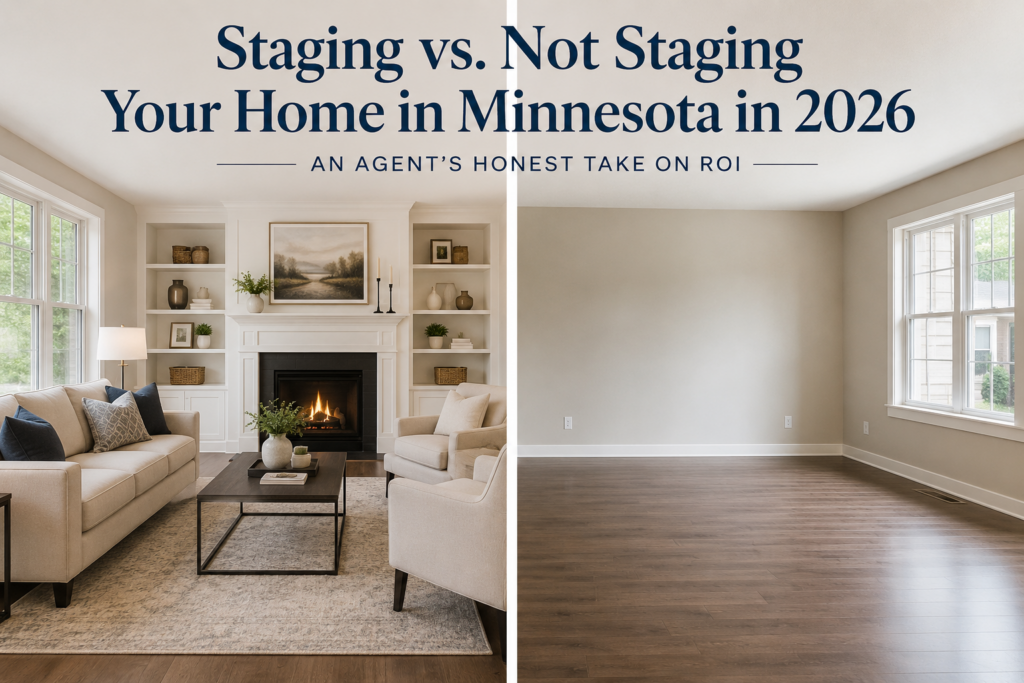
Staging vs. Not Staging Your Home in Minnesota in 2026: An Agent’s Honest Take on ROI

Split image comparing a professionally staged living room with furniture and decor to the same style empty living room, illustrating home staging ROI in Minnesota

Every seller asks some version of the same question: “Do I actually need to stage this place?” It’s a fair question, especially when a full staging job can run into the thousands of dollars. After watching staged and unstaged homes hit the market across the Twin Cities all year, I can tell you the honest answer isn’t yes or no — it’s “it depends on your home, your price point, and your competition.” Let’s talk through the real home staging ROI picture for Minnesota sellers in 2026, without the sales pitch.

What Staging Actually Costs in the Twin Cities

Full-service staging (a professional coming in and furnishing empty or awkward rooms) typically runs $2,000–$6,000 for a first month in a mid-size Twin Cities home, depending on square footage and how many rooms need furniture versus a simple refresh. Consultation-only staging, where a stager walks through your already-furnished home and tells you what to move, remove, or rearrange, is far cheaper — often $150–$400 for a two-hour visit. Vacant homes cost the most to stage because everything from the sofa to the artwork has to be brought in and rented monthly.

For context on how these costs measure against typical resale numbers, Redfin’s housing market data is a solid, current benchmark for Twin Cities price trends by neighborhood.

The Case for Staging: Where It Pays Off

Staging earns its keep in a few very specific situations. Vacant homes are the clearest case — empty rooms photograph poorly, make spaces feel smaller than they are, and give buyers nothing to picture their own life inside. Higher-priced listings ($500K and up) are another spot where staging tends to pay for itself, because buyers at that price point expect a move-in-ready, magazine-quality presentation and will mentally deduct for anything that looks dated or unfinished. Awkward layouts — a bonus room with no obvious purpose, a basement that’s half-finished, a formal dining room nobody uses anymore — also benefit from staging, since a stager’s job is essentially to answer the buyer’s unspoken question: “what would I even do with this space?”

When Staging Isn’t Worth the Money

On the flip side, I’ve watched plenty of sellers spend money on staging that didn’t move the needle. If your home is already tastefully furnished and decluttered, a full staging job is often overkill — a two-hour consultation to fine-tune what you already have will get you 90% of the benefit for a fraction of the cost. Starter homes and homes priced under roughly $300K in competitive Twin Cities suburbs like Plymouth or Prior Lake also tend to sell fast on price and location alone; buyers in that range are often more forgiving of a lived-in look, especially in a tight inventory market. And if your timeline is short or your home is going to sell primarily on land value or a teardown/renovation basis, staging dollars are usually better spent elsewhere — like a fresh coat of paint or fixing a known inspection issue.

4 Factors That Actually Determine Your Staging ROI

1

Whether the Home Is Vacant or Occupied

Vacant homes see the biggest lift from staging because there’s simply nothing for buyers to compare their imagination against. Occupied homes usually need editing, not furnishing.

2

Price Point and Buyer Expectations

The higher the price, the more polish buyers expect. A $700K Edina listing and a $280K Prior Lake starter home are playing by different rules entirely.

3

How Competitive Your Local Market Is

In neighborhoods with tight inventory, buyers will look past cosmetic flaws. In slower or more saturated pockets, staging becomes a real differentiator against similar listings.

4

The Home’s Layout and Quirks

Unusual or ambiguous spaces benefit most from staging’s core job: showing buyers exactly how to use a room they wouldn’t otherwise know what to do with.

DIY Staging: Getting 80% of the Benefit for Almost Nothing

If a full staging budget isn’t in the cards, you can get most of the visual benefit yourself. Declutter aggressively — pack away a third of what’s in every room, including closets, since buyers open them. Depersonalize by putting away family photos and strong personal decor choices so buyers can picture themselves there instead of you. Fix the small stuff a stager would flag anyway: burnt-out bulbs, scuffed walls, cluttered countertops. And don’t underestimate curb appeal — for many Twin Cities buyers, the first impression happens in the driveway, not the entryway. None of this requires a stager’s invoice, just a weekend and a willingness to pack a few boxes early.

So, Should You Stage?

The honest answer: it depends on your specific home, price range, and market — which is exactly the kind of judgment call a good local agent should be helping you make, not a blanket rule from a blog post. An agent who knows your neighborhood’s current competition can tell you in five minutes whether staging dollars will come back to you at closing or whether that money is better spent elsewhere. If you’re getting ready to sell and want a second opinion on staging (or anything else in your prep list), MinnMatch can connect you with a vetted local agent who’ll walk your home and give you a straight answer — free, with no pressure to hire the first person you talk to.

For more on how the Minneapolis Area Realtors track local market conditions that influence pricing and presentation decisions, visit mplsrealtor.com.

Is the Twin Cities Real Estate Market Going to Shift in Fall 2026? What the Data Says

Notebook reading "Twin Cities Real Estate Market Fall 2026 Outlook" with Minnesota cutout, coffee, and market trend charts

Every August, the same question starts popping up in group chats and open houses across the metro: is the market finally about to turn? With fall right around the corner, the Twin Cities real estate market fall 2026 outlook is getting a lot of attention — and this year, there’s actually some real data behind the question, not just seasonal nerves. Let’s walk through what’s happening right now, what the numbers say is coming, and what it means whether you’re buying, selling, or just watching from the sidelines.

$370K
Minneapolis median sale price
6.65%
30-year fixed mortgage rate
7-Yr High
Twin Cities housing inventory
20-45
Days on market (by area)

Sources: Redfin, Freddie Mac PMMS, Minneapolis Area Realtors (as of August 2026)

What the Data Is Actually Showing Heading Into Fall

Let’s start with what we know for sure. According to Redfin, Minneapolis homes sold for a median of $370,000 over the three months ending in June 2026, up about 2.5% from the same period last year, with the typical home going under contract in around three weeks. At the same time, Minneapolis Area Realtors reported that Twin Cities inventory hit a seven-year high in July, even as new listings and closed sales climbed to four-year highs for the month. That’s an unusual combination — more homes for sale AND more homes selling, all while mortgage rates stayed elevated.

Mortgage rates, meanwhile, have been drifting in a narrow band. Freddie Mac’s weekly survey put the 30-year fixed rate at 6.65% as of late August, slightly higher than the 6.58% average from a year ago. Rates haven’t collapsed, but they haven’t spiked either — and that steadiness is a big part of why this fall doesn’t look like a repeat of the whiplash years of 2022 and 2023.

Four Signs the Twin Cities Real Estate Market Fall 2026 Shift Is Real

1
Inventory keeps climbing
Seven-year-high inventory means buyers have more to choose from than they’ve had in a long time. More choices usually means less pressure to overbid, which nudges a market toward balance.

2
Days on market are stretching out
Depending on the source and submarket, homes are taking anywhere from about three to six-plus weeks to sell. That’s still competitive in some pockets, but it’s a real change from the multiple-offers-in-48-hours pace of a few years ago.

3
Seller incentives are creeping back
Closing cost help and rate buydowns are showing up in more listings across the metro. Sellers offering incentives is usually a sign they’ve noticed buyers have leverage again — a hallmark of a shifting market.

4
Rates are steady, not falling
Steady-but-elevated rates keep some would-be buyers on the sidelines through fall, which tends to slow demand just enough to let inventory keep building rather than getting soaked up.

What a “Shift” Would (and Wouldn’t) Look Like

Here’s the part that gets lost in a lot of the fall real estate headlines: a shift in the Twin Cities real estate market doesn’t mean a crash. Prices are still up year-over-year almost everywhere in the metro. What’s shifting is the balance of power between buyers and sellers, not the value of homes themselves. A more balanced market usually looks like: homes sitting for a few extra weeks, sellers pricing more realistically instead of banking on bidding wars, and buyers actually having room to negotiate on things like inspection repairs or closing dates. That’s very different from the kind of correction that shows up in a recession — and nothing in the current data points to that.

What This Means If You’re Buying This Fall

If you’ve been priced out or burned out from competing on offers the past couple of years, this fall is genuinely one of the more forgiving windows we’ve seen in a while. More inventory means more time to actually see a home before deciding, and sellers who’ve been sitting on the market a bit are often more open to covering closing costs or negotiating on price. That said, well-priced homes in popular areas like Edina, Eden Prairie, and parts of South Minneapolis are still moving fast — this isn’t a market where you can assume every listing will wait for you.

What This Means If You’re Selling This Fall

Selling in a market with rising inventory means you’re competing with more listings than sellers faced a year or two ago. Pricing accurately from day one matters more than it used to — homes that come out overpriced tend to sit, get stale, and eventually chase the market down with price cuts. On the flip side, buyer activity is still solid, and homes priced right for their neighborhood are still selling in a reasonable timeframe. The sellers who do best this fall tend to be the ones working with an agent who understands their specific submarket, not just metro-wide averages.

Navigating Whatever the Market Does Next

The honest answer is that the Twin Cities real estate market fall 2026 data points to a gradual rebalancing, not a dramatic shift in either direction. That’s actually good news — it means there’s time to make a thoughtful decision instead of a rushed one. The trickiest part is that conditions vary a lot block by block and suburb by suburb, which is exactly why so many buyers and sellers lean on a local agent instead of trying to read national headlines. Whatever the Twin Cities real estate market fall 2026 numbers end up doing month to month, the smartest move is still the same: work with someone who knows your neighborhood cold. If you want a clearer read on what’s happening in your specific neighborhood, MinnMatch can match you with a vetted local agent who tracks these numbers block by block, not just at the metro level. And if you’re curious how the matching process works before you commit to anything, our how it works page walks through it step by step.