Negotiating Repairs After a Home Inspection in Minnesota in 2026: What’s Reasonable to Ask

Home inspection report on clipboard with handwritten repair requests for roof, electrical, plumbing, and HVAC in a Minnesota kitchen

The inspection is done, the report has landed in your inbox, and it’s twelve pages of photos, moisture readings, and phrases like “recommend further evaluation.” Take a breath. Almost every Minnesota home inspection turns up something — that’s what inspectors are for. The real skill isn’t finding a home with zero issues; it’s knowing which ones are worth a fight and which ones you should let go so the deal, and the relationship with your seller, stays intact. Negotiating repairs after inspection is one of the most consequential — and most misunderstood — steps in buying a house here, and getting it right takes a mix of local knowledge and a level head.

What “Reasonable” Actually Means When Negotiating Repairs After Inspection

Minnesota’s standard inspection contingency isn’t a punch list — it’s a safety valve. It exists so a buyer isn’t stuck closing on a house with a cracked foundation or knob-and-tube wiring they didn’t know about. That framing matters when you’re deciding what to negotiate. Safety issues, code violations, and anything affecting the structure, roof, electrical, plumbing, or major systems are almost always fair game. Peeling paint on a 1920s trim board, a scuffed garage floor, or a dated bathroom vanity generally aren’t — those are things you accounted for (or should have) when you made your offer.

A useful gut check: would this issue affect whether the home is safe, habitable, or insurable? If yes, it belongs in your repair request. If it’s really about taste or wear you noticed after the fact, it’s better handled with a contractor after closing than with a seller before it. This is the mental filter to run through every item on the report before you start negotiating repairs after inspection with the seller.

The Issues Minnesota Inspectors Flag Most Often

Some findings show up again and again in Twin Cities inspection reports, and each one carries its own negotiating logic:

Radon. This is the one that catches out-of-state buyers off guard. Roughly two in five Minnesota homes test above the EPA’s action level of 4.0 pCi/L, largely because of the uranium-bearing glacial soils under most of the state. A high radon reading isn’t a reason to panic or walk — mitigation systems typically run in the low four figures and work well. It is, however, a completely standard and reasonable thing to ask a seller to install or credit before closing.

Roof and ice dam damage. Our freeze-thaw winters are hard on roofs, and inspectors regularly flag ice-dam-related shingle damage, soffit rot, or inadequate attic ventilation. If a roof is at or near the end of its life, or there’s evidence of active water intrusion, that’s a legitimate repair or credit request — not a nitpick.

Aging mechanicals. A furnace, water heater, or electrical panel that’s original to a 1970s or ’80s home and clearly failing is fair to negotiate. One that’s simply older but still functioning and passing inspection usually isn’t — you can’t ask a seller to replace something just because it’s not new.

Sump pumps and water intrusion. With our water table and clay-heavy soils in parts of the metro, a nonfunctional sump pump or signs of past basement water are worth addressing before closing, especially in homes near lakes or in low-lying areas.

Older wiring and plumbing. In pre-1960s homes across South Minneapolis, St. Paul, and other established neighborhoods, knob-and-tube wiring or galvanized plumbing can affect insurability, which gives you real negotiating leverage — insurers sometimes won’t write a policy until it’s addressed.

Repairs, Credits, or a Price Reduction: Choosing Your Ask

Once you’ve decided what’s worth raising, you generally have three ways to ask for it, and each has trade-offs:

Ask the seller to complete the repair. This works well for defined, licensed-contractor jobs — a radon mitigation system, an electrical panel upgrade — where you want it done correctly before you own the problem. The trade-off is quality control: you’re trusting the seller to hire someone competent on a deadline, and you should ask for receipts or a licensed contractor’s invoice as proof.

Ask for a closing cost credit. This is often the cleanest option — the seller reduces what they’re contributing at closing, and you handle the repair yourself with a contractor you trust, on your own timeline. It’s usually the preferred route for anything where quality of work matters more than speed.

Ask for a straight price reduction. Less common, but sometimes used for bigger-ticket items where both sides just want to simplify and move forward without haggling over contractor estimates.

Whichever route you choose, get a couple of contractor quotes before you name a number. A repair request backed by a real estimate is taken far more seriously than one based on a guess — and it’s one of the simplest ways to strengthen your position when negotiating repairs after inspection.

Structuring the Ask Without Blowing Up the Deal

Minnesota purchase agreements built on the standard Minnesota Association of REALTORS® forms give you a defined inspection contingency window, and your repair request typically goes to the seller as a formal amendment within that timeframe. A few habits make the process smoother for everyone:

Prioritize your list. Leading with three or four legitimate, well-documented issues lands better than a fifteen-item wish list that buries the real concerns in cosmetic noise. Sellers — and their agents — tend to respond defensively to a laundry list and reasonably to a short, specific one.

Know your walk-away point before you send the request. If the seller declines or only partially agrees, Minnesota’s inspection contingency generally allows you to cancel the purchase agreement and have your earnest money returned, provided you’re acting within the contingency period. Deciding in advance what you’d actually walk away from keeps the negotiation from becoming personal.

Expect some back-and-forth. In a balanced or buyer-leaning market, sellers are often willing to address safety and major-system items to keep the deal moving. In a competitive, multiple-offer market, buyers sometimes waive repair requests entirely to stay attractive — which is exactly why it’s worth thinking through your inspection strategy before you write an offer, not after. Redfin’s market data can give you a read on how much negotiating leverage buyers currently have in your area before you decide how hard to push.

Let Someone Who Negotiates This Weekly Handle It

Reading an inspection report is one thing; knowing what a Wayzata seller will actually agree to versus what a St. Paul seller will, or how a listing agent typically responds to a radon credit request, is a different kind of knowledge — the kind that comes from doing this negotiation dozens of times a year in your specific market. That’s exactly the gap a locally connected buyer’s agent closes. MinnMatch’s free agent-matching service connects you with a vetted Twin Cities agent who knows how repair negotiations actually play out neighborhood by neighborhood — not just what the contract allows, but what’s realistic to ask for and win. If you’re not sure how the matching process works, our how it works page walks through it in a couple of minutes, and there’s never a cost to you as a buyer.

Preparing Your Twin Cities Home for a Fall 2026 Sale: What to Do Right Now

Twin Cities fall home prep checklist notepad, coffee mug, and pumpkins on a porch table with a house in autumn foliage

If you’re planning to prepare your home for a fall sale here in the Twin Cities, the next few weeks matter more than you might think. Freddie Mac’s latest survey puts the 30-year mortgage rate at 6.67% as of August 13, 2026, and buyers who’ve been waiting on the sidelines are starting to move again now that rates have eased slightly. Meanwhile, Minneapolis Area REALTORS® data shows the 16-county metro sitting around 2.8 months of supply, with homes typically taking about 42 days to sell. That’s a healthier, more balanced market than we’ve seen in years — but it also means buyers have options, and your home needs to earn their attention. Here’s what to do right now if you’re aiming for a September or October listing.

Why Fall 2026 Rewards Sellers Who Prep Early

Fall listings in Minnesota tend to attract serious, motivated buyers — people who need to move before winter, relocating for a job, or wrapping up a home search that stalled over the summer. But with median sale prices in the metro hovering around $410,000 and inventory more plentiful than in past autumns, buyers are comparing homes side by side instead of rushing to beat a bidding war. A home that shows well from day one tends to sell faster and closer to asking price than one that needs a price cut a few weeks in. That’s the whole reason to prepare your home for a fall sale now instead of the week before your photos are scheduled.

This Week: Declutter, Deep Clean & Handle the Small Repairs

Start with the tasks that make the biggest visual difference for the least amount of money:

  • Clear countertops, closets, and the garage — buyers are judging storage space, and clutter shrinks every room in photos.
  • Book a deep clean, including carpets and windows, so the home smells and feels fresh for showings.
  • Walk the house with fresh eyes and fix the little things — a leaky faucet, a sticky door, a cracked outlet cover. Inspectors will find them anyway, and it’s cheaper to handle them now.
  • Touch up scuffed walls and trim with neutral paint where it’ll be noticed in listing photos.

None of this requires a major renovation. It’s about removing the small distractions that make buyers pause instead of picture themselves living there.

Curb Appeal, Before the Leaves Start Piling Up

Minnesota curb appeal has a shelf life once September hits. A few things worth doing now, while the yard still looks like summer:

  • Clean out gutters and downspouts before the first big leaf drop — buyers notice, and inspectors definitely will.
  • Mow, edge, and refresh mulch beds; a few pots of fall-blooming mums by the front door go a long way in photos.
  • Pressure-wash the siding, driveway, and front walk while the weather still cooperates.
  • Have your furnace serviced now rather than during your first showing week — a fall listing with a freshly inspected furnace is a genuine selling point in Minnesota.

How to Prepare Your Home for a Fall Sale: Work Backward From Your Listing Date

If you want to prepare your home for a fall sale that actually lists in mid-September, count backward: photos usually need to happen about a week before your listing goes live, which means cleaning, repairs, and any staging should wrap up two to three weeks before that. Pricing conversations with your agent should happen even earlier, since local market conditions and comparable sales in your specific neighborhood will shape where you land. Waiting until the last minute tends to compress all of this into a stressful sprint — starting now gives you room to breathe and gives your agent time to plan the launch properly.

Getting Matched With the Right Agent for a Fall Launch

Every neighborhood in the Twin Cities moves a little differently in the fall, and the agent who sold a colonial in Edina last spring isn’t necessarily the right fit for your rambler in Prior Lake this October. If you’re not already working with someone, now is the time to get matched — not the week you want to list. MinnMatch connects you with a vetted local agent who knows your specific market and can help you prepare your home for a fall sale the right way, walking your prep list with you before anything goes live. It’s free, it’s personal, and it means you’re not guessing at what actually matters for your home. Curious how the matching works first? Here’s how it works.

How to Read a Minnesota Purchase Agreement in 2026: Key Clauses Every Buyer Must Understand

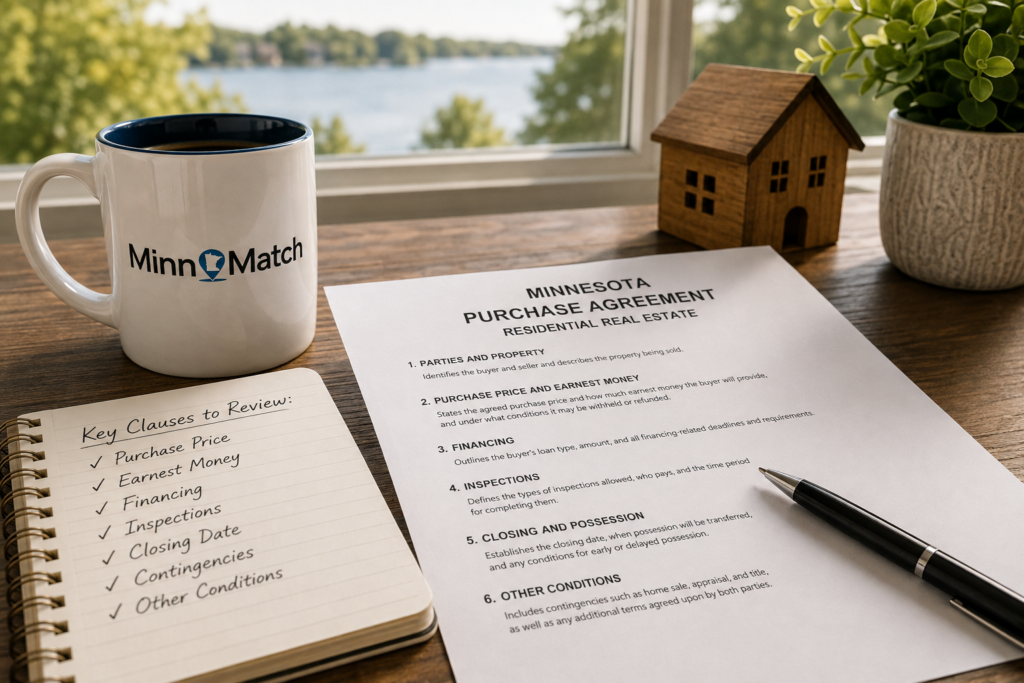
Minnesota purchase agreement document with key clauses checklist, MinnMatch coffee mug, and lake view in background

By the time a Twin Cities buyer sits down to sign, the Minnesota purchase agreement has already done most of the heavy lifting — it’s the document that turns a verbal “we have a deal” into a legally binding contract. But it’s also dense, full of checkboxes and legal shorthand, and easy to skim past when you’re excited about a house. Understanding what you’re actually agreeing to, clause by clause, is one of the best ways to avoid surprises between your accepted offer and closing day. Here’s what’s actually in a standard Minnesota purchase agreement in 2026, and why each section matters more than it looks.

What Your Purchase Agreement Says About Price & Financing

The top of the agreement covers the basics — purchase price, the legal property description, and the closing date — but the earnest money section deserves more attention than most buyers give it. Earnest money is the deposit you put down to show you’re serious, typically held in a broker’s trust account until closing. The agreement spells out the amount, where it’s held, and — critically — the conditions under which you get it back if the deal falls apart. If a contingency in your favor isn’t met and you cancel properly, your earnest money should be returned. If you back out for a reason the contract doesn’t cover, you could forfeit it. This section also lays out your financing terms: loan type, down payment amount, and the interest rate range you’re qualifying for, which protects you if rates move before your loan is locked. If you’re using a first-time buyer program or down payment assistance, make sure those details match what’s on file with your lender — Minnesota Housing is a good source for verifying program specifics before you sign.

Contingencies: The Escape Hatches Every Buyer Needs

Contingencies are the conditions that must be satisfied for the sale to move forward, and they’re the part of a Minnesota purchase agreement that actually protects you as a buyer. The most common ones are the financing contingency (the deal is off if your loan isn’t approved), the inspection contingency (you can renegotiate or walk away based on what an inspector finds), and the appraisal contingency (protection if the home appraises for less than your offer price). Some agreements also include a sale contingency, which makes your purchase dependent on selling your current home first — useful, but it can make your offer less competitive in a fast-moving market. Each contingency comes with a deadline written directly into the agreement, so missing a date can mean losing the protection entirely, even if you intended to use it. If a term like “appraisal gap” or “escalation clause” shows up alongside your contingencies, Redfin’s glossary of real estate terms is a quick way to double-check what you’re agreeing to.

Seller Disclosures and What Minnesota Law Requires

Minnesota law requires sellers to complete a written disclosure statement in good faith before a purchase agreement is signed, covering known material defects — things like a leaky roof, past water intrusion, or an aging furnace. Sellers also have to disclose specifics around private wells and septic or sewage systems, which matters a lot in the suburban and lake communities around the Twin Cities where municipal sewer isn’t a given. If the home was built before 1978, federal law adds a lead-based paint disclosure requirement on top of the state rules. Read this document closely and cross-reference it against what your inspector finds — a mismatch between what was disclosed and what’s actually there can be grounds to renegotiate. You can review the state’s disclosure framework directly through the Minneapolis Area Realtors resource library if you want the fuller legal picture.

Closing Date, Possession & What’s Actually Included

It sounds simple, but confusion over the closing date and possession date causes real friction. Closing is when ownership legally transfers; possession is when you actually get the keys — and in Minnesota, those aren’t always the same day. Some sellers negotiate a short post-closing occupancy period to give themselves time to move out, which should be spelled out with a per-diem rent amount if it runs long. Just as important is the fixtures and personal property section, which lists exactly what stays with the home — appliances, window treatments, that wall-mounted TV bracket — and what the seller plans to take. If you fell in love with the light fixtures during a showing, don’t assume; get them written into the agreement.

Default Clauses: What Happens If Something Falls Apart

Near the bottom of most Minnesota purchase agreements sits the default and remedies section — the part nobody wants to think about but everyone should read. It outlines what happens if either side fails to follow through: whether the non-defaulting party can pursue specific performance (forcing the sale to close), seek damages, or simply cancel and keep or recover the earnest money. There’s often an arbitration or mediation clause here too, which can affect how a dispute gets resolved if one comes up. None of this is meant to scare you off — most Twin Cities transactions close without incident — but knowing what recourse exists on both sides gives you a clearer picture of what you’re actually signing.

A purchase agreement is negotiable up until both parties sign, and a good buyer’s agent will walk you through every clause before you’re staring at a deadline. That kind of hands-on guidance is exactly what MinnMatch is built around — if you’re preparing to make an offer and want an agent who’ll actually explain what you’re signing, find your match with MinnMatch and get paired with a vetted local agent for free. Curious how the matching process works first? Take a look at how MinnMatch works.

What Is a Seller’s Disclosure in Minnesota? A 2026 Guide for Buyers and Sellers

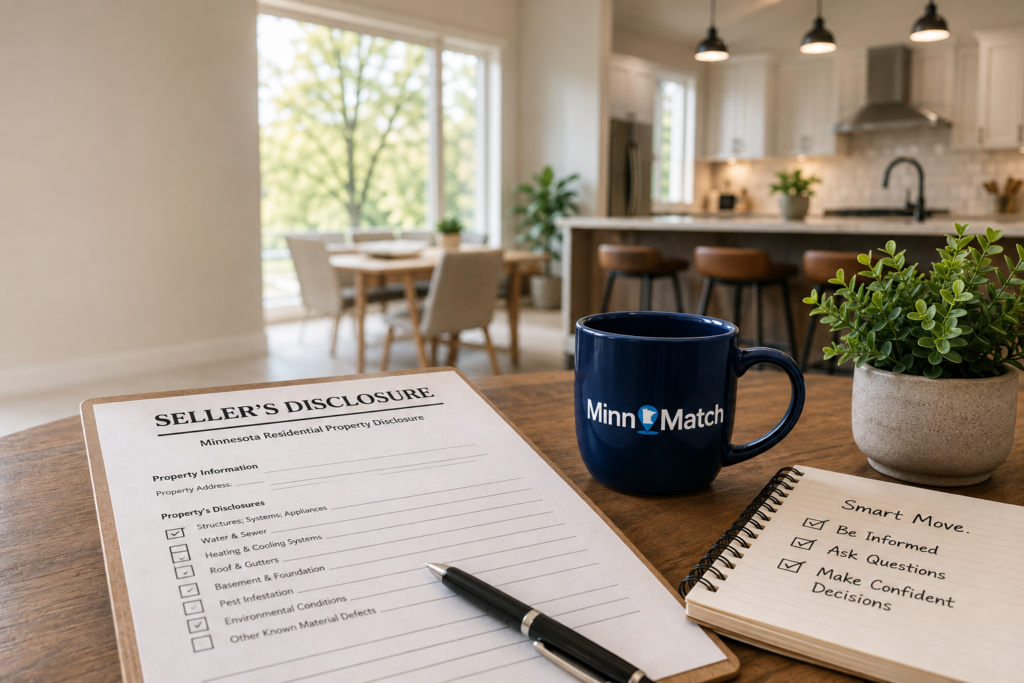
Seller's disclosure form on a kitchen table next to a MinnMatch mug and a notepad reading "Smart Move: Be Informed, Ask Questions, Make Confident Decisions"

If you’ve bought or sold a home in the Twin Cities, you’ve probably signed or reviewed a stack of paper without reading every line. But there’s one document you shouldn’t skim: the seller’s disclosure. In Minnesota, this form is more than a formality — it’s a legal obligation with real consequences if it’s done wrong. Whether you’re prepping to list your home or reviewing one before making an offer, here’s what a seller’s disclosure in Minnesota actually requires, what it covers, and what happens when something gets left out.

What Minnesota Law Actually Requires

Minnesota’s seller disclosure requirement comes from state statute, not just real estate custom. Before a purchase agreement is signed, the seller has to give the buyer a written disclosure covering material facts they’re aware of that could reasonably affect an ordinary buyer’s use and enjoyment of the property, or any specific intended use the seller knows the buyer has in mind. You can read the statute itself on the Minnesota Office of the Revisor’s website. The key word is “material” — the law isn’t asking sellers to list every scuff mark, but it is asking them to be upfront about anything that could change a buyer’s decision to purchase, or what they’d be willing to pay.

What Counts as a Material Fact

This is where most sellers get nervous, and honestly, it’s simpler than it feels. A material fact is something you actually know about — not something you’re guessing at or should have known. Common examples in Twin Cities homes include past water intrusion or basement leaks, foundation cracks, roof age and condition, known mold, failed mechanical systems, drainage issues, or problems with the septic or well system. If you’re not sure about something, Minnesota law allows you to mark it “unknown” rather than guess — as long as that’s the honest answer. What you can’t do is answer “no” to a question you know the real answer to. The standard is good faith, based on what you actually knew at the time you signed.

Special Disclosures Beyond the Standard Form

A handful of Minnesota-specific disclosures often get layered on top of the standard seller’s disclosure. If your home has a well — active or sealed — state law requires a separate Well Disclosure Certificate. Homes built before 1978 also trigger a federal lead-based paint disclosure, which is common in the older housing stock around Edina, Minnetonka, and many South Minneapolis neighborhoods. And if you’re selling in Minneapolis or St. Paul specifically, you’ll also run into a Truth-in-Housing inspection — a city-mandated, point-of-sale evaluation that’s separate from the state disclosure but covers similar ground. Radon is worth a mention too: Minnesota has some of the highest radon levels in the country, and while testing isn’t mandatory, any known results have to be disclosed.

When Sellers Are Exempt

Not every transaction requires this paperwork. The most common exemption is new construction that’s never been lived in — buyers of new builds are protected instead by Minnesota’s new home warranty laws. A few other narrow exemptions exist for certain transfers, like some foreclosures or transfers between family members. If you’re unsure whether your sale qualifies for an exemption, that’s a good question to bring to your agent or a real estate attorney before you assume you’re off the hook.

What Happens If Something Gets Missed

This is the part that should motivate careful disclosure more than any statute citation. If a seller knowingly leaves a material fact off the disclosure, a buyer has up to two years after closing to bring a claim — and they’ll need to show the seller actually knew about the issue. That can mean damages, legal fees, or in serious cases, the sale getting unwound entirely. It’s a big reason experienced Twin Cities agents push sellers to disclose early and thoroughly rather than hope a problem doesn’t come up. For buyers, it’s also a reminder to actually read the disclosure line by line — and to still get an independent inspection, since a disclosure only covers what the seller knows, not everything that could be wrong with the house.

Whether you’re getting ready to disclose or getting ready to read one, having an agent who knows how Twin Cities disclosure norms actually play out — not just what the form says — makes a real difference. If you’re not sure where to start, MinnMatch can connect you with a local agent who’s handled this exact paperwork dozens of times and can walk you through it before it becomes a problem instead of after.

Why Twin Cities Sellers Are Getting a Pre-Listing Inspection Before They List in 2026

Person holding a "Pre-Listing Inspection" checklist clipboard in front of a Twin Cities home with a "Coming Soon" real estate sign

If you’re getting ready to sell a home in the Twin Cities this year, there’s a decision that comes up long before your first showing: should you pay for a pre-listing inspection? It’s not required, and plenty of Minnesota sellers skip it. But more and more agents around the metro are recommending it upfront, especially in a market where buyers are cautious and inspection-related renegotiations can derail a deal. Here’s what a pre-listing inspection actually does for you, what it tends to cost, and how to decide if it’s worth it for your sale.

What Is a Pre-Listing Inspection, Exactly?

A pre-listing inspection is the same type of general home inspection a buyer would order, except you hire the inspector yourself, before the home ever hits the market. A licensed inspector walks the property top to bottom — roof, foundation, electrical, plumbing, HVAC, windows, and more — and hands you a full report of what they find. Some Twin Cities sellers stop there. Others use the report to get ahead of repairs, adjust their price, or simply have documentation ready to share with buyers.

It’s a growing trend, but it’s still very much optional in Minnesota. Nothing in state law requires a seller to have their home inspected before listing — Minneapolis Area Realtors notes that the decision is entirely up to the seller and their agent’s recommendation based on the home’s age and condition.

The Real Benefit: Fewer Surprises After You’re Under Contract

The biggest advantage of a pre-listing inspection isn’t the report itself — it’s timing. When a buyer’s inspector finds a cracked heat exchanger or an aging roof three weeks into a purchase agreement, you’re negotiating repairs or a price reduction under pressure, often with a closing date already on the calendar. When you get that same information before you list, you get to decide, on your own timeline, whether to fix it, price around it, or disclose it and move forward.

That matters a lot in the Twin Cities right now. Inventory has been tight enough in several suburbs that sellers don’t want to lose a buyer over a repair negotiation that could have been settled — or avoided entirely — before the home ever went live.

Pricing Confidence and Fewer Renegotiations

A home’s condition is a pricing input, not just a disclosure issue. Sellers who complete a pre-listing inspection often price their home more accurately from day one, because they’re not guessing at what a buyer’s inspector might turn up. If the report comes back clean, that’s a selling point you can lean into. If it surfaces a few items, you can factor those into your list price rather than getting hit with a lowball renegotiation after you’ve already accepted an offer.

It also tends to shorten the path to closing. Buyers and their agents read confidence into a seller who’s already done the homework — it signals there’s nothing being hidden, which can mean fewer contingencies and a smoother path to the closing table.

What It Costs and How to Fit It Into Your Timeline

Most general home inspections in the Twin Cities run somewhere between $300 and $600, depending on the size and age of the home, with additional cost for add-ons like radon testing or a sewer scope — both common requests in older Minnesota housing stock. Plan on scheduling it 2–4 weeks before you intend to list, which gives you time to review the report, get repair quotes if needed, and decide on next steps without rushing.

One thing to flag with your agent: Minnesota’s seller disclosure law still requires you to disclose known material defects, whether or not you order a pre-listing inspection. Getting one doesn’t create new disclosure obligations — it just means you’re finding out about issues on your own schedule instead of a buyer’s.

Is a Pre-Listing Inspection Right for Your Sale?

It’s not a fit for every seller. If your home is newer, well-maintained, and you’re confident in its condition, the added cost may not move the needle much. But for older homes, homes that have been rented for years, or homes where you suspect there could be deferred maintenance, a pre-listing inspection can be the difference between a smooth sale and a stressful renegotiation. According to Redfin’s seller resources, inspection issues remain one of the most common reasons a deal falls through or gets re-negotiated after going under contract — which is exactly the scenario a pre-listing inspection is designed to prevent.

The best way to decide is to talk it through with an agent who knows your specific home and neighborhood — not a generic rule of thumb.

Get Matched With an Agent Who’ll Give You a Straight Answer

Whether a pre-listing inspection makes sense for your home depends on its age, condition, and your local market — the kind of judgment call a good local agent is built for. MinnMatch can match you with a vetted Twin Cities agent who’ll walk through your specific situation and help you decide whether a pre-listing inspection is worth it before you list. Curious how the matching process works? Here’s how it works — and it’s free for sellers.

How to Price Your Twin Cities Home in 2026: What the Comps Actually Tell You

Laptop showing comparable home sales data next to a Twin Cities market comparison report and pricing checklist

If you’ve pulled up recent sales near your house and thought “okay, but what does this actually mean for MY price,” you’re asking the right question. Comps aren’t a magic number—they’re a starting point that still needs a trained eye to interpret. And in the Twin Cities right now, that eye matters more than usual. Inventory across Minnesota just hit a seven-year high, with metro listings up more than 5% from a year ago, while Minneapolis Area Realtors data shows homes are still moving in around six weeks and selling close to full asking price. That combination—more choices for buyers, but a market that still rewards accurate pricing—is exactly why so many Twin Cities sellers get this step wrong. Here’s how to price your Twin Cities home using the comps in front of you, not just the number a website spits out.

Why Raw Comps Rarely Match Your Home Exactly

A comp is only useful once you’ve adjusted it for what’s actually different. Two three-bedroom ramblers a block apart in Richfield can sell $40,000 apart because one has a finished basement and the other doesn’t, or one closed in April during peak buyer competition and the other closed in a slower month. When you price your Twin Cities home, the goal isn’t to average the comps—it’s to figure out which ones are honestly similar and which ones need adjusting up or down for square footage, lot size, garage stalls, updates, and condition.

A good local agent does this adjustment work as part of a full comparative market analysis, weighing not just sale price but days on market, concessions, and how many offers each comp actually received. That last part rarely shows up on a public listing site, but it changes everything about what a comp is really telling you.

What the Current Twin Cities Numbers Actually Say

As of the most recent Minnesota Realtors report, the Twin Cities metro median sale price sits around $410,000, up roughly 2% from last year, with homes averaging in the low-to-mid 40s for days on market and sellers typically receiving close to 99.6% of their final list price. That last figure is the one worth sitting with: it means well-priced homes are still selling close to ask, but the margin for error has narrowed compared to the tightest years of the pandemic-era market. Overprice a home today and it doesn’t just sit—it often ends up selling for less than if it had been priced accurately from day one, because buyers start to wonder what’s wrong with it after a few weeks of silence.

Inventory is also a bigger factor in your pricing than it was a year or two ago. With more listings for buyers to compare against, your home is competing directly with the comp down the street that’s still active—not just the ones that already closed. Redfin’s local market data shows homes across the metro still selling in around three weeks on average, but that pace varies a lot by suburb, price point, and condition, which is exactly why a one-size-fits-all number from an online estimator can miss so badly.

The Overpricing Trap Twin Cities Sellers Keep Falling Into

It’s tempting to price high and “see what happens”—especially if you’ve heard stories about bidding wars from a few years back. But in a market with rising inventory, that strategy usually backfires. The first two weeks after listing get the most buyer traffic and the most showings your home will ever see. Price too high during that window, and you burn through your best shot at multiple offers. By the time you drop the price, the buyers who were originally excited have often moved on to something else, and the new price can look like a red flag rather than a fresh opportunity.

This is especially true in suburbs like Eden Prairie, Minnetonka, and Plymouth, where buyers are actively cross-shopping similar homes across neighboring suburbs. If your price doesn’t line up with what the comps in those areas support, buyers will simply move to the next listing on their tour.

Adjusting for Your Home’s Real Condition

Comps also assume a level of updating and condition that your home may or may not match. An original 1998 kitchen isn’t the same as one updated in 2023, even if the square footage and bedroom count are identical. When you price your Twin Cities home, be honest about where it falls on that spectrum—not to talk yourself down, but to set a number buyers will actually believe once they walk through the door. A price that matches what buyers see in person tends to hold up through inspection and appraisal; a price that only makes sense from the street often doesn’t.

This is also where local financing conditions matter more than people expect. With the 30-year fixed mortgage rate hovering in the mid-6% range this summer according to Freddie Mac’s weekly survey, monthly payment sensitivity is real for a lot of Twin Cities buyers. A home priced even $10,000–$15,000 above what the comps support can push a buyer’s payment past their comfort zone entirely, shrinking your pool of interested offers before a single showing happens.

The Smartest Way to Price Your Twin Cities Home

Automated home value estimates are a fine starting point, but they’re pulling from public records and broad averages—they don’t know that your street floods a little in spring, that your neighbor’s finished basement isn’t permitted, or that a comp two doors down included a $15,000 seller credit that never showed up in the headline sale price. An agent who works your specific pocket of the Twin Cities day in and day out will catch those details, because they’re the ones who negotiated some of those deals themselves.

That’s really what it takes to price your Twin Cities home well: reading the comps the way someone who knows your neighborhood would, not the way a spreadsheet does. If you want a second opinion before you land on a listing price, MinnMatch can connect you with a local agent who knows your specific street, your specific suburb, and exactly how your comps stack up—free, with no obligation. It’s a quick way to find out whether the number you’re considering will actually hold up once real buyers start walking through the door.

The MinnMatch Process: How We Match Twin Cities Buyers and Sellers with the Right Agent

The MinnMatch process: a 5-step agent matching workflow shown on a laptop overlooking the Minneapolis skyline

If you’ve ever tried to find a real estate agent in the Twin Cities, you know the usual options: ask a friend for a name, scroll through online reviews that all sound the same, or pick whoever’s face is on the biggest bus bench ad. None of that tells you whether an agent actually understands your neighborhood, your price range, or what you’re trying to accomplish. That’s the gap the MinnMatch process was built to close. Instead of guessing, we sit down with you first, learn what you actually need, and hand-match you with a local agent who’s the right fit — at no cost to you. Here’s exactly how it works, from the first message to your first showing.

The MinnMatch Process: Built as a Matchmaker, Not a Directory

A lot of agent-finder sites are really just directories — you type in a zip code and get a list of names, sorted by whoever paid for placement. That’s not the MinnMatch process. We’re closer to a matchmaker than a search engine. A real person reviews what you tell us about your move, cross-references it against agents actively working in that specific pocket of the Twin Cities, and makes an introduction based on fit — not on who bought the most ad space. If you want the fuller story on how that differs from other ways people find agents, we’ve written about it in more depth on our how it works page.

Step 1: Tell Us What You’re Trying to Do

The MinnMatch process starts with a short form on our find an agent page — it takes a couple of minutes. We ask the basics: are you buying, selling, or both, what part of the Twin Cities you’re focused on (or leaving), your rough timeline, and anything specific that matters to you, like needing an agent who knows new construction, lake properties, or first-time buyer programs inside and out. There’s no pressure and no obligation attached to filling it out. Whether you’re a buyer planning a move to Eden Prairie or a seller listing a home in South Minneapolis, the goal of this step is simple: give us enough to work with so the match isn’t a shot in the dark.

Step 2: We Match You with a Handpicked Local Agent

This is the core of the MinnMatch process, and it’s where the human part really matters. Every agent in our network has already been through a screening process before they’re eligible for a match — we don’t dig into that criteria here, but you can read more about how vetting works on our site if you’re curious. Once your information comes in, we look for an agent whose track record lines up with your specific situation: someone who’s closed deals in Plymouth if that’s where you’re headed, or who regularly handles listings in the price range you’re working with. It’s a judgment call made by a person, not an algorithm sorting by zip code and calling it a day.

Step 3: We Introduce You — No Strings Attached

Local market data can shift block by block, and resources like Redfin are a useful way to sanity-check pricing trends in a specific neighborhood before you even talk to an agent — but the agent match itself is where the real value of the MinnMatch process shows up. Once we’ve found a fit, we make the introduction directly, usually by email or phone, so you and the agent can connect quickly. From there, it’s your call. If the agent feels like the right partner for your buying or selling journey, you move forward together. If for any reason it’s not a fit, you tell us and we’ll find you someone else — there’s no cost to you either way, and no obligation to keep working with an agent who isn’t clicking. That’s a meaningfully different experience than getting a referral from a friend, where backing out can feel awkward. For an apples-to-apples look at how MinnMatch stacks up against other ways people search, our site has a comparison worth checking out.

Step 4: Your Agent Takes It from There

After the match, your agent handles the parts you’d expect — pricing conversations, showings, offers, negotiations, and paperwork through closing. According to the Minneapolis Area Realtors, buyer and seller agents in this market typically guide clients through everything from initial search or listing prep to the final signature, and that’s exactly the relationship the MinnMatch process is designed to set up — just with a stronger starting fit than a cold search would give you. If financing questions come up along the way, resources through the Minnesota Housing Finance Agency can also be a helpful reference point for first-time buyers working through down payment assistance options.

Whether you’re just starting to think about a move or you’re ready to list this week, the MinnMatch process starts with one simple step: telling us what you need. Find your agent match today, completely free, and let us make the introduction — no directories, no guesswork, just the right Twin Cities agent for your situation.

What Is a Comparative Market Analysis (CMA) and Why You Need One in Minnesota in 2026

Comparative market analysis report on a desk with a Minnesota home, neighborhood map, and MinnMatch coffee mug

If you’ve spent any time talking to a Twin Cities real estate agent, you’ve probably heard the term “CMA” thrown around. It sounds technical, but it’s really one of the most useful documents you’ll encounter as a buyer or seller in Minnesota’s 2026 market. A comparative market analysis takes the guesswork out of pricing by showing you, in black and white, what similar homes in your area have actually sold for. Whether you’re getting ready to list a home in Edina or you’re trying to figure out if a listing in Plymouth is priced fairly, understanding what a CMA is — and how to read one — puts you in a much stronger position.

What Exactly Is a Comparative Market Analysis?

A comparative market analysis is a report, usually prepared by a licensed real estate agent, that estimates a home’s current market value by comparing it to similar properties — often called “comps” — that have recently sold, are currently listed, or went under contract in the same area. A good CMA looks at square footage, lot size, bedroom and bathroom count, age, condition, and location, then adjusts for differences between the subject property and each comp.

In a market like the Twin Cities, where prices can shift block by block — a rambler in South Minneapolis can behave very differently than one in Prior Lake — a comparative market analysis grounds your expectations in local data instead of national headlines or a Zillow estimate. According to Minneapolis Area Realtors, local market conditions vary significantly by neighborhood and price tier, which is exactly why a CMA needs to be built from nearby, recent, and truly comparable sales rather than a citywide average.

CMA vs. Appraisal: They’re Not the Same Thing

It’s easy to confuse a comparative market analysis with a home appraisal, but they serve different purposes and come from different people. A CMA is typically prepared by your real estate agent, is free, and is meant to help set a listing price or shape an offer. An appraisal is completed by a state-licensed, independent appraiser, usually costs a few hundred dollars, and is required by your lender before closing to confirm the home is worth what you’re paying for it.

Think of it this way: a CMA is a strategic estimate built for decision-making before you list or offer, while an appraisal is a formal, regulated valuation used to protect the lender’s investment. The two often land in a similar range, but they’re not interchangeable, and a CMA is never a substitute for the appraisal your mortgage will require.

Why Sellers Should Start Here, Not With a Number They Have in Mind

Plenty of Twin Cities sellers walk into the process with a price already in their head, often based on what a neighbor’s house sold for years ago or what a home improvement show made pricing look like. A comparative market analysis replaces that gut feeling with current, local evidence. It’s the starting point for a listing strategy — before staging decisions, before marketing photos, before the “For Sale” sign goes in the yard.

We’ll go deep on pricing strategy and how to interpret specific comps in an upcoming article, but the short version is this: a CMA is the foundation everything else gets built on. If you’re weighing whether to list this year, our seller resources page is a good next stop, and connecting with a local agent through MinnMatch’s free agent-matching service is the easiest way to get a CMA built specifically for your address, not a generic estimate.

Buyers Need a CMA Too — Here’s Why

A comparative market analysis isn’t just a seller’s tool. Before you write an offer on a home in Minnetonka or Eden Prairie, a buyer’s agent can run a CMA to tell you whether the asking price actually lines up with what similar homes have sold for recently. That’s especially valuable in a market where a well-staged listing photo or an eager seller’s price can make a home look like a deal — or a stretch — when the comps tell a different story.

A buyer-side CMA also gives you real leverage in negotiations. Instead of an offer based on a feeling, you can point to actual recent sales nearby. If you’re just starting to look, our buyer resources page walks through what else to expect, and Redfin can be a helpful place to sanity-check recent sale prices in a neighborhood you’re considering, alongside the more detailed comps your agent pulls.

Getting an Accurate CMA in the Twin Cities Market

The accuracy of a comparative market analysis depends entirely on the person building it. An agent who knows a specific pocket of the Twin Cities — the difference between a Wayzata lake lot and one a few blocks off the water, or why one South Minneapolis block sells faster than the one next to it — will build a far more useful CMA than an automated online estimate ever could. Housing conditions can also shift with financing programs and affordability trends; resources like the Minnesota Housing Finance Agency track statewide affordability data that can add helpful context to a hyper-local CMA.

This is really where local expertise makes or breaks the number. An out-of-area agent, or a generic online tool, simply won’t know the nuances that move value street by street across the metro.

Get a CMA From an Agent Who Knows Your Neighborhood

Whether you’re preparing to sell or trying to make sense of a listing price, a comparative market analysis is only as good as the agent behind it. MinnMatch connects Twin Cities buyers and sellers with handpicked local agents — for free — so you get a CMA built on real neighborhood knowledge, not guesswork. Find your agent match today and get a clear, accurate picture of what your home — or your next one — is really worth.

10 Questions Every Minnesota Home Seller Should Ask Before Signing with an Agent

Minnesota home seller meeting with a real estate agent at a lake house dining table to ask listing questions

Picking a listing agent is a lot like hiring a contractor to renovate your kitchen: the person you choose will shape your timeline, your stress level, and ultimately your bottom line. Yet plenty of Minnesota sellers still pick an agent because a neighbor used them once, or because they recognize the name from a bus bench ad. With the Twin Cities market moving at a brisker pace than it has in years — homes here are selling in a median of three weeks or so — the agent you choose to represent your sale deserves more scrutiny than that. Before you sign anything, sit down with your top one or two candidates and ask them these 10 questions. The answers will tell you more about how your sale will actually go than any sales pitch will.

1. How will you price my home, and what’s your evidence?

Any agent can hand you a number. A good agent will walk you through a comparative market analysis (CMA) built from recent closed sales in your specific neighborhood — not just the metro-wide average. Twin Cities pricing varies block by block; a home in Edina’s Country Club neighborhood prices on an entirely different curve than one in South Minneapolis. Ask to see the comps. Ask why your home compares the way it does. If an agent’s number sounds suspiciously high “to win the listing,” that’s a red flag — an overpriced home tends to sit, and a home that sits long enough starts looking stale to buyers even after a price cut.

2. What’s your commission, and exactly what does it cover?

Since the 2024 NAR settlement reshaped how agents get paid, commission is no longer a fixed, take-it-or-leave-it number quietly baked into the deal — it’s a line item you negotiate directly with your listing agent, spelled out in writing before you sign anything. Minnesota listing commissions commonly run in the 2.5–3% range, though rates vary by brokerage, home price, and market. Ask specifically what services that fee includes: professional photography, staging consultation, a marketing budget, open houses, or just the listing itself. Also ask whether you’ll be offering any commission to a buyer’s agent and how that decision affects buyer interest in your specific price range.

3. What does your marketing plan actually look like?

“I’ll put it on the MLS” is not a marketing plan — every agent does that. Ask for specifics: Who shoots the photos, and have you seen their work? Is there a videographer or drone shot for larger lots and lake properties? How will the listing be promoted on social media, and to which buyer’s-agent networks? If you’re selling near Lake Minnetonka or in a higher-end suburb like Wayzata, ask how the agent reaches out-of-state or relocating buyers who may not be searching local Facebook groups. The right marketing plan should match your home’s price point and the buyer pool you’re actually trying to reach.

4. How many listings have you closed in my specific area this year?

An agent with 200 sales across the entire metro isn’t automatically the right fit for your street. Local market fluency — knowing which school district boundary line affects price, which suburb has tighter inventory, which neighborhood has an HOA quirk buyers ask about — comes from working that specific area repeatedly. Ask how many transactions they’ve closed in your city or neighborhood in the past 12 months, and ask to see (or at least hear about) a couple of recent examples. An agent who’s sold five homes in Plymouth this year will know that market’s rhythm far better than one whose business is spread thin across the whole metro.

5. What’s your communication style, and how often will I hear from you?

This sounds like a soft question, but it’s one of the biggest sources of seller frustration. Will you get a call after every showing, or radio silence until an offer comes in? Does the agent personally handle your file, or does a transaction coordinator or junior team member take over once it’s listed? Ask how they prefer to communicate (text, email, phone) and how quickly you can expect a response. If you’re balancing a sale with a full-time job and a move across the metro, knowing you won’t be left wondering what’s happening matters more than almost anything else on this list.

6. What should I fix, update, or stage before listing — and what should I skip?

A good listing agent should be able to walk your home with you and tell you, room by room, what’s worth the investment and what isn’t. Twin Cities buyers tend to respond strongly to updated kitchens, fresh paint in neutral tones, and curb appeal — especially given how much of the buying season happens in spring and summer when lawns and landscaping are on full display. But not every project pays for itself. Ask the agent to be specific and honest, even if that means telling you not to spend money on something you were planning to fix.

7. How will you handle multiple offers, and how do you advise on offer terms beyond price?

With inventory still relatively tight across much of the metro, well-priced homes in popular suburbs can still draw competing offers. Ask how the agent typically structures an offer deadline, how they evaluate offers that aren’t all-cash or aren’t the highest price (financing contingencies, appraisal gaps, and closing timelines all matter), and how they’ll keep you from leaving money — or peace of mind — on the table. An agent who can talk through a real multiple-offer scenario in detail has clearly been through one before.

8. What happens if my home doesn’t sell quickly?

Not every home goes pending in the first week, and that’s worth planning for before it happens, not after. Ask what the agent’s plan is if the home is still active after 30 or 45 days: Do they recommend a price adjustment, new photography, a re-launch as a “new” listing, or a change in marketing strategy? Also ask about the length of the listing agreement itself and what your options are if the relationship isn’t working — a shorter initial term with the option to renew gives you flexibility without locking you in if expectations aren’t being met.

9. Who else is involved in my transaction, and what do they handle?

Many Twin Cities agents work as part of a team, which isn’t a bad thing — but you should know upfront who’s actually showing up to your listing appointment versus who’s drafting your paperwork, scheduling your photographer, or fielding buyer questions. Ask whether you’ll have one point of contact throughout, and get names and roles for anyone else who’ll touch your file. There’s nothing wrong with a team structure as long as you know exactly who to call when you have a question.

10. Can you walk me through a recent sale that didn’t go smoothly — and how you handled it?

Every experienced agent has a story about an inspection that turned up something unexpected, an appraisal that came in low, or a buyer who got cold feet days before closing. How they answer this question tells you a lot more than their highlight reel of easy sales. Listen for problem-solving, not blame — you want an agent who stays calm, communicates clearly, and has a track record of getting deals back on track when something goes sideways. Real estate rarely goes exactly according to plan, and the agent’s response to friction is often the best preview of what working with them will actually feel like.

Finding the right fit shouldn’t be guesswork

The best protection against a mismatched agent isn’t a longer list of interview questions — it’s starting the search with agents who are already a strong fit for your home, your neighborhood, and your goals. That’s the whole idea behind how MinnMatch works: instead of cold-calling agents off a billboard or picking whoever ran the last open house you attended, you tell us a little about your home and your timeline, and we hand-match you with local, vetted agents who actually specialize in your part of the Twin Cities. There’s no cost to you, no algorithm guessing on your behalf — just a real local matchmaker doing the legwork before you ever sit down for that first interview.

Ready to start those conversations with the right agents already in the room? Find your agent match with MinnMatch and walk into your listing interview already a step ahead.

Selling your Minnesota home? Get matched with a local agent who’s earned your questions — and your trust.


Find My Agent Match

Sources: Minneapolis Area Realtors®, Minnesota Housing Finance Agency, Redfin Minneapolis Housing Market Data.

The Real Cost of Overpricing Your Home in the Twin Cities in 2026 — And How to Avoid It

"For Sale" sign with "Price Reduced" tag in front of Twin Cities home, winter skyline behind

It’s tempting. You love your house, the kitchen remodel cost a fortune, and your neighbor down the block “got” a number that seemed sky-high. So why not list a little higher and see what happens? In the Twin Cities in 2026, that decision is one of the most expensive mistakes a seller can make — and it rarely plays out the way people hope. Overpricing your home doesn’t just risk a slower sale. It can quietly cost you thousands of dollars by the time you actually close.

Here’s what’s actually happening in the Minneapolis–St. Paul market right now, why overpricing backfires, and how to land on a number that gets your home sold for the most money in the least amount of time.

The Twin Cities Market Has Shifted — And Pricing Strategy Matters More Than Ever

A few years ago, sellers could get away with an aggressive list price because buyers had no other choice — inventory was scarce and offers came in within days. That’s not the market we’re in anymore. According to Minneapolis Area Realtors, homes across the metro are now sitting on the market for roughly 43 to 47 days on average, and the percentage of original list price that sellers actually receive has been gradually trending down, landing in the high 90s rather than the 100%-plus numbers seen during the frenzy years.

Months of supply has also crept up to around 2 to 2.5 months in much of the metro. That’s still technically a mild seller’s advantage — but it’s a far cry from the “list it high and watch the bidding war” conditions of 2021–2022. Buyers today have options, more time to compare, and far less patience for a home that feels overpriced for what it offers. Pricing your home correctly the first time in this market isn’t a nice-to-do — it’s the difference between a smooth sale and a stale listing.

What Overpricing a Home Actually Costs You

“Let’s just price it high and see what happens” feels low-risk. In practice, it sets off a chain reaction that almost always ends with sellers netting less than if they’d priced accurately from day one. Here’s the typical pattern our partner agents see play out across the Twin Cities:

You Miss the Critical First-Two-Weeks Window

The first one to two weeks on the market generate the most buyer traffic and showings any listing will ever see. Serious buyers and their agents are watching new listings closely, and that early surge is when multiple-offer situations happen. If your home is priced above what the market will bear, that window passes with light showings and no offers — and you don’t get it back. Every week that goes by after that, interest drops further.

Buyers (and Their Agents) Start to Wonder What’s Wrong

Buyers in Eden Prairie, Plymouth, Edina, or anywhere else in the metro are almost always working with an agent who tracks days on market. A listing that’s been sitting for 60, 75, or 90+ days starts to raise questions: Is there something wrong with the house? Is the seller unrealistic? Will they take a lowball offer out of desperation? None of that may be true, but perception drives behavior, and a stale listing invites lower offers, not higher ones.

You End Up Chasing the Market Down

This is the part that really stings. Most overpriced listings eventually get a price reduction. But by the time that happens, you’ve already lost momentum, and the new, lower price often has to compete with newer, fresher listings that are priced correctly from the start. Instead of landing close to your original number, sellers frequently end up cutting the price more than once and settling for a sale price below what an accurate initial listing would have brought in.

Appraisal Problems Can Tank the Deal Entirely

Even if you do get a buyer at an inflated price, the home still has to appraise for that amount if the buyer is financing the purchase. If the appraisal comes in lower — which is common when the list price wasn’t grounded in comparable sales — the deal can fall apart entirely, or you may be forced to renegotiate at a lower number anyway, after weeks of lost time.

Why Sellers Overprice in the First Place

It’s rarely about greed. It’s usually one of these very human reasons:

Emotional attachment. You’ve lived there for years, raised a family, renovated the basement yourself. None of that has anything to do with market value, but it’s hard not to let it influence the number you have in mind.

Anchoring to renovation costs. A $60,000 kitchen remodel doesn’t necessarily add $60,000 in resale value — sometimes it adds far less, depending on the neighborhood and what buyers are actually willing to pay for in that price range.

Comparing to the wrong “comp.” Your neighbor’s sale two years ago, a Zillow estimate, or a listing price (not sale price) you saw online can all create an unrealistic anchor. None of those reflect what’s actually selling, for how much, right now, in your specific neighborhood.

“Testing the market.” Some sellers list high thinking they can always come down later. As outlined above, this strategy almost always backfires — it just costs you the most valuable window of buyer attention first.

How to Price Your Home Correctly the First Time

The good news: avoiding all of the above is straightforward when you have the right information and the right agent guiding the process.

Start with a real comparative market analysis (CMA). A proper CMA looks at homes that actually sold — not just listed — in your specific neighborhood within the last three to six months, adjusted for square footage, condition, and upgrades. This is the single most reliable tool for landing on an accurate number.

Pay attention to days-on-market trends in your specific area. Metro-wide averages are a starting point, but a home in Wayzata or Minnetonka can behave very differently than one in South Minneapolis. A local agent who’s actively working your neighborhood will know the difference.

Separate what you spent from what buyers will pay. Renovations matter for livability and buyer appeal, but pricing should be grounded in what comparable homes are actually selling for — not your total investment in the property.

Price to attract activity in the first two weeks, not to leave room for negotiation. A home priced accurately from the start tends to generate strong early interest, sometimes even multiple offers, which puts you in a stronger negotiating position than a high price that needs to be chased downward later.

For more on how pricing fits into the bigger picture of getting your home ready to list, the Minnesota Housing Finance Agency also offers useful resources for homeowners navigating a sale.

The Right Agent Makes All the Difference

Pricing a home correctly isn’t guesswork, and it isn’t something an automated online estimate can do reliably either. It takes an agent who knows your specific neighborhood, understands current Twin Cities buyer behavior, and is willing to have an honest conversation with you about value — even when that conversation isn’t the one you were hoping for.

That’s exactly the kind of match MinnMatch is built to make. Instead of guessing which agent to call, tell us about your home and your goals, and we’ll connect you with a vetted, local Twin Cities agent who knows your neighborhood’s pricing realities inside and out — so you list at the right number the first time, not after months of expensive trial and error. Curious how the process works? Visit our how it works page to see how simple it is to get matched with the right agent for your sale.