Why MinnMatch Is the Smarter Way to Find a Real Estate Agent in the Twin Cities

A magnifying glass focusing on a home with a checkmark icon, with the Minneapolis skyline in the background — representing finding the right real estate agent in the Twin Cities

Finding a Twin Cities real estate agent shouldn’t feel like a gamble. Yet for most buyers and sellers, that’s exactly what it is — a scroll through Zillow profiles, a few Google searches, maybe a referral from a coworker who bought a house three years ago. You end up with someone who may or may not know your target neighborhood, may or may not have the experience level your situation demands, and may or may not be the right fit for how you like to communicate. There’s a smarter way — and that’s exactly what MinnMatch was built to do.

We Match You With a Twin Cities Real Estate Agent — You Don’t Search

The core difference between MinnMatch and every agent directory or referral platform you’ve used before is simple: we do the matching for you. You’re not handed a list of agents and left to figure it out. You’re not bidding on your own time with agents who pay to be at the top of a search result. Instead, a real human at MinnMatch listens to your situation — your timeline, your price range, your neighborhood preferences, your communication style — and handpicks a vetted local agent who genuinely fits.

Think of it less like a search engine and more like a trusted recruiter. Except instead of placing candidates for a job, we’re placing the right agent for one of the biggest financial decisions of your life.

“Most platforms are paid directories dressed up as matching services. MinnMatch is the opposite — free for buyers and sellers, with the matching done by people who actually know the Twin Cities market.”

Local Expertise That Actually Means Something

The Twin Cities real estate market isn’t monolithic. A buyer looking in Edina has entirely different needs than one eyeing a place in South Minneapolis. A seller in Lake Minnetonka is navigating a completely different buyer pool than someone listing in Plymouth. Hyper-local knowledge isn’t a nice-to-have — it’s the difference between getting the right offer and leaving money on the table, or winning a competitive bid versus losing out.

Every agent in the MinnMatch network is vetted specifically for their local expertise. We know which agents are specialists in Wayzata, who dominates in Eden Prairie, and who has the track record in Prior Lake to back it up. That intelligence doesn’t exist in a Zillow rating or a Google review count — according to the Minneapolis Area Realtors, local market conditions can vary significantly even between neighboring zip codes. It comes from doing this work, in this market, consistently.

It’s Free — And There’s No Catch

MinnMatch is completely free for buyers and sellers. No subscription. No lead fee passed along to you. No premium tier that unlocks the actually-good agents. The service works because agents value the quality of our referrals — you’re not a cold lead scraped from an ad click. You’re a matched client who is ready to move, informed about the process, and paired with an agent who is genuinely right for your situation. That’s worth something to agents, and it’s how the model sustains itself without charging you a dime.

You don’t have to wonder whether the agent being recommended to you paid for that recommendation. They didn’t.

The Problem With Most Agent-Finding Methods

Let’s be direct about the alternatives:

  • Big portal directories (Zillow, Realtor.com) — Agents pay for placement. The ones at the top aren’t necessarily the best for your situation; they’re the ones who spent the most on ads.
  • Friend and family referrals — Well-intentioned, but your cousin’s agent who sold a house in Bloomington two years ago may not be the right match for what you’re doing in Minnetonka today.
  • Random Google searches — SEO doesn’t equal competence. The agent ranking for “Twin Cities real estate agent” isn’t necessarily the agent who will serve you best.
  • National referral networks — These often match you with whoever is available or whoever pays the referral fee, not whoever is the best fit for your specific needs.

None of these methods start with your situation. MinnMatch does.

How MinnMatch Works in Practice

The process is designed to be low-friction. You share a little about what you’re looking for — buying or selling, where, when, and any specifics that matter to you. From there, MinnMatch does the work. We tap our curated network, identify the agents who are the strongest fit, and make an introduction. You’re not fielding calls from five agents who all got your number from a lead form. You’re getting a thoughtful match and a warm introduction.

You can learn more about the full process on our How It Works page, or browse our FAQ if you have questions about what to expect. If you’re still weighing your options, Redfin’s guide to choosing a real estate agent is a helpful overview of what to look for — and MinnMatch handles all of it for you.

The Right Twin Cities Real Estate Agent Changes Everything

A well-matched agent isn’t just more pleasant to work with — they produce better outcomes. They know how to price a home for your specific neighborhood. They know which listings are worth your time before they’re widely public. They negotiate in a way that fits the local market dynamics, not a one-size-fits-all playbook. They communicate on your schedule in your preferred style. The difference between a good agent and the right agent can be tens of thousands of dollars and months of stress.

Minnesota Housing Finance Agency data consistently shows that informed buyers and sellers — those who work with agents matched to their specific situation — fare better in negotiations and close with fewer surprises. You can explore current homebuyer resources at mnhousing.gov for additional context on the Minnesota market.

That’s the case MinnMatch makes every day for buyers and sellers across the Twin Cities. Not that we have all the agents — but that we have the right agents, and we know how to connect you with the one who’s right for you.

Ready to get matched?

It takes just a few minutes to tell us about your situation. Start the process here — and let MinnMatch handle the rest. You can also learn more about us or check out our market insights to get a sharper sense of what’s happening in the Twin Cities right now.

South Minneapolis Real Estate Spring 2026: Neighborhoods, Prices & Where Buyers Are Competing

South Minneapolis real estate spring 2026 — lakeside homes, cherry blossoms, and the Minneapolis skyline

The South Minneapolis real estate market in spring 2026 is showing its characteristic energy — buyers circling open houses in Longfellow, sellers doing quick refreshes before listing in Nokomis, and “sold over ask” signs reappearing in the city’s most sought-after pockets. But this spring also looks meaningfully different from the frenzy of 2021 and 2022. If you’re buying or selling in South Minneapolis right now, understanding where competition is concentrated — and where it isn’t — can be the difference between a smart move and a costly one.

“This spring, South Minneapolis rewards the prepared buyer and the strategic seller. Knowing which neighborhoods are moving fast — and which offer room to negotiate — is the most important edge you can have.”

South Minneapolis Real Estate in Spring 2026: The Overall Picture

Minneapolis home prices in March 2026 were up 6% compared to a year ago, with a citywide median sale price of $355,000. Homes are selling in about 30 days on average — slightly faster than the 32-day pace seen a year earlier. That’s meaningful: the market isn’t stalling, but buyers are no longer stampeding either.

The data points to a stabilizing market — slightly more homes for sale, softer overall buyer demand, and prices holding steady rather than rapidly escalating. This creates a more balanced environment compared to the competitive and fast-moving years of 2021–2022. For buyers, that means more time to think. For sellers, it means pricing correctly matters more than ever. You can track current citywide trends at the Minneapolis Area Realtors market data hub.

South Minneapolis sits at the heart of this dynamic. The area south of I-94 — from the upscale Calhoun-Isles neighborhoods to the more accessible Powderhorn and Nokomis communities — spans a wide range of price points, neighborhood characters, and buyer competition levels. Here’s how the key neighborhoods stack up this spring.

Neighborhood-by-Neighborhood Breakdown

Nokomis & Minnehaha: Family-Friendly and Still Moving Fast

Nokomis continues to be one of South Minneapolis’s most desirable — and competitive — areas for families. The combination of lake access, Minnehaha Regional Park, and solid neighborhood schools draws consistent buyer interest year over year. Market data shows neighborhood medians in the low-to-mid $300,000s, with a strong supply of tidy single-family options appealing to buyers who want parks, paths, and a genuine neighborhood feel.

Well-maintained bungalows near the lake and Minnehaha Falls corridor are generating multiple offers quickly. If you’re targeting this area, expect to compete — and come in prepared with pre-approval in hand. First-time buyers who find a move-in-ready home in Nokomis under $350,000 should move decisively.

Longfellow: The Greenway Effect on Spring 2026 Home Prices

The Longfellow community — encompassing Seward, Cooper, Howe, and Hiawatha — offers a range of housing options from classic bungalows to modern updates, with home prices typically running from the mid-$200,000s to over $600,000. That wide range reflects the neighborhood’s diversity: some blocks command premiums for riverfront proximity or extensive updates, while others remain accessible to value-focused buyers.

Residents enjoy 5.7 miles of walking and bike paths on the Midtown Greenway, which runs through Longfellow and Seward — a significant lifestyle draw that supports strong demand from young professionals and active households. Homes within easy walking distance of the Greenway tend to list and close faster than those farther from the trail network.

For sellers in Longfellow, spring 2026 is a good moment to list — especially if your home has been recently updated. Buyers in this area are lifestyle-motivated and will pay for turnkey.

Powderhorn: Best Value in South Minneapolis Real Estate Right Now

Powderhorn Park is considered one of the value-focused options in Minneapolis, with reported medians ranging from the low $200,000s to the high $300,000s depending on sub-area and property condition. That makes it one of the few remaining areas of South Minneapolis where buyers — especially first-timers — can get into a detached single-family home without stretching their budget to the limit.

Investor activity has picked up in pockets of Powderhorn, reflecting growing confidence in the area’s long-term trajectory. For owner-occupants, this is a neighborhood worth watching carefully: prices are still accessible today, but the gap between Powderhorn and adjacent Nokomis and Longfellow has been narrowing. Buyers open to some cosmetic work can find the strongest value per square foot in South Minneapolis here.

Seward: Walkable, Transit-Connected, and Consistently In Demand

Seward sits just east of the Greenway, close to the University of Minnesota corridor and the Mississippi River gorge. It has a mix of older homes with strong transit options, including proximity to the light rail Green Line. Median prices in Seward typically land in the mid-to-upper $300,000s, with low vacancy and steady demand year-round.

Seward draws a broad mix of buyers: young professionals who want walkability, families who value proximity to the river gorge trails, and buyers who prioritize transit access. It’s one of the more reliably liquid neighborhoods in South Minneapolis — meaning homes sell consistently regardless of broader market conditions. Don’t expect many deals here; the market is efficient and buyers know what they’re getting.

Standish & Corcoran: The Spring 2026 Sleeper Neighborhoods

Standish and Corcoran are two adjacent South Minneapolis neighborhoods drawing significant buyer attention right now. They sit between the more premium Nokomis area to the south and busier corridors to the north, offering a price point — typically mid-$200,000s to mid-$300,000s — that has become increasingly attractive as values in surrounding neighborhoods have risen.

For buyers who’ve been priced out of Nokomis or Longfellow’s most desirable blocks, Standish and Corcoran are worth serious consideration this spring. The housing stock — predominantly craftsman bungalows and two-stories from the early-to-mid 20th century — is the same character buyers love in pricier South Minneapolis neighborhoods, often at a meaningful discount. That equation is unlikely to hold indefinitely.

Spring 2026 Price Snapshot: South Minneapolis Neighborhoods

Neighborhood Typical Price Range Buyer Competition Best For
Nokomis / Minnehaha Low–mid $300,000s High — moves fast Families, lake-lifestyle buyers
Longfellow Mid $200,000s–$600,000+ Moderate–high Greenway lifestyle, active households
Seward Mid–upper $300,000s Consistent, efficient Young professionals, transit users
Powderhorn Low $200,000s–high $300,000s Moderate Value-focused buyers, first-timers
Standish & Corcoran Mid $200,000s–mid $300,000s Growing Value seekers, long-term upside

Where Buyers Are Competing in South Minneapolis This Spring

Not every listing in South Minneapolis is drawing a crowd. But certain types of properties — in certain locations — are seeing multiple offers and quick closings. Here’s what’s generating competition in the spring 2026 market:

1

Move-in ready homes under $375,000

Turnkey homes in this price range consistently attract the most buyers across South Minneapolis neighborhoods. With mortgage rates still elevated, buyers are hesitant to take on major renovation costs on top of purchase price. Clean, updated, well-maintained homes sell quickly — often above list price.

2

Homes within walking distance of parks and trails

Proximity to Lake Nokomis, Minnehaha Falls, Minnehaha Creek, and the Midtown Greenway commands a premium. With limited inventory across Minneapolis this spring, well-located homes with lifestyle amenities are being absorbed quickly by the buyer pool.

3

Classic bungalows and craftsman homes with original character

South Minneapolis’s early-20th-century housing stock — original woodwork, built-ins, arched doorways — remains deeply appealing. Homes that preserve that character while offering updated kitchens or baths are among the most competed-for properties in the area.

4

Well-priced entry-level homes

The entry-level tier of South Minneapolis remains competitive despite the broader market cooling. Homes that are priced right in desirable areas are still drawing multiple looks — and sellers who price accurately are closing faster and with fewer concessions. For context on statewide affordability programs that may benefit first-time buyers, visit Minnesota Housing.

What Sellers Need to Know This Spring

Spring 2026 is still a good time to sell in South Minneapolis — but the days of listing at an inflated price and waiting for offers to roll in are behind us. The market rewards sellers who price accurately from day one, present their homes well, and work with an agent who genuinely knows the neighborhood.

Key considerations for sellers this spring:

  • Pricing is everything. Strategy matters more than ever in this environment. Homes that come in overpriced are sitting longer and often requiring price reductions — which signals weakness to buyers. Price to the comparable sales, not your wishlist.
  • First impressions drive offers. Buyers in South Minneapolis are lifestyle buyers. Curb appeal, fresh landscaping, and a clean interior are not optional in spring — they’re table stakes. Simple updates pay outsized dividends.
  • Neighborhood expertise matters. A price that’s right for Nokomis may be wrong for two miles north. You need an agent who can make that distinction confidently and back it up with data.
  • Timing the market is less important than timing your listing. Spring is South Minneapolis’s strongest buyer season. If you’re ready, don’t wait.

What Buyers Need to Know This Spring

The pressure to make an offer within hours has dissipated, replaced by a market that rewards thorough due diligence. That’s genuinely good news for buyers who’ve been frustrated by the past few years. But it doesn’t mean you can afford to be passive — especially in South Minneapolis, where well-priced, well-located homes are still moving quickly.

Practical advice for buyers this spring:

  • Get pre-approved before you start touring. In competitive pockets, sellers are still receiving multiple offers. Not having pre-approval ready means you can’t move when the right home hits.
  • Define your non-negotiables by neighborhood, not just features. Decide whether you’re a Nokomis buyer, a Longfellow buyer, or open to emerging areas like Standish. Your agent can focus and advocate much more effectively with that clarity.
  • Don’t dismiss fixer-uppers in premium locations. With competition for turnkey homes stiff, a home that needs cosmetic work in a top-tier block can be a smart play — especially if you’re patient and handy.
  • Understand what’s driving the market in your target neighborhood. The dynamics in Powderhorn are not the same as in Nokomis. A locally knowledgeable agent isn’t just helpful — it’s the single biggest advantage you can have. You can also explore current listings and recent sales data for South Minneapolis on Redfin.

Ready to Buy or Sell in South Minneapolis?

MinnMatch connects buyers and sellers with handpicked, vetted local real estate agents who specialize in South Minneapolis neighborhoods. Our matching process is free, human-powered, and built around your specific situation — not an algorithm. Whether you’re navigating Nokomis competition or figuring out if Powderhorn is right for you, we’ll connect you with an agent who genuinely knows the area.

Find Your South Minneapolis Agent →

The Bottom Line

South Minneapolis real estate in spring 2026 is not the frenzied seller’s market of a few years ago — and that’s actually a healthy thing. Prices are up modestly, inventory is slightly improved, and both buyers and sellers have more room to make deliberate decisions. But “more balanced” doesn’t mean “easy.” The best homes in the best spots still move fast, and the buyers and sellers who succeed are the ones who show up prepared, priced right, and matched with an agent who knows these blocks as well as they know the data.

If you’re planning a move in South Minneapolis this spring, don’t go it alone. See how MinnMatch works — and let us connect you with a local agent who can give you the edge you need.

Prior Lake MN Spring 2026: Waterfront Properties, Market Prices & Buyer Competition

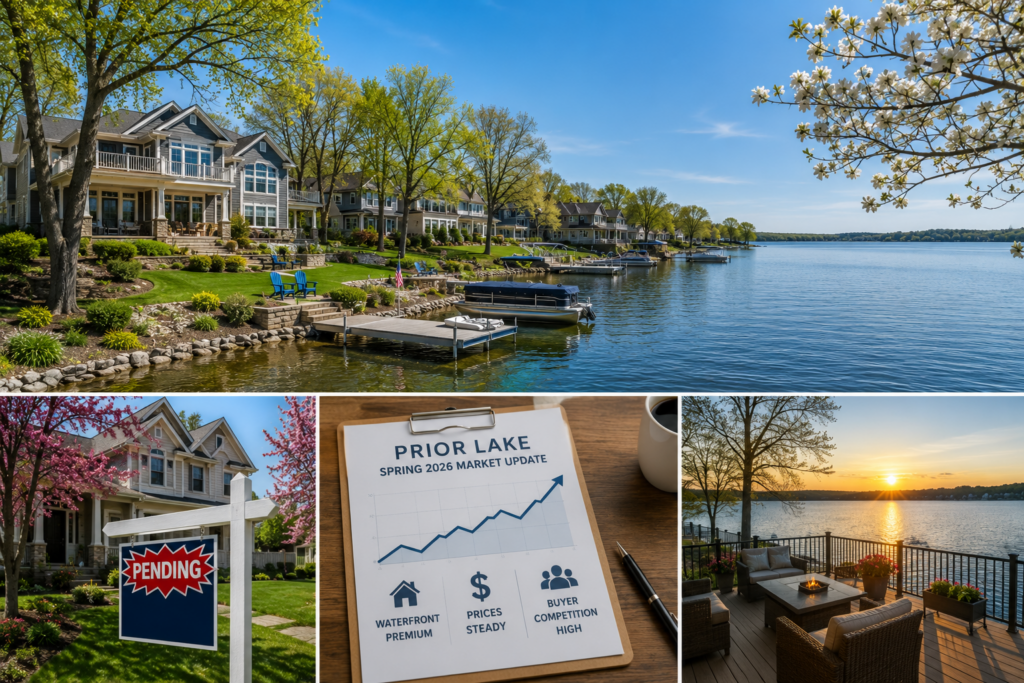
Prior Lake MN waterfront homes with private docks and lake views in spring 2026


If you’re searching for Prior Lake MN waterfront homes in spring 2026, you’ve picked one of the most active — and most competitive — moments this market has seen in years. Whether you’re drawn by the lakefront lifestyle on Lower or Upper Prior Lake, or you’re watching prices closely before making your move, here’s an honest look at where the market stands this spring and what it means for buyers and sellers alike.

What Makes Prior Lake MN Waterfront Homes So Competitive

Prior Lake sits about 20 miles southwest of downtown Minneapolis, offering a commuter-friendly location that’s rare for a true lake community. The town is anchored by two connected bodies of water — Upper and Lower Prior Lake — along with Spring Lake, which draws buyers looking for a quieter, more natural setting. Together, these lakes give Prior Lake one of the most diverse waterfront real estate offerings in the Twin Cities metro. According to the Minnesota Realtors Association, the southwest metro continues to see strong demand driven by limited inventory and lifestyle appeal.

Waterfront properties here range from modest lake cabins and updated cottages to sprawling luxury estates with private docks, panoramic views, and high-end finishes. The variety is part of why Prior Lake attracts such a broad range of buyers — from young families and move-up buyers to empty nesters relocating from larger Twin Cities homes.

“Prior Lake MN waterfront homes carry an average price of around $394 per square foot — making local expertise and agent relationships more important than ever when navigating this market.”

Spring 2026 Waterfront Home Prices in Prior Lake MN

Prices across Prior Lake have been climbing steadily. The average home value in Prior Lake now sits at approximately $526,000, up roughly 3.2% over the past year, according to Zillow’s 2026 market data. For waterfront and lake-adjacent properties, the numbers climb considerably higher.

$526K
Avg. Home Value
↑ 3.2% year-over-year

$590K
Median Waterfront List
~30 active listings

$460K
Median Sold Price
Feb. 2026

~27
Days to Pending
For typical listings

Waterfront listings specifically tell a more dramatic story. Across active lake property listings in Prior Lake, the average listing price approaches $1.8 million, reflecting the premium on direct shoreline access. The highest-priced lakefront properties in the area have been listed well above $5 million. For buyers on a more typical budget, updated non-waterfront homes in established Prior Lake neighborhoods remain available in the $400,000–$550,000 range — though that window is narrowing.

Inventory grew over 30% compared to the previous period in early 2026, but total supply remains low — sitting at roughly 1.83 months. In real estate, anything under three months of supply signals a seller’s market, and Prior Lake is well below that threshold heading into the busy spring season.

Buyer Competition for Waterfront Homes in Prior Lake This Spring

Prior Lake is rated as a very competitive market by Redfin’s Compete Score. Homes receive multiple offers, some with waived contingencies, and “hot” listings — particularly those priced right on desirable stretches of shoreline — go pending in as few as 10–14 days. The average home sells for about 1% above list price, but well-positioned waterfront properties regularly command more.

Spring amplifies this competition significantly. As ice melts and buyers start visualizing dock days and summer evenings on the water, demand spikes — and buyers who’ve been pre-approved and prepared all winter suddenly find themselves in multiple-offer situations they weren’t expecting. The lesson: spring is not the time to start slow.

How to Win in Prior Lake’s Spring 2026 Waterfront Market

  • Pre-approval in hand — sellers in competitive markets won’t wait while you arrange financing.
  • A local agent who knows the lake — agents with direct relationships in Prior Lake often know about listings before they hit the MLS. This is especially true for waterfront homes, where some sellers prefer a quiet sale.
  • Flexibility on timeline — offering sellers a closing date that works for them is a powerful (and often underused) negotiating tool.
  • Realistic expectations on price — trying to lowball in a sub-two-month supply market rarely works and can cost you the right home.
  • Understanding of lake-specific due diligence — shoreline regulations, dock permits, flood zone classifications, and HOA rules around lake access all matter and vary by property.

Upper vs. Lower Prior Lake: Choosing the Right Waterfront Home

Not all waterfront is created equal — and in Prior Lake, that’s especially true. Upper and Lower Prior Lake are connected, but they have distinct characteristics that affect both pricing and lifestyle.

Lower Prior Lake

The larger of the two lakes, Lower Prior Lake draws buyers who want maximum water access and are focused on boating, skiing, and summer entertaining. Shoreline lots here are larger and more sought-after. Expect higher price points and steeper competition for direct-frontage homes.

Upper Prior Lake

Connected to Lower via a channel, Upper Prior Lake tends to be a bit quieter. Buyers here often find slightly more value per square foot on the water, and properties range from well-updated mid-century lake homes to newer builds. It’s a strong option for buyers who want true lakefront without the highest-tier price tags.

Spring Lake is a third option worth considering for buyers open to the surrounding area. Known for clear water and a more natural setting, it attracts buyers who prioritize tranquility over motorized recreation. Lot sizes and access arrangements vary widely, so working with an agent who knows each lake personally makes a real difference.

What Sellers of Prior Lake Waterfront Homes Should Know

If you own a waterfront or lake-adjacent property in Prior Lake, spring 2026 is a favorable time to list. Inventory remains historically low, buyer demand is building, and the seasonal surge of lake-motivated buyers creates natural urgency. Homes that are priced correctly and presented well are going pending quickly.

That said, “favorable market” doesn’t mean any price will fly. The February 2026 data showed a median sold price of $460,000 against a median list price of $775,000 — a gap that reflects the reality of aspirational pricing meeting actual buyer budgets. Sellers who overprice can sit longer than expected in a market where correctly-priced homes are moving in under a month.

Waterfront-specific presentation matters enormously. Dock condition, shoreline access, outdoor living spaces, and views are your biggest selling features — and the best agents know how to market those things to qualified buyers, not just list the square footage and wait. The Minnesota Housing Finance Agency also offers programs that can help qualifying buyers afford lake-area homes, which broadens your buyer pool as a seller.

Buying or Selling in Prior Lake This Spring?

MinnMatch connects buyers and sellers with handpicked, vetted local agents who know Prior Lake’s waterfront market inside and out — at no cost to you. We do the matchmaking. You focus on the move.

Find a Prior Lake Agent

Prior Lake MN Housing Market Trends to Watch Through Summer 2026

Mortgage rates have stabilized considerably from their 2023–2024 peaks, hovering in the 6% range heading into spring. That’s made a real difference in buyer activity — more households who were sitting on the sidelines have re-entered the market, which is one reason competition is firming up again even as inventory has grown slightly. Analysts expect Minnesota home prices to appreciate another 2–4% through 2026, with Prior Lake’s lake premium likely outpacing that trend on desirable waterfront properties.

One number worth watching: the list-to-sold price ratio. In the broader Minnesota market, homes are selling at roughly 99.1% of list price — just barely under asking. In Prior Lake’s most competitive waterfront segments, well-positioned homes regularly close at or above list. If rates hold and spring brings the buyer activity that’s expected, that ratio could tick upward through June and July. For current statewide context, Redfin’s Minnesota housing market tracker is updated monthly.

For buyers, the takeaway is clear: act with preparation, not panic — but don’t assume you have unlimited time on any given listing. For sellers, the window is open, but pricing strategy and agent selection matter more than ever.

Why Agent Match Matters When Buying Waterfront Homes in Prior Lake MN

Waterfront transactions carry nuances that most standard real estate transactions don’t. Dock rights, riparian access, lakeshore setback regulations, shoreline alteration permits, and seasonal inspection considerations are all part of the picture. An agent who regularly works Prior Lake — and knows specific streets, associations, and the quirks of individual shoreline stretches — provides a material advantage over a generalist agent covering the entire metro.

At MinnMatch, we match buyers and sellers with agents based on their specific situation — not whoever is available. For Prior Lake buyers, that means connecting you with agents who actively work the lake communities, know the inventory before it lists, and can help you navigate the added complexity of waterfront due diligence. For sellers, it means finding an agent with a genuine track record on the water, not just a zip code claim. Learn more about Prior Lake real estate or explore how we help buyers and sellers across the Twin Cities.

Explore Nearby Lake Communities

Considering other waterfront or southwest metro options? We cover these communities too:

Lake Minnetonka
Eden Prairie
Minnetonka
Wayzata
Plymouth

Market data referenced in this article is drawn from publicly available sources including MLS records, Redfin, Zillow, Movoto, LakePlace.com, and industry market reports current as of early spring 2026. Real estate market conditions change frequently. This article is intended for informational purposes and does not constitute financial or legal advice. Always consult a licensed real estate professional for guidance specific to your situation.

Pre-Approval in 2026: What Minnesota Buyers Need to Know Before House Hunting

Mortgage pre-approval documents with house keys, a green approval checkmark, and a Minnesota state outline, with a Twin Cities suburban home in the background


Minnesota Buyer’s Guide · 2026

Mortgage Pre-Approval in Minnesota: What Every Buyer Needs to Know Before House Hunting in 2026

Interest rates have shifted. Lending rules have changed. Here's what every Twin Cities buyer should know before stepping into a single open house.

📅 May 2026
🕐 8 min read
MinnMatch Editorial Team

Mortgage pre-approval in Minnesota isn't just a formality — it's the foundation of your entire home buying strategy in 2026. Whether you're targeting a craftsman in South Minneapolis, a townhome in Plymouth, or a lakefront property near Wayzata, sellers expect a verified pre-approval letter before they'll take your offer seriously.

If you're planning to buy a home in Minnesota this year, skipping pre-approval doesn't just slow you down — it can cost you the home entirely. The window between finding a home and losing it to another buyer can be days, sometimes hours.

Here's everything you need to know about mortgage pre-approval in Minnesota — specifically in the Twin Cities and greater Minnesota market — straight from the team at MinnMatch.


Why Mortgage Pre-Approval in Minnesota Matters More Than Ever in 2026

The Minnesota housing market has matured significantly since the volatility of 2022–2023. Competition in desirable neighborhoods — Eden Prairie, Edina, North Loop, Rosemount — remains intense, and sellers are increasingly savvy. In most multiple-offer situations, a seller won't even glance at an offer without a pre-approval letter attached.

But beyond winning offers, mortgage pre-approval gives you clarity. It sets a realistic ceiling on what you can afford, protects you from emotional overreach, and positions you as a serious buyer. According to Minneapolis Area REALTORS®, the majority of accepted Twin Cities offers include a verified pre-approval letter — not just a pre-qualification.

74%
of accepted offers in the Twin Cities had pre-approval letters attached in 2025

11 days
average time on market for single-family homes in metro Minnesota (early 2026)

3–5
competing offers on popular listings in sought-after Twin Cities suburbs


Pre-Qualification vs. Pre-Approval: Know the Difference

These two terms are often used interchangeably, but they're not the same — and in a competitive Minnesota market, the difference matters enormously.

Factor Pre-Qualification Pre-Approval
What it involves Self-reported income & assets, no verification Full credit check, income verification, document review
Time to complete Minutes (online form) 1–5 business days
Seller confidence Low — often dismissed High — accepted by virtually all sellers
Rate lock available? No Often yes, depending on lender
Best used for Early budgeting exploration Active house hunting, submitting offers

⚠️

Don't be misled by online pre-qual tools. Many mortgage websites offer instant “pre-qualification” that takes 90 seconds and checks no financial data. These letters carry little to no weight with Minnesota sellers in 2026. Make sure you're getting a true mortgage pre-approval from a licensed Minnesota lender.


What Minnesota Mortgage Lenders Are Looking at in 2026

Lending standards have stabilized since the turbulence of 2023, but lenders are still thorough. Here's what you'll need to have in order before applying for mortgage pre-approval in Minnesota:


Documents You'll Need to Gather

Two years of tax returns — W-2s or 1099s. Self-employed buyers typically need two full years of filed returns plus a year-to-date profit & loss statement.

Recent pay stubs — typically the last 30 days. If you've changed jobs recently, be prepared for extra scrutiny.

Bank statements (2–3 months) — lenders want to see your down payment is in your account and has been there long enough to be considered “seasoned.”

Credit report authorization — your lender will pull this directly, but review your own credit beforehand for any errors or surprises.

Photo ID — government-issued ID for all borrowers on the application.

Gift letter (if applicable) — if any portion of your down payment is a gift from family, lenders require a signed letter confirming it doesn't need to be repaid.

Asset statements — 401(k), IRA, brokerage accounts, etc. These may count toward your reserves.

Key Financial Metrics Lenders Evaluate

Debt-to-income ratio (DTI): Most conventional loans want your total monthly debt payments — including the new mortgage — to be below 43–45% of your gross monthly income. FHA loans can go slightly higher. A lower DTI strengthens your application significantly.

Credit score: Conventional loans typically require a minimum 620, though you'll see better interest rates at 740+. FHA loans allow scores as low as 580 with a 3.5% down payment. In Minnesota's competitive market, a strong credit profile can also help you negotiate better terms.

Down payment: Conventional loans now allow as little as 3% down for first-time buyers. FHA is 3.5%. VA and USDA loans — applicable to eligible buyers in certain Minnesota rural areas — remain zero-down options. More down typically means lower monthly payments and no private mortgage insurance (PMI).


Minnesota Home Buyer Programs That Work Alongside Pre-Approval

Minnesota has robust homebuyer assistance programs that can significantly reduce the upfront cost of buying a home. These are worth exploring before you commit to a lender — and many of them integrate directly into the mortgage pre-approval process. Minnesota Housing administers the state's primary programs, and your lender should be familiar with all of them.

1

Minnesota Housing Start Up Loan

Designed for first-time buyers, this program offers below-market interest rates and down payment assistance of up to $17,000. Income and purchase price limits apply, but they're generous enough for many Twin Cities buyers.

2

Step Up Program

For repeat buyers or those with higher incomes who don't qualify for Start Up. Provides competitive rates and optional down payment assistance. Particularly useful in suburban markets like Plymouth, Woodbury, or Lakeville.

3

Community Homeownership Programs

Several metro counties — including Hennepin and Ramsey — offer local down payment assistance grants and forgivable loans for buyers purchasing in specific neighborhoods or income brackets.

4

Veteran-Specific Programs

Minnesota Veterans Home Loan offers a low-interest mortgage alongside federal VA loan benefits. If you're a veteran buying in Minnesota, using both programs together can dramatically reduce costs.

MinnMatch Pro Tip

Many Minnesota buyers leave money on the table by not asking their lender about state and county assistance programs upfront. A great local lender — one familiar with Minnesota Housing programs — will proactively walk you through these options. When we match buyers with agents, we can also connect you with vetted local lenders who know these programs inside and out.


How Long Does Pre-Approval Last — and What Can Invalidate It?

A typical mortgage pre-approval letter is valid for 60 to 90 days. After that, your lender will need to re-verify your financial information before the letter can be used. In a slower market, this might not matter much. In Minnesota's current market, where good homes move fast, you'll want to time your pre-approval carefully.

What Can Kill Your Minnesota Pre-Approval After You Get It

Getting pre-approved is step one. Protecting it is step two. These are the most common mistakes buyers make that can invalidate or weaken their pre-approval before closing:


Things to Avoid After Getting Pre-Approved

Opening new credit cards or taking out any new loans

Making large purchases (furniture, a car, appliances) before closing

Switching jobs or becoming self-employed

Moving money between accounts without documentation

Missing any bill payments or letting accounts go delinquent

Co-signing any loan for another person


How to Choose the Right Minnesota Mortgage Lender for Pre-Approval

Not all lenders are created equal — and this is especially true in Minnesota, where familiarity with local programs and market timing can make a meaningful difference. The Consumer Financial Protection Bureau recommends comparing at least three lenders before committing to ensure you're getting competitive terms.

Local vs. national lenders: Big national banks offer scale, but local Minnesota lenders and credit unions — like Affinity Plus, Firefly Credit Union, or Twin Cities-based mortgage brokers — often have more flexibility, faster turnaround, and deeper knowledge of state programs.

Mortgage brokers vs. direct lenders: A mortgage broker shops your file across multiple lenders to find the best rate. A direct lender funds the loan themselves. Brokers can be especially useful for buyers with non-standard income (freelancers, business owners, commission-based earners).

Get multiple quotes: Rate differences of even 0.25% compound meaningfully over 30 years. Rate shopping within a 14–45 day window counts as a single credit inquiry, so comparing lenders won't hurt your score.

Ask the right questions: What loan programs are you familiar with? What's your average time from application to clear-to-close? Do you offer rate locks, and for how long? What are your fees, and are they negotiable?


The Right Order of Operations for Minnesota Home Buyers

Many buyers get this backwards. Here's the sequence that actually sets you up for success — from securing your Minnesota mortgage pre-approval to finding the right agent and closing on your home:

1

Review your credit and finances

Pull your credit reports from all three bureaus (free at AnnualCreditReport.com). Dispute any errors. Pay down high-utilization accounts if you can. Give yourself 60–90 days before applying if you need to clean things up.

2

Get pre-approved — not just pre-qualified

Apply with at least two Minnesota mortgage lenders. Get a formal pre-approval letter with a specific dollar amount. This is what sellers and their agents want to see.

3

Find the right buyer's agent

With pre-approval in hand, now you're ready to work with an agent. This order matters — a great agent will want to know your pre-approval amount to properly guide your search. MinnMatch matches Minnesota buyers with vetted local agents at no cost.

4

Start your search strategically

With pre-approval and a trusted agent in place, you can move fast when the right home comes along — and in Minnesota's market, speed often determines who wins.

The MinnMatch Difference

Most buyers find their agent before getting pre-approved — but the best agents actually prefer you to have it first. At MinnMatch, when we match you with a vetted Twin Cities buyer's agent, we'll also help you think through the pre-approval process so you're genuinely ready to compete. It's the kind of guidance that comes from a human matchmaker, not an algorithm.

MinnMatch

Ready to Find Your Agent — and Your Home?

MinnMatch personally matches Minnesota buyers and sellers with the right local agent for their situation. No algorithms. No ads. Just a free, human-powered introduction to a vetted professional who knows your market.

Get Matched — It's Free →

MM
MinnMatch Editorial Team
Minnesota Real Estate Guidance · minnmatch.com

How to Find the Best Real Estate Agent in the Twin Cities in 2026: A Step-by-Step Guide

House keys and model home representing finding the right real estate agent in the Twin Cities

MinnMatch.com  |  Twin Cities Real Estate Guide  |  2026


How to Find the Best Real Estate Agent in the Twin Cities in 2026: A Step-by-Step Guide

By MinnMatch  |  Updated May 2026  |  14 min read


Knowing how to find the best real estate agent in the Twin Cities in 2026 is one of the most valuable things you can do before buying or selling a home in Minnesota — and one of the most overlooked. There are over 17,000 licensed real estate agents in Minnesota, and they are not all created equal. Most buyers and sellers choose based on a referral, a Google search, or whoever showed up first on Zillow. That is not a strategy. That is luck.

This step-by-step guide will show you exactly what separates a great Twin Cities agent from an average one, the questions you must ask before signing anything, the red flags that cost buyers and sellers thousands of dollars, and how MinnMatch does the vetting for you — for free.

⚡ Quick Summary

To find the best real estate agent in the Twin Cities, evaluate candidates on five criteria: local market knowledge, recent transaction history, communication style, verified client results, and trustworthiness. This guide walks you through each one — plus the 10 interview questions every Minnesota buyer and seller should ask.

Why Finding the Best Real Estate Agent in the Twin Cities Matters More Than Ever in 2026

The Twin Cities real estate market in 2026 is not the market it was two years ago. Inventory levels have shifted. Mortgage rate dynamics have changed buyer behavior. Some neighborhoods that were intensely competitive have cooled, while others that flew under the radar are now seeing bidding wars. The agent you choose needs to be actively working in the market right now — not coasting on a reputation built in a different era.

Here is what is at stake when you choose the wrong agent:

  • Buyers with an inexperienced agent overpay, miss critical due diligence red flags, or lose competitive offers because their agent did not know how to structure them.
  • Sellers with the wrong listing agent overprice or underprice their home, sit on the market too long, and net significantly less than they should have.
  • In both cases the process takes longer, causes more stress, and costs more money than it needed to.

The right agent is a genuine financial asset. Learn more about how MinnMatch matches Twin Cities buyers and sellers with agents who are genuinely great at what they do.

Step 1 — Get Clear on What You Need Before You Find a Real Estate Agent

The best real estate agent for a first-time buyer in Plymouth is not the same as the best agent for someone selling a lakefront home on Lake Minnetonka. Before you start evaluating candidates, get clear on your situation.

Are you buying or selling?

Buyer’s agents and listing agents have different skill sets, different roles, and are compensated differently. Some agents specialize in one side of the transaction. Learn about working with a buyer’s agent or see how MinnMatch helps sellers find the right listing agent.

What is your price range and property type?

An agent who works primarily in the $250K–$400K first-time buyer market may not be the best choice for a $1.2M Edina luxury home. Look for demonstrated experience in your specific price range and property type — single-family, townhome, condo, new construction, or lakeshore.

Which Twin Cities communities are you targeting?

Eden Prairie behaves differently from South Minneapolis. Wayzata is not the same market as Prior Lake, even though both involve lakefront properties. You want an agent with deep knowledge of your target community — not just a statewide license.

Your Situation What to Prioritize in a Twin Cities Agent
First-time buyer Patient communicator, strong buyer education skills, knowledge of MN first-time buyer programs
Move-up buyer Negotiation strength, ability to coordinate a simultaneous sale and purchase
Downsizer Experience with older properties, sensitivity to the emotional complexity of the process
Relocation buyer Deep local knowledge, strong digital communication, remote-friendly process
Luxury buyer/seller Specific luxury market track record, discretion, premium marketing capabilities
Investment buyer Understanding of cap rates, rental demand, and cash flow analysis in your target area

Step 2 — Where to Find a Top Real Estate Agent in Minneapolis (and Where Not To)

Most people start their search in one of three places: a Google search, Zillow or Realtor.com’s agent directories, or a friend’s recommendation. All three have meaningful limitations when you are trying to find the best real estate agent in the Twin Cities.

The problem with online agent directories

Zillow Premier Agents and Realtor.com profiles do not rank agents by quality or results. They rank agents by who paid the most for placement. The agent at the top of your search may simply be the one who spent the most on advertising that month — not the most experienced or effective agent in your area.

The problem with referrals alone

Referrals come with built-in bias. Your coworker loved their agent — but that agent helped them buy a $280K townhome in Bloomington. You are looking for a lakefront property in Minnetonka at twice the budget. What worked for them may not be the right fit for your situation.

Better ways to find a great Twin Cities real estate agent

  • Local agent matchmaking services (like MinnMatch): Agents are vetted on track record, local expertise, and client feedback, then you are personally matched based on your specific situation. The most thorough process available — and completely free for buyers and sellers.
  • Local real estate attorneys or lenders: These professionals work alongside agents on every transaction and know who consistently shows up prepared and professional.
  • Community Facebook groups: Search your target neighborhood’s group for agent recommendations. Real neighbors, real opinions — not paid placements.
  • Recent neighborhood sales: Look up who listed or represented the buyer on recent sales in your target area. Agents with multiple recent closings in a specific neighborhood are genuinely active there.

Step 3 — How to Choose a Realtor in Minnesota: 5 Criteria That Actually Matter

Once you have a shortlist of two or three agents, evaluate them systematically. This is the same framework MinnMatch uses when vetting agents for our network — the five things that consistently separate great agents from average ones.

1. Hyperlocal market knowledge

A top real estate agent in Minneapolis or any Twin Cities suburb should be able to speak fluently about current conditions in your specific target area — not just the metro in general. Ask: What is the average days on market right now in this neighborhood? Are prices softening or holding firm? Which streets or subdivisions should I avoid and why? If you get vague, generic answers, that is a red flag.

2. Recent, relevant transaction history

Years of experience do not equal current competence. An agent licensed for 20 years who closes 5–6 transactions annually may have less current market knowledge than an agent in year four who closes 30+. Look for agents closing 20 or more transactions per year with specific experience in your price range and target communities. Ask: How many homes have you sold in this neighborhood in the last 12 months? How did your listings compare to original asking price?

3. Communication style and responsiveness

Buying or selling a home involves dozens of time-sensitive decisions. You need an agent who communicates the way you communicate — phone, text, email, or video — and who responds within a reasonable window. The first signal is how they respond to your very first inquiry. If it takes 48 hours to return your initial call, that is a preview of what the entire transaction will feel like.

4. Verified client results

Ask for references from recent clients whose situation resembles yours. Ask those references directly: Did the agent price your home correctly the first time? Were there surprises you wish you had known about upfront? Would you use them again without hesitation? Reviews are easy to curate. Actual references are much harder to fake.

5. Trustworthiness and honest counsel

You are going to make the largest financial transaction of your life with this person. Pay attention to whether they listen carefully, whether they push back constructively when you are about to make a mistake, and whether they seem genuinely invested in your outcome rather than their commission. An agent who tells you only what you want to hear is a liability. An agent who gives you honest, sometimes uncomfortable counsel is worth their weight in gold.

Step 4 — The Exact Questions to Ask When You Interview a Real Estate Agent in the Twin Cities

Always interview at least two agents before committing. These ten questions go deeper than surface credentials and will quickly reveal whether you have found a top real estate agent in Minneapolis or someone you should pass on.

📋 The MinnMatch Agent Interview Checklist

  1. How many transactions did you close in the past 12 months, and how many were in my target area?
  2. What is your average list-price-to-sale-price ratio for the listings you have represented?
  3. How do you typically communicate with clients — and how quickly do you respond to messages?
  4. Have you recently worked with buyers or sellers in my specific price range and situation?
  5. What is your strategy for pricing my home or writing a competitive offer in the current market?
  6. Are you a full-time agent? Do you work solo or with a team?
  7. How many active clients are you working with right now?
  8. What happens if I am not satisfied — can I cancel our agreement?
  9. Can you give me three references from clients you worked with in the past six months?
  10. What do you know about this specific neighborhood that I would not find on Zillow?

Step 5 — Red Flags to Watch for When Finding a Real Estate Agent in MN

Knowing what to walk away from is just as important as knowing what to look for. These warning signs consistently indicate a poor fit — regardless of how polished the agent’s marketing looks.

  • They cannot answer specific questions about your target neighborhood. Vague answers about “the market” are not the same as genuine hyperlocal knowledge.
  • They pressure you to move before you are ready. A great agent creates urgency when the market demands it — not to push you into a decision that serves their timeline.
  • They suggest a suspiciously high listing price. Some agents win listings by telling sellers what they want to hear, then push for price reductions later. This is called “buying the listing” and it costs sellers real money.
  • They are difficult to reach before you have even signed. If they are slow to respond when they are competing for your business, they will not improve once you are locked in.
  • They have no verifiable local transaction history. A Minnesota real estate license does not equal competence. Look for documented results in your specific market.
  • They discourage you from getting a home inspection. This is a serious red flag in any market condition, with serious financial consequences.
  • They cannot clearly explain how they are compensated in 2026. Following the NAR settlement, buyer agent compensation has changed significantly. Your agent should explain their fee structure clearly and confidently before you sign anything.

The Shortcut: Let MinnMatch Find the Best Twin Cities Real Estate Agent for You — Free

Everything described in this guide — the research, the vetting, the interviews, the comparison — takes significant time. Most Twin Cities buyers and sellers are already managing jobs, families, and the emotional weight of a major life transition. The last thing they need is a second job evaluating real estate agents.

That is exactly why MinnMatch exists. When you use MinnMatch to find the best real estate agent in the Twin Cities, here is what happens:

  1. You tell us about your situation — your target area, budget, timeline, and what matters most to you in an agent.
  2. A real human at MinnMatch — not an algorithm — reviews your profile and identifies the one or two agents in our network who are the best fit for your specific needs.
  3. We make the introduction. You meet your matched agent. If it is not the right fit, we find you someone else.
  4. There is no cost to you — ever. MinnMatch is completely free for buyers and sellers.

We focus exclusively on the Twin Cities, which means we know the agents here at a depth no national platform can match. We know which agents are dominant in Plymouth, who has the deepest luxury experience in Edina, who is the go-to choice for first-time buyers in Eden Prairie, and who consistently wins in South Minneapolis.

🏡 Ready to Find Your Perfect Twin Cities Agent?

Tell us what you are looking for and we will personally connect you with the right Twin Cities real estate agent — for free.

Get Matched at MinnMatch →

Frequently Asked Questions: Finding a Real Estate Agent in the Twin Cities in 2026

How much does a real estate agent cost in Minnesota in 2026?

Following the NAR settlement that took effect in 2024, buyer agent compensation is now negotiated directly rather than automatically offered through the MLS. Sellers typically pay their listing agent 2.5–3%, and buyers negotiate their agent’s compensation separately — often built into the purchase offer. Always have your agent explain their compensation structure in full before signing anything. The Minneapolis Area Realtors website is a useful external resource for current commission guidance.

Should I use a big-name brokerage or an independent agent?

Brokerage brand matters far less than most people assume. The quality of your experience depends almost entirely on the individual agent, not the company logo on their business card. A great independent agent will outperform a mediocre agent at a national brokerage every time. Focus on the person, not the brand.

What is the difference between a buyer’s agent and a listing agent?

A buyer’s agent represents the person purchasing a home. A listing agent represents the seller. In Minnesota an agent can legally represent both sides — called dual agency — but this creates a direct conflict of interest. Most buyers and sellers are better protected by an agent representing only their side of the transaction. Visit our FAQ page for more answers to common Minnesota real estate questions.

How do I verify a real estate agent is licensed in Minnesota?

You can verify any Minnesota agent’s license through the Minnesota Department of Commerce license lookup tool. It shows current license status, any disciplinary history, and the date they were first licensed.

Is MinnMatch really free for buyers and sellers?

Yes — completely free. MinnMatch is compensated by agents who join our vetted network, which means we are financially incentivized to make a great match for you, not just a fast one. Learn more about how MinnMatch works.

Bottom Line: Here Is How to Find the Best Real Estate Agent in the Twin Cities in 2026

Finding the best real estate agent in the Twin Cities in 2026 is not about finding the most recognizable name or the agent with the most yard signs in your neighborhood. It is about finding the right agent for your specific situation — your price range, your target community, your communication style, and your goals.

The five-step process outlined here — getting clear on your needs, searching in the right places, evaluating systematically, asking the right questions, and watching for red flags — will get you to a better outcome than the average Minnesota buyer or seller achieves. And if you would rather skip the process and have a team of local experts do it for you, MinnMatch was built for exactly that.

Find your perfect Twin Cities real estate agent at MinnMatch.com — free, fast, and done right.


About MinnMatch: MinnMatch.com is a Minnesota-based real estate agent matchmaking service connecting buyers and sellers across the Twin Cities with handpicked, vetted local agents. Our matching service is always free for buyers and sellers. MinnMatch focuses exclusively on the Twin Cities metro, including Lake Minnetonka, Plymouth, Wayzata, Minnetonka, Eden Prairie, Prior Lake, South Minneapolis, and Edina.


Lake Minnetonka Community Guide: A Simple Breakdown

Lakefront home on Lake Minnetonka at sunset with a motorboat on the water, a private dock, hydrangeas in the foreground, and mature trees framing the property

Lake Minnetonka isn’t just one place—it’s a collection of distinct communities, each with its own personality, price points, and lifestyle.

If you’re starting your home search, it can feel a little overwhelming. The good news? You don’t need to know everything right away—you just need a simple feel for how the areas differ.

This guide gives you a clean, practical breakdown of all the main Lake Minnetonka communities so you can start narrowing in on what fits you best.

Wayzata

One of the most well-known lake towns, Wayzata offers a walkable downtown right on the water.

What it’s known for:

  • Upscale homes and strong long-term value
  • Restaurants, shops, and lakefront activity
  • A polished, high-demand feel

Best fit: Buyers who want walkability, energy, and a premium location.

Excelsior

Excelsior brings charm, history, and a laid-back lake vibe.

What it’s known for:

  • Small-town feel with local shops and restaurants
  • Community events and lakefront park space
  • Character-filled homes

Best fit: Buyers who value charm, community, and a slower pace.

Minnetonka

Minnetonka offers flexibility, convenience, and a wide range of home options.

What it’s known for:

  • Variety of neighborhoods and price points
  • Easy access to highways and amenities
  • Strong schools and established communities

Best fit: Buyers looking for value, options, and practicality near the lake.

Orono

Orono is known for space, privacy, and high-end lakefront living.

What it’s known for:

  • Large lots and quiet settings
  • Luxury homes and premium shoreline
  • A more secluded, residential feel

Best fit: Buyers prioritizing privacy, views, and long-term lake living.

Tonka Bay

Tonka Bay is small, quiet, and tucked into some of the lake’s most desirable shoreline.

What it’s known for:

  • Peaceful residential feel
  • Access to marinas and lake activity
  • Close proximity to Wayzata

Best fit: Buyers who want a quieter setting without being far from amenities.

Deephaven

Deephaven offers a mix of lake access, community feel, and convenience.

What it’s known for:

  • Strong sense of community
  • Parks, trails, and lake access
  • Blend of older homes and newer builds

Best fit: Buyers looking for a balanced lifestyle near the lake.

Woodland

Woodland is a smaller, upscale community with a quiet, residential feel.

What it’s known for:

  • High-end homes
  • Low density and privacy
  • Close proximity to Wayzata

Best fit: Buyers wanting a premium location with a quieter setting.

Greenwood

Greenwood is one of the smallest communities on the lake, but highly desirable.

What it’s known for:

  • Tight-knit neighborhood feel
  • Mix of lakefront and non-lakefront homes
  • Convenient access to surrounding areas

Best fit: Buyers looking for a small, established community.

Shorewood

Shorewood offers a mix of lake access, neighborhoods, and value.

What it’s known for:

  • More accessible price points (compared to some areas)
  • Family-friendly neighborhoods
  • Proximity to Excelsior

Best fit: Buyers who want to be near the lake with a bit more flexibility on price.

Spring Park

Spring Park is a small lakeside community with a casual, relaxed feel.

What it’s known for:

  • Close connection to the lake
  • Smaller homes and lots
  • A low-key, local vibe

Best fit: Buyers who want a simple, lake-oriented lifestyle.

Mound & Minnetrista

These western communities offer more space and often better value.

What they’re known for:

  • Larger lots and quieter surroundings
  • More affordable entry points into the Lake Minnetonka area
  • Growing interest from buyers seeking space

Best fit: Buyers who want room to spread out and a more relaxed pace.

Victoria

While slightly removed from the main shoreline, Victoria still connects closely to the Lake Minnetonka lifestyle.

What it’s known for:

  • Newer construction and planned communities
  • Parks, trails, and family-friendly feel
  • Access to both Lake Minnetonka and nearby lakes

Best fit: Buyers looking for newer homes and a suburban feel near the lake.

Final Thoughts

Each Lake Minnetonka community offers something a little different. Some are built around walkability and energy. Others focus on privacy, space, or value.

The key is figuring out what matters most to you:

  • Walkability or privacy
  • Lakefront or near-lake
  • Newer homes or established neighborhoods

Once you have clarity on that, the right community usually becomes much easier to spot.

If you’re starting your search, taking the time to explore a few of these areas in person can make all the difference—and help you feel confident about where you ultimately land.

Lake Minnetonka, Real Estate

Explore homes, communities, and lake living around Minnetonka.
Read More