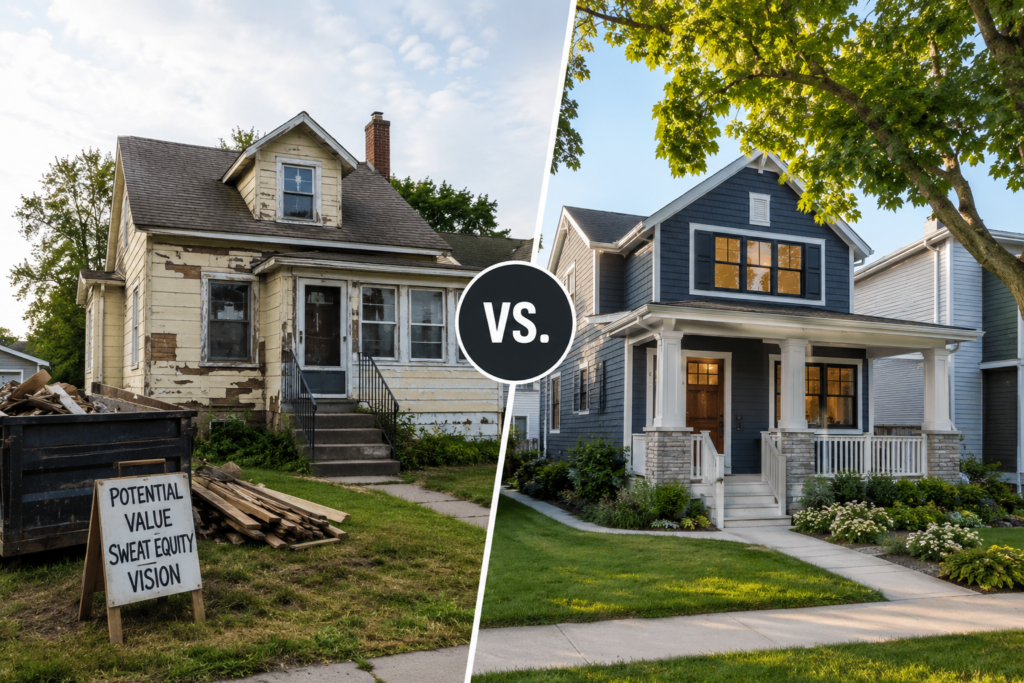
Fixer-Upper vs. Move-In Ready in the Twin Cities in 2026: Which Is the Better Investment?

Fixer-upper vs. move-in ready home comparison in the Twin Cities

If you’re house hunting in the Twin Cities this year, you’ve probably stood in a dated kitchen at some point and wondered: is this a diamond in the rough, or a money pit with new carpet? The fixer-upper vs. move-in ready question is one of the most common forks in the road for Minnesota buyers in 2026, and with mortgage rates still hovering in the mid-6% range and metro inventory finally loosening up, the answer isn’t as obvious as it used to be. Whether the better investment is the home that needs work or the one that’s already done depends on your budget, your timeline, and how much Minnesota winter you’re willing to spend under a tarp.

What “Fixer-Upper” and “Move-In Ready” Actually Mean Right Now

In the Twin Cities, a huge share of the housing stock dates back to the 1950s through the 1980s, which means “fixer-upper” can mean anything from a home that just needs cosmetic updates — paint, flooring, a kitchen refresh — to a full gut job with knob-and-tube wiring or a leaking cast iron sewer line hiding behind the walls. Move-in ready, meanwhile, typically means a home where the roof, mechanicals, and major systems have already been updated, even if the finishes aren’t your personal style. The metro’s inventory has grown noticeably this year, with the number of homes for sale climbing to roughly 10,900 across the 13-county area, giving buyers more of both types to choose from than they’ve seen in years.

That added supply matters, because it means buyers weighing fixer-upper vs. move-in ready options aren’t forced into a single lane the way they were in tighter markets. You have room to actually compare, rather than grabbing whatever hits the market first.

The Math: Renovation Costs vs. the Price Premium for Move-In Ready

This is where a lot of buyers get tripped up, because renovation math in the Twin Cities doesn’t always match what you’ll see on national remodeling shows. Local kitchen remodels commonly run $50,000 to $175,000 or more depending on scope and finishes, bathroom remodels typically land between $30,000 and $85,000, and a basement finish can run $45,000 to $200,000+. Twin Cities pricing tends to run higher than national averages, partly because of an older housing stock that often needs electrical panel or plumbing updates before the “pretty” work can even start.

On the resale side, a mid-range kitchen remodel has historically recouped somewhere in the 75–85% range at resale, while smaller, cosmetic-only updates can return 90% or more. Compare that to the current metro median sale price of around $400,000–$410,000, and you can start running your own back-of-napkin math: is the discount on the fixer-upper larger than what you’d spend to bring it up to move-in-ready condition, plus a buffer for surprises? In most cases in this market, the discount needs to be meaningful — not just a few thousand dollars — for a fixer-upper to pencil out as the better investment.

Financing the Gap: Rates, Renovation Loans, and Timeline Reality

Financing is where the fixer-upper vs. move-in ready decision gets real. As of late July 2026, the 30-year fixed mortgage rate has been sitting around 6.58%, a level that’s held fairly steady over the past several weeks. For a fixer-upper, you’re often financing two things at once — the purchase and the renovation — which usually means a renovation-specific loan product (like an FHA 203(k) or a conventional renovation loan) rather than just a standard purchase mortgage. These loans typically carry more paperwork, more inspections, and a longer closing timeline than a conventional purchase, so budget extra weeks, not days.

Move-in ready homes skip that complexity entirely — you close, you move in, and your mortgage payment is your only monthly wildcard. If your timeline is tight (a job relocation, a lease ending, kids starting school), that predictability alone can outweigh a lower purchase price on a project home.

Where Fixer-Uppers Make Sense in the Twin Cities — and Where They Don’t

Location changes this calculus quite a bit. In established, high-demand areas where land and lot value carry a lot of the price, a dated home on a great block can be a smart renovation candidate, because you’re paying primarily for location and can add value through updates. In faster-moving suburban markets with newer housing stock, the “fixer-uppers” you find are often outliers for a reason — deferred maintenance that’s more expensive to fix than the discount suggests. It’s also worth noting that months of supply varies a lot by price range in the metro right now, with mid-priced homes moving faster than either the lower or upper ends, which affects how much negotiating room you’ll actually have on a project home.

The honest answer to fixer-upper vs. move-in ready isn’t universal — it’s specific to the suburb, the price range, and the individual house. A local agent who knows which streets have aging infrastructure and which renovations actually hold their value in your target neighborhood is worth far more here than a national rule of thumb.

Fixer-Upper vs. Move-In Ready: Which Is the Better Investment for You?

There’s no universal winner in the fixer-upper vs. move-in ready debate — just a better fit for your budget, your timeline, and your appetite for a construction dumpster in the driveway through a Minnesota winter. What matters most is running the real numbers on a specific house, not a hypothetical one, before you fall in love with either the discount or the granite countertops.

That’s exactly the kind of judgment call a good local agent helps with every day. If you’re trying to figure out whether a specific fixer-upper is a smart bet or a slow-motion budget blowout, MinnMatch can match you with a Twin Cities agent who knows the renovation history and resale patterns of the neighborhoods you’re considering — for free. Curious how the matching process works? Here’s how MinnMatch works.

Sources: Freddie Mac Primary Mortgage Market Survey, Minneapolis Area Realtors Market Data, Redfin Minneapolis Housing Market.
HOA or No HOA? What Minnesota Buyers in 2026 Need to Know Before Making an Offer

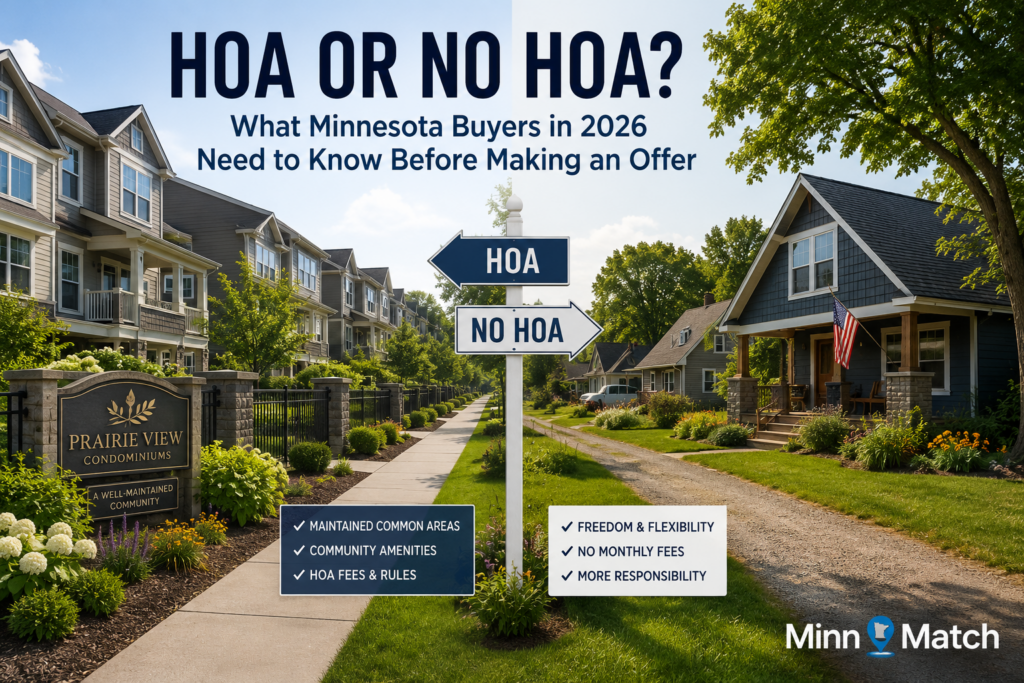
Split graphic comparing HOA townhome community and non-HOA single-family home with a signpost pointing each direction

You found the layout you want, the price feels right, and then the listing mentions it: HOA. For a lot of Twin Cities buyers, that one line raises more questions than it answers. Is an HOA in Minnesota a dealbreaker, a convenience, or just part of the territory once you start touring townhomes and condos? The honest answer is “it depends” — but 2026 is actually a meaningful year to be asking, because Minnesota just overhauled the law that governs how an HOA in Minnesota operates. Here’s what buyers need to understand before writing an offer.

What an HOA in Minnesota Actually Is (And Who It Governs)

Most homeowners associations in Minnesota — whether attached to a townhome, condo, or single-family planned community — fall under the Minnesota Common Interest Ownership Act, commonly shortened to MCIOA. This is the state law that has applied automatically to common interest communities created after June 1, 1994, and it sets the ground rules for how an HOA collects dues, manages shared property, and communicates with owners. Older associations aren’t automatically covered, though many have voluntarily opted in over the years. If a property you’re considering has an association, that association almost certainly answers to MCIOA, and understanding the basics of that law is one of the more useful things a Minnesota buyer can do before making an offer.

In practice, an HOA takes on responsibilities you’d otherwise handle yourself: exterior maintenance, landscaping, snow removal, insurance on shared structures, and upkeep of amenities like pools or clubhouses. In exchange, you agree to pay dues, follow the community’s rules, and accept that some decisions about your building or block are made collectively rather than individually. For buyers weighing a lower-maintenance lifestyle against wanting full control of their property, that trade-off is really the heart of the HOA question.

What an HOA in Minnesota Actually Costs You Each Month

This is where buyers are often caught off guard, and the numbers vary enough that a single figure would be misleading. Metro-wide reporting on 2025 sales put the median HOA fee across the Twin Cities at roughly $278 a month — a notably higher share of the typical house payment than most U.S. metros see. Townhome-specific associations in the metro tend to run higher than that median, commonly landing somewhere in the $300–$450 range, especially in communities with more shared amenities. Condo dues can climb well beyond that: buildings with elevators, structural reserves, or full-service amenities have pushed some Twin Cities condo fees close to $1,000 a month.

Because the range is this wide, don’t anchor to a single “average” when you’re evaluating a specific property. Ask for the association’s most recent financials and reserve study, and look at the trend over the past three to five years, not just the current monthly number. A fee that looks reasonable today can jump significantly if the association has been underfunding its reserves — which is exactly the kind of risk Minnesota’s new rules are trying to catch earlier.

Minnesota’s New HOA Rules: What Changed in 2026

2026 is a genuinely important year for anyone buying into a homeowners association here. Minnesota lawmakers passed a significant update to MCIOA this session — sometimes referred to as an HOA “bill of rights” — with most provisions set to take effect January 1, 2027, giving associations roughly seven months to come into compliance. Buyers closing between now and then should know the changes are coming, because they’ll shape how the association you’re joining operates going forward.

Among the more buyer-relevant pieces: associations will face new transparency requirements around board meetings and documents, competitive-bidding rules for larger maintenance contracts, limits on fines, added protections against retaliation, and a streamlined process for terminating an HOA under certain conditions. Existing MCIOA requirements already in place include annual financial statements (with a CPA review unless owners waive it), reserve fund reviews at least every three years, and a resale disclosure certificate that sellers must provide when a unit changes hands. That resale certificate is one of the single most useful documents a buyer can request — it typically spells out current dues, any pending special assessments, and the financial health of the association.

The state’s Department of Commerce keeps current guidance on MCIOA and common interest communities, and it’s worth a look if you want the details straight from the source rather than secondhand. You can find that at the Minnesota Department of Commerce’s common interest community resource page.

HOA or No HOA: How to Decide What’s Right for You

There’s no universally right answer here — it comes down to what kind of homeowner you want to be. An HOA can be a genuinely good fit if you travel often, want predictable (if sometimes pricier) monthly costs instead of surprise repair bills, or specifically want amenities like a pool, fitness room, or maintained common grounds without personally managing any of it. Nationally, homes in HOA communities have tended to carry a modest price premium over similar non-HOA homes, which some buyers see as a sign the arrangement holds resale value — a data point tracked at the national level by the U.S. Census Bureau’s housing statistics.

On the other side, if you want full control over your landscaping, exterior paint color, or whether you can park a boat in the driveway, an association’s rules can feel restrictive fast. And as Twin Cities condo owners have learned recently, rising dues can make a property harder to resell, particularly at the entry-level price point where buyers are most fee-sensitive. If you’re comparing a specific HOA property against a non-HOA alternative, it often helps to look at recent comparable sales and neighborhood context — resources like Redfin’s neighborhood and market data can be useful for that kind of side-by-side comparison, alongside whatever your agent pulls directly from the MLS.

Whichever direction you lean, read the governing documents before you write an offer — not after. Declarations, bylaws, rules, and the most recent meeting minutes will tell you far more about day-to-day life in that community than the listing sheet ever will.

Getting the Right Guidance for Your Situation

HOA questions are exactly the kind of thing that benefit from someone who knows the specific building, block, or association you’re considering — not just general rules of thumb. A Twin Cities agent who regularly works in a given community will already know which associations are well-run, which have had special assessments, and which fee ranges are typical for that neighborhood. If you’re weighing an HOA property and want that kind of on-the-ground read before you make an offer, MinnMatch can match you with a local agent who’s handled exactly this kind of decision before.

Lock Your Rate or Float? What Minnesota Home Buyers Should Know About Mortgage Rates in 2026

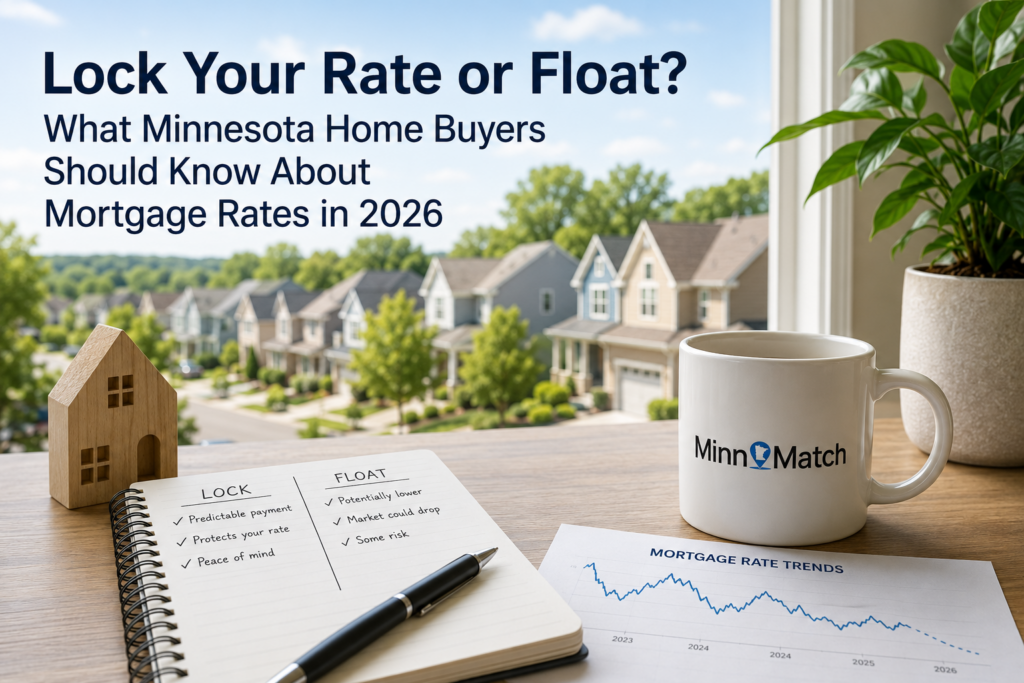
Notebook comparing lock vs. float mortgage rate options with MinnMatch mug and Twin Cities homes

If you’re shopping for a home in the Twin Cities right now, you’ve probably noticed mortgage rates have been anything but boring lately. They ticked up two weeks in a row through late July, and the Federal Reserve’s next meeting could nudge them further in either direction. That leaves a lot of Minnesota buyers asking the same question: should you lock your mortgage rate the moment you get an offer, or float it and hope for a better number before closing? There’s no universal right answer, but there is a smart way to think through it — and that’s what we’re walking through here.

Where Minnesota Mortgage Rates Stand Right Now

As of the most recent Freddie Mac Primary Mortgage Market Survey, the average 30-year fixed rate mortgage sits at 6.58%, up slightly from 6.55% the week before and 6.49% the week before that. Compare that to a year ago, when the 30-year average was running closer to 6.74%, and you can see rates have actually improved a bit over the past twelve months even with this recent upward drift. The 15-year fixed rate, often used by move-up buyers and downsizers here in the Twin Cities, is averaging just under 6%.

What does that mean if you’re house hunting in Eden Prairie, Plymouth, or South Minneapolis this summer? Mostly that rates have been trading in a fairly narrow band for a couple of months, but the direction has tilted upward recently rather than the steady drift downward a lot of buyers were hoping for. That’s exactly the kind of environment where a mortgage rate lock decision actually matters.

Locking vs. Floating: What Each Choice Really Means

A rate lock is an agreement with your lender that guarantees a specific interest rate for a set period — typically 30, 45, or 60 days — while your loan moves through underwriting to closing. Once locked, your rate won’t change even if the broader market moves, whether that’s good news or bad news for you. Most Minnesota lenders don’t charge extra for a standard lock window, though longer locks (say, 90 days for new construction) sometimes come with a small fee or slightly higher rate.

Floating means you’re choosing not to lock yet, betting that rates will drop before you need to commit. Some lenders also offer a “float-down” option, which lets you lock now but still capture a lower rate if one becomes available before closing — usually for an added fee. Floating without any safety net at all is the riskiest version of this strategy, since there’s nothing protecting you if rates move the other direction while you wait.

Why the Fed’s Late-July Meeting Matters for Your Rate Strategy

The Federal Reserve’s Federal Open Market Committee meets July 28-29, and it’s one of the more closely watched meetings of the year for anyone weighing a mortgage rate lock decision. The Fed has held its benchmark rate steady through multiple meetings in 2026, and most market pricing points to another hold this time around, though a modest increase hasn’t been ruled out given persistent inflation. Mortgage rates don’t move in lockstep with the Fed’s overnight rate, but Fed commentary and inflation data both tend to ripple through to the 30-year fixed rate within days.

Practically speaking, if you’re closing on a Twin Cities home in the next few weeks, this meeting sits right in the middle of your process. That’s a strong argument for locking sooner rather than later if you’re already comfortable with today’s rate and don’t want to be surprised by a rate hike mid-transaction. Floating through a Fed meeting is a real bet, not a guaranteed win.

How to Decide: Questions Minnesota Buyers Should Ask

There’s no single formula for the lock-or-float decision, but a few questions tend to clarify it fast:

  • How far out is your closing? The further away, the more time rates have to move — in either direction.
  • Would a small rate increase change whether the home is affordable? If your budget is tight, locking removes that variable entirely.
  • Does your lender offer a float-down option? This can be a reasonable middle ground if you want some downside protection.
  • How do you feel about today’s rate on its own merits? If it works for your monthly payment and long-term plans, waiting for a “maybe” is rarely worth the stress.

If affordability is tight either way, it’s also worth asking your lender whether you qualify for a Minnesota Housing fixed-rate loan program, which can sometimes offer more favorable terms than a standard conventional loan. Most Minnesota loan officers will tell you the same thing: rate locks exist to remove uncertainty, not to time the market perfectly. If today’s rate lets you comfortably afford the home you want, locking it in is rarely a mistake — even if rates dip slightly afterward. Chasing the absolute bottom of the market is a gamble, not a strategy.

Get Rate Guidance From an Agent Who Knows the Twin Cities Market

Mortgage rate decisions don’t happen in a vacuum — they’re tied to your timeline, your target neighborhoods, and how competitive the market is for the home you want. A great local agent will loop in a trusted lender and help you weigh the lock-or-float question against your actual purchase timeline, not just the headlines. That’s exactly the kind of personal guidance MinnMatch was built to provide. Tell us what you’re looking for and where, and we’ll hand-match you with a vetted Twin Cities agent who can help you navigate financing decisions alongside everything else. Find your agent match today, or visit how MinnMatch works to see the process from start to finish.

Moving to Minnesota from Out of State in 2026: Your Complete Real Estate Survival Guide

Moving truck with "Welcome Home" Minnesota decal parked at a Twin Cities house, skyline across the lake, MinnMatch logo

If you’re moving to Minnesota this year, you’re part of a trend that’s finally reversed after nearly a decade. For the first time since 2018, more people moved into Minnesota from other states than left — and a good number of them are landing right here in the Twin Cities. Whether you’re relocating for a job at one of the metro’s major employers, chasing a lower cost of living than the coasts, or simply ready for a change of scenery, buying a home in an unfamiliar market is a very different experience than buying in your hometown. This guide walks you through what out-of-state buyers need to know about Minnesota real estate in 2026 — from current prices and rates to the paperwork nobody warns you about.

Why People Are Moving to Minnesota Right Now

Minnesota spent years watching more residents pack up for other states than it gained in return. That changed with the most recent U.S. Census Bureau data, which showed a net gain of roughly 8,300 residents from domestic migration between mid-2024 and mid-2025 — the state’s first positive domestic migration total since 2018. It’s a modest number in the grand scheme, and it doesn’t erase the tens of thousands of residents Minnesota lost during the pandemic-era exodus to lower-tax, warmer-weather states. But the direction matters. Working-age adults and families relocating for jobs in health care, tech, and manufacturing are a meaningful part of that shift, and many of them are choosing the Twin Cities metro specifically for its job market, school systems, and relative affordability compared to the coasts.

If you’re relocating to Minnesota from a higher-cost state, you’ll likely notice the difference immediately in what your budget buys. That said, don’t assume Minnesota is uniformly cheap — some Twin Cities suburbs carry price tags that rival coastal markets, while others offer real value. Understanding those neighborhood-level differences before you start touring homes will save you a lot of second-guessing.

What It Costs to Buy a Home After Moving to Minnesota

As of June 2026, the median home price across the Twin Cities metro sat at roughly $410,000, up about 2 percent from a year earlier, according to Minneapolis Area Realtors data. Statewide, the median was closer to $375,000. Inventory has also loosened up considerably — the Twin Cities metro ended June with nearly 10,900 homes on the market, a seven-year high for the region, and homes were sitting for an average of about six weeks before selling. That’s a real shift from the frenzied, multiple-offer market of a few years ago, and it means out-of-state buyers arriving in 2026 generally have more room to shop, negotiate, and think before making an offer than buyers did in 2021 or 2022.

Mortgage rates are the other half of the budgeting picture. Freddie Mac’s Primary Mortgage Market Survey put the average 30-year fixed rate at 6.55% in mid-July 2026, with 15-year rates near 5.93%. Rates like these mean it’s worth getting pre-approved before you start touring homes in the Twin Cities, since your budget on paper can shift meaningfully with even a quarter-point move in rate. If you haven’t worked with a Minnesota lender before, ask any agent you connect with locally for a few reputable recommendations — out-of-state pre-approvals from a national online lender don’t always move as smoothly through Minnesota’s closing process as one from a lender who works here regularly.

The Minnesota-Specific Checklist Out-of-State Buyers Miss

Buying a home is only part of relocating to Minnesota — there’s a set of state-specific administrative steps that catch a lot of newcomers off guard:

  • Driver’s license and vehicle registration: New Minnesota residents are required to transfer their driver’s license and register their vehicle in the state within a set window after establishing residency. Plan a trip to Minnesota Driver and Vehicle Services early — it’s rarely a same-day process.
  • Homestead classification: Once you close on a Minnesota home and it becomes your primary residence, apply for homestead classification with your county assessor. It can meaningfully lower your property tax bill compared to a non-homesteaded property, but it isn’t automatic — you have to file for it.
  • Winter prep isn’t optional: If you’re coming from a warm-weather state, budget for real winter gear, a home with a functioning furnace and roof (have both inspected carefully), and — if your new home has one — a driveway and walkway you’re prepared to keep clear from November through March.
  • School enrollment timing: Twin Cities school districts often have enrollment windows and open-enrollment deadlines that run well ahead of the school year. If you’re moving with kids, start that process as soon as you have an address, not after you’ve unpacked.

None of this is meant to be discouraging — it’s simply the paperwork layer that a local agent will walk you through as a matter of course, but that out-of-state buyers often have to piece together themselves.

Choosing Where to Land in the Twin Cities

One of the hardest parts of moving to Minnesota from out of state is that you don’t have decades of local knowledge to draw on when picking a community. Families relocating for schools and space often land in suburbs like Plymouth, Eden Prairie, or Minnetonka. Buyers drawn to lake life and a slower pace tend to look toward Wayzata and the broader Lake Minnetonka area, while those who want walkable urban living gravitate toward neighborhoods in South Minneapolis. If budget is more flexible and top-tier schools and amenities are the priority, Edina consistently draws relocating buyers willing to pay for it.

The honest answer is that no article can tell you which of these fits your life — that’s a conversation, not a checklist. It depends on your commute, your kids’ ages, whether you want a yard or a patio, and how much winter driving you’re willing to do. This is exactly the kind of decision where a few good questions from someone who knows these towns block by block save you months of guessing.

You Don’t Have to Figure Out the Twin Cities Alone

Moving to Minnesota from out of state means buying a home in a market you didn’t grow up watching — you don’t have the neighborhood instincts a local buyer has, and that’s completely normal. That’s exactly the gap MinnMatch was built to close. Instead of searching for an agent and hoping they understand what matters to a newcomer, tell us about your move — your job, your must-haves, your timeline — and we’ll personally match you with a Twin Cities agent who knows the specific communities you’re considering and has helped other relocating buyers navigate the same learning curve. It’s a free service for buyers, and it takes the guesswork out of picking both a neighborhood and an agent at the same time. See how the matching process works, or go ahead and find your Twin Cities agent today.

The MinnMatch Process: How We Match Twin Cities Buyers and Sellers with the Right Agent

The MinnMatch process: a 5-step agent matching workflow shown on a laptop overlooking the Minneapolis skyline

If you’ve ever tried to find a real estate agent in the Twin Cities, you know the usual options: ask a friend for a name, scroll through online reviews that all sound the same, or pick whoever’s face is on the biggest bus bench ad. None of that tells you whether an agent actually understands your neighborhood, your price range, or what you’re trying to accomplish. That’s the gap the MinnMatch process was built to close. Instead of guessing, we sit down with you first, learn what you actually need, and hand-match you with a local agent who’s the right fit — at no cost to you. Here’s exactly how it works, from the first message to your first showing.

The MinnMatch Process: Built as a Matchmaker, Not a Directory

A lot of agent-finder sites are really just directories — you type in a zip code and get a list of names, sorted by whoever paid for placement. That’s not the MinnMatch process. We’re closer to a matchmaker than a search engine. A real person reviews what you tell us about your move, cross-references it against agents actively working in that specific pocket of the Twin Cities, and makes an introduction based on fit — not on who bought the most ad space. If you want the fuller story on how that differs from other ways people find agents, we’ve written about it in more depth on our how it works page.

Step 1: Tell Us What You’re Trying to Do

The MinnMatch process starts with a short form on our find an agent page — it takes a couple of minutes. We ask the basics: are you buying, selling, or both, what part of the Twin Cities you’re focused on (or leaving), your rough timeline, and anything specific that matters to you, like needing an agent who knows new construction, lake properties, or first-time buyer programs inside and out. There’s no pressure and no obligation attached to filling it out. Whether you’re a buyer planning a move to Eden Prairie or a seller listing a home in South Minneapolis, the goal of this step is simple: give us enough to work with so the match isn’t a shot in the dark.

Step 2: We Match You with a Handpicked Local Agent

This is the core of the MinnMatch process, and it’s where the human part really matters. Every agent in our network has already been through a screening process before they’re eligible for a match — we don’t dig into that criteria here, but you can read more about how vetting works on our site if you’re curious. Once your information comes in, we look for an agent whose track record lines up with your specific situation: someone who’s closed deals in Plymouth if that’s where you’re headed, or who regularly handles listings in the price range you’re working with. It’s a judgment call made by a person, not an algorithm sorting by zip code and calling it a day.

Step 3: We Introduce You — No Strings Attached

Local market data can shift block by block, and resources like Redfin are a useful way to sanity-check pricing trends in a specific neighborhood before you even talk to an agent — but the agent match itself is where the real value of the MinnMatch process shows up. Once we’ve found a fit, we make the introduction directly, usually by email or phone, so you and the agent can connect quickly. From there, it’s your call. If the agent feels like the right partner for your buying or selling journey, you move forward together. If for any reason it’s not a fit, you tell us and we’ll find you someone else — there’s no cost to you either way, and no obligation to keep working with an agent who isn’t clicking. That’s a meaningfully different experience than getting a referral from a friend, where backing out can feel awkward. For an apples-to-apples look at how MinnMatch stacks up against other ways people search, our site has a comparison worth checking out.

Step 4: Your Agent Takes It from There

After the match, your agent handles the parts you’d expect — pricing conversations, showings, offers, negotiations, and paperwork through closing. According to the Minneapolis Area Realtors, buyer and seller agents in this market typically guide clients through everything from initial search or listing prep to the final signature, and that’s exactly the relationship the MinnMatch process is designed to set up — just with a stronger starting fit than a cold search would give you. If financing questions come up along the way, resources through the Minnesota Housing Finance Agency can also be a helpful reference point for first-time buyers working through down payment assistance options.

Whether you’re just starting to think about a move or you’re ready to list this week, the MinnMatch process starts with one simple step: telling us what you need. Find your agent match today, completely free, and let us make the introduction — no directories, no guesswork, just the right Twin Cities agent for your situation.

What Is a Comparative Market Analysis (CMA) and Why You Need One in Minnesota in 2026

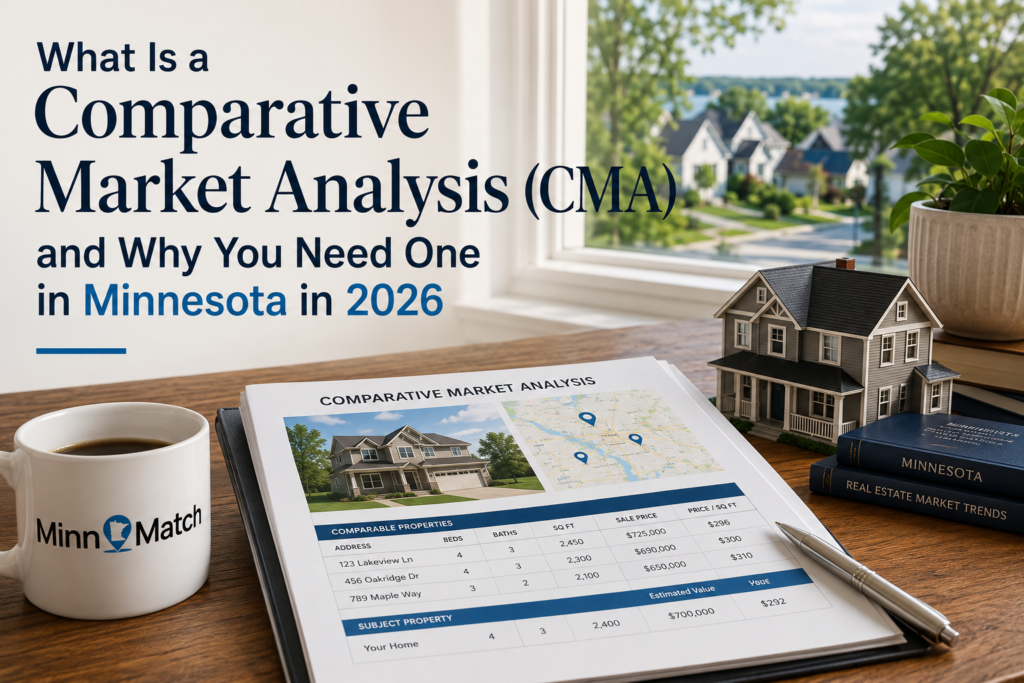
Comparative market analysis report on a desk with a Minnesota home, neighborhood map, and MinnMatch coffee mug

If you’ve spent any time talking to a Twin Cities real estate agent, you’ve probably heard the term “CMA” thrown around. It sounds technical, but it’s really one of the most useful documents you’ll encounter as a buyer or seller in Minnesota’s 2026 market. A comparative market analysis takes the guesswork out of pricing by showing you, in black and white, what similar homes in your area have actually sold for. Whether you’re getting ready to list a home in Edina or you’re trying to figure out if a listing in Plymouth is priced fairly, understanding what a CMA is — and how to read one — puts you in a much stronger position.

What Exactly Is a Comparative Market Analysis?

A comparative market analysis is a report, usually prepared by a licensed real estate agent, that estimates a home’s current market value by comparing it to similar properties — often called “comps” — that have recently sold, are currently listed, or went under contract in the same area. A good CMA looks at square footage, lot size, bedroom and bathroom count, age, condition, and location, then adjusts for differences between the subject property and each comp.

In a market like the Twin Cities, where prices can shift block by block — a rambler in South Minneapolis can behave very differently than one in Prior Lake — a comparative market analysis grounds your expectations in local data instead of national headlines or a Zillow estimate. According to Minneapolis Area Realtors, local market conditions vary significantly by neighborhood and price tier, which is exactly why a CMA needs to be built from nearby, recent, and truly comparable sales rather than a citywide average.

CMA vs. Appraisal: They’re Not the Same Thing

It’s easy to confuse a comparative market analysis with a home appraisal, but they serve different purposes and come from different people. A CMA is typically prepared by your real estate agent, is free, and is meant to help set a listing price or shape an offer. An appraisal is completed by a state-licensed, independent appraiser, usually costs a few hundred dollars, and is required by your lender before closing to confirm the home is worth what you’re paying for it.

Think of it this way: a CMA is a strategic estimate built for decision-making before you list or offer, while an appraisal is a formal, regulated valuation used to protect the lender’s investment. The two often land in a similar range, but they’re not interchangeable, and a CMA is never a substitute for the appraisal your mortgage will require.

Why Sellers Should Start Here, Not With a Number They Have in Mind

Plenty of Twin Cities sellers walk into the process with a price already in their head, often based on what a neighbor’s house sold for years ago or what a home improvement show made pricing look like. A comparative market analysis replaces that gut feeling with current, local evidence. It’s the starting point for a listing strategy — before staging decisions, before marketing photos, before the “For Sale” sign goes in the yard.

We’ll go deep on pricing strategy and how to interpret specific comps in an upcoming article, but the short version is this: a CMA is the foundation everything else gets built on. If you’re weighing whether to list this year, our seller resources page is a good next stop, and connecting with a local agent through MinnMatch’s free agent-matching service is the easiest way to get a CMA built specifically for your address, not a generic estimate.

Buyers Need a CMA Too — Here’s Why

A comparative market analysis isn’t just a seller’s tool. Before you write an offer on a home in Minnetonka or Eden Prairie, a buyer’s agent can run a CMA to tell you whether the asking price actually lines up with what similar homes have sold for recently. That’s especially valuable in a market where a well-staged listing photo or an eager seller’s price can make a home look like a deal — or a stretch — when the comps tell a different story.

A buyer-side CMA also gives you real leverage in negotiations. Instead of an offer based on a feeling, you can point to actual recent sales nearby. If you’re just starting to look, our buyer resources page walks through what else to expect, and Redfin can be a helpful place to sanity-check recent sale prices in a neighborhood you’re considering, alongside the more detailed comps your agent pulls.

Getting an Accurate CMA in the Twin Cities Market

The accuracy of a comparative market analysis depends entirely on the person building it. An agent who knows a specific pocket of the Twin Cities — the difference between a Wayzata lake lot and one a few blocks off the water, or why one South Minneapolis block sells faster than the one next to it — will build a far more useful CMA than an automated online estimate ever could. Housing conditions can also shift with financing programs and affordability trends; resources like the Minnesota Housing Finance Agency track statewide affordability data that can add helpful context to a hyper-local CMA.

This is really where local expertise makes or breaks the number. An out-of-area agent, or a generic online tool, simply won’t know the nuances that move value street by street across the metro.

Get a CMA From an Agent Who Knows Your Neighborhood

Whether you’re preparing to sell or trying to make sense of a listing price, a comparative market analysis is only as good as the agent behind it. MinnMatch connects Twin Cities buyers and sellers with handpicked local agents — for free — so you get a CMA built on real neighborhood knowledge, not guesswork. Find your agent match today and get a clear, accurate picture of what your home — or your next one — is really worth.

Down Payment Assistance in Minnesota 2026: Every Program Buyers Should Know About

Down Payment Assistance in Minnesota 2026 — home purchase clipboard, house model, and binder with Twin Cities lake and skyline in background

If saving for a down payment feels like the biggest hurdle between you and a Twin Cities home, you’re not alone — and the good news is that Minnesota down payment assistance is more available than most buyers realize. Between state programs, city-specific loans in Minneapolis and Saint Paul, and nonprofit options layered on top, many first-time buyers end up putting far less down than the traditional 20% myth suggests. The tricky part isn’t whether help exists — it’s figuring out which programs you actually qualify for and how they stack together. Here’s a clear, no-jargon walkthrough of the major programs on the table in 2026.

Minnesota Down Payment Assistance Through Start Up and Step Up

The most widely used source of Minnesota down payment assistance comes from Minnesota Housing (MHFA), the state’s housing finance agency. Its Start Up program is built for first-time buyers — meaning you haven’t owned a home in the last three years — and currently pairs a fixed-rate first mortgage with a downpayment and closing cost loan of up to $18,000. If you’ve owned before, or your income exceeds Start Up’s limits, the Step Up program offers similar downpayment assistance up to $14,000 and is open to repeat buyers as well. Both require completing an approved homebuyer education course and working with a Minnesota Housing–approved lender, since the agency itself doesn’t originate loans directly.

One detail buyers often miss: the downpayment loan amount and structure (deferred vs. monthly payment) can shift as the agency updates its offerings, so it’s worth confirming current figures directly with Minnesota Housing or your lender before you budget around a specific number.

The First-Generation Homebuyer Loan

One of the more meaningful additions to Minnesota’s down payment assistance lineup is the First-Generation Homebuyer Loan, aimed at buyers whose parents or legal guardians never owned a home (or lost one to foreclosure). It’s a 20-year deferred, interest-free loan of up to $35,000 for down payment and closing costs, and it’s forgivable — half the balance is forgiven after 10 years, with the rest forgiven at year 20, as long as you stay in the home. It has to be paired with a Start Up first mortgage, and it can’t be combined with a similar program run separately by the Midwest Minnesota Community Development Corporation, so a homeownership advisor can help you sort out which route fits your situation.

City-Specific Help in Minneapolis and Saint Paul

Buyers purchasing inside city limits often have an extra layer of Minnesota down payment assistance to draw on. Minneapolis runs its own program, Homeownership Opportunity Minneapolis (HOM), through the city’s Community Planning & Economic Development department. It’s a zero-interest, no-monthly-payment loan that doesn’t come due until you sell, refinance, or move, with the assistance amount tied to your income relative to the area median. Saint Paul offers a comparable interest-free, deferred down payment loan through its own housing program, with the assistance amount varying by household need. Both cities require homebuyer education or financial wellness counseling completed before you sign a purchase agreement, so it’s worth starting that step early if you’re house-hunting in either city.

Because exact loan amounts and income tiers for these city programs are updated periodically, treat any specific dollar figure you see online as a starting point rather than a guarantee — your lender or the city’s housing office can confirm what’s currently funded and what you’d qualify for.

County and Nonprofit Options Worth Knowing About

Beyond the state and the two biggest cities, several Twin Cities counties and nonprofits administer their own down payment assistance, often layered on top of a Minnesota Housing loan rather than replacing it. Dakota, Anoka, and other metro counties have offered downpayment and closing cost loans through their Community Development Agencies, and organizations like NeighborWorks Home Partners and Twin Cities Habitat for Humanity provide additional assistance and homeownership counseling, particularly for buyers who don’t quite fit the standard first-time buyer mold. Programs like these tend to have limited annual funding, so timing your application — and getting pre-approved with a participating lender — matters as much as meeting the eligibility criteria.

Figuring Out What You Actually Qualify For

With this many overlapping programs, the honest answer to “how much down payment assistance can I get in Minnesota?” is: it depends on your income relative to the area median income for your county, your target city, whether you’re a first-time or first-generation buyer, and which lender you work with. Some of these programs can be stacked; others explicitly can’t be combined. The most efficient path is usually to complete a homebuyer education course early, talk with a participating lender about which state and local programs apply to your situation, and loop in a local real estate agent who already knows which programs tend to move quickly at your target price point — especially in a market where listing prices vary widely by neighborhood.

Down payment assistance can make homeownership possible years sooner than you might expect, but sorting out eligibility across state, city, and nonprofit programs isn’t something to guess your way through. A local agent who works with these programs regularly can point you toward lenders who are approved for the specific assistance you need, and help you understand how a program’s repayment terms affect your long-term plans. If you’re ready to start that conversation, MinnMatch can match you with a local agent who knows the Twin Cities down payment landscape inside and out — or visit our how it works page to see how the matching process gets you there.

Minnesota Property Taxes in 2026: What Every Home Buyer Needs to Budget For

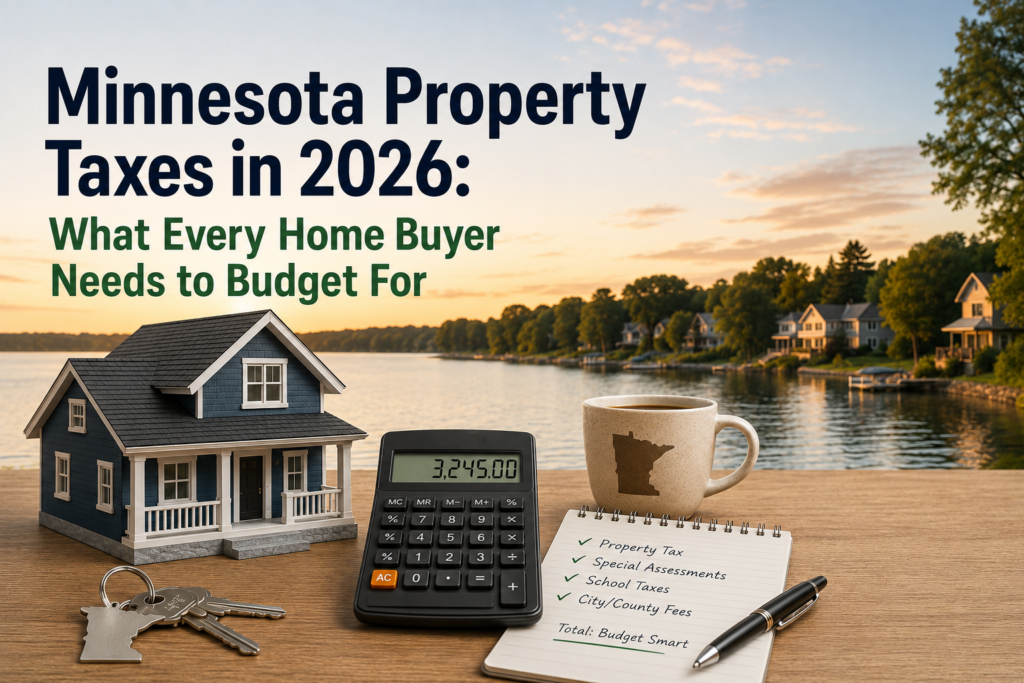
Minnesota property taxes 2026 header graphic with model home, calculator showing $3,245, and budgeting checklist by a Twin Cities lake

If you’re house hunting anywhere in the Twin Cities this year, there’s a number on every listing you’re probably skimming past: the estimated property tax. It’s easy to focus on the sticker price of a home and treat taxes as an afterthought, but in Minnesota, property taxes can add hundreds of dollars to your monthly payment — and the amount varies a lot more by city and county than most buyers expect. Understanding Minnesota property taxes in 2026 before you make an offer can save you from an unpleasant surprise on your first escrow statement.

How Minnesota Actually Calculates Your Property Tax Bill

Minnesota’s property tax system isn’t a simple flat percentage — it’s a multi-step formula, and knowing the steps helps explain why two similarly priced homes a few miles apart can have very different tax bills. Here’s the short version:

  1. Assessed (taxable market) value: Your county assessor determines this based on comparable sales and property characteristics. Taxes payable in 2026 are based on 2025 assessed values.
  2. Class rate: Minnesota applies different rates depending on how a property is used. A primary residence with homestead classification is taxed at 1% on the first $500,000 of value and 1.25% on anything above that.
  3. Tax capacity: Your taxable value multiplied by the class rate gives you your property’s “tax capacity” — the base number local governments actually tax.
  4. Local levy: Your county, city, school district, and any special taxing districts each set their own levies, which combine into your total tax rate for that specific location.

That last step is why location matters so much. Two homes with identical values — one in Edina and one in Prior Lake — can land in very different school districts and city levy structures, which changes the final bill even though the state-level formula is the same. You can dig into your own numbers using the Minnesota Department of Revenue’s property tax data.

What Twin Cities Buyers Can Expect to Pay

Statewide, effective property tax rates in Minnesota generally land somewhere around 1% of a home’s market value, though the exact figure shifts from year to year and source to source depending on methodology. What’s more useful for Twin Cities buyers is the pattern: core metro counties like Hennepin and Ramsey tend to run above that statewide average — often somewhere in the 1.1% to 1.3% range — while many outer-ring and exurban counties come in lower. Suburban counties like Dakota, Anoka, Carver, and Washington typically fall somewhere in between, with plenty of variation between individual cities and school districts within each county.

It’s also worth knowing that levies have been trending upward across much of the metro heading into 2026, driven by city, county, and school district budget increases rather than any single statewide change. If you’re comparing two neighborhoods, don’t just compare list prices — ask your agent to pull the actual estimated taxes payable for each specific address, since even the county-level averages can undersell (or oversell) what a particular property will cost. You can also cross-reference neighborhood-level trends using Redfin’s local market data alongside your county assessor’s numbers.

Budgeting Property Taxes Into Your Monthly Payment

Most Twin Cities buyers with a mortgage don’t pay property taxes as one lump annual bill — they pay them monthly through an escrow account, bundled into their regular mortgage payment alongside principal, interest, and homeowners insurance (often shorthanded as PITI). Here’s what that means practically when you’re budgeting:

  • Your lender estimates the annual property tax bill, divides it by 12, and adds that amount to your monthly payment.
  • Because Minnesota counties typically bill property taxes twice a year (spring and fall installments), your escrow account is building up a cushion between those due dates.
  • If your assessed value or local levy rises after your first year, expect your monthly escrow payment to adjust — sometimes by a noticeable amount — even if your interest rate never changes.

A good rule of thumb when comparing homes: don’t just look at the mortgage principal and interest estimate a listing shows you. Ask for the full estimated monthly payment including taxes and insurance, especially in cities with higher-than-average levies. It’s a conversation worth having with your lender and your agent before you get attached to a specific home.

Homestead Classification: A Quick Word for New Owners

One detail that trips up first-time Minnesota buyers: the lower 1% class rate mentioned above only applies once your new home is classified as a homestead — meaning it’s your primary residence, not a rental or second home. You’ll need to apply for homestead classification with your county assessor after closing, and missing the deadline can mean paying a non-homestead rate for a full extra year. Requirements and deadlines vary slightly by county, so this is one of those details worth confirming directly with your assessor’s office or your real estate agent as soon as you close. We’ll be covering homestead classification and exemptions in more depth in an upcoming article — for now, just make a note to file promptly.

Don’t Let Taxes Be an Afterthought

Property taxes aren’t the most exciting part of buying a home, but they’re one of the most predictable ongoing costs you’ll take on as a homeowner — and unlike your interest rate, they can shift year to year based on decisions made by your city council, county board, and school district. Twin Cities buyers who factor taxes into their budget from the start avoid the sting of a bigger-than-expected escrow adjustment down the road.

This is exactly the kind of hyper-local detail a good agent should be walking you through before you write an offer — not after. If you want a Twin Cities agent who’ll pull the real tax numbers for the specific neighborhoods you’re considering, find your match with MinnMatch and get connected with someone who knows these details block by block.

How Long Does It Take to Buy a Home in the Twin Cities in 2026? A Realistic Timeline

Desk scene with a home buying timeline calendar showing search, tour, offer, under contract, and closing steps, Minneapolis skyline in background

If you’re just starting to think about buying a home, one question comes up almost immediately: how long is this actually going to take? It’s a fair question, and the honest answer is “it depends” — but that’s not very helpful when you’re trying to plan a move, give notice on a lease, or figure out when to start packing. So let’s break down a realistic Twin Cities home buying timeline for 2026, based on what’s actually happening in the local market right now, not generic national averages.

Step One: Getting Pre-Approved (Usually 1–2 Weeks)

Before you tour a single home, you’ll want a mortgage pre-approval in hand. Lenders will ask for pay stubs, tax returns, bank statements, and a look at your credit, and most can turn around a pre-approval letter within a few business days once you’ve submitted everything. Give yourself a week or two here, especially if you need to track down documents or clean up anything on your credit report first. With 30-year mortgage rates in the Twin Cities hovering in the high 5% to upper 6% range through early 2026, it’s worth shopping two or three lenders — even a small rate difference changes your monthly payment more than people expect.

Step Two: House Hunting (4–10 Weeks, Depending on the Market)

This is the stage where your home buying timeline can stretch or shrink the most, and it depends heavily on price point and location. According to Minneapolis Area Realtors market data, well-priced homes in the $350,000 to $500,000 range have been moving in around 40 days on the market, while homes priced under $120,000 or in more niche categories have taken closer to 100 days to sell. Redfin’s data for Minneapolis proper shows homes selling in around three weeks on average as of mid-2026, though that number is pulled up or down significantly by neighborhood and condition. The takeaway: if you’re searching in a popular suburb like Eden Prairie or Edina, expect competition and a faster pace. If you’re more flexible on location, you’ll likely have more time to look and less pressure to rush a decision.

Inventory has loosened up compared to the ultra-tight years of 2021–2022, with months of supply across the metro sitting in a range of roughly 1.5 to 3 months depending on the source and time of year. That gives most 2026 buyers a bit more breathing room to actually compare homes instead of feeling forced into an offer on day one.

Step Three: Making an Offer and Getting It Accepted (A Few Days to a Week)

Once you find the right place, writing and submitting an offer typically takes a day or two with your agent. From there, it depends on the seller: some respond within hours, especially on well-priced homes that are attracting multiple offers, while others take a few days if they’re weighing several offers or waiting on other decisions. In a more balanced market like the one Twin Cities buyers are seeing in 2026, back-and-forth negotiation on price, closing date, or included items is common and can add a few more days before everyone signs off.

Step Four: Under Contract to Closing Day (Typically 30–45 Days)

This is the stretch most first-time buyers underestimate. Once your offer is accepted, you’re not done — you’re entering the inspection, appraisal, and underwriting phase, and it usually takes 30 to 45 days to reach the closing table. Here’s roughly how that time breaks down:

  • Home inspection: Usually scheduled within the first week under contract, with results back a day or two later.
  • Appraisal: Ordered by your lender, typically completed within one to two weeks.
  • Underwriting and loan approval: This is often the longest piece, and can take two to four weeks depending on your lender’s workload and how quickly you supply any additional documents they request.
  • Final walkthrough and closing: Scheduled once your loan is clear to close, usually within the last few days before you get the keys.

Cash buyers can move faster through this stage since there’s no lender underwriting to wait on, but financed purchases — which make up the majority of Twin Cities transactions — should plan on the full 30 to 45 days.

So, Realistically: How Long Does the Whole Process Take?

Add it all up, and most Twin Cities buyers in 2026 are looking at somewhere between two and four months from the day they start seriously house hunting to the day they close — longer if they’re being selective in a competitive suburb, shorter if they find the right home quickly and sail through underwriting. Buyers with financing hiccups, homes needing repair negotiations, or appraisal gaps should build in extra cushion. If you’re also selling a home at the same time, add more time still for coordinating both closings.

The biggest variable isn’t the paperwork — it’s finding the right home in the first place. That’s exactly where having an agent who knows your target neighborhoods, communicates fast, and can spot a well-priced listing before it gets competitive makes the difference between a two-month search and a six-month one. If you’d like to skip the guesswork of finding that agent yourself, MinnMatch will personally match you with a vetted local Twin Cities agent suited to your timeline, budget, and neighborhoods of interest, at no cost to you. Curious how the process works? Take a look at how MinnMatch works and get matched in minutes.

Contingencies in a Minnesota Home Purchase in 2026: Which to Keep, Which to Waive

Couple reviewing a Minnesota home purchase agreement and contingencies at kitchen table

If you’ve started shopping for a home in the Twin Cities this year, you’ve probably heard some version of the same advice from a friend or a Facebook group: “waive your contingencies or you’ll never win a bid.” That advice made a lot of sense in 2021, when homes in Minneapolis and St. Paul were getting 50+ offers in a weekend. It makes a lot less sense in 2026, when inventory has loosened up and buyers have more room to negotiate. The real question isn’t whether to waive contingencies across the board — it’s which ones actually protect you, and which ones you can let go of without much risk.

What Home Purchase Contingencies Actually Do in Minnesota

A contingency is a condition written into your purchase agreement that has to be satisfied before the sale is fully binding. In Minnesota, contingencies are usually built directly into the standard Minnesota Association of REALTORS® purchase agreement rather than added as a separate document, and each one gives you a specific, time-limited window to walk away — and keep your earnest money — if something doesn’t check out.

Without a contingency in place, you’re agreeing to move forward no matter what the inspection, the appraisal, or your financing turns out to look like. That’s exactly why home purchase contingencies have become a bargaining chip in competitive offers: sellers comparing multiple bids often favor the offer with fewer strings attached, even if it isn’t the highest dollar amount.

The four contingencies you’ll run into in nearly every Twin Cities transaction are the inspection contingency, the financing contingency, the appraisal contingency, and — less commonly in this market — the home sale contingency. Each one carries a different level of risk if you waive it, which is why a blanket “waive everything” strategy can backfire.

Why the Calculus Has Changed in the 2026 Twin Cities Market

During the frenzied years of 2020 through 2023, waiving an inspection contingency was often treated as table stakes just to get a showing, let alone an accepted offer. That’s not the market Minnesota buyers are navigating in 2026. Inventory has recovered meaningfully across the metro, and homes are sitting longer than they did at the height of the pandemic-era market.

Local market data tells the story. Minneapolis homes were selling in the low-to-mid 40-day range as of mid-2026, a meaningful slowdown from the multi-day turnarounds buyers faced a few years ago, and active listings in the metro have grown on a year-over-year basis. Redfin’s local market tracker shows Minneapolis homes selling for roughly 100% of list price on average — strong, but no longer the 10-to-20-over-asking chaos of a few years back.

That doesn’t mean competition has disappeared. Well-priced homes in popular pockets of Edina, Minnetonka, and South Minneapolis can still draw multiple offers in a matter of days. But the days of needing to waive every protection just to be taken seriously are largely behind us — which means the decision should be made property-by-property, not as a default strategy.

The Inspection Contingency: Generally Worth Keeping

Of all the contingencies on the table, the inspection contingency is the one Twin Cities real estate attorneys and agents most consistently advise buyers to hold onto. It gives you a defined window — typically five to seven days — to bring in a licensed inspector and identify problems with the roof, foundation, electrical, plumbing, or mechanical systems before you’re locked in.

Minnesota law requires sellers to disclose known defects, but “known” is the operative word — a seller may genuinely have no idea their foundation has a hairline crack or their sewer line is failing. Without an inspection contingency, your only recourse if something major surfaces after closing is proving the seller knew about it and concealed it, which is a difficult and expensive legal standard to meet.

Minnesota homes carry some specific inspection considerations worth flagging to your agent: radon levels, which run high in many parts of the state and aren’t detectable without specialized equipment; aging mechanical systems in homes built before the 1980s; and sump pump or sewer line condition, particularly in older Minneapolis and St. Paul housing stock. If a home falls into any of those categories, an inspection contingency is rarely the place to cut a corner.

If you do want to make your offer more competitive without fully waiving this protection, ask your agent about a pass/fail inspection instead — you still inspect the home, but you agree only to flag and walk away from major safety or structural issues rather than negotiating over every minor item on the list.

The Financing Contingency: Risky to Waive Unless You’re Paying Cash

A financing contingency protects you if your mortgage falls through — whether because of a job change, a credit issue that surfaces during underwriting, or an appraisal that complicates your loan terms. Pre-approval letters are a strong signal to sellers, but they are not a guarantee of final loan approval. Underwriting can still uncover problems that a pre-approval never caught.

Waiving this contingency means that if your financing falls apart for any reason, you risk losing your earnest money deposit entirely. Unless you’re buying with cash or have an unusually ironclad financial position, most Twin Cities agents and real estate attorneys recommend keeping this one in place. It’s also worth noting that cash buyers routinely skip this contingency altogether, which is one reason all-cash offers remain so attractive to sellers in competitive situations.

The Appraisal Contingency: A Reasonable Place to Compromise

An appraisal contingency protects you if the home appraises for less than your purchase price, giving you the option to renegotiate, cover the gap in cash, or walk away. In a market where bidding above asking price is still common in desirable neighborhoods, this is the contingency that most often comes into tension with a strong offer.

A full waiver isn’t your only option here. Many Twin Cities buyers are instead agreeing to cover a defined gap — say, the first $10,000 to $15,000 of any appraisal shortfall — rather than waiving the protection entirely. This signals confidence to a seller without exposing you to unlimited risk if the appraisal comes in significantly under your offer.

The Home Sale Contingency: Usually Not an Option in This Market

A home sale contingency makes your purchase conditional on successfully selling your current home first. It’s the contingency sellers are least willing to accept, since it ties their closing timeline to a transaction they have no control over. In most competitive Twin Cities offers, this one isn’t realistically on the table at all.

If you need to sell before you buy, the more practical path in 2026 is usually a bridge loan, a rent-back arrangement with your buyer, or simply listing your current home first and timing your purchase offer once it’s under contract. A knowledgeable local agent can walk you through which of these fits your specific timeline and finances.

Smarter Alternatives to a Full Waiver

Buyers don’t have to choose between an all-or-nothing offer and losing the house. Some of the more creative strategies Twin Cities agents are using in 2026 include shortening contingency windows rather than removing them, getting a pre-offer inspection or walkthrough before writing an offer at all, offering a flexible closing date or rent-back period the seller values, and increasing earnest money with a clause that makes it non-refundable after a defined point.

Each of these can strengthen an offer in the eyes of a seller without putting your entire purchase — or your earnest money — at risk if something goes wrong.

Deciding which contingencies to keep and which to waive isn’t a decision to make alone, and it shouldn’t be a one-size-fits-all strategy applied to every offer. The right call depends on the specific property, how many other offers you’re up against, and your own financial cushion if something goes wrong. That’s exactly the kind of judgment call a locally experienced agent earns their commission on. If you’re not sure who to trust with that advice, MinnMatch can match you with a vetted Twin Cities agent who negotiates contingencies for a living — at no cost to you. Curious how the matching process works? Here’s how it works.