Why MinnMatch Is the Smarter Way to Find a Real Estate Agent in the Twin Cities

A magnifying glass focusing on a home with a checkmark icon, with the Minneapolis skyline in the background — representing finding the right real estate agent in the Twin Cities

Finding a Twin Cities real estate agent shouldn’t feel like a gamble. Yet for most buyers and sellers, that’s exactly what it is — a scroll through Zillow profiles, a few Google searches, maybe a referral from a coworker who bought a house three years ago. You end up with someone who may or may not know your target neighborhood, may or may not have the experience level your situation demands, and may or may not be the right fit for how you like to communicate. There’s a smarter way — and that’s exactly what MinnMatch was built to do.

We Match You With a Twin Cities Real Estate Agent — You Don’t Search

The core difference between MinnMatch and every agent directory or referral platform you’ve used before is simple: we do the matching for you. You’re not handed a list of agents and left to figure it out. You’re not bidding on your own time with agents who pay to be at the top of a search result. Instead, a real human at MinnMatch listens to your situation — your timeline, your price range, your neighborhood preferences, your communication style — and handpicks a vetted local agent who genuinely fits.

Think of it less like a search engine and more like a trusted recruiter. Except instead of placing candidates for a job, we’re placing the right agent for one of the biggest financial decisions of your life.

“Most platforms are paid directories dressed up as matching services. MinnMatch is the opposite — free for buyers and sellers, with the matching done by people who actually know the Twin Cities market.”

Local Expertise That Actually Means Something

The Twin Cities real estate market isn’t monolithic. A buyer looking in Edina has entirely different needs than one eyeing a place in South Minneapolis. A seller in Lake Minnetonka is navigating a completely different buyer pool than someone listing in Plymouth. Hyper-local knowledge isn’t a nice-to-have — it’s the difference between getting the right offer and leaving money on the table, or winning a competitive bid versus losing out.

Every agent in the MinnMatch network is vetted specifically for their local expertise. We know which agents are specialists in Wayzata, who dominates in Eden Prairie, and who has the track record in Prior Lake to back it up. That intelligence doesn’t exist in a Zillow rating or a Google review count — according to the Minneapolis Area Realtors, local market conditions can vary significantly even between neighboring zip codes. It comes from doing this work, in this market, consistently.

It’s Free — And There’s No Catch

MinnMatch is completely free for buyers and sellers. No subscription. No lead fee passed along to you. No premium tier that unlocks the actually-good agents. The service works because agents value the quality of our referrals — you’re not a cold lead scraped from an ad click. You’re a matched client who is ready to move, informed about the process, and paired with an agent who is genuinely right for your situation. That’s worth something to agents, and it’s how the model sustains itself without charging you a dime.

You don’t have to wonder whether the agent being recommended to you paid for that recommendation. They didn’t.

The Problem With Most Agent-Finding Methods

Let’s be direct about the alternatives:

  • Big portal directories (Zillow, Realtor.com) — Agents pay for placement. The ones at the top aren’t necessarily the best for your situation; they’re the ones who spent the most on ads.
  • Friend and family referrals — Well-intentioned, but your cousin’s agent who sold a house in Bloomington two years ago may not be the right match for what you’re doing in Minnetonka today.
  • Random Google searches — SEO doesn’t equal competence. The agent ranking for “Twin Cities real estate agent” isn’t necessarily the agent who will serve you best.
  • National referral networks — These often match you with whoever is available or whoever pays the referral fee, not whoever is the best fit for your specific needs.

None of these methods start with your situation. MinnMatch does.

How MinnMatch Works in Practice

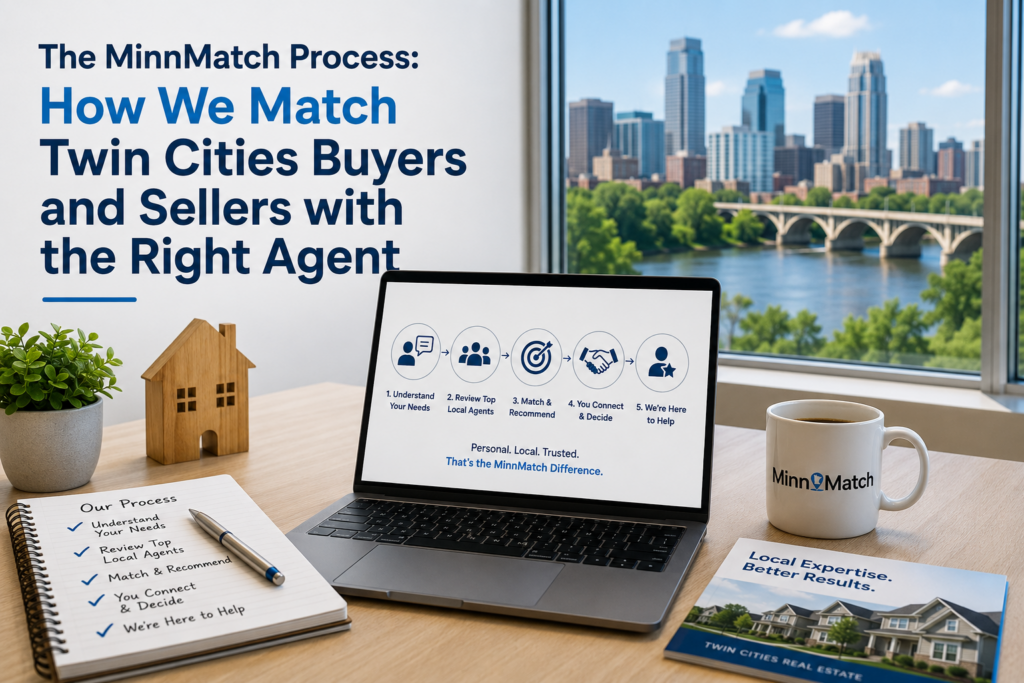
The process is designed to be low-friction. You share a little about what you’re looking for — buying or selling, where, when, and any specifics that matter to you. From there, MinnMatch does the work. We tap our curated network, identify the agents who are the strongest fit, and make an introduction. You’re not fielding calls from five agents who all got your number from a lead form. You’re getting a thoughtful match and a warm introduction.

You can learn more about the full process on our How It Works page, or browse our FAQ if you have questions about what to expect. If you’re still weighing your options, Redfin’s guide to choosing a real estate agent is a helpful overview of what to look for — and MinnMatch handles all of it for you.

The Right Twin Cities Real Estate Agent Changes Everything

A well-matched agent isn’t just more pleasant to work with — they produce better outcomes. They know how to price a home for your specific neighborhood. They know which listings are worth your time before they’re widely public. They negotiate in a way that fits the local market dynamics, not a one-size-fits-all playbook. They communicate on your schedule in your preferred style. The difference between a good agent and the right agent can be tens of thousands of dollars and months of stress.

Minnesota Housing Finance Agency data consistently shows that informed buyers and sellers — those who work with agents matched to their specific situation — fare better in negotiations and close with fewer surprises. You can explore current homebuyer resources at mnhousing.gov for additional context on the Minnesota market.

That’s the case MinnMatch makes every day for buyers and sellers across the Twin Cities. Not that we have all the agents — but that we have the right agents, and we know how to connect you with the one who’s right for you.

Ready to get matched?

It takes just a few minutes to tell us about your situation. Start the process here — and let MinnMatch handle the rest. You can also learn more about us or check out our market insights to get a sharper sense of what’s happening in the Twin Cities right now.

Pre-Approval in 2026: What Minnesota Buyers Need to Know Before House Hunting

Mortgage pre-approval documents with house keys, a green approval checkmark, and a Minnesota state outline, with a Twin Cities suburban home in the background


Minnesota Buyer’s Guide · 2026

Mortgage Pre-Approval in Minnesota: What Every Buyer Needs to Know Before House Hunting in 2026

Interest rates have shifted. Lending rules have changed. Here's what every Twin Cities buyer should know before stepping into a single open house.

📅 May 2026
🕐 8 min read
MinnMatch Editorial Team

Mortgage pre-approval in Minnesota isn't just a formality — it's the foundation of your entire home buying strategy in 2026. Whether you're targeting a craftsman in South Minneapolis, a townhome in Plymouth, or a lakefront property near Wayzata, sellers expect a verified pre-approval letter before they'll take your offer seriously.

If you're planning to buy a home in Minnesota this year, skipping pre-approval doesn't just slow you down — it can cost you the home entirely. The window between finding a home and losing it to another buyer can be days, sometimes hours.

Here's everything you need to know about mortgage pre-approval in Minnesota — specifically in the Twin Cities and greater Minnesota market — straight from the team at MinnMatch.


Why Mortgage Pre-Approval in Minnesota Matters More Than Ever in 2026

The Minnesota housing market has matured significantly since the volatility of 2022–2023. Competition in desirable neighborhoods — Eden Prairie, Edina, North Loop, Rosemount — remains intense, and sellers are increasingly savvy. In most multiple-offer situations, a seller won't even glance at an offer without a pre-approval letter attached.

But beyond winning offers, mortgage pre-approval gives you clarity. It sets a realistic ceiling on what you can afford, protects you from emotional overreach, and positions you as a serious buyer. According to Minneapolis Area REALTORS®, the majority of accepted Twin Cities offers include a verified pre-approval letter — not just a pre-qualification.

74%
of accepted offers in the Twin Cities had pre-approval letters attached in 2025

11 days
average time on market for single-family homes in metro Minnesota (early 2026)

3–5
competing offers on popular listings in sought-after Twin Cities suburbs


Pre-Qualification vs. Pre-Approval: Know the Difference

These two terms are often used interchangeably, but they're not the same — and in a competitive Minnesota market, the difference matters enormously.

Factor Pre-Qualification Pre-Approval
What it involves Self-reported income & assets, no verification Full credit check, income verification, document review
Time to complete Minutes (online form) 1–5 business days
Seller confidence Low — often dismissed High — accepted by virtually all sellers
Rate lock available? No Often yes, depending on lender
Best used for Early budgeting exploration Active house hunting, submitting offers

⚠️

Don't be misled by online pre-qual tools. Many mortgage websites offer instant “pre-qualification” that takes 90 seconds and checks no financial data. These letters carry little to no weight with Minnesota sellers in 2026. Make sure you're getting a true mortgage pre-approval from a licensed Minnesota lender.


What Minnesota Mortgage Lenders Are Looking at in 2026

Lending standards have stabilized since the turbulence of 2023, but lenders are still thorough. Here's what you'll need to have in order before applying for mortgage pre-approval in Minnesota:


Documents You'll Need to Gather

Two years of tax returns — W-2s or 1099s. Self-employed buyers typically need two full years of filed returns plus a year-to-date profit & loss statement.

Recent pay stubs — typically the last 30 days. If you've changed jobs recently, be prepared for extra scrutiny.

Bank statements (2–3 months) — lenders want to see your down payment is in your account and has been there long enough to be considered “seasoned.”

Credit report authorization — your lender will pull this directly, but review your own credit beforehand for any errors or surprises.

Photo ID — government-issued ID for all borrowers on the application.

Gift letter (if applicable) — if any portion of your down payment is a gift from family, lenders require a signed letter confirming it doesn't need to be repaid.

Asset statements — 401(k), IRA, brokerage accounts, etc. These may count toward your reserves.

Key Financial Metrics Lenders Evaluate

Debt-to-income ratio (DTI): Most conventional loans want your total monthly debt payments — including the new mortgage — to be below 43–45% of your gross monthly income. FHA loans can go slightly higher. A lower DTI strengthens your application significantly.

Credit score: Conventional loans typically require a minimum 620, though you'll see better interest rates at 740+. FHA loans allow scores as low as 580 with a 3.5% down payment. In Minnesota's competitive market, a strong credit profile can also help you negotiate better terms.

Down payment: Conventional loans now allow as little as 3% down for first-time buyers. FHA is 3.5%. VA and USDA loans — applicable to eligible buyers in certain Minnesota rural areas — remain zero-down options. More down typically means lower monthly payments and no private mortgage insurance (PMI).


Minnesota Home Buyer Programs That Work Alongside Pre-Approval

Minnesota has robust homebuyer assistance programs that can significantly reduce the upfront cost of buying a home. These are worth exploring before you commit to a lender — and many of them integrate directly into the mortgage pre-approval process. Minnesota Housing administers the state's primary programs, and your lender should be familiar with all of them.

1

Minnesota Housing Start Up Loan

Designed for first-time buyers, this program offers below-market interest rates and down payment assistance of up to $17,000. Income and purchase price limits apply, but they're generous enough for many Twin Cities buyers.

2

Step Up Program

For repeat buyers or those with higher incomes who don't qualify for Start Up. Provides competitive rates and optional down payment assistance. Particularly useful in suburban markets like Plymouth, Woodbury, or Lakeville.

3

Community Homeownership Programs

Several metro counties — including Hennepin and Ramsey — offer local down payment assistance grants and forgivable loans for buyers purchasing in specific neighborhoods or income brackets.

4

Veteran-Specific Programs

Minnesota Veterans Home Loan offers a low-interest mortgage alongside federal VA loan benefits. If you're a veteran buying in Minnesota, using both programs together can dramatically reduce costs.

MinnMatch Pro Tip

Many Minnesota buyers leave money on the table by not asking their lender about state and county assistance programs upfront. A great local lender — one familiar with Minnesota Housing programs — will proactively walk you through these options. When we match buyers with agents, we can also connect you with vetted local lenders who know these programs inside and out.


How Long Does Pre-Approval Last — and What Can Invalidate It?

A typical mortgage pre-approval letter is valid for 60 to 90 days. After that, your lender will need to re-verify your financial information before the letter can be used. In a slower market, this might not matter much. In Minnesota's current market, where good homes move fast, you'll want to time your pre-approval carefully.

What Can Kill Your Minnesota Pre-Approval After You Get It

Getting pre-approved is step one. Protecting it is step two. These are the most common mistakes buyers make that can invalidate or weaken their pre-approval before closing:


Things to Avoid After Getting Pre-Approved

Opening new credit cards or taking out any new loans

Making large purchases (furniture, a car, appliances) before closing

Switching jobs or becoming self-employed

Moving money between accounts without documentation

Missing any bill payments or letting accounts go delinquent

Co-signing any loan for another person


How to Choose the Right Minnesota Mortgage Lender for Pre-Approval

Not all lenders are created equal — and this is especially true in Minnesota, where familiarity with local programs and market timing can make a meaningful difference. The Consumer Financial Protection Bureau recommends comparing at least three lenders before committing to ensure you're getting competitive terms.

Local vs. national lenders: Big national banks offer scale, but local Minnesota lenders and credit unions — like Affinity Plus, Firefly Credit Union, or Twin Cities-based mortgage brokers — often have more flexibility, faster turnaround, and deeper knowledge of state programs.

Mortgage brokers vs. direct lenders: A mortgage broker shops your file across multiple lenders to find the best rate. A direct lender funds the loan themselves. Brokers can be especially useful for buyers with non-standard income (freelancers, business owners, commission-based earners).

Get multiple quotes: Rate differences of even 0.25% compound meaningfully over 30 years. Rate shopping within a 14–45 day window counts as a single credit inquiry, so comparing lenders won't hurt your score.

Ask the right questions: What loan programs are you familiar with? What's your average time from application to clear-to-close? Do you offer rate locks, and for how long? What are your fees, and are they negotiable?


The Right Order of Operations for Minnesota Home Buyers

Many buyers get this backwards. Here's the sequence that actually sets you up for success — from securing your Minnesota mortgage pre-approval to finding the right agent and closing on your home:

1

Review your credit and finances

Pull your credit reports from all three bureaus (free at AnnualCreditReport.com). Dispute any errors. Pay down high-utilization accounts if you can. Give yourself 60–90 days before applying if you need to clean things up.

2

Get pre-approved — not just pre-qualified

Apply with at least two Minnesota mortgage lenders. Get a formal pre-approval letter with a specific dollar amount. This is what sellers and their agents want to see.

3

Find the right buyer's agent

With pre-approval in hand, now you're ready to work with an agent. This order matters — a great agent will want to know your pre-approval amount to properly guide your search. MinnMatch matches Minnesota buyers with vetted local agents at no cost.

4

Start your search strategically

With pre-approval and a trusted agent in place, you can move fast when the right home comes along — and in Minnesota's market, speed often determines who wins.

The MinnMatch Difference

Most buyers find their agent before getting pre-approved — but the best agents actually prefer you to have it first. At MinnMatch, when we match you with a vetted Twin Cities buyer's agent, we'll also help you think through the pre-approval process so you're genuinely ready to compete. It's the kind of guidance that comes from a human matchmaker, not an algorithm.

MinnMatch

Ready to Find Your Agent — and Your Home?

MinnMatch personally matches Minnesota buyers and sellers with the right local agent for their situation. No algorithms. No ads. Just a free, human-powered introduction to a vetted professional who knows your market.

Get Matched — It's Free →

MM
MinnMatch Editorial Team
Minnesota Real Estate Guidance · minnmatch.com

Buyer’s Market or Seller’s Market? How to Read the Twin Cities Housing Market in 2026

A real estate agent showing the MinnMatch website to a couple on a suburban Twin Cities street

Buyer’s Market or Seller’s Market? How to Read the Twin Cities Housing Market in 2026

The Twin Cities housing market in 2026 is sending mixed signals — and if you’re trying to figure out whether it favors buyers or sellers right now, you’re asking exactly the right question. The answer is nuanced, and understanding the data can make a real difference whether you’re buying, selling, or simply deciding when to make your move.


The Twin Cities Housing Market in 2026: It’s Complicated — But Shifting

The market doesn’t fit neatly into either bucket. After years of an aggressive seller’s market where homes flew off the market in days, the region is experiencing what many local real estate professionals are calling a “great housing reset” — a meaningful transition toward more balanced conditions, even if we haven’t fully arrived there yet. According to the Minneapolis Area REALTORS®, early 2026 data confirms the shift is real and measurable.

Here’s what the latest data tells us:

📊 March 2026 Twin Cities Market Snapshot

  • Median Sales Price~$380,000 (flat YoY)
  • Inventory8,524 units (+3.3%)
  • New Listings6,182 (+1.9%)
  • Pending Sales4,126 (−2.9%)
  • Days on Market62 days (+5.1%)
  • Months Supply2.3 months (+4.5%)

What those numbers add up to: more breathing room for buyers — but sellers still hold an edge in most price ranges.


Why the 2026 Housing Market Still Leans Seller — Just Not Overwhelmingly So

A balanced market typically requires about five to six months of housing supply. At 2.3 months, the Twin Cities is still firmly in seller-favored territory — just far less intensely than it was in 2021–2022, when homes received dozens of offers within hours of listing.

Prices reflect this. The median sales price for single-family detached homes has actually increased 2.9% year-over-year to $429,000, even as overall market conditions soften. Homes that are priced correctly and well-presented are still selling — buyers are simply less willing to waive contingencies or dramatically overpay than they were a few years ago.

The $350,001–$500,000 range remains the sweet spot, moving in a median of just 41 days. At the other end, homes priced below $120,000 are sitting considerably longer — a median of 102 days. For statewide context, the Minnesota Housing Finance Agency tracks affordability trends that help explain why lower price points are lingering.


What’s Changed: The Buyer’s Leverage Is Growing

While sellers maintain the upper hand overall, 2026 has introduced real opportunities for buyers that simply didn’t exist in recent years:

More Time to Decide

With days on market rising and pending sales declining, buyers are no longer forced to write offers the same day they tour a home. You can schedule a proper inspection, compare multiple properties, and make a thoughtful decision without a five-offer bidding war breathing down your neck.

Seller Incentives Are Back

Something that disappeared entirely during the pandemic market frenzy has quietly returned: seller concessions. Builders and motivated sellers are increasingly offering incentives — rate buydowns, closing cost credits, and home warranties — to attract buyers in a more competitive listing environment.

Inventory Has Expanded

New listings are up across the metro, with Ramsey County seeing an 11.3% inventory increase. While supply remains tight, buyers in 2026 have meaningfully more options than they did in 2023 or 2024. That translates to less desperation and more informed decision-making. You can track active listings in real time on Redfin’s Minneapolis market page.


Not All Twin Cities Neighborhoods Are Equal

The Twin Cities metro is large and diverse — and market conditions vary significantly by area. Here’s a general read on how different submarkets are behaving in 2026:

🏙 Minneapolis & St. Paul

Well-maintained homes still generate quick interest — but condition and upgrades matter more than ever. Buyers have options and will pass on homes needing significant work unless the price reflects it.

🏡 South Metro & Apple Valley

Listings generally sell near asking price, but median market times are rising. Sellers need to be realistic; above-list offers are no longer automatic.

🌲 Suburban & Exurban Areas

Buyers are increasingly searching beyond city limits for value and space. Suburban markets are seeing a notable uptick as affordability takes priority over proximity.

📍 Hennepin vs. Ramsey

Hennepin held steady (+0.4% closed sales). Ramsey dipped slightly (−1.9%) but gained the most new inventory (+11.3%). Buyers didn’t disappear — they got selective.


What the Twin Cities Housing Market Means if You’re Buying in 2026

This is a strategic window — not a buyer’s market in the traditional sense, but one where thoughtful, well-prepared buyers have real power that simply wasn’t available a few years ago.

  • Get pre-approved before you start looking.
    Sellers still want certainty, and a strong pre-approval letter signals you’re serious.
  • 🔍
    Don’t skip the inspection.
    Unlike 2021, you no longer have to choose between an inspection and winning a bid. Use it.
  • 📊
    Negotiate with data, not emotion.
    With longer days on market, you have leverage to ask for concessions, repairs, or price reductions — especially on homes that have been sitting.
  • 🤝
    Work with a local expert.
    Neighborhood-level knowledge matters enormously when market conditions vary so widely across the metro.


What the Twin Cities Housing Market Means if You’re Selling in 2026

The market is still in your favor — but the margin for error has narrowed. Overpricing a home in 2026 doesn’t just cost you a few days; it can mean sitting for weeks while buyers scroll past your listing.

  • 💲
    Price it right from day one.
    Buyers are doing their homework and won’t overpay. A well-priced home still sells quickly; an overpriced one lingers.
  • 📸
    Presentation matters more than it used to.
    With more inventory to compare against, buyers are discerning. Professional photos, staging, and addressing obvious repairs are table stakes now.
  • 📅
    Consider strategic timing.
    Late spring and early summer remain peak listing season in Minnesota. Preparing early — not waiting until May — gives you a competitive edge.
  • 🔄
    Be open to negotiation.
    A buyer asking for closing cost assistance or a home warranty isn’t necessarily a bad offer — it may be the best offer you’ll get.

The Bottom Line for Twin Cities Homeowners and Buyers

The Twin Cities housing market in 2026 is best described as a soft seller’s market in transition. Prices are stable, inventory is slowly growing, and buyers are gaining leverage they haven’t had in years — but supply is still tight enough that well-prepared sellers with the right pricing strategy continue to do well.

Whether you’re buying or selling, the biggest mistake you can make right now is treating this market like it was in 2021 or assuming it’s flipped entirely to buyer-friendly territory. The truth is in between — and navigating that nuance is exactly where having the right agent makes all the difference.

Not sure which agent is right for your situation?That’s exactly what MinnMatch does. We match Twin Cities buyers and sellers with vetted, local real estate agents — hand-picked based on your neighborhood, price range, and goals. No algorithms. No guesswork. Just the right agent for you, at no cost.

Find Your Agent at MinnMatch.com →

How to Find the Best Real Estate Agent in the Twin Cities in 2026: A Step-by-Step Guide

House keys and model home representing finding the right real estate agent in the Twin Cities

MinnMatch.com  |  Twin Cities Real Estate Guide  |  2026


How to Find the Best Real Estate Agent in the Twin Cities in 2026: A Step-by-Step Guide

By MinnMatch  |  Updated May 2026  |  14 min read


Knowing how to find the best real estate agent in the Twin Cities in 2026 is one of the most valuable things you can do before buying or selling a home in Minnesota — and one of the most overlooked. There are over 17,000 licensed real estate agents in Minnesota, and they are not all created equal. Most buyers and sellers choose based on a referral, a Google search, or whoever showed up first on Zillow. That is not a strategy. That is luck.

This step-by-step guide will show you exactly what separates a great Twin Cities agent from an average one, the questions you must ask before signing anything, the red flags that cost buyers and sellers thousands of dollars, and how MinnMatch does the vetting for you — for free.

⚡ Quick Summary

To find the best real estate agent in the Twin Cities, evaluate candidates on five criteria: local market knowledge, recent transaction history, communication style, verified client results, and trustworthiness. This guide walks you through each one — plus the 10 interview questions every Minnesota buyer and seller should ask.

Why Finding the Best Real Estate Agent in the Twin Cities Matters More Than Ever in 2026

The Twin Cities real estate market in 2026 is not the market it was two years ago. Inventory levels have shifted. Mortgage rate dynamics have changed buyer behavior. Some neighborhoods that were intensely competitive have cooled, while others that flew under the radar are now seeing bidding wars. The agent you choose needs to be actively working in the market right now — not coasting on a reputation built in a different era.

Here is what is at stake when you choose the wrong agent:

  • Buyers with an inexperienced agent overpay, miss critical due diligence red flags, or lose competitive offers because their agent did not know how to structure them.
  • Sellers with the wrong listing agent overprice or underprice their home, sit on the market too long, and net significantly less than they should have.
  • In both cases the process takes longer, causes more stress, and costs more money than it needed to.

The right agent is a genuine financial asset. Learn more about how MinnMatch matches Twin Cities buyers and sellers with agents who are genuinely great at what they do.

Step 1 — Get Clear on What You Need Before You Find a Real Estate Agent

The best real estate agent for a first-time buyer in Plymouth is not the same as the best agent for someone selling a lakefront home on Lake Minnetonka. Before you start evaluating candidates, get clear on your situation.

Are you buying or selling?

Buyer’s agents and listing agents have different skill sets, different roles, and are compensated differently. Some agents specialize in one side of the transaction. Learn about working with a buyer’s agent or see how MinnMatch helps sellers find the right listing agent.

What is your price range and property type?

An agent who works primarily in the $250K–$400K first-time buyer market may not be the best choice for a $1.2M Edina luxury home. Look for demonstrated experience in your specific price range and property type — single-family, townhome, condo, new construction, or lakeshore.

Which Twin Cities communities are you targeting?

Eden Prairie behaves differently from South Minneapolis. Wayzata is not the same market as Prior Lake, even though both involve lakefront properties. You want an agent with deep knowledge of your target community — not just a statewide license.

Your Situation What to Prioritize in a Twin Cities Agent
First-time buyer Patient communicator, strong buyer education skills, knowledge of MN first-time buyer programs
Move-up buyer Negotiation strength, ability to coordinate a simultaneous sale and purchase
Downsizer Experience with older properties, sensitivity to the emotional complexity of the process
Relocation buyer Deep local knowledge, strong digital communication, remote-friendly process
Luxury buyer/seller Specific luxury market track record, discretion, premium marketing capabilities
Investment buyer Understanding of cap rates, rental demand, and cash flow analysis in your target area

Step 2 — Where to Find a Top Real Estate Agent in Minneapolis (and Where Not To)

Most people start their search in one of three places: a Google search, Zillow or Realtor.com’s agent directories, or a friend’s recommendation. All three have meaningful limitations when you are trying to find the best real estate agent in the Twin Cities.

The problem with online agent directories

Zillow Premier Agents and Realtor.com profiles do not rank agents by quality or results. They rank agents by who paid the most for placement. The agent at the top of your search may simply be the one who spent the most on advertising that month — not the most experienced or effective agent in your area.

The problem with referrals alone

Referrals come with built-in bias. Your coworker loved their agent — but that agent helped them buy a $280K townhome in Bloomington. You are looking for a lakefront property in Minnetonka at twice the budget. What worked for them may not be the right fit for your situation.

Better ways to find a great Twin Cities real estate agent

  • Local agent matchmaking services (like MinnMatch): Agents are vetted on track record, local expertise, and client feedback, then you are personally matched based on your specific situation. The most thorough process available — and completely free for buyers and sellers.
  • Local real estate attorneys or lenders: These professionals work alongside agents on every transaction and know who consistently shows up prepared and professional.
  • Community Facebook groups: Search your target neighborhood’s group for agent recommendations. Real neighbors, real opinions — not paid placements.
  • Recent neighborhood sales: Look up who listed or represented the buyer on recent sales in your target area. Agents with multiple recent closings in a specific neighborhood are genuinely active there.

Step 3 — How to Choose a Realtor in Minnesota: 5 Criteria That Actually Matter

Once you have a shortlist of two or three agents, evaluate them systematically. This is the same framework MinnMatch uses when vetting agents for our network — the five things that consistently separate great agents from average ones.

1. Hyperlocal market knowledge

A top real estate agent in Minneapolis or any Twin Cities suburb should be able to speak fluently about current conditions in your specific target area — not just the metro in general. Ask: What is the average days on market right now in this neighborhood? Are prices softening or holding firm? Which streets or subdivisions should I avoid and why? If you get vague, generic answers, that is a red flag.

2. Recent, relevant transaction history

Years of experience do not equal current competence. An agent licensed for 20 years who closes 5–6 transactions annually may have less current market knowledge than an agent in year four who closes 30+. Look for agents closing 20 or more transactions per year with specific experience in your price range and target communities. Ask: How many homes have you sold in this neighborhood in the last 12 months? How did your listings compare to original asking price?

3. Communication style and responsiveness

Buying or selling a home involves dozens of time-sensitive decisions. You need an agent who communicates the way you communicate — phone, text, email, or video — and who responds within a reasonable window. The first signal is how they respond to your very first inquiry. If it takes 48 hours to return your initial call, that is a preview of what the entire transaction will feel like.

4. Verified client results

Ask for references from recent clients whose situation resembles yours. Ask those references directly: Did the agent price your home correctly the first time? Were there surprises you wish you had known about upfront? Would you use them again without hesitation? Reviews are easy to curate. Actual references are much harder to fake.

5. Trustworthiness and honest counsel

You are going to make the largest financial transaction of your life with this person. Pay attention to whether they listen carefully, whether they push back constructively when you are about to make a mistake, and whether they seem genuinely invested in your outcome rather than their commission. An agent who tells you only what you want to hear is a liability. An agent who gives you honest, sometimes uncomfortable counsel is worth their weight in gold.

Step 4 — The Exact Questions to Ask When You Interview a Real Estate Agent in the Twin Cities

Always interview at least two agents before committing. These ten questions go deeper than surface credentials and will quickly reveal whether you have found a top real estate agent in Minneapolis or someone you should pass on.

📋 The MinnMatch Agent Interview Checklist

  1. How many transactions did you close in the past 12 months, and how many were in my target area?
  2. What is your average list-price-to-sale-price ratio for the listings you have represented?
  3. How do you typically communicate with clients — and how quickly do you respond to messages?
  4. Have you recently worked with buyers or sellers in my specific price range and situation?
  5. What is your strategy for pricing my home or writing a competitive offer in the current market?
  6. Are you a full-time agent? Do you work solo or with a team?
  7. How many active clients are you working with right now?
  8. What happens if I am not satisfied — can I cancel our agreement?
  9. Can you give me three references from clients you worked with in the past six months?
  10. What do you know about this specific neighborhood that I would not find on Zillow?

Step 5 — Red Flags to Watch for When Finding a Real Estate Agent in MN

Knowing what to walk away from is just as important as knowing what to look for. These warning signs consistently indicate a poor fit — regardless of how polished the agent’s marketing looks.

  • They cannot answer specific questions about your target neighborhood. Vague answers about “the market” are not the same as genuine hyperlocal knowledge.
  • They pressure you to move before you are ready. A great agent creates urgency when the market demands it — not to push you into a decision that serves their timeline.
  • They suggest a suspiciously high listing price. Some agents win listings by telling sellers what they want to hear, then push for price reductions later. This is called “buying the listing” and it costs sellers real money.
  • They are difficult to reach before you have even signed. If they are slow to respond when they are competing for your business, they will not improve once you are locked in.
  • They have no verifiable local transaction history. A Minnesota real estate license does not equal competence. Look for documented results in your specific market.
  • They discourage you from getting a home inspection. This is a serious red flag in any market condition, with serious financial consequences.
  • They cannot clearly explain how they are compensated in 2026. Following the NAR settlement, buyer agent compensation has changed significantly. Your agent should explain their fee structure clearly and confidently before you sign anything.

The Shortcut: Let MinnMatch Find the Best Twin Cities Real Estate Agent for You — Free

Everything described in this guide — the research, the vetting, the interviews, the comparison — takes significant time. Most Twin Cities buyers and sellers are already managing jobs, families, and the emotional weight of a major life transition. The last thing they need is a second job evaluating real estate agents.

That is exactly why MinnMatch exists. When you use MinnMatch to find the best real estate agent in the Twin Cities, here is what happens:

  1. You tell us about your situation — your target area, budget, timeline, and what matters most to you in an agent.
  2. A real human at MinnMatch — not an algorithm — reviews your profile and identifies the one or two agents in our network who are the best fit for your specific needs.
  3. We make the introduction. You meet your matched agent. If it is not the right fit, we find you someone else.
  4. There is no cost to you — ever. MinnMatch is completely free for buyers and sellers.

We focus exclusively on the Twin Cities, which means we know the agents here at a depth no national platform can match. We know which agents are dominant in Plymouth, who has the deepest luxury experience in Edina, who is the go-to choice for first-time buyers in Eden Prairie, and who consistently wins in South Minneapolis.

🏡 Ready to Find Your Perfect Twin Cities Agent?

Tell us what you are looking for and we will personally connect you with the right Twin Cities real estate agent — for free.

Get Matched at MinnMatch →

Frequently Asked Questions: Finding a Real Estate Agent in the Twin Cities in 2026

How much does a real estate agent cost in Minnesota in 2026?

Following the NAR settlement that took effect in 2024, buyer agent compensation is now negotiated directly rather than automatically offered through the MLS. Sellers typically pay their listing agent 2.5–3%, and buyers negotiate their agent’s compensation separately — often built into the purchase offer. Always have your agent explain their compensation structure in full before signing anything. The Minneapolis Area Realtors website is a useful external resource for current commission guidance.

Should I use a big-name brokerage or an independent agent?

Brokerage brand matters far less than most people assume. The quality of your experience depends almost entirely on the individual agent, not the company logo on their business card. A great independent agent will outperform a mediocre agent at a national brokerage every time. Focus on the person, not the brand.

What is the difference between a buyer’s agent and a listing agent?

A buyer’s agent represents the person purchasing a home. A listing agent represents the seller. In Minnesota an agent can legally represent both sides — called dual agency — but this creates a direct conflict of interest. Most buyers and sellers are better protected by an agent representing only their side of the transaction. Visit our FAQ page for more answers to common Minnesota real estate questions.

How do I verify a real estate agent is licensed in Minnesota?

You can verify any Minnesota agent’s license through the Minnesota Department of Commerce license lookup tool. It shows current license status, any disciplinary history, and the date they were first licensed.

Is MinnMatch really free for buyers and sellers?

Yes — completely free. MinnMatch is compensated by agents who join our vetted network, which means we are financially incentivized to make a great match for you, not just a fast one. Learn more about how MinnMatch works.

Bottom Line: Here Is How to Find the Best Real Estate Agent in the Twin Cities in 2026

Finding the best real estate agent in the Twin Cities in 2026 is not about finding the most recognizable name or the agent with the most yard signs in your neighborhood. It is about finding the right agent for your specific situation — your price range, your target community, your communication style, and your goals.

The five-step process outlined here — getting clear on your needs, searching in the right places, evaluating systematically, asking the right questions, and watching for red flags — will get you to a better outcome than the average Minnesota buyer or seller achieves. And if you would rather skip the process and have a team of local experts do it for you, MinnMatch was built for exactly that.

Find your perfect Twin Cities real estate agent at MinnMatch.com — free, fast, and done right.


About MinnMatch: MinnMatch.com is a Minnesota-based real estate agent matchmaking service connecting buyers and sellers across the Twin Cities with handpicked, vetted local agents. Our matching service is always free for buyers and sellers. MinnMatch focuses exclusively on the Twin Cities metro, including Lake Minnetonka, Plymouth, Wayzata, Minnetonka, Eden Prairie, Prior Lake, South Minneapolis, and Edina.

Mortgage & Financing Basics in Minnesota | Twin Cities Guide

Person logging into an online banking app on a smartphone, representing mortgage and financing research for Twin Cities home buyers


Understanding mortgage basics in Minnesota is one of the most important steps you can take before buying a home in the Twin Cities. Whether you’re a first-time buyer in Eden Prairie or upgrading to a lake home near Wayzata, knowing your loan options, down payment requirements, and what lenders look for will save you time, money, and stress — and put you in a much stronger position when the right home hits the market.

Types of Mortgage Loans Available in Minnesota

Minnesota buyers have access to a wide range of loan products. Choosing the right one depends on your credit profile, how much you’ve saved, and whether you’re buying in an urban or suburban market.

Conventional Loans

Not government-backed. Typically require a 620+ credit score and 3–20% down. Best for buyers with solid credit and stable income. Widely available from Twin Cities lenders and credit unions.

FHA Loans

Backed by the Federal Housing Administration. Allow down payments as low as 3.5% with a 580+ credit score. A popular choice for first-time buyers in South Minneapolis, Plymouth, and other competitive suburbs.

VA Loans

Available to eligible veterans, active-duty service members, and surviving spouses. No down payment required, no PMI, and competitive rates. Minnesota has a large military community — this is an excellent option if you qualify.

USDA Loans

Designed for rural and some suburban areas. No down payment required if the property is in an eligible zone. Some communities on the outskirts of the metro — including parts of Prior Lake — may qualify.

Jumbo Loans

For homes priced above the conforming loan limit (~$806,500 in 2025). Common in high-value markets like Lake Minnetonka, Edina, and Wayzata. Require stronger credit and larger reserves.

Fixed vs. Adjustable Rate

Fixed-rate mortgages lock in your rate for the life of the loan (15 or 30 years). ARMs offer a lower initial rate that adjusts after a set period. Most Minnesota buyers in long-term homes prefer fixed-rate for predictability.

Minnesota Down Payment Assistance Programs

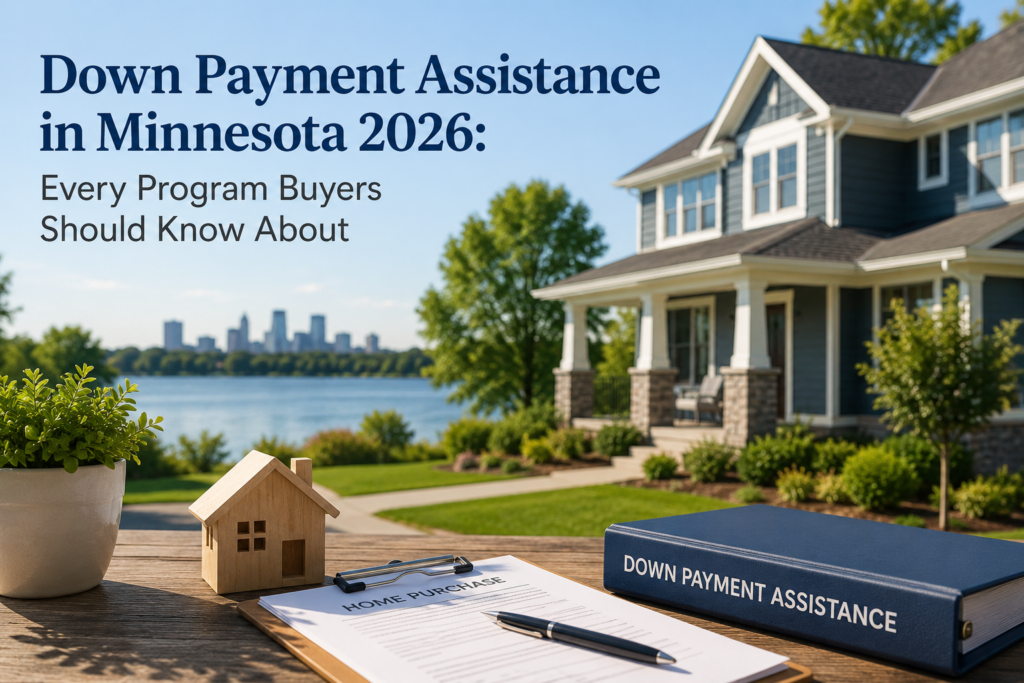
Coming up with a down payment is the #1 barrier most buyers face. The good news: Minnesota has some of the country’s most robust down payment assistance (DPA) programs, particularly for first-time and moderate-income buyers.

Key Programs to Know

  • MN Housing Start Up — Offers below-market interest rates plus optional DPA for first-time buyers statewide. Income and purchase price limits apply.
  • MN Housing Step Up — For repeat buyers or those with higher incomes who still need help. Flexible income limits and loan types.
  • Monthly Payment Loan (MPL) — A second mortgage from Minnesota Housing to cover the down payment and closing costs, repaid monthly alongside your first mortgage.
  • Deferred Payment Loan (DPL) — Zero interest, no monthly payments required. Due only when you sell, refinance, or pay off the home. Income-restricted.
  • Local City/County Programs — Many Twin Cities municipalities (including Minneapolis, Saint Paul, and Hennepin County) offer their own layered DPA grants.

Eligibility rules, income limits, and program availability change regularly. Always verify details directly through Minnesota Housing Finance Agency (mnhousing.gov) or ask your lender.

Getting Pre-Approved: What Minnesota Lenders Look For

Pre-approval is non-negotiable in the Twin Cities market. In competitive neighborhoods like Edina or Minnetonka, sellers routinely reject offers that don’t come with one. Here’s what lenders evaluate:

  1. Credit Score — Most conventional lenders want 620+; FHA allows 580+. Higher scores unlock better rates. Pull your free report at AnnualCreditReport.com and dispute any errors before you apply.
  2. Debt-to-Income Ratio (DTI) — Your total monthly debt payments divided by gross monthly income. Most lenders cap this at 43–50%. Pay down revolving debt before applying if possible.
  3. Employment & Income History — Two years of steady employment in the same field is the gold standard. Self-employed buyers will need two years of tax returns and a profit-and-loss statement.
  4. Assets & Reserves — Lenders want to see enough savings for your down payment, closing costs (typically 2–3% of the purchase price in Minnesota), and a few months of mortgage payments in reserve.
  5. Property Type — Condos, multi-family homes, and rural properties can come with additional underwriting requirements. Your lender should flag these early.

💡 Pro Tip: Get pre-approved — not just pre-qualified. Pre-qualification is a quick estimate; pre-approval involves verified documentation and carries far more weight with sellers. In multiple-offer situations, it can be the difference between winning and losing.

Understanding Mortgage Rates in Minnesota

Mortgage rates in Minnesota generally track national averages set by broader economic conditions and Federal Reserve policy — but your personal rate depends on your credit score, loan type, down payment size, loan term, and the lender you choose.

A few things to keep in mind when comparing rates:

  • APR vs. Interest Rate — The APR includes fees and gives a truer picture of the total cost. Always compare APRs, not just headline rates.
  • Discount Points — You can pay upfront points to buy down your rate. This makes sense if you plan to stay in the home long-term.
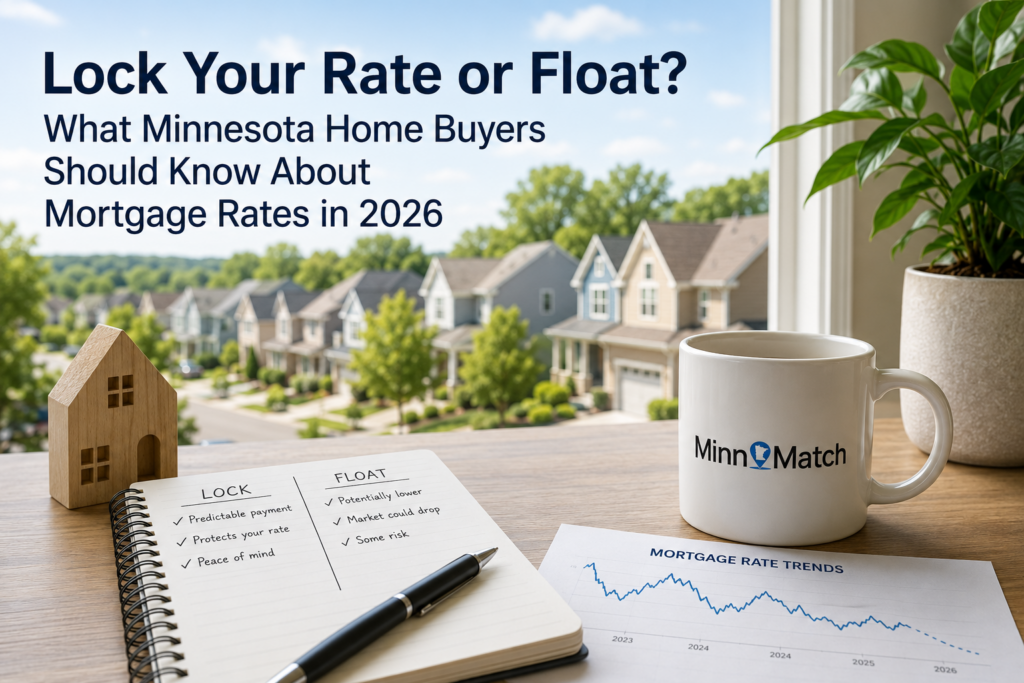
  • Rate Locks — Once you find a home, locking your rate protects you from increases during underwriting. Most locks run 30–60 days.
  • Shop Multiple Lenders — Rates vary meaningfully between banks, credit unions, and mortgage brokers. Getting 3–5 quotes can save you thousands over the life of the loan. Use resources like Redfin Mortgage or local Minnesota credit unions to compare.

Closing Costs in Minnesota: What to Budget For

Closing costs are separate from your down payment and are easy to underestimate. In Minnesota, buyers typically pay 2–3% of the purchase price at closing. On a $450,000 home, that’s $9,000–$13,500.

Cost Item Typical Range Notes
Loan Origination Fee 0.5–1% of loan Negotiable with some lenders
Appraisal $500–$800 Required by lender to confirm value
Title Insurance $1,000–$2,500 Protects lender (and optionally you) from title defects
Home Inspection $400–$600 Strongly recommended; paid before closing
Prepaid Interest Varies Interest accrued from closing date to first payment
Property Tax Escrow 2–3 months Collected upfront to fund escrow account
Recording Fees (MN) $100–$300 Paid to county to record the deed and mortgage

Some sellers in slower markets may agree to cover part of your closing costs — a great negotiating point your agent can help you work into an offer. Learn more about what to expect as a buyer on our Buyers page.

First-Time Homebuyer Resources in Minnesota

If this is your first home purchase, you’re in good company — and there’s substantial support available to you in the Twin Cities.

  • Homebuyer Education Course — Required for many DPA programs. Minnesota Housing-approved courses can be taken online or in person. They cover budgeting, the purchase process, and long-term homeownership. Visit mnhousing.gov to find approved providers.
  • Minneapolis Area REALTORS® — Publishes monthly market data and resources for local buyers. Helpful for understanding current inventory and pricing trends. See mplsrealtor.com.
  • HUD-Approved Housing Counselors — Free or low-cost counseling from nonprofit agencies certified by the Department of Housing and Urban Development. They can review your credit, help you build a savings plan, and walk you through loan options.
  • MinnMatch Agent Matching — Once your financing picture is clearer, pairing with the right buyer’s agent makes a real difference. Our free matching service connects you with vetted, local agents who know your target neighborhoods inside and out.

Mortgage Basics Minnesota: Common Questions Answered

How much do I need to put down in Minnesota?

It depends on the loan type. Conventional loans can go as low as 3%, FHA at 3.5%, and VA/USDA at 0%. A larger down payment (20%+) eliminates private mortgage insurance (PMI) and reduces your monthly payment, but it’s not required. Many successful Twin Cities buyers close with 5–10% down.

What’s the difference between pre-qualification and pre-approval?

Pre-qualification is an informal estimate based on self-reported numbers. Pre-approval involves submitting documentation — pay stubs, tax returns, bank statements — and a hard credit pull. Pre-approval letters carry real weight with sellers. In a competitive market, don’t skip this step.

Can I use a gift for my down payment?

Yes, most loan programs allow gifted funds from family members. You’ll need a gift letter stating the money doesn’t need to be repaid. FHA and conventional loans both permit this; your lender will guide you through documentation requirements.

Is it better to use a local Minnesota lender or a national bank?

Both can work well. Local credit unions and mortgage brokers often offer competitive rates and more personalized service — and they understand Minnesota-specific programs like MN Housing products. National banks may have streamlined apps and consistent processes. The best choice is the lender who gives you the right rate, clear communication, and can close on time.

What credit score do I need to buy a home in Minnesota?

Most conventional loans require a 620 minimum. FHA loans go as low as 580 (with 3.5% down) or even 500 (with 10% down). VA and USDA loans don’t have a set minimum, but most lenders apply an internal floor around 620–640. The higher your score, the better your rate — every 20-point improvement can meaningfully reduce your monthly payment.

Ready to Start Your Home Search in the Twin Cities?

Getting your financing in order is step one. Step two is finding an agent who knows your market. MinnMatch connects Minnesota buyers with handpicked, vetted local agents — completely free.

Find Your Agent

This article is intended for general informational purposes. Loan programs, income limits, and rates change frequently. Always consult with a licensed mortgage professional for advice specific to your situation.

Buying a Home in Minnesota

Two-story red craftsman-style home with white trim, dark shutters, a covered front porch, and a dormer window, representing a typical single-family home for sale in Minnesota

A Clear, Practical Guide for Minnesota Buyers Backed by Local Expertise

Buying a home in Minnesota is exciting, but it can also feel complex. From understanding local market conditions to navigating inspections and negotiations, small details can make a meaningful difference in outcomes.

This guide gives Minnesota buyers a clear, plain-language overview of the home buying process so you can make informed decisions and work confidently with the right local real estate professional.


1. Understanding the Minnesota Housing Market

Minnesota real estate is highly local. Market conditions can vary widely between the Twin Cities, first-ring suburbs, outer suburbs, and lake communities.

  • Inventory levels and available homes
  • Interest rates and affordability
  • Seasonal patterns, especially spring and early summer competition
  • Local demand by neighborhood and school district

In many Twin Cities communities, well-priced homes can still receive multiple offers. In others, buyers may have more room to negotiate. Understanding the dynamics of your specific area is critical.

This is where knowledgeable local guidance becomes invaluable.


2. Getting Financially Prepared

Before touring homes, it is important to understand your financial position.

  • Review your credit and monthly budget
  • Get pre-approved with a reputable lender
  • Understand down payment and closing cost requirements

Minnesota buyers often work with local mortgage professionals who understand state programs, property tax structures, and appraisal norms.

A strong pre-approval strengthens your offer and signals seriousness to sellers.


3. Choosing the Right Location

Minnesota offers a wide range of living environments, from urban neighborhoods to suburban communities and lake-area homes.

  • Commute and transportation options
  • Schools and amenities
  • Property taxes and assessments
  • Long-term resale potential
  • Lifestyle fit such as walkability or lake access

What works in Minneapolis may not apply in Edina, Wayzata, Prior Lake, or Lake Minnetonka. Local pricing patterns and buyer expectations differ by community.


4. Touring Homes and Evaluating Properties

  • Overall condition and maintenance
  • Layout and functionality
  • Age of major systems such as roof and HVAC
  • Traffic patterns and lot features

In Minnesota, seasonal conditions matter. Snow and frozen ground can conceal issues, making professional inspections especially important.


5. Making an Offer in Minnesota

A Minnesota purchase agreement typically includes:

  • Purchase price
  • Earnest money
  • Inspection and financing contingencies
  • Closing date
  • Included personal property
  • Additional terms or addenda

In competitive situations, strategy matters. Local insight can guide escalation clauses, inspection timing, and non-price terms.


6. Inspections and Due Diligence

  • General home inspection
  • Radon testing, very common in Minnesota
  • Sewer line inspection
  • Well and septic inspections where applicable

Based on results, buyers may proceed as-is, request repairs, renegotiate terms, or withdraw if contingencies allow.


7. Appraisal and Final Financing

The lender orders an appraisal to confirm value. If it meets expectations, the transaction proceeds. If it comes in low, additional negotiation may be required.

The lender completes underwriting before issuing clear-to-close approval.


8. Closing on Your Minnesota Home

  • Final walkthrough
  • Signing documents with title company or attorney
  • Funding down payment and closing costs
  • Recording of the deed

Once completed, the home is officially yours.


Why Local Guidance Matters

  • Neighborhood-specific pricing
  • Competitive offer strategy
  • Inspection norms
  • Negotiation expectations
  • Avoiding costly missteps

Online information is helpful, but buying a home is rarely one-size-fits-all.


How MinnMatch Helps

MinnMatch connects Minnesota buyers with trusted, experienced local real estate professionals through a thoughtful, human-reviewed matching process. There is no cost and no pressure. Just clear guidance and a carefully matched local expert when you are ready.

Get Matched