Preparing Your Twin Cities Home for a Fall 2026 Sale: What to Do Right Now

Twin Cities fall home prep checklist notepad, coffee mug, and pumpkins on a porch table with a house in autumn foliage

If you’re planning to prepare your home for a fall sale here in the Twin Cities, the next few weeks matter more than you might think. Freddie Mac’s latest survey puts the 30-year mortgage rate at 6.67% as of August 13, 2026, and buyers who’ve been waiting on the sidelines are starting to move again now that rates have eased slightly. Meanwhile, Minneapolis Area REALTORS® data shows the 16-county metro sitting around 2.8 months of supply, with homes typically taking about 42 days to sell. That’s a healthier, more balanced market than we’ve seen in years — but it also means buyers have options, and your home needs to earn their attention. Here’s what to do right now if you’re aiming for a September or October listing.

Why Fall 2026 Rewards Sellers Who Prep Early

Fall listings in Minnesota tend to attract serious, motivated buyers — people who need to move before winter, relocating for a job, or wrapping up a home search that stalled over the summer. But with median sale prices in the metro hovering around $410,000 and inventory more plentiful than in past autumns, buyers are comparing homes side by side instead of rushing to beat a bidding war. A home that shows well from day one tends to sell faster and closer to asking price than one that needs a price cut a few weeks in. That’s the whole reason to prepare your home for a fall sale now instead of the week before your photos are scheduled.

This Week: Declutter, Deep Clean & Handle the Small Repairs

Start with the tasks that make the biggest visual difference for the least amount of money:

  • Clear countertops, closets, and the garage — buyers are judging storage space, and clutter shrinks every room in photos.
  • Book a deep clean, including carpets and windows, so the home smells and feels fresh for showings.
  • Walk the house with fresh eyes and fix the little things — a leaky faucet, a sticky door, a cracked outlet cover. Inspectors will find them anyway, and it’s cheaper to handle them now.
  • Touch up scuffed walls and trim with neutral paint where it’ll be noticed in listing photos.

None of this requires a major renovation. It’s about removing the small distractions that make buyers pause instead of picture themselves living there.

Curb Appeal, Before the Leaves Start Piling Up

Minnesota curb appeal has a shelf life once September hits. A few things worth doing now, while the yard still looks like summer:

  • Clean out gutters and downspouts before the first big leaf drop — buyers notice, and inspectors definitely will.
  • Mow, edge, and refresh mulch beds; a few pots of fall-blooming mums by the front door go a long way in photos.
  • Pressure-wash the siding, driveway, and front walk while the weather still cooperates.
  • Have your furnace serviced now rather than during your first showing week — a fall listing with a freshly inspected furnace is a genuine selling point in Minnesota.

How to Prepare Your Home for a Fall Sale: Work Backward From Your Listing Date

If you want to prepare your home for a fall sale that actually lists in mid-September, count backward: photos usually need to happen about a week before your listing goes live, which means cleaning, repairs, and any staging should wrap up two to three weeks before that. Pricing conversations with your agent should happen even earlier, since local market conditions and comparable sales in your specific neighborhood will shape where you land. Waiting until the last minute tends to compress all of this into a stressful sprint — starting now gives you room to breathe and gives your agent time to plan the launch properly.

Getting Matched With the Right Agent for a Fall Launch

Every neighborhood in the Twin Cities moves a little differently in the fall, and the agent who sold a colonial in Edina last spring isn’t necessarily the right fit for your rambler in Prior Lake this October. If you’re not already working with someone, now is the time to get matched — not the week you want to list. MinnMatch connects you with a vetted local agent who knows your specific market and can help you prepare your home for a fall sale the right way, walking your prep list with you before anything goes live. It’s free, it’s personal, and it means you’re not guessing at what actually matters for your home. Curious how the matching works first? Here’s how it works.


The Hidden Costs of Buying a Home in Minnesota That Nobody Warns You About in 2026

Notebook checklist of hidden home buying costs in Minnesota with coffee mug, calculator, and house keys

By the time you’ve saved for a down payment and budgeted for closing costs, you probably feel like you’ve covered the bases. But the hidden costs of buying a home in Minnesota — the ones nobody puts on a checklist — tend to show up after those two big numbers are already spent — in the weeks before closing, on moving day, and during that first, expensive year of ownership. None of them are secret, exactly. They’re just easy to miss when every guide (including a few of our own) focuses on the down payment and the closing statement. Here’s what actually catches Twin Cities buyers off guard, and what to set aside for it.

Homeowners Insurance Costs More Than Most Buyers Plan For

Minnesota’s hail, wind, and tornado exposure has pushed homeowners insurance premiums up sharply over the past two years, and published 2026 estimates for the state land anywhere from about $2,500 to $3,500+ a year depending on the source, your dwelling coverage, and your ZIP code — noticeably higher than a lot of buyers expect when they’re penciling out a monthly payment. Your lender will require proof of coverage before closing, and your first year’s premium is typically collected upfront and folded into escrow, which means it’s due before you’ve unpacked a single box. If your home has an older roof, a walkout basement prone to water issues, or sits in a hail-prone western suburb, get quotes early — some insurers are getting pickier about older roofs and claims history, and a surprise decline a week before closing is a headache nobody wants. Checking recent sold listings on a site like Redfin can also give you a sense of a neighborhood’s typical home age and construction, which insurers factor into their quotes.

Two riders are also worth budgeting for separately, since they’re not always included by default: sewer/sump pump backup coverage (common and cheap to add, but a real gap if skipped in a state full of basements) and, for lakefront or low-lying properties, flood coverage through a separate policy.

Testing You Didn’t Know You’d Pay For

A standard home inspection covers the basics, but several common Minnesota add-ons are among the most overlooked hidden costs of buying a home in this market — separate line items — and they’re almost always the buyer’s expense during the inspection period. Radon testing runs roughly $100–$175 if your inspector doesn’t already include it, and it’s worth doing: the Minnesota Department of Health estimates that a large share of homes statewide test above the action level, largely because of our soil composition and how tightly we seal homes against the cold. If levels come back high, mitigation systems typically cost $1,000–$2,000 to install — a number worth knowing before you’re negotiating repairs.

If you’re buying a home with a private well or septic system — common in the outer suburbs and lake communities — add well water testing and a septic inspection to your budget as well; together these can run several hundred dollars, and septic issues in particular can turn into a much bigger negotiation if the system is aging. A sewer line scope (checking for tree roots or breaks in older neighborhoods like South Minneapolis) is another optional add-on, typically $200–$300, that’s cheap insurance against a very expensive surprise.

Moving Day Isn’t Free — and Minnesota Weather Doesn’t Help

Local movers in the Twin Cities generally charge by the hour, and a typical in-metro move lands somewhere between $500 and $1,800 depending on home size, crew count, and how much stuff you’re hauling — more if you’re moving during the busy May–September stretch, when demand (and pricing) both climb. Add in supplies, a storage unit if your closing and move-out dates don’t line up, and tips for the crew, and it’s easy to spend $1,000+ that never showed up on a closing cost worksheet. If you’re closing in winter, budget a little extra flexibility too: a snowstorm on moving day is a Minnesota rite of passage, and rescheduling a crew last-minute rarely comes cheap.

The First-Year Cash Crunch: More Hidden Costs of Buying a Home in Minnesota

This is where a lot of the real hidden costs show up — not at closing, but in the months after. A few to plan for:

Escrow shortfalls. Your lender estimates your first year of property taxes and insurance when they set up escrow, but if your home’s assessed value jumps at reassessment — common after a purchase, since the sale price often resets the county’s valuation with the local assessor’s office — your escrow account can come up short. You’ll either owe a lump sum or see your monthly payment increase to cover the gap. (We’ve covered the mechanics of Minnesota property taxes in more detail if you want the full picture.)

HOA and association costs. If you’re buying a townhome, condo, or a house in a covenant community, ask for the HOA’s reserve study and meeting minutes before you close — not just the current dues. A thin reserve fund is often a warning sign of a special assessment coming down the line, and those can run into the thousands per unit with little notice.

The stuff that isn’t “broken,” just old. Inspections flag safety and functionality issues, not a water heater that’s simply nearing the end of its expected life or a furnace that’s fine today but 18 years old. A general rule of thumb: set aside 1–2% of your home’s value annually for maintenance and eventual replacements, even if nothing’s wrong at closing.

The Small Stuff That Adds Up

None of these break the bank alone, but together they’re often a few hundred to a thousand-plus dollars in the first month: rekeying or replacing locks, utility deposits (especially if you’re new to the area and don’t have an established account history with Xcel Energy or CenterPoint), a Minnesota-grade snow blower or roof rake if you don’t already own one, and basic yard equipment if you’re moving from a place where someone else handled the lawn. It’s worth building a simple “move-in fund” separate from your down payment and closing costs — even a few thousand dollars in reserve takes the pressure off that first month considerably. If you’re a first-time buyer working with a tight budget, it’s also worth checking whether you still qualify for down payment or closing cost assistance through Minnesota Housing — some programs can free up cash specifically for these first-year costs.

None of these hidden costs should scare you off buying — they’re manageable when you know they’re coming. The buyers who get blindsided are usually the ones who only budgeted for the numbers on the purchase agreement. A local agent who works this market regularly can walk you through what to expect for your specific home, neighborhood, and situation before you’re locked into a closing date. MinnMatch can connect you with one, free of charge — no pressure, just a second set of eyes on the numbers.

Eden Prairie MN August 2026: Back-to-School Season & What It Means for the Housing Market

Kids walking to school with backpacks in an Eden Prairie MN neighborhood, August 2026

Backpacks are back on the shelves, Eden Prairie Schools is finalizing its fall calendar, and for a lot of local families, that combination sparks the same question every August: should we move now, or wait until next summer? The Eden Prairie housing market tends to shift subtly this time of year, and understanding that shift can help you time a purchase, a sale, or a listing decision a little more strategically.

Why Back-to-School Timing Shapes the Eden Prairie Housing Market

Eden Prairie Schools’ 2026–27 calendar has students returning the week after Labor Day, with kindergarten through 5th grade, 6th grade, 9th grade, and TASSEL students starting Tuesday, September 8, and 7th–8th and 10th–12th graders following on September 9. That later start, pushed back because Labor Day falls unusually late in 2026, gives families a slightly wider window to close on a home, get settled, and register kids for school without the scramble that comes with an early-September start date. It’s part of why August tends to bring a wave of buyers who want to be unpacked and enrolled before the first bell rings, rather than moving mid-semester and disrupting a school year already in progress.

Where Prices and Inventory Stand This August

Home values in Eden Prairie have generally landed in the $470,000 to $530,000 range this summer, depending on the data source, the month, and whether you’re looking at list price or closed sale price. According to Redfin, Eden Prairie remains a highly competitive market, with homes typically going under contract within about three to four weeks of listing. Inventory has loosened slightly compared to the ultra-tight conditions of the past few years, but well-priced homes in good school-boundary locations are still fielding multiple offers, particularly the kind of move-in-ready, family-friendly listings that back-to-school buyers tend to prioritize.

Mortgage rates are also part of this picture. Freddie Mac’s latest survey put the 30-year fixed rate at 6.69% in early August 2026, ticking up slightly from the prior week. That’s kept some budget-conscious buyers on the sidelines, but it hasn’t slowed the Eden Prairie housing market the way you might expect — strong school ratings and easy access to job centers in the southwest metro continue to pull buyers in even when rates are elevated.

Eden Prairie Schools: Still a Major Draw for Relocating Families

It’s no secret that Eden Prairie’s school district is one of the biggest reasons families target this suburb specifically instead of nearby communities. Every August, that draw becomes very literal — families relocating for school quality want to close before Ramp-Up Day and orientation events, not after. If you’re moving with kids, it’s worth building in extra time for the practical side of a back-to-school move: transferring records, meeting new teachers, and getting a feel for a new attendance boundary before the first day, rather than trying to handle all of it during move-in week.

What This Means If You’re Buying

If you’re house-hunting in Eden Prairie right now with a fall deadline in mind, plan around a realistic closing timeline — typically 30 to 45 days from an accepted offer — and start well before you think you need to. Late-summer inventory can include some genuinely great options, since sellers who list in August are often motivated to close before the school year fully kicks in too. Get pre-approved early, know which elementary or middle school boundary matters most to your family, and be ready to move quickly on a home that checks the right boxes, since well-located listings in this price range aren’t sitting long.

What This Means If You’re Selling

For sellers, back-to-school season is a legitimate window worth paying attention to. Families who want to be settled before September are motivated, decisive, and often willing to move fast on a home that fits their timeline. If your property is in a sought-after school boundary, staging it to highlight family-friendly features — a mudroom, a flexible bonus room, proximity to parks or the elementary school — can resonate with exactly the buyers who are shopping the Eden Prairie housing market right now under a bit of a deadline.

Whether you’re racing the school calendar or just starting to think about a move, timing decisions like this go a lot smoother with someone who knows Eden Prairie’s neighborhoods and school boundaries inside and out. MinnMatch connects you with a handpicked local agent who fits your situation — free for buyers and sellers, with no algorithm guessing on your behalf. Curious how the process works? Check out how MinnMatch works, or browse more on Eden Prairie real estate to see what else is happening in the market.

How to Read a Minnesota Purchase Agreement in 2026: Key Clauses Every Buyer Must Understand

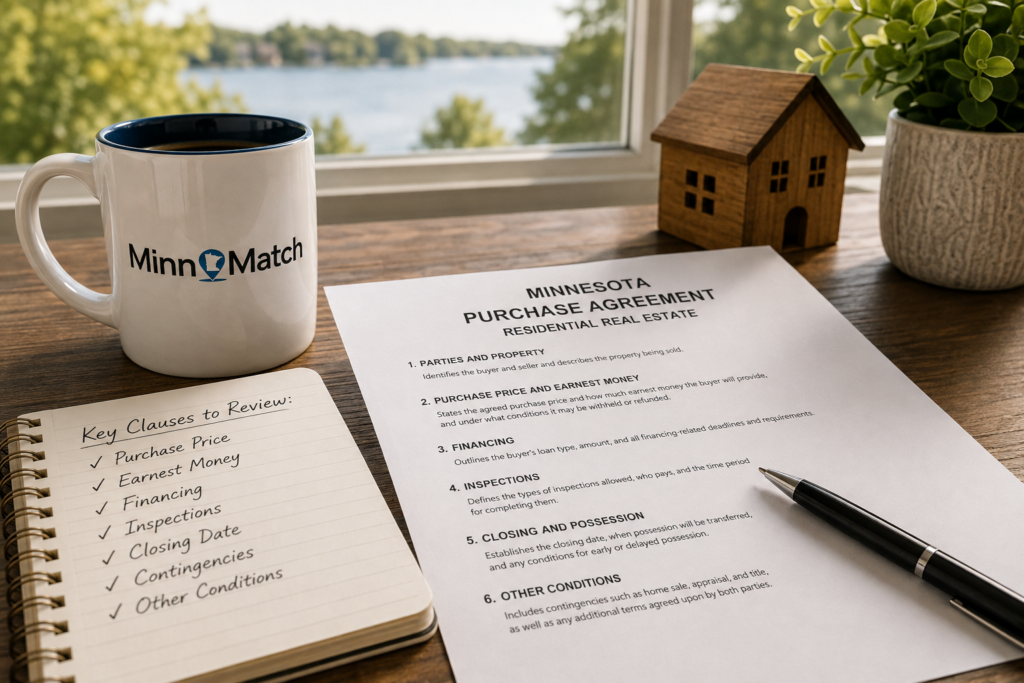
Minnesota purchase agreement document with key clauses checklist, MinnMatch coffee mug, and lake view in background

By the time a Twin Cities buyer sits down to sign, the Minnesota purchase agreement has already done most of the heavy lifting — it’s the document that turns a verbal “we have a deal” into a legally binding contract. But it’s also dense, full of checkboxes and legal shorthand, and easy to skim past when you’re excited about a house. Understanding what you’re actually agreeing to, clause by clause, is one of the best ways to avoid surprises between your accepted offer and closing day. Here’s what’s actually in a standard Minnesota purchase agreement in 2026, and why each section matters more than it looks.

What Your Purchase Agreement Says About Price & Financing

The top of the agreement covers the basics — purchase price, the legal property description, and the closing date — but the earnest money section deserves more attention than most buyers give it. Earnest money is the deposit you put down to show you’re serious, typically held in a broker’s trust account until closing. The agreement spells out the amount, where it’s held, and — critically — the conditions under which you get it back if the deal falls apart. If a contingency in your favor isn’t met and you cancel properly, your earnest money should be returned. If you back out for a reason the contract doesn’t cover, you could forfeit it. This section also lays out your financing terms: loan type, down payment amount, and the interest rate range you’re qualifying for, which protects you if rates move before your loan is locked. If you’re using a first-time buyer program or down payment assistance, make sure those details match what’s on file with your lender — Minnesota Housing is a good source for verifying program specifics before you sign.

Contingencies: The Escape Hatches Every Buyer Needs

Contingencies are the conditions that must be satisfied for the sale to move forward, and they’re the part of a Minnesota purchase agreement that actually protects you as a buyer. The most common ones are the financing contingency (the deal is off if your loan isn’t approved), the inspection contingency (you can renegotiate or walk away based on what an inspector finds), and the appraisal contingency (protection if the home appraises for less than your offer price). Some agreements also include a sale contingency, which makes your purchase dependent on selling your current home first — useful, but it can make your offer less competitive in a fast-moving market. Each contingency comes with a deadline written directly into the agreement, so missing a date can mean losing the protection entirely, even if you intended to use it. If a term like “appraisal gap” or “escalation clause” shows up alongside your contingencies, Redfin’s glossary of real estate terms is a quick way to double-check what you’re agreeing to.

Seller Disclosures and What Minnesota Law Requires

Minnesota law requires sellers to complete a written disclosure statement in good faith before a purchase agreement is signed, covering known material defects — things like a leaky roof, past water intrusion, or an aging furnace. Sellers also have to disclose specifics around private wells and septic or sewage systems, which matters a lot in the suburban and lake communities around the Twin Cities where municipal sewer isn’t a given. If the home was built before 1978, federal law adds a lead-based paint disclosure requirement on top of the state rules. Read this document closely and cross-reference it against what your inspector finds — a mismatch between what was disclosed and what’s actually there can be grounds to renegotiate. You can review the state’s disclosure framework directly through the Minneapolis Area Realtors resource library if you want the fuller legal picture.

Closing Date, Possession & What’s Actually Included

It sounds simple, but confusion over the closing date and possession date causes real friction. Closing is when ownership legally transfers; possession is when you actually get the keys — and in Minnesota, those aren’t always the same day. Some sellers negotiate a short post-closing occupancy period to give themselves time to move out, which should be spelled out with a per-diem rent amount if it runs long. Just as important is the fixtures and personal property section, which lists exactly what stays with the home — appliances, window treatments, that wall-mounted TV bracket — and what the seller plans to take. If you fell in love with the light fixtures during a showing, don’t assume; get them written into the agreement.

Default Clauses: What Happens If Something Falls Apart

Near the bottom of most Minnesota purchase agreements sits the default and remedies section — the part nobody wants to think about but everyone should read. It outlines what happens if either side fails to follow through: whether the non-defaulting party can pursue specific performance (forcing the sale to close), seek damages, or simply cancel and keep or recover the earnest money. There’s often an arbitration or mediation clause here too, which can affect how a dispute gets resolved if one comes up. None of this is meant to scare you off — most Twin Cities transactions close without incident — but knowing what recourse exists on both sides gives you a clearer picture of what you’re actually signing.

A purchase agreement is negotiable up until both parties sign, and a good buyer’s agent will walk you through every clause before you’re staring at a deadline. That kind of hands-on guidance is exactly what MinnMatch is built around — if you’re preparing to make an offer and want an agent who’ll actually explain what you’re signing, find your match with MinnMatch and get paired with a vetted local agent for free. Curious how the matching process works first? Take a look at how MinnMatch works.

Minnetonka MN August 2026: Late Summer Market Update & Best Value Neighborhoods

Tree-lined Minnetonka MN neighborhood street with craftsman-style homes, August 2026

If you’ve been watching the Minnetonka MN real estate market from the sidelines this summer, late August is worth a second look. The frantic pace of June has cooled, inventory has loosened up just enough to give buyers room to breathe, and a handful of Minnetonka neighborhoods are quietly offering some of the best value the suburb has seen all year. Here’s what’s actually happening on the ground right now — and where the smart money is looking.

Where the Minnetonka MN Real Estate Market Stands in Late Summer 2026

As of early August, roughly 150-plus homes are active on the market in Minnetonka at any given time, with a median list price sitting right around $525,000. That’s a meaningful shift from the frenzy of spring: homes are now averaging closer to 45–50 days on market instead of the two-to-three-week turnarounds buyers were fighting over back in May. Months of supply has crept up to just over two, which still favors sellers overall, but gives buyers noticeably more breathing room to negotiate than they had earlier this year.

Homes are still selling close to asking — typically in the high 90s as a percentage of list price — but the share of homes selling above asking has dropped noticeably from where it stood a year ago. Price reductions are also becoming more common than they were in spring, which is usually the first sign that a market is entering its late-summer cooling phase. For a broader look at how this compares to the rest of the metro, see our August 2026 Twin Cities market update.

What Homes Are Actually Selling For

Zillow’s home value index puts the typical Minnetonka home around $440,000, up modestly year-over-year, while active listing prices skew higher — a reflection of the mix of lakefront and near-lake inventory that dominates the west side of the city. According to Redfin’s market data, price growth across the broader Twin Cities has been steady but far from explosive this year, and Minnetonka is tracking that pattern closely rather than outrunning it.

It’s worth remembering that “Minnetonka” covers a lot of ground price-wise. West-side, lake-adjacent pockets near Deephaven and Wayzata push the average up considerably, while the east side of the city — closer to Hopkins and St. Louis Park — tells a very different, more affordable story. That gap is exactly where this month’s opportunity lives.

The Best Value Neighborhoods in Minnetonka Right Now

If you’re priced out of the lake-adjacent west side but still want the Minnetonka address, school district, and commute, these are the areas delivering the strongest value this late-summer season:

  • Glen Lake — A walkable pocket with its own small downtown of shops and restaurants, Glen Lake mixes starter single-family homes and townhouses at prices well below the west-side lake premium.
  • Groveland — One of Minnetonka’s most diverse housing stocks, ranging from modest starter homes to larger updated properties, with an active neighborhood association and strong appreciation trends.
  • Minnetonka Mills — A historic area along Minnehaha Creek with a mix of older, well-priced homes and newer construction, plus easy access to parks and trails.
  • Tonkawood — One of the more consistently listed neighborhoods in the city, offering a good supply of mid-range homes for buyers who want options without a bidding war.

These east and central Minnetonka neighborhoods won’t give you lake frontage, but they will get you into the Minnetonka school district — consistently one of the strongest in the state — at a price point that’s still realistic for a lot of Twin Cities buyers.

What This Means If You’re Buying or Selling This Month

For buyers, late summer is historically one of the better windows to shop Minnetonka: less competition than spring, more room to negotiate on price or closing costs, and sellers who are often more motivated to close before the school year fully kicks in. If you’ve been priced out of the west-side lake market, now is a smart time to take a serious look at the value neighborhoods above.

For sellers, pricing accurately matters more right now than it did in May. With days on market stretching out and price reductions ticking up, homes priced realistically from day one are still moving quickly — it’s the overpriced listings that are sitting. Understanding where your specific neighborhood falls in the Minnetonka MN real estate market right now is the difference between a smooth sale and a stale listing. For general context on regional pricing trends, Minnesota Housing and MAAR’s mplsrealtor.com both publish regularly updated local statistics worth checking before you set a list price.

Find the Right Agent for Your Corner of Minnetonka

Whether you’re chasing value in Glen Lake or negotiating a west-side lake property, the right agent needs to actually know these micro-markets — not just the citywide averages. That’s the whole idea behind MinnMatch: we personally match Minnetonka buyers and sellers with vetted local agents who know these neighborhoods block by block. It’s free, it’s human-powered, and it takes the guesswork out of finding someone who actually gets this market. Get matched with a Minnetonka agent today.

What to Look for at a Home Showing in Minnesota: A Room-by-Room Guide for 2026

Agent showing a couple the living room during a Minnesota home showing, with a home showing checklist clipboard in the foreground

You’ve got a showing on the calendar, and it’s easy to get swept up in the fresh paint and staged throw pillows. But a good home showing checklist helps you see past the surface and spot the things that actually matter — the stuff a professional inspector will catch later, sure, but also the stuff that tells you right away whether a home is worth pursuing at all. In Minnesota, where basements, roofs, and furnaces work overtime against snow, ice, and humidity swings, a sharp eye during the showing can save you from wasting an offer on the wrong house — or help you walk into negotiations already knowing what to ask for. Here’s a room-by-room guide to what to look for at a home showing in 2026, whether you’re touring a 1920s bungalow in South Minneapolis or a newer build in Plymouth.

The Basement: Minnesota’s Make-or-Break Space

Almost every Twin Cities home has a basement, and it’s often the single most telling room on your home showing checklist. Look for water stains along the base of the walls, efflorescence (that chalky white residue that signals past moisture), and any musty smell that lingers even with the lights on and doors open. Check whether there’s a sump pump, and if so, ask when it was last tested — spring snowmelt puts real pressure on Minnesota basements, and a pump that hasn’t run in years is a gamble. Take note of the floor: sloped or cracked concrete can point to foundation settling, which is common in older homes but still worth flagging for a closer look later.

While you’re down there, glance at the furnace and water heater. Most residential furnaces last 15–20 years, and given how hard Minnesota winters push a heating system, an aging unit is a real budget line item, not a minor detail.

The Kitchen: Beyond the Countertops

It’s easy to fall for granite and a farmhouse sink, but your home showing checklist should push you past the finishes. Open a few cabinet doors and drawers to check for soft spots or water damage underneath the sink. Turn on the faucet and watch how long it takes for hot water to arrive and whether the water pressure feels strong — weak pressure can hint at plumbing issues that are common in homes built before the 1970s, which describes a lot of housing stock in Minneapolis and St. Paul. Look at the outlets near the counters, too; GFCI outlets near water sources are a code requirement in newer construction, and their absence in an older kitchen isn’t a dealbreaker, but it’s good to know before you’re budgeting for updates.

Bathrooms: Small Rooms, Big Clues

Bathrooms punch above their weight when it comes to what a home showing can reveal. Press gently on the flooring around the toilet and tub — any give or softness usually means water damage underneath. Check the caulk lines around the tub and shower; cracked or moldy caulk is a quick fix, but staining on the ceiling of the room below (if there is one) is a bigger flag worth asking about. Run the shower for a minute and see how quickly the drain clears, and check under the sink for any signs of past leaks. In a two-story Twin Cities home, a poorly maintained upstairs bathroom can eventually become a downstairs ceiling problem, so it’s worth connecting the dots between floors as you tour.

Roof, Windows & Exterior: What Minnesota Weather Leaves Behind

Before you walk inside, take a minute in the driveway or yard. Look at the roofline for sagging, missing shingles, or dark streaking, which can all be signs of age or storm damage — hail and heavy snow load take a toll on Minnesota roofs, and a roof nearing the end of its life is one of the more expensive updates a buyer can inherit. Check the gutters for ice dam damage, especially loose or pulled-away sections, and look at the grading around the foundation to see whether the ground slopes away from the house (it should) or pools water toward it (it shouldn’t). Inside, put a hand near the window frames on a cooler day — drafts are a quick, informal test of how well the windows are sealed, and older single-pane or poorly maintained windows can mean higher heating bills through a long Minnesota winter.

Storage, Layout & Livability

Not everything on a smart home showing checklist is about defects — some of it is about fit. Walk the closets and think honestly about whether your belongings will actually work in the space. Stand in the main living areas and picture your furniture there, not the staged pieces currently filling the room. Check cell signal in the basement if you work from home, note which direction the primary bedroom windows face if morning light matters to you, and pay attention to street noise or nearby traffic patterns, which can be harder to gauge from listing photos than almost anything else. These aren’t inspection items, but they’re just as important to whether a home is genuinely right for you.

Your Home Showing Checklist, Put Into Action

A thorough walkthrough won’t replace a licensed home inspection once you’re under contract, but a sharp home showing checklist helps you avoid wasting time — and an offer — on a home with problems you could have spotted on day one. According to the Minneapolis Area Realtors, inventory in the Twin Cities has been moving quickly this year, which means buyers often only get one real look before deciding whether to make an offer — all the more reason to know what you’re looking for before you walk through the door. For deeper context on how Minnesota home inspections and licensing work, the Minnesota Department of Labor and Industry is a solid resource once you’re ready for that next step.

If you’d rather not walk through showings alone, that’s exactly what a good buyer’s agent is for — someone who’s toured hundreds of Twin Cities homes and knows what a slightly-sloped basement floor or a drafty window really means for your offer. MinnMatch can match you with a local agent who knows your target neighborhoods inside and out, at no cost to you. Curious how the matching process works? Take a look at how MinnMatch works before your next showing.

Wayzata MN August 2026: End-of-Summer Deals & Why Smart Buyers Act Before Labor Day

Boat docked on Lake Minnetonka at sunset in Wayzata, MN with text "Wayzata MN August 2026: End-of-Summer Deals & Why Smart Buyers Act Before Labor Day"

There’s a shift that happens in Wayzata every year right around now, and it has nothing to do with interest rates or inventory reports. It’s the calendar. Boats start coming out of Wayzata Bay a little earlier, school supply lists show up in mailboxes, and the buyers who spent June and July touring open houses on their lunch breaks quietly disappear back into their routines. For Wayzata real estate, that shift is exactly why the next few weeks matter so much. The buyers who stay in the game right now, while everyone else is packing up for Labor Day, are the ones who tend to walk away with the better deal.

What’s Actually Happening in Wayzata Real Estate Right Now

Wayzata has never been a market you can sum up with one number, and that’s truer than usual this year. Depending on which data set you’re looking at, typical sale prices in Wayzata have been landing somewhere in the $800,000s for the broader market, while listing prices skew meaningfully higher once you factor in the town’s mix of downtown condos, Wayzata Highlands homes, and true Lake Minnetonka lakefront estates that can run into the seven figures. That spread is normal for a town this small and this specialized — a handful of high-end closings can swing the “median” considerably from month to month, so it’s worth looking at ranges rather than a single headline price when you’re sizing up the market (per Redfin’s Wayzata market data).

Homes here have generally been taking longer to sell than they did a couple of years ago — often into the 50- to 100-day range rather than the frantic multiple-offer timelines of the pandemic years — which tells you Wayzata has settled into a more balanced, less frenzied market. That’s good news if you’re a buyer who’s been priced out of bidding wars, and it’s a big part of why late summer is worth paying attention to.

Why Smart Buyers Move Before Labor Day

Labor Day functions like an unofficial closing bell on the summer buying season across the Minneapolis Area Realtors footprint, and Wayzata feels it more than most communities because so much of its lifestyle appeal — the lake, the boats, the walkable downtown patios along Lake Street — is tied to warm weather. Once school starts and the calendar flips to fall, a big chunk of the casual buyer pool simply stops looking until spring. That’s not because Wayzata becomes less desirable; it’s because families settle into routines and put the search on pause.

For the buyers who keep going, that pullback in competition is the whole opportunity. Sellers who listed back in May or June and are still on the market by late August are often more motivated than they were at the start of summer — especially if they’ve already bought their next home or have a move tied to the school year. A well-prepared offer in the next few weeks can land with less competition and more room to negotiate than the exact same offer would have gotten in June.

Mortgage rates are part of this equation too. The 30-year fixed rate has been hovering in the mid-6% range this summer, and while that’s not the sub-6% environment some buyers are waiting for, it’s also not moved dramatically week to week — which means there’s little upside in waiting on rates alone (per Freddie Mac’s Primary Mortgage Market Survey). If a home works for your budget today, betting on a materially better rate a few months from now is a gamble, not a strategy.

Where the Deals Tend to Hide in Wayzata This Time of Year

Not every corner of the Wayzata real estate market cools off the same way. True lakefront and lake-view properties on Wayzata Bay tend to hold their value and their pace year-round — that’s a scarce category buyers compete for regardless of season. But in neighborhoods like Locust Hills, Wayzata Highlands, and the areas around Gleason Lake, late-summer listings that have sat for a few weeks are exactly where a patient buyer can find room to negotiate on price, closing costs, or timeline.

Downtown Wayzata condos and townhomes are worth a second look right now as well. They tend to draw a different buyer pool than single-family homes on the west end of the lake, and inventory in that segment often lingers a bit longer in late summer since so much of the demand is seasonal — vacation buyers and empty-nesters who were shopping earlier in the year and have since moved on to other priorities.

If You’re Selling in Wayzata, Don’t Assume the Window Closed

It’s tempting for sellers to assume the buyers still shopping in late August are just “kicking tires,” but the opposite is usually true. Anyone touring homes in Wayzata after the lake traffic thins out is typically serious — they’ve often already lost out on a home or two earlier in the summer and are motivated to close before fall. A well-priced, well-presented listing right now can still move quickly, especially against less competition from other new listings hitting the market.

Whether you’re chasing a late-summer deal in the Wayzata real estate market or trying to get a listing sold before the leaves turn, the agent you work with matters more this time of year than almost any other. MinnMatch personally matches Twin Cities buyers and sellers with vetted local agents who know Wayzata street by street — not an algorithm, and not a stranger from out of state. It’s free, it’s fast, and it’s built for exactly this kind of decision. Find your Wayzata agent match or learn more about how MinnMatch works.

Twin Cities Mortgage Rates in August 2026: Why They Climbed Back Toward 6.7% — And What It Means for Buyers

Twin Cities mortgage rates chart showing 6.67% 30-year fixed rate climbing from January to August 2026, MinnMatch mug on desk with Minneapolis skyline

Twin Cities mortgage rates have had a wild ride in 2026. Back in late February, the 30-year fixed rate briefly dropped below 6% for the first time in three and a half years, giving buyers real hope for an easier spring. Since then, rates have climbed steadily back up, landing at 6.66% as of the most recent Freddie Mac survey in late July. If you’ve been tracking Twin Cities mortgage rates while sitting on the sidelines, here’s what actually happened, and what it means if you’re buying in the Minneapolis–Saint Paul metro right now.

Where Twin Cities Mortgage Rates Stand Right Now

According to the latest Freddie Mac Primary Mortgage Market Survey, the 30-year fixed-rate mortgage averaged 6.66% as of July 30, 2026, up from 6.58% the week before. The 15-year fixed averaged 6.04% over the same period. Day-to-day lender averages have bounced around a similar range through early August, with some daily readings pushing closer to 6.9%. For context, a year ago at this time the 30-year rate was actually a touch higher, at 6.72%, so despite the recent climb, today’s rates aren’t out of line with where things stood in the summer of 2025.

Why Rates Dropped, Then Climbed Right Back Up

The dip below 6% in late February came alongside slower economic data and improving housing inventory nationally, which briefly pulled rates down to their lowest point since 2022. That window didn’t last. As tensions escalated in the Middle East earlier this year, oil prices climbed, and higher oil prices tend to feed directly into inflation expectations, which pushes mortgage rates back up. The Federal Reserve has held its benchmark rate steady through the summer, but a handful of policymakers have pushed for a hike rather than a cut, a sign that the inflation picture is still murky enough to keep rates elevated for now. Most major forecasters, including the Mortgage Bankers Association and Fannie Mae, expect 30-year rates to hover in the mid-6% range through the rest of 2026 rather than returning to February’s lows anytime soon.

What This Means for Twin Cities Buyers Today

Locally, the swing hasn’t cooled the market as much as you might expect. Twin Cities inventory is still tight in many popular suburbs, and homes are continuing to sell quickly with multiple offers in competitive price ranges. The practical takeaway for buyers is that a rate in the mid-6% range is likely to be the reality for the next several months, not a temporary spike to wait out. Getting pre-approved now, with a clear sense of what a payment looks like at today’s rates, puts you in a much stronger position than holding out for a rate environment that may not arrive this year.

It’s also worth talking to your lender about rate locks and buydown options. With rates this volatile week to week, a temporary or permanent buydown can sometimes soften the blow more effectively than trying to time a market that even economists are struggling to predict. You can also check the Minnesota Housing Finance Agency for current down payment assistance and first-time buyer loan programs, which can help offset some of the added cost of today’s rates.

Should You Wait or Buy Now?

There’s no universal answer, but the pattern this year is a useful reminder: rates can move quickly in either direction based on global events well outside anyone’s control. Twin Cities mortgage rates dropped almost a full point between last summer and this February, then climbed most of the way back within a few months. Buyers who wait for a “perfect” rate often end up waiting through a market that keeps shifting instead. If your finances are ready and you find a home that fits your needs, current rates shouldn’t be a reason to sit out entirely, especially with refinancing always an option down the road if rates do ease later.

Not sure how today’s rates affect your budget or timeline? A local Twin Cities agent can help you weigh the numbers and figure out what actually makes sense for your situation. Find your agent match for free through MinnMatch, or learn more about our process on the How It Works page.

What Is a Seller’s Disclosure in Minnesota? A 2026 Guide for Buyers and Sellers

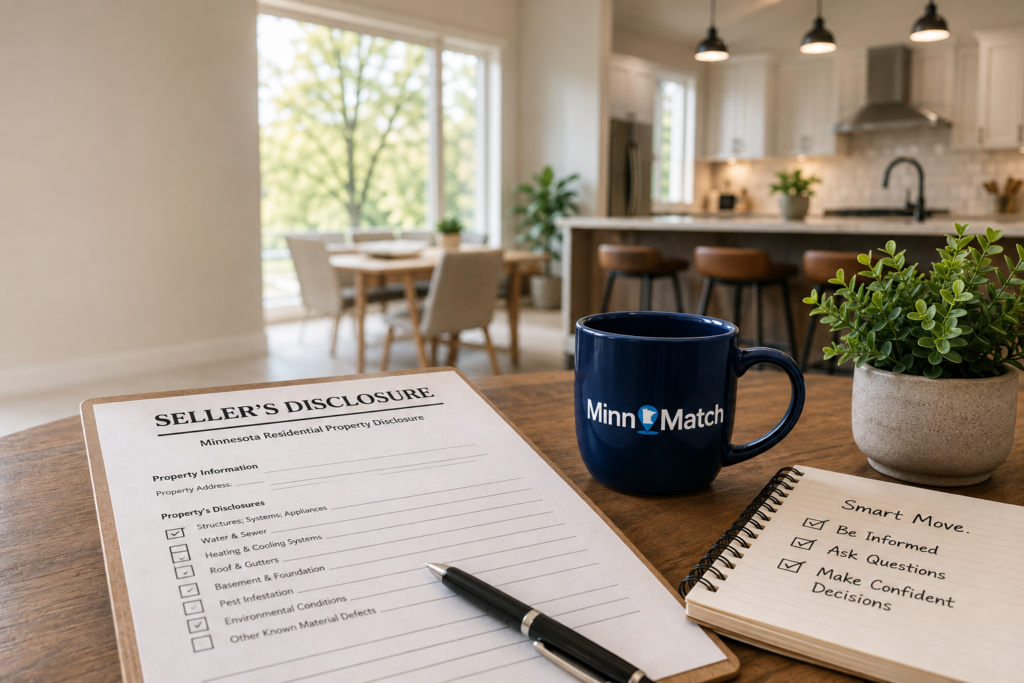
Seller's disclosure form on a kitchen table next to a MinnMatch mug and a notepad reading "Smart Move: Be Informed, Ask Questions, Make Confident Decisions"

If you’ve bought or sold a home in the Twin Cities, you’ve probably signed or reviewed a stack of paper without reading every line. But there’s one document you shouldn’t skim: the seller’s disclosure. In Minnesota, this form is more than a formality — it’s a legal obligation with real consequences if it’s done wrong. Whether you’re prepping to list your home or reviewing one before making an offer, here’s what a seller’s disclosure in Minnesota actually requires, what it covers, and what happens when something gets left out.

What Minnesota Law Actually Requires

Minnesota’s seller disclosure requirement comes from state statute, not just real estate custom. Before a purchase agreement is signed, the seller has to give the buyer a written disclosure covering material facts they’re aware of that could reasonably affect an ordinary buyer’s use and enjoyment of the property, or any specific intended use the seller knows the buyer has in mind. You can read the statute itself on the Minnesota Office of the Revisor’s website. The key word is “material” — the law isn’t asking sellers to list every scuff mark, but it is asking them to be upfront about anything that could change a buyer’s decision to purchase, or what they’d be willing to pay.

What Counts as a Material Fact

This is where most sellers get nervous, and honestly, it’s simpler than it feels. A material fact is something you actually know about — not something you’re guessing at or should have known. Common examples in Twin Cities homes include past water intrusion or basement leaks, foundation cracks, roof age and condition, known mold, failed mechanical systems, drainage issues, or problems with the septic or well system. If you’re not sure about something, Minnesota law allows you to mark it “unknown” rather than guess — as long as that’s the honest answer. What you can’t do is answer “no” to a question you know the real answer to. The standard is good faith, based on what you actually knew at the time you signed.

Special Disclosures Beyond the Standard Form

A handful of Minnesota-specific disclosures often get layered on top of the standard seller’s disclosure. If your home has a well — active or sealed — state law requires a separate Well Disclosure Certificate. Homes built before 1978 also trigger a federal lead-based paint disclosure, which is common in the older housing stock around Edina, Minnetonka, and many South Minneapolis neighborhoods. And if you’re selling in Minneapolis or St. Paul specifically, you’ll also run into a Truth-in-Housing inspection — a city-mandated, point-of-sale evaluation that’s separate from the state disclosure but covers similar ground. Radon is worth a mention too: Minnesota has some of the highest radon levels in the country, and while testing isn’t mandatory, any known results have to be disclosed.

When Sellers Are Exempt

Not every transaction requires this paperwork. The most common exemption is new construction that’s never been lived in — buyers of new builds are protected instead by Minnesota’s new home warranty laws. A few other narrow exemptions exist for certain transfers, like some foreclosures or transfers between family members. If you’re unsure whether your sale qualifies for an exemption, that’s a good question to bring to your agent or a real estate attorney before you assume you’re off the hook.

What Happens If Something Gets Missed

This is the part that should motivate careful disclosure more than any statute citation. If a seller knowingly leaves a material fact off the disclosure, a buyer has up to two years after closing to bring a claim — and they’ll need to show the seller actually knew about the issue. That can mean damages, legal fees, or in serious cases, the sale getting unwound entirely. It’s a big reason experienced Twin Cities agents push sellers to disclose early and thoroughly rather than hope a problem doesn’t come up. For buyers, it’s also a reminder to actually read the disclosure line by line — and to still get an independent inspection, since a disclosure only covers what the seller knows, not everything that could be wrong with the house.

Whether you’re getting ready to disclose or getting ready to read one, having an agent who knows how Twin Cities disclosure norms actually play out — not just what the form says — makes a real difference. If you’re not sure where to start, MinnMatch can connect you with a local agent who’s handled this exact paperwork dozens of times and can walk you through it before it becomes a problem instead of after.

Plymouth MN Back-to-School 2026: Why Families Keep Choosing This Suburb Year After Year

Family walking to school past the Welcome to Plymouth Minnesota sign

Every August, the same pattern plays out across the Twin Cities: moving trucks show up in Plymouth driveways just as school supply lists start circulating. It’s not a coincidence. Plymouth MN families have made this suburb one of the most requested destinations for buyers with kids, and the back-to-school season is when that demand is easiest to see. Between top-ranked schools, a deep bench of parks and community programming, and a housing stock built around family life, Plymouth keeps earning repeat consideration from parents who could choose almost anywhere in the western metro.

Why Plymouth MN Families Keep Choosing the Schools

Most of Plymouth is served by Wayzata Public Schools, and the district’s reputation is a big part of why so many parents start their search here. SchoolDigger ranks Wayzata High School among the top handful of high schools in Minnesota, and independent ranking sites consistently place it at or near the top statewide for academics and student outcomes. Niche.com rates the district’s overall performance highly as well, with strong marks across academics and student life. A smaller slice of Plymouth falls into the Robbinsdale district, so it’s worth confirming your specific address before you fall in love with a listing — school boundaries in Plymouth don’t always follow city lines.

For families weighing a move, the practical takeaway is this: strong schools support long-term home values, and they also shape day-to-day life for a family with kids — sports, activities, and the friend groups that form in elementary school and often stick around through graduation.

Parks and Programming Built Around Kids

Schools get families in the door, but it’s the everyday infrastructure that keeps them here. The Plymouth Community Center is the anchor — its K.U.B.E. Indoor Playground, sensory room, walking track, and year-round classes give parents a go-to option no matter the weather. Plymouth Creek Park adds nearly 100 acres of playgrounds, a skate park, a disc golf course, and one of the state’s first hard-surface pump tracks. Add in Medicine Lake for paddling and picnics, an active Hennepin County Library branch, and seasonal programming through Three Rivers Park District, and it’s easy to see why families with young kids describe Plymouth as a suburb built for their stage of life rather than retrofitted for it.

What Plymouth Homes Are Actually Selling For This Summer

Pricing in Plymouth varies quite a bit depending on the data source, the specific neighborhood, and home type, so it’s worth looking at a range rather than a single number. Redfin’s citywide figures put the recent median sale price around $505,000, up roughly 5% year over year, while other trackers show Plymouth medians landing anywhere from the high $400,000s to the mid-$600,000s depending on the month and the mix of homes that sold. Smaller submarkets like the Plymouth-Wayzata border area tend to run higher, often into the $600,000s, reflecting proximity to Wayzata schools and lake access.

The practical advice for a family shopping right now: don’t anchor on one headline number from a single site. Ask your agent to pull comps for the specific neighborhood and school boundary you’re targeting, since Plymouth’s price ranges shift block by block more than the citywide averages suggest.

Timing a Move Around the School Calendar

Late summer is a tricky window for Plymouth MN families trying to move before the first day of school. Inventory tends to thin out compared to spring, and homes zoned for the most in-demand elementary schools can move quickly when they do hit the market. If a hard start-of-school deadline matters to your family, it’s worth getting pre-approved and touring early, rather than waiting until August to start looking seriously. Families who move mid-year, after the school year has already started, generally find the transition easier if they prioritize proximity to their new school over shaving a few dollars off the sale price.

Finding the Right Neighborhood, Not Just the Right House

Plymouth is a big suburb, and “moving to Plymouth” can mean very different things depending on which elementary school boundary, which park system, and which commute pattern you land in. A house that looks perfect online might sit in a school boundary that doesn’t match what your family needs, or a 20-minute drive from the parks and activities you actually plan to use every week. This is where local knowledge matters more than a listing photo — and it’s exactly the kind of match a good local agent is built for.

If you’re weighing a move to Plymouth this back-to-school season, MinnMatch can match you with a local agent who actually knows which streets feed which schools, which parks your kids will use most, and which Plymouth neighborhoods fit your family’s budget and timeline. It’s a free, human conversation — not a listing feed — and it’s built for exactly this kind of decision.