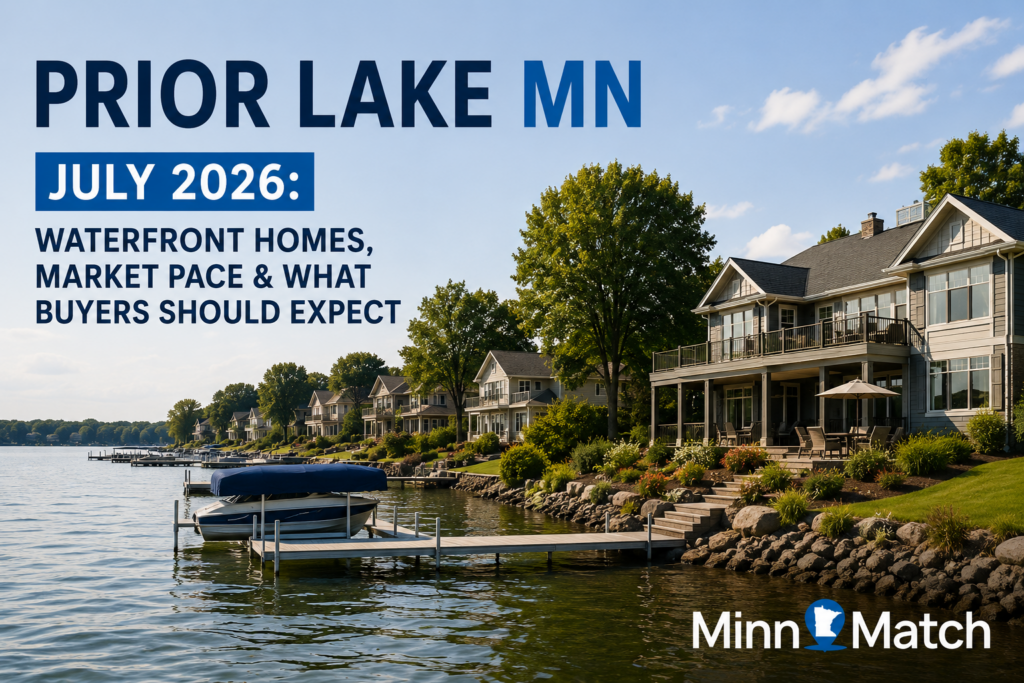
Prior Lake MN July 2026: Waterfront Homes, Market Pace & What Buyers Should Expect

Waterfront homes with private docks on Prior Lake, MN in July 2026

July in Prior Lake looks the way it always does at the height of lake season: boats parked at every third dock along Spring Lake and Upper Prior Lake, kids riding bikes down to the beach at Sand Point Beach Park, and a steady trickle of new listings hitting the market as sellers try to catch peak-summer buyer attention. But if you’ve been watching from the sidelines since spring, the Prior Lake MN summer market 2026 has shifted in a few ways worth knowing before you make an offer, especially if a lake lot is on your wish list. Here’s what’s actually happening with pace, pricing, and waterfront inventory this month, and what it means if you’re buying in Scott County right now.

The Prior Lake MN Summer Market 2026: How Fast Is It Moving?

The short answer: slower than it was in the spring, but still active. Homes in Prior Lake are currently averaging somewhere in the 60- to 90-day range on market, up noticeably from the 20-day pace you’ll see quoted for the core Twin Cities metro. That gap matters. Prior Lake has always sold on its own clock, partly because it draws a buyer who’s willing to wait for the right lot, the right view, or the right price rather than settling for the first available house. Inventory has also grown heading into summer, with active listings roughly doubling since early spring as more sellers list to catch the seasonal wave of lake-life shoppers. More homes on the market plus a slower pace usually adds up to one thing for buyers: a little more breathing room to negotiate than you’d have found in April or May.

Waterfront Homes: What’s Listed and What They’re Selling For

Waterfront is where Prior Lake earns its reputation, and July is when that inventory tends to look its best. Right now, active lakefront and lake-adjacent listings span a wide range: mid-range walkout homes on lake-access lots in the $600,000s, larger two-story properties directly on the water pushing toward $1 million, and a handful of estate-style parcels on acreage near Credit River well above that. That spread is normal for a lake market. A three-season porch, a swimmable shoreline versus a bog-heavy one, and dock access all move the number more than square footage alone. If you’re shopping waterfront specifically, expect list prices to hold firmer than the rest of the market, since sellers with genuine lake frontage know exactly how limited that inventory is, even when the broader Prior Lake market is giving buyers a bit more room.

Why Prices Are Cooling Compared to Earlier This Year

Median sold prices in Prior Lake have been easing off their spring peak, with recent monthly figures landing in the roughly $420,000 to $460,000 range depending on the mix of homes that closed. That’s a meaningful step down from the highs reported earlier in the year, and it’s paired with more homes selling below their original list price than we saw over the winter. None of this means Prior Lake is a soft market, homes are still closing close to asking on average, but it does mean sellers are pricing more realistically and buyers have slightly more leverage to negotiate on non-waterfront properties than they did a few months ago. For broader context on how this compares to the rest of the metro, Minneapolis Area Realtors’ market data shows the wider Twin Cities region holding steadier, which suggests Prior Lake’s shift is more local supply catching up to demand than a metro-wide slowdown.

What Buyers Should Expect This Summer

If you’re actively house hunting in Prior Lake this month, a few things are worth planning around. First, expect competition to stay concentrated on the best waterfront and lake-view lots, those still move quickly and sometimes with multiple offers, even while the broader market softens. Second, non-waterfront homes priced sensibly are a different story: with days on market stretching out and inventory up, you have more room to ask for closing cost help, request repairs, or simply take a weekend to think before writing an offer. Third, if financing is part of your plan, it’s worth checking current down payment assistance options through Minnesota Housing before you start touring, since program terms can shift year to year and it’s easier to know your numbers upfront than to scramble mid-negotiation. And if you’re weighing Prior Lake against nearby options, comparing current asking prices on Redfin’s Prior Lake listings alongside what’s happening in Eden Prairie or Lake Minnetonka communities can help you sanity-check whether Prior Lake’s pricing still fits your budget for the lake lifestyle you’re after.

The Bottom Line for This Summer

Prior Lake in July 2026 is a market with two speeds: waterfront lots that still move on their own urgency, and everything else that’s giving buyers a little more time and negotiating room than earlier this year. Reading that difference correctly, and knowing which category the home you’re looking at falls into, is exactly the kind of local read that makes or breaks an offer in a lake community like this one. That’s where having an agent who actually works this specific market pays off. Every agent in our Prior Lake network tracks these shifts street by street, not just citywide, so you’re not guessing whether a listing is priced to move or priced to test the market. If you’re ready to start touring, find your Prior Lake match today, or read more about how MinnMatch works to see how the process fits into your summer home search.
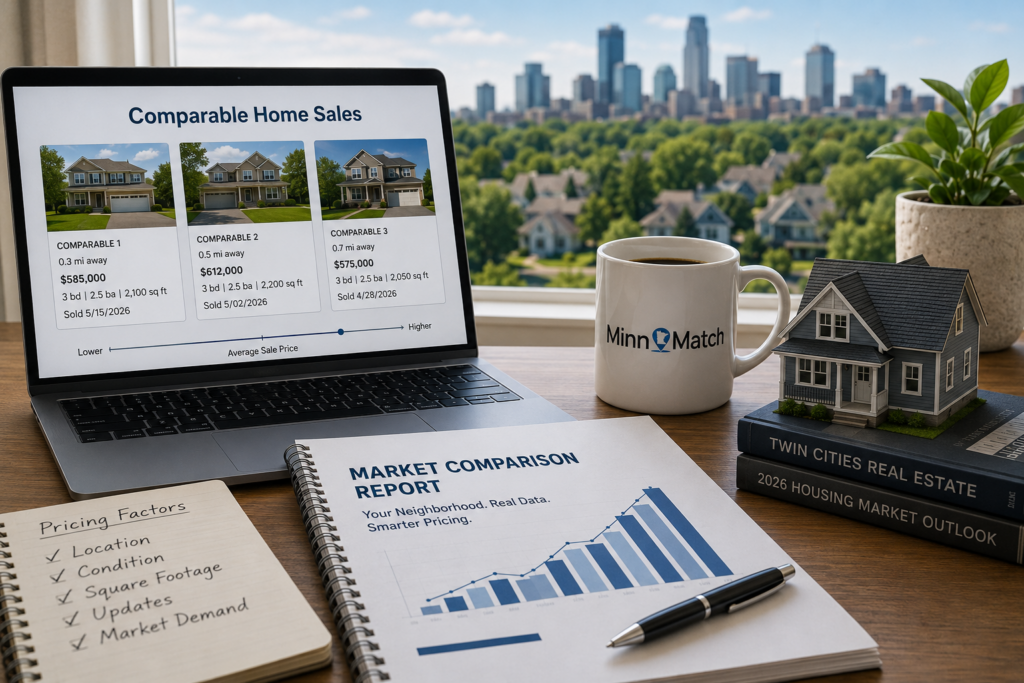

How to Price Your Twin Cities Home in 2026: What the Comps Actually Tell You

Laptop showing comparable home sales data next to a Twin Cities market comparison report and pricing checklist

If you’ve pulled up recent sales near your house and thought “okay, but what does this actually mean for MY price,” you’re asking the right question. Comps aren’t a magic number—they’re a starting point that still needs a trained eye to interpret. And in the Twin Cities right now, that eye matters more than usual. Inventory across Minnesota just hit a seven-year high, with metro listings up more than 5% from a year ago, while Minneapolis Area Realtors data shows homes are still moving in around six weeks and selling close to full asking price. That combination—more choices for buyers, but a market that still rewards accurate pricing—is exactly why so many Twin Cities sellers get this step wrong. Here’s how to price your Twin Cities home using the comps in front of you, not just the number a website spits out.

Why Raw Comps Rarely Match Your Home Exactly

A comp is only useful once you’ve adjusted it for what’s actually different. Two three-bedroom ramblers a block apart in Richfield can sell $40,000 apart because one has a finished basement and the other doesn’t, or one closed in April during peak buyer competition and the other closed in a slower month. When you price your Twin Cities home, the goal isn’t to average the comps—it’s to figure out which ones are honestly similar and which ones need adjusting up or down for square footage, lot size, garage stalls, updates, and condition.

A good local agent does this adjustment work as part of a full comparative market analysis, weighing not just sale price but days on market, concessions, and how many offers each comp actually received. That last part rarely shows up on a public listing site, but it changes everything about what a comp is really telling you.

What the Current Twin Cities Numbers Actually Say

As of the most recent Minnesota Realtors report, the Twin Cities metro median sale price sits around $410,000, up roughly 2% from last year, with homes averaging in the low-to-mid 40s for days on market and sellers typically receiving close to 99.6% of their final list price. That last figure is the one worth sitting with: it means well-priced homes are still selling close to ask, but the margin for error has narrowed compared to the tightest years of the pandemic-era market. Overprice a home today and it doesn’t just sit—it often ends up selling for less than if it had been priced accurately from day one, because buyers start to wonder what’s wrong with it after a few weeks of silence.

Inventory is also a bigger factor in your pricing than it was a year or two ago. With more listings for buyers to compare against, your home is competing directly with the comp down the street that’s still active—not just the ones that already closed. Redfin’s local market data shows homes across the metro still selling in around three weeks on average, but that pace varies a lot by suburb, price point, and condition, which is exactly why a one-size-fits-all number from an online estimator can miss so badly.

The Overpricing Trap Twin Cities Sellers Keep Falling Into

It’s tempting to price high and “see what happens”—especially if you’ve heard stories about bidding wars from a few years back. But in a market with rising inventory, that strategy usually backfires. The first two weeks after listing get the most buyer traffic and the most showings your home will ever see. Price too high during that window, and you burn through your best shot at multiple offers. By the time you drop the price, the buyers who were originally excited have often moved on to something else, and the new price can look like a red flag rather than a fresh opportunity.

This is especially true in suburbs like Eden Prairie, Minnetonka, and Plymouth, where buyers are actively cross-shopping similar homes across neighboring suburbs. If your price doesn’t line up with what the comps in those areas support, buyers will simply move to the next listing on their tour.

Adjusting for Your Home’s Real Condition

Comps also assume a level of updating and condition that your home may or may not match. An original 1998 kitchen isn’t the same as one updated in 2023, even if the square footage and bedroom count are identical. When you price your Twin Cities home, be honest about where it falls on that spectrum—not to talk yourself down, but to set a number buyers will actually believe once they walk through the door. A price that matches what buyers see in person tends to hold up through inspection and appraisal; a price that only makes sense from the street often doesn’t.

This is also where local financing conditions matter more than people expect. With the 30-year fixed mortgage rate hovering in the mid-6% range this summer according to Freddie Mac’s weekly survey, monthly payment sensitivity is real for a lot of Twin Cities buyers. A home priced even $10,000–$15,000 above what the comps support can push a buyer’s payment past their comfort zone entirely, shrinking your pool of interested offers before a single showing happens.

The Smartest Way to Price Your Twin Cities Home

Automated home value estimates are a fine starting point, but they’re pulling from public records and broad averages—they don’t know that your street floods a little in spring, that your neighbor’s finished basement isn’t permitted, or that a comp two doors down included a $15,000 seller credit that never showed up in the headline sale price. An agent who works your specific pocket of the Twin Cities day in and day out will catch those details, because they’re the ones who negotiated some of those deals themselves.

That’s really what it takes to price your Twin Cities home well: reading the comps the way someone who knows your neighborhood would, not the way a spreadsheet does. If you want a second opinion before you land on a listing price, MinnMatch can connect you with a local agent who knows your specific street, your specific suburb, and exactly how your comps stack up—free, with no obligation. It’s a quick way to find out whether the number you’re considering will actually hold up once real buyers start walking through the door.

The MinnMatch Process: How We Match Twin Cities Buyers and Sellers with the Right Agent

The MinnMatch process: a 5-step agent matching workflow shown on a laptop overlooking the Minneapolis skyline

If you’ve ever tried to find a real estate agent in the Twin Cities, you know the usual options: ask a friend for a name, scroll through online reviews that all sound the same, or pick whoever’s face is on the biggest bus bench ad. None of that tells you whether an agent actually understands your neighborhood, your price range, or what you’re trying to accomplish. That’s the gap the MinnMatch process was built to close. Instead of guessing, we sit down with you first, learn what you actually need, and hand-match you with a local agent who’s the right fit — at no cost to you. Here’s exactly how it works, from the first message to your first showing.

The MinnMatch Process: Built as a Matchmaker, Not a Directory

A lot of agent-finder sites are really just directories — you type in a zip code and get a list of names, sorted by whoever paid for placement. That’s not the MinnMatch process. We’re closer to a matchmaker than a search engine. A real person reviews what you tell us about your move, cross-references it against agents actively working in that specific pocket of the Twin Cities, and makes an introduction based on fit — not on who bought the most ad space. If you want the fuller story on how that differs from other ways people find agents, we’ve written about it in more depth on our how it works page.

Step 1: Tell Us What You’re Trying to Do

The MinnMatch process starts with a short form on our find an agent page — it takes a couple of minutes. We ask the basics: are you buying, selling, or both, what part of the Twin Cities you’re focused on (or leaving), your rough timeline, and anything specific that matters to you, like needing an agent who knows new construction, lake properties, or first-time buyer programs inside and out. There’s no pressure and no obligation attached to filling it out. Whether you’re a buyer planning a move to Eden Prairie or a seller listing a home in South Minneapolis, the goal of this step is simple: give us enough to work with so the match isn’t a shot in the dark.

Step 2: We Match You with a Handpicked Local Agent

This is the core of the MinnMatch process, and it’s where the human part really matters. Every agent in our network has already been through a screening process before they’re eligible for a match — we don’t dig into that criteria here, but you can read more about how vetting works on our site if you’re curious. Once your information comes in, we look for an agent whose track record lines up with your specific situation: someone who’s closed deals in Plymouth if that’s where you’re headed, or who regularly handles listings in the price range you’re working with. It’s a judgment call made by a person, not an algorithm sorting by zip code and calling it a day.

Step 3: We Introduce You — No Strings Attached

Local market data can shift block by block, and resources like Redfin are a useful way to sanity-check pricing trends in a specific neighborhood before you even talk to an agent — but the agent match itself is where the real value of the MinnMatch process shows up. Once we’ve found a fit, we make the introduction directly, usually by email or phone, so you and the agent can connect quickly. From there, it’s your call. If the agent feels like the right partner for your buying or selling journey, you move forward together. If for any reason it’s not a fit, you tell us and we’ll find you someone else — there’s no cost to you either way, and no obligation to keep working with an agent who isn’t clicking. That’s a meaningfully different experience than getting a referral from a friend, where backing out can feel awkward. For an apples-to-apples look at how MinnMatch stacks up against other ways people search, our site has a comparison worth checking out.

Step 4: Your Agent Takes It from There

After the match, your agent handles the parts you’d expect — pricing conversations, showings, offers, negotiations, and paperwork through closing. According to the Minneapolis Area Realtors, buyer and seller agents in this market typically guide clients through everything from initial search or listing prep to the final signature, and that’s exactly the relationship the MinnMatch process is designed to set up — just with a stronger starting fit than a cold search would give you. If financing questions come up along the way, resources through the Minnesota Housing Finance Agency can also be a helpful reference point for first-time buyers working through down payment assistance options.

Whether you’re just starting to think about a move or you’re ready to list this week, the MinnMatch process starts with one simple step: telling us what you need. Find your agent match today, completely free, and let us make the introduction — no directories, no guesswork, just the right Twin Cities agent for your situation.

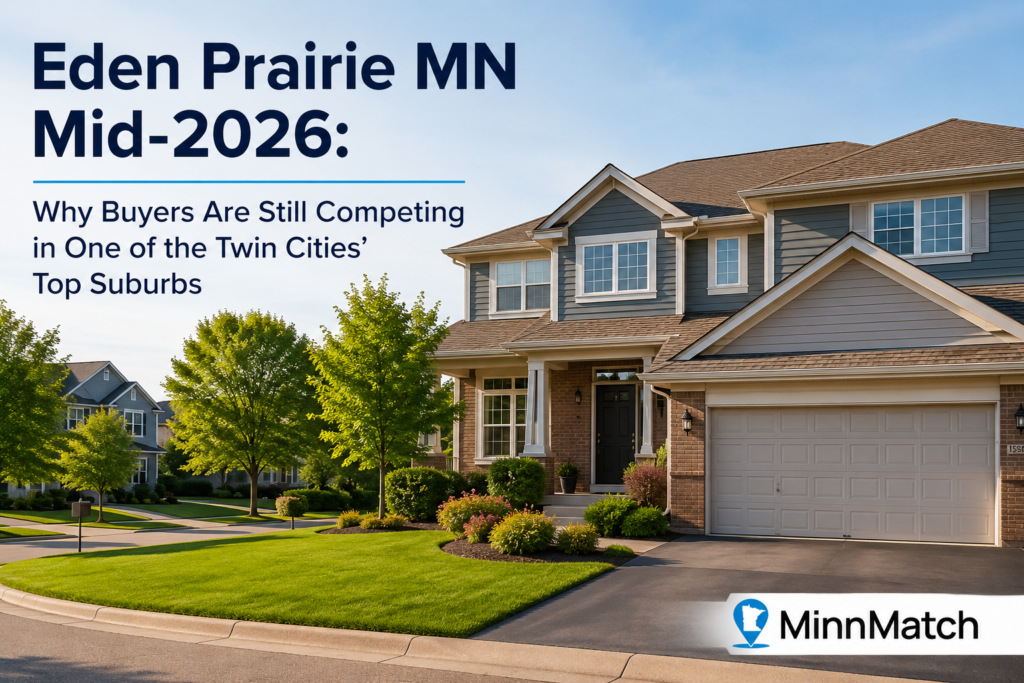
Why Buyers Are Still Competing in One of the Twin Cities’ Top Suburbs

Two-story blue and brick home with manicured lawn in Eden Prairie, MN — mid-2026 housing market update from MinnMatch

Halfway through 2026, the Eden Prairie market is proving it hasn’t lost a step. While some Twin Cities suburbs have cooled off a bit as summer rolls on, Eden Prairie buyers are still writing competitive offers, still facing multiple bids on well-priced homes, and still closing fast when they find the right fit. If you’re house hunting here this summer, it helps to understand exactly why the pace hasn’t slowed — and how to position yourself to win when it counts.

Where the Eden Prairie Market Actually Stands Right Now

Pricing data varies a bit depending on the source and the exact window measured, which is normal for a market this active. Minneapolis Area Realtors® reported a rolling 12-month median sales price in Eden Prairie in the high $470,000s as of early spring, up modestly year over year, with days on market ticking up slightly compared to the ultra-tight conditions of a year ago. Meanwhile, Redfin’s more recent three-month snapshot puts the median sale price closer to $530,000, with homes fielding roughly six offers on average and going under contract in about three and a half weeks. Taken together, the honest picture is a market somewhere in the high-$400,000s to low-$500,000s depending on home type and neighborhood, but with one consistent thread: well-priced, move-in-ready homes are still drawing real competition.

That multiple-offer environment is the headline for mid-2026 buyers. Even as mortgage rates have kept some shoppers on the sidelines nationally, Eden Prairie’s mix of top-rated schools, employment access, and established neighborhoods keeps demand steady enough that inventory rarely sits long.

Why Eden Prairie Keeps Drawing Competition Mid-Summer

A few things set Eden Prairie apart from suburbs that see more seasonal drop-off after the spring rush. It’s home to major employers along the I-494/Highway 212 corridor, which keeps a steady stream of relocation and job-change buyers in the mix all year. Eden Prairie Schools also continues to be a draw for families trying to get settled before the new school year, which adds urgency to the July and August buying window specifically. And unlike some outer suburbs, Eden Prairie’s inventory skews toward well-maintained homes in established neighborhoods — the kind that don’t need much convincing to generate multiple showings in the first weekend.

The result: buyers who assume mid-year means less competition are often surprised when a well-priced listing near Round Lake or the Purgatory Creek area draws several offers within days.

What Buying Eden Prairie This Summer Actually Looks Like

If you’re buying Eden Prairie property this summer, expect a faster pace than a typical fall or winter search. That means having financing fully lined up before you tour — not just a pre-qualification letter, but a firm pre-approval from a lender who can move quickly. It means being ready to see new listings within a day or two of them hitting the market, since homes that check the boxes on schools, updates, and lot size tend not to linger. And it means having a clear sense of your ceiling going in, because the homes generating multiple offers are often the ones that end up selling above list.

None of this means overpaying blindly. It means being prepared enough that when the right home does come along, you’re not scrambling to catch up while someone else’s offer lands first.

How Local Buyers Are Staying Competitive

The buyers having the most success in Eden Prairie’s mid-2026 market tend to have three things in common: an agent who already knows the neighborhoods well enough to spot a good listing before it’s saturated with showings, financing that’s genuinely ready to go, and realistic expectations about what a competitive offer looks like in this price range. A generic, one-size-fits-all approach doesn’t work as well here as it might in a slower market — the difference between winning and losing a home often comes down to local knowledge and speed.

This is exactly where having the right agent matters most. An agent who specializes in the Eden Prairie market will already understand which neighborhoods tend to move fastest, what a fair-but-competitive offer looks like for a given street or school boundary, and how to help you write terms that stand out without stretching you past your comfort zone.

Ready to Compete for Your Eden Prairie Home?

Buying in a competitive market like Eden Prairie’s is a lot easier with a local expert in your corner. MinnMatch connects you with a handpicked, vetted agent who knows the Eden Prairie market inside and out — free of charge, with no algorithm guessing at what you need. Find your Eden Prairie agent match today, or learn more about how MinnMatch works before your next showing.

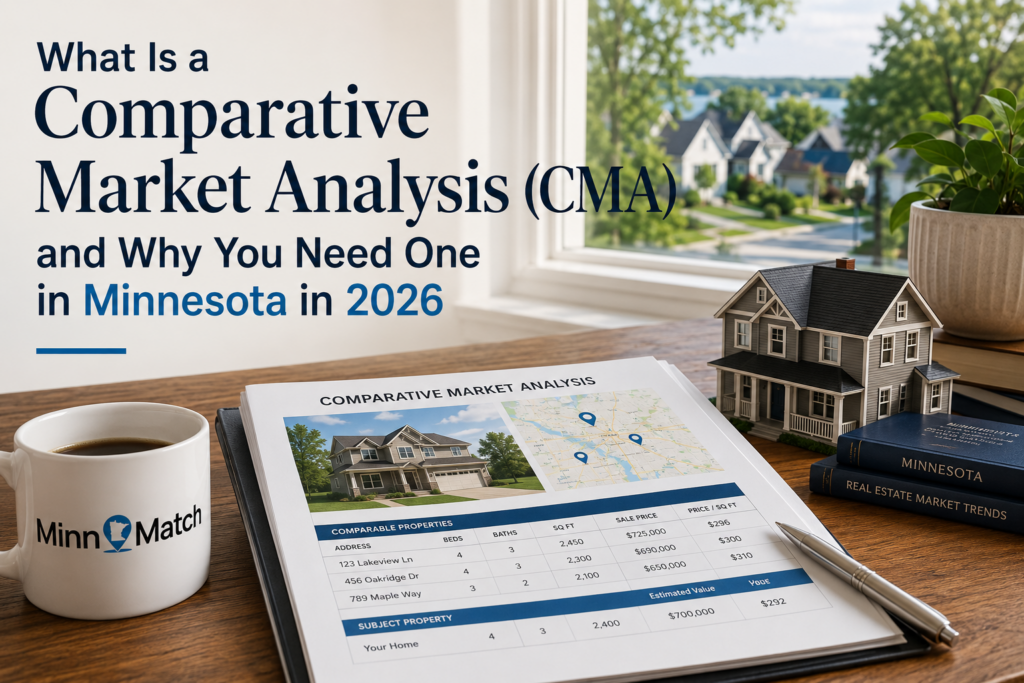
What Is a Comparative Market Analysis (CMA) and Why You Need One in Minnesota in 2026

Comparative market analysis report on a desk with a Minnesota home, neighborhood map, and MinnMatch coffee mug

If you’ve spent any time talking to a Twin Cities real estate agent, you’ve probably heard the term “CMA” thrown around. It sounds technical, but it’s really one of the most useful documents you’ll encounter as a buyer or seller in Minnesota’s 2026 market. A comparative market analysis takes the guesswork out of pricing by showing you, in black and white, what similar homes in your area have actually sold for. Whether you’re getting ready to list a home in Edina or you’re trying to figure out if a listing in Plymouth is priced fairly, understanding what a CMA is — and how to read one — puts you in a much stronger position.

What Exactly Is a Comparative Market Analysis?

A comparative market analysis is a report, usually prepared by a licensed real estate agent, that estimates a home’s current market value by comparing it to similar properties — often called “comps” — that have recently sold, are currently listed, or went under contract in the same area. A good CMA looks at square footage, lot size, bedroom and bathroom count, age, condition, and location, then adjusts for differences between the subject property and each comp.

In a market like the Twin Cities, where prices can shift block by block — a rambler in South Minneapolis can behave very differently than one in Prior Lake — a comparative market analysis grounds your expectations in local data instead of national headlines or a Zillow estimate. According to Minneapolis Area Realtors, local market conditions vary significantly by neighborhood and price tier, which is exactly why a CMA needs to be built from nearby, recent, and truly comparable sales rather than a citywide average.

CMA vs. Appraisal: They’re Not the Same Thing

It’s easy to confuse a comparative market analysis with a home appraisal, but they serve different purposes and come from different people. A CMA is typically prepared by your real estate agent, is free, and is meant to help set a listing price or shape an offer. An appraisal is completed by a state-licensed, independent appraiser, usually costs a few hundred dollars, and is required by your lender before closing to confirm the home is worth what you’re paying for it.

Think of it this way: a CMA is a strategic estimate built for decision-making before you list or offer, while an appraisal is a formal, regulated valuation used to protect the lender’s investment. The two often land in a similar range, but they’re not interchangeable, and a CMA is never a substitute for the appraisal your mortgage will require.

Why Sellers Should Start Here, Not With a Number They Have in Mind

Plenty of Twin Cities sellers walk into the process with a price already in their head, often based on what a neighbor’s house sold for years ago or what a home improvement show made pricing look like. A comparative market analysis replaces that gut feeling with current, local evidence. It’s the starting point for a listing strategy — before staging decisions, before marketing photos, before the “For Sale” sign goes in the yard.

We’ll go deep on pricing strategy and how to interpret specific comps in an upcoming article, but the short version is this: a CMA is the foundation everything else gets built on. If you’re weighing whether to list this year, our seller resources page is a good next stop, and connecting with a local agent through MinnMatch’s free agent-matching service is the easiest way to get a CMA built specifically for your address, not a generic estimate.

Buyers Need a CMA Too — Here’s Why

A comparative market analysis isn’t just a seller’s tool. Before you write an offer on a home in Minnetonka or Eden Prairie, a buyer’s agent can run a CMA to tell you whether the asking price actually lines up with what similar homes have sold for recently. That’s especially valuable in a market where a well-staged listing photo or an eager seller’s price can make a home look like a deal — or a stretch — when the comps tell a different story.

A buyer-side CMA also gives you real leverage in negotiations. Instead of an offer based on a feeling, you can point to actual recent sales nearby. If you’re just starting to look, our buyer resources page walks through what else to expect, and Redfin can be a helpful place to sanity-check recent sale prices in a neighborhood you’re considering, alongside the more detailed comps your agent pulls.

Getting an Accurate CMA in the Twin Cities Market

The accuracy of a comparative market analysis depends entirely on the person building it. An agent who knows a specific pocket of the Twin Cities — the difference between a Wayzata lake lot and one a few blocks off the water, or why one South Minneapolis block sells faster than the one next to it — will build a far more useful CMA than an automated online estimate ever could. Housing conditions can also shift with financing programs and affordability trends; resources like the Minnesota Housing Finance Agency track statewide affordability data that can add helpful context to a hyper-local CMA.

This is really where local expertise makes or breaks the number. An out-of-area agent, or a generic online tool, simply won’t know the nuances that move value street by street across the metro.

Get a CMA From an Agent Who Knows Your Neighborhood

Whether you’re preparing to sell or trying to make sense of a listing price, a comparative market analysis is only as good as the agent behind it. MinnMatch connects Twin Cities buyers and sellers with handpicked local agents — for free — so you get a CMA built on real neighborhood knowledge, not guesswork. Find your agent match today and get a clear, accurate picture of what your home — or your next one — is really worth.

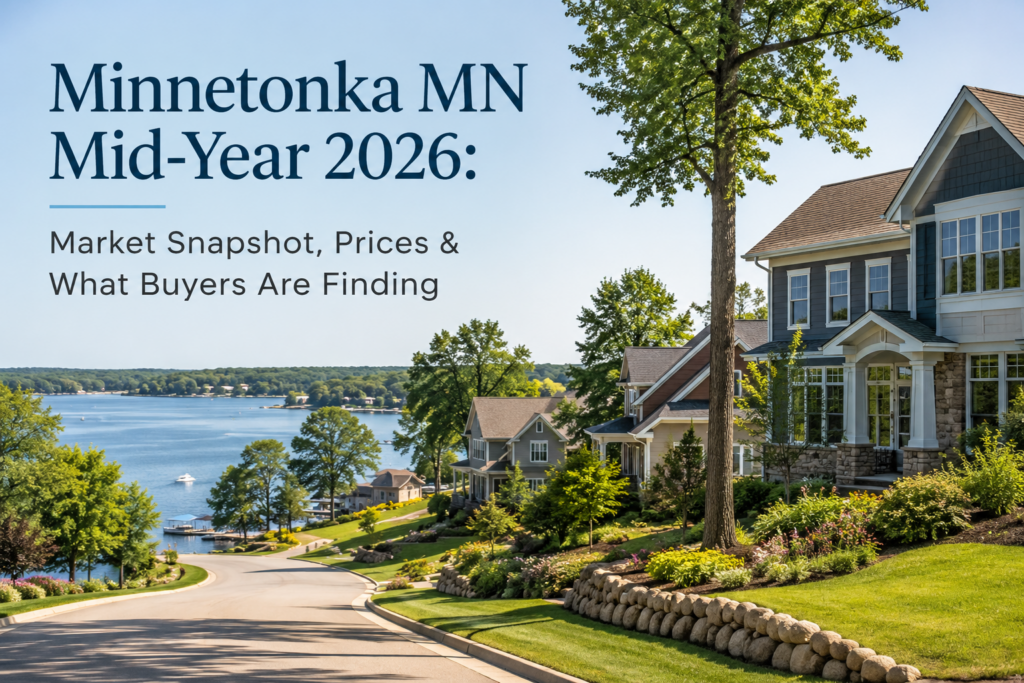
Minnetonka MN Mid-Year 2026: Market Snapshot, Prices & What Buyers Are Finding

Minnetonka MN mid-year 2026 market snapshot with lakefront homes and Lake Minnetonka shoreline in the background

We’re at the halfway point of 2026, and if you’ve been watching Minnetonka listings come and go, you’ve probably noticed something: the Minnetonka housing market isn’t behaving quite like it did in the spring, and it’s not behaving quite like the rest of the Twin Cities either. Prices are still holding up well, but the pace has shifted, and the experience buyers are having on the ground — especially in the most sought-after pockets near the lake and top-rated schools — looks different depending on price point and neighborhood. Here’s an honest look at where things stand at mid-year, straight from the numbers.

The Minnetonka Housing Market at the Midpoint of 2026

Depending on which source you check, Minnetonka’s median sale price this summer lands somewhere between roughly $500,000 and $550,000. Minneapolis Area Realtors puts the rolling median around $500,000–$507,500 depending on the month, while other trackers that look at a narrower, more recent window have reported medians closer to $515,000–$550,000. That spread isn’t a red flag — it’s mostly a reflection of small monthly sample sizes and different measurement windows, which is common in a mid-size suburb like Minnetonka where a handful of high-end lake-adjacent sales can swing a monthly median noticeably.

What’s more consistent across sources: homes are still selling close to full asking price, generally in the high-90s percent of list price. That’s a strong signal that Minnetonka hasn’t slipped into a buyer’s market — sellers with a well-priced, well-presented home are still doing well here in 2026.

Why the Days-on-Market Numbers Don’t All Agree

If you’ve searched around, you may have seen wildly different numbers for how fast Minnetonka homes are selling — everything from under three weeks to closer to seven or eight. Both can be true at once. Rolling 12-month averages (which smooth out seasonal swings and slower winter listings) tend to land in the 45–50 day range, while shorter, recent snapshots taken during the busy summer buying season often show homes moving in 2–3 weeks. The practical takeaway for anyone house hunting in Minnetonka right now: well-priced homes in popular neighborhoods are moving fast, but the annual average includes plenty of slower winter listings that pull the number up.

Inventory is also tight by historical standards — most measures put Minnetonka at somewhere around 2 to 2.6 months of supply. Anything under about 4–5 months is generally considered favorable to sellers, so buyers should expect some competition, particularly on move-in-ready homes under $600,000.

What Buyers Are Actually Finding Right Now

Talk to buyers who’ve been actively looking in Minnetonka this summer and a pattern emerges. Homes that are updated, correctly priced, and in walkable, established neighborhoods are drawing multiple showings in the first weekend and sometimes multiple offers. Roughly a third of Minnetonka sales are still closing above the original list price — down somewhat from a year ago, which suggests bidding wars are less frantic than they were, but still very much a factor buyers need to plan for.

On the flip side, homes that need work, are overpriced for their condition, or sit on busier roads are seeing more price reductions than they did last summer, and buyers who are patient and pre-approved have more room to negotiate on those listings than they would have two or three years ago. It’s a market that rewards buyers who’ve done their homework and can move quickly when the right house does come along — which is exactly the kind of situation where having an agent who knows Minnetonka block by block makes a real difference. That’s the kind of local matching MinnMatch was built around — you can see how the matching process works if you’re getting ready to start touring.

What Sellers Should Take Away From the Mid-Year Numbers

If you’re weighing whether to list in Minnetonka this summer, the Minnetonka housing market’s mid-year data is largely encouraging. Sale-to-list ratios near 99% mean sellers aren’t leaving much on the table, and homes in good condition are still selling briskly. The caveat is pricing discipline — with inventory up modestly compared to a year ago, homes that come out of the gate overpriced are sitting longer and eventually taking a reduction, while accurately priced listings are still seeing strong early interest. A local agent who’s tracking recent closed sales in your specific neighborhood, not just citywide averages, is worth the conversation before you set a list price.

The Second Half of 2026: What to Watch

Broader Minnesota housing market forecasts point to gradual stabilization through the rest of 2026 — modest price growth, slowly easing mortgage rates, and improving inventory. The Minnetonka housing market, as one of the metro’s stronger inner-ring suburbs, tends to hold up better than the regional average in any environment, thanks to its schools, lake access, and steady demand. Expect the second half of the year to look a lot like the first: a market that favors sellers overall, but one where buyers who are organized, flexible, and working with the right local agent can still find good opportunities.

Buying or Selling in Minnetonka This Summer?

Numbers only tell part of the story — the rest comes from knowing which streets are drawing multiple offers and which listings have room to negotiate. Find a Minnetonka-area agent through MinnMatch and get matched, free, with someone who actually knows this market right now. You can also browse more Minnetonka community resources or check our latest Twin Cities market insights before you dive in.

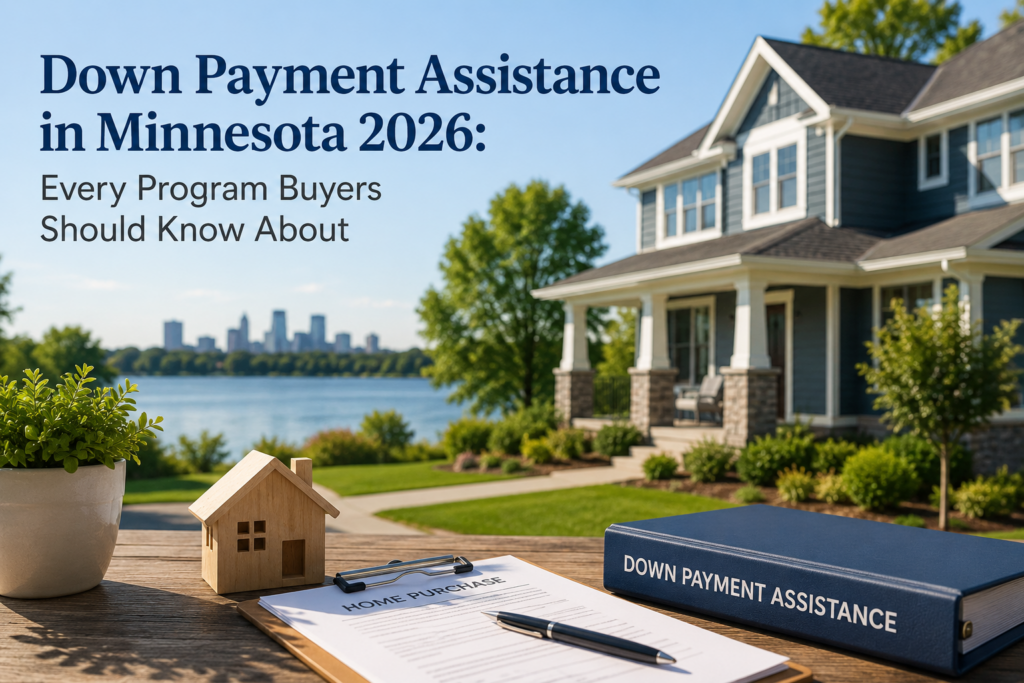
Down Payment Assistance in Minnesota 2026: Every Program Buyers Should Know About

Down Payment Assistance in Minnesota 2026 — home purchase clipboard, house model, and binder with Twin Cities lake and skyline in background

If saving for a down payment feels like the biggest hurdle between you and a Twin Cities home, you’re not alone — and the good news is that Minnesota down payment assistance is more available than most buyers realize. Between state programs, city-specific loans in Minneapolis and Saint Paul, and nonprofit options layered on top, many first-time buyers end up putting far less down than the traditional 20% myth suggests. The tricky part isn’t whether help exists — it’s figuring out which programs you actually qualify for and how they stack together. Here’s a clear, no-jargon walkthrough of the major programs on the table in 2026.

Minnesota Down Payment Assistance Through Start Up and Step Up

The most widely used source of Minnesota down payment assistance comes from Minnesota Housing (MHFA), the state’s housing finance agency. Its Start Up program is built for first-time buyers — meaning you haven’t owned a home in the last three years — and currently pairs a fixed-rate first mortgage with a downpayment and closing cost loan of up to $18,000. If you’ve owned before, or your income exceeds Start Up’s limits, the Step Up program offers similar downpayment assistance up to $14,000 and is open to repeat buyers as well. Both require completing an approved homebuyer education course and working with a Minnesota Housing–approved lender, since the agency itself doesn’t originate loans directly.

One detail buyers often miss: the downpayment loan amount and structure (deferred vs. monthly payment) can shift as the agency updates its offerings, so it’s worth confirming current figures directly with Minnesota Housing or your lender before you budget around a specific number.

The First-Generation Homebuyer Loan

One of the more meaningful additions to Minnesota’s down payment assistance lineup is the First-Generation Homebuyer Loan, aimed at buyers whose parents or legal guardians never owned a home (or lost one to foreclosure). It’s a 20-year deferred, interest-free loan of up to $35,000 for down payment and closing costs, and it’s forgivable — half the balance is forgiven after 10 years, with the rest forgiven at year 20, as long as you stay in the home. It has to be paired with a Start Up first mortgage, and it can’t be combined with a similar program run separately by the Midwest Minnesota Community Development Corporation, so a homeownership advisor can help you sort out which route fits your situation.

City-Specific Help in Minneapolis and Saint Paul

Buyers purchasing inside city limits often have an extra layer of Minnesota down payment assistance to draw on. Minneapolis runs its own program, Homeownership Opportunity Minneapolis (HOM), through the city’s Community Planning & Economic Development department. It’s a zero-interest, no-monthly-payment loan that doesn’t come due until you sell, refinance, or move, with the assistance amount tied to your income relative to the area median. Saint Paul offers a comparable interest-free, deferred down payment loan through its own housing program, with the assistance amount varying by household need. Both cities require homebuyer education or financial wellness counseling completed before you sign a purchase agreement, so it’s worth starting that step early if you’re house-hunting in either city.

Because exact loan amounts and income tiers for these city programs are updated periodically, treat any specific dollar figure you see online as a starting point rather than a guarantee — your lender or the city’s housing office can confirm what’s currently funded and what you’d qualify for.

County and Nonprofit Options Worth Knowing About

Beyond the state and the two biggest cities, several Twin Cities counties and nonprofits administer their own down payment assistance, often layered on top of a Minnesota Housing loan rather than replacing it. Dakota, Anoka, and other metro counties have offered downpayment and closing cost loans through their Community Development Agencies, and organizations like NeighborWorks Home Partners and Twin Cities Habitat for Humanity provide additional assistance and homeownership counseling, particularly for buyers who don’t quite fit the standard first-time buyer mold. Programs like these tend to have limited annual funding, so timing your application — and getting pre-approved with a participating lender — matters as much as meeting the eligibility criteria.

Figuring Out What You Actually Qualify For

With this many overlapping programs, the honest answer to “how much down payment assistance can I get in Minnesota?” is: it depends on your income relative to the area median income for your county, your target city, whether you’re a first-time or first-generation buyer, and which lender you work with. Some of these programs can be stacked; others explicitly can’t be combined. The most efficient path is usually to complete a homebuyer education course early, talk with a participating lender about which state and local programs apply to your situation, and loop in a local real estate agent who already knows which programs tend to move quickly at your target price point — especially in a market where listing prices vary widely by neighborhood.

Down payment assistance can make homeownership possible years sooner than you might expect, but sorting out eligibility across state, city, and nonprofit programs isn’t something to guess your way through. A local agent who works with these programs regularly can point you toward lenders who are approved for the specific assistance you need, and help you understand how a program’s repayment terms affect your long-term plans. If you’re ready to start that conversation, MinnMatch can match you with a local agent who knows the Twin Cities down payment landscape inside and out — or visit our how it works page to see how the matching process gets you there.

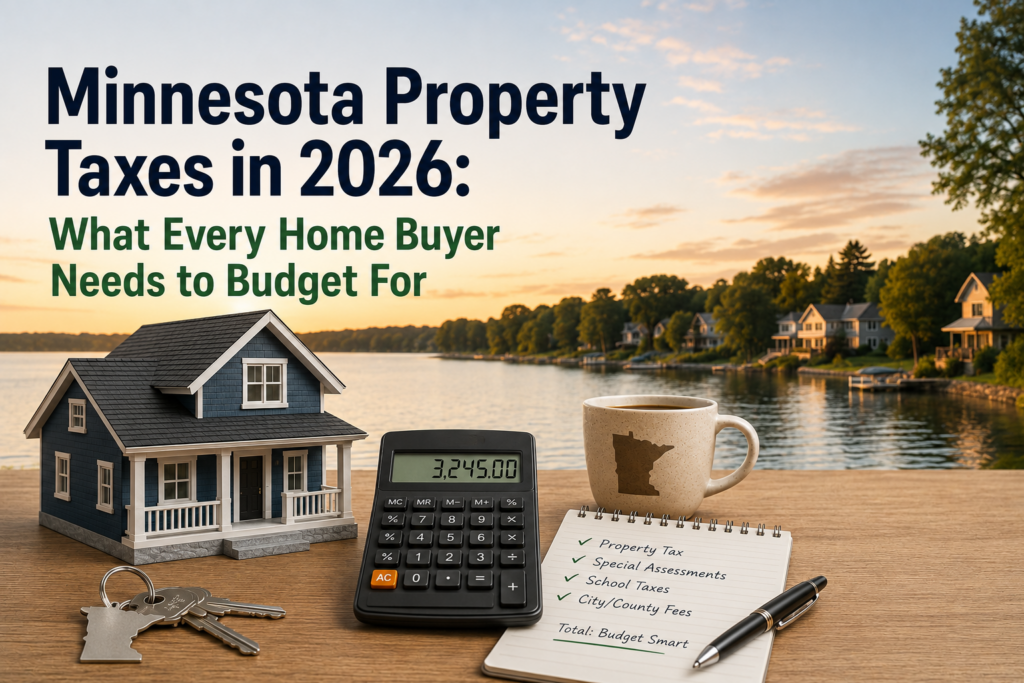
Minnesota Property Taxes in 2026: What Every Home Buyer Needs to Budget For

Minnesota property taxes 2026 header graphic with model home, calculator showing $3,245, and budgeting checklist by a Twin Cities lake

If you’re house hunting anywhere in the Twin Cities this year, there’s a number on every listing you’re probably skimming past: the estimated property tax. It’s easy to focus on the sticker price of a home and treat taxes as an afterthought, but in Minnesota, property taxes can add hundreds of dollars to your monthly payment — and the amount varies a lot more by city and county than most buyers expect. Understanding Minnesota property taxes in 2026 before you make an offer can save you from an unpleasant surprise on your first escrow statement.

How Minnesota Actually Calculates Your Property Tax Bill

Minnesota’s property tax system isn’t a simple flat percentage — it’s a multi-step formula, and knowing the steps helps explain why two similarly priced homes a few miles apart can have very different tax bills. Here’s the short version:

  1. Assessed (taxable market) value: Your county assessor determines this based on comparable sales and property characteristics. Taxes payable in 2026 are based on 2025 assessed values.
  2. Class rate: Minnesota applies different rates depending on how a property is used. A primary residence with homestead classification is taxed at 1% on the first $500,000 of value and 1.25% on anything above that.
  3. Tax capacity: Your taxable value multiplied by the class rate gives you your property’s “tax capacity” — the base number local governments actually tax.
  4. Local levy: Your county, city, school district, and any special taxing districts each set their own levies, which combine into your total tax rate for that specific location.

That last step is why location matters so much. Two homes with identical values — one in Edina and one in Prior Lake — can land in very different school districts and city levy structures, which changes the final bill even though the state-level formula is the same. You can dig into your own numbers using the Minnesota Department of Revenue’s property tax data.

What Twin Cities Buyers Can Expect to Pay

Statewide, effective property tax rates in Minnesota generally land somewhere around 1% of a home’s market value, though the exact figure shifts from year to year and source to source depending on methodology. What’s more useful for Twin Cities buyers is the pattern: core metro counties like Hennepin and Ramsey tend to run above that statewide average — often somewhere in the 1.1% to 1.3% range — while many outer-ring and exurban counties come in lower. Suburban counties like Dakota, Anoka, Carver, and Washington typically fall somewhere in between, with plenty of variation between individual cities and school districts within each county.

It’s also worth knowing that levies have been trending upward across much of the metro heading into 2026, driven by city, county, and school district budget increases rather than any single statewide change. If you’re comparing two neighborhoods, don’t just compare list prices — ask your agent to pull the actual estimated taxes payable for each specific address, since even the county-level averages can undersell (or oversell) what a particular property will cost. You can also cross-reference neighborhood-level trends using Redfin’s local market data alongside your county assessor’s numbers.

Budgeting Property Taxes Into Your Monthly Payment

Most Twin Cities buyers with a mortgage don’t pay property taxes as one lump annual bill — they pay them monthly through an escrow account, bundled into their regular mortgage payment alongside principal, interest, and homeowners insurance (often shorthanded as PITI). Here’s what that means practically when you’re budgeting:

  • Your lender estimates the annual property tax bill, divides it by 12, and adds that amount to your monthly payment.
  • Because Minnesota counties typically bill property taxes twice a year (spring and fall installments), your escrow account is building up a cushion between those due dates.
  • If your assessed value or local levy rises after your first year, expect your monthly escrow payment to adjust — sometimes by a noticeable amount — even if your interest rate never changes.

A good rule of thumb when comparing homes: don’t just look at the mortgage principal and interest estimate a listing shows you. Ask for the full estimated monthly payment including taxes and insurance, especially in cities with higher-than-average levies. It’s a conversation worth having with your lender and your agent before you get attached to a specific home.

Homestead Classification: A Quick Word for New Owners

One detail that trips up first-time Minnesota buyers: the lower 1% class rate mentioned above only applies once your new home is classified as a homestead — meaning it’s your primary residence, not a rental or second home. You’ll need to apply for homestead classification with your county assessor after closing, and missing the deadline can mean paying a non-homestead rate for a full extra year. Requirements and deadlines vary slightly by county, so this is one of those details worth confirming directly with your assessor’s office or your real estate agent as soon as you close. We’ll be covering homestead classification and exemptions in more depth in an upcoming article — for now, just make a note to file promptly.

Don’t Let Taxes Be an Afterthought

Property taxes aren’t the most exciting part of buying a home, but they’re one of the most predictable ongoing costs you’ll take on as a homeowner — and unlike your interest rate, they can shift year to year based on decisions made by your city council, county board, and school district. Twin Cities buyers who factor taxes into their budget from the start avoid the sting of a bigger-than-expected escrow adjustment down the road.

This is exactly the kind of hyper-local detail a good agent should be walking you through before you write an offer — not after. If you want a Twin Cities agent who’ll pull the real tax numbers for the specific neighborhoods you’re considering, find your match with MinnMatch and get connected with someone who knows these details block by block.

Prior Lake vs. Eden Prairie: Which Growing Suburb Is the Better Buy in 2026?

Prior Lake vs. Eden Prairie neighborhoods in Minnesota comparing homes, parks, and lakeside living in 2026

If you’re cross-shopping Prior Lake vs. Eden Prairie for your next move, you’re comparing two of the Twin Cities’ most in-demand growing suburbs — but they get there in very different ways. One is a lake-anchored Scott County community that’s grown fast over the past two decades. The other is an established, amenity-rich Hennepin County suburb with a national reputation for livability. Both show up on “best places to live” lists. Both have real estate markets that have stayed competitive through 2026. So which one is the better buy? Let’s break down what the numbers, the geography, and the day-to-day experience actually look like in each.

Prior Lake vs. Eden Prairie: How Home Prices Compare in 2026

Price is usually the first question in any Prior Lake vs. Eden Prairie comparison, and the honest answer is: it’s closer than most buyers expect. Recent Redfin data for Eden Prairie has shown median sale prices moving in roughly the $460,000–$530,000 range depending on the month and home mix, with homes typically selling in three to four weeks and often drawing multiple offers. Prior Lake’s market has landed in a similar band, generally $480,000–$540,000, with a slightly longer average time on market — often closer to five weeks.

The takeaway: neither suburb is the clear budget option. Both sit above the broader Twin Cities metro median, and both have seen year-over-year price growth in 2026. If your search is purely price-driven, the Prior Lake vs. Eden Prairie decision probably won’t be settled on the listing price alone — it’ll come down to what each dollar buys you in terms of lot size, home age, and lake or golf course proximity, which varies more within each city than between them.

Scott County vs. Hennepin County: What the Location Actually Means

Here’s where Prior Lake and Eden Prairie really diverge. Eden Prairie sits in Hennepin County, tucked along the Highway 212/169 corridor about 15–20 minutes from downtown Minneapolis in normal traffic. It’s part of the inner ring of established, built-out suburbs, which means infrastructure, retail, and job centers (including a substantial local employer base) are already mature.

Prior Lake is in Scott County, roughly 30–35 minutes south of downtown Minneapolis via Highway 13 or County Road 42. It’s grown quickly as a lake-lifestyle destination, and while it doesn’t have Eden Prairie’s density of corporate campuses, it offers noticeably more new construction and larger lots for buyers who want space. If your commute runs south or southwest of the metro, or you work remotely and commute distance matters less, Prior Lake narrows that gap considerably. If your job anchors you closer to Minneapolis, St. Louis Park, or the 494 corridor, Eden Prairie’s shorter commute is a real, daily advantage.

Schools, Lakes, and Everyday Lifestyle

Both suburbs are known for strong schools, but they serve families a little differently. Eden Prairie Schools is a large, well-established district with a wide range of programming and decades of enrollment history, which appeals to families who want a known quantity. Prior Lake-Savage Area Schools has built a strong reputation of its own, including its E-STEM programming, and tends to attract families drawn to newer buildings and a still-growing district.

Lifestyle is really the deciding factor for a lot of buyers. Prior Lake is built around its namesake lake — think boating, fishing, a year-round farmers market, and a walkable downtown with lake views from local restaurants. Eden Prairie leans into parks, trails, and polished retail and dining options, with a more suburban-corporate feel and easy access to shopping along the Highway 212 corridor. Neither is “better” in the abstract — it depends on whether your ideal Saturday involves a boat launch or a bike trail.

So, Which Suburb Is the Better Buy in 2026?

When it comes down to Prior Lake vs. Eden Prairie, the “better buy” really depends on what you’re optimizing for. If a shorter commute to Minneapolis, an established school system, and turnkey suburban amenities matter most, Eden Prairie is the stronger fit — you’ll pay a comparable price for a more built-out, lower-maintenance lifestyle. If you want more home and lot for a similar budget, a growing community with room left to develop, and a genuine lake-town feel, Prior Lake is likely your better buy, especially if your commute allows for those extra 10–15 minutes.

For context on how these two stack up against other Twin Cities suburbs, it’s worth checking current figures from the Minnesota Housing Finance Agency and local market reports from Minneapolis Area Realtors, since both suburbs’ markets can shift month to month.

Get Matched With an Agent Who Knows Both Markets

The truth is, comparing Prior Lake vs. Eden Prairie on paper only gets you so far — the right call often comes down to details a spreadsheet can’t capture, like which Prior Lake neighborhoods flood on shoulder-season storms or which Eden Prairie school boundaries are about to shift. That’s where a local, vetted agent makes the difference. MinnMatch can match you with a Twin Cities agent who knows both Scott County and Hennepin County inside and out, so you can make your decision with real local insight instead of just averages. Curious how the matching process works? See how MinnMatch works — it’s free for buyers and sellers.

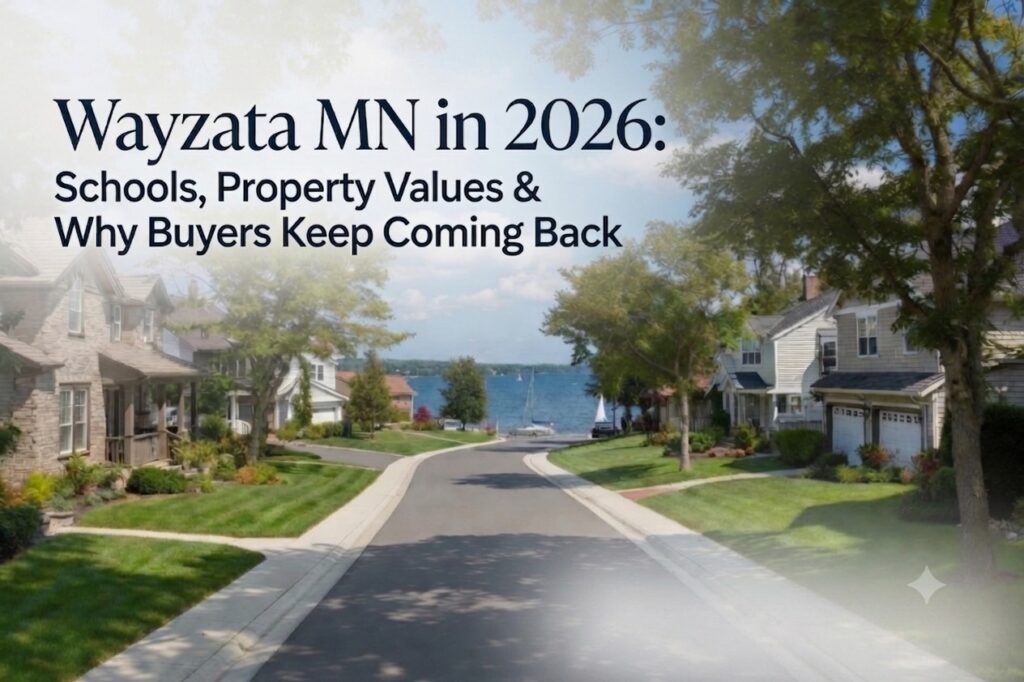
Wayzata MN in 2026: Schools, Property Values & Why Buyers Keep Coming Back

Tree-lined street in Wayzata, MN leading to Lake Minnetonka, homes on both sides

Ask a dozen Twin Cities agents where their clients want to end up, and Wayzata comes up more than almost anywhere else. It’s not just the lake views or the walkable downtown — it’s the combination of top-tier schools, home values that have held up through a cooling statewide market, and a small-town feel that’s rare this close to Minneapolis. If you’ve been eyeing Wayzata, MN real estate in 2026, here’s an honest look at what’s driving demand, what homes actually cost, and why buyers keep coming back year after year.

Wayzata Schools Are the Draw — And the Numbers Back It Up

For the third year running, Niche has ranked Wayzata Public Schools the number one school district in Minnesota, with an A+ overall grade and the state’s top-ranked high school. The district also lands in the top 1% of all public school districts nationwide out of more than 12,000 districts, with elementary schools like Kimberly Lane, Northwoods, Plymouth Creek, and Meadow Ridge regularly landing among the state’s best. For families relocating to the Twin Cities, that ranking alone explains a huge share of the demand we see for Wayzata property values — buyers aren’t just paying for a house, they’re paying for a school assignment they know will hold its value.

It’s worth noting that “Wayzata schools” is really shorthand for Wayzata Public Schools (ISD 284), which serves a footprint stretching well beyond the city itself — into Plymouth, Medina, and parts of Maple Grove and Corcoran. That’s an important nuance for buyers: you can access the district’s boundaries at a range of price points, not just inside Wayzata city limits, which opens up options for buyers who want the schools without the full lakefront premium.

What Wayzata Homes Actually Cost in 2026

Wayzata is a small, lake-driven market, and pricing varies dramatically block by block — which means any single “median price” headline can be misleading. Broadly, buyers should expect typical single-family homes in Wayzata neighborhoods to range from roughly $600,000 to $4 million or more, with true lakefront estates on Lake Minnetonka regularly exceeding $10 million. Listing data through the first half of 2026 has shown days on market stretching into the 55–60 day range, longer than the frenzied pace of a few years ago, which points to a more balanced market where buyers have a bit more room to negotiate than they’ve had in a while.

That’s a notable shift from the ultra-competitive conditions of 2021–2022. Statewide, Minnesota’s overall housing market has been described by Redfin as trending toward equilibrium, with the typical Minnesota home selling in the $360,000–$380,000 range — a useful reminder of just how far above the statewide median Wayzata sits, and why it’s considered one of the metro’s premium markets alongside Edina, Minnetonka, and Eden Prairie.

Financing also plays a bigger role in Wayzata than in more affordable suburbs, simply because loan amounts are larger. As of early July 2026, Freddie Mac’s weekly survey put the average 30-year fixed mortgage rate at 6.43%, down slightly from earlier in the year. For a $1.5 million-plus purchase, even small rate movements can shift a monthly payment by hundreds of dollars, so buyers at this price point are especially well served by locking in rate quotes early and working with a lender experienced in jumbo loans.

Why Buyers Keep Choosing Wayzata Over Comparable Suburbs

Wayzata’s staying power comes down to a combination few other Twin Cities suburbs can match: direct Lake Minnetonka access, a genuinely walkable downtown with restaurants and shops rather than a strip mall, and a top-ranked school district serving the whole area. Neighborhoods like Locust Hills appeal to buyers who want larger lots and mature trees within walking distance of the lake, while areas closer to Gleason Lake offer a lower entry point for move-up buyers who still want the Wayzata address and school assignment.

There’s also a long-term value argument. Buyers who might otherwise consider a comparably priced home in a suburb without Wayzata’s school ranking or lake access tend to see Wayzata as the safer long-term hold — even when it means paying a premium today.

What This Means If You’re Buying or Selling in Wayzata Right Now

For buyers, 2026’s slightly longer days-on-market and modestly improved inventory mean there’s more room to do real due diligence than in past years — get the inspection, negotiate on repairs, and don’t feel forced into a same-day offer. For sellers, it means presentation and pricing accuracy matter more than they did during the frenzy years; homes priced realistically for their specific neighborhood (rather than the headline lakefront numbers) are still moving well.

Either way, a market this nuanced — where price can swing by millions of dollars between two streets — is exactly where local expertise pays for itself.

Thinking about buying or selling in Wayzata? MinnMatch can connect you with a local agent who knows the difference between a Gleason Lake starter home and a Locust Hills estate — no algorithms, just a real match. Find your Wayzata agent or learn more about how MinnMatch works.