How Long Does It Take to Buy a Home in the Twin Cities in 2026? A Realistic Timeline

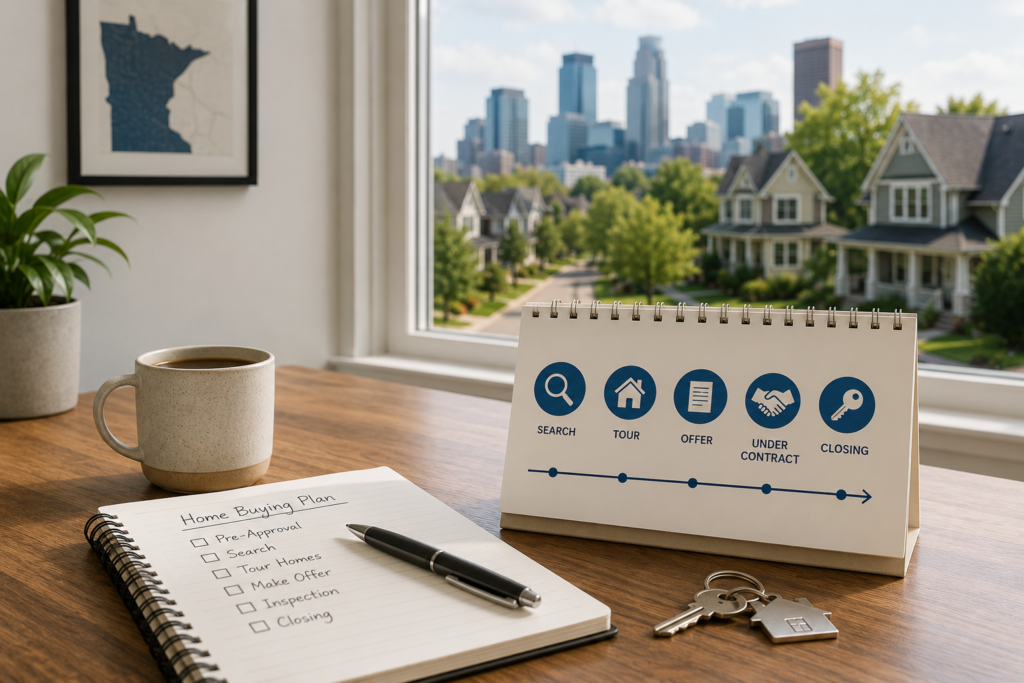
Desk scene with a home buying timeline calendar showing search, tour, offer, under contract, and closing steps, Minneapolis skyline in background

If you’re just starting to think about buying a home, one question comes up almost immediately: how long is this actually going to take? It’s a fair question, and the honest answer is “it depends” — but that’s not very helpful when you’re trying to plan a move, give notice on a lease, or figure out when to start packing. So let’s break down a realistic Twin Cities home buying timeline for 2026, based on what’s actually happening in the local market right now, not generic national averages.

Step One: Getting Pre-Approved (Usually 1–2 Weeks)

Before you tour a single home, you’ll want a mortgage pre-approval in hand. Lenders will ask for pay stubs, tax returns, bank statements, and a look at your credit, and most can turn around a pre-approval letter within a few business days once you’ve submitted everything. Give yourself a week or two here, especially if you need to track down documents or clean up anything on your credit report first. With 30-year mortgage rates in the Twin Cities hovering in the high 5% to upper 6% range through early 2026, it’s worth shopping two or three lenders — even a small rate difference changes your monthly payment more than people expect.

Step Two: House Hunting (4–10 Weeks, Depending on the Market)

This is the stage where your home buying timeline can stretch or shrink the most, and it depends heavily on price point and location. According to Minneapolis Area Realtors market data, well-priced homes in the $350,000 to $500,000 range have been moving in around 40 days on the market, while homes priced under $120,000 or in more niche categories have taken closer to 100 days to sell. Redfin’s data for Minneapolis proper shows homes selling in around three weeks on average as of mid-2026, though that number is pulled up or down significantly by neighborhood and condition. The takeaway: if you’re searching in a popular suburb like Eden Prairie or Edina, expect competition and a faster pace. If you’re more flexible on location, you’ll likely have more time to look and less pressure to rush a decision.

Inventory has loosened up compared to the ultra-tight years of 2021–2022, with months of supply across the metro sitting in a range of roughly 1.5 to 3 months depending on the source and time of year. That gives most 2026 buyers a bit more breathing room to actually compare homes instead of feeling forced into an offer on day one.

Step Three: Making an Offer and Getting It Accepted (A Few Days to a Week)

Once you find the right place, writing and submitting an offer typically takes a day or two with your agent. From there, it depends on the seller: some respond within hours, especially on well-priced homes that are attracting multiple offers, while others take a few days if they’re weighing several offers or waiting on other decisions. In a more balanced market like the one Twin Cities buyers are seeing in 2026, back-and-forth negotiation on price, closing date, or included items is common and can add a few more days before everyone signs off.

Step Four: Under Contract to Closing Day (Typically 30–45 Days)

This is the stretch most first-time buyers underestimate. Once your offer is accepted, you’re not done — you’re entering the inspection, appraisal, and underwriting phase, and it usually takes 30 to 45 days to reach the closing table. Here’s roughly how that time breaks down:

  • Home inspection: Usually scheduled within the first week under contract, with results back a day or two later.
  • Appraisal: Ordered by your lender, typically completed within one to two weeks.
  • Underwriting and loan approval: This is often the longest piece, and can take two to four weeks depending on your lender’s workload and how quickly you supply any additional documents they request.
  • Final walkthrough and closing: Scheduled once your loan is clear to close, usually within the last few days before you get the keys.

Cash buyers can move faster through this stage since there’s no lender underwriting to wait on, but financed purchases — which make up the majority of Twin Cities transactions — should plan on the full 30 to 45 days.

So, Realistically: How Long Does the Whole Process Take?

Add it all up, and most Twin Cities buyers in 2026 are looking at somewhere between two and four months from the day they start seriously house hunting to the day they close — longer if they’re being selective in a competitive suburb, shorter if they find the right home quickly and sail through underwriting. Buyers with financing hiccups, homes needing repair negotiations, or appraisal gaps should build in extra cushion. If you’re also selling a home at the same time, add more time still for coordinating both closings.

The biggest variable isn’t the paperwork — it’s finding the right home in the first place. That’s exactly where having an agent who knows your target neighborhoods, communicates fast, and can spot a well-priced listing before it gets competitive makes the difference between a two-month search and a six-month one. If you’d like to skip the guesswork of finding that agent yourself, MinnMatch will personally match you with a vetted local Twin Cities agent suited to your timeline, budget, and neighborhoods of interest, at no cost to you. Curious how the process works? Take a look at how MinnMatch works and get matched in minutes.

Plymouth MN in 2026: A Complete Guide to Every Major Neighborhood for Today’s Buyers

Stone Plymouth, MN entrance sign beside a landscaped pond with townhomes in the background

If you’ve started house hunting in Plymouth, you already know the challenge: this is not a one-size-fits-all suburb. Minnesota’s seventh-largest city stretches across more than 36 square miles northwest of Minneapolis, and it’s genuinely a patchwork of distinct Plymouth MN neighborhoods — from wooded lakeside enclaves near Medicine Lake to newer family developments closer to Maple Grove and Corcoran. Some areas feed into Wayzata schools, others into Robbinsdale, Hopkins, or Osseo. Some are walkable to Parkers Lake Park; others are built around cul-de-sacs and three-car garages. Knowing which pocket of Plymouth fits your life — and your budget — makes all the difference. Here’s a neighborhood-by-neighborhood breakdown to help you buy smart in 2026.

Why Plymouth MN Neighborhoods Vary So Much

Plymouth is home to roughly 80,000 residents, making it one of the largest suburbs in the Twin Cities metro. That size is exactly why it can’t be described as a single market. The city was built out over decades, so you’ll find 1960s and ’70s ramblers and split-levels in older sections mixed with sprawling new construction in areas that were farmland just twenty years ago. Four different school districts touch Plymouth — Wayzata, Robbinsdale, Hopkins, and Osseo — which means the “best” neighborhood really depends on your school priorities, commute, and price point, not just the city limits on a map.

Across Plymouth MN neighborhoods, the citywide median sale price sits around $505,000 as of spring 2026, according to Redfin’s Plymouth market data — but that number hides a lot. Depending on the neighborhood, you’ll find everything from condos and townhomes in the $200,000s to executive homes well north of $1 million. Let’s walk through the major pockets.

East Plymouth: Medicine Lake & Shelard Park

The eastern edge of Plymouth, closest to Minneapolis and Golden Valley, is built around Medicine Lake and the well-established Shelard Park and Hidden Valley areas. This part of town tends to have older housing stock — think mature trees, smaller lots, and more modest square footage than you’ll find further west — which makes it one of the more accessible entry points into Plymouth for first-time buyers. It’s also the most connected part of the city for commuters, with quick access to Highway 55 and I-394 into downtown Minneapolis.

Medicine Lake itself is a genuine amenity here — swimming beaches, a regional trail, and boat access — and French Regional Park sits right along its shore with year-round programming. The City of Plymouth’s planning maps are a handy free resource if you want to see exact neighborhood and zoning boundaries before you start touring. If proximity to the city and a lower entry price matter more to you than a brand-new kitchen, this corner of Plymouth deserves a look.

Central Plymouth: Parkers Lake & Northwood West

The middle of the city, anchored by Parkers Lake Park, is where a lot of Plymouth’s family-driven demand concentrates. Neighborhoods like Northwood West offer a mix of well-kept single-family homes and townhomes, and the whole area benefits from the Northwest Greenway trail system that laces through central and western Plymouth, connecting parks, schools, and neighborhoods for walkers and bikers.

Don’t expect a shopping district at the actual corner of County Road 6 and Vicksburg Lane, though — that intersection is limited to a Domino’s Pizza and Vicksburg Liquor, not a retail cluster. For groceries, restaurants, and bigger-box shopping, residents in this part of Plymouth typically drive a few minutes to retail corridors elsewhere in the city. Central Plymouth spans multiple school boundaries, so if district assignment is a dealbreaker for your family, confirm the specific address before you fall in love with a listing.

West Plymouth: The Luxury Corridor Near Wayzata

The stretch of Plymouth closest to Wayzata carries the city’s highest price points, and it’s where you’ll hear names like Hollydale, Hampton Hills, and Plymouth Preserve come up often. These neighborhoods sit inside the Wayzata School District, which is consistently one of the draws for buyers willing to pay a premium. In this stretch, Redfin has tracked median sale prices well above the citywide figure — in the $600,000s in early 2026 for the Plymouth-Wayzata submarket — reflecting larger lots, executive-style homes, and closer proximity to Lake Minnetonka’s western communities.

Hampton Hills, for example, sits near Parkers Lake Park with wooded, walkable streets, while Plymouth Preserve is known for newer executive construction near the Northwest Greenway. If you’re comparing this part of Plymouth against nearby options, our Wayzata community guide and Minnetonka neighborhood breakdown are worth a look side by side.

North & Northwest Plymouth: New Construction Territory

The northern and northwestern edges of Plymouth — bordering Maple Grove, Corcoran, and Medina — are where most of the city’s newer development has happened over the last decade. Buyers here are typically looking for new-build or near-new single-family homes, larger floor plans, and modern amenities, often at a lower price per square foot than the equivalent home closer to Wayzata. This part of the city also tends to overlap with the Osseo school district rather than Wayzata, so it’s worth double-checking boundaries if a specific school is part of your decision.

This is generally the part of Plymouth where you’ll get the most new-construction options if that’s a priority, though it also means fewer mature trees and established landscaping compared to the city’s older neighborhoods.

So Which Plymouth Neighborhood Is Right for You?

Comparing Plymouth MN neighborhoods side by side, there’s no single “best” answer — it genuinely depends on what you’re optimizing for. Want the shortest commute into Minneapolis and a lower entry price? Look east, near Medicine Lake. Want walkability to parks and trails? Central Plymouth around Parkers Lake is hard to beat. Chasing the Wayzata School District and willing to pay for it? The western corridor near Hollydale and Hampton Hills is where to focus. Prioritizing new construction and more square footage per dollar? Start north.

Because Plymouth spans four school districts and such a wide range of price points, it’s easy to fall in love with a house and only later discover it’s in the “wrong” pocket for your commute or your kids’ school. If financing is part of your planning, the Minnesota Housing Finance Agency is worth a look for first-time buyer programs that can apply anywhere in Plymouth. But the neighborhood-level nuance is exactly the kind of thing a Plymouth-focused agent should walk you through before you write an offer, not after.

Not sure which of Plymouth’s neighborhoods actually fits your budget and priorities? MinnMatch connects you with a vetted local agent who knows these neighborhoods block by block — free for buyers, no algorithm involved. See how the matching process works and get paired with the right agent for your search.

July 2026 Twin Cities Real Estate Market Update

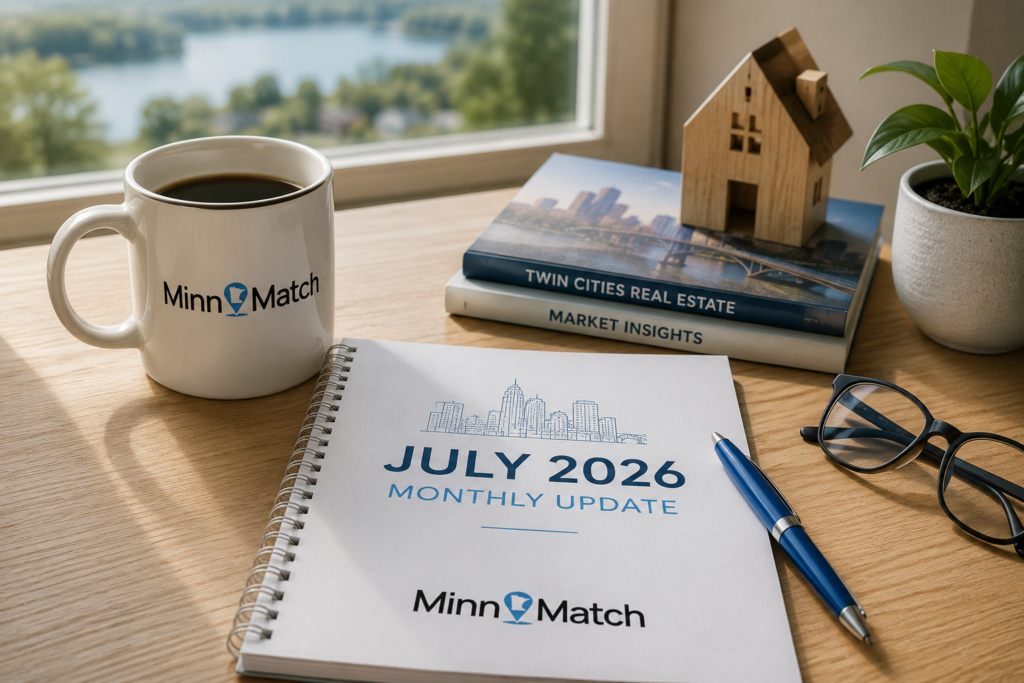
MinnMatch July 2026 monthly Twin Cities real estate market update notebook on desk with coffee mug and model home

We’re officially halfway through 2026, and it’s a good time to pause and take stock of the Twin Cities real estate market. The first half of the year didn’t move in a straight line — and June, in particular, threw a few curveballs. New listings climbed, homes sat a little longer, and buyers had more room to negotiate than they’ve had in years. Here’s what actually happened, why it happened, and what it means if you’re planning to buy or sell in the second half of 2026.

Where the Twin Cities Real Estate Market Stands at Mid-Year

Zoom out to the 12 months ending in spring 2026, and the metro-wide picture is one of a market that’s cooled from the frenzy of a few years ago but hasn’t stalled. Twin Cities median sale prices have been running in the high-$300,000s to around $390,000 metro-wide, with single-family homes averaging closer to $429,000, according to Redfin’s Minneapolis market data. That’s modest appreciation — nothing like the double-digit jumps of 2021 and 2022, but still a gain.

Inventory has been the real story of 2026. Active listings have been building for months, which is exactly what a market needs to shift some leverage back toward buyers. Single-family homes are sitting at roughly two months of supply, and townhomes are close behind — both still favor sellers technically, but the gap has narrowed noticeably compared to the tightest years on record.

A Bumpier June — And Why It Happened

If June felt slower than usual, you weren’t imagining it. Local agent Art, who works with buyers and sellers across the metro, summed it up well in his monthly market minute: June was bumpier than usual, with new listings rising, days on market stretching out, and months of supply climbing as a result.

The causes weren’t local — they were macro. Mortgage rates spent much of June anchored in the mid-6% range, with Freddie Mac’s weekly survey showing the 30-year fixed hovering between 6.4% and 6.6% for most of the month. Geopolitical uncertainty overseas pushed oil prices and Treasury yields higher, which dragged mortgage rates along with them, while stubbornly high inflation kept the Federal Reserve on hold rather than cutting rates. Add it up, and buyers had less incentive to move quickly, even with more homes to choose from.

The Golden Handcuffs Are Still the Biggest Obstacle

Beyond the headlines, Art pointed to something a lot of Twin Cities homeowners are quietly wrestling with: the “golden handcuffs” effect. Plenty of people want to move — for more space, a better commute, or a life change — but locked-in mortgage rates from a few years ago are holding them back. Trading a sub-3% rate for something in the mid-6% range can mean a home that’s only 30% more expensive on paper ends up costing nearly double in monthly payment. That math is enough to keep a lot of would-be sellers on the sidelines, which in turn keeps some of the entry-level and move-up inventory buyers want out of reach.

Second Half Outlook: Tools Buyers and Sellers Can Actually Use

The good news, as Art put it, is that uncertainty at the macro level creates opportunity for buyers and sellers willing to act with purpose. A few strategies worth knowing about heading into the second half of 2026:

  • Adjustable-rate mortgages are back in the conversation. For buyers who don’t plan to stay in a home for the full 30 years, an ARM can meaningfully lower the initial rate.
  • Seller-paid rate buydowns are increasingly common. In a market where sellers have more listings to compete against, offering to buy down a buyer’s rate for the first few years is a real concession sellers are making.
  • Negotiating room has genuinely opened up. With months of supply rising, buyers have more standing to ask for repairs, credits, or price adjustments than they did a year or two ago.

None of these tools are one-size-fits-all, and the right move depends heavily on your timeline, your down payment, and your local submarket — which is exactly where having someone who watches these numbers every week pays off.

Whether you’re trying to time a move around today’s rates or figure out if now’s the right moment to finally sell, the details matter more in a market like this one. MinnMatch can match you with a local agent who knows exactly what’s happening in your neighborhood — not just the metro averages. Curious how the process works? See how MinnMatch works.

Which Lake Minnetonka Town Fits Your Budget? (2026)

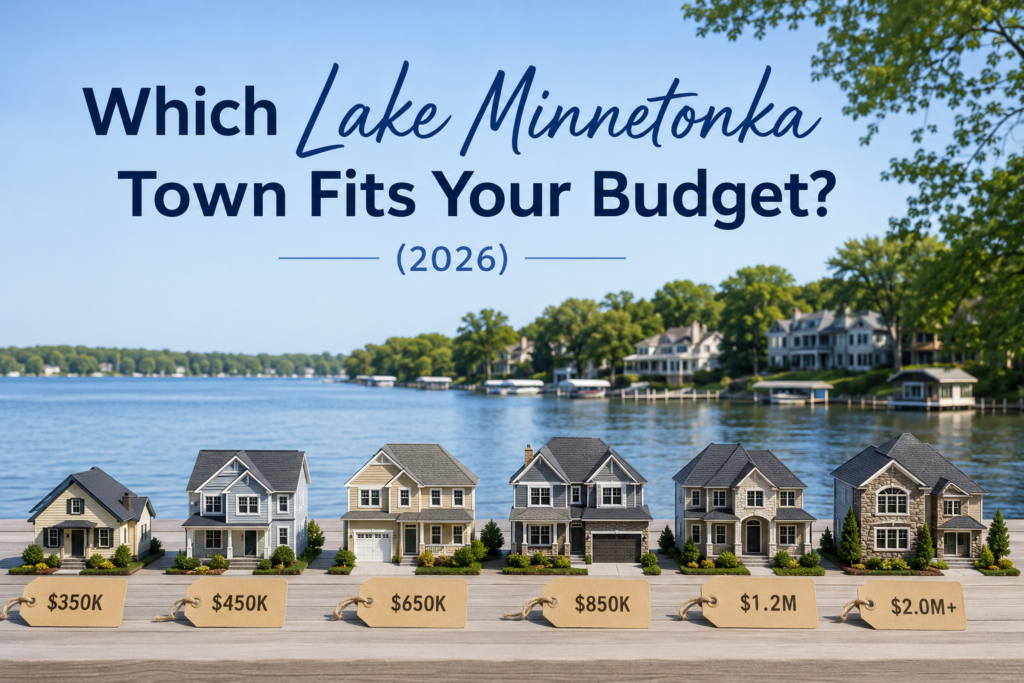
Featured image graphic titled "Which Lake Minnetonka Town Fits Your Budget? (2026)" showing a row of house illustrations with price tags from $350K to $2.0M+ along a Lake Minnetonka shoreline

“Lake Minnetonka” sounds like one market, but it’s really four or five very different ones stitched together around the same shoreline. Excelsior, Wayzata, Mound, and Tonka Bay all sit on or near the lake, all share that unmistakable lake-town feel, and all have wildly different price tags. If you’ve been searching “Lake Minnetonka homes for sale” and getting whiplash between $375K listings and $2 million estates, this is why. Here’s what each town actually costs to buy into right now, and who tends to land where.

Excelsior: The Walkable Lake Town, With a Wide Price Spread

Excelsior has the most range of any town on this list. Recent Redfin data puts the median sale price for homes that closed last month at roughly $375K, while new luxury listings near downtown and the water routinely list well above $1 million. The gap comes down to location within Excelsior: a condo or smaller home a few blocks from the village core can land in the high $300Ks to mid $400Ks, while anything with real lake frontage or a downtown walk score climbs fast. Homes here are also moving briskly, with a median of around a month on market.

Excelsior tends to attract buyers who want the lake lifestyle — coffee shops, restaurants, the Commons, boat access — without committing to full waterfront ownership. If that’s the appeal for you, ask your agent to filter specifically by walk-to-downtown distance, since price per square foot can swing significantly within just a few blocks.

Wayzata: The Premium Address

Wayzata sits at the top of the price ladder among these four towns. Redfin’s most recent figures show a median sale price in the $800Ks for closed sales, while new construction and lakefront listings frequently run well into the $1.5M–$2M range. Homes here also tend to sit on the market longer than in the other towns — often 60 to 100+ days — which actually works in a serious buyer’s favor by allowing more room to negotiate than the headline prices suggest.

Wayzata’s downtown investment in public shoreline access and a more walkable lakefront has reinforced its reputation as the most polished address on the lake. If budget allows, it’s worth touring, but buyers priced out of Wayzata proper often find very similar lake access — at a fraction of the cost — just a few minutes away.

Mound: The Value Play on the Lake

Mound is consistently the most affordable entry point to Lake Minnetonka living. Redfin reports a median sale price in the $385K–$400K range, with single-story and smaller homes often listing in the $340Ks. Homes also move quickly here, frequently selling within three to seven weeks. For buyers who want lake access — boat slips, swim beaches, and trail connections to the Lake Minnetonka Regional Park — without paying Wayzata or Tonka Bay prices, Mound is usually the town worth a closer look first.

The trade-off is that true lakefront in Mound is rarer and competes hard when it does come up — some shared-access neighborhoods with boat slips have sold for under $900K even with renovations, which is a meaningful discount compared to similar access points elsewhere on the lake.

Tonka Bay: Small, Quiet, and Lakefront-Heavy

Tonka Bay is the smallest market of the four, with only a handful of homes for sale at any given time, so pricing here should be read as a range rather than a precise number. Active and recently pending listings cluster heavily in the $1.2M–$1.6M range, reflecting how much of the inventory is waterfront or near-waterfront. Because so few homes change hands here in a given month, it’s worth working with an agent who tracks Tonka Bay closely and can flag a new listing immediately — by the time a Tonka Bay home shows up on a typical portal search, it may already have an offer.

So Which Lake Minnetonka Town Fits Your Budget?

If you’re working with a budget under $450K, Mound and the outer edges of Excelsior are realistically your best entry points to the lake. In the $450K–$900K range, Excelsior’s broader inventory and parts of Wayzata’s market come into play. Above $1M, Wayzata and Tonka Bay both offer true lakefront living, with Tonka Bay leaning even more heavily toward waterfront-only inventory. None of these numbers are fixed — Lake Minnetonka pricing shifts block by block, and the right agent can tell you in five minutes whether a town is realistically in reach or worth stretching for.

Not sure which Lake Minnetonka town actually fits your budget and lifestyle? Find an agent who knows these towns block by block, or learn more about how MinnMatch works to get matched with the right local expert, free.

South Minneapolis vs. Northeast Minneapolis: Which Urban Neighborhood Should You Buy In?

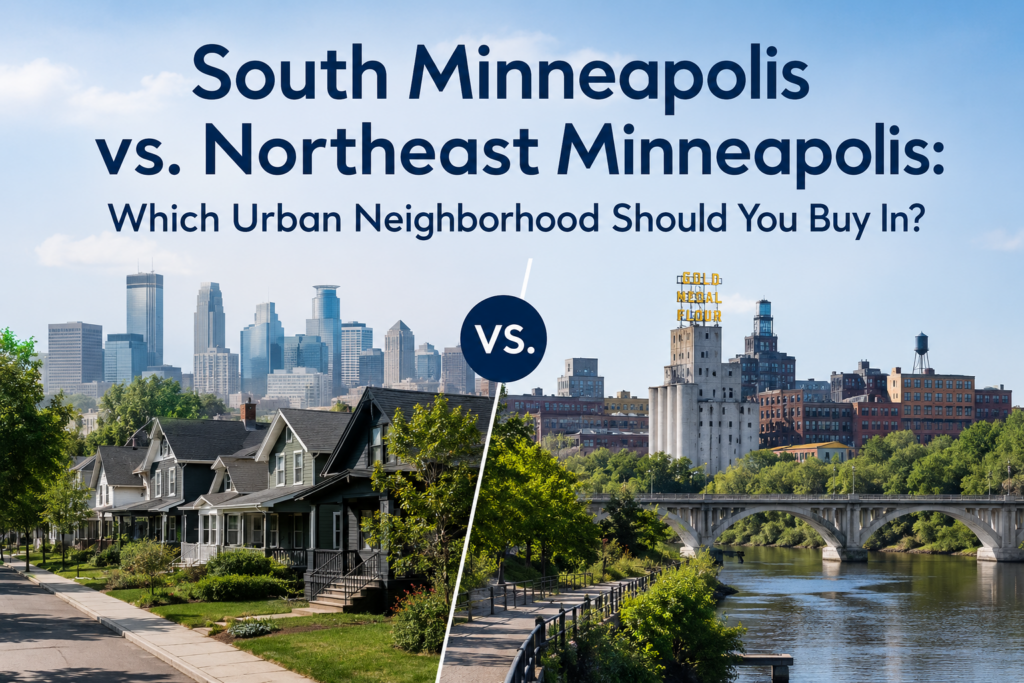
South Minneapolis vs. Northeast Minneapolis split image comparing residential bungalow street to Nordeast riverfront and Stone Arch Bridge

If you’ve decided you want to live inside Minneapolis proper — not out in the suburbs, but in the heart of the city where you can walk to coffee, bike the parkways, and actually know your neighbors — you’ve probably already narrowed your search to two areas: South Minneapolis and Northeast Minneapolis. Both are beloved, both are walkable, and both have passionate residents who will tell you theirs is the better half of the city. The truth is more nuanced than that, and which one is right for you depends less on hype and more on your daily life, your budget, and the kind of energy you want outside your front door.

The Short Version: Two Very Different Personalities

South Minneapolis is the city’s green, lake-laced backbone. It stretches from the Chain of Lakes east through Powderhorn, Nokomis, and Longfellow, and it’s defined by tree-canopied streets, classic bungalows and Cape Cods, and easy access to Lake Nokomis, Minnehaha Falls, and the Mississippi River gorge. Northeast Minneapolis, or “Nordeast” as locals call it, sits across the river from downtown and carries a completely different identity: a former Eastern European immigrant enclave turned arts and brewery district, with a grittier, more industrial edge and some of the most distinctive housing stock in the city.

Neither is “better.” They’re built for different lifestyles, and a lot of buyers who think they want one end up happier in the other once they actually compare them side by side.

What You’ll Pay: Pricing Compared

Pricing across both areas varies a lot by sub-neighborhood, so a single citywide figure doesn’t tell the real story. In South Minneapolis, the lake-adjacent pockets command a premium: Nokomis homes have recently sold in the high $360,000s to $390,000 range, while Longfellow — closer to the river and the light rail — has traded in the low $330,000s to mid $370,000s depending on the month. Powderhorn, the most affordable of South Minneapolis’s core neighborhoods, has recently listed in the $300,000–$320,000 range, making it one of the better entry points into city living south of downtown.

Northeast Minneapolis runs a similar overall range but with a bit more affordability at the median. Recent data puts the typical Northeast home sale around $340,000–$350,000, with homes moving in roughly a month on the market — a touch slower than the most competitive South Minneapolis pockets, but still well within a normal, healthy pace for the Twin Cities. Northeast also has more variation in housing stock condition, since the area mixes century-old worker cottages with recently renovated or new-construction infill, so the price range you’ll actually shop in can swing widely block to block.

Bottom line: if pure affordability is your top priority, Northeast and Powderhorn are both strong entry points into city living. If you want to be a five-minute walk from a lake, South Minneapolis’s Nokomis and Longfellow neighborhoods will cost you more — but you’re paying for the lake.

Daily Life: Lakes and Parkways vs. Arts and Breweries

South Minneapolis is built around its parks system. You’re never far from a lake loop, a bike path, or the Minnehaha Parkway, and the area’s commercial corridors — Lake Street, 38th Street, the Nokomis business district — tend to mix family-friendly restaurants, coffee shops, and small grocers. It’s a neighborhood that rewards a slower pace: morning runs around Lake Nokomis, weekend farmers markets, kids on bikes.

Northeast has a different rhythm entirely. The Northeast Minneapolis Arts District — centered around Central and Hennepin Avenues — has been recognized nationally as one of the best arts districts in the country, and the neighborhood has the highest concentration of breweries anywhere in the city. Add in Eastern European-rooted institutions that have anchored the area for generations, alongside newer Latin American and immigrant-owned businesses along Central Avenue, and you get a neighborhood that feels more layered and more urban-edge than South Minneapolis. If you want a Saturday that involves gallery hopping, a taproom flight, and dinner somewhere you’ve never tried before, Northeast delivers that in a way South Minneapolis generally doesn’t.

Both neighborhoods are highly walkable and well served by Minneapolis Parks, but the texture of that walkability is different: South Minneapolis walking means lakes and tree canopy; Northeast walking means murals, converted warehouses, and a working river.

Housing Stock: What You’re Actually Buying

South Minneapolis is dominated by classic 1900s–1950s housing: bungalows, Cape Cods, and a healthy stock of 1.5- and 2-story single-family homes, often with detached garages and modest yards. It’s consistent and predictable — most buyers know roughly what they’re getting before they walk in.

Northeast is more eclectic. You’ll find small worker cottages from the early 1900s sitting next to renovated duplexes, converted lofts in former industrial buildings, and pockets of new construction infill, especially closer to the river and in areas like Bottineau and Holland. This variety can be a feature or a frustration depending on what you want — buyers looking for character and willing to take on some renovation often gravitate to Northeast, while buyers who want a turnkey, move-in-ready home with fewer surprises often lean South Minneapolis.

Commute and Connectivity

South Minneapolis has the edge for transit, particularly along the Blue Line through Longfellow, which gives quick access to downtown and the airport. Northeast doesn’t have light rail running through its core, but it’s geographically tight to downtown — many Northeast neighborhoods are a five- to ten-minute drive from the city’s office core, often faster than a South Minneapolis commute during peak traffic. If you work downtown and want to minimize windshield time, Northeast’s proximity is genuinely underrated.

So Which One Should You Buy In?

If you want lakes, parkways, consistent housing stock, and a calmer day-to-day pace — and you’re willing to pay a bit more for the neighborhoods closest to the water — South Minneapolis is probably your fit. If you want character, art, breweries, a shorter commute downtown, and a bit more room to find value through renovation, Northeast Minneapolis deserves a serious look. Plenty of buyers end up cross-shopping both, and that’s exactly the kind of decision a local agent who knows the block-by-block differences can help you make with confidence rather than guesswork.

Not Sure Which Minneapolis Neighborhood Fits You?

South Minneapolis and Northeast Minneapolis each have their own micro-markets, and the right one for you depends on details a national site can’t tell you. MinnMatch connects you with a vetted, handpicked Twin Cities agent who knows both areas block by block — for free, with no obligation.

Find your match at MinnMatch →
  |  
See how MinnMatch works →

Contingencies in a Minnesota Home Purchase in 2026: Which to Keep, Which to Waive

Couple reviewing a Minnesota home purchase agreement and contingencies at kitchen table

If you’ve started shopping for a home in the Twin Cities this year, you’ve probably heard some version of the same advice from a friend or a Facebook group: “waive your contingencies or you’ll never win a bid.” That advice made a lot of sense in 2021, when homes in Minneapolis and St. Paul were getting 50+ offers in a weekend. It makes a lot less sense in 2026, when inventory has loosened up and buyers have more room to negotiate. The real question isn’t whether to waive contingencies across the board — it’s which ones actually protect you, and which ones you can let go of without much risk.

What Home Purchase Contingencies Actually Do in Minnesota

A contingency is a condition written into your purchase agreement that has to be satisfied before the sale is fully binding. In Minnesota, contingencies are usually built directly into the standard Minnesota Association of REALTORS® purchase agreement rather than added as a separate document, and each one gives you a specific, time-limited window to walk away — and keep your earnest money — if something doesn’t check out.

Without a contingency in place, you’re agreeing to move forward no matter what the inspection, the appraisal, or your financing turns out to look like. That’s exactly why home purchase contingencies have become a bargaining chip in competitive offers: sellers comparing multiple bids often favor the offer with fewer strings attached, even if it isn’t the highest dollar amount.

The four contingencies you’ll run into in nearly every Twin Cities transaction are the inspection contingency, the financing contingency, the appraisal contingency, and — less commonly in this market — the home sale contingency. Each one carries a different level of risk if you waive it, which is why a blanket “waive everything” strategy can backfire.

Why the Calculus Has Changed in the 2026 Twin Cities Market

During the frenzied years of 2020 through 2023, waiving an inspection contingency was often treated as table stakes just to get a showing, let alone an accepted offer. That’s not the market Minnesota buyers are navigating in 2026. Inventory has recovered meaningfully across the metro, and homes are sitting longer than they did at the height of the pandemic-era market.

Local market data tells the story. Minneapolis homes were selling in the low-to-mid 40-day range as of mid-2026, a meaningful slowdown from the multi-day turnarounds buyers faced a few years ago, and active listings in the metro have grown on a year-over-year basis. Redfin’s local market tracker shows Minneapolis homes selling for roughly 100% of list price on average — strong, but no longer the 10-to-20-over-asking chaos of a few years back.

That doesn’t mean competition has disappeared. Well-priced homes in popular pockets of Edina, Minnetonka, and South Minneapolis can still draw multiple offers in a matter of days. But the days of needing to waive every protection just to be taken seriously are largely behind us — which means the decision should be made property-by-property, not as a default strategy.

The Inspection Contingency: Generally Worth Keeping

Of all the contingencies on the table, the inspection contingency is the one Twin Cities real estate attorneys and agents most consistently advise buyers to hold onto. It gives you a defined window — typically five to seven days — to bring in a licensed inspector and identify problems with the roof, foundation, electrical, plumbing, or mechanical systems before you’re locked in.

Minnesota law requires sellers to disclose known defects, but “known” is the operative word — a seller may genuinely have no idea their foundation has a hairline crack or their sewer line is failing. Without an inspection contingency, your only recourse if something major surfaces after closing is proving the seller knew about it and concealed it, which is a difficult and expensive legal standard to meet.

Minnesota homes carry some specific inspection considerations worth flagging to your agent: radon levels, which run high in many parts of the state and aren’t detectable without specialized equipment; aging mechanical systems in homes built before the 1980s; and sump pump or sewer line condition, particularly in older Minneapolis and St. Paul housing stock. If a home falls into any of those categories, an inspection contingency is rarely the place to cut a corner.

If you do want to make your offer more competitive without fully waiving this protection, ask your agent about a pass/fail inspection instead — you still inspect the home, but you agree only to flag and walk away from major safety or structural issues rather than negotiating over every minor item on the list.

The Financing Contingency: Risky to Waive Unless You’re Paying Cash

A financing contingency protects you if your mortgage falls through — whether because of a job change, a credit issue that surfaces during underwriting, or an appraisal that complicates your loan terms. Pre-approval letters are a strong signal to sellers, but they are not a guarantee of final loan approval. Underwriting can still uncover problems that a pre-approval never caught.

Waiving this contingency means that if your financing falls apart for any reason, you risk losing your earnest money deposit entirely. Unless you’re buying with cash or have an unusually ironclad financial position, most Twin Cities agents and real estate attorneys recommend keeping this one in place. It’s also worth noting that cash buyers routinely skip this contingency altogether, which is one reason all-cash offers remain so attractive to sellers in competitive situations.

The Appraisal Contingency: A Reasonable Place to Compromise

An appraisal contingency protects you if the home appraises for less than your purchase price, giving you the option to renegotiate, cover the gap in cash, or walk away. In a market where bidding above asking price is still common in desirable neighborhoods, this is the contingency that most often comes into tension with a strong offer.

A full waiver isn’t your only option here. Many Twin Cities buyers are instead agreeing to cover a defined gap — say, the first $10,000 to $15,000 of any appraisal shortfall — rather than waiving the protection entirely. This signals confidence to a seller without exposing you to unlimited risk if the appraisal comes in significantly under your offer.

The Home Sale Contingency: Usually Not an Option in This Market

A home sale contingency makes your purchase conditional on successfully selling your current home first. It’s the contingency sellers are least willing to accept, since it ties their closing timeline to a transaction they have no control over. In most competitive Twin Cities offers, this one isn’t realistically on the table at all.

If you need to sell before you buy, the more practical path in 2026 is usually a bridge loan, a rent-back arrangement with your buyer, or simply listing your current home first and timing your purchase offer once it’s under contract. A knowledgeable local agent can walk you through which of these fits your specific timeline and finances.

Smarter Alternatives to a Full Waiver

Buyers don’t have to choose between an all-or-nothing offer and losing the house. Some of the more creative strategies Twin Cities agents are using in 2026 include shortening contingency windows rather than removing them, getting a pre-offer inspection or walkthrough before writing an offer at all, offering a flexible closing date or rent-back period the seller values, and increasing earnest money with a clause that makes it non-refundable after a defined point.

Each of these can strengthen an offer in the eyes of a seller without putting your entire purchase — or your earnest money — at risk if something goes wrong.

Deciding which contingencies to keep and which to waive isn’t a decision to make alone, and it shouldn’t be a one-size-fits-all strategy applied to every offer. The right call depends on the specific property, how many other offers you’re up against, and your own financial cushion if something goes wrong. That’s exactly the kind of judgment call a locally experienced agent earns their commission on. If you’re not sure who to trust with that advice, MinnMatch can match you with a vetted Twin Cities agent who negotiates contingencies for a living — at no cost to you. Curious how the matching process works? Here’s how it works.

10 Questions Every Minnesota Home Seller Should Ask Before Signing with an Agent

Minnesota home seller meeting with a real estate agent at a lake house dining table to ask listing questions

Picking a listing agent is a lot like hiring a contractor to renovate your kitchen: the person you choose will shape your timeline, your stress level, and ultimately your bottom line. Yet plenty of Minnesota sellers still pick an agent because a neighbor used them once, or because they recognize the name from a bus bench ad. With the Twin Cities market moving at a brisker pace than it has in years — homes here are selling in a median of three weeks or so — the agent you choose to represent your sale deserves more scrutiny than that. Before you sign anything, sit down with your top one or two candidates and ask them these 10 questions. The answers will tell you more about how your sale will actually go than any sales pitch will.

1. How will you price my home, and what’s your evidence?

Any agent can hand you a number. A good agent will walk you through a comparative market analysis (CMA) built from recent closed sales in your specific neighborhood — not just the metro-wide average. Twin Cities pricing varies block by block; a home in Edina’s Country Club neighborhood prices on an entirely different curve than one in South Minneapolis. Ask to see the comps. Ask why your home compares the way it does. If an agent’s number sounds suspiciously high “to win the listing,” that’s a red flag — an overpriced home tends to sit, and a home that sits long enough starts looking stale to buyers even after a price cut.

2. What’s your commission, and exactly what does it cover?

Since the 2024 NAR settlement reshaped how agents get paid, commission is no longer a fixed, take-it-or-leave-it number quietly baked into the deal — it’s a line item you negotiate directly with your listing agent, spelled out in writing before you sign anything. Minnesota listing commissions commonly run in the 2.5–3% range, though rates vary by brokerage, home price, and market. Ask specifically what services that fee includes: professional photography, staging consultation, a marketing budget, open houses, or just the listing itself. Also ask whether you’ll be offering any commission to a buyer’s agent and how that decision affects buyer interest in your specific price range.

3. What does your marketing plan actually look like?

“I’ll put it on the MLS” is not a marketing plan — every agent does that. Ask for specifics: Who shoots the photos, and have you seen their work? Is there a videographer or drone shot for larger lots and lake properties? How will the listing be promoted on social media, and to which buyer’s-agent networks? If you’re selling near Lake Minnetonka or in a higher-end suburb like Wayzata, ask how the agent reaches out-of-state or relocating buyers who may not be searching local Facebook groups. The right marketing plan should match your home’s price point and the buyer pool you’re actually trying to reach.

4. How many listings have you closed in my specific area this year?

An agent with 200 sales across the entire metro isn’t automatically the right fit for your street. Local market fluency — knowing which school district boundary line affects price, which suburb has tighter inventory, which neighborhood has an HOA quirk buyers ask about — comes from working that specific area repeatedly. Ask how many transactions they’ve closed in your city or neighborhood in the past 12 months, and ask to see (or at least hear about) a couple of recent examples. An agent who’s sold five homes in Plymouth this year will know that market’s rhythm far better than one whose business is spread thin across the whole metro.

5. What’s your communication style, and how often will I hear from you?

This sounds like a soft question, but it’s one of the biggest sources of seller frustration. Will you get a call after every showing, or radio silence until an offer comes in? Does the agent personally handle your file, or does a transaction coordinator or junior team member take over once it’s listed? Ask how they prefer to communicate (text, email, phone) and how quickly you can expect a response. If you’re balancing a sale with a full-time job and a move across the metro, knowing you won’t be left wondering what’s happening matters more than almost anything else on this list.

6. What should I fix, update, or stage before listing — and what should I skip?

A good listing agent should be able to walk your home with you and tell you, room by room, what’s worth the investment and what isn’t. Twin Cities buyers tend to respond strongly to updated kitchens, fresh paint in neutral tones, and curb appeal — especially given how much of the buying season happens in spring and summer when lawns and landscaping are on full display. But not every project pays for itself. Ask the agent to be specific and honest, even if that means telling you not to spend money on something you were planning to fix.

7. How will you handle multiple offers, and how do you advise on offer terms beyond price?

With inventory still relatively tight across much of the metro, well-priced homes in popular suburbs can still draw competing offers. Ask how the agent typically structures an offer deadline, how they evaluate offers that aren’t all-cash or aren’t the highest price (financing contingencies, appraisal gaps, and closing timelines all matter), and how they’ll keep you from leaving money — or peace of mind — on the table. An agent who can talk through a real multiple-offer scenario in detail has clearly been through one before.

8. What happens if my home doesn’t sell quickly?

Not every home goes pending in the first week, and that’s worth planning for before it happens, not after. Ask what the agent’s plan is if the home is still active after 30 or 45 days: Do they recommend a price adjustment, new photography, a re-launch as a “new” listing, or a change in marketing strategy? Also ask about the length of the listing agreement itself and what your options are if the relationship isn’t working — a shorter initial term with the option to renew gives you flexibility without locking you in if expectations aren’t being met.

9. Who else is involved in my transaction, and what do they handle?

Many Twin Cities agents work as part of a team, which isn’t a bad thing — but you should know upfront who’s actually showing up to your listing appointment versus who’s drafting your paperwork, scheduling your photographer, or fielding buyer questions. Ask whether you’ll have one point of contact throughout, and get names and roles for anyone else who’ll touch your file. There’s nothing wrong with a team structure as long as you know exactly who to call when you have a question.

10. Can you walk me through a recent sale that didn’t go smoothly — and how you handled it?

Every experienced agent has a story about an inspection that turned up something unexpected, an appraisal that came in low, or a buyer who got cold feet days before closing. How they answer this question tells you a lot more than their highlight reel of easy sales. Listen for problem-solving, not blame — you want an agent who stays calm, communicates clearly, and has a track record of getting deals back on track when something goes sideways. Real estate rarely goes exactly according to plan, and the agent’s response to friction is often the best preview of what working with them will actually feel like.

Finding the right fit shouldn’t be guesswork

The best protection against a mismatched agent isn’t a longer list of interview questions — it’s starting the search with agents who are already a strong fit for your home, your neighborhood, and your goals. That’s the whole idea behind how MinnMatch works: instead of cold-calling agents off a billboard or picking whoever ran the last open house you attended, you tell us a little about your home and your timeline, and we hand-match you with local, vetted agents who actually specialize in your part of the Twin Cities. There’s no cost to you, no algorithm guessing on your behalf — just a real local matchmaker doing the legwork before you ever sit down for that first interview.

Ready to start those conversations with the right agents already in the room? Find your agent match with MinnMatch and walk into your listing interview already a step ahead.

Selling your Minnesota home? Get matched with a local agent who’s earned your questions — and your trust.


Find My Agent Match

Sources: Minneapolis Area Realtors®, Minnesota Housing Finance Agency, Redfin Minneapolis Housing Market Data.

Inside Edina MN in 2026: Country Club, Morningside & the Neighborhoods Everyone Wants In

Tree-lined street of historic homes in Edina, MN with text "Inside Edina MN in 2026: Country Club, Morningside"

Ask five different people what their favorite among Edina’s neighborhoods is, and you’ll probably get five different answers — and they’ll all make a good case. Edina isn’t one big suburb with a single personality. It’s more like a cluster of small towns that happen to share a ZIP code, each with its own architecture, price point, and pace of life. Some streets feel like a stroll through 1928. Others feel like a quiet cul-de-sac built last decade. If you’re house hunting in Edina right now, knowing the difference between, say, Country Club and Parkwood Knolls isn’t trivia — it’s the difference between finding the right home and just finding a home in the right city.

Country Club: Edina’s Most Storied Address

If you’ve spent any time house hunting in the Edina neighborhoods near 50th & France, you’ve probably driven through Country Club without realizing it — until you noticed the sidewalks only run on one side of the street, the trees form a canopy overhead, and every home looks like it was built with the same careful hand. That’s not an accident. Country Club was platted in 1924 by developer Samuel Thorpe as one of the first planned communities in Minnesota, and it earned a spot on the National Register of Historic Places in 1980 for good reason.

Today, the 14-block district is still governed by a historic designation that protects street-facing facades, which means the Tudor and Colonial Revival homes you see today look remarkably close to how they looked decades ago. Buyers love that consistency, and they’re paying for it: the median sale price in Country Club has been hovering around $1.5 million, with homes typically moving in roughly a month. Walkability is a huge draw too — residents can stroll to the Edina Country Club itself (golf, tennis, a pool, and a clubhouse) or over to the boutiques and restaurants at 50th & France without ever getting in a car.

It’s a neighborhood that rewards buyers who value history and don’t mind a little structure — literally, since exterior changes go through a city approval process. For the right family, that trade-off is the whole point.

Morningside: Small-Town Charm, Big-City Access

Just south and west of Country Club, Morningside has its own following — and a noticeably different feel. This is one of the more affordable Edina neighborhoods, with a median sale price closer to $800,000, and it shows in the housing stock: charming 1930s and ’40s bungalows alongside newer custom builds, set on lots that average around a quarter acre. The vibe here is more village than estate. Locals describe it as the spot where Edina’s suburban comfort meets Minneapolis’s urban energy, sandwiched between the shops along Excelsior Boulevard, the boutiques at 50th & France, and the coffee shops near Lake Harriet.

Families gravitate here for the schools — Concord Elementary, South View Middle, and Edina High School all carry strong ratings — and for the walkability. It’s the kind of place where kids bike to the park and parents actually run into neighbors at the coffee shop, not just wave from the driveway. Homes here move fast, often in just over three weeks, which tells you something about demand in this corner of the Edina real estate market.

The Rest of the Map: Parkwood Knolls, Indian Hills, Highlands & More

Country Club and Morningside tend to get the headlines, but they’re far from the whole story. Edina is home to more than a dozen distinct pockets, and each one solves a slightly different problem for buyers:

  • Parkwood Knolls — newer construction, larger lots, and a more spacious, landscaped feel for buyers who want room to spread out without leaving Edina.
  • Arden Park — tucked along Minnehaha Creek, ideal for buyers who want parks and trails practically in the backyard.
  • Indian Hills — quiet, established, and known for some of the most exclusive homes in the city.
  • Highlands — a popular family pick with strong school access and a more classic suburban layout.
  • White Oaks — walkable to the Edina Country Club and 50th & France, with a mix of established and new builds on larger lots.

The throughline across nearly all of these Edina neighborhoods is school access — Edina Public Schools consistently earn top marks, and that reputation shapes demand block by block, sometimes even street by street.

How to Actually Choose Between Edina Neighborhoods

Here’s the thing nobody tells you when you start researching Edina neighborhoods online: the listing photos all start to look the same after a while, and the descriptions blur together. What actually separates Country Club from Morningside from Parkwood Knolls isn’t just price — it’s daily life. Do you want to walk to dinner, or do you want a three-car garage and a half-acre of yard? Are you drawn to historic character, or would you rather not deal with a certificate-of-appropriateness process before swapping out your front door?

According to market data from Redfin, pricing and pace can swing meaningfully even between neighborhoods that sit half a mile apart, which is exactly why a one-size-fits-all approach to house hunting in Edina rarely works.

This is exactly the kind of decision where a local agent earns their keep — someone who knows not just the listing prices, but which streets in Country Club rarely turn over, or which pocket of Morningside is about to see a wave of new listings. MinnMatch can match you with an Edina-area agent who already knows these neighborhoods block by block, so you’re not starting from scratch. Curious how the matching process works? Here’s how it works — and it’s free for buyers and sellers.

New Construction vs. Existing Homes in the Twin Cities in 2026: Which Should You Buy?

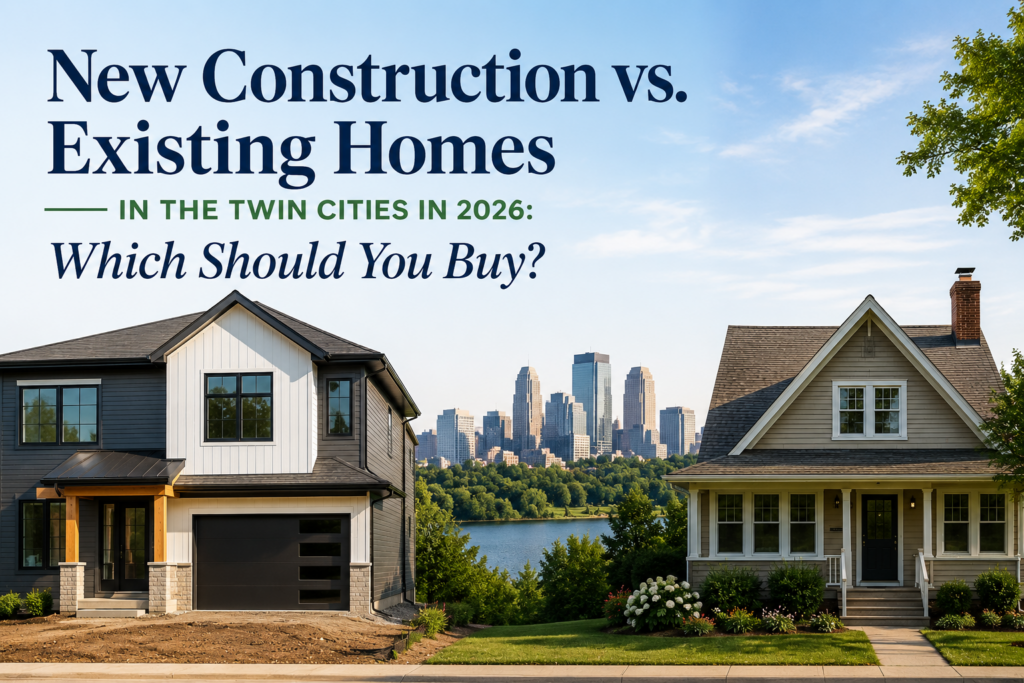
New construction home and existing home side by side with Minneapolis skyline, illustrating new build vs. resale comparison

If you’re starting a home search in the Twin Cities this year, you’ve probably already landed on the big question: new construction vs. existing homes — which one actually makes sense for you? It’s one of the most common questions buyers bring to MinnMatch, and there’s no universal right answer — but there is a clearer picture in 2026 than there’s been in years. The price gap between new construction and existing homes in the Twin Cities has narrowed significantly, builders are leaning on incentives instead of price cuts, and inventory in older neighborhoods is still tight. Here’s how to think through the decision.

New Construction vs. Existing Homes: What’s Actually Cheaper Right Now

For most of the past 15 years, new construction carried a clear price premium over existing homes. That’s not really true anymore — at least not nationally, and the Twin Cities reflects the broader trend. Nationally, in the first quarter of 2026, the median price for a new single-family home actually came in slightly below the median price for an existing home, marking the fourth straight quarter that resale prices have edged out new-build prices. Builders have been managing affordability by building smaller homes, building on smaller lots, and offering closing-cost credits and rate buydowns instead of dropping list prices outright, while existing-home prices have kept climbing — albeit slowly — because so many owners are reluctant to give up mortgage rates they locked in years ago.

In the Midwest specifically, new homes still carry a modest premium over existing homes — roughly $60,000–$67,000 in recent quarters — but that’s a much smaller gap than the Northeast or West see, and it’s been shrinking. Locally, Twin Cities resale prices have been holding fairly steady, with the 13-county metro’s median sale price sitting somewhere in the high $380,000s to low $390,000s through early 2026, depending on the month and data source. New construction pricing across the metro varies widely by suburb, lot type, and builder, but third-ring suburbs like Rogers, Otsego, Dayton, Lakeville, and Rosemount tend to offer the most new-build inventory under $450,000, while closer-in, established suburbs command higher premiums for land and location.

The Case for New Construction

In the new construction vs. existing homes debate, new builds win on predictability. A new home comes with a builder warranty, new mechanicals, and current energy codes — which matters in a state with Minnesota’s heating bills. You typically get more say in floor plan, finishes, and layout, and you’re not inheriting someone else’s deferred maintenance, outdated electrical panel, or 1990s kitchen.

It’s also where most of the buyer leverage is right now. Builders are actively offering mortgage rate buydowns, closing cost credits, and free upgrade packages on many homes, particularly spec homes and communities with aging inventory — incentives that often aren’t advertised and have to be specifically requested. The most active new-construction suburbs in the metro right now include Rogers, Otsego, and Dayton in the northwest corridor; Lakeville and Rosemount in the south metro; Woodbury in the east metro; and Maple Grove for buyers targeting a more established, premium new-build market. Builders active across these communities include D.R. Horton, Pulte Homes, M/I Homes, David Weekley Homes, Lennar, and several smaller regional builders.

The tradeoffs are real, though. Production-built single-family homes typically take six to nine months from contract to closing, longer if you start a build in fall given Minnesota winters. Design center upgrades add up fast — the average Twin Cities buyer spends $40,000 to $80,000 above the base price on options — and lot premiums for walkout, pond-facing, or cul-de-sac lots can run another $10,000 to $50,000. New construction also typically means a longer commute, since most active building is happening in third-ring suburbs rather than the urban core or first-ring suburbs like Richfield, Roseville, or Golden Valley, where new building mostly means infill or teardown projects on a much smaller scale.

The Case for an Existing Home

Existing homes still win on a few fronts that matter a lot to many buyers: location, lot size and mature landscaping, established neighborhoods with sidewalks and tree cover already in place, and proximity to the urban core or first-ring suburbs where new construction is scarce. If you want to be in South Minneapolis, Edina’s Country Club neighborhood, Linden Hills, or a walkable first-ring suburb, you’re shopping the resale market almost by default — there simply isn’t much room left to build new there.

Existing homes also close faster. Instead of a six-to-nine-month build timeline, a typical Twin Cities resale closing happens within 30 to 60 days of an accepted offer, which matters if you’re working around a lease, a school year, or a job start date. And while the price math between new construction and existing homes is closer than it used to be, an existing home in a desirable established neighborhood with multiple offers can still come in below what a comparable new build would cost once you add lot premiums and design center upgrades.

The downside is inventory. Twin Cities active listings have stayed tight, with many longtime owners holding onto homes they financed at much lower mortgage rates, which keeps competition for the best existing homes high in popular neighborhoods. Redfin’s Minneapolis market data shows homes still receiving multiple offers and selling in around a month on average in competitive pockets of the metro. Existing homes also mean inheriting someone else’s choices — and someone else’s age of roof, furnace, and water heater — so a thorough inspection matters more here than almost anywhere else in the process.

Property Taxes and Energy Costs: New Construction vs. Existing Homes

One detail that catches new-construction buyers off guard: property tax assessments on a brand-new home are often based on the completed value, not the price of the lot before the house went up, so your first full-year tax bill can come in noticeably higher than what you estimated at the design center. It’s worth asking your builder or lender for a realistic estimate before you sign, rather than assuming taxes will track an older comparable home nearby.

On the efficiency side, new homes are typically built to current energy codes with tighter envelopes, newer insulation, and more efficient HVAC systems — a real advantage for Minnesota heating bills. Worth noting, though: Minnesota’s HOMES energy rebate program is limited to existing single-family homes and multifamily buildings, so if you’re buying an older home, that program may be worth exploring after closing, while new-construction buyers should ask their builder directly about utility-sponsored efficiency rebates, since several Minnesota utilities offer their own new-construction incentive programs.

New Construction vs. Existing Homes: So, Which Should You Buy?

There’s no single right answer to the new construction vs. existing homes question — it really comes down to what you’re optimizing for. If predictability, a warranty, modern systems, and builder incentives matter most, and you’re flexible on location, new construction in a third-ring suburb is worth a serious look. If location, lot character, mature neighborhoods, and a faster closing timeline matter more, an existing home is probably the better fit, even with the inspection homework that comes with it.

Either path comes with its own negotiation landscape — builder contracts work very differently than resale purchase agreements, and most builders require buyer-agent registration before or at your first model home visit, or you can lose your right to independent representation on that community entirely. That’s exactly the kind of detail a locally connected agent catches before it costs you. If you’re trying to decide between new construction and an existing home in the Twin Cities, MinnMatch can match you with a local agent who works both sides of the market and can walk you through the real numbers for your specific suburbs and budget. And if you’re still early in the process and want to understand how matching works first, our How It Works page is a good place to start.

New construction or existing home — not sure which fits your budget and timeline?

MinnMatch connects you with a vetted local agent who can walk you through both options for free — no algorithm, just a real Twin Cities expert who knows your target suburbs.

Find Your Twin Cities Agent

South Minneapolis Summer 2026: Urban Living, Walkable Neighborhoods & Real Estate Prices

Alt text: South Minneapolis row houses along a tree-lined walking path with the downtown Minneapolis skyline and a lake in the background, summer 2026

If you’re tracking South Minneapolis real estate summer 2026, you’re watching one of the most walkable, lake-rich corners of the Twin Cities hit its peak season. The Chain of Lakes is full of paddleboards, patios along Lake Street and 50th & France are packed by 6 p.m., and the lakefront paths are doing double duty as commuter routes and evening hangouts. It’s also, predictably, when this part of the city heats up on the market. If you’ve been circling neighborhoods like Nokomis, Longfellow, Tangletown, or Linden Hills, here’s a grounded look at what’s actually happening with prices, pace, and walkability right now.

South Minneapolis Real Estate Summer 2026: Prices by Neighborhood

“South Minneapolis” isn’t one market — it’s a patchwork of distinct pockets, and the price spread between them is significant. Based on recent neighborhood-level sales data from Redfin’s Minneapolis market reports, here’s roughly where things stand this summer:

  • Longfellow: Median sale prices have generally landed in the high $330Ks to mid $340Ks, making it one of the more accessible entry points along the river.
  • Nokomis: Recent sales have clustered in the mid-to-high $360Ks to upper $380Ks, reflecting steady demand for the lake-adjacent 1920s housing stock.
  • Tangletown: This pocket has consistently traded at a premium, with recent medians pushing into the high $700Ks to near $800K for many listings.
  • Linden Hills: The priciest of the bunch, with medians generally in the $690K–$700K range and some listings well above that for homes closest to the lake.
  • Southwest Minneapolis (broader area): Pulling these pockets together, the wider southwest submarket has shown a median in the $550Ks, up modestly year over year.

For context, the citywide Minneapolis median has been running somewhere in the $345K–$375K range this year, so South Minneapolis as a whole skews above the city average — though Longfellow and parts of Nokomis remain genuinely attainable compared to the lake-rim neighborhoods further west. You can dig into county-wide trends yourself through Minneapolis Area Realtors’ market data, which tracks pricing and inventory across the metro month to month.

Why Walkability Is Driving So Much of the Demand

Ask anyone shopping South Minneapolis real estate this summer what’s on their list, and “walkable” comes up almost every time. This part of the city was largely built before everyone assumed you’d drive everywhere, and it shows: corner coffee shops, neighborhood grocery stores, and a streetcar-era commercial grid that still works on foot or bike.

A few corridors stand out for summer livability:

  • Lake Harriet & Linden Hills: The bandshell, the walking path around the lake, and the 43rd & Upton shopping strip make this one of the most pedestrian-friendly stretches in the city.
  • 50th & France (Tangletown/Fulton edge): A genuine small-downtown feel with boutiques, restaurants, and patio seating that fills up on summer evenings.
  • Lake Nokomis: Beaches, a swimming area, and a recreational path that connects easily to the rest of the Chain of Lakes system.
  • Longfellow’s West River Parkway: Mississippi River access and proximity to Minnehaha Park give this neighborhood a different, more wooded kind of walkability.

If walkability is a top priority for you, it’s worth touring neighborhoods on foot rather than just driving through — the difference between a “walkable” listing description and an actual walkable block can be more nuanced than it looks online.

Market Pace This Summer: How Fast Are Homes Moving?

Pace varies meaningfully by neighborhood. Nokomis has generally been among the fastest-moving and most competitive pockets in the city, with homes often going under contract in under two weeks during active stretches. Longfellow and the broader southwest submarket have tended to move a bit more slowly — often three to four-plus weeks — giving buyers slightly more room to think before writing an offer.

Across Hennepin County more broadly, 2026 has brought a more balanced market than the previous few years — inventory has grown, and homes are sitting a bit longer on average than they did during the tightest pandemic-era stretches. That said, well-priced homes in desirable South Minneapolis pockets, especially anything near a lake or park, are still attracting multiple offers in many cases. The Minnesota Housing Finance Agency is also a useful resource if you’re exploring down payment assistance or first-time buyer programs that could apply to a South Minneapolis purchase.

Buying in South Minneapolis This Summer

Summer buyers are dealing with two forces at once: more overall inventory than recent years, but persistent competition for the most walkable, lake-adjacent blocks. A few practical takeaways:

  • If your budget points you toward Longfellow or parts of Nokomis, you’re likely to have more breathing room than in Linden Hills or Tangletown.
  • Get pre-approved before touring — in the hotter pockets, the timeline from listing to offer deadline can still move quickly.
  • Walk the neighborhood at different times of day. Summer evenings tell you a lot about traffic noise, patio activity, and how busy the lake paths really get.

Selling in South Minneapolis This Summer

If you own in South Minneapolis, summer is generally the strongest window of the year to list. Buyers can actually picture themselves on your block — patio furniture out, lake paths busy, trees fully leafed in. A few things matter more here than in a typical suburban listing:

  • Lead with location specifics. Distance to the lake path, the walk score to the nearest coffee shop, bike route access — these details sell South Minneapolis homes more than generic staging photos.
  • Price realistically for your micro-pocket. The difference between a Longfellow comp and a Linden Hills comp three neighborhoods away is enormous; pricing off the wrong comp set is a common and costly mistake.
  • Time showings around the lifestyle. Weekend morning showings near the lakes, when the neighborhood is at its liveliest but not overrun, tend to leave the best impression.

A local agent who actually knows the difference between a Nokomis buyer and a Tangletown buyer can make a real difference in how a listing is priced and marketed — this isn’t a market where a one-size-fits-all approach gets the best result.

Buying or selling in South Minneapolis this summer?

MinnMatch connects you with vetted local agents who know these neighborhoods block by block — from Longfellow’s river bluffs to Linden Hills’ lake paths. No algorithms, no guesswork, just the right local match.

Find Your South Minneapolis Agent

Curious how MinnMatch’s matching process actually works? Take a look at how it works — it takes just a few minutes to get paired with an agent who already knows your target neighborhood.