Wayzata MN Summer 2026: Boating, Dining & a Real Estate Market That Never Slows Down

Lakefront dining table with wine glass overlooking Lake Minnetonka with sailboat at sunset in Wayzata MN

If you’ve spent even one summer evening in Wayzata — watching sailboats cross Wayzata Bay, the sun dropping behind the tree line over Lake Minnetonka — you already understand why people don’t just visit this town. They try to figure out how to stay. The Wayzata MN real estate market reflects that pull: a small, tightly held inventory of luxury homes in a community where lifestyle, location, and long-term value all point in the same direction. Whether you’re here to boat, to dine, or to seriously consider making a move, summer 2026 is a compelling time to pay attention.

Wayzata on the Water: Why Summer Here Is Unlike Anywhere Else in Minnesota

Lake Minnetonka is the crown jewel of the Twin Cities metro, and Wayzata sits on its northern shore with front-row access. The city’s name itself comes from the Dakota word Waziyata, meaning “north shore” — a fitting origin for a community that has organized itself around the lake for well over a century.

Summer in Wayzata means pontoon boats cutting across calm bays on weekday mornings, regattas drawing weekend crowds to the waterfront, and the steady hum of activity along the Panoway — the community’s lakeside promenade. The pedestrian-only boardwalk has become one of the most popular gathering spots in the western suburbs, a place where families stroll, couples catch sunsets, and locals run into neighbors they haven’t seen since spring.

For boaters, Wayzata Marine and other local outfitters keep the docks busy all season, and the public launch gives access to all 14,000-plus acres of Lake Minnetonka. Each summer, the Wayzata Art Experience transforms the Panoway into a two-day juried art festival featuring more than 150 artists, live music, food vendors, classic wooden boats, and an artisan beer and wine garden — one of the most well-attended outdoor events in the metro. James J. Hill Days rounds out the summer calendar with community celebrations rooted in the city’s railroad heritage.

All of that energy — the water, the events, the walkable downtown — doesn’t just make for a great summer. It builds a community that people actively compete to join, which has a very direct effect on what happens in the Wayzata real estate market.

Dining in Downtown Wayzata: From Casual Dockside to White-Tablecloth Lakefront

One of the quieter compliments Wayzata receives is that its restaurant scene punches well above its population. For a city of roughly 4,000 people, the dining options are genuinely impressive — and in summer, when patios open and the lake becomes part of the backdrop, they’re hard to beat anywhere in Minnesota.

6Smith remains the anchor of the downtown dining scene. Situated just steps from the water with nothing but dock between the restaurant and Lake Minnetonka, it offers a fine-dining experience — fresh seafood, steaks, lobster rolls — that draws visitors from across the metro and earns consistent recognition as one of the best restaurants on the lake. Reservations are encouraged, especially on summer weekends.

CōV brings a different energy: an East Coast-meets-Midwest vibe that the restaurant describes as channeling Nantucket or the Hamptons. The lakefront patio hosts a summer music series, the menu runs from burgers to seafood, and the lobster guacamole has developed a devoted following. On any given summer Friday evening, the patio is exactly as good as it sounds.

Gianni’s Steakhouse has long been a go-to for classic steakhouse fare in a setting that feels occasion-worthy without being stiff. Maggie’s, in contrast, is the town’s beloved no-frills diner — counter service, great pizza and burgers, and the kind of place that feels like it belongs to the community rather than a dining trend.

The combination of lakefront fine dining, lively patio bars, and neighborhood staples makes Wayzata’s food scene one of the genuine lifestyle amenities that buyers factor in when evaluating whether to put down roots here versus in neighboring communities. When clients ask about life in Wayzata, the answer almost always involves at least one restaurant recommendation.

The Wayzata MN Real Estate Market in Summer 2026: What the Numbers Show

Wayzata’s housing market operates at a price point that reflects its status as one of the most desirable addresses in the Twin Cities. Median list prices have hovered near the $2 million range, with active listings this spring showing an average price per square foot above $800, according to current MLS data. Total active inventory in the city typically runs between 70 and 130 homes at any given time — a relatively thin supply for the level of buyer interest the community generates.

For context, Redfin’s Wayzata market data shows median sale prices in the high six figures to low seven figures depending on the time of year and product type — a range heavily influenced by whether lakefront or non-lakefront properties dominate a given month’s closings. When a direct-access Lake Minnetonka home changes hands, it can pull the median significantly higher; when townhomes and interior lots move, the figures moderate.

Days on market in Wayzata tend to run longer than the broader Twin Cities metro — averaging in the range of 80 to 107 days depending on the season, reflecting both the luxury price point and the selective pool of qualified buyers. That doesn’t mean the market is slow in any absolute sense; it means buyers are deliberate and sellers who price correctly still find strong outcomes. Premium lakefront properties — especially those with deeded lake access, private docks, and significant shoreline footage — continue to command top dollar and generate competitive interest when they hit the market.

One well-known characteristic of Wayzata’s highest-end segment: many of the best properties never reach the MLS. Off-market transactions are common, especially in the Ferndale and Bushaway Road areas, where established families hold multi-generational homes that pass quietly through agent networks. If you’re searching Zillow for a Wayzata lakefront home and wondering why inventory looks thin, that’s part of the explanation.

What Makes Wayzata Real Estate Different from Other Lake Minnetonka Communities

Lake Minnetonka has no shortage of desirable communities — Excelsior, Minnetonka Beach, Tonka Bay, Deephaven all have their own loyal followings. But Wayzata occupies a specific niche that sets it apart from almost all of them: it is the only Lake Minnetonka community with a true walkable downtown directly on the water.

That combination — lakefront access, a functioning downtown with shops and restaurants, strong schools in the Wayzata Public Schools district, and reasonable proximity to Minneapolis (roughly 15 miles west on I-394) — is genuinely rare. Buyers who want lake lifestyle without sacrificing urban convenience consistently put Wayzata at the top of their shortlist.

The community also benefits from strong long-term value stability. The desirability of Lake Minnetonka shoreline is not a recent trend — it has anchored generational wealth in the Twin Cities for over 100 years, and there is no structural reason to expect that to change. Buyers purchasing in Wayzata today are making a long-term bet on one of the most consistently valued real estate markets in Minnesota, according to data tracked by Minneapolis Area Realtors.

For those comparing Wayzata to nearby Minnetonka or Eden Prairie, the price premium is real — but it buys something that the neighboring suburbs simply cannot replicate: lake access combined with a downtown that feels alive in every season.

Tips for Buyers Entering the Wayzata Market This Summer

If you’re seriously considering a purchase in Wayzata, a few things are worth understanding before you start your search:

Get pre-approved and prepared to move quickly. At the $1M–$3M+ price range, transactions require serious financial documentation. In a thin-inventory market, arriving unprepared often means watching a property disappear before you can make a competitive offer.

Understand the spectrum of “lake access.” There is a significant difference between a home with deeded lakeshore, a home with association dock access, and a home with no water access at all. Each tier carries very different price points and lifestyle implications. Know which matters most to you before touring.

Don’t rely solely on public listings. As noted above, a meaningful share of Wayzata’s best properties trade off-market. An agent with deep roots in this specific community will have access to opportunities that never hit Zillow or Realtor.com.

Be patient, but not passive. Extended days on market in Wayzata doesn’t mean sellers are desperate — it means the buyer pool is smaller and more selective. Properties priced well and in good condition still move. Being ready to act when the right home appears is more valuable than a fast market.

Ready to Explore Wayzata Real Estate?

Wayzata is a market where who you know matters as much as what you can find online. MinnMatch connects buyers and sellers with experienced, vetted local agents who specialize in Lake Minnetonka communities — including Wayzata’s most coveted streets and off-market opportunities. Our service is free, human-powered, and built for buyers and sellers who want to get it right the first time.
Find a Wayzata Agent

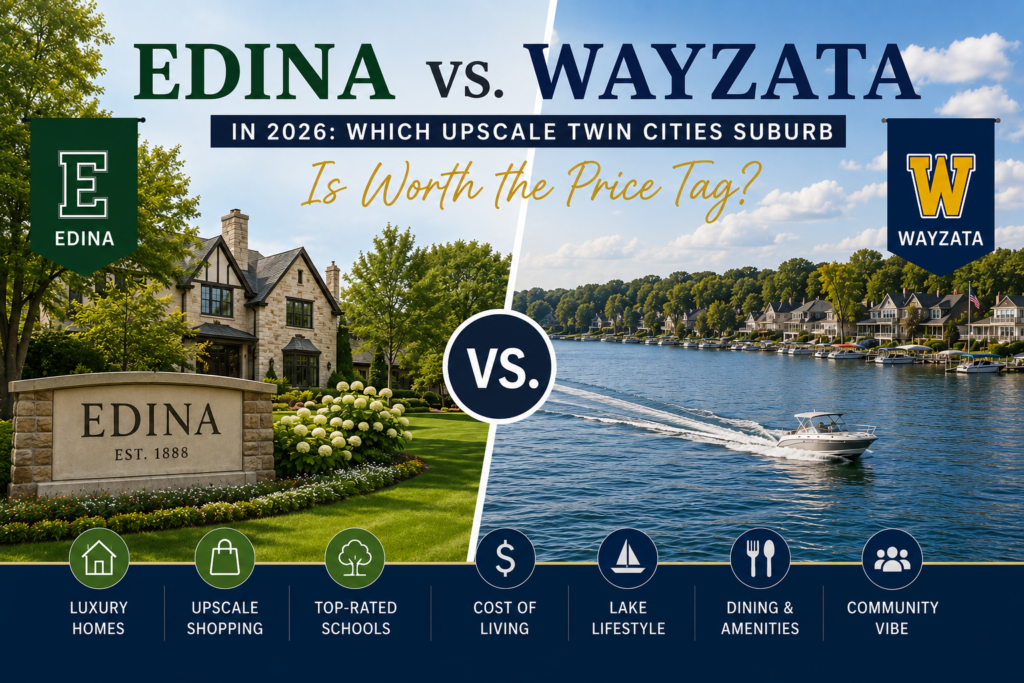
Edina vs. Wayzata in 2026: Which Upscale Twin Cities Suburb Is Worth the Price Tag?

Edina vs. Wayzata in 2026 — comparing luxury homes, lake lifestyle, schools, and cost of living in two upscale Twin Cities suburbs

Two names come up again and again when buyers are shopping the top tier of the Twin Cities market: Edina and Wayzata. Both are prestigious. Both have outstanding schools. Both will cost you. But they’re not the same place, and the right choice depends heavily on how you want to live. If you’re weighing these two upscale Twin Cities suburbs against each other in 2026, here’s what you actually need to know — prices, trade-offs, and all.

The Price Tag: What Homes Actually Cost in Edina vs. Wayzata

Let’s start with the number that matters most. Edina’s median home price is currently around $580,000–$630,000, depending on the month and source — with the most active segment sitting between $400,000 and $600,000. You’ll find entry-level condos near Southdale in the $180,000s and estate properties in Indian Hills pushing well past $3 million. That’s a wide range, which is part of Edina’s appeal: it has more runway for buyers at different budgets.

Wayzata runs considerably higher. Redfin data puts Wayzata’s median sale price at roughly $828,000, and price-per-square-foot figures reflect that premium — Minneapolis Area Realtors data shows Wayzata at approximately $310 per square foot compared to Edina’s $268. When you factor in the lakefront homes and large-lot estates near Lake Minnetonka, the ceiling in Wayzata is essentially unlimited.

Bottom line: if you’re comparing apples to apples in terms of square footage and condition, Wayzata will almost always cost more. The question is whether that premium is worth it to you — and that depends on what you’re buying into beyond the house itself.

Schools: Both Are Elite, but With Different Flavors

School quality is a primary driver for families choosing between these two suburbs, and you genuinely can’t go wrong with either. According to Niche’s 2026 Best School Districts in Minnesota rankings, Wayzata Public Schools ranks #1 in the Twin Cities metro, earning an A+. Edina Public School District follows closely at #3 statewide, also with an A+. Both districts have a strong college-prep culture, dedicated teaching staff, and robust extracurricular programs.

There are some nuanced differences. The Edina district has built a strong reputation around talent development programs, language immersion, and travel-based learning opportunities starting in early childhood. Wayzata schools boast a 96% graduation rate — well above state averages — and a wide range of AP and honors offerings. Wayzata High School itself is physically located in Plymouth, which surprises some buyers; the district boundary doesn’t perfectly match the city limits.

For most families, both districts will deliver an exceptional public school experience. If the small edge in district ranking matters to you, Wayzata has it — but Edina is not far behind by any meaningful measure.

Lifestyle and Location: The Real Differentiator

This is where Edina and Wayzata really diverge. Edina sits right on the border of Minneapolis — about 15 minutes to downtown — and feels like the best of suburban and urban living layered together. You get walkable retail at 50th & France, Centennial Lakes Park, a strong dining and coffee scene, and the kind of neighborhood character that comes from decades of established community. It’s practical, polished, and year-round livable.

Wayzata is a completely different vibe. It’s a small lakefront city on the north shore of Lake Minnetonka, with a compact, walkable downtown built around boutique shops, lakeside dining, and a marina. In summer, it’s magical — boat slips, waterfront promenades, and a community energy that’s hard to replicate. The trade-off is that Wayzata’s downtown appeal is seasonal, and it sits farther west of Minneapolis, adding commute time for those working in the city or eastern suburbs.

Simply put: if you want a suburb that functions efficiently year-round with quick city access, Edina wins. If lake life is central to how you relax and entertain — boating, swimming, watching sunsets over the water — Wayzata’s premium starts to make a lot more sense.

Commute and Convenience: Edina Has the Edge

Edina’s inner-ring location is genuinely one of its most underrated assets. Residents are 15 minutes from downtown Minneapolis, with easy access to major corridors like Highway 100, I-494, and France Avenue. Southdale Center, multiple grocery options, and a dense mix of services make daily errands fast and convenient regardless of the season.

Wayzata is farther west — typically 25 to 35 minutes from downtown Minneapolis depending on traffic — and its smaller size means fewer everyday conveniences within walking or short driving distance. That said, nearby Minnetonka and Plymouth fill in many of those gaps, and buyers who work in the western suburbs or from home often find the commute trade-off entirely acceptable.

If you commute into Minneapolis daily, Edina is the clearer choice. If your work is flexible or based on the west side of the metro, Wayzata becomes much more viable.

So Which One Is Worth It? Here’s How to Decide

There’s no universal right answer here — and anyone who tells you there is probably hasn’t spent much time in both communities. What we can tell you is this: Edina offers more value per dollar for buyers prioritizing proximity to Minneapolis, year-round convenience, and a slightly wider entry point into an upscale market. Its schools are elite, its neighborhoods are established, and its price appreciation has been consistent.

Wayzata commands a premium that’s justified for buyers who want lakefront access, a distinctive small-town atmosphere, and a lifestyle built around Lake Minnetonka. If the lake is a genuine priority — not just a nice-to-have — you’ll feel that difference every weekend from May through October, and the community identity will reward that investment.

According to Minnesota Housing Finance Agency data, both communities have shown long-term price resilience, making either a sound long-term investment for buyers who plan to stay. The real question isn’t which suburb is objectively better — it’s which one fits the way you actually want to live.

That’s where having a local expert in your corner makes all the difference. At MinnMatch, we connect buyers with vetted Twin Cities agents who know both of these markets from the inside — the streets, the neighborhoods, the blocks that hold value, and the ones that don’t. Whether you’re leaning toward Edina or Wayzata, we’ll match you with the right agent to make your move with confidence. Get matched for free →

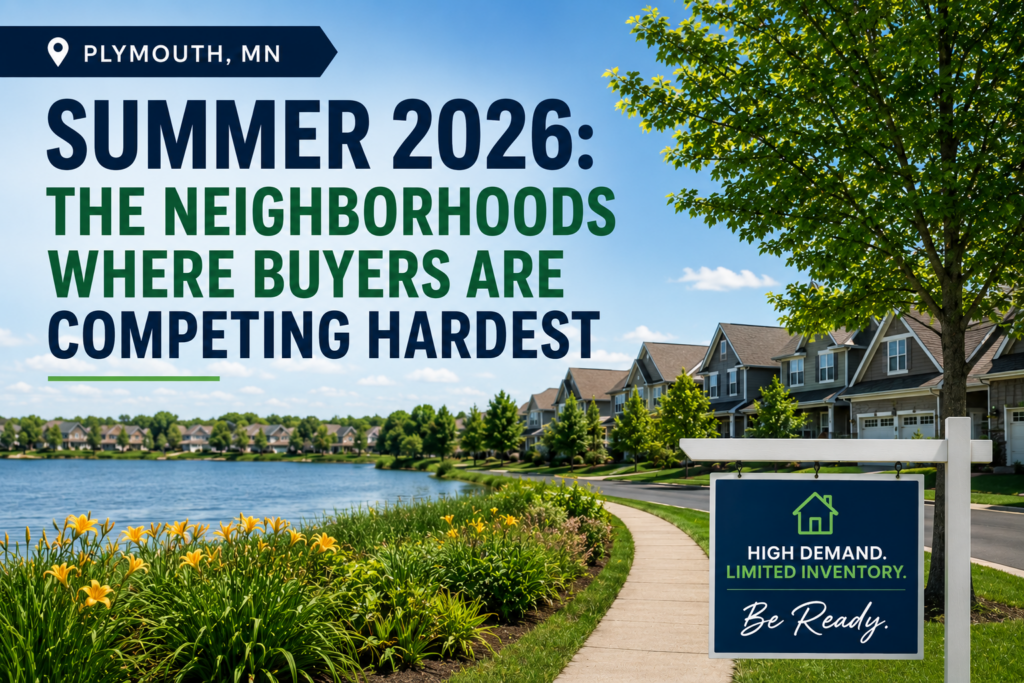
Plymouth MN Summer 2026: The Neighborhoods Where Buyers Are Competing Hardest

Plymouth MN lakeside neighborhood in summer 2026 with homes, walking path, and real estate sign reading High Demand Limited Inventory

If you’ve been searching for a home in Plymouth this summer, you already know: the right listing at the right price doesn’t wait around. Plymouth is one of the Twin Cities’ most consistently sought-after suburbs — ranked among the best places to live in Minnesota year after year — and the summer 2026 market is showing exactly why. While the city overall is operating close to balanced conditions, certain Plymouth neighborhoods are drawing multiple offers, fast closes, and buyers who came prepared. Whether you’re just starting your search or have already lost a home to another offer, understanding where competition is highest in Plymouth right now can change how you approach your next move.

Why Plymouth Is Still a Top Target for Twin Cities Buyers

Plymouth’s appeal has never been one thing — it’s everything stacking together. The city sits in the western metro with easy freeway access to Minneapolis via I-394 and I-494, a trail system stretching over 90 miles, Medicine Lake, and dozens of well-maintained parks. But the single biggest driver of buyer demand, especially among families relocating from out of state, is the school district.

The majority of Plymouth falls within Wayzata Public Schools (ISD 284), which has been ranked the #1 school district in Minnesota for 2024, 2025, and 2026 by Niche. That reputation doesn’t just matter to families with kids in school — it matters to every buyer thinking about resale value down the road. Homes within ISD 284 boundaries consistently carry a valuation premium, and that premium is one reason why certain Plymouth neighborhoods see faster-moving, more competitive conditions than others.

City-wide, Plymouth’s median home sale price sits around $478,000–$500,000 heading into summer 2026, with the Plymouth-Wayzata corridor — where Wayzata school district properties are concentrated — tracking closer to $641,000 at the median. Homes are generally spending between 32 and 56 days on market across the city, though well-priced properties in the neighborhoods below are moving considerably faster.

The Plymouth Neighborhoods Where Competition Is Sharpest

Not every corner of Plymouth is equally competitive — and knowing the difference can save you weeks of frustration. Here are the areas drawing the most buyer interest this summer:

Hollydale

Hollydale is Plymouth’s newest luxury neighborhood — and one of the most talked-about communities in the western metro right now. Built on the former Hollydale Golf Course, it features newer construction homes with open floor plans, high-end finishes, and a setting of mature trees and wetlands that gives it an almost resort-like feel. It’s located just five minutes from Wayzata High School, sits within ISD 284, and includes community amenities like a pool, clubhouse, pickleball court, and playground. Custom homes here from builders like Gonyea, Swanson, and Hanson regularly list from the $900s into the $3M+ range, and move quickly at those price points — a signal of how much demand exists in this pocket. If you’re shopping in Hollydale, being pre-approved and ready to move is non-negotiable.

Plymouth-Wayzata Corridor (West Plymouth)

The stretch of western Plymouth closest to Wayzata — sometimes called the Plymouth-Wayzata neighborhood — is where you’ll find some of the city’s most established, high-value residential streets. Larger lots, custom-built homes, and consistent proximity to both Wayzata’s lakefront amenities and Plymouth’s trail networks make this area extremely attractive. With median sale prices in this corridor running around $641,000 and homes spending about 32–56 days on market, well-priced homes here are not sitting. Buyers competing in this area are often move-up buyers with significant equity or relocating professionals with strong budgets — which means your offer needs to be clean and credible.

The Medicine Lake Area

Homes near Medicine Lake offer something relatively rare in Plymouth: lakefront or lake-adjacent living without Lake Minnetonka price tags. Properties along the lake and within a few blocks of the shoreline — especially Craftsman-style homes on larger, tree-lined lots — draw buyers looking for a lifestyle upgrade alongside their real estate purchase. Inventory near the lake is limited by geography, which creates natural scarcity. When a well-maintained lake-adjacent home hits the market here, it typically doesn’t stay listed long. Buyers interested in this area should monitor new listings closely and be ready to act within days, not weeks.

Cimarron Ponds and Southwest Plymouth

Southwest Plymouth — including neighborhoods like Cimarron Ponds — tends to be one of the more affordable entry points into the city, with single-family homes typically pricing in the mid-$400s to low-$500s. That relative affordability, combined with good access to Bass Lake Road, Rockford Road Plaza, and French Regional Park, makes these neighborhoods popular with first-time buyers and families stretching their budgets to get into Plymouth’s school district. Competition in this price range can be fierce precisely because there are fewer options: when a move-in-ready home hits the $430,000–$490,000 range, multiple buyers often show up. These aren’t luxury listings, but don’t underestimate them.

High-End Townhome Communities (Bassett Creek Crossing, Wyndemere Farms, The Courts of Nantree)

Plymouth’s premium townhome market — particularly communities like Bassett Creek Crossing, Wyndemere Farms, and The Courts of Nantree near the former Hollydale Golf Course — is attracting a specific kind of buyer: downsizers leaving larger single-family homes who want low-maintenance living without leaving Plymouth, and relocating professionals who want quality square footage without yard and exterior upkeep. These communities range from roughly $400,000 to $750,000 and typically offer around 3,000–3,500 square feet of living space. When a well-updated unit opens up, it often draws multiple interested parties quickly.

What’s Driving Competition in Plymouth’s Hottest Pockets?

Across all these neighborhoods, the competition comes down to a few consistent pressures:

  • Low inventory in the most desirable pockets. Even as overall Plymouth inventory has grown modestly in 2026, the ISD 284-zoned, well-finished homes buyers most want remain scarce. City-wide supply sits under 1 month — meaning the best listings get absorbed fast.
  • The Wayzata schools pull. For families relocating to Minnesota, the “where to live” question is often answered by one question: “Can I get into ISD 284?” That funnels significant demand into a defined geographic zone — raising competition within it.
  • Rate-sensitive buyers off the sidelines. As mortgage rates have shown modest improvement heading into summer 2026, buyers who had been waiting are re-entering the market — adding more demand to the same limited supply of well-priced homes.
  • Summer timing. Summer is always Plymouth’s highest-activity season, driven by families wanting to be settled before the school year. June and July consistently see more offers, faster decisions, and less room to negotiate.

How to Compete Successfully in Plymouth This Summer

Knowing which neighborhoods are competitive is only useful if you’re prepared to act when the right home appears. A few things that separate successful buyers in Plymouth’s tighter pockets:

  • Pre-approval is the starting point, not the finish line. In competitive pockets, a lender call within the past 30 days and a fully underwritten pre-approval puts you far ahead of a buyer with just a letter on file.
  • Know your walk-away number before you see the house. In a multiple-offer situation, emotion sets the price — knowing your ceiling in advance keeps you in control.
  • Work with an agent who has Plymouth-specific experience. Neighborhood nuances — like which streets carry ISD 284 zoning, where new construction may be coming, or which listings are likely to generate multiple offers — are things an experienced local agent knows before you do.
  • Be strategic about contingencies. This doesn’t mean waiving everything — it means structuring your offer thoughtfully so it stands out without unnecessary risk.

For more on how the broader Plymouth market compares to other West Metro suburbs, Redfin’s Plymouth market data is updated regularly. The Minneapolis Area Realtors market reports are also a reliable benchmark for tracking citywide and metro-level trends.

Find a Plymouth Agent Who Knows These Neighborhoods Cold

Competing in Plymouth’s summer market isn’t just about speed — it’s about working with someone who already knows which neighborhoods are moving fast, which listings are worth pursuing, and how to write an offer that holds up under pressure. At MinnMatch, we connect buyers with experienced, locally grounded Plymouth agents who know the city street by street — not just zip code by zip code.

Tell us what you’re looking for and we’ll match you with a Plymouth agent who can help you compete — and win — this summer.

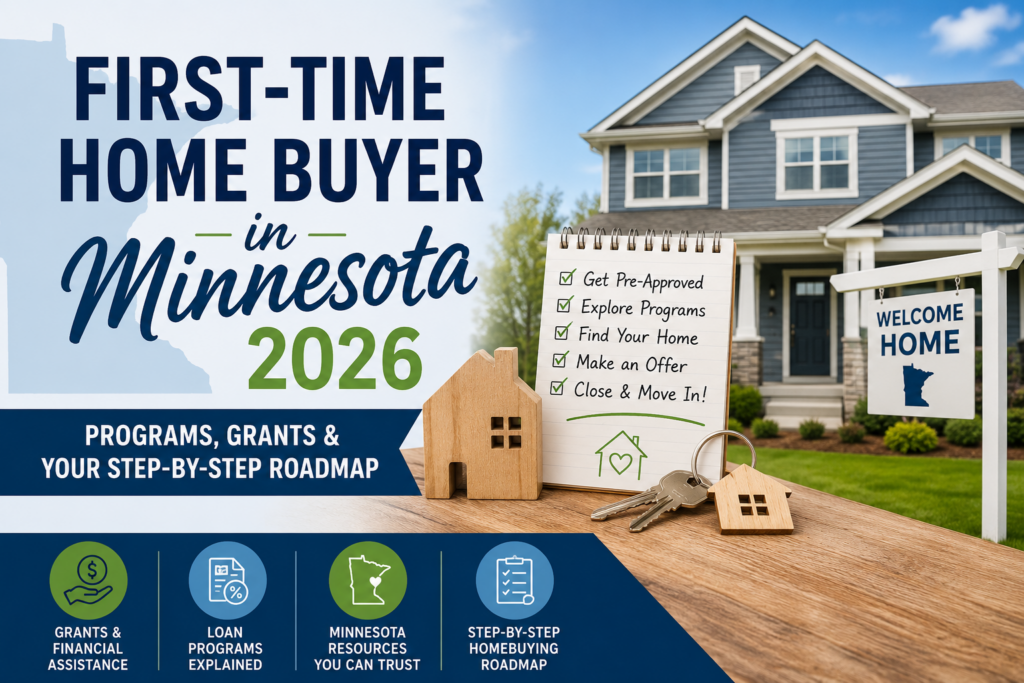
First-Time Home Buyer in Minnesota 2026: Programs, Grants & Your Step-by-Step Roadmap

First-time home buyer in Minnesota 2026 — programs, grants and step-by-step homebuying roadmap

Buying your first home in Minnesota is one of the biggest financial moves you’ll ever make — and in 2026, it’s more achievable than you might think. Between competitive mortgage programs through the Minnesota Housing Finance Agency (MHFA), targeted down payment grants, and a Twin Cities market that still offers real opportunities in the right neighborhoods, first-time home buyers in Minnesota have more tools at their disposal than ever. This guide walks you through every program worth knowing about — and gives you a clear, step-by-step roadmap from “I think I’m ready” to keys in hand.

What Counts as a First-Time Home Buyer in Minnesota?

Before diving into programs, it helps to know how Minnesota officially defines “first-time buyer.” The MHFA uses a standard definition: you qualify if you have not owned a primary residence in the past three years. That means even if you owned a home a decade ago but have been renting since, you can still access first-time buyer programs today. Divorced individuals who haven’t owned since the split may also qualify — it’s worth confirming your status with an MHFA-approved lender.

There’s also an important distinction between programs for first-time buyers specifically and programs open to any buyer. The MHFA’s Step Up program, for example, is available to repeat buyers as well — so even if you don’t qualify as a first-timer, don’t stop reading.

Minnesota First-Time Home Buyer Programs in 2026

The state’s main gateway for first-time home buyer programs in Minnesota is the Minnesota Housing Finance Agency (MHFA), which offers below-market interest rate loans and down payment assistance that can dramatically reduce what you need upfront. Here’s a breakdown of the primary programs available in 2026.

🏠 MHFA Start Up Loan

The Start Up loan is the flagship program for first-time buyers in Minnesota. It offers a competitively priced first mortgage with below-market interest rates — and it’s the required first mortgage for accessing most of MHFA’s down payment assistance options.

  • Who qualifies: First-time buyers (no ownership in past 3 years)
  • Income limits (Twin Cities 11-county metro): Up to $124,200 for 1–2 person households; up to $142,800 for 3+ person households
  • Income limits (all other MN counties): Up to $111,800 for 1–2 person; up to $128,500 for 3+
  • Minimum credit score: 640
  • Purchase price limit: $450,000
  • Education required: Yes — a homebuyer education course is mandatory

💰 Down Payment & Closing Cost Assistance

Paired with a Start Up first mortgage, MHFA offers three down payment loan options that can cover both your down payment and closing costs:

Monthly Payment Loan — Borrow up to $18,000 as a second mortgage at 0% interest, repaid in monthly installments over 10 years alongside your main mortgage. No separate income limits apply; any Start Up-eligible borrower can use this option.

Deferred Payment Loan (DPL) — A 0% interest second mortgage with no monthly payments required. You repay the loan when you sell, refinance, or pay off the home. Income limits apply (up to $89,000 for 1–2 person households in the metro).

Deferred Payment Loan Plus (DPL+) — For lower-income buyers with at least one “targeting factor” (such as purchasing in a high-cost area or being a person of color), this offers larger assistance amounts with favorable terms.

⭐ First-Generation Homebuyer Loan Program

One of the most significant programs launched in recent years, the First-Generation Homebuyer Loan offers up to $35,000 in down payment and closing cost assistance — as a deferred, interest-free, and forgivable loan. Half of the loan is forgiven after 10 years and the remainder after 20 years. To qualify, you must be a first-generation homebuyer (meaning neither of your parents owned a home, or you were in foster care), and you must use a Start Up first mortgage.

Note: This program is funded and available on a first-come, first-served basis. If you think you may qualify, connecting with an MHFA-approved lender early is strongly advised.

Local & Federal Programs First-Time Buyers in Minnesota Should Know

Beyond the MHFA’s statewide programs, Minnesota buyers may have access to additional assistance through local governments and federal loan types. A few worth knowing:

FHA Loans — Federally backed mortgages requiring as little as 3.5% down with a 580+ credit score. FHA loans are especially popular with first-time buyers who have limited savings or are still building credit. They’re widely available through conventional lenders in the Twin Cities and can be combined with MHFA down payment assistance.

VA Loans — If you’re a veteran, active-duty service member, or eligible surviving spouse, VA loans offer 0% down financing with no private mortgage insurance. Minnesota has a strong military community, and many Twin Cities buyers take advantage of this benefit.

USDA Rural Development Loans — Available in qualifying rural and some suburban areas of Minnesota, USDA loans also offer 0% down. Some communities in the outer metro — think areas beyond the immediate Twin Cities ring — may qualify. Worth checking if you’re open to a longer commute.

City & County Programs — Minneapolis, Saint Paul, and several suburban counties offer their own buyer assistance programs on top of state resources. Anoka County, for example, points buyers directly to MHFA’s programs; other counties have additional local funds. Ask your agent or lender what’s available in the specific community where you’re shopping.

For a broader look at the Minnesota housing market and what today’s buyers are navigating, Redfin’s Minneapolis market overview is a helpful real-time reference.

Your Step-by-Step Roadmap to Buying Your First Home in Minnesota

Knowing the programs is one thing. Knowing what to do — and in what order — is what actually gets you from renter to homeowner. Here’s how the process looks for a typical first-time buyer in the Twin Cities metro.

1

Check Your Credit & Know Your Numbers

Pull your credit report and know your score before you talk to anyone. Most MHFA programs require a minimum 640. If you’re below that, spend 3–6 months paying down balances and correcting any errors on your report. Also tally your savings — you’ll want a clear picture of what you have available for a down payment, closing costs, and emergency reserves after closing.

2

Take the Required Homebuyer Education Course

Most MHFA programs require completing an approved homebuyer education course before closing. The good news: it’s available online, takes roughly 6 hours, and costs around $75. Minnesota Housing publishes a list of approved providers at mnhousing.gov. Get this done early — it’s a prerequisite, not an afterthought.

3

Get Pre-Approved Through an MHFA-Approved Lender

To access any MHFA program, you must work with an MHFA-approved lender — not just any bank or mortgage company. The list is available on the Minnesota Housing website. When you apply, your lender will automatically assess which state programs you qualify for and handle the paperwork. This is also where you’ll lock in your pre-approval letter, which is essential before making any offers in today’s Twin Cities market.

4

Find a Local Real Estate Agent Who Knows the Market

For first-time buyers especially, your agent makes an enormous difference. You want someone who works regularly in the neighborhoods you’re targeting, understands how MHFA programs interact with offer strategy, and will advocate for you through inspection, negotiation, and closing. The Twin Cities has hundreds of agents — the challenge is finding the right fit for your situation, not just someone with a license. This is exactly why MinnMatch exists: to connect first-time buyers with vetted, locally experienced agents who specialize in exactly what you’re looking for.

5

Search, Offer & Negotiate

With pre-approval in hand and an agent by your side, you’re ready to start shopping. In the Twin Cities, the sub-$400K segment tends to move quickly — especially in suburbs like Plymouth, Lakeville, and Woodbury where first-time buyers often compete. Your agent will help you structure competitive offers, advise on contingencies, and negotiate on your behalf if issues come up after inspection.

6

Home Inspection, Appraisal & Final Financing

Once your offer is accepted, you’ll move into the due diligence period. A home inspection is strongly recommended — even in competitive markets. Your lender will order an appraisal, and your MHFA loan will be formally processed during this period. Budget 30–45 days from accepted offer to close in most Twin Cities transactions.

7

Close & Get Your Keys

Closing day is when everything comes together. You’ll sign documents, your down payment assistance is applied, closing costs are settled, and ownership transfers to you. If you used a Deferred Payment Loan, note that there are no extra payments at the closing table for that portion — it’s handled as a second lien that only comes due when you sell or refinance later. Then: you’re a homeowner.

What’s the Real Cost of Buying Your First Home in the Twin Cities in 2026?

Let’s talk numbers. The median home price in Minnesota was approximately $354,500 as of early 2026, though Twin Cities metro prices vary widely by neighborhood and suburb. Here’s a rough picture of what a first-time buyer might need at closing — and how MHFA assistance changes that equation.

Expense Without Assistance With MHFA Programs
Down Payment (3.5% FHA on $350K) $12,250 Covered by DPA loan
Closing Costs (~3% of purchase) ~$10,500 Partially/fully covered by DPA
Homebuyer Education Course ~$75 ~$75
Home Inspection $350–$550 $350–$550
Total Out-of-Pocket Estimate $23,000–$25,000 As low as $500–$2,000+

*Estimates based on a $350,000 purchase price using FHA financing with a Monthly Payment Loan for down payment assistance. Actual amounts vary by purchase price, loan type, and specific programs used. Consult an MHFA-approved lender for a precise breakdown.

For a deeper look at how Minnesota compares nationally and what homeownership trends look like, the U.S. Census Bureau’s homeownership data provides useful context.

Where in the Twin Cities Should First-Time Buyers Look in 2026?

With the MHFA purchase price cap at $450,000, first-time buyers have more options than you might expect — including in some of the metro’s most desirable communities. Here are a few areas where first-time buyers are finding traction right now.

Plymouth — Consistently ranked among the best suburbs in the state, Plymouth offers solid inventory in the $300K–$420K range, excellent schools, and a community feel that first-time buyers tend to love. It’s competitive but not impossible.

Lakeville & Burnsville — South metro suburbs with strong value, newer housing stock, and room to grow. Lakeville especially has attracted first-time buyers who want more space for their money.

Brooklyn Park & Maple Grove — Northwest metro suburbs that offer a wide price range and a diverse housing market. Brooklyn Park in particular is seeing renewed buyer interest from first-timers priced out of tighter suburban markets.

South Minneapolis Neighborhoods — For buyers who want city living, neighborhoods like Nokomis, Longfellow, and Powderhorn offer urban character, walkability, and entry-level price points that remain accessible compared to many coastal metros. Explore MinnMatch’s guide to South Minneapolis real estate for a closer look.

Eden Prairie — If your budget stretches toward the higher end of what MHFA allows, Eden Prairie gives first-time buyers access to one of the Twin Cities’ top-rated suburbs. It’s not the cheapest option, but the lifestyle amenities and school quality are hard to beat.

Ready to Take the Next Step?

Knowing the programs is only half the equation. The other half is having the right agent in your corner — someone who knows the Twin Cities market, understands how MHFA financing works in an offer situation, and will walk with you from your first showing to closing day. MinnMatch connects first-time buyers with hand-picked, locally vetted agents at no cost to you.

Find My Agent — It’s Free

Summer Is Peak Season on Lake Minnetonka — Here’s Why Smart Sellers List Now

Lakefront home on Lake Minnetonka in summer with a classic wooden boat docked and Adirondack chairs on the deck

If you own a home on or near Lake Minnetonka, you already know what summer feels like out here — boats on the water by 7 a.m., dinner on the deck until dark, neighbors you only see three months a year suddenly everywhere. What you might not fully appreciate is that this exact feeling is what drives buyers to make their move — and why the window between Memorial Day and Labor Day is the single most powerful selling season on the lake. Right now, in June 2026, that window is wide open. And the sellers who list today are the ones positioned to get top dollar before it closes.

Why Summer Is the Season That Defines Lake Minnetonka Real Estate

Lakefront real estate operates on a different calendar than the broader housing market. While spring is often the peak selling season for suburban homes across the Twin Cities, Lake Minnetonka’s peak runs from Memorial Day through mid-August — and for a very simple reason: buyers need to see the lake at its best before they’ll commit to buying on it.

Think about what buyers are actually purchasing when they buy a Lake Minnetonka home. It’s not just square footage and a neighborhood — it’s a lifestyle. They want to picture themselves on the dock, launching from the slip, watching fireworks from the deck. That vision only comes to life in summer. A lakefront home shown in January tells a buyer almost nothing about why the property is worth a premium. A lakefront home shown in June, with the water sparkling and boats in the slip, sells itself.

This isn’t just intuition — it’s reflected in the data. LakePlace.com currently shows 218 active Lake Minnetonka lake property listings with an average listing price of $2.84 million — and that pool of motivated, financially serious buyers is actively browsing right now. The buyers shopping in June aren’t casually clicking through Zillow. They’ve been planning this purchase for months, they’re pre-qualified, and they want to be on the water before summer slips away.

The Numbers Behind the Summer Seller’s Advantage

The broader Twin Cities market is giving sellers real momentum heading into summer 2026. According to Minneapolis Area Realtors®, the metro’s months supply of single-family homes sits at just 2.0 months — firmly in seller’s territory. The median sales price in the region has climbed to $380,000, and closed home sales jumped 46.7% month-over-month from February to March 2026, signaling that buyer activity is accelerating into the warm season. And 2026 has delivered the strongest spring for new listings since 2022, which means buyers have been actively engaged and ready to pull the trigger.

On the lake itself, the premium over broader market prices is substantial. While Hennepin County’s rolling median hovers around $400,000, Lake Minnetonka’s shoreline communities command a completely different price tier. The Minneapolis Area REALTORS® 2024 Annual Housing Report showed median sale prices of $2.29 million in Minnetonka Beach, $1.90 million in Tonka Bay, $1.14 million in Orono, $1.09 million in Wayzata, $1.0 million in Deephaven, and $840,000 in Excelsior. The average Lake Minnetonka lakeshore listing runs $545 per square foot — nearly 2.5x the broader metro average.

Lakefront properties have also shown strong appreciation. Average sales prices on the lake rose roughly 3.9% in 2025, with price per square foot up 5.2% — outpacing the broader market and signaling continued demand that hasn’t softened heading into 2026.

The Window Is Shorter Than You Think

Here’s the truth that catches a lot of Lake Minnetonka sellers off guard: the prime selling window on the lake is about 10 to 12 weeks long. Once you get past mid-August, buyers’ urgency drops off fast. School starts, attention shifts, and the emotional pull of “I need to be on the lake this summer” disappears until next year. What had been a motivated, time-pressed buyer pool becomes a much more patient, deliberate one — and patient buyers negotiate harder.

Sellers who list in late August or September often find themselves chasing the market rather than leading it. They miss the buyers who were ready to act in June. They watch their days on market climb. They start reducing their price in October to attract whatever off-season traffic is left. By contrast, sellers who list in early June catch buyers at peak motivation — when “I want to be here for the rest of this summer” is a real and powerful emotion that translates into faster decisions and stronger offers.

That’s not a minor detail. On a $1.5 million lakefront property, the difference between a strong June offer and a discounted September offer can easily be $75,000 to $150,000 — just from timing alone.

What Smart Lake Minnetonka Sellers Are Doing Right Now

Getting the most out of a summer listing on Lake Minnetonka isn’t just about timing — it’s about showing up ready. A few things that move the needle on lakefront properties specifically:

Price from true lakefront comps, not county averages. The biggest pricing mistake sellers make is benchmarking against Hennepin County’s overall median. Your pricing strategy needs to account for your specific bay location, shoreline footage, dock access, water orientation, and privacy. A home on the coveted west side of the lake with 100 feet of shoreline and a deep-water slip is priced very differently than a deeded-access property two blocks from the water — even if they’re in the same zip code.

Show the lake, not just the house. Professional photography and video should capture the property from the water, not just from the driveway. Drone footage of the bay, the dock, the shoreline approach — this is what lakefront buyers actually want to see, and it’s what makes a listing stand out in a market where buyers are browsing from across the country.

Get the dock and shoreline ready before you list. Buyers will walk the shoreline. A weathered dock, invasive weeds near the water’s edge, or an overgrown bank tells a buyer there’s deferred maintenance — even if the home itself is immaculate. Pressure-washing the dock, trimming the shoreline, and putting the boat lift in service before photos are taken can make a significant difference in first impressions.

Work with an agent who knows the lake — not just the metro. Lake Minnetonka’s 37 bays, 31 channels, and 120+ miles of shoreline create enormous variation in value. An agent who sells homes across the metro may not know the difference in buyer demand between a home on Crystal Bay versus one on Cook’s Bay, or how much a south-facing orientation adds at sunset. You need someone who has negotiated lakefront-specific deals, understands DNR shoreline regulations, and can speak fluently to dock rights and water access.

Find the Right Agent — and Move Before the Season Peaks

If you’re thinking about selling your Lake Minnetonka home this year, the time to act is now — not in August, not after Labor Day, and not “when things slow down.” The buyers are here, the market is strong, and the emotional pull of summer on the lake is working in your favor. Every week you wait is a week of that window closing.

At MinnMatch, we specialize in connecting Lake Minnetonka sellers with agents who actually know this market — people who’ve closed deals on these shores, understand lakefront pricing nuances, and know how to reach the right buyers fast. Our matching process is free, personal, and built around your specific property and goals.

Connect with a Lake Minnetonka listing agent through MinnMatch today — and get your home in front of summer buyers while the season is still working for you.

June 2026 Twin Cities Housing Market Report: Summer Trends, Inventory Shifts & Neighborhood Insights

Colorful stacked toy houses with cash and a sun illustration representing the Twin Cities summer 2026 housing market

Summer is here, and the Twin Cities housing market has something to say. After years of frenzied bidding wars, shrinking inventory, and buyers waiving every contingency just to get to the closing table, June 2026 feels noticeably different. More homes are hitting the market. Prices are softening in a meaningful way. And buyers — still cautious, but increasingly empowered — are taking their time. Whether you’re buying, selling, or just keeping an eye on the market, here’s your ground-level look at what’s happening across the Twin Cities metro this summer.

The Numbers Don’t Lie: A Market in Transition

The April 2026 data from Minneapolis Area Realtors® told a story that surprised even seasoned local agents. Home sales in the metro were down more than 3% compared to April 2025, with roughly 3,800 closings recorded. The median sale price dipped 2% to $392,000 — the first meaningful price decline in years. Active listings across the metro jumped 16.1% year-over-year, reaching approximately 13,560 available homes. And the average days on market stretched to 57 days, a sign that buyers are no longer rushing.

Most striking? Closed home prices in April 2026 were 3.5% lower than the same month in 2025 — one of the steeper year-over-year declines the metro has recorded in recent memory, and a notable reversal after years of steady appreciation. The 2026 Twin Cities market report headline from Minneapolis Area Realtors said it plainly: “More Homes, More Deals, Softer Metro Prices.” That’s not a crash — but it is a clear shift. Minneapolis Area Realtors leadership described the current softness as the market “finding balance” after the COVID-era surge — less a collapse and more a correction toward normalcy.

What’s Driving the Shift? Agents Weigh In

We asked two of our top MinnMatch partner agent teams to share what they’re seeing on the ground. Their perspectives offer a rare window into the real dynamics shaping transactions right now — not just the data, but the psychology behind it.

Emily & Kelly point to pricing strategy as the single most important variable in today’s market: “Homes that are priced correctly from the start tend to outperform those that chase the market. Even in what is still considered a seller-leaning environment, we’re seeing fewer multiple-offer situations than in previous years.” When a home is strategically priced — sometimes slightly below market — it generates stronger showings, shorter days on market, and often ends up closing higher due to competitive interest. Multiple-offer situations that do develop are closing around 10% over list price on average, though results vary considerably based on condition, location, and strategy.

Buyers, they note, are exercising real caution around waiving inspections — unless a pre-listing inspection is already on file, which has become an increasingly useful tool for sellers. Negotiations overall feel more deliberate. “Both sides are more selective and intentional,” they say, “which is shaping a more balanced negotiation environment.” Winning offers today often hinge on creative terms rather than simply the highest number — a recent deal their team closed came together because they identified a specific seller priority and addressed it directly in the offer, avoiding a prolonged multiple-offer situation altogether.

Art, another veteran MinnMatch partner agent, offers a blunter read: “The market doesn’t feel different. It IS different.” He’s been watching buyers become significantly more discerning — and he’s seeing a new factor at play. “AI is increasing its presence in vetting properties. Clients now use it to help them understand, as an independent party, what a property may be worth.” His view: AI tools can give buyers a starting point, but they’re no substitute for real MLS data and a knowledgeable local agent. A Buyer’s Market Analysis from an expert in the field remains the most reliable way to understand true value.

Art also points to a broader backdrop that’s shaping buyer psychology: “While interest rates have bounced a bit to the mid-6s, gas is at a 4.5-year high. Inflation is up again. And we’re involved in another international conflict.” Even with a strong stock market and continued consumer spending, economic anxiety is real — and it’s translating to more cautious offers and longer days on market across the metro. His bottom line: “It’s a buyer’s market, and now’s a great time to buy.” To be precise, the metro’s months of supply still sits between roughly 1.8 and 2.4 months — well below the 5 to 6 months that technically defines a buyer’s market. But Art’s point holds: buyers have meaningfully more leverage today than they’ve had in years, and the window is real.

Inventory Is Up — But It’s Not Equal Everywhere

One of the defining stories of the 2026 Twin Cities housing market is the inventory surge — the most available homes in nine consecutive years. But that inventory isn’t evenly distributed, and where you’re shopping makes an enormous difference.

In the urban cores of Minneapolis and St. Paul, well-conditioned and updated homes can still generate quick attention, but buyers have become more selective about what they’ll pay a premium for. The days of “buy anything, anywhere, at any price” are firmly over. Move-in-ready homes in desirable neighborhoods continue to perform; dated properties are sitting.

In the suburbs and south metro, including communities like Eden Prairie, Prior Lake, and Edina, listings are generally selling near asking price, but median market times are extending as buyers take a more measured approach. Affordability-focused buyers are increasingly looking to areas like Plymouth and the outer-ring suburbs where value per square foot remains compelling.

Townhomes are a notable bright spot. In April 2026, townhome sales were the only property type to show annual growth — up 7.2% metro-wide — as buyers gravitate toward lower-maintenance, more affordable entry points into homeownership. Condo prices, by contrast, saw the steepest decline, falling 3.1% year-over-year to a median of $190,000. Redfin’s Minneapolis market data reflects similar mixed signals at the neighborhood level.

Summer Seasonality: Slow Start, Active Ahead

June in the Twin Cities always comes with a familiar rhythm: school ends, cabin weekends pull families north, graduation parties fill up the calendar. Real estate activity typically softens slightly in early June before picking back up through July and into August. This year is following that pattern — with one key difference. Agents are reporting that buyer activity has picked up modestly over the past few weeks, suggesting we may be heading into a more active summer than the spring data implied.

Mortgage rates remain a variable worth watching. The 30-year fixed rate has been bouncing in the mid-6% range — elevated compared to the pandemic-era lows that many buyers still remember, but stabilizing compared to the volatility of recent years. Minnesota Housing Finance Agency programs continue to offer first-time buyer assistance that can meaningfully offset those rate headwinds for qualifying households.

For sellers, the summer window remains real — but the playbook has changed. Overpriced listings that once sold anyway are now sitting. Homes that are prepped, priced correctly, and positioned well for their neighborhood are still generating strong results. Pre-listing inspections are gaining traction as a way to reduce friction and give buyers confidence, shortening the path from offer to close.

More Leverage for Buyers — What It Means for Your Move

The June 2026 Twin Cities housing market presents a genuinely interesting opportunity — particularly for buyers who’ve been sitting on the sidelines waiting for conditions to improve. More inventory means more choices. Softer prices mean more negotiating room. Longer days on market mean more time for due diligence. This isn’t a buyer’s market in the technical sense — inventory levels aren’t there yet — but buyers have more breathing room than they’ve had since before the pandemic. Sellers willing to inspect, price honestly, and negotiate in good faith are still closing deals at solid prices. Those chasing 2022-era numbers are learning the hard way that this market doesn’t reward wishful thinking.

Whether this represents a temporary cooling or the beginning of a longer market shift is, honestly, the question everyone is asking. The smart move — for buyers and sellers alike — is to work with a local agent who knows the data, knows the neighborhoods, and can help you navigate the nuance. A Buyer’s Market Analysis or Seller’s Pricing Consultation from a vetted local expert is still the most reliable tool available, regardless of what any app or algorithm tells you.

At MinnMatch, we personally match Twin Cities buyers and sellers with handpicked, vetted local agents who specialize in your specific market — at no cost to you. If you’re trying to make sense of this shifting market and want someone who actually knows the neighborhoods, the data, and the dynamics firsthand, we’d love to connect you with the right agent today.

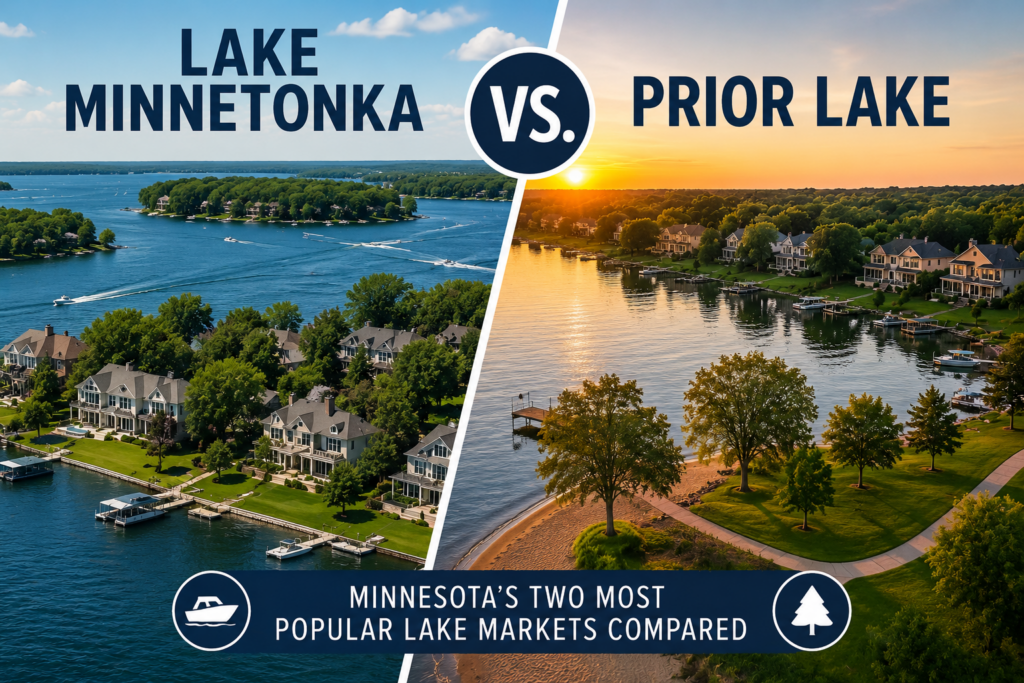
Lake Minnetonka vs. Prior Lake: Minnesota’s Two Most Popular Lake Markets Compared

Aerial comparison of Lake Minnetonka and Prior Lake waterfront homes in Minnesota

If you’re searching for a lake home in the Twin Cities metro, two names come up again and again: Lake Minnetonka and Prior Lake. Both offer genuine waterfront living, strong community identities, and real estate markets that consistently outperform their landlocked neighbors. But Lake Minnetonka vs. Prior Lake real estate is not an apples-to-apples comparison — and understanding the differences could save you months of searching in the wrong direction.

This guide breaks down both markets across price, lifestyle, buyer profile, and long-term value so you can make a more informed decision — or hand this article to the agent who’s helping you make it.

Not sure which market is right for you? MinnMatch can match you with a vetted local agent who knows both lakes inside and out.

Lake Minnetonka vs. Prior Lake: The Basics

Before comparing the real estate, it helps to understand what you’re actually buying access to.

Lake Minnetonka is the headline act of Minnesota metro lake living. Spanning roughly 14,000 acres across 14 communities in Hennepin County, it’s the largest and most storied lake in the Twin Cities area — a destination that has defined western-suburb prestige for more than a century. Wayzata, Excelsior, Orono, and Deephaven are among the communities that ring its 125 miles of shoreline. The lake sits approximately 12 miles west of downtown Minneapolis.

Prior Lake — technically two connected lakes, Upper and Lower Prior Lake — covers about 1,340 combined acres in Scott County, roughly 20 miles southwest of downtown Minneapolis. It’s smaller in scale but punches well above its size in desirability. The city of Prior Lake has grown significantly in recent decades and is now home to approximately 27,000 residents who have built their community identity around water access, outdoor recreation, and quality schools.

In short: Lake Minnetonka is the prestige play. Prior Lake is the accessible-but-still-aspirational alternative. Both are legitimate lake markets — but they attract meaningfully different buyers.

Price Comparison: What Does a Lake Home Actually Cost?

Lake Minnetonka

Lake Minnetonka is one of the most expensive residential real estate markets in Minnesota, full stop. As of May 2026, there are roughly 218 active waterfront listings on the lake with an average asking price of approximately $2.8 million — and a price per square foot hovering around $545. Typical lakeshore listings average about 4,500 square feet with nearly four bedrooms and four bathrooms.

The range is wide. Entry-level access to Lake Minnetonka shoreline can start around $1 million for a smaller or dated cottage, while high-end estates in Orono or Wayzata regularly list at $10 million and above. At the extreme end, an extraordinary off-market estate was listed at $55 million — more than 29,000 square feet with a wine cave, movie theater, bowling lanes, and multiple docks.

For buyers who want proximity to the lake but not a direct shoreline price tag, the broader communities surrounding the lake — the city of Minnetonka, Wayzata, Excelsior — offer more accessible entry points. The city of Minnetonka’s overall median home value sits around $521,000 as of 2025, reflecting the mix of lakefront luxury and inland residential neighborhoods.

Prior Lake

Prior Lake offers a more accessible price spectrum while still delivering real waterfront value. The citywide median home value is approximately $526,000 as of early 2026 — remarkably close to broader Minnetonka — but the waterfront premium is more moderate.

As of May 2026, there are 57 active lake property listings in Prior Lake with an average listing price of roughly $1.65 million and a price per square foot of $383 — meaningfully below Lake Minnetonka’s $545. The most expensive waterfront listing sits at $17.9 million, while more modest lake-access properties can be found for as little as $135,000 (typically association-access or smaller lots).

For buyers who want lakefront living in the $600,000–$1.2 million range, Prior Lake offers options that simply don’t exist on Lake Minnetonka. That’s a significant differentiator for move-up buyers, growing families, and buyers relocating from out of state.

Side-by-Side Snapshot

Metric Lake Minnetonka Prior Lake
Lake size ~14,000 acres ~1,340 acres
Avg. waterfront listing price ~$2.8M (May 2026) ~$1.65M (May 2026)
Avg. price per sq ft (waterfront) ~$545 ~$383
Citywide median home value ~$521,000 (Minnetonka city) ~$526,000
Distance to Minneapolis ~12 miles west ~20 miles southwest
School district(s) Minnetonka, Wayzata, Orono, Mound Westonka Prior Lake-Savage Area Schools
Communities on the lake 14 1 (city of Prior Lake)

Lifestyle: Two Very Different Lake Vibes

Lake Minnetonka: Established Elegance, Walkable Villages, Deep Roots

Lake Minnetonka has a character that’s hard to replicate — it has been Minnesota’s most coveted lake address for well over a century. The 14 communities surrounding it each have distinct identities. Wayzata is boutique-chic with a vibrant downtown, waterfront dining, and a Metra train connection to Minneapolis. Excelsior has the feel of a classic Midwestern lake town, with independent shops, a public beach, and summer street festivals. Orono and Greenwood offer wooded privacy and estate-scale properties. Deephaven sits somewhere in between — elegantly residential, less commercial, deeply quiet.

The lake itself supports year-round recreation. In summer it’s a full destination: boating, paddleboarding, sailing regattas, and fishing tournaments. In winter, ice fishing shanties dot the bays and the lake is a fixture of the local snowmobile culture. The social fabric around Lake Minnetonka is dense — yacht clubs, community events in Excelsior, the iconic Lord Fletcher’s on the water — and buyers are often as drawn to that community energy as they are to the shoreline itself.

Proximity to Minneapolis is a genuine selling point, too. Most lake towns are a 20–30 minute drive, making it feasible to live a lake-first life without sacrificing urban access.

Prior Lake: Active, Unpretentious, Growing Fast

Prior Lake has a different energy — less legacy prestige, more lived-in vitality. The city has grown considerably over the past two decades, and that growth has attracted a younger demographic of families who want authentic lake access without the stratospheric price tag of the west metro lakes.

Upper Prior Lake tends to attract buyers who want calmer waters, more privacy, and a settled residential character. Lower Prior Lake, with its more open water, draws the boating and water sports crowd. Both are consistently among the most popular recreational lakes in the south metro. The lake hosts strong fishing — walleye, northern pike, largemouth bass, and crappie — and the broader community includes 51 parks, extensive trail networks, and the prestigious Wilds Golf Club adjacent to the lake’s southern neighborhoods.

The Prior Lake Association has worked since 1946 to preserve and promote the water and shoreline, and the city actively monitors water quality and manages aquatic invasive species — a sign that the community takes its lake asset seriously for the long term.

Scott County’s consistent growth has made Prior Lake one of the fastest-growing communities in Minnesota, and the Prior Lake-Savage Area Schools draw strong reviews from families considering the area. For buyers who are prioritizing school quality alongside lake access, Prior Lake checks both boxes at a more attainable price point.

Which Lake Market Is Right for You? Buyer Profiles

Both Lake Minnetonka and Prior Lake attract lake-lifestyle buyers — but the specific buyer profiles diverge in meaningful ways. Here’s a practical breakdown.

Lake Minnetonka Is Typically the Better Fit If:

  • Your budget for waterfront is $1.5 million or above, and ideally $2–5 million for a move-in-ready lakeshore property.
  • You want walkable access to vibrant communities like Wayzata or Excelsior — coffee shops, restaurants, boutiques, right from the boat or the sidewalk.
  • You’re drawn to the prestige and legacy of the address — Lake Minnetonka is a known quantity nationwide and carries status that Prior Lake simply doesn’t match.
  • You work in Minneapolis and want a west-metro commute or access to Wayzata’s Metra rail stop.
  • You prioritize a robust social lake culture — yacht clubs, regattas, and a dense community of other lake residents who share the lifestyle.
  • You’re looking at this as a long-term luxury investment and want the brand-name lake with historical price resilience.

Prior Lake Is Typically the Better Fit If:

  • You want genuine waterfront access with a budget in the $500,000–$1.5 million range — a segment where Lake Minnetonka options are extremely limited.
  • You have school-age children and want a strong, cohesive school district (Prior Lake-Savage) paired with a family-oriented community culture.
  • You prefer a more intimate lake — fewer commercial operators, calmer on summer weekends, a more neighborhood-oriented feel.
  • You work in the south metro (Shakopee, Eden Prairie, Burnsville) and want to minimize commute time while maximizing lifestyle.
  • You’re a first-time lake-home buyer and want to learn the lifestyle before potentially stepping up to a higher-price lake market later.
  • Outdoor recreation — fishing, boating, golf at The Wilds, trail access — matters more to you than proximity to upscale commercial districts.

Market Dynamics: Competition, Inventory, and Days on Market

Lake Minnetonka waterfront is structurally undersupplied — there’s a fixed amount of shoreline, very few new lots, and demand that remains elevated even when broader markets soften. In July 2025, waterfront homes on Lake Minnetonka averaged about 63 days on market, up from 31 days the prior year as buyers exercised more patience at elevated price points. That’s not a sign of weakness so much as a reflection of how selective the buyer pool is at $2–5 million.

Prior Lake is more active in volume terms. The broader Prior Lake market had 52 homes sold in August 2025, up meaningfully from 38 the prior year — and homes in the city sell in roughly 26–40 days depending on the segment. Waterfront properties move faster and with less negotiating room, similar to any lake-adjacent market in the metro.

Both markets benefit from Minnesota’s broader housing dynamics: statewide, inventory remains limited relative to buyer demand, and lake properties in the Twin Cities continue to be treated as lifestyle assets rather than purely transactional purchases. Buyers who hold well-positioned lake homes on either lake tend to hold them — which keeps turnover low and well-priced listings competitive.

What to Watch For in Either Market

Both lake markets have nuances that make local expertise essential. A few things to keep in mind before you make an offer on either lake:

Shoreline rights and dock permits. Not all “lake access” properties are equal. Direct shoreline ownership, deeded dock rights, water depth at the dock, and HOA rules around boat storage vary significantly — even between adjacent properties. Confirm these entitlements before you close, not after.

Aquatic invasive species. Both lakes have documented AIS concerns. Prior Lake manages zebra mussels and Eurasian watermilfoil actively, and Lake Minnetonka has faced similar challenges. This doesn’t diminish the lakes’ value, but it’s worth understanding what ongoing management looks like and how it affects your recreational experience.

Community fit over shoreline metrics. Buyers often get so focused on feet of frontage and water depth that they underweigh the community question: Will you feel at home here? Lake Minnetonka’s 14 distinct communities each have their own social temperature. Prior Lake’s neighborhoods — Sand Pointe, Watzl’s Beach, The Wilds, Jeffers Pond — also differ meaningfully. Touring the community at lake-season pace, not just viewing the house, matters.

Year-round livability. Both lakes support year-round living, but the off-season character is worth experiencing. Lake Minnetonka’s towns maintain energy through winter. Prior Lake is more residential-quiet off-season. Neither is a negative — just a question of what you’re optimizing for.

How MinnMatch Can Help You Choose

Choosing between Lake Minnetonka and Prior Lake isn’t just a price decision — it’s a lifestyle decision, and getting it right means having an agent who actually knows both markets, not just the MLS data.

At MinnMatch, we match buyers and sellers with vetted local agents based on your specific situation — your budget, your lifestyle priorities, your timeline, and which lake genuinely fits the life you’re trying to build. Our matching is personal, not algorithmic. You don’t get sorted into a pool and called by whoever picks up first. You get connected with an agent who has real, recent experience in the market you’re entering.

If you’re exploring lake home options in the Twin Cities — whether that’s Lake Minnetonka, Prior Lake, or somewhere else entirely — start here. The conversation is free, and the guidance is local.

You can also explore our community guides for Lake Minnetonka and Prior Lake for more neighborhood-level detail, or browse our market insights for the latest Twin Cities real estate trends.

For additional context on Minnesota lake markets and statewide housing data, see the Minneapolis Area Realtors monthly market reports, the Minnesota Housing Finance Agency, and property data from Redfin’s Minnesota market overview.


Twin Cities Suburbs Ranked: The Best Places to Buy a Home in 2026

Twin Cities suburbs ranked best places to buy a home in 2026, with Minneapolis skyline in background

Shopping for a home in the Twin Cities in 2026? You’re not alone — and you’re not without options. Despite higher mortgage rates and lingering affordability pressures across the country, the Minneapolis–St. Paul metro still has suburbs that offer real value, strong schools, and communities worth putting down roots in. Whether you’re a first-time buyer chasing square footage, a growing family eyeing top-rated districts, or a move-up buyer ready to upgrade, there’s a suburb on this list for you. We’ve pulled together the best places to buy a home in the Twin Cities suburbs right now, based on home prices, market trends, livability, and what buyers are actually prioritizing in 2026. If you want help finding an agent who knows these neighborhoods inside and out, MinnMatch can match you with a vetted local expert — for free.

How We Ranked These Twin Cities Suburbs

This isn’t a purely algorithmic list. We looked at a combination of real market data — median home prices, days on market, price trends from sources like Redfin’s Minnesota market reports and the Minneapolis Area Association of Realtors’ 2025 Annual Housing Market Report — along with livability factors like school quality, community character, commute access, and what buyers are actually asking for right now. The result is a practical guide to the best places to buy a home in the Twin Cities suburbs in 2026, across a range of price points.

One important note on context: the statewide median home sale price in Minnesota was around $354,500 as of March 2026, according to Redfin. Everything below is measured relative to that baseline — and to what your money actually buys you on the ground.

1. Maple Grove — Best Overall Value in the Northwest Metro

Maple Grove consistently earns high marks for livability, and 2026 is no different. With a median home price hovering around $390,000–$405,000, it sits comfortably above the state median while offering a level of amenity and polish that’s hard to beat at that price point. Think big-box convenience, fantastic parks like Elm Creek Park Reserve, highly rated Osseo-area schools, and neighborhoods that feel genuinely cared for.

The market here moves relatively fast — homes are typically going under contract within 31 to 35 days — which tells you demand is still healthy even if prices have softened slightly from their peak. For families who want a suburb that has it all without venturing into the $500K+ range, Maple Grove remains one of the best places to buy a home in the Twin Cities.

Best for: Families, first-time move-up buyers, anyone who wants suburban amenities without the luxury price tag.

2. Eden Prairie — Polished Living on the Southwest Side

Eden Prairie is one of those suburbs that earns its reputation year after year. With a median sale price around $438,000–$462,000 depending on the month, it’s priced noticeably above the county median of $376,000 — but buyers consistently find the value proposition compelling. Over 41% of Eden Prairie sellers received at or above their original asking price in 2025, according to NorthstarMLS data, one of the stronger close-price ratios in the metro.

Beyond the numbers: Eden Prairie offers Bryant Lake Regional Park, the Eden Prairie Center, a highly regarded school district, and convenient access to Highway 212 and I-494. It’s a suburb that functions well as a long-term place to live — not just a financial bet. Homes here are classified as “very competitive” by Redfin, typically selling in about 25 to 30 days, so buyers should come prepared to move quickly.

Best for: Buyers who want a well-rounded southwest suburb with strong resale value and quality schools. Explore the Eden Prairie community page for more local info.

3. Lakeville — Dakota County’s Growth Story

Lakeville has been one of the Twin Cities’ fastest-growing suburbs for years, and for good reason. With a median home price around $450,000–$467,000 as of early 2026, it’s priced competitively for what you get: newer construction, spacious lots, a well-regarded school district (ISD 194), and a small-town downtown that still has real character. The city is consistently ranked among the best places to raise a family in Minnesota.

Lakeville tends to attract buyers who prioritize space and newer builds over urban proximity. The commute to downtown Minneapolis is longer than some west-metro options — plan on 40–45 minutes without traffic — but many buyers consider that a worthwhile tradeoff for the square footage and lot sizes you get. Sales volume in early 2026 has been notably strong, with hundreds of transactions per month, suggesting robust buyer interest remains.

Best for: Families who want newer homes, bigger yards, and Dakota County’s excellent schools without leaving the metro.

4. Woodbury — The East Metro’s Consistent Performer

Woodbury doesn’t get as much attention as its west-metro counterparts, but buyers who discover it tend to stay loyal. The average home value sits around $457,000, up slightly year over year — a sign of steady, if not flashy, appreciation. What Woodbury delivers is reliability: well-planned neighborhoods, South Washington County Schools (consistently strong performers), low crime, and access to both St. Paul and downtown Minneapolis via I-94.

For buyers who work in St. Paul or the east metro — or who want to be closer to the Wisconsin border — Woodbury is often the first suburb they look at, and frequently the one they choose. Niche’s 2026 rankings highlighted it as one of the Twin Cities’ standout communities for housing stability, a factor that matters when you’re making a long-term investment.

Best for: East metro commuters, families, and buyers who value stability and long-term appreciation over flash.

5. Plymouth — The Premium West Metro Option

Plymouth commands some of the higher price points on this list — median values in the $520,000–$535,000 range — but it earns them. It’s one of the best places to buy a home in the Twin Cities if your priorities include lake access, top-tier Wayzata School District schools, and a suburban experience that genuinely borders on luxurious. Medicine Lake, Parkers Lake, and French Regional Park are all right there. And with Hwy 55, I-494, and Hwy 169 all converging nearby, Plymouth is one of the better-connected suburbs in the metro.

Buyers who stretch their budget for Plymouth tend to be rewarded — both in the quality of life and in resale performance. The Wayzata School District is one of the most coveted in the state, and homes in Plymouth routinely receive strong offers. If the price is within reach, it’s a community worth serious consideration. Check out MinnMatch’s Plymouth community page for neighborhood details.

Best for: Move-up buyers and families willing to invest more for the Wayzata School District and west-metro lake access.

6. Edina — Prestige, Proximity, and a Price to Match

Edina is in a different category than the rest of this list — and that’s by design. With a median home price around $750,000, it’s firmly luxury territory, but it’s included here because it consistently attracts buyers who are weighing the southwest suburbs and want to understand the full spectrum. What Edina offers is unmatched in the Twin Cities: proximity to Minneapolis, the 50th & France shopping district, Edina Public Schools (one of the most respected districts in Minnesota), and a density of amenities that suburban buyers rarely get at any price.

If your budget allows it, Edina functions almost like an urban neighborhood with suburban square footage. If Edina is on your radar, visit MinnMatch’s Edina community page and talk to an agent who specializes in the area — competition is real and strategy matters.

Best for: Luxury buyers who want the feel of a walkable, upscale community with full suburban amenities.

What to Keep in Mind as You Search in 2026

The Twin Cities suburbs market in 2026 is more nuanced than it was during the pandemic frenzy — and that’s actually a good thing for buyers who are patient and prepared. Inventory is slowly improving in many communities. Days on market have stretched in some suburbs, giving buyers a bit more breathing room. But well-priced homes in desirable neighborhoods are still moving quickly, often within a few weeks of listing.

One factor worth watching: property tax rates can vary meaningfully across these suburbs, even between cities with similar home prices. According to Minnesota Department of Revenue data, municipal tax rates differ notably across Hennepin County communities, and school district levies add another layer. Make sure you’re asking your agent for parcel-level tax estimates — not just city averages — before making a final decision. The Minnesota Housing Finance Agency also offers programs that may help with down payment assistance for qualifying buyers.

The other thing to keep in mind: ranking lists and market data tell part of the story, but every buyer’s situation is different. A suburb that’s objectively “ranked #1” might not be the right fit for your commute, your school priorities, or your lifestyle. That’s where a knowledgeable local agent makes all the difference.

Find the Right Twin Cities Suburb — With the Right Agent

At MinnMatch, we connect Twin Cities homebuyers with handpicked, vetted local agents who actually know the neighborhoods — not just the zip codes. Whether you’re eyeing Maple Grove’s value, Plymouth’s schools, or Lakeville’s space, we’ll match you with someone who can help you navigate the market with confidence. It’s free, it’s human-powered, and it works. See how MinnMatch works or get matched with an agent today.

Home Inspection Checklist for Twin Cities Buyers in 2026: What to Look for Room by Room

Home inspection checklist for Twin Cities buyers — inspector examining basement, attic, electrical, and HVAC systems

You’ve found a home you love, your offer was accepted, and now it’s time for one of the most important steps in the buying process: the home inspection. For Twin Cities buyers in 2026, having a solid home inspection checklist isn’t just helpful — it’s essential. Minnesota homes come with quirks that buyers in other parts of the country never deal with: freeze-thaw foundation stress, aging boilers, ice dam damage, and basements that have seen decades of harsh winters. This room-by-room guide will help you know what to look for, what questions to ask, and when to walk away.

Why Home Inspections Matter More in Minnesota

Minnesota’s climate is genuinely hard on homes. We’re talking about temperature swings that can exceed 100°F between January and July, snowmelt that tests every foundation and window seal, and frost lines that go 42–48 inches deep. A home that looks pristine in April might be hiding moisture intrusion, cracked masonry, or HVAC systems that were pushed to the limit all winter long.

The Minneapolis Area Realtors consistently report that inspection contingencies remain one of the most negotiated points in local purchase agreements — meaning local buyers use them, and sellers know it. Don’t waive your inspection to win a bidding war if you can avoid it. A few thousand dollars of repairs you didn’t see coming can become a $30,000 problem fast.

Before the Inspection: How to Prepare

Hire a licensed Minnesota home inspector — not just anyone with a flashlight and a checklist. Look for inspectors certified through InterNACHI or ASHI with direct Twin Cities experience. Ask how many inspections they’ve done on older Minneapolis or St. Paul homes — pre-1980 construction has its own set of considerations.

Plan to attend the inspection in person. A good inspector will walk you through every finding live, and you’ll understand the report far better when you’ve seen the issue with your own eyes. Block out 2.5–4 hours depending on home size. Bring this checklist and take your own notes.

Your agent should also be there — or at least available by phone. A good local agent knows which inspection findings are deal-breakers versus which ones are standard negotiating points in this market. If you’re still looking for the right agent fit, see how MinnMatch connects you with vetted Twin Cities agents who specialize in exactly this kind of guidance.

Room-by-Room Home Inspection Checklist for Twin Cities Buyers

Basement & Foundation

This is ground zero for Minnesota home inspections. The basement tells the real story of how a home has weathered our winters.

  • Foundation cracks: Horizontal cracks are a serious red flag — they indicate lateral soil pressure. Vertical or diagonal hairline cracks are more common and often manageable, but worth monitoring.
  • Water staining or efflorescence: Those white chalky mineral deposits on basement walls signal past moisture intrusion. Ask if there’s a sump pump and when it was last serviced.
  • Sump pump condition: In Minnesota, a functioning sump pump is non-negotiable in most homes. Check if it has a battery backup — essential during spring thaw when power outages and flooding coincide.
  • Egress windows: If the basement is finished or used as a bedroom, egress windows are required by Minnesota building code. Confirm they’re present and open properly.
  • Radon: Minnesota has some of the highest radon levels in the country. If a radon test wasn’t included in your inspection, add it. Mitigation systems cost $800–$2,500 but are highly effective.

Roof & Attic

Minnesota roofs take a beating. Snow load, ice dams, and UV degradation all shorten a roof’s lifespan faster than in moderate climates.

  • Shingle condition: Look for curling, missing, or granule-losing shingles. Ask the age of the roof — asphalt shingles in Minnesota typically last 20–25 years due to our freeze-thaw cycles.
  • Ice dam damage: Check the eaves and the attic ceiling below them for water staining. Ice dams are a symptom of poor attic insulation — a fix that can run $3,000–$10,000+.
  • Attic ventilation and insulation: Inadequate attic insulation causes ice dams and spikes your heating bill. Minnesota code recommends R-49 to R-60 in attics.
  • Flashing around chimneys, vents, and skylights: This is one of the most common sources of roof leaks. Gaps or rust in the flashing are negotiating points.
  • Gutters and downspouts: Make sure they’re clear, properly pitched, and directing water away from the foundation. Improper drainage is a top cause of basement water issues.

HVAC, Plumbing & Electrical

These are the big-ticket systems that buyers most often underestimate. A failing furnace in December is a crisis — not a budget line item.

  • Furnace age and condition: Minnesota furnaces work hard. A furnace over 15–20 years old is approaching end of life. Ask for service records and note the filter condition — a dirty filter signals deferred maintenance.
  • Boiler systems: Many older Twin Cities homes — especially in South Minneapolis, Edina, and St. Paul — have boiler heat. Have a specialist inspect boilers; standard inspectors may not evaluate them fully.
  • Central A/C: Inspect the compressor and check refrigerant levels. Many older homes have had central air added as an afterthought — make sure it’s properly sized.
  • Water heater: Note the age (stamped on the unit). Water heaters last 8–12 years. A 10-year-old tank is a near-term replacement.
  • Plumbing material: Pre-1990 homes may have galvanized steel or polybutylene pipes, both of which are prone to failure. Copper and PEX are preferred.
  • Electrical panel: Look for Federal Pacific or Zinsco panels — these are known fire risks and may affect your homeowner’s insurance. Knob-and-tube wiring in older homes is another red flag. Make sure the panel is properly labeled and has no double-tapped breakers.

Kitchen & Bathrooms

  • Under-sink moisture: Run every faucet and check under sinks immediately. Slow leaks cause mold and rot that sellers may have covered up cosmetically.
  • Exhaust fans: Bathroom fans should vent to the exterior — not just into the attic. Attic-vented fans are a code violation and a direct cause of moisture and mold.
  • Grout and caulk around tubs and showers: Gaps here allow water to work behind tile. Minor caulking is cheap; water damage behind the wall is not.
  • Toilet function: Flush every toilet and check for rocking or soft flooring around the base — both signal a failed wax seal and potential subfloor rot.
  • GFCI outlets: All outlets within 6 feet of water sources should be GFCI-protected. Missing GFCI outlets near sinks are a safety issue and a code item.

Living Areas, Windows & Doors

  • Window seals: Fogged or cloudy double-pane windows have failed seals — the insulating gas has escaped. In Minnesota winters, this is a real comfort and energy issue, not just cosmetic.
  • Window operation: Open and close every window. Painted-shut or swollen windows that won’t open are fire egress issues.
  • Door operation and weatherstripping: Doors that stick can signal foundation settlement. Check all exterior weatherstripping — gaps are direct heat loss in our winters.
  • Ceilings and walls: Look for water stains (brown rings), cracks at corners, or nail pops — all can indicate moisture, settling, or poor workmanship.
  • Fireplace and chimney: Ask if the fireplace has been inspected recently. Chimney liners, dampers, and firebox condition are all worth a closer look — especially in older Twin Cities homes where woodburning fireplaces are common.

Garage & Exterior

  • Garage door auto-reverse: The door should reverse when it meets resistance. This is a required safety feature.
  • CO detector in attached garages: If the garage is attached, make sure there’s proper fire separation and CO protection into the living space.
  • Driveway and walkway condition: Cracks and heaving from freeze-thaw cycles are extremely common in Minnesota. Not always a dealbreaker, but factor in the cost.
  • Grading and drainage: The ground around the foundation should slope away from the home. Flat or inward-sloping grade is a basement water risk.
  • Deck and stairs: Check for rot, loose railings, and proper ledger board attachment. Deck failures cause injuries — don’t skip this.

What Happens After the Inspection in a Twin Cities Transaction

Once you have the report, you have options: ask the seller to make repairs, request a price reduction, request a credit at closing, or — if the issues are severe enough — walk away under your inspection contingency. In the current Twin Cities market, sellers expect some negotiation on inspection findings, but prioritize the items that affect safety, structural integrity, and major systems over cosmetic issues.

Your agent’s experience matters enormously here. A great local agent has seen hundreds of inspection reports and knows which findings are likely to come up on any comparable home in this market, which ones sellers will budge on, and which ones are worth drawing a line over. Minnesota Housing also offers resources for first-time buyers navigating purchase agreements and inspection contingencies if you want additional guidance.

According to Redfin’s Minneapolis market data, homes in the Twin Cities have remained competitive even as inventory shifts — meaning inspection strategy can genuinely affect whether your deal closes on favorable terms.

Work With an Agent Who Knows What to Watch For

A great home inspection checklist is a start — but the right buyer’s agent is what ties it all together. MinnMatch connects Twin Cities buyers with handpicked local agents who know the neighborhoods, the common issues in local housing stock, and how to negotiate inspection findings effectively. It’s free, personal, and built entirely around your needs.


Find Your Agent — It’s Free →

How Real Estate Agent Commissions Work in Minnesota in 2026 (Post-NAR Settlement Update)

Real estate agent holding a model home with stacked coins and a signed contract, Minnesota state outline in background


If you’ve bought or sold a home in the past year, you’ve probably noticed things feel a little different when it comes to agent fees. That’s not your imagination. A major legal settlement — known as the NAR settlement — changed the rules around real estate commissions nationwide, and those changes are now fully in effect here in Minnesota. Whether you’re a buyer, a seller, or just curious, this guide breaks down exactly how agent pay works in 2026 and what it means for your wallet.

What the NAR Settlement Actually Changed

In August 2024, a landmark settlement between the National Association of Realtors (NAR) and class-action plaintiffs went into effect. The core of the dispute: plaintiffs argued that the old commission structure — where sellers were required to pre-offer buyer’s agent compensation through the MLS — inflated fees and violated antitrust laws. The settlement resulted in over $418 million in damages and, more importantly, a complete overhaul of how commissions are advertised and negotiated.

Minnesota was directly included in the settlement’s coverage, as home sales in the state dating back to October 2017 were part of the class period.

Here’s what specifically changed:

  • No more MLS commission offers for buyers’ agents. Listing agents can no longer advertise buyer-agent compensation on the MLS. Any offer of buyer-side compensation must now happen outside the MLS — typically through the purchase agreement itself.
  • Written buyer agreements are now required. Before a real estate agent can show you a home, you must sign a written buyer representation agreement that clearly spells out how (and how much) your agent will be paid.
  • Sellers are no longer automatically on the hook for buyer agent fees. This is the most misunderstood change. Sellers are no longer required to pay the buyer’s agent — but they can still choose to.
  • All commission rates remain fully negotiable. Nothing in the settlement sets or caps rates. Every deal is different.

🏡 The Bottom Line: Commissions didn’t disappear — they became more transparent and more negotiable. Buyers and sellers in Minnesota now have more control than ever, but that also means more conversations to have upfront.

How Real Estate Commissions Work in Minnesota in 2026

For Sellers: What You Pay Your Listing Agent

Sellers negotiate a commission directly with the listing agent they hire. In Minnesota, listing agent fees typically range from 2.5% to 3% of the sale price, though this varies by agent, brokerage, and the complexity of the transaction. On a $355,000 home — roughly the current median sale price in Minneapolis per recent Redfin data — a 3% listing commission comes to about $10,650.

This is what it used to be called the “listing side” of the traditional 6% split. That total 6% figure was never mandated by law — it was an industry norm. Now that the buyer-side portion is decoupled, sellers more clearly see (and negotiate) their own agent’s fee.

Can Sellers Still Pay the Buyer’s Agent?

Yes — and many sellers in Minnesota still choose to. Offering to cover the buyer’s agent fee can be a smart strategy in a competitive market because it makes your home accessible to buyers who may have limited cash on hand. In a balanced or buyer-friendly market, it can mean more showings and stronger offers.

The key difference in 2026: this offer can’t be advertised on the MLS. It’s negotiated deal by deal, typically included as a seller concession in the purchase agreement. Your listing agent should walk you through the strategy that makes sense for your specific situation and neighborhood.

For Buyers: Understanding the Written Agreement

Before your agent shows you a single home, you’ll be asked to sign a Buyer Representation Agreement. This document outlines the agent’s compensation — and it’s legally binding. Don’t let that scare you. It’s actually designed to protect you: you know exactly what you’re agreeing to before you’re emotionally invested in a house.

Buyer’s agent fees in Minnesota typically land between 2.5% and 3% of the purchase price. Here’s how payment usually flows in practice:

  • Seller pays it as a concession: The most common scenario. The seller agrees to credit the buyer’s agent commission as part of the deal. This keeps the buyer from needing extra cash at closing.
  • Buyer pays out of pocket: Less common, but possible — particularly in hot markets where sellers aren’t offering concessions.
  • Rolled into the loan: In some cases with certain loan types, buyer-agent fees may be financed. Ask your lender about this option.
  • Negotiated down or to zero: Yes, you can negotiate the rate. This is especially relevant if you’re buying a higher-priced home or if the agent’s workload will be lighter (e.g., a new construction purchase with a builder).

What Commissions Actually Cost in Minnesota: Real Numbers

Here’s what commission costs look like at common Twin Cities price points, assuming a 2.5%–3% listing fee and the seller also covering a 2.5%–3% buyer agent fee:

Home Sale Price 3% Listing Fee 2.5% Buyer Agent Fee Total (5.5%)
$275,000 $8,250 $6,875 $15,125
$355,000 $10,650 $8,875 $19,525
$390,000 $11,700 $9,750 $21,450
$550,000 $16,500 $13,750 $30,250
$750,000 $22,500 $18,750 $41,250

Note: These figures are illustrative. Actual commission rates are negotiable and vary by agent, brokerage, and transaction. The Twin Cities metro median sale price was approximately $390,000 in 2025, per NorthstarMLS data. Minnesota statewide median sat near $354,500 as of March 2026, per Redfin.

What Affects Commission Rates in Minnesota?

Commission rates aren’t random. Several factors influence what you’ll be quoted:

  • Price point. Higher-priced homes often see slightly lower percentage rates because the absolute dollar amount is already substantial. A luxury home in Edina or Lake Minnetonka at $1M+ might be negotiated at 2%–2.5% on each side.
  • Property type. Single-family homes typically align with standard rates. Vacant land, commercial properties, or unusual properties may carry higher fees due to longer timelines and specialized expertise.
  • Market conditions. In a seller’s market with low inventory and quick sales, agents may accept slightly less. In a slower buyer’s market — like parts of the current Twin Cities landscape — agents may hold firmer.
  • Agent experience and services. A top-producing agent who provides professional photography, staging consultation, targeted marketing, and deep market knowledge brings real value. Commission is often a reflection of what you get.
  • Scope of work. Buying a new construction home where the builder has an in-house sales team? Your buyer’s agent may negotiate a reduced fee since their workload differs from a traditional resale purchase.

Common Misconceptions About the New Rules

❌ Myth: “Buyer’s agents are now free to buyers.”

Not exactly. Buyer agents still get paid — the question is how and by whom. The most common scenario in Minnesota is still the seller covering the buyer agent fee through a concession. But this is now negotiated, not assumed.

❌ Myth: “Commissions have dropped significantly since the settlement.”

Industry data suggests buyer agent commissions are actually holding relatively steady or even ticking up in some markets — partly because explicit agreements are creating more transparency around what agents provide, not less value for it.

❌ Myth: “I can skip a buyer’s agent to save money.”

This is one of the most dangerous misconceptions. The seller’s agent legally represents the seller. Going unrepresented means navigating inspections, disclosures, offer strategy, title, and contingencies without an advocate in your corner — often the most expensive mistake a buyer can make.

❌ Myth: “The 6% commission is dead.”

The old blanket 6% norm was already fading before the settlement, and the settlement accelerated that. But combined commissions still often land between 5% and 6% when both sides are covered. The difference now is that it’s negotiated openly rather than baked in silently.

Questions to Ask Any Agent Before You Sign

Whether you’re buying or selling, these are smart questions to ask up front:

  • What is your commission rate, and what services does it include?
  • Is your rate negotiable?
  • (For sellers) Do you recommend offering buyer-agent compensation, and how would you structure that?
  • (For buyers) What does the buyer representation agreement say about how you’re paid if the seller doesn’t offer compensation?
  • Can I see examples of homes you’ve recently sold (or helped buy) in my price range and neighborhood?
  • What happens if I decide not to buy (or sell)? Am I locked in?

A great agent won’t be rattled by these questions — they’ll welcome them.

How MinnMatch Takes the Guesswork Out of Finding the Right Agent

Knowing how commissions work is only half the battle. The other half is finding an agent who’s actually worth it — someone who knows your neighborhood, has a proven track record, and is going to advocate hard for you through a transaction that’s likely the biggest financial move of your life.

That’s what MinnMatch does. We’re a free, human-powered matchmaking service that connects Minnesota buyers and sellers with handpicked, vetted local agents — not a random directory, not an algorithm. We take time to understand your situation and match you with someone who genuinely fits.

The agents in our network are transparent about their fees, sharp on the post-NAR landscape, and equipped to help you navigate commission conversations confidently — whether you’re listing a home in Eden Prairie, buying in Edina, or searching around Lake Minnetonka.

Find Your Agent — It’s Free →

Additional Resources

For more information on how Minnesota’s real estate market and regulations work, these are solid starting points:

Curious about how the buying or selling process works beyond just commissions? Read more on MinnMatch:

Disclosure: This article is for informational purposes only and does not constitute legal or financial advice. Commission rates vary by agent and transaction. Always review any representation agreement carefully before signing. MinnMatch is a free service for buyers and sellers — we are compensated through a referral fee paid by the agent upon a successful closing.